
Table 1:
Needle and ring nematode populations belonging to the genera Longidorus and Xenocriconemella, collected from downy oak (Quercus pubescens Willd.) forests in Greece, were used and sequenced in this study.
| Species | Sample code | Location | D2–D3 | ITS1/ITS | COI |
|---|---|---|---|---|---|
| Longidorus aetnaeus | THE2 | Thessaloniki, Northern Greece | PV917559–PV917560 | PV891811–PV891812 | PV871896–PV871897 |
| Longidorus intermedius | THE1 | Thessaloniki, Northern Greece | PV917561–PV917566 | PV891813–PV891816 | PV871898–PV871901 |
| Longidorus intermedius | PIE2 | Pieria, Northern Greece | PV917567–PV917572 | PV891817–PV891819 | PV871902–PV871905 |
| Longidorus iranicus | T098 | Tatoi, Central Greece | PV917573 | - | - |
| Xenocriconemella iberica | THE2 | Thessaloniki, Northern Greece | PV917574–PV917578 | PV891820–PV891824 | - |
| Xenocriconemella paraiberica | THE2 | Thessaloniki, Northern Greece | PV917579–PV917583 | PV891825–PV891829 | - |
| Xenocriconemella paraiberica | PIE6 | Pieria, Northern Greece | PV917584–PV917588 | PV891830–PV891834 | - |
| Xenocriconemella paraiberica | T106 | Chalkidiki, Northern Greece | PV917589–PV917590 | PV891835–PV891836 | - |
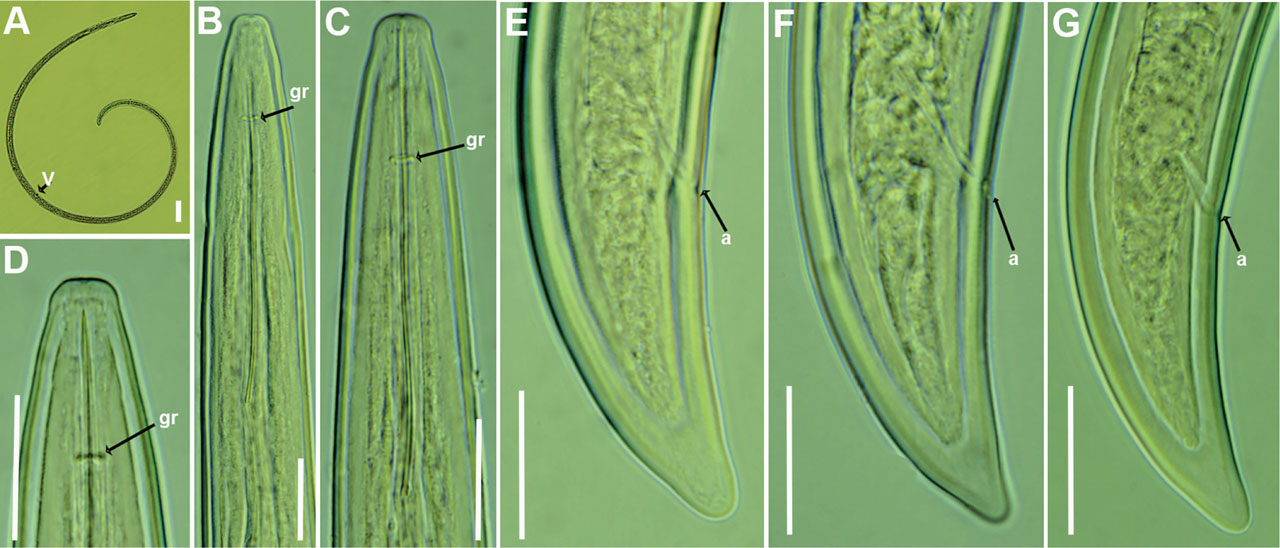
Figure 1:
Light micrographs of Longidorus aetnaeus Roca, Lamberti, Agostinelli, and Vinciguerra, 1986, from Greece (A–G). (A) Whole female, (B–D) Female anterior regions, (E–G) Female tail regions.
Abbreviations: a = anus; gr = guiding ring; V = vulva. Scale bars: A = 100 µm, B–G = 20 µm.
Table 2:
Morphometric characterization of adult females of Longidorus aetnaeus Roca, Lamberti, Agostinelli and Vinciguerra, 1986, Longidorus intermedius Kozlowska and Seinhorst, 1979, and Longidorus iranicus Sturhan and Barooti, 1983 from Greece.
| Trait*/locality | Longidorus aetnaeus | Longidorus intermedius | Longidorus iranicus | |
|---|---|---|---|---|
| Thessaloniki | Thessaloniki | Pieria | Tatoi | |
| n | 5 | 6 | 6 | 2 |
| L | 2.83 ± 0.28 (2.52–3.24) | 3.88 ± 0.42 (3.23–4.39) | 3.93 ± 0.39 (3.33–4.34) | (5.23, 5.61) |
| a | 72.9 ± 5.9 (66.9–80.0) | 76.8 ± 7.7 (64.6–86.1) | 78.8 ± 6.5 (68.0–86.8) | (100.5, 105.9) |
| b | 10.2 ± 0.9 (9.3–11.6) | 9.9 ± 0.8 (8.8–10.8) | 10.0 ± 0.8 (8.8–11.0) | (13.9, 16.3) |
| c | 61.4 ± 3.0 (58.1–64.8) | 93.6 ± 8.2 (78.8–101.8) | 95.8 ± 8.7 (87.5–108.8) | (149.3, 155.9) |
| c′ | 2.0 ± 0.1 (1.8–2.1) | 1.2 ± 0.1 (1.1–1.3) | 1.2 ± 0.2 (1.1–1.4) | (0.9, 0.9) |
| d | 2.6 ± 0.1 (2.6–2.7) | 2.6 ± 0.1 (2.5–2.8) | 2.6 ± 0.2 (2.5–2.8) | (3.0, 3.1) |
| d′ | 1.9 ± 0.1 (1.9–2.0) | 2.1 ± 0.1 (1.9–2.3) | 2.0 ± 0.1 (1.8–2.1) | (2.3, 2.3) |
| V | 46.5 ± 1.5 (44.2–48.3) | 47.5 ± 2.3 (44.7–51.1) | 47.0 ± 1.2 (45.8–48.7) | (48.6, 49.0) |
| Odontostyle length | 75.5 ± 1.6 (74.0–78.0) | 115.1 ± 2.4 (112.5–119.0) | 113.3 ± 5.6 (108.0–122.0) | (97.0, 104.0) |
| Odontophore length | 41.6 ± 0.9 (41.0–43.0) | 61.5 ± 1.0 (60.0–63.0) | 60.7 ± 3.1 (55.0–63.0) | (51.0, 55.0) |
| Total stylet length | 117.1 ± 2.5 (115.0–121.0) | 176.6 ± 3.3 (173.5–182.0) | 174.0 ± 7.0 (168.0–185.0) | (148.0, 159.0) |
| Anterior end to guide ring | 23.8 ± 1.0 (23.0–25.5) | 29.8 ± 1.6 (28.5–32.0) | 30.6 ± 1.8 (27.5–32.5) | (30.0, 33.0) |
| Tail length | 46.2 ± 4.8 (41.0–50.0) | 41.6 ± 4.4 (37.5–48.0) | 41.1 ± 3.1 (36.5–44.5) | (35.0, 36.0) |
| Hyaline part of tail length | 14.3 ± 1.7 (12.0–16.0) | 12.8 ± 0.7 (12.0–14.0) | 13.3 ± 1.3 (11.5–15.0) | (12.0, 12.5) |
| Width at level of: | ||||
| lip region | 9.2 ± 0.4 (9.0–10.0) | 11.5 ± 0.3 (11.0–12.0) | 11.6 ± 0.5 (11.0–12.0) | (10.0, 10.5) |
| vulva or mid-body | 38.8 ± 2.0 (36.5–41.0) | 50.6 ± 3.5 (45.5–56.0) | 49.9 ± 4.0 (45.0–54.0) | (52.0, 53.0) |
| anus | 23.5 ± 1.8 (21.0–25.5) | 34.5 ± 3.0 (31.0–39.0) | 33.5 ± 3.7 (30.0–39.0) | (38.0, 39.0) |
All measurements are expressed in micrometers (μm) and presented as mean ± standard deviation (range), except for body length, which is given in millimeters (mm).
* Abbreviations are defined in Jairajpuri and Ahmad (1992).
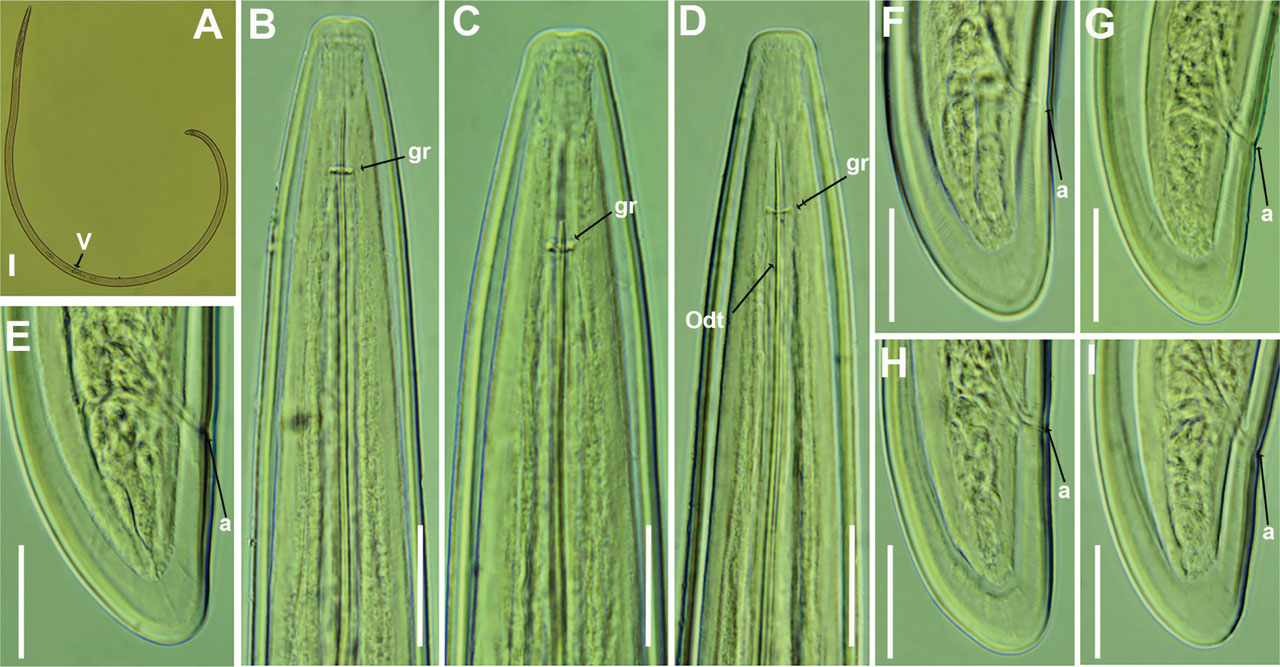
Figure 2:
Light micrographs of Longidorus intermedius Kozlowska and Seinhorst, 1979 from Greece (A–I). (A) Whole female, (B–D) Female anterior regions, (E–O) Female tail regions.
Abbreviations: a = anus; gr = guiding ring; V = vulva. Scale bars: A = 100 µm, B–O = 20 µm.
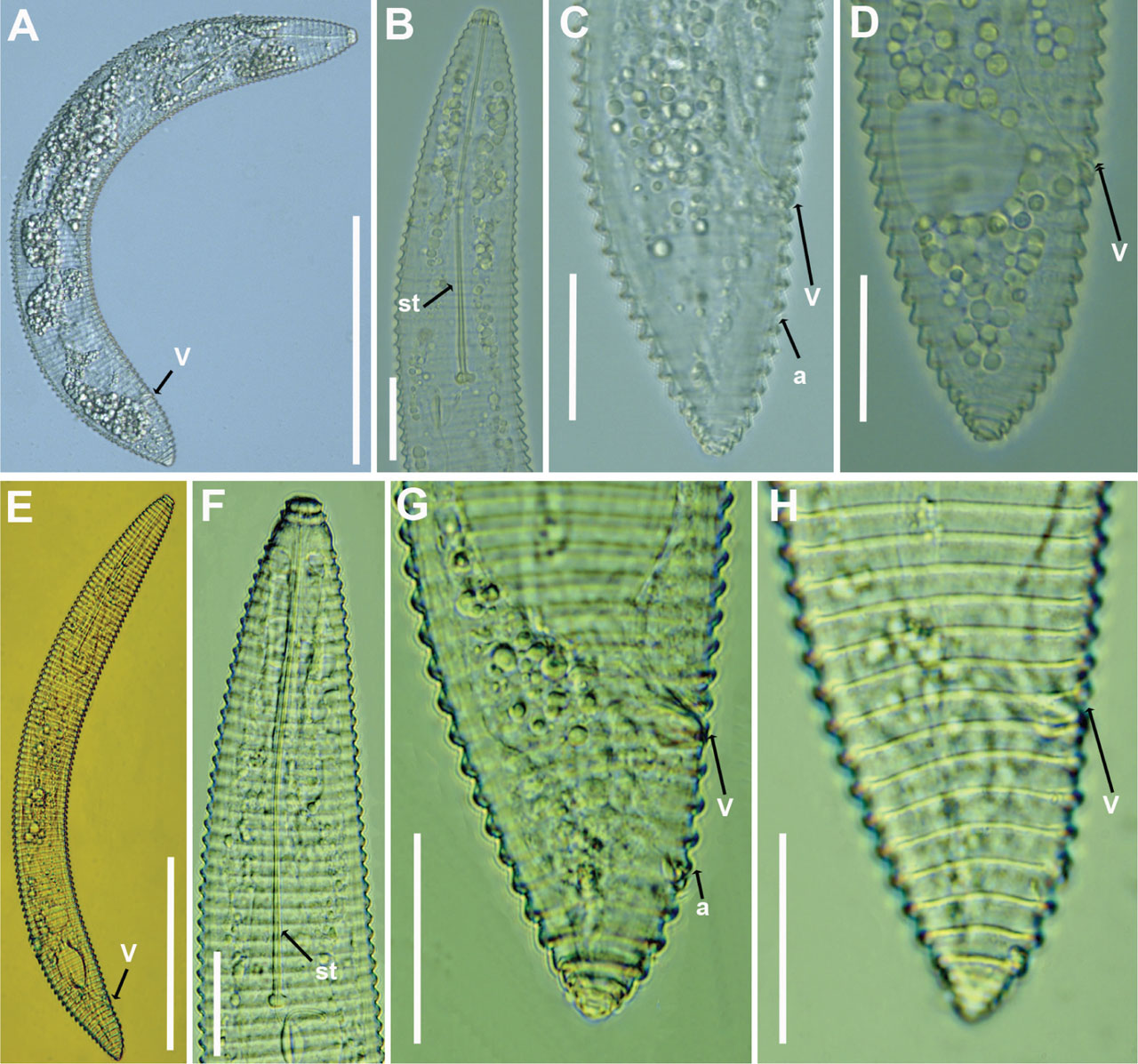
Figure 3:
Light micrographs of Xenocriconemella iberica Archidona-Yuste, Clavero-Camacho, Ruiz-Cuenca, Cantalapiedra-Navarrete, Liébanas, Castillo, and Palomares-Rius 2024 (A–D) and Xenocriconemella paraiberica Archidona-Yuste, Clavero-Camacho, Ruiz-Cuenca, Cantalapiedra-Navarrete, Liébanas, Castillo, and Palomares-Rius 2024 (E–H) from Greece. (A, E) Whole female, (B, F) Female anterior regions, (C–H) Female tail regions. Abbreviations: a = anus; st = stylet; V = vulva. Scale bars: A, E = 100 µm, B–D, F–H = 20 µm.
Table 3:
Morphometric characterization of adult females of Xenocriconemella paraiberica Archidona-Yuste, Clavero-Camacho, Ruiz-Cuenca, Cantalapiedra-Navarrete, Liébanas, Castillo, and Palomares-Rius, 2024 and Xenocriconemella iberica Archidona-Yuste, Clavero-Camacho, Ruiz-Cuenca, Cantalapiedra-Navarrete, Liébanas, Castillo, and Palomares-Rius, 2024 from Greece.
| Trait*/locality | Xenocriconemella paraiberica | Xenocriconemella iberica | ||
|---|---|---|---|---|
| Thessaloniki | Pieria | Chalkidiki | Thessaloniki | |
| n | 5 | 5 | 2 | 5 |
| L | 310.4 ± 41.1 (250–356) | 304.2 ± 23.6 (270–333) | (274, 298) | 309.8 ± 49.6 (248–354) |
| R | 107.4 ± 5.9 (100–114) | 105.6 ± 5.0 (100–111) | (102, 107) | 104.6 ± 3.7 (100–110) |
| Rst | 35.6 ± 2.6 (32–38) | 33.4 ± 1.8 (31–36) | (33, 34) | 35.2 ± 1.3 (34–37) |
| Roes | 46.6 ± 1.8 (45–49) | 45.2 ± 2.3 (43–49) | (44, 45) | 44.8 ± 1.3 (43–46) |
| Rex | 37.6 ± 2.5 (35–40) | 35.8 ± 1.9 (34–39) | (35, 36) | 37.4 ± 0.5 (37–38) |
| RV | 11.8 ± 0.4 (11–12) | 11.8 ± 0.8 (11–13) | (11, 12) | 11.6 ± 0.5 (11–12) |
| Rvan | 4.0 ± 0 (4–4) | 3.8 ± 0.4 (3–4) | (4, 4) | 4.0 ± 0 (4–4) |
| Ran | 7.8 ± 0.4 (7–8) | 8.0 ± 0.7 (7–9) | (7, 8) | 7.6 ± 0.5 (7–8) |
| O | 7.8 ± 0.3 (7.2–8.6) | 7.9 ± 0.3 (7.5–8.2) | (7.7, 7.8) | 8.0 ± 0.4 (7.4–8.4) |
| a | 9.5 ± 1.2 (8.1–11.1) | 9.8 ± 0.3 (9.3–10.1) | (9.4, 9.9) | 9.4 ± 1.6 (7.1–11.4) |
| b | 2.6 ± 0.3 (2.1–2.8) | 2.5 ± 0.2 (2.2–2.7) | (2.2, 2.5) | 2.7 ± 0.3 (2.3–3.0) |
| c | 21.4 ± 2.9 (17.9–24.1) | 22.6 ± 4.0 (18.7–28.9) | (18.6, 22.8) | 21.2 ± 4.6 (15.5–25.7) |
| c′ | 0.7 ± 0.1 (0.7–0.8) | 0.8 ± 0.1 (0.7–0.9) | (0.9, 0.9) | 0.7 ± 0.1 (0.7–0.8) |
| V | 90.2 ± 1.2 (88.5–91.6) | 89.7 ± 1.8 (86.5–91.0) | (89.1, 89.9) | 90.3 ± 0.4 (89.8–90.7) |
| VL/VB | 1.0 ± 0.1 (0.8–1.1) | 0.9 ± 0.2 (0.7–1.1) | (1.0, 1.1) | 0.9 ± 0.1 (0.8–1.1) |
| Stylet | 93.4 ± 3.6 (89.0–97.0) | 91.0 ± 4.5 (86.0–97.0) | (91.0, 97.0) | 93.0 ± 3.2 (88.0–96.0) |
| Pharynx | 120.8 ± 4.9 (115–128) | 122.4 ± 5.6 (117–131) | (118.0, 124.0) | 114.6 ± 9.5 (102–126) |
| Maximum body width | 32.8 ± 2.6 (30.0–36.0) | 31.0 ± 1.6 (29.0–33.0) | (29.0, 30.0) | 33.2 ± 4.1 (27.0–37.0) |
| Anal body width | 19.8 ± 2.2 (17.5–23.5) | 17.9 ± 3.7 (14.0–23.5) | (14.0, 18.0) | 20.3 ± 2.9 (16.0–23.0) |
| Vulva to anus distance | 13.4 ± 2.3 (11.0–17.0) | 14.4 ± 1.9 (12.0–17.0) | (13.0, 14.0) | 13.6 ± 2.1 (11.0–16.0) |
| Tail | 14.5 ± 0.7 (14.0–15.5) | 13.8 ± 2.6 (11.0–17.0) | (12.0, 16.0) | 14.8 ± 1.2 (13.0–16.0 |
All measurements are expressed in micrometers (μm) and presented as mean ± standard deviation (range).
* Abbreviations are defined in Archidona-Yuste et al. (2024).
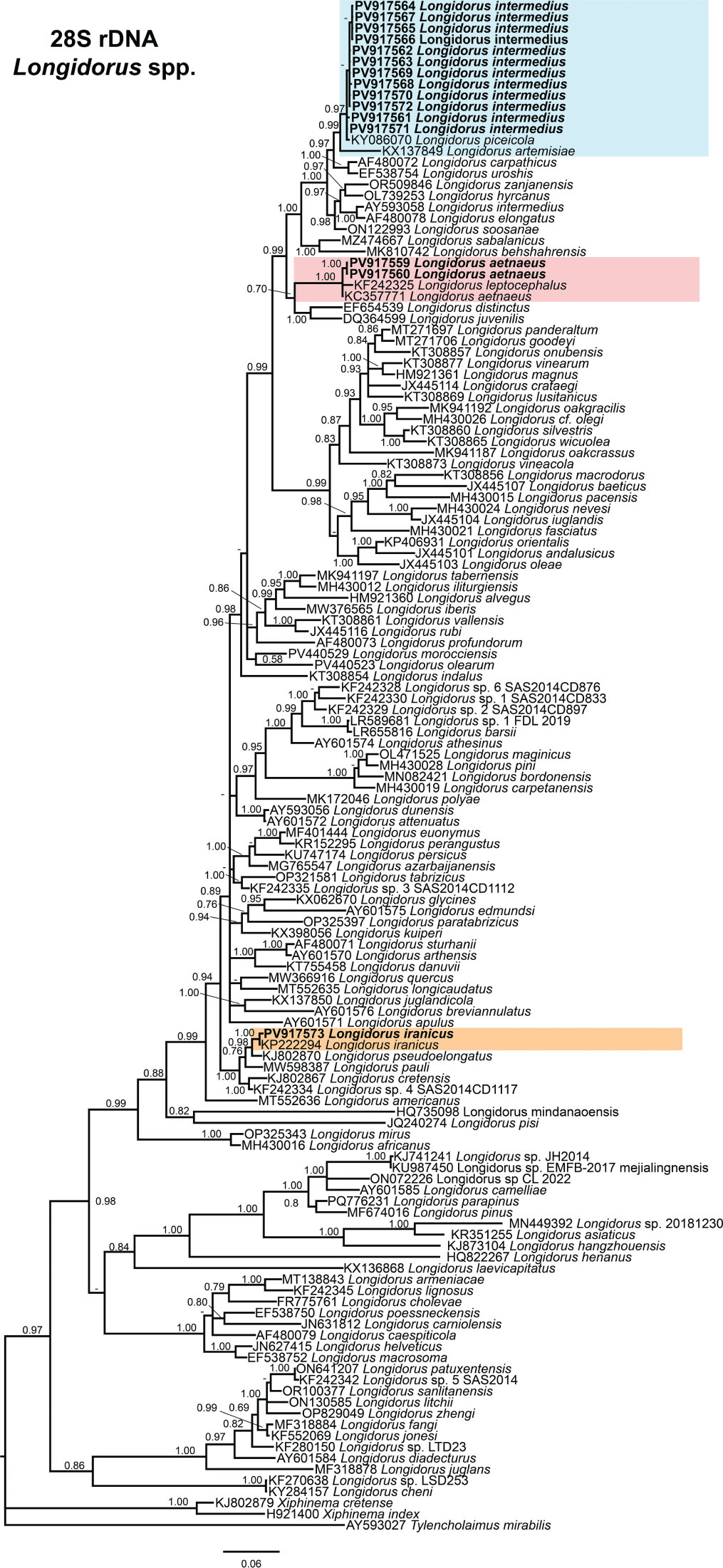
Figure 4:
Phylogenetic relationships of Longidorus aetnaeus Roca, Lamberti, Agostinelli, and Vinciguerra, 1986 and Longidorus intermedius Kozlowska and Seinhorst, 1979 from Greece within Longidorus spp., inferred from a Bayesian 50% majority-rule consensus tree based on D2–D3 expansion segments of the 28S rDNA gene. The analysis was conducted under the symmetrical model with invariable sites and gamma distribution (SYM + I + G): − lnL = 17367.5440; AIC = 35293.087920; freqA = 0.2500; freqC = 0.2500; freqG = 0.2500; freqT = 0.2500; R(a) = 0.6301; R(b) = 2.3716; R(c) = 1.2643; R(d) = 0.3973; R(e) = 4.2679; R(f) = 1.0000; Pinva = 0.2970; and Shape = 0.7080. PP >0.70 are indicated at the relevant nodes. Newly generated sequences are shown in bold. The scale bar represents the expected number of substitutions per site. Colored boxes denote clade associations of Longidorus species included in this study. AIC, Akaike information criterion; PP, posterior probabilities.
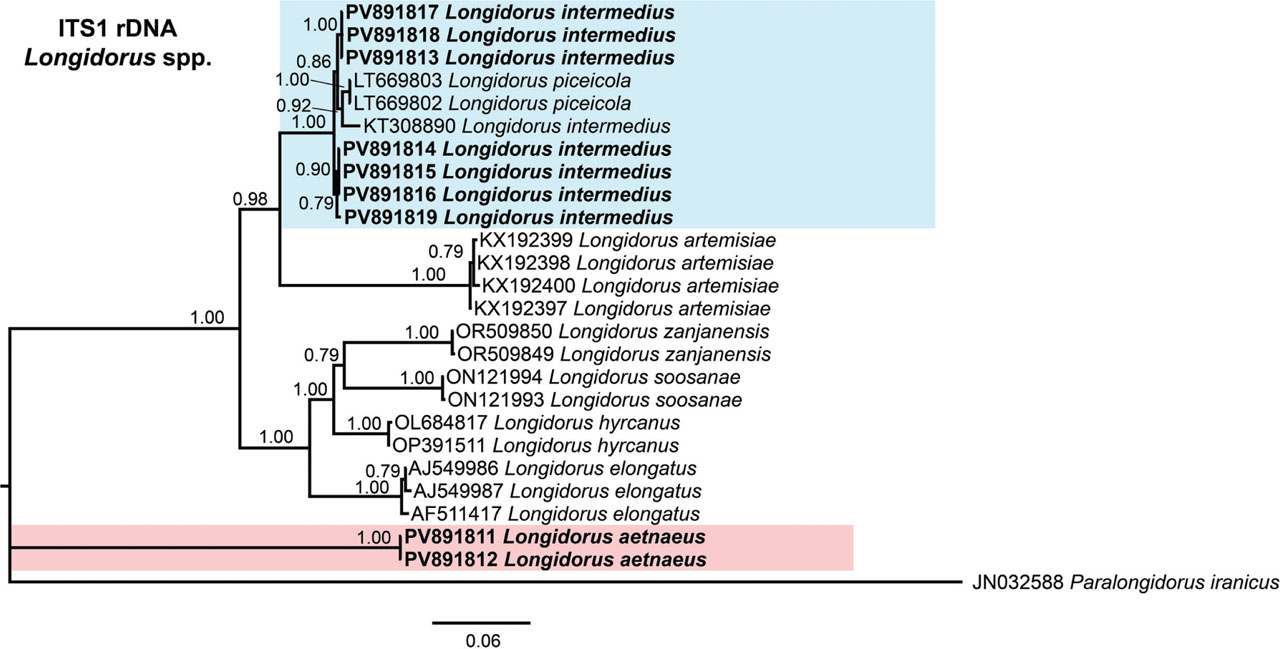
Figure 5:
Phylogenetic relationships of Longidorus aetnaeus Roca, Lamberti, Agostinelli, and Vinciguerra, 1986 and Longidorus intermedius Kozlowska and Seinhorst, 1979 from Greece within Longidorus spp., inferred from a Bayesian 50% majority-rule consensus tree based on ITS1 rDNA gene. The analysis was conducted under the general time-reversible model and a gamma distribution (GTR + G): −lnL = 6986.5651; AIC = 14091.130240; freqA = 0.2493; freqC = 0.2071; freqG = 0.2721; freqT = 0.2715; R(a) = 0.7154; R(b) = 2.1386; R(c) = 0.7569; R(d) = 0.3744; R(e) = 3.2444; R(f) = 1.0000; and Shape = 0.7090. PP >0.70 are indicated at the relevant nodes. Newly generated sequences are shown in bold. The scale bar represents the expected number of substitutions per site. Colored boxes denote clade associations of Longidorus species included in this study. AIC, Akaike information criterion; ITS, internal transcribed spacer; PP, posterior probabilities.
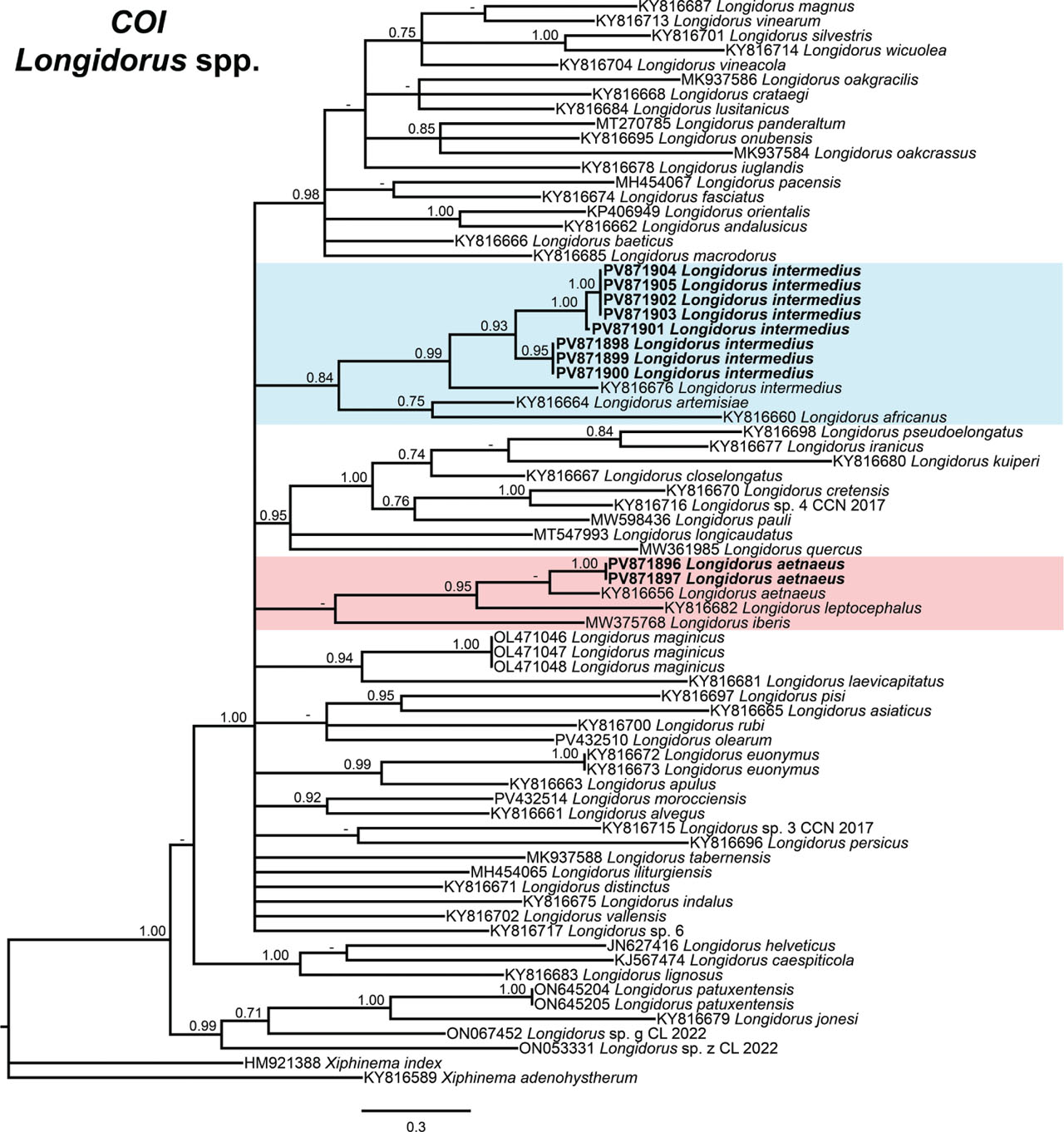
Figure 6:
Phylogenetic relationships of Longidorus aetnaeus Roca, Lamberti, Agostinelli and Vinciguerra, 1986 and Longidorus intermedius Kozlowska and Seinhorst, 1979 from Greece within Longidorus spp., inferred from a Bayesian 50% majority-rule consensus tree based on COI mtDNA gene. The analysis was conducted under the transversion model with invariable sites and a gamma-shaped distribution (TVM + I + G): −lnL = 11077.4604; AIC = 22464.920820; freqA = 0.2466; freqC = 0.2026; freqG = 01391; freqT = 0.4116; R(a) = 0.4113; R(b) = 13.4611; R(c) = 0.9401; R(d) = 2.0351; R(e) = 13.4611; R(f) = 1.0000; Pinva = 0.3360; and Shape = 0.3420. PP >0.70 are indicated at the relevant nodes. Newly generated sequences are shown in bold. The scale bar represents the expected number of substitutions per site. Colored boxes denote clade associations of Longidorus species included in this study. AIC, Akaike information criterion; PP, posterior probabilities.