
Entomopathogenic nematodes (EPNs) from the genus Heterorhabditis Poinar (1927) have been used as biological control agents for many insect pests around the globe due to their ease of mass production, high virulence, and host specificity. Their effective performance in the field has led to increased research of these organisms, especially in many of the developing countries (San-Blas et al, 2019; van Lenteren et al., 2025).
Heterorhabditis have been found in many regions and habitats from all over the world, except in Antarctica (Griffin et al., 1990). Currently, 22 Heterorhabditis species have been described (Půža and Machado, 2024; Machado et al., 2025a, 2025b; Půža et al., 2025) and, according to phylogenetic analysis, the genus is divided into three groups: indica, bacteriophora, and megidis (Nguyen et al., 2008; Dhakal et al., 2020; Půža and Machado, 2024). Despite surveys in 7 out of 13 South American countries, the prevalence of EPNs and their biodiversity remain largely unknown across the subcontinent, and published information is limited (San-Blas et al., 2019). In South America, five Heterorhabditis species have been reported or described: Heterorhabditis hambletoni (Pereira, 1937), H. amazonensis (Andaló et al., 2006), H. indica (Poinar et al., 1992), H. atacamensis (Edgington et al., 2011), and H. bacteriophora (Poinar, 1975), while the latter two species have been found in Chile (Edgington et al., 2011; San-Blas et al., 2019; Lankin et al., 2022).
During a survey on the biodiversity of nematodes in the Petrel lagoon in 2023 (Pichilemu, central Chile), a population of Heterorhabditis sp. was found in a coastal dune (between the shore and the lagoon). Morphological, morphometric, and molecular analyses indicated that the recovered nematodes represent a new species that belongs to the megidis group. We describe this new species herein as Heterorhabditis caligo n. sp.
Materials and Methods
Sampling procedure
Heterorhabditis caligo n. sp., was isolated from a coastal dune between the Petrel lagoon and the seashore in Pichilemu (central Chile) in January 2023. A composite soil sample (20 subsamples of 1 kg each) was baited using Galleria mellonella (L.) (Lepidoptera: Pyralidae) larvae (Bedding and Akhurst, 1975). The soil samples with the G. mellonella larvae were kept in the dark at 20°C; after 7 days, dead larvae showing red coloration (typical for Heterorhabditis infection) were recovered and placed in White traps (White, 1927). Emerging infective juveniles (IJs) from the traps were stored at 15°C and a sample was used to reinfect fresh G. mellonella to confirm Koch’s postulates.
Morphologic characterization
For taxonomic studies, 10 G. mellonella larvae were exposed to IJs (100 IJs per G. mellonella) in a 9.0 cm diameter Petri dish lined with moistened filter paper and kept in the dark at 20°C. Hermaphrodites were collected 5 days post-infection; males and amphimictic females were collected 7 days post-infection by dissecting the G. mellonella cadavers in tap water, IJs were obtained from G. mellonella cadavers placed on White traps (White, 1927), and nematodes were collected within the first week of emergence.
Live observations of hermaphrodites, males, females, and IJs were carried out using light microscopy. For more detailed studies and the preparation of permanent slides, 20 additional specimens per stage were collected in tap water and killed by heating at 60°C for 5 min and immediately fixed with TAF (7 ml formalin, 2 ml triethanolamine, 91 ml distilled water) at the same temperature (Courtney et al., 1955). Fixed nematodes were processed for glycerine mounting, using a slow evaporation technique. Permanent slides were prepared using glass slides and cover-glass supported with Parafilm strips to prevent flattening. The slides were sealed with nail polish. These mounted nematodes were used for morphometric studies and description, while morphometrics of IJs were done using live and dead specimens mounted in tap water (Nguyen, 2007) using a Leica DM2500 compound microscope equipped with differential interference contrast.
Molecular Characterization
Nematode nuclear and mitochondrial genome sequencing and assembly procedures
Genome sequencing was carried out largely based on the work of Machado et al. (2025a, 2025b), with minor modifications. Briefly, genomic DNA of H. caligo n. sp. UOH-032 was extracted using a Blood and Tissue Kit (Qiagen, Hilden, Germany). The resulting DNA was used for library preparation using the VAHTS® Universal Plus DNA Library Prep Kit for Illumina (Ref. ND617, Vazyme Biotech Co., Nanjing, China). Indexed libraries were then pooled at equimolar concentrations and sequenced (2 × 150 bp) on an Illumina NovaSeq 6000 instrument. High-quality reads were obtained using fastp v0.23.4 (Chen et al., 2018). The resulting reads were assembled with SPAdes 3.15.5 (Bankevich et al., 2012). Scaffolds shorter than 200 bp were removed. The final assemblies were polished using Pilon 1.24 and the National Center for Biotechnology Information (NCBI) Foreign Contamination Screen (FCS) genome cross-species aligner (GX) tool (NCBI FCS GX v0.5.0) was used to remove scaffolds belonging to organisms other than Nematoda (Walker et al., 2014; Astashyn et al., 2024). Finally, nuclear genome completeness and contamination were assessed using BUSCO 5.4.6 and the nematoda_odb10 database (Seppey et al., 2019). The mitochondrial genome of H. caligo n. sp. UOH-032 was assembled using NOVOplasty v4.3.1 (Dierckxsens et al., 2016). Features of the assembled genome of H. caligo n. sp. UOH-032 and the genomes of other Heterorhabditis species used in this study and related statistics are presented in Tables S1 and S2 in the Supplementary Material.
Nematode whole nuclear and mitochondrial phylogenomic reconstructions
Phylogenomic and phylogenetic reconstructions were carried out largely based on the work of Machado et al. (2025a, 2025b) with minor modifications. To estimate the evolutionary relationships based on nuclear genomes, ortholog clustering analyses were first performed using OrthoFinder2 on the protein-coding genes of all the Heterorhabditis species, with Oscheius tipulae as the outgroup (Emms and Kelly, 2019). Protein sequences of H. caligo n. sp. UOH-032 were obtained by annotating the assembled genomes using Maker v2.31.11 (Cantarel et al., 2008). After the ortholog clustering analyses, single-copy orthogroups were selected and their sequences were aligned with MAFFT v7.526 (Katoh et al., 2005). The resulting alignment was then used to reconstruct phylogenetic relationships using FastTree v2.1.10 based on the Jones-Taylor-Thornton 1992 model with a continuous approximation of the gamma distribution (JTT + CAT) (Price et al., 2010). To estimate the evolutionary relationships based on mitochondrial genomes, the mitochondrial genomes were first assembled using NOVOplasty v4.3.1 and then annotated using MITOS2 v2.1.9 (Bernt et al., 2013; Dierckxsens et al., 2016). Protein-coding genes were then concatenated in the following order: cytochrome c oxidase subunits 1–3 (cox-1, cox-2, and cox-3), cytochrome b (cob), and NADH dehydrogenase subunits 1–6 (nad-1, nad-2, nad-3, nad-4, nad-4l, nad-5, and nad-6). The obtained concatenated sequences were then aligned with MAFFT v7.526 (Katoh et al., 2005). Finally, phylogenetic trees were built based on the Kimura 2–parameter model (K2 + G + I) using MEGA7 (Kimura, 1980; Kumar et al., 2016). Graphical representation and editing of the phylogenetic trees were performed with Interactive Tree of Life (v3.5.1) (Letunic and Bork, 2016). All the sequences used for phylogenetic reconstructions were downloaded from the NCBI databank using the accession numbers given in Machado et al. (2025) (Table S3 in Supplementary Material). The sequences of H. caligo n. sp. UOH-032 generated in this study were deposited in the NCBI under the accession numbers provided in Table S3 in the Supplementary Material.
Nematode single-gene phylogenetic reconstructions
To reconstruct phylogenetic relationships based on single gene sequences, the following genes/genetic regions were analyzed: the mitochondrial cytochrome c oxidase subunit I (cox-1) gene, the internal transcribed spacer (ITS) region of the rRNA gene, the calmodulin 1 (cmd-1) gene, and the thin filament (F-actin)-associated protein (unc-87) gene (Machado et al., 2025). Phylogenetic reconstructions were carried out using the Maximum Likelihood method based on the Kimura 2–parameter (K2 + G + I) model (Kimura, 1980). The trees with the highest log likelihood are shown. The percentage of trees in which the associated taxa clustered together is shown next to the branches. Initial tree(s) for the heuristic search were obtained automatically by applying Neighbor–Join and BioNJ algorithms to a matrix of pairwise distances estimated using the Maximum Composite Likelihood (MCL) approach, and then selecting the tree topology with the superior log likelihood value. A discrete Gamma distribution (+G) was used to model evolutionary rate differences among sites, and the rate variation model allowed for some sites to be evolutionarily invariable (+I). The trees are drawn to scale, with branch lengths measured in terms of substitutions per site. Graphical representation and editing of the phylogenetic trees were performed with Interactive Tree of Life (v3.5.1) (Letunic and Bork, 2016). Sequences of the ITS region of the rRNA gene were extracted from the whole ribosomal RNA operon sequences (see below) using Barrnap 1.2.2. The sequences of the calmodulin 1 (cmd-1) gene and the thin filament (F-actin)-associated protein (unc-87) gene were obtained by performing a BLAST search using the assembled genome of H. caligo n. sp. UOH-032 as the reference and the sequences of H. safricana SF281 as queries. All the sequences used for phylogenetic reconstructions were downloaded from the NCBI database using the accession numbers given in the work of Machado et al. (2025) and presented in Table S3 in the Supplementary Material. The sequences of the mitochondrial large subunit ribosomal RNA (rrnL) gene, the mitochondrial small subunit ribosomal RNA (rrnS) gene, and the D2–D3 expansion segments of the 28S rRNA (D2D3) gene were not used due to their poor phylogenetic resolving power (Dhakal et al., 2020; Machado et al., 2021, 2025b; Bhat et al., 2023). However, we deposited the sequences in the NCBI for future studies under the following accession numbers: PX240084 (rrnL), PX241222 (rrnS), and PX240083 (D2D3). In a previous study, Machado et al. (2025) identified the fanconi-associated nuclease 1 (fan-1) and the serine/threonine-protein phosphatase 4 regulatory subunit 1 (ppfr-1) genes as suitable markers to phylogenetically resolve the different species of the genus Heterorhabditis. Given that H. caligo n. sp. is closely related to H. marelatus, and there are no fan-1 or ppfr-1 sequences available for this species due to the lack of laboratory cultures, we did not produce phylogenetic trees using these markers but deposited the sequences in the NCBI for future studies under the following accession numbers: PV892896 (fan-1) and PV892897 (ppfr-1).
Nematode whole ribosomal RNA operon phylogenetic reconstructions
The whole ribosomal RNA operon of H. caligo n. sp. UOH-032 was obtained by mapping illumina reads to the ribosomal RNA operon sequences of Caenorhabditis elegans (NCBI accession number: MN519140) using Bowtie2 v2.5.3 (Langmead and Salzberg, 2012). Mapped reads were then assembled using SPAdes 3.15.5 (Bankevich et al., 2012). The resulting sequences were aligned with the sequences of other Heterorhabditis species reported by Machado et al. (2025) using MUSCLE v3.8.31 (Edgar, 2004). The alignment was then used to reconstruct phylogenetic relationships by the Maximum Likelihood method based on the Kimura 2–parameter (K2 + G + I) model (Kimura, 1980). The trees with the highest log likelihood are shown. The percentage of trees in which the associated taxa clustered together is shown next to the branches. Initial tree(s) for the heuristic search were obtained automatically by applying Neighbor–Join and BioNJ algorithms to a matrix of pairwise distances estimated using the MCL approach, and then selecting the tree topology with the superior log likelihood value. A discrete Gamma distribution (+G) was used to model evolutionary rate differences among sites, and the rate variation model allowed for some sites to be evolutionarily invariable (+I). The trees are drawn to scale, with branch lengths measured in terms of substitutions per site. Graphical representation and editing of the phylogenetic trees were performed with Interactive Tree of Life (v3.5.1) (Letunic and Bork, 2016). All the sequences used for phylogenetic reconstructions were downloaded from the NCBI database using the accession numbers given in the work of Machado et al. (2025) and presented in Table S3 in the Supplementary Material. The sequences of H. caligo n. sp. UOH-032 generated in this study were deposited in the NCBI under the accession numbers provided also in Table S3 in the Supplementary Material.
Symbiotic Bacteria Characterization
Bacteria whole genome sequencing
The symbiotic bacteria associated with H. caligo n. sp. UOH-032 were isolated using our standard protocols. Briefly, a drop of hemolymph from G. mellonella infected with H. caligo n. sp. 24 hr earlier was streaked onto an NBTA agar plate (37 g standard nutrient agar I [Carl Roth, Karlsruhe, Germany], 25 mg bromothymol blue, 1 l distilled water; after sterilization, the medium was cooled to 50°C and supplemented with 4 mL of 1% 2,3,5-triphenyltetrazolium chloride solution). The drop of hemolymph was then spread on the agar using the streak plate method. Petri dishes were sealed with Parafilm. One single colony was further subcultured and used for whole genome sequencing. To this end, gDNA was extracted and purified using Blood and Tissue Kit (Qiagen, Hilden, Germany), following the manufacturer’s instructions. The resulting DNA was used for sequencing using Illumina and Oxford Nanopore technologies. To this end, gDNA was first examined for concentration, purity, and integrity by Nanodrop, Qubit, and 0.35% agarose electrophoresis, respectively. Then, for Illumina-based sequencing, a DNA library was prepared using the TruSeq DNA PCR–Free LT Library Prep (FC–121–3003) kit. Indexed libraries were pooled at equimolar concentrations and sequenced (2 × 150 bp) on an Illumina HiSeq 3000 instrument. Finally, raw Illumina reads were quality trimmed using Trimmomatic 0.39 (Bolger et al., 2014). For ONT sequencing, gDNA was fragmented with gTube to generate DNA fragments of approximately 8 kb. Then, DNA libraries were prepared using the SQK-LSK109 ligation sequencing kit. The products were then purified with magnetic beads. Final products were purified with magnetic beads, and sequenced using the PromethION 48 device. Nanopore sequencing raw data was saved as fast5 format with entire original sequencing signals. Each read corresponds to one fast5 file. Base calling was processed on fast5 file by MinKNOW to generate fastq sequence file. Raw sequences were processed for adapter removal, low-quality reads removal, and short reads removal (Threshold: 2,000 bp). Genomes were assembled using the Illumina and ONT reads using Unicycler (Wick et al., 2017). Minor assembly errors were corrected using Pilon 1.22 (Walker et al., 2014). Completeness and contamination of the assembled genomes were assessed using CheckM v1.2.2 with default parameters (Parks et al., 2015).
Core genome-based phylogenetic reconstructions and sequence comparisons
To reconstruct whole-genome-based phylogenetic relationships, genomes were first aligned using Roary 3.13.0. Genes to be considered core had to be present in 40% of the genomes with an 80% protein identity. Obtained alignments were used to build phylogenetic trees using FastTree 2.1.10 based on the Generalized Time Reversible Model (GTR). Graphical representation and edition of the phylogenetic trees were performed with Interactive Tree of Life (v3.5.1) (Chevenet et al., 2006; Letunic and Bork, 2016). Digital DNA-DNA hybridization (dDDH) values were used to determine pairwise whole-genome sequence similarities. These values were calculated using the Genome Blast Distance Phylogeny (GBPD) method through the Genome-to-Genome Distance Calculator 2.1 and formula 2 of the Deutsche Sammlung von Mikroorganismen und Zellkulturen (DSMZ) web service (http://ggdc.dsmz.de) using default parameters (Auch et al., 2010a, 2010b; Meier-Kolthoff et al., 2013, 2014). dDDH values of 70% and 79% delimit species and subspecies boundaries, respectively (Wayne et al., 1987; Meier-Kolthoff et al., 2013; Machado et al., 2018). The accession numbers of the sequences used for these analyses are shown in Table S4 in the Supplementary Material.
Results
Description
Heterorhabditis caligo* n. sp. (Figs. 1–5 and Table 1).
*The specific Latin epithet means “fog” due to the constant morning fog present at the sampling site.
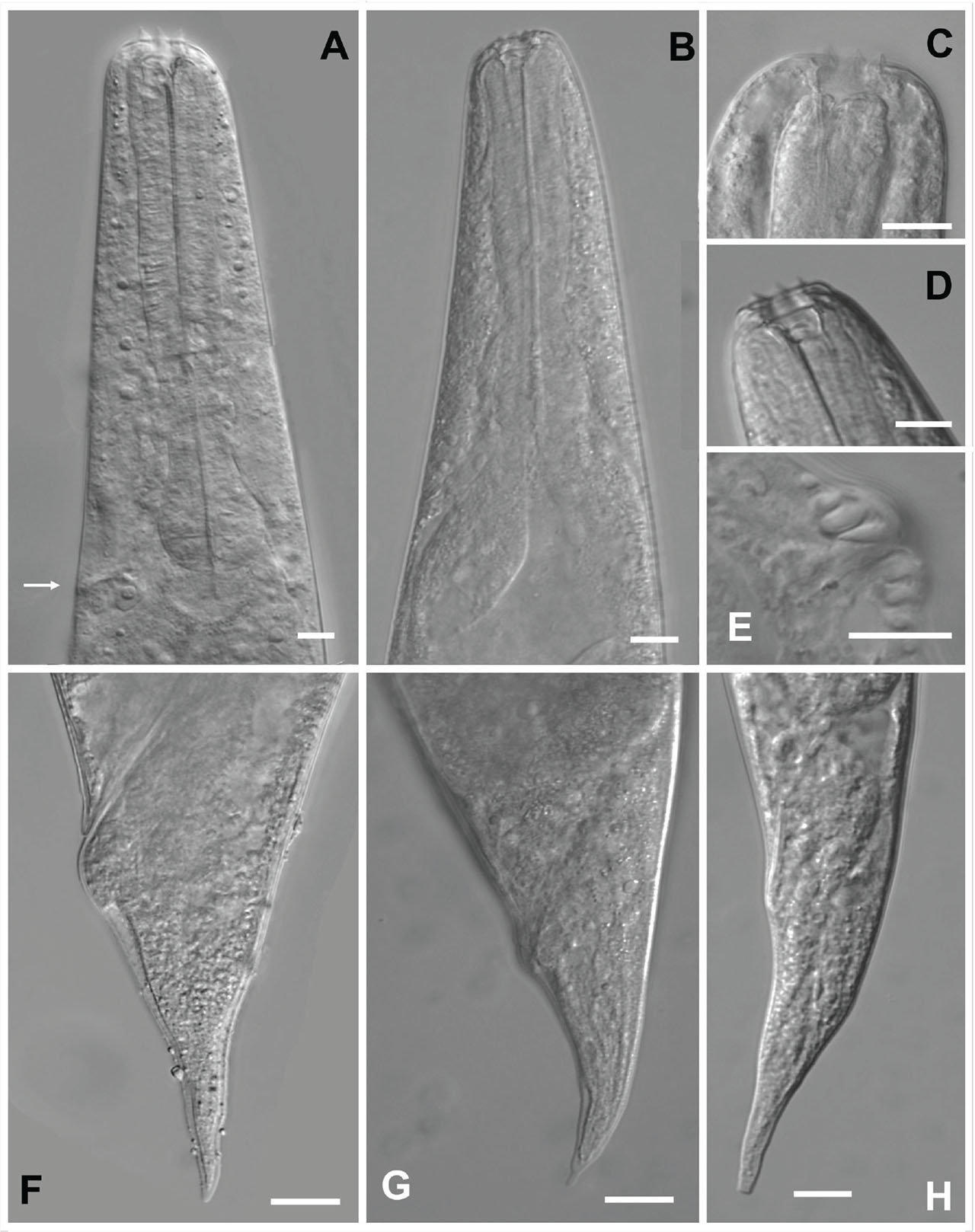
Figure 1:
Light microscopy photographs of the hermaphrodite and amphimictic female of Heterorhabditis caligo n. sp. (A) anterior region of hermaphrodite, (B) anterior region of the amphimictic female, (C) detail of the head showing the labial papillae of hermaphrodites, (D) detail of the head showing the labial papillae of the amphimictic female, (E) detail of the vulva of the hermaphrodite, (F,G) tail variations of the hermaphrodites, (H) tail of the amphimictic female. Scale bars: A–D and F–H = 20 μm; E = 10 μm.
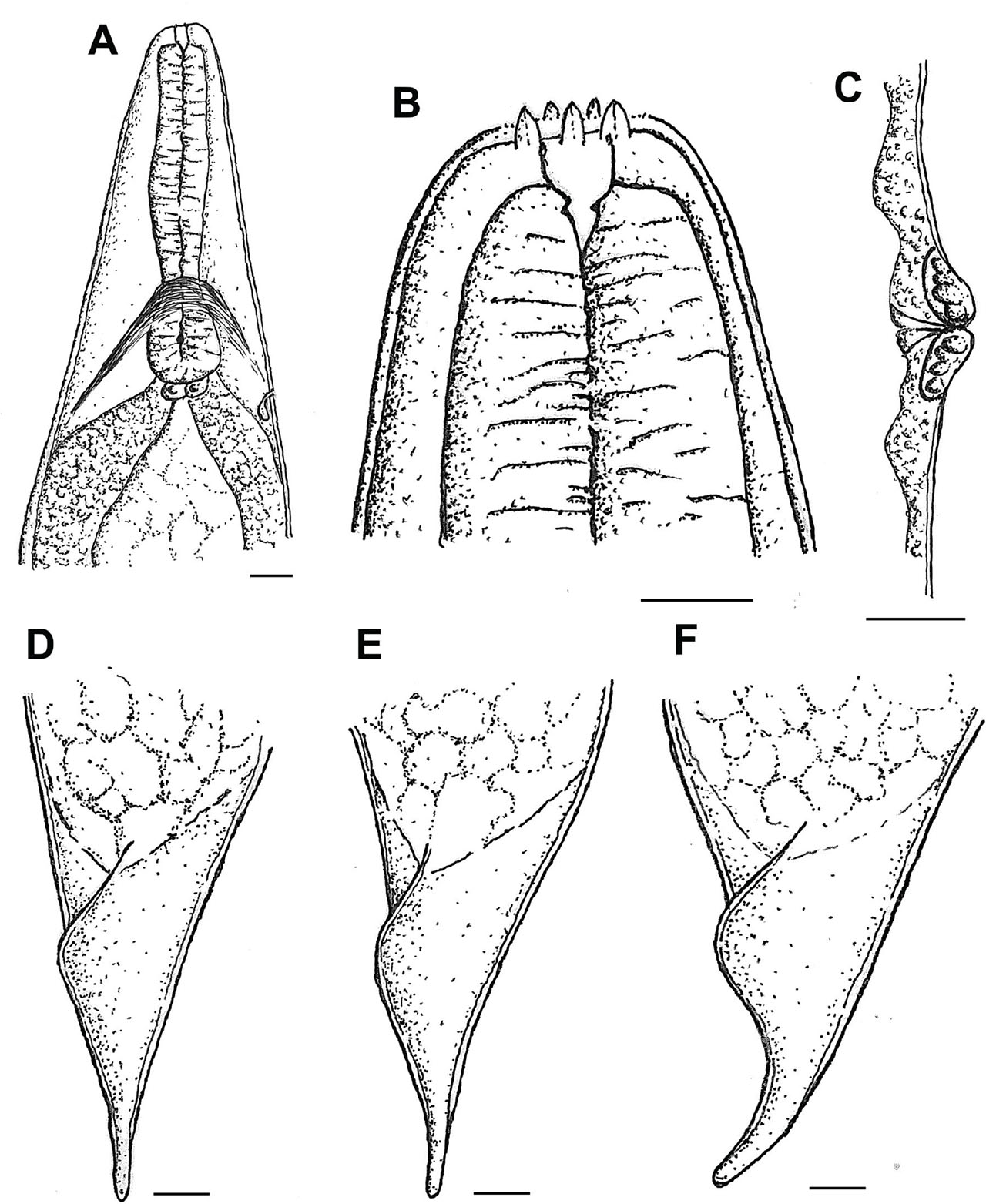
Figure 2:
Drawings of the hermaphrodite of Heterorhabditis caligo n. sp. (A) anterior region, (B) head region, (C) vulva; (D–F) Tail variations of the hermaphrodites, Scale bars: A–B and D–F = 20 μm; C = 10 μm.
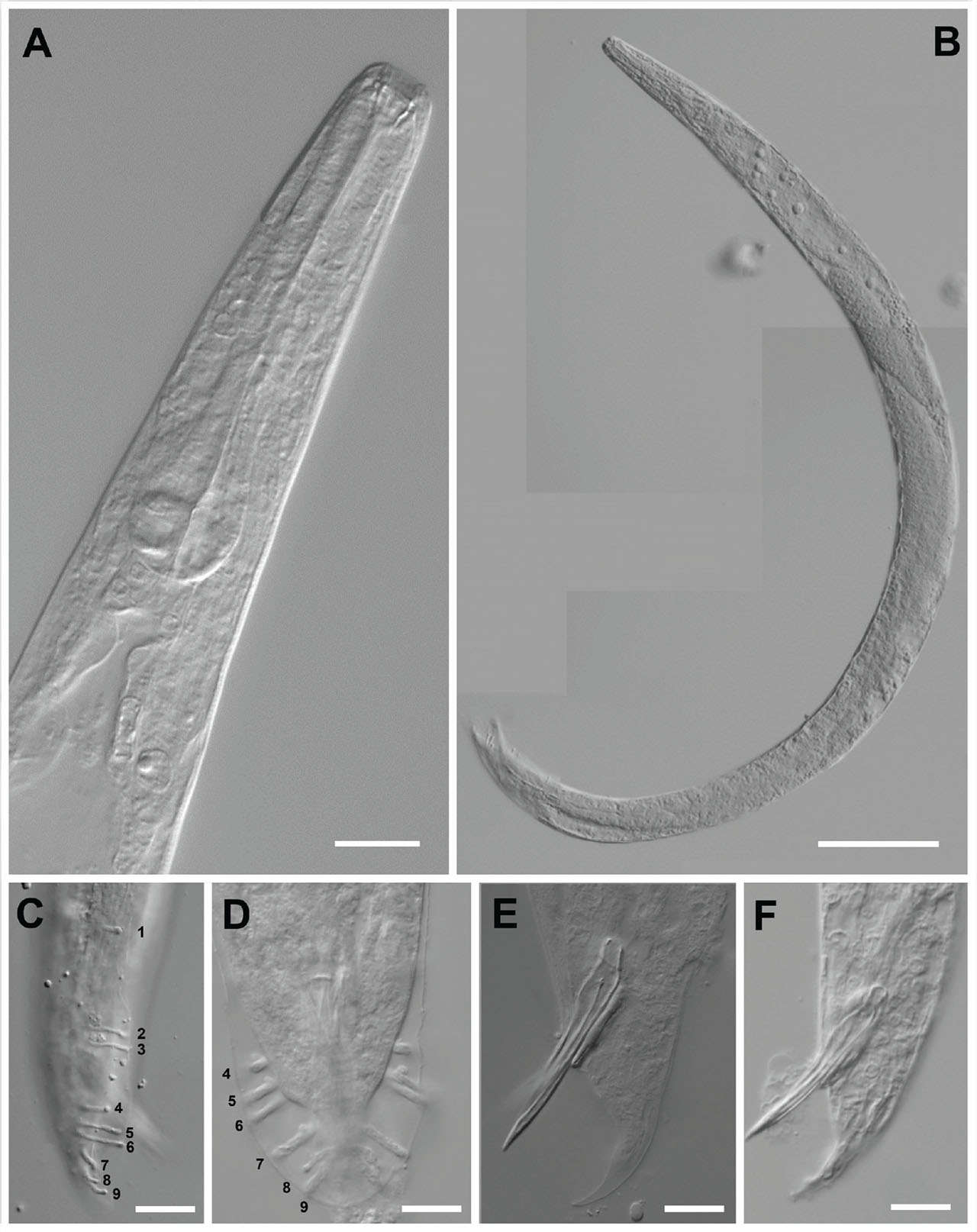
Figure 3:
Light microscopy photographs of males of H. caligo n. sp. (A) anterior part of the male (B) male in toto; (C,D) Lateral and ventral view of papillary arrangement gubernaculum of first-generation male in ventral view; (E,F) tail showing spicula and gubernaculum shapes. Scale bars: A = 20 μm; B = 100 μm; C–F = 10 μm.
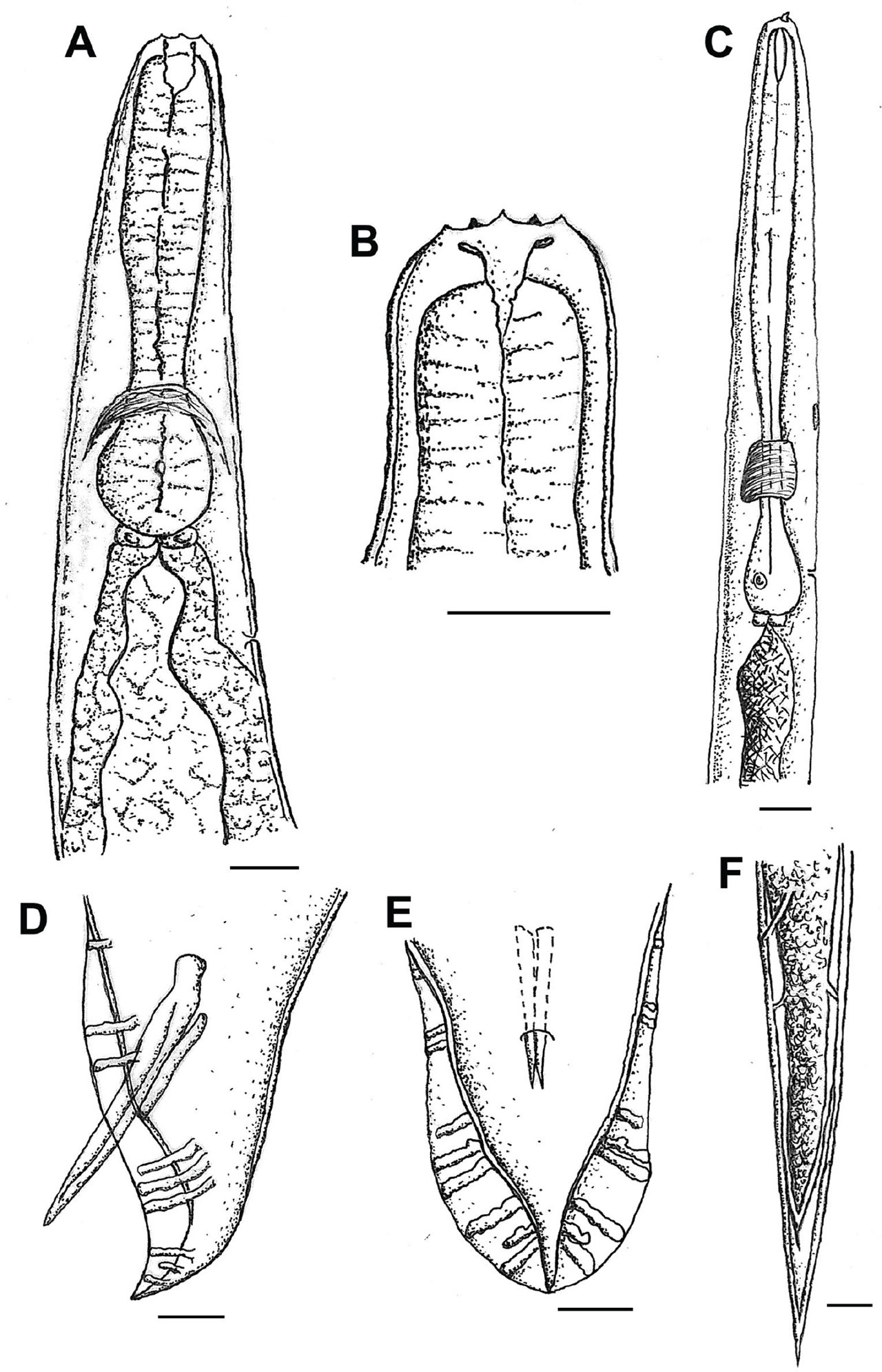
Figure 4:
Drawings of male and IJs of Heterorhabditis caligo n. sp. (A) anterior region of male; (B) head; (C) anterior region of IJ; (D) posterior portion of male in lateral view, showing spicules, gubernaculum and papillae arrangement; (E) posterior portion of male in ventral view, showing spicules, gubernaculum and papillae arrangement; (F) posterior portion of IJ showing amphids. Scale bars: A–B = 20 μm; C–F = 10 μm. IJs, infective juveniles.
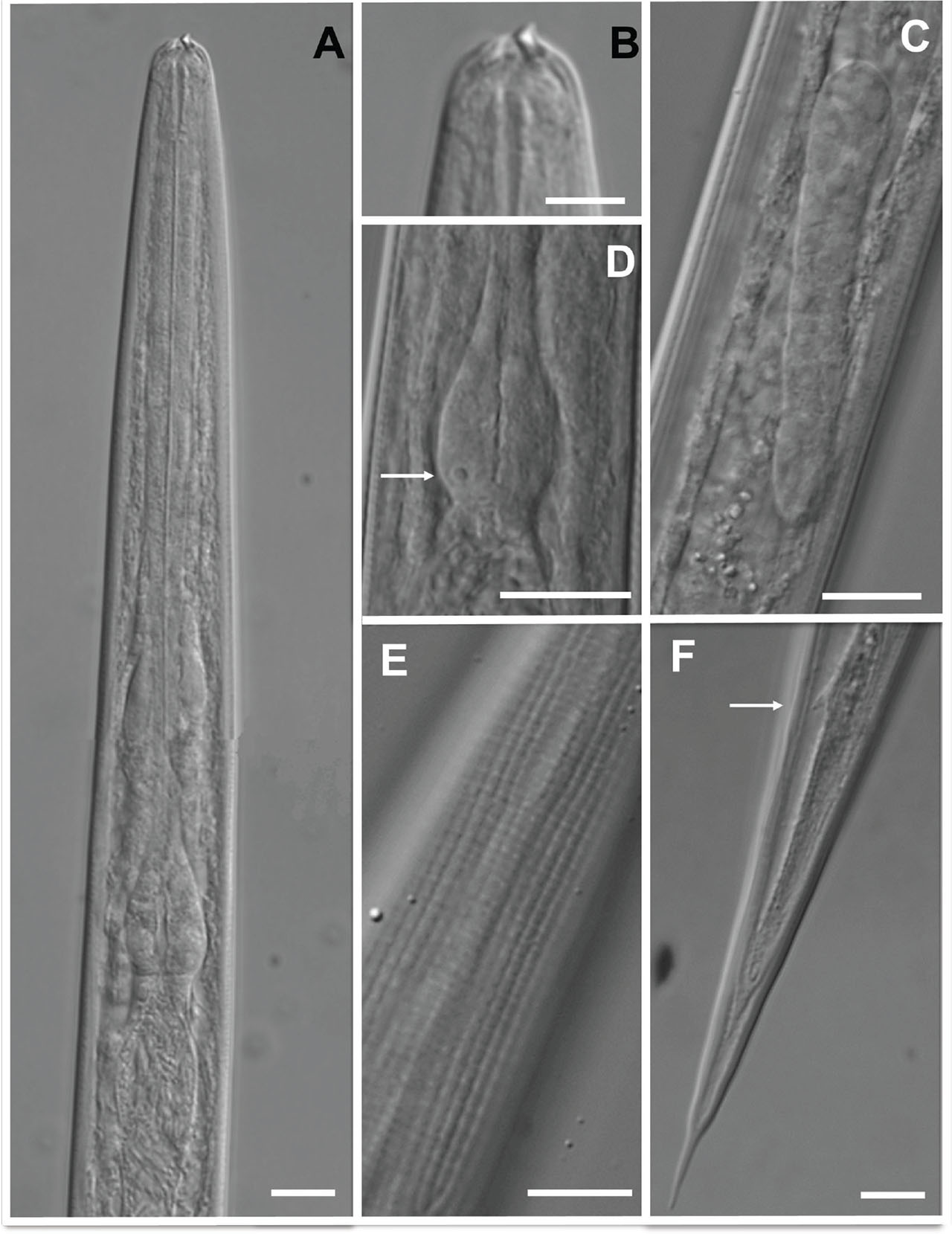
Figure 5:
Light microscopy photographs of IJs of Heterorhabditis caligo n. sp. (A) anterior part showing bacterial cells in the intestine (arrow), (B) detail of the head showing the dorsal tooth, (C) genital primordium, (D) basal bulb showing subventral gland (arrow), (E) tessellate pattern of the cuticle, (F) tail showing phasmid (arrow). Scale bars = 10 μm. IJs, infective juveniles.
Table 1:
Morphometrics of Heterorhabditis caligo n. sp.
| Character | Males | Hermaphrodites Paratypes | Females Paratypes | IJs Paratypes | |
|---|---|---|---|---|---|
| Holotype | Paratypes | ||||
| n | - | 20 | 20 | 20 | 20 |
| L | 967 | 1,018 ± 80 (864–1,174) | 3,616 ± 602 (2,855–4,950) | 2,674 ± 302 (2,002–3,103) | 669 ± 43 (568–723) |
| a | 20.1 | 19 ± 1.08 (16.9–20.8) | 14 ± 1.85 (11–18) | 15 ± 0.83 (13–17) | 27 ± 1.3 (23.7–29.1) |
| b | 8.3 | 9 ± 0.53 (7.7–9.5) | 16 ± 1.36 (13.5–19.19) | 16 ± 1.5 (13.1–19.6) | 5 ± 0.3 (4.2–5.2) |
| c | 32.2 | 31 ± 3.45 (24–38.9) | 40 ± 7.3 (27.7–55.2) | 2 ± 1.8 (2.4–0.13) | 6.8 ± 0.5 (5.4–7.7) |
| c′ | 1.3 | 1 ± 0.18 (1.1–1.8) | 1.7 ± 0.33 (1.2–2.3) | 15 ± 2.2 (11.8–19.6) | 6 ± 0.4 (5.6–7.2) |
| V | 46 ± 2.8 (40.3–50) | 52 ± 2.47 (45.6–56.8) | |||
| Max. body diam. | 48 | 54 ± 4.1 (45–59) | 265 ± 39 (187–336) | 183 ± 20.2 (133–210) | 25 ± 1.5 (22–28) |
| Excretory pore | 124 | 131 ± 7.7 (118–146) | 239 ± 37.9 (180–310) | 193 ± 16.5 (169–224) | 119 ± 6.3 (105–128) |
| Nerve ring | 71 | 74 ± 6.4 (63–92) | 156 ± 29 (122–216) | 103 ± 15 (77–141) | 107 ± 4.2 (95–114) |
| Pharynx (ES) | 117 | 118 ± 4.2 (112–126) | 224 ± 36.6 (175–294) | 173 ± 13.7 (148–197) | 141 ± 4 (135–150) |
| Hemizonoid | 113 ± 4.0 (106–117) | ||||
| Testis reflection | 128 | 133 ± 29.1 (85–245) | |||
| Tail length | 30 | 33 ± 4 (25–41) | 92 ± 11.9 (71–110) | 83 ± 7.3 (74–99) | 98 ± 9.7 (84–129) |
| Tail length without sheath | 71 ± 5.1 (60–79) | ||||
| Anal body diam. | 24 | 23 ± 2.1 (21–27) | 55 ± 10.6 (40–75) | 42 ± 2.82 (38–50) | 16 ± 0.8 (15–18) |
| Spicule length | 51 | 50 ± 3 (41–52) | |||
| Gubernaculum length | 21 | 21 ± 1.1 (18–23) | |||
| D% | 106 | 112 ± 6.7 (102–129) | 84 ± 4.3 (75–91) | ||
| E% | 413 | 403 ± 52.3 (367–535) | 121 ± 4 (94–135) | ||
| SW% | 213 | 214 ± 24.4 (152–248) | |||
| GS% | 41 | 42 ± 3 (35–49) | |||
Hermaphroditic females
The measurements of 20 hermaphroditic females are given in Table 1. The body is C-shaped when heat-relaxed, and robust when containing many eggs and embryos. Hatched juveniles are present in older specimens. They are cuticle smooth, with the anterior end tapering anteriorly. The labial region has six prominent lips, each with a terminal labial papilla (Figs. 1A,B and 2B). Cephalic papillae and amphidial apertures are not observed with LM. Stoma is rhabditoid type, with a short cheilostom with a hardly visible refringent rounded cheilorhabdia, gymnostom well-developed, refringent, bar-like rhabdia, and funnel-shaped stegostom surrounded by the pharyngeal collar. The pharynx is with subcylindrical procorpus, metacorpus slightly swollen, narrow isthmus, and basal bulb well developed. Nerve rings surround the isthmus. The excretory pore at the intestine level (Fig. 1A) is always posterior to the basal bulb. The cardia is rounded and protruding into the intestine. The reproductive system is didelphic–amphidelphic. The ovotestes are well developed and reflexed. Uteri are with numerous embryonated eggs. The vagina is short and the vulva is a transverse slit, with no epytigmata and light to moderate protruding lips, close to the mid-body (Fig. 1E). The anal swelling is inconspicuous or moderately developed posteriorly, and the rectum is slender, about 1–2 times the anal body width. The tail conoid has a narrower rounded terminus, lacking a mucron (Figs. 1F,G and 2D–F). Phasmids are inconspicuous.
Amphimictic females
The measurements of 20 females are given in Table 1. The body arcuate with general morphology is similar to that of hermaphroditic females. The body is tapering toward the anterior end, which is truncated with six prominent lips bearing labial papillae (Figs. 1B,D). The reproductive system is didelphic–amphidelphic with ovaries well developed, reflexed, vulva slightly protruded (anterior lip = 6 ± 2.8 μm, range 2–11 μm and posterior lip = 7 ± 2.4 μm, range 4–13 μm) with a transverse slit opening with no epitygmata, vagina short, and exudates or copulation plug present in some specimens (6 out of 20). Eggs and embryo are present. Anal swelling is slight to moderate, and the rectum is slender and shorter than in hermaphroditic females (ranging 0.7–1.5 times the anal body width). The tail conoid with a rounded tip lacks a mucron. Phasmids are inconspicuous.
Males
The measurements of 20 males are given in Table 1. The body is curved ventrally (open C-shape) or sometimes straight when heat relaxed. The anterior end is truncated (Figs. 3A,B; 4A) and the lip region has six labial papillae. Stoma, with a short cheilostom and refringent rounded cheilorhabdia, has a funnel-shaped stegostom surrounded by the pharyngeal collar (Fig. 4B). The pharynx is with a subcylindrical procorpus, the isthmus is narrower than the metacorpus, and the basal bulb is well developed and spheroid. The nerve ring is located around the isthmus. The excretory pore is always located below the basal bulb (1 basal bulb length). Cardia is conspicuous, rounded, and not protruding into the intestine. The reproductive system is monorchid, with testis reflexed. The vas deferens are well developed. The spicules are also well developed, paired, and colorless with small, quadrangular manubrium set from the lamina by a short calamus. The lamina is almost straight with a single rib and an acute terminus. The gubernaculum is robust, and curved anteriorly in its distal partition in 90% of the specimens. The tail conoid is with an acute tip, ventrally curved, and flanked by the bursa. The bursa peloderan bearis nine pairs of bursal papillae, three precloacal (papillae 1 alone and 2, 3 grouped) and six postcloacal (papillae 4, 5, and 6 grouped and 7, 8, 9 grouped). The fourth and eighth papillae pairs are always shorter within their groups and do not reach the bursal edge (Figs. 3C–F; 4D,E).
Infective juveniles
The measurements of 20 IJ are given in Table 1. The body is straight when heat relaxed (Fig. 5A). A sheath (second-stage cuticle) is present. The cuticle is with a tessellate pattern posterior to the lip region in both sheathed and exsheathed specimens (Fig. 5E). The lip region bears the dorsal tooth under the sheath (Figs. 4C and 5A,B). The pharynx is slender, with a cylindrical corpus, a narrower and slender isthmus, and basal bulb pyriform without developed valves. The subventral gland is often seen in 1,000X magnification (Figs. 4C and 5D). A nerve ring surrounds the isthmus. The excretory pore is located anterior to the nerve ring and basal bulb. Hemizonid is visible in 20% of the specimens, always anterior to the excretory pore. Cardia is present, not protruding into the intestine. Symbiotic bacterial cells are clearly distinguishable in the intestine lumen (Fig. 5A). Genital primordium is conspicuous and visible in 400 and 1,000× magnification (about 32 μm long and 6 μm width) (Fig. 5C). Rectum narrow, not clearly discernible in many specimens. Tail conoid with finely pointed terminus. Phasmids often visible in 1,000× magnification (Figs. 4F; 5F).
Diagnosis and relationships
Heterorhabditis caligo n. sp. can be separated from the other species within the megidis clade by a combination of the morphological, morphometric, and molecular characteristics. H. caligo n. sp. is morphologically and morphometrically similar to H. marelatus with the following differences: In males, the fourth and eighth pairs of the bursal papillae are shorter and do not reach the edge of the bursa in H. caligo n. sp. (Figs. 3D and 4E), whereas all the papillae in H. marelatus reach the edge of the bursa. The excretory pore of amphimictic females of H. caligo n. sp. is located more posteriorly than in those of H. marelatus 193 (169–224) μm vs. 157 (139–178) μm, respectively. The pharynx of H. caligo n. sp. is longer than that of H. marelatus 173 (148–197) μm vs. 144 (129–164) μm, and the tale of the former is longer than that of H. marelatus 83 (74–99) μm vs. 67 (55–81). The IJs of H. caligo n. sp. are similar in length but differ from H. marelatus by the longer pharynx, 141 (135–150) μm vs. 133 (121–138) μm, and the position of the excretory pore from the anterior end, 119 (105–128) μm vs. 102 (81–113) μm. In H. caligo n. sp., the hemizonid is always located anterior to the excretory pore, whereas in H. marelatus the hemizonid is usually located just posterior to the excretory pore.
The males of H. caligo n. sp. can be separated from males of H. megidis by the shape of the bursa (peloderan vs. pseudopeloderan), and the lack of a fine tip extending beyond the bursal membrane present in the latter, shorter distance from the anterior end to the excretory pore 119 (105–128) μm vs. 156 (139–176) μm. The IJs of H. caligo n. sp. are smaller compared with H. megidis 667 (568–723) μm vs. 768 (736–800) μm), and have a shorter distance from the head to the excretory pore 119 (105–128) μm vs. 131 (123–142) μm.
Males of H. caligo n. sp. have excretory pores more posteriorly located than the males of H. downesi 131 (118–146) μm vs. 89 (86–91) μm, respectively, and a longer pharynx 118 (112–126) μm vs. 101 (97–106) μm, respectively. Hermaphroditic females of H. caligo n. sp. can be differentiated from hermaphroditic females of H. downesi by the shape of their tails (conoid with rounded tip lacking a mucron vs blunt and mucronate). IJs of H. caligo n. sp. have longer tails than the IJs of H. downesi 98 (84–129) μm vs. 68 (62–74) μm; they differ in the a ratio 27 (24–29) vs. 35 (29–42), respectively, and c ratio 6.8 (5.4–7.7) vs. 9.5 (8.5–10.5) and lack the spike-like tip present in the IJs of H. downesi.
The males of H. caligo n. sp. can be differentiated from those of H. safricana by their GS% 42 (35–49) vs. 53.9 (43.3–61.7), respectively. The amphimictic females of H. caligo n. sp. have a longer distance from the anterior end to the excretory pore compared with H. safricana females at 193 (169–224) μm vs. 171 (151–196) μm.
The amphimictic females of H. caligo n. sp. have a longer distance from the anterior end to the excretory pore compared with H. atacamensis females at 193 (169–224) μm vs. 161 (154–182) μm, and pharynx length 173 (148–197) vs. 150 (129–167). IJs of H. caligo n. sp. are longer compared with the IJs from H. atacamensis, 667 (568–723) μm vs. 611 (578–666) μm, but have a shorter E% 121 (94–135) vs. 165 (149–182).
Heterorhabditis caligo n. sp. is morphologically and morphometrically similar in all stages compared with H. zealandica but the IJs of the former lack the spine-like terminus present in the latter. In males the disposition of the bursal papillae varies between both species: in the case of H. caligo n. sp., the terminal papillae form a clear cluster of three pairs (seventh, eighth and ninth), whereas in H. zealandica the seventh pair is somewhat closer to the sixth papillae rather than the eighth. Also, the fourth bursal papillae of H. caligo n. sp. do not reach the edge as in H. zealandica.
Type host and locality
The host of this nematode in nature is unknown. H. caligo n. sp. was isolated, using the Galleria baiting method, from a coastal dune between the Petrel lagoon and the seashore, in Pichilemu (central Chile) (−34.379151, −71.995739). The typical vegetation of these dunes comprises Ammophila arenaria (Poales: Poaceae), Ambrosia chamissonis (Asterales: Asteraceae), and Carpobrotus chilensis (Caryophyllales: Aizoaceae). Although the dunes were relatively small, we successfully isolated this new species, which co-occurred with a population of Steinernema australe. Pichilemu and its coastal lagoon are characterized by a Mediterranean climate with a mean yearly temperature of 13.9°C. The region experiences winter-dominant precipitation. These coastal wetlands are ecologically important but increasingly vulnerable, as dwindling winter rainfall causes water levels to drop, severing seasonal connections to the Pacific Ocean and affecting the brackish nature of the lagoons.
Type material
A slide containing the male holotype and Eppendorf tubes containing 50 hermaphrodites, 50 females, and 50 males fixed in TAF were deposited in the National Museum of Natural Sciences (Madrid, Spain). The rest of the specimens, 15 males and 15 females, remain in the Laboratory of Nematology at the Universidad de O’Higgins, Chile. As required by the International Commission on Zoological Nomenclature, the ZooBank registration number for the new Linnaean binomials is LSID urn:lsid:zoobank.org:pub:446F3205-AD35-4655-8DB9-AAB86E99A6FA
Molecular Characterization and Phylogenetic Analysis
Nematode phylogenetic relationship reconstructions
Whole nuclear and mitochondrial genome, and whole ribosomal operon-based trees show that H. caligo n. sp. belongs to the megidis clade and is closely related to H. safricana (Figs. 6–8). Although these phylogenetic reconstructions enable robust species discrimination and inference of phylogenetic relationships in the genus Heterorhabditis, they are insufficient to show that H. caligo n. sp. is a novel species due to the lack of available sequences of H. marelatus, a member of the megidis clade, which is closely related to H. safricana and H. caligo n. sp. As we have not yet been able to obtain whole genome sequences of H. marelatus because there are no H. marelatus specimens in laboratory cultures, we reconstructed phylogenetic relationships using additional available sequences. Phylogenetic trees using individual or concatenated sequences of the ITS region of the rRNA gene, the cytochrome c oxidase subunit I (cox-1) gene, the calmodulin 1 (cmd-1) gene, and thin filament F-actin-associated protein (unc-87) gene show often a clear separation between H. caligo n. sp. and its sister species H. marelatus, H. safricana, and H. atacamensis (Figs. 9–11; Figures S1 and S2 in the Supplementary Material). At the nucleotide level, H. caligo n. sp. shares no more than 93% sequence identity in the cytochrome c oxidase subunit I (cox-1) gene, 98.9% in the ITS region of the rRNA gene, 92.5% in the calmodulin 1 (cmd-1) gene, and 97.2% in the thin filament F-actin-associated protein (unc-87) gene with its sister species H. marelatus, H. safricana, and H. atacamensis (Table S5 in the Supplementary Material). Different isolates of the same species share more than 98.7% in the sequences of the cytochrome c oxidase subunit I (cox-1) gene, more than 99.8% in the sequences of the ITS region of the rRNA gene, more than 99.1% in the sequences of the calmodulin 1 (cmd-1) gene, and more than 99.5% in the sequences of the thin filament F-actin-associated protein (unc-87). Hence, H. caligo n. sp. represents a novel phylogenetically distinct species.
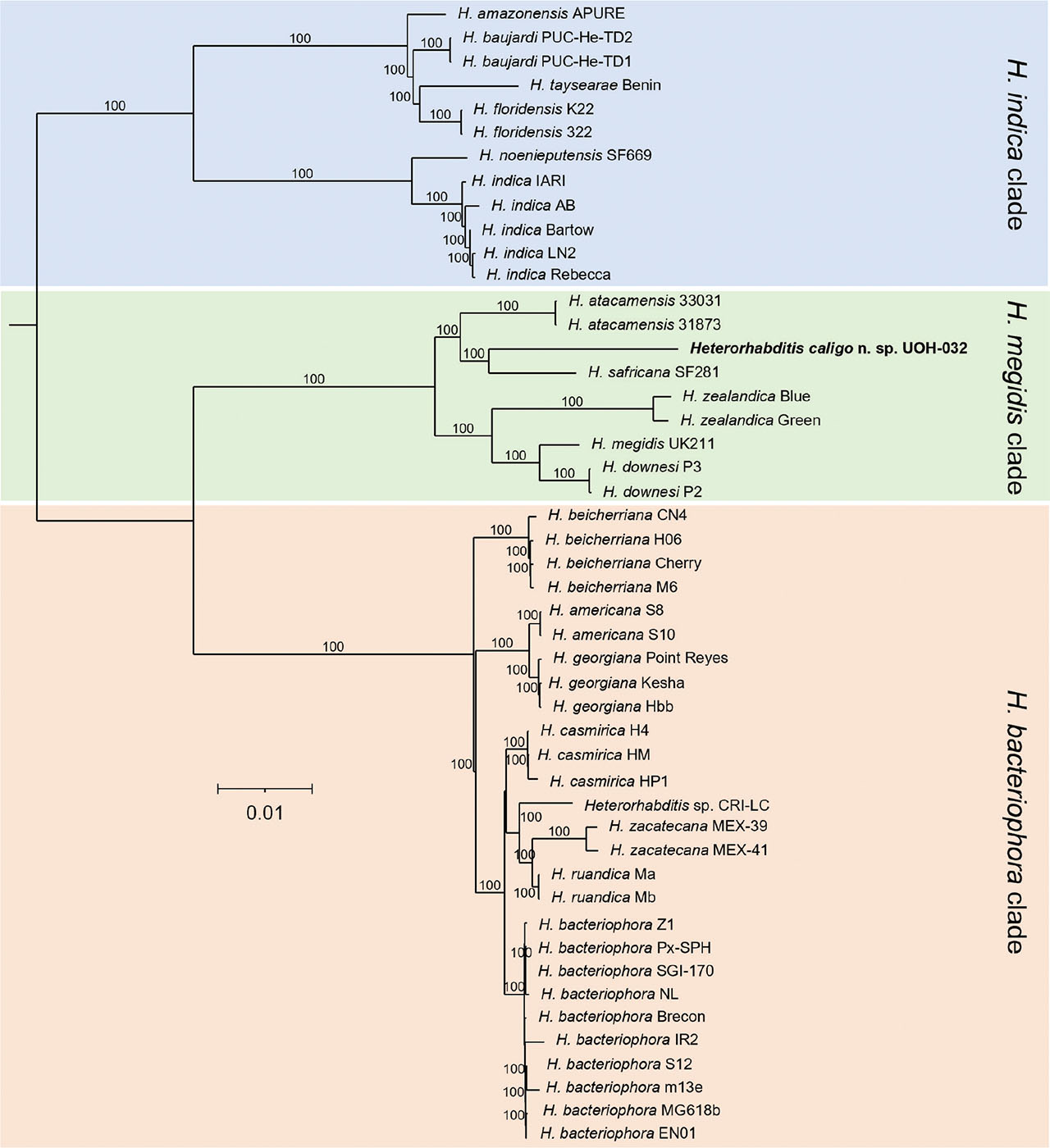
Figure 6:
Approximately-maximum-likelihood phylogenetic trees reconstructed from concatenated sequences of orthogroups of different Heterorhabditis species. A total of 4,600 single-copy orthogroups, comprising 1,846,787 amino acid positions, were analyzed. Numbers at the nodes represent bootstrap values based on 500 replications. Bars represent average nucleotide substitutions per sequence position. Heterorhabditis mexicana from the indica clade and H. marelatus from the megidis clade could not be included in the analyses due to lack of laboratory cultures.
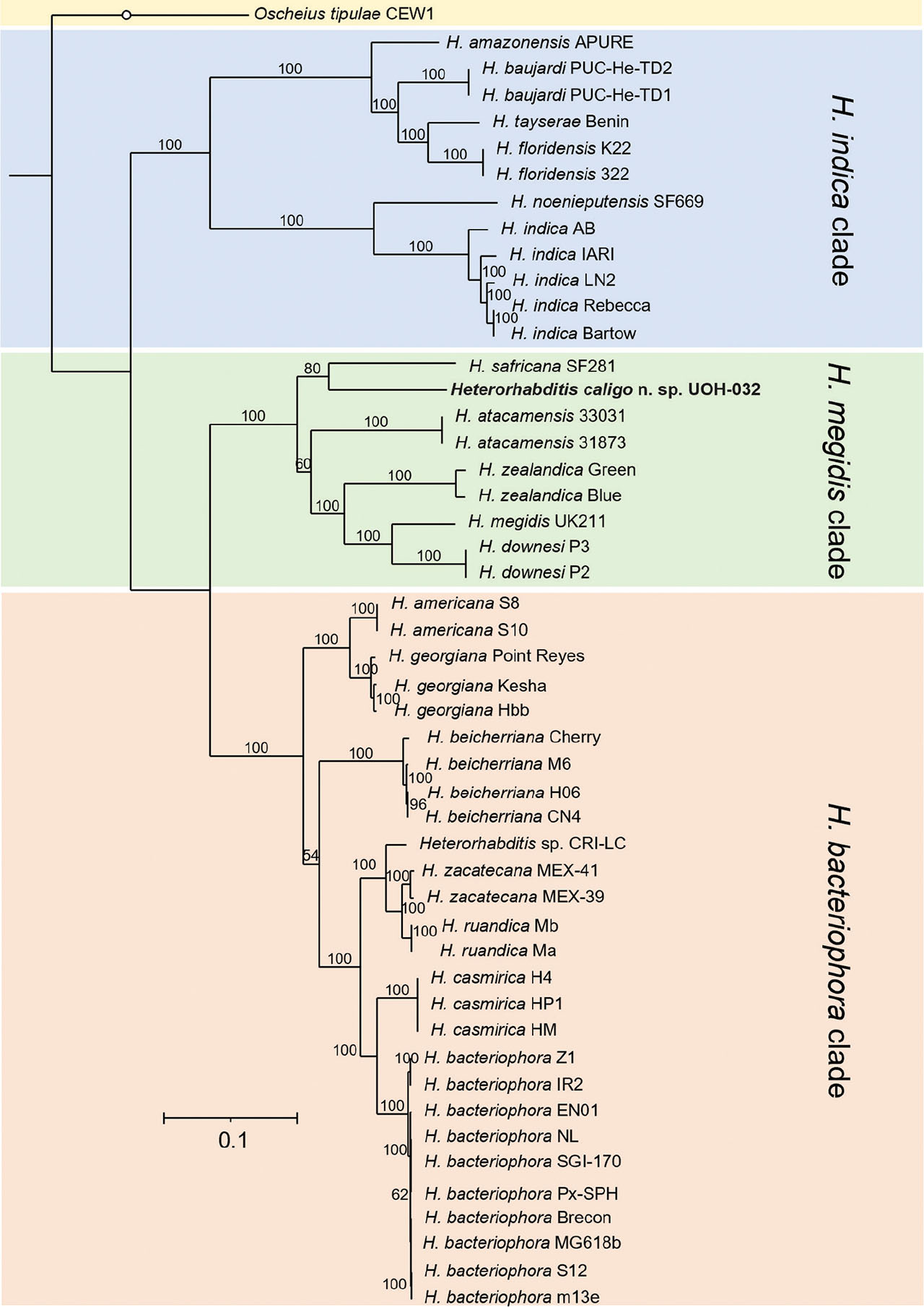
Figure 7:
Maximum-likelihood phylogenetic tree reconstructed from concatenated sequences of the following protein-coding genes: cytochrome c oxidase, cytochrome b, and NADH dehydrogenase of the mitochondrial genomes of different Heterorhabditis species. A total of 9,494 nucleotide positions were analyzed. The genes were concatenated in the following order: cob, cox-1, cox-2, cox-3, nad-1, nad-2, nad-3, nad-4, nad-4l, nad-5, and nad-6. Accession numbers of the concatenated sequences used for the analyses are shown in Table S3 in the Supplementary Material. Numbers at nodes represent bootstrap values based on 500 replications. Bars represent average nucleotide substitutions per sequence position. Heterorhabditis mexicana from the indica clade and H. marelatus from the megidis clade could not be included in the analyses due to lack of laboratory cultures.
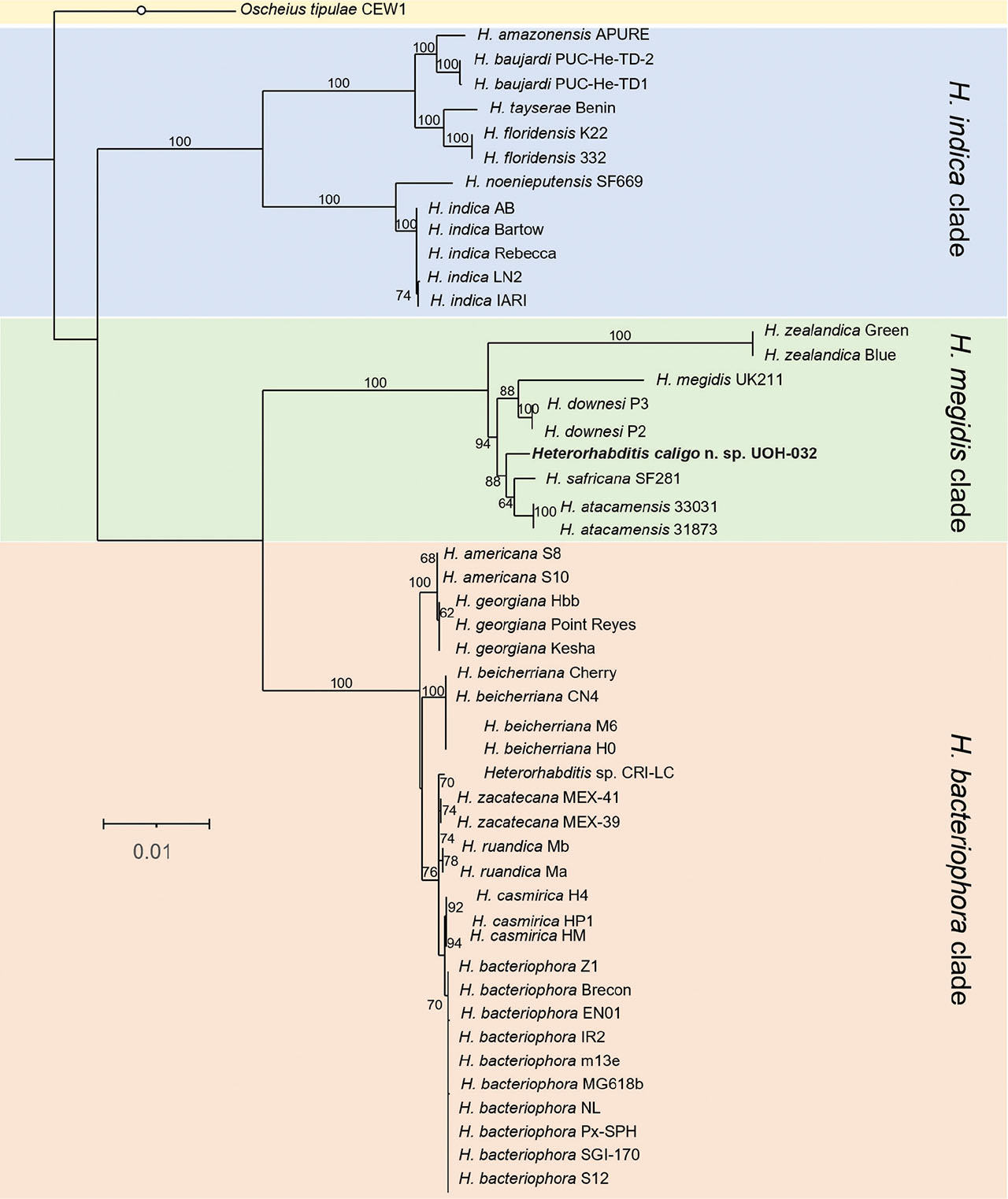
Figure 8:
Maximum-likelihood phylogenetic tree reconstructed from the whole ribosomal RNA operons of different Heterorhabditis species. A total of 5,927 nucleotide positions were analyzed. Accession numbers of the sequences used for the analyses are shown in Table S3 in the Supplementary Material. Numbers at nodes represent bootstrap values based on 500 replications. Bars represent average nucleotide substitutions per sequence position. Heterorhabditis mexicana from the indica clade and H. marelatus from the megidis clade could not be included in the analyses due to lack of laboratory cultures.
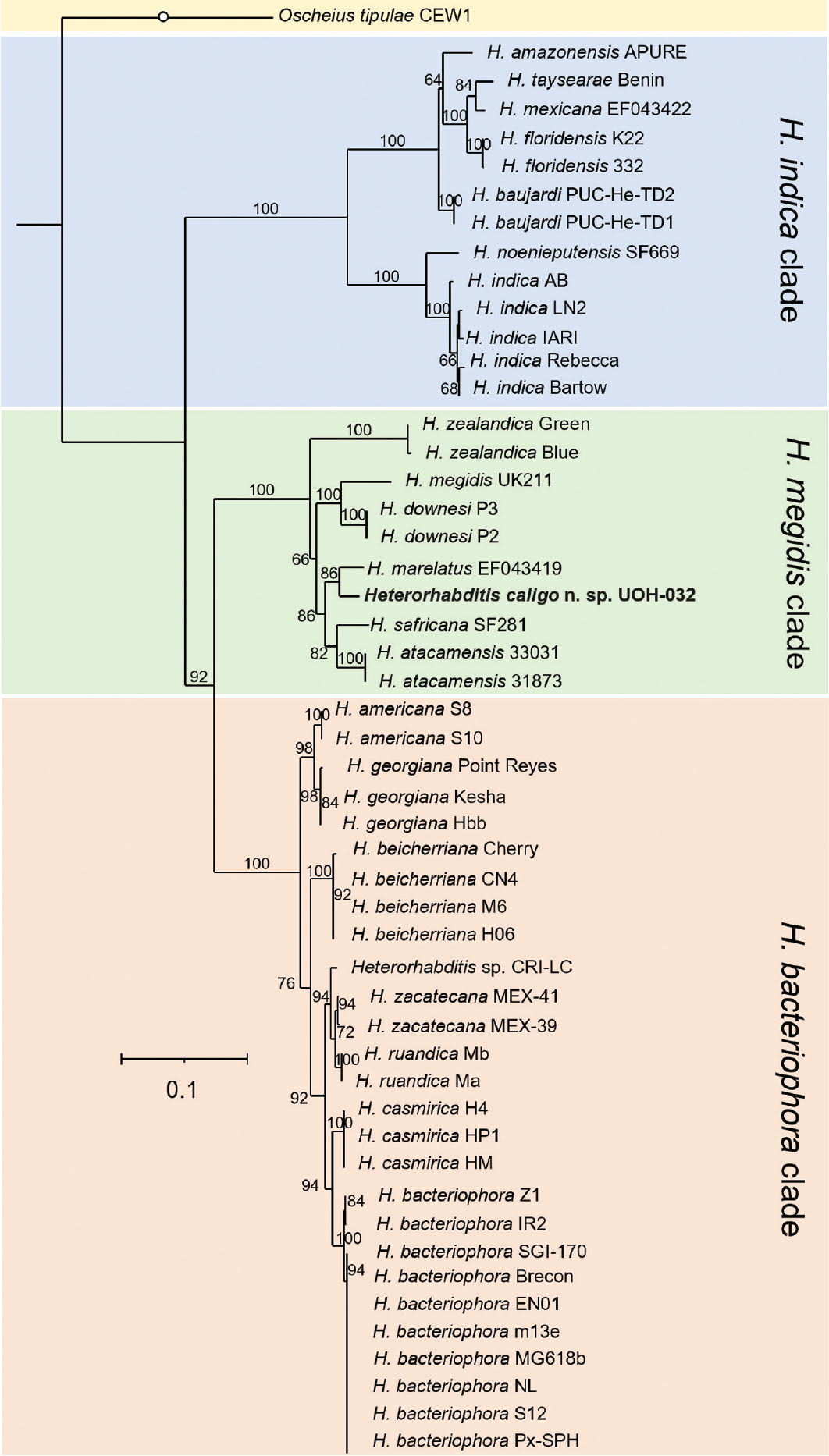
Figure 9:
Maximum aphylogenetic tree reconstructed from the concatenated sequences of the ITS region of the rRNA gene and the cytochrome c oxidase subunit I (cox-1) gene of different Heterorhabditis species. A total of 1,482 nucleotide positions were analyzed. The ITS sequences of H. marelatus and H. mexicana were obtained from the NCBI using the accession numbers AY321479 and EF043444, respectively. The ITS sequences of all the other isolates were extracted from whole ribosomal RNA operons. These sequences were then trimmed to obtain sequences that cover the region flanked by the commonly used primers TW81 and AW28. The cox-1 sequences of H. marelatus and H. mexicana were obtained from the NCBI using the accession numbers EF043419 and EF043422, respectively. The sequences of all the other isolates were extracted from whole mitochondrial genomes. These sequences were then trimmed to obtain sequences that cover the region flanked by the commonly used primers HCF and HCR. Accession numbers of the nucleotide sequences used for the analyses are shown in Table S3 in the Supplementary Material. Numbers at nodes represent bootstrap values based on 500 replications. Bars represent average nucleotide substitutions per sequence position. ITS, internal transcribed spacer; NCBI, National Center for Biotechnology Information.
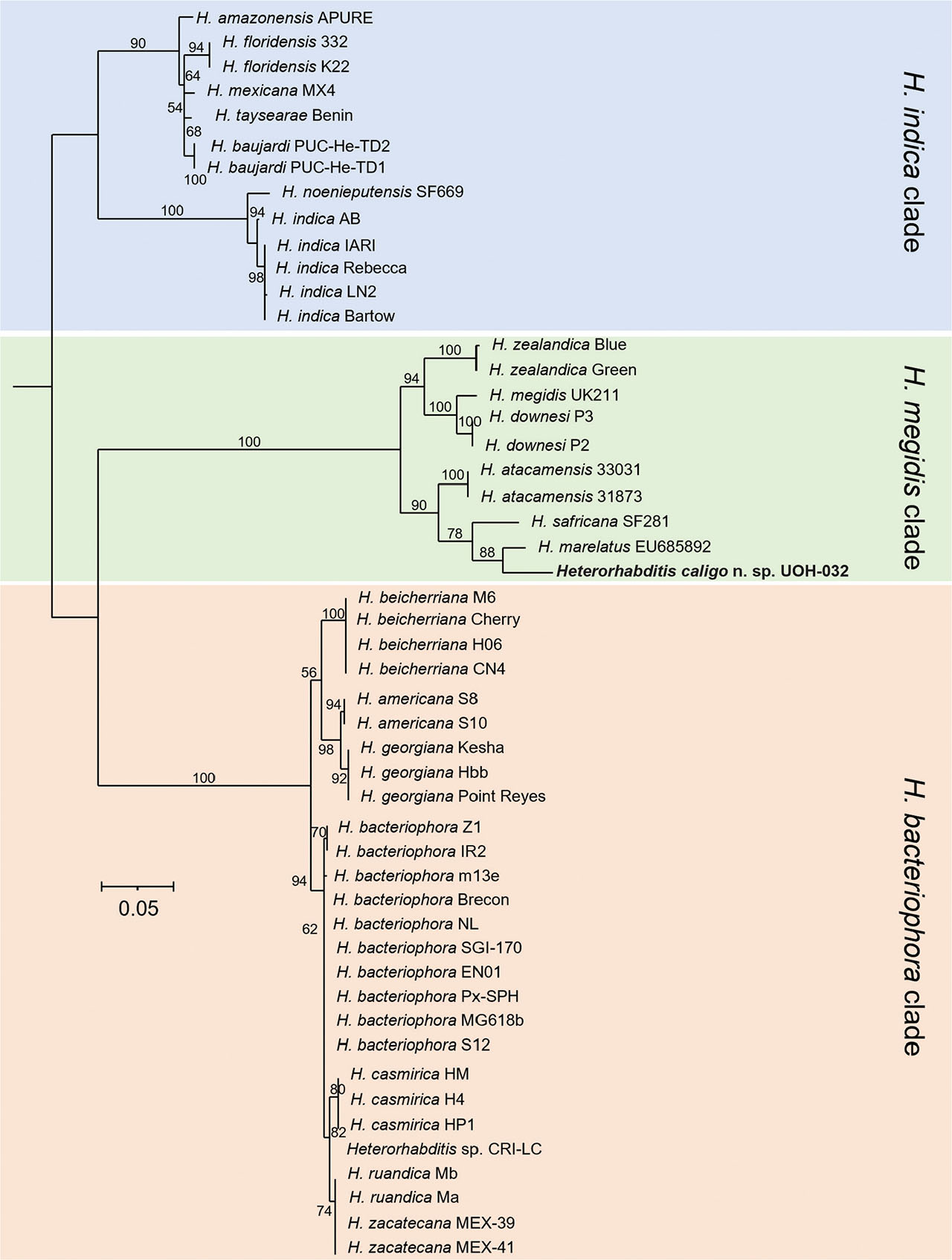
Figure 10:
Maximum-likelihood phylogenetic tree reconstructed from the nucleotide sequences of the calmodulin 1 (cmd-1) gene. A total of 738 nucleotide positions were analyzed. Accession numbers of the nucleotide sequences used for the analyses are shown in Table S3 in the Supplementary Material. Numbers at nodes represent bootstrap values based on 500 replications. Bars represent average nucleotide substitutions per sequence position. Trees were rooted at the midpoint.
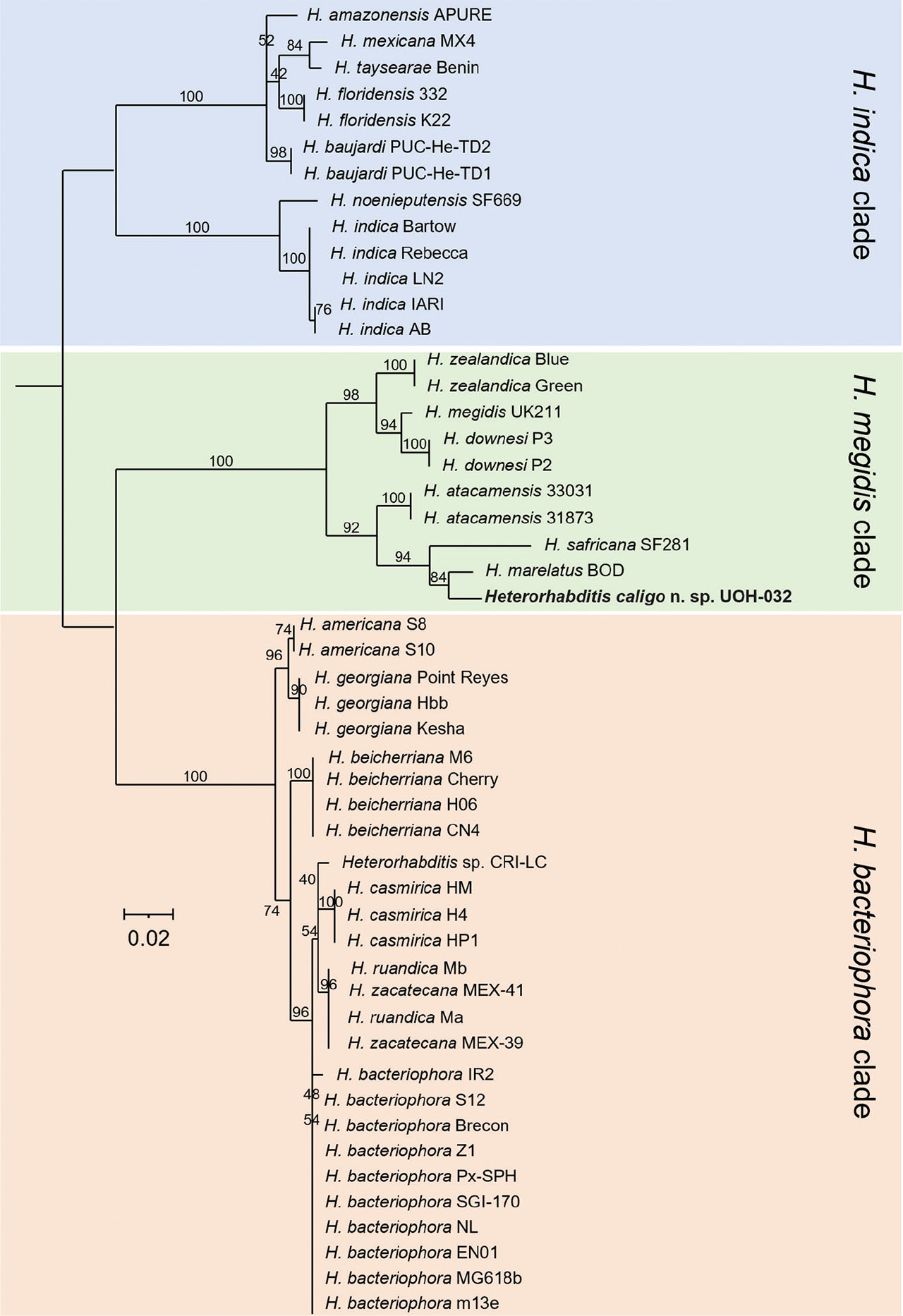
Figure 11:
Maximum-likelihood phylogenetic tree reconstructed from the nucleotide sequences of the thin filament F-actin-associated protein (unc-87) gene. A total of 465 nucleotide positions were analyzed. Accession numbers of the nucleotide sequences used for the analyses are shown in Table S3 in the Supplementary Material. Numbers at nodes represent bootstrap values based on 500 replications. Bars represent average nucleotide substitutions per sequence position. Trees were rooted at the midpoint.
Bacterial symbionts
Phylogenetic reconstructions based on core genome sequences and sequence comparisons show that the bacterial symbiont isolated from H. caligo n. sp. belongs to the species P. tasmaniensis (Fig. 12). The dDDH scores between DSM 22387T, the type strain of the species P. tasmaniensis, and strain UOH-032, isolated from H. caligo n. sp., is 85.3%, which is above the 70% and 79% thresholds that delimit prokaryotic species and subspecies, respectively, showing that they are conspecific (Table S6 in the Supplementary Material). The intraspecific dDDH values in the genus Photorhabdus are greater than 87%, and often greater than 97% (Machado et al., 2018, 2021).
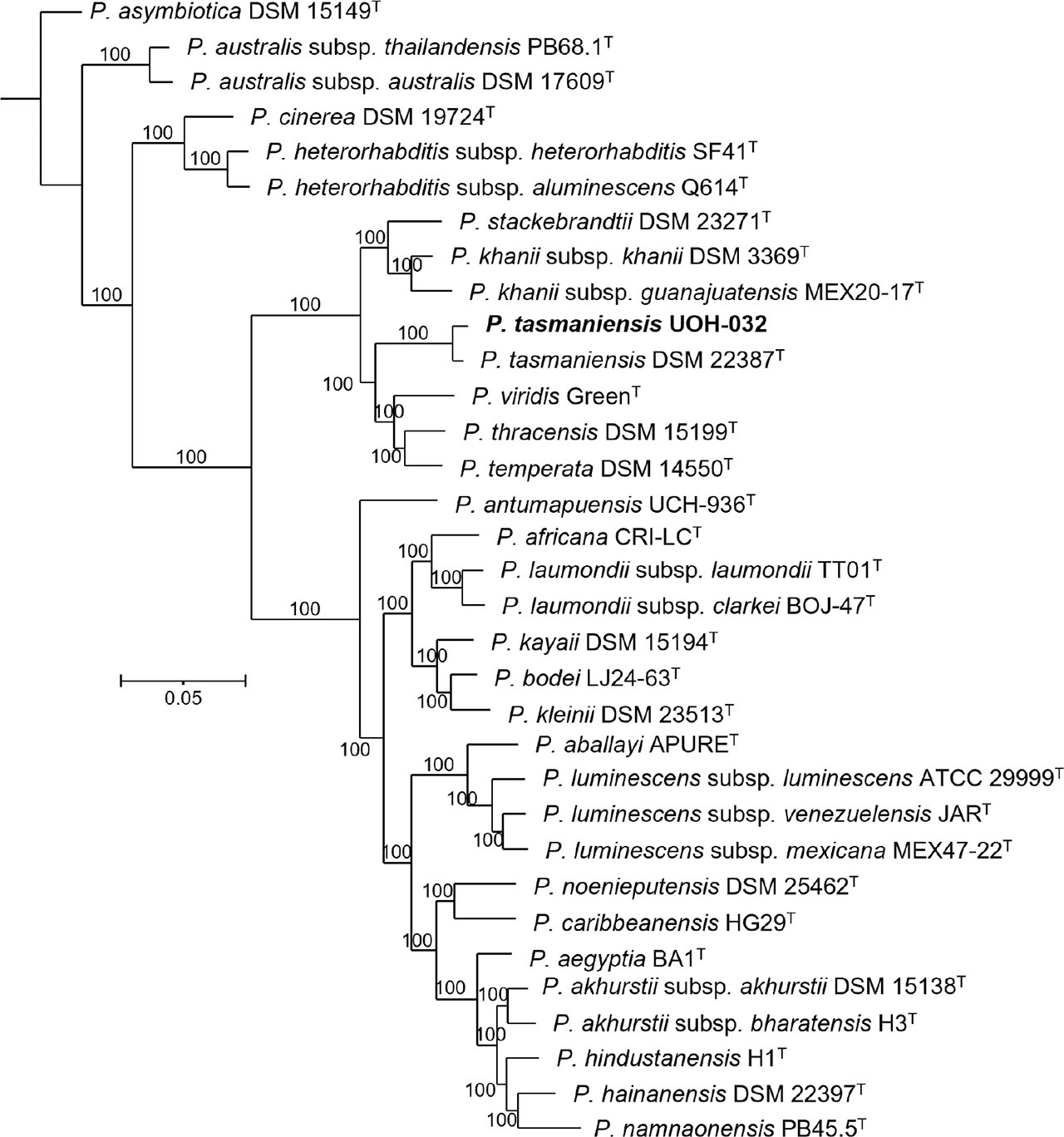
Figure 12:
Phylogenetic reconstruction based on core genome sequences of Photorhabdus type strains with validly published names. A total of 3,526,609 nucleotide positions (3,455 core genes) were used in the analyses. Numbers at the nodes represent SH-like branch supports. Bar represents 0.05 nucleotide substitutions per sequence position. Accession numbers of the genome sequences used for the reconstruction are shown in Table S4 in the Supplementary Material.
Data availability statement
The sequences of H. caligo n. sp. UOH-032 were deposited in the NCBI database under the accession numbers shown in Table S3 in the Supplementary Material. In addition, the sequences of the fan-1, the ppfr-1, rrnL, rrnS, and D2D3 genes were deposited under accession numbers PV892896, PV892897, PX240084, PX241222, and PX240083, respectively.
Discussion
The discovery of Heterorhabditis caligo n. sp. from the coastal dunes of Pichilemu represents a significant addition to the known diversity of EPNs in South America, particularly within Chile’s Mediterranean climate zone. The species’ occurrence in sandy coastal habitats suggests ecological adaptations to arid, salt-influenced environments that may distinguish it from other members of the megidis group typically found in more mesic conditions. The association with Photorhabdus tasmaniensis as its bacterial symbiont further emphasizes the complex co-evolutionary relationships within these nematode–bacteria partnerships, particularly noteworthy given that this bacterial species was originally described from Australia, suggesting either broader geographic distribution patterns or convergent symbiotic associations across distant biogeographic regions.
The discovery of H. caligo n. sp. highlights the ongoing need for comprehensive taxonomic characterization within the Heterorhabditis group, particularly regarding its intraspecific relationships. While, due to the availability of living specimens, the intraspecific molecular relationships of most of the species have been studied in the past, this information is still lacking for some species such as H. marelatus, H. safricana, and the newly described species (Machado et al., 2025). This is particularly relevant given the relatively high sequence similarity values of some taxonomically relevant gene markers.
The distinctive morphological characters, particularly the shortened fourth and eighth bursal papillae in males and the posterior positioning of the excretory pore in females, provide reliable diagnostic features. However, the absence of laboratory cultures for several closely related species, particularly H. marelatus, limits comprehensive morphological analysis and underscores the critical need for establishing culture collections of EPNs to support both taxonomic research and biological control applications.
Acknowledgments
The authors thank the “Ilustre Municipalidad de Pichilemu” for their logistical support in the preparation of the survey and sampling sites. This study was partially funded by Agencia Nacional de Investigación y Desarrollo (ANID-Chile) through the grant project FONDECYT-Regular 1221016 and by the Ministry of Education of Chile through the grant project “Sistema Articulado de Investigación en Cambio Climático y Sustentabilidad de Zonas Costeras de Chil e (URO RED21992).”
Notes
Supplementary Materials
Supplementary Figures
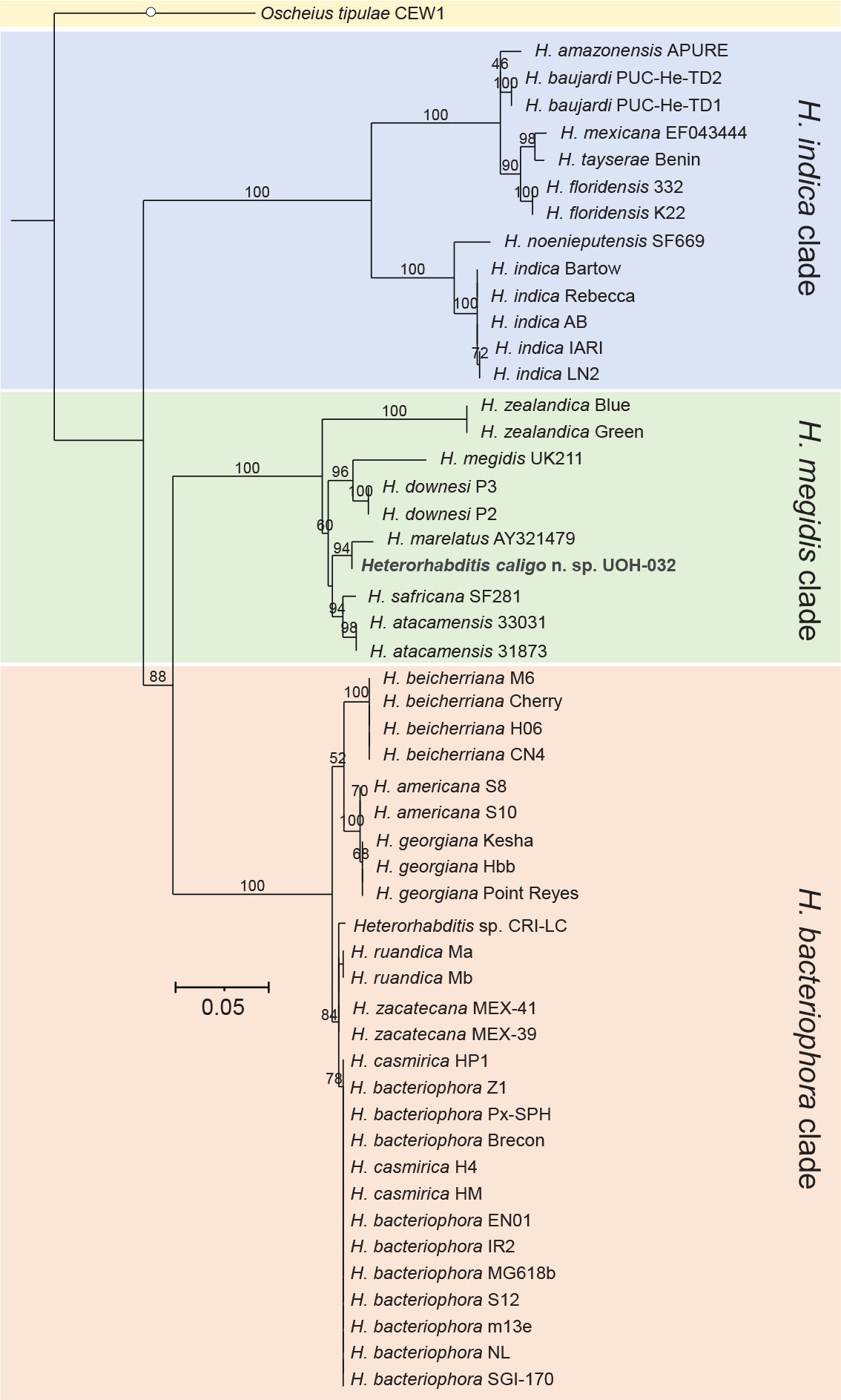
Figure S1:
Maximum-likelihood phylogenetic tree reconstructed from the sequences of the ITS region of the rRNA gene of different Heterorhabditis species. A total of 1075 nucleotide positions were analyzed. The sequences of H. marelatus and H. mexicana were obtained from the NCBI using the accession numbers AY321479 and EF043444, respectively. The sequences of all the other isolates were extracted from whole ribosomal RNA operons. These sequences were then trimmed to obtain sequences that cover the region flanked by the commonly used primers TW81 and AW28. Accession numbers of the nucleotide sequences used for the analyses are shown in Table S3 in the Supplementary Material. Numbers at the nodes represent bootstrap values based on 500 replications. Bars represent average nucleotide substitutions per sequence position. ITS, internal transcribed spacer.
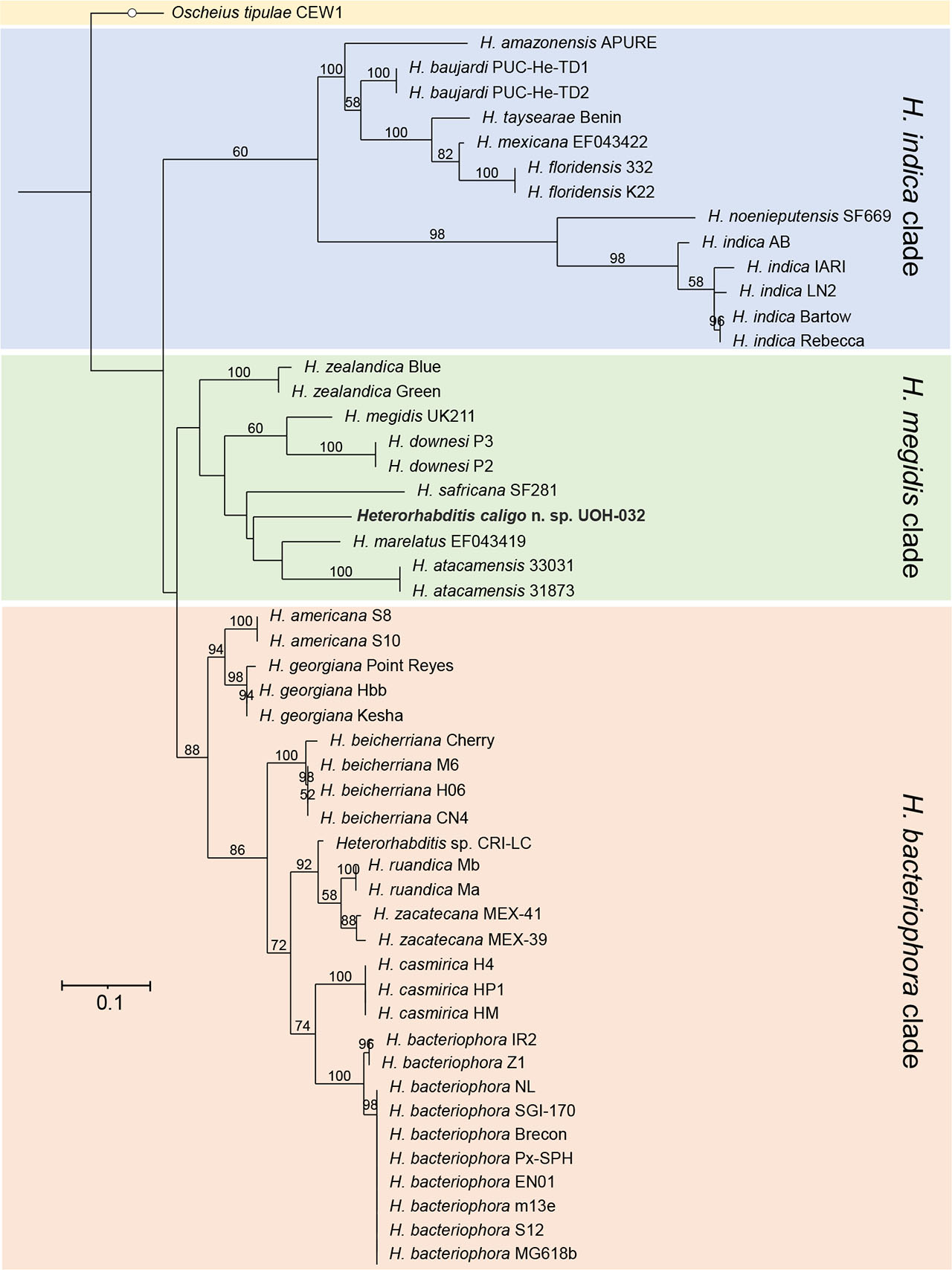
Figure S2:
Maximum-likelihood phylogenetic tree reconstructed from the sequences of the cytochrome c oxidase subunit I (cox-1) gene of different Heterorhabditis species. A total of 401 nucleotide positions were analyzed. The sequences of H. marelatus and H. mexicana were obtained from the NCBI using the accession numbers EF043419 and EF043422, respectively. The sequences of all the other isolates were extracted from whole mitochondrial genomes. These sequences were then trimmed to obtain sequences that cover the region flanked by the commonly used primers HCF and HCR. Accession numbers of the nucleotide sequences used for the analyses are shown in Table S3 in the Supplementary Material. Numbers at the nodes represent bootstrap values based on 500 replications. Bars represent average nucleotide substitutions per sequence position.
Supplementary Tables
Table S1:
Features and assemble statistics of the nematode genomes generated and/or used in this study.
| Species | Strain designation(s) | L50 | N50 | L90 | N90 | Genome size (bp) | GC content (%) |
|---|---|---|---|---|---|---|---|
| H. amazonensis | APURE | 185 | 94744 | 692 | 21806 | 65101680 | 33.72 |
| H. americana | S10 | 432 | 48365 | 1815 | 6421 | 72782968 | 33.07 |
| S8 | 635 | 33153 | 2886 | 3735 | 72234711 | 33.27 | |
| H. atacamensis | 31873 | 212 | 82969 | 940 | 12449 | 67224907 | 32.98 |
| 33031 | 218 | 81903 | 981 | 11470 | 67409700 | 33.09 | |
| Brecon | 585 | 35417 | 2251 | 6475 | 69889708 | 32.85 | |
| EN01 | 593 | 35153 | 2635 | 4057 | 71959660 | 33.02 | |
| IR2 | 422 | 50708 | 1521 | 10601 | 70203201 | 32.90 | |
| m13e | 787 | 27231 | 3030 | 4697 | 72585993 | 33.08 | |
| H. bacteriophora | MG618b | 639 | 33083 | 2791 | 4049 | 71868631 | 33.02 |
| NL | 424 | 49858 | 1597 | 9515 | 71077392 | 33.14 | |
| S12 | 594 | 35368 | 2637 | 4102 | 71872306 | 33.00 | |
| SGI-170 | 415 | 50445 | 1801 | 5833 | 73250772 | 33.13 | |
| Px-SPH | 396 | 53254 | 1778 | 5674 | 73984962 | 33.22 | |
| Z1 | 383 | 54630 | 1655 | 6479 | 73293000 | 33.13 | |
| H. baujardi | PUC-He-TD1 | 166 | 102718 | 632 | 23255 | 64662943 | 33.73 |
| PUC-He-TD2 | 210 | 86004 | 814 | 15671 | 66175497 | 33.60 | |
| Cherry | 387 | 53208 | 1595 | 7903 | 71960759 | 32.97 | |
| H. beicherriana | CN4 | 740 | 28317 | 3011 | 4301 | 70797395 | 32.83 |
| H06 | 586 | 35927 | 2488 | 4871 | 70742037 | 32.82 | |
| M6 | 378 | 55114 | 1600 | 7533 | 72276565 | 33.06 | |
| H. caligo n. sp. | UOH-032 | 216 | 90000 | 991 | 11663 | 72194284 | 33.78 |
| H4 | 410 | 52252 | 1770 | 6413 | 73080526 | 33.16 | |
| H. casmirica | HM | 412 | 51774 | 1771 | 6469 | 73036779 | 33.15 |
| HP1 | 496 | 40787 | 1808 | 9330 | 70153441 | 32.94 | |
| H. downesi | P2, pur2 | 582 | 33455 | 2189 | 6602 | 66295249 | 33.33 |
| P3, pur3 | 344 | 53355 | 1310 | 11663 | 65144250 | 33.18 | |
| H. floridensis | 332 | 195 | 92043 | 712 | 21459 | 64561023 | 33.74 |
| K22 | 190 | 94213 | 711 | 21075 | 64790060 | 33.79 | |
| Hbb | 617 | 34453 | 2713 | 4209 | 71543875 | 32.94 | |
| H. georgiana | Kesha | 432 | 49201 | 1880 | 5965 | 72925328 | 33.06 |
| Point Reyes | 425 | 49428 | 1803 | 6471 | 72527224 | 33.03 | |
| AB, HeM | 225 | 79854 | 917 | 12606 | 65680349 | 33.80 | |
| Bartow | 247 | 73385 | 1017 | 10433 | 66304658 | 33.86 | |
| H. indica | IARI, IARI-EPN-Hms1 | 73 | 234422 | 298 | 60148 | 67546827 | 32.34 |
| LN2 | 244 | 74414 | 1018 | 10332 | 66427391 | 33.91 | |
| Rebecca | 223 | 81088 | 916 | 11868 | 65936969 | 33.83 | |
| H. megidis | UK211 | 234 | 77932 | 1025 | 11317 | 66720551 | 33.23 |
| H. noenieputensis | SF669 | 272 | 66412 | 1186 | 7769 | 66740923 | 34.02 |
| H. ruandica | Rw18_M-Hr1a | 456 | 46969 | 2072 | 4705 | 73994590 | 32.80 |
| Rw18_M-Hr1b | 451 | 48699 | 2058 | 5143 | 74807992 | 33.81 | |
| H. safricana | SF281 | 181 | 92924 | 847 | 12279 | 66942788 | 33.06 |
| H. taysearae | Benin | 235 | 78313 | 928 | 12299 | 66991707 | 34.04 |
| H. zacatecana | MEX-39 | 450 | 46782 | 1866 | 6629 | 72489781 | 33.01 |
| MEX-41 | 611 | 34263 | 2558 | 4886 | 71022245 | 32.85 | |
| H. zealandica | Blue, SF41 | 283 | 66513 | 1280 | 8325 | 67614449 | 33.11 |
| Green, MJ2C | 216 | 83151 | 979 | 10895 | 67060566 | 33.09 | |
| Heterorhabditis sp. | CRI-LC | 410 | 50459 | 1639 | 7686 | 72017000 | 32.97 |
Table S2:
Features and annotation statistics of the nematode genomes generated and/or used in this study.
| Species | Strain designation(s) | BUSCO Genome assembly | Number of proteins | BUSCO proteins |
|---|---|---|---|---|
| H. amazonensis | APURE | 83 | 11725 | 82 |
| H. americana | S10 | 80 | 20149 | 81 |
| S8 | 80 | 18366 | 80 | |
| H. atacamensis | 31873 | 82 | 13256 | 75 |
| 33031 | 82 | 13239 | 81 | |
| Brecon | 81 | 15525 | 71 | |
| EN01 | 80 | 19242 | 75 | |
| IR2 | 81 | 19233 | 77 | |
| m13e | 80 | 19084 | 77 | |
| H. bacteriophora | MG618b | 80 | 19127 | 81 |
| NL | 80 | 15490 | 81 | |
| S12 | 80 | 19200 | 81 | |
| SGI-170 | 81 | 21150 | 83 | |
| Px-SPH | 81 | 24383 | 76 | |
| Z1 | 81 | 21949 | 75 | |
| H. baujardi | PUC-He-TD1 | 83 | 11561 | 76 |
| PUC-He-TD2 | 83 | 11648 | 74 | |
| Cherry | 82 | 20528 | 80 | |
| H. beicherriana | CN4 | 80 | 13778 | 77 |
| H06 | 82 | 17382 | 81 | |
| M6 | 82 | 25282 | 72 | |
| H. caligo n. sp. | UOH-032 | 82 | 16223 | 80 |
| H. casmirica | H4 | 81 | 18294 | 72 |
| HM | 80 | 18376 | 76 | |
| HP1 | 80 | 15124 | 71 | |
| H. downesi | P2, pur2 | 80 | 12235 | 83 |
| P3, pur3 | 81 | 12257 | 83 | |
| H. floridensis | 332 | 83 | 11541 | 82 |
| K22 | 83 | 11587 | 76 | |
| Hbb | 80 | 19156 | 81 | |
| H. georgiana | Kesha | 80 | 23309 | 76 |
| Point Reyes | 81 | 20357 | 82 | |
| AB, HeM | 82 | 12823 | 82 | |
| Bartow | 82 | 13059 | 85 | |
| H. indica | IARI, IARI-EPN-Hms1 | 84 | 11844 | 81 |
| LN2 | 82 | 13088 | 80 | |
| Rebecca | 83 | 12933 | 81 | |
| H. megidis | UK211 | 82 | 13224 | 80 |
| H. noenieputensis | SF669 | 82 | 13418 | 75 |
| H. ruandica | Rw18_M-Hr1a | 80 | 18441 | 81 |
| Rw18_M-Hr1b | 81 | 18274 | 79 | |
| H. safricana | SF281 | 82 | 12947 | 75 |
| H. taysearae | Benin | 83 | 20647 | 70 |
| H. zacatecana | MEX-39 | 80 | 24958 | 76 |
| MEX-41 | 81 | 24402 | 81 | |
| H. zealandica | Blue, SF41 | 82 | 21057 | 81 |
| Green, MJ2C | 83 | 20417 | 82 | |
| Heterorhabditis sp. | CRI-LC | 81 | 19815 | 81 |
Table S3:
National Center for Biotechnology Information (NCBI) databank accession numbers of the nematode sequences used for phylogenetic reconstructions.
| Species | Strain designation(s) | Whole rRNA Operon | cob | Partial | Complete | |||||||||||
|---|---|---|---|---|---|---|---|---|---|---|---|---|---|---|---|---|
| cox-1 | cox-1 | cox-2 | cox-3 | nad-1 | nad-2 | nad-3 | nad-4 | nad-4I | nad-5 | nad-6 | unc-87 | cmd-1 | ||||
| H. amazonensis | APURE | PQ345856 | PQ428464 | PQ368640 | PQ341126 | PQ428511 | PQ428558 | PQ428605 | PQ428652 | PQ428699 | PQ367523 | PQ428746 | PQ428793 | PQ428840 | PQ367570 | PQ367617 |
| H. americana | S10 | PQ345891 | PQ428499 | PQ368684 | PQ341161 | PQ428546 | PQ428593 | PQ428640 | PQ428687 | PQ428734 | PQ367558 | PQ428781 | PQ428828 | PQ428875 | PQ367605 | PQ367652 |
| S8 | PQ345893 | PQ428501 | PQ368683 | PQ341163 | PQ428548 | PQ428595 | PQ428642 | PQ428689 | PQ428736 | PQ367560 | PQ428783 | PQ428830 | PQ428877 | PQ367607 | PQ367654 | |
| H. atacamensis | 31873 | PQ345852 | PQ428460 | PQ368641 | PQ341122 | PQ428507 | PQ428554 | PQ428601 | PQ428648 | PQ428695 | PQ367519 | PQ428742 | PQ428789 | PQ428836 | PQ367566 | PQ367613 |
| 33031 | PQ345853 | PQ428461 | PQ368642 | PQ341123 | PQ428508 | PQ428555 | PQ428602 | PQ428649 | PQ428696 | PQ367520 | PQ428743 | PQ428790 | PQ428837 | PQ367567 | PQ367614 | |
| Brecon | PQ345860 | PQ428468 | PQ368643 | PQ341130 | PQ428515 | PQ428562 | PQ428609 | PQ428656 | PQ428703 | PQ367527 | PQ428750 | PQ428797 | PQ428844 | PQ367574 | PQ367621 | |
| EN01 | PQ345864 | PQ428472 | PQ368644 | PQ341134 | PQ428519 | PQ428566 | PQ428613 | PQ428660 | PQ428707 | PQ367531 | PQ428754 | PQ428801 | PQ428848 | PQ367578 | PQ367625 | |
| IR2 | PQ345872 | PQ428480 | PQ368645 | PQ341142 | PQ428527 | PQ428574 | PQ428621 | PQ428668 | PQ428715 | PQ367539 | PQ428762 | PQ428809 | PQ428856 | PQ367586 | PQ367633 | |
| H. bacteriophora | m13e, TT01 | PQ345876 | PQ428484 | PQ368646 | PQ341146 | PQ428531 | PQ428578 | PQ428625 | PQ428672 | PQ428719 | PQ367543 | PQ428766 | PQ428813 | PQ428860 | PQ367590 | PQ367637 |
| MG618b | PQ345882 | PQ428490 | PQ368647 | PQ341152 | PQ428537 | PQ428584 | PQ428631 | PQ428678 | PQ428725 | PQ367549 | PQ428772 | PQ428819 | PQ428866 | PQ367596 | PQ367643 | |
| NL | PQ345883 | PQ428491 | PQ368648 | PQ341153 | PQ428538 | PQ428585 | PQ428632 | PQ428679 | PQ428726 | PQ367550 | PQ428773 | PQ428820 | PQ428867 | PQ367597 | PQ367644 | |
| S12 | PQ345892 | PQ428500 | PQ368650 | PQ341162 | PQ428547 | PQ428594 | PQ428641 | PQ428688 | PQ428735 | PQ367559 | PQ428782 | PQ428829 | PQ428876 | PQ367606 | PQ367653 | |
| SGI-170, SGI170 | PQ345896 | PQ428504 | PQ368651 | PQ341166 | PQ428551 | PQ428598 | PQ428645 | PQ428692 | PQ428739 | PQ367563 | PQ428786 | PQ428833 | PQ428880 | PQ367610 | PQ367657 | |
| Px-SPH, PxSPH | PQ345889 | PQ428497 | PQ368649 | PQ341159 | PQ428544 | PQ428591 | PQ428638 | PQ428685 | PQ428732 | PQ367556 | PQ428779 | PQ428826 | PQ428873 | PQ367603 | PQ367650 | |
| Z1 | PQ345898 | PQ428506 | PQ368652 | PQ341168 | PQ428553 | PQ428600 | PQ428647 | PQ428694 | PQ428741 | PQ367565 | PQ428788 | PQ428835 | PQ428882 | PQ367612 | PQ367659 | |
| H. baujardi | PUC-He-TD1 | PQ345887 | PQ428495 | PQ368653 | PQ341157 | PQ428542 | PQ428589 | PQ428636 | PQ428683 | PQ428730 | PQ367554 | PQ428777 | PQ428824 | PQ428871 | PQ367601 | PQ367648 |
| PUC-He-TD2 | PQ345888 | PQ428496 | PQ368654 | PQ341158 | PQ428543 | PQ428590 | PQ428637 | PQ428684 | PQ428731 | PQ367555 | PQ428778 | PQ428825 | PQ428872 | PQ367602 | PQ367649 | |
| Cherry | PQ345861 | PQ428469 | PQ368655 | PQ341131 | PQ428516 | PQ428563 | PQ428610 | PQ428657 | PQ428704 | PQ367528 | PQ428751 | PQ428798 | PQ428845 | PQ367575 | PQ367622 | |
| H. beicherriana | CN4 | PQ345862 | PQ428470 | PQ368656 | PQ341132 | PQ428517 | PQ428564 | PQ428611 | PQ428658 | PQ428705 | PQ367529 | PQ428752 | PQ428799 | PQ428846 | PQ367576 | PQ367623 |
| H06 | PQ345866 | PQ428474 | PQ368657 | PQ341136 | PQ428521 | PQ428568 | PQ428615 | PQ428662 | PQ428709 | PQ367533 | PQ428756 | PQ428803 | PQ428850 | PQ367580 | PQ367627 | |
| M6 | PQ345877 | PQ428485 | PQ368658 | PQ341147 | PQ428532 | PQ428579 | PQ428626 | PQ428673 | PQ428720 | PQ367544 | PQ428767 | PQ428814 | PQ428861 | PQ367591 | PQ367638 | |
| H. caligo n. sp. | UOH-032 | PV871102 | PV873291 | PV873292 | PV873292 | PV873293 | PV873294 | PV873295 | PV873296 | PV873297 | PV873298 | PV873300 | PV873299 | PV873301 | PV892898 | PV892895 |
| H4 | PQ345867 | PQ428475 | PQ368659 | PQ341137 | PQ428522 | PQ428569 | PQ428616 | PQ428663 | PQ428710 | PQ367534 | PQ428757 | PQ428804 | PQ428851 | PQ367581 | PQ367628 | |
| H. casmirica | HM | PQ345869 | PQ428477 | PQ368660 | PQ341139 | PQ428524 | PQ428571 | PQ428618 | PQ428665 | PQ428712 | PQ367536 | PQ428759 | PQ428806 | PQ428853 | PQ367583 | PQ367630 |
| HP1 | PQ345870 | PQ428478 | PQ368661 | PQ341140 | PQ428525 | PQ428572 | PQ428619 | PQ428666 | PQ428713 | PQ367537 | PQ428760 | PQ428807 | PQ428854 | PQ367584 | PQ367631 | |
| H. downesi | P2, pur2 | PQ345884 | PQ428492 | PQ368662 | PQ341154 | PQ428539 | PQ428586 | PQ428633 | PQ428680 | PQ428727 | PQ367551 | PQ428774 | PQ428821 | PQ428868 | PQ367598 | PQ367645 |
| P3, pur3 | PQ345885 | PQ428493 | PQ368663 | PQ341155 | PQ428540 | PQ428587 | PQ428634 | PQ428681 | PQ428728 | PQ367552 | PQ428775 | PQ428822 | PQ428869 | PQ367599 | PQ367646 | |
| H. floridensis | 332 | PQ345854 | PQ428462 | PQ368664 | PQ341124 | PQ428509 | PQ428556 | PQ428603 | PQ428650 | PQ428697 | PQ367521 | PQ428744 | PQ428791 | PQ428838 | PQ367568 | PQ367615 |
| K22 | PQ345873 | PQ428481 | PQ368665 | PQ341143 | PQ428528 | PQ428575 | PQ428622 | PQ428669 | PQ428716 | PQ367540 | PQ428763 | PQ428810 | PQ428857 | PQ367587 | PQ367634 | |
| Hbb | PQ345868 | PQ428476 | PQ368668 | PQ341138 | PQ428523 | PQ428570 | PQ428617 | PQ428664 | PQ428711 | PQ367535 | PQ428758 | PQ428805 | PQ428852 | PQ367582 | PQ367629 | |
| H. georgiana | Kesha | PQ345874 | PQ428482 | PQ368666 | PQ341144 | PQ428529 | PQ428576 | PQ428623 | PQ428670 | PQ428717 | PQ367541 | PQ428764 | PQ428811 | PQ428858 | PQ367588 | PQ367635 |
| Point Reyes | PQ345886 | PQ428494 | PQ368667 | PQ341156 | PQ428541 | PQ428588 | PQ428635 | PQ428682 | PQ428729 | PQ367553 | PQ428776 | PQ428823 | PQ428870 | PQ367600 | PQ367647 | |
| AB, HeM | PQ345855 | PQ428463 | PQ368669 | PQ341125 | PQ428510 | PQ428557 | PQ428604 | PQ428651 | PQ428698 | PQ367522 | PQ428745 | PQ428792 | PQ428839 | PQ367569 | PQ367616 | |
| H. indica | Bartow | PQ345857 | PQ428465 | PQ368670 | PQ341127 | PQ428512 | PQ428559 | PQ428606 | PQ428653 | PQ428700 | PQ367524 | PQ428747 | PQ428794 | PQ428841 | PQ367571 | PQ367618 |
| IARI, IARI-EPN-Hms1 | PQ345871 | PQ428479 | PQ368671 | PQ341141 | PQ428526 | PQ428573 | PQ428620 | PQ428667 | PQ428714 | PQ367538 | PQ428761 | PQ428808 | PQ428855 | PQ367585 | PQ367632 | |
| LN2 | PQ345875 | PQ428483 | PQ368672 | PQ341145 | PQ428530 | PQ428577 | PQ428624 | PQ428671 | PQ428718 | PQ367542 | PQ428765 | PQ428812 | PQ428859 | PQ367589 | PQ367636 | |
| Rebecca | PQ345890 | PQ428498 | PQ368673 | PQ341160 | PQ428545 | PQ428592 | PQ428639 | PQ428686 | PQ428733 | PQ367557 | PQ428780 | PQ428827 | PQ428874 | PQ367604 | PQ367651 | |
| H. megidis | UK211 | PQ345897 | PQ428505 | PQ368674 | PQ341167 | PQ428552 | PQ428599 | PQ428646 | PQ428693 | PQ428740 | PQ367564 | PQ428787 | PQ428834 | PQ428881 | PQ367611 | PQ367658 |
| H. noenieputensis | SF669 | PQ345895 | PQ428503 | PQ368675 | PQ341165 | PQ428550 | PQ428597 | PQ428644 | PQ428691 | PQ428738 | PQ367562 | PQ428785 | PQ428832 | PQ428879 | PQ367609 | PQ367656 |
| H. ruandica | Rw18_M-Hr1a, Ma | PQ345878 | PQ428486 | PQ368676 | PQ341148 | PQ428533 | PQ428580 | PQ428627 | PQ428674 | PQ428721 | PQ367545 | PQ428768 | PQ428815 | PQ428862 | PQ367592 | PQ367639 |
| Rw18_M-Hr1b, Mb | PQ345879 | PQ428487 | PQ368677 | PQ341149 | PQ428534 | PQ428581 | PQ428628 | PQ428675 | PQ428722 | PQ367546 | PQ428769 | PQ428816 | PQ428863 | PQ367593 | PQ367640 | |
| H. safricana | SF281 | PQ345894 | PQ428502 | PQ368678 | PQ341164 | PQ428549 | PQ428596 | PQ428643 | PQ428690 | PQ428737 | PQ367561 | PQ428784 | PQ428831 | PQ428878 | PQ367608 | PQ367655 |
| H. taysearae | Benin | PQ345858 | PQ428466 | PQ368685 | PQ341128 | PQ428513 | PQ428560 | PQ428607 | PQ428654 | PQ428701 | PQ367525 | PQ428748 | PQ428795 | PQ428842 | PQ367572 | PQ367619 |
| H. zacatecana | MEX-39, MEX39 | PQ345880 | PQ428488 | PQ368686 | PQ341150 | PQ428535 | PQ428582 | PQ428629 | PQ428676 | PQ428723 | PQ367547 | PQ428770 | PQ428817 | PQ428864 | PQ367594 | PQ367641 |
| MEX-41, MEX41 | PQ345881 | PQ428489 | PQ368679 | PQ341151 | PQ428536 | PQ428583 | PQ428630 | PQ428677 | PQ428724 | PQ367548 | PQ428771 | PQ428818 | PQ428865 | PQ367595 | PQ367642 | |
| H. zealandica | Blue, SF41 | PQ345859 | PQ428467 | PQ368681 | PQ341129 | PQ428514 | PQ428561 | PQ428608 | PQ428655 | PQ428702 | PQ367526 | PQ428749 | PQ428796 | PQ428843 | PQ367573 | PQ367620 |
| Green, MJ2C | PQ345865 | PQ428473 | PQ368680 | PQ341135 | PQ428520 | PQ428567 | PQ428614 | PQ428661 | PQ428708 | PQ367532 | PQ428755 | PQ428802 | PQ428849 | PQ367579 | PQ367626 | |
| Heterorhabditis sp. | CRI-LC, CRILC | PQ345863 | PQ428471 | PQ368682 | PQ341133 | PQ428518 | PQ428565 | PQ428612 | PQ428659 | PQ428706 | PQ367530 | PQ428753 | PQ428800 | PQ428847 | PQ367577 | PQ367624 |
Table S4:
National Center for Biotechnology Information (NCBI) accession numbers of the Photorhabdus sequences used in this study. Sequences generated in this study are shown in bold.
| Strain | Genome |
|---|---|
| P. aballayi APURET | JAPFCD01 |
| P. africana CRI-LCT | JAXBVE01 |
| P. aegyptia BA1T | JFGV01 |
| P. akhurstii subsp. akhurstii DSM 15138T | RCWE01 |
| P. akhurstii subsp. bharatensis H3T | PUWU01 |
| P. antumapuensis UCH-936T | JAHZMK01 |
| P. australis subsp. thailandensis PB68.1T | LOMY01 |
| P. australis subsp. australis DSM 17609T | JONO01 |
| P. asymbiotica ATCC 43949T | RBLJ01 |
| P. bodei LJ24-63T | NSCM01 |
| P. caribbeanensis DSM 22391T | RCWB01 |
| P. cinerea DSM 19724T | PUJW01 |
| P. hainanensis DSM 22397T | RCWD01 |
| P. heterorhabditis subsp. aluminescens Q614T | JABBCS01 |
| P. heterorhabditis subsp. heterorhabditis SF41T | RCWA01 |
| P. hindustanensis H1T | PUWT01 |
| P. kayaii DSM 15194T | JAJAFZ01 |
| P. khanii subsp. khanii DSM 3369T | AYSJ01 |
| P. khanii subsp. guanajuatensis MEX20-17T | PUJY01 |
| P. kleinii DSM 23513T | JAJAFY01 |
| P. laumondii subsp. clarkei BOJ-47T | NSCI01 |
| P. laumondii subsp. laumondii TT01T | WSFH01 |
| P. luminescens subsp. luminescens ATCC 29999T | FMWJ01 |
| P. luminescens subsp. mexicana MEX47-22T | PUJX01 |
| P. luminescens subsp. venezuelensis JART | JAPFFZ01 |
| P. namnaonensis PB45.5T | LOIC01 |
| P. noenieputensis DSM 25462T | RCWC01 |
| P. stackebrandtii DSM 23271T | PUJV01 |
| P. tasmaniensis DSM 22387T | PUJU01 |
| P. tasmaniensis UOH-32 | XXXXX |
| P. temperata DSM 14550T | JAJAFX01 |
| P. thracensis DSM 15199T | CP011104 |
| P. viridis GreenT | JBEJZY01 |
Table S5:
Sequence identities (%) and nucleotide differences (bp) in the sequences of the cytochrome c oxidase subunit I (cox-1), the ITS region of the rRNA gene, the calmodulin 1 (cmd-1) gene, and thin filament F-actin-associated protein (unc-87) gene of H. caligo n. sp. and its more closely related species: H. marelatus, H. atacamensis, and H. safricana.
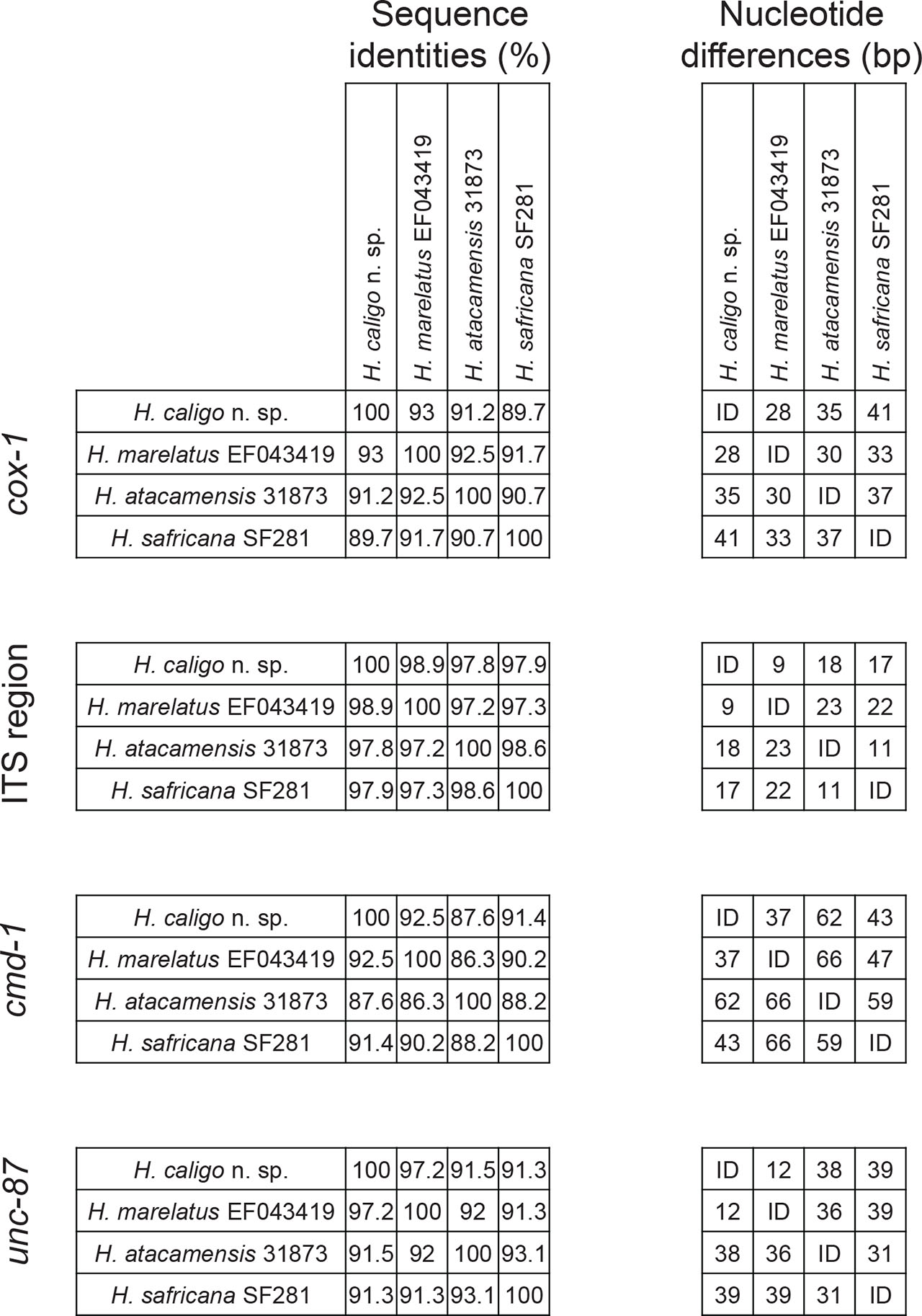
Table S6:
Pairwise comparison of digital DNA–DNA Hybridization (dDDH) scores (%) of P. tasmaniensis UOH-032 and all the Photorhabdus type strains with validly published names. Accession numbers of gene sequences used are shown in Table S4.
| Strain | dDDH (%) |
|---|---|
| P. aballayi sp. nov. APURET | 30.7 |
| P. aegyptia BA1T | 31.5 |
| P. africana CRI-LCT | 32.3 |
| P. akhurstii subsp. akhurstii DSM 15138T | 31.2 |
| P. akhurstii subsp. bharatensis H3T | 31.3 |
| P. antumapuensis UCH-936T | 32.7 |
| P. asymbiotica DSM 15149T | 30.7 |
| P. australis subsp. australis DSM 17609T | 30.5 |
| P. australis subsp. thailandensis PB68.1T | 30.8 |
| P. bodei LJ24-63T | 32.6 |
| P. caribbeanensis HG29T | 30.8 |
| P. cinerea DSM 19724T | 31.7 |
| P. hainanensis DSM 22397T | 31.1 |
| P. heterorhabditis subsp. aluminescens Q614T | 32.7 |
| P. heterorhabditis subsp. heterorhabditis SF41T | 31.7 |
| P. hindustanensis H1T | 31.1 |
| P. kayaii DSM 15194T | 32.6 |
| P. khanii subsp. guanajuatensis MEX20-17T | 48.1 |
| P. khanii subsp. khanii DSM 3369T | 47.6 |
| P. kleinii DSM 23513T | 32 |
| P. laumondii subsp. clarkei BOJ-47T | 32.1 |
| P. laumondii subsp. laumondii TT01T | 31.9 |
| P. luminescens subsp. luminescens ATCC 29999T | 30.8 |
| P. luminescens subsp. mexicana MEX47-22T | 30.7 |
| P. luminescens subsp. venezuelensis JART | 30.7 |
| P. namnaonensis PB45.5T | 31.1 |
| P. noenieputensis DSM 25462T | 31.1 |
| P. stackebrandtii DSM 23271T | 47.1 |
| P. tasmaniensis DSM 22387T | 85.3 |
| P. temperata DSM 14550T | 51.1 |
| P. thracensis DSM 15199T | 50.8 |
| P. viridis GreenT | 49 |