
Table 1:
Results of multi-site summer fluopyram program study, 2022–2023.
| Location | Treatment | Dormant bud counts (Lcm/g)a | P-valueb |
|---|---|---|---|
| Chagrin Falls, OH | Non-treated | 837.56 ± 331.01 A | <0.0001 |
| Summer Program | 7.62 ± 5.36 B | ||
| Fairfield, CT | Non-treated | 2590.49 ± 1258.51 A | =0.0005 |
| Summer Program | 3.78 ± 1.52 B | ||
| New London, CT | Non-treated | 4861.3 ± 1384.56 A | =0.0017 |
| Summer Program | 1909.26 ± 1404.84 B |
Direct impact on Litylenchus crenatae mccannii (Lcm) populations was measured using nematode extractions from dormant buds in late winter following summer treatments. Counts were standardized by bud mass of the sample.
a Raw means plus/minus standard error are shown. Means followed by the same letter are not significantly different by Student’s t-test, P < 0.05, using transformation by log (x + 1) prior to analysis.
Table 2:
Results of multi-site summer fluopyram program study, 2022–2023.
| Location | Treatment | % Canopy BLD symptoms | % Fine twig dieback | ||||||||
|---|---|---|---|---|---|---|---|---|---|---|---|
| N | 2022a | N | 2023 | P-valueb | N | 2022 | N | 2023 | P-value | ||
| Chagrin Falls, OH | Non-treated | 9 | 64.44 ± 7.66 A | 9 | 88.89 ± 3.51 A | = 0.0005 | 9 | 40.56 ± 6.69 A | 9 | 51.67 ± 5.59 A | = 0.0143 |
| Summer Program | 12 | 69.17 ± 5.11 A | 11 | 34.18 ± 10.35 B | 12 | 47.5 ± 6.17 A | 11 | 28.64 ± 6.47 B | |||
| Fairfield, CT | Non-treated | 8 | 75.63 ± 8.21 A | 4 | 84 ± 10.02 A | < 0.0001 | 8 | 63.75 ± 5.96 A | 4 | 77.00 ± 2.38 A | = 0.0046 |
| Summer Program | 11 | 66.36 ± 8.66 A | 11 | 5.91 ± 0.61 B | 11 | 56.82 ± 5.81 A | 11 | 27.73 ± 7.53 B | |||
| New London, CT | Non-treated | 9 | 8.33 ± 1.44 A | 8 | 76.06 ± 9.27 A | = 0.9009 | 9 | 5 ± 0 A | 8 | 50.31 ± 11.11 A | = 0.8592 |
| Summer Program | 14 | 13.93 ± 3.28 A | 14 | 75.75 ± 4.49 A | 14 | 5 ± 0 A | 14 | 51.07 ± 6.86 A | |||
Summer program efficacy on BLD management was measured by the percent canopy with foliar BLD symptoms and the percent canopy with fine twig dieback or thinning, as determined by visual rating consensus in the season of treatment and following treatment.
a Raw means plus/minus standard error are shown. Means followed by the same letter are not significantly different by Student’s t-test, P < 0.05, using square root transformation prior to analysis.
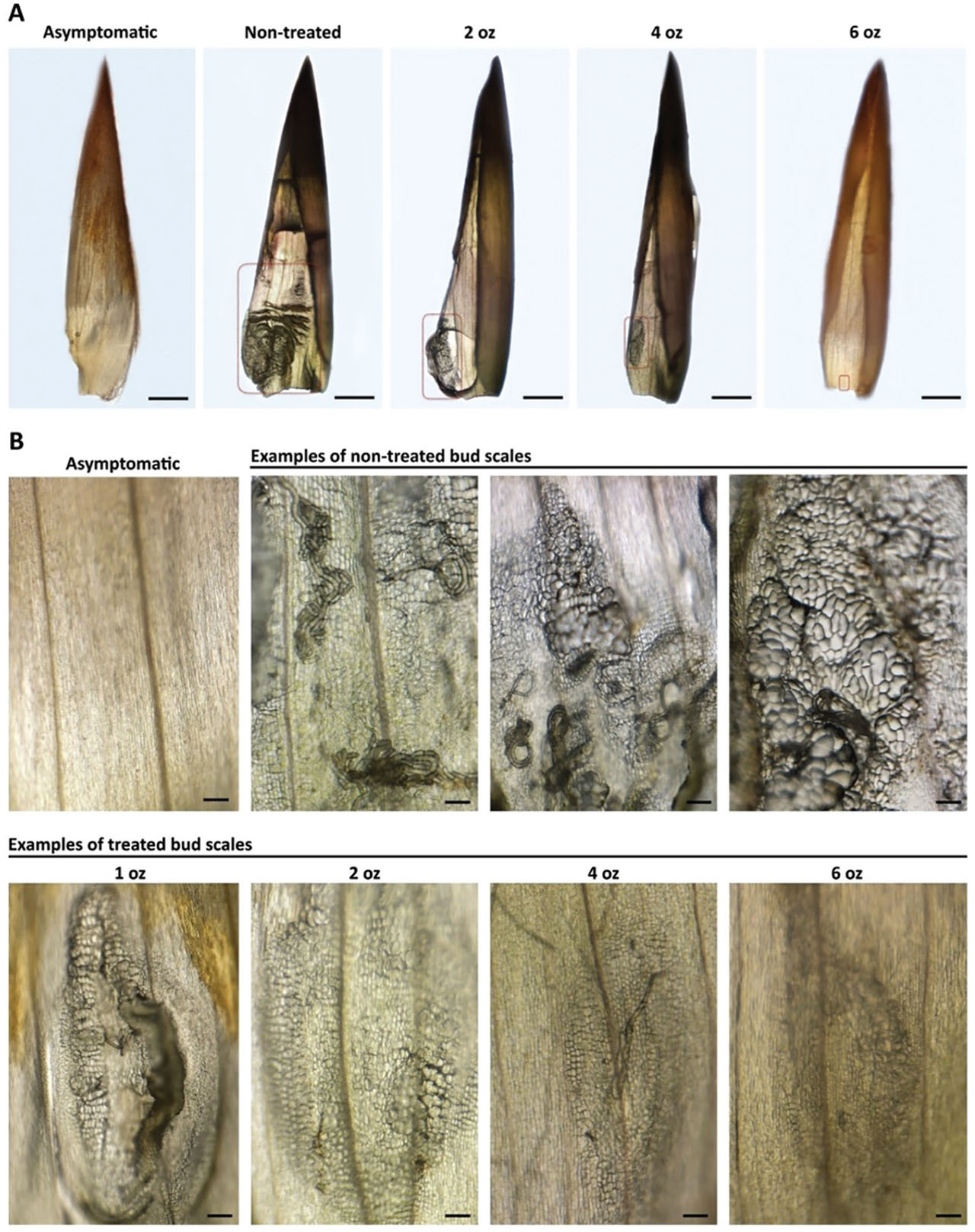
Figure 1:
Bud scale morphology of asymptomatic, non-treated, and fluopyram-treated BLD buds of European beech (Fagus sylvatica). (A) Stereoscope images of asymptomatic, non-treated, and treated individual bud scales (i.e., number of ounces/100 gallons) infected with Litylenchus crenatae mccannii (Lcm) nematodes showing different levels of cell damage. The red rectangle indicates the bud scale damage area in each treatment. (B) Stereoscope images showing enlarged bud scale cells associated with the presence of nematodes on non-treated bud scales versus bud scale enlargement associated with the different fluopyram treatments applied in this study. Scale bars: (A) 1 mm; (B) 100 µm. Treatments in ounces shown as standard tank-mix rates of 1 fl. oz./100 gal., 2 fl. oz./100 gal., 4 fl. oz./100 gal., and 6 fl. oz./100 gal., equivalent to 0.08 mL/L, 0.16 mL/L, 0.32 mL/L, and 0.47 mL/L, respectively. BLD, beech leaf disease.
Table 3:
Results of fluopyram application rate study performed on Long Island, NY, 2023–2024.
| Treatment | N | Lcm/cm2 | N | Lcm/g | Lcm eggs/g | Damage ratingb |
|---|---|---|---|---|---|---|
| 2023––Foliagea | 2024––Bud | 2024––Bud | 2024––Bud scale | |||
| Broadform (0.08 mL/L) | 10 | 0.3 ± 0.3 B | 5 | 26.13 ± 6.95 B | 36.91 ± 16.27 B | 0.61 ± 0.11 B |
| Broadform (0.16 mL/L) | 10 | 0 ± 0 B | 5 | 13.25 ± 6.33 B | 51.32 ± 36.57 B | 0.51 ± 0.14 B |
| Broadform (0.32 mL/L) | 10 | 0 ± 0 B | 5 | 11.7 ± 5.86 B | 4.17 ± 4.17 B | 0.35 ± 0.13 B |
| Broadform (0.47 mL/L) | 10 | 0 ± 0 B | 5 | 2.15 ± 1.11 B | 0.76 ± 0.76 B | 0.12 ± 0.05 B |
| Non-treated | 10 | 95.5 ± 32.04 A | 8 | 8323.4 ± 2531.01 A | 4237.17 ± 1771.21 A | 1.63 ± 0.21 A |
| P-valuec | P < 0.0001 | P < 0.0001 | P = 0.0038 | P < 0.0001 |
Direct impact on Litylenchus crenatae mccannii (Lcm) populations was measured using live Lcm extraction from foliage following two of three treatments, Lcm (active and eggs) extracted from late summer developing buds, and bud scale damage ratings. Count data were standardized by foliage area and bud mass of material in each sample. Product applied as Broadform using four application rates lower than the highest label rate of 0.63 mL/L (8 fl. oz./100 gal.). Application rates were 0.08 mL/L, 0.16 mL/L, 0.32 mL/L, and 0.47 mL/L, equivalent to standard tank-mix rates of 1 fl. oz./100 gal., 2 fl. oz./100 gal., 4 fl. oz./100 gal., and 6 fl. oz./100 gal., respectively.
a Raw means plus/minus standard error are shown. Means followed by the same letter are not significantly different, Tukey HSD, P < 0.05, using square root transformation for all count data prior to one-way ANOVA and means separation. For the non-parametric analysis of bud scale damage, means were separated with a Wilcoxon pairwise analysis.
b Damage ratings shown as treatment means using the methodology described in Wolf and Vieira (2024).
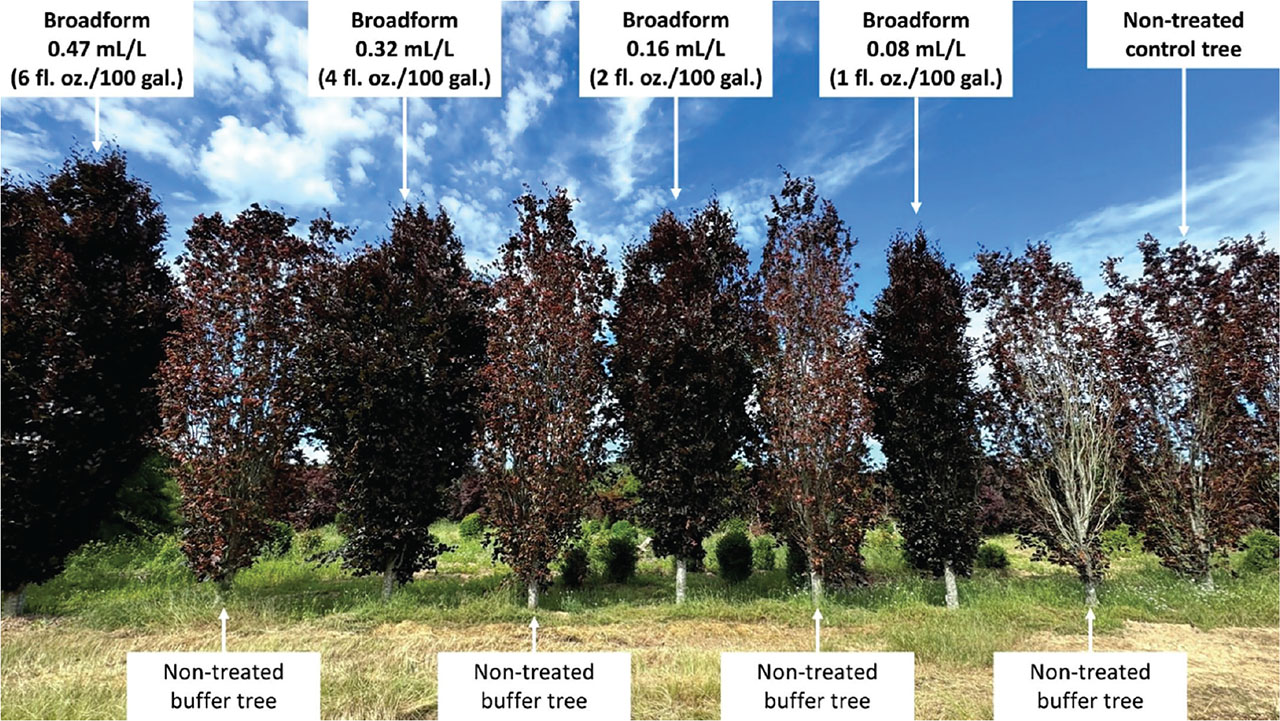
Figure 2:
At a private nursery on Long Island, NY, several rows of fastigiate European beech (Fagus sylvatica cvs) were used for the fluopyram foliar application rate study. These nine beeches illustrate one treatment block from the study, using the product Broadform to treat BLD caused by the foliar nematode Litylenchus crenatae mccannii (Lcm). From left to right, the treatment groups and Broadform application rates (including standard tank-mix rates) were as follows: 0.47 mL/L, non-treated buffer; 0.32 mL/L, non-treated buffer; 0.16 mL/L, non-treated buffer; 0.08 mL/L, non-treated buffer; and non-treated control. Image taken 11 June 2024. BLD, beech leaf disease.
Table 4:
Results of fluopyram application rate study performed on Long Island, NY, 2023–2024.
| Treatment | N | % Canopy BLD symptoms | % Fine twig dieback | ||
|---|---|---|---|---|---|
| 2023a | 2024 | 2023 | 2024 | ||
| Broadform (0.08 mL/L) | 10 | 77.1 ± 7.15 A | 9.3 ± 2.6 B | 4.8 ± 2.92 A | 1.3 ± 0.68 B |
| Broadform (0.16 mL/L) | 10 | 83.1 ± 6.36 A | 10.9 ± 2.39 B | 6.4 ± 2.54 A | 0.8 ± 0.55 B |
| Broadform (0.32 mL/L) | 10 | 83 ± 6.08 A | 10.23 ± 2.62 B | 7.9 ± 3.05 A | 1.8 ± 0.76 B |
| Broadform (0.47 mL/L) | 10 | 84.4 ± 5.96 A | 6.6 ± 1.49 B | 5 ± 1.95 A | 2.5 ± 2.01 B |
| Non-treated | 10 | 84.38 ± 7.24 A | 89.3 ± 2.99 A | 6.5 ± 1.92 A | 22.4 ± 7.01 A |
| P-valueb | P = 0.9300 | P < 0.0001 | P = 0.9071 | P < 0.0001 | |
Treatment efficacy on disease management was measured by the percent canopy with foliar BLD symptoms and the percent canopy with fine twig dieback or thinning, as determined by visual rating consensus in the season of treatment and following treatment. Product applied as Broadform using four application rates lower than the highest label rate of 0.63 mL/L (8 fl. oz./100 gal.). Application rates were 0.08 mL/L, 0.16 mL/L, 0.32 mL/L, and 0.47 mL/L, equivalent to standard tank-mix rates of 1 fl. oz./100 gal., 2 fl. oz./100 gal., 4 fl. oz./100 gal., and 6 fl. oz./100 gal., respectively.
Table 5:
Results of fluopyram-based management programs, implemented at three seasonal timings, in Perry, OH, and Chardon, OH, 2023–2024.
| Treatmenta | N | Lcm/cm2 | Lcm/g2 |
|---|---|---|---|
| 2023––Foliageb | 2024––Bud | ||
| Spring | 14 | 0.25 ± 0.25 B | 31.29 ± 17.15 B |
| Spring & Summer | 15 | 0 ± 0 B | 25.73 ± 9.04 B |
| Summer | 13 | 9.65 ± 3.83 AB | 30.46 ± 18.29 B |
| Non-treated | 14 | 46.24 ± 24.67 A | 143.86 ± 54.07 A |
| P-valuec | P = 0.0005 | P = 0.0105 |
To measure post-treatment impact on Litylenchus crenatae mccannii (Lcm) populations, live Lcm nematodes were extracted from foliage taken in late summer and from late dormant season buds. Count data were standardized by foliage area and bud mass of material in each sample.
Table 6:
Results of fluopyram-based management programs implemented at three seasonal timings in Perry, OH, and Chardon, OH, 2023–2024.
| Treatmenta | N | % Canopy BLD symptoms | N | % Fine twig diebackc | ||
|---|---|---|---|---|---|---|
| 2023b | 2024 | 2023 | 2024 | |||
| Spring | 14 | 75 ± 5.3 A | 18.2 ± 6.2 B | 8 | 25.6 ± 5.6 A | 8.94 ± 1.37 A |
| Spring & Summer | 15 | 54.7 ± 7 A | 6 ± 1.2 B | 8 | 24.4 ± 6.5 A | 5.63 ± 1.03 A |
| Summer | 13 | 58.5 ± 7.7 A | 10.2 ± 3.7 B | 8 | 30.6 ± 5.4 A | 6.75 ± 0.98 A |
| Non-treated | 14 | 54.3 ± 6.3 A | 41.5 ± 7.7 A | 8 | 16.9 ± 4.4 A | 9.88 ± 1.63 A |
| P-valued | P = 0.0982 | P < 0.0001 | P = 0.3843 | P = 0.0966 | ||
To measure program efficacy on disease management, the percent canopy with foliar BLD symptoms and the percent canopy with fine twig dieback or thinning were determined by visual consensus ratings during the treatment season and the season following treatment.
b Means plus/minus standard error of the mean are shown. Letters following each rating represent levels that are statistically different based on Tukey’s HSD, P < 0.05, using square root transformation prior to post hoc means separation.