
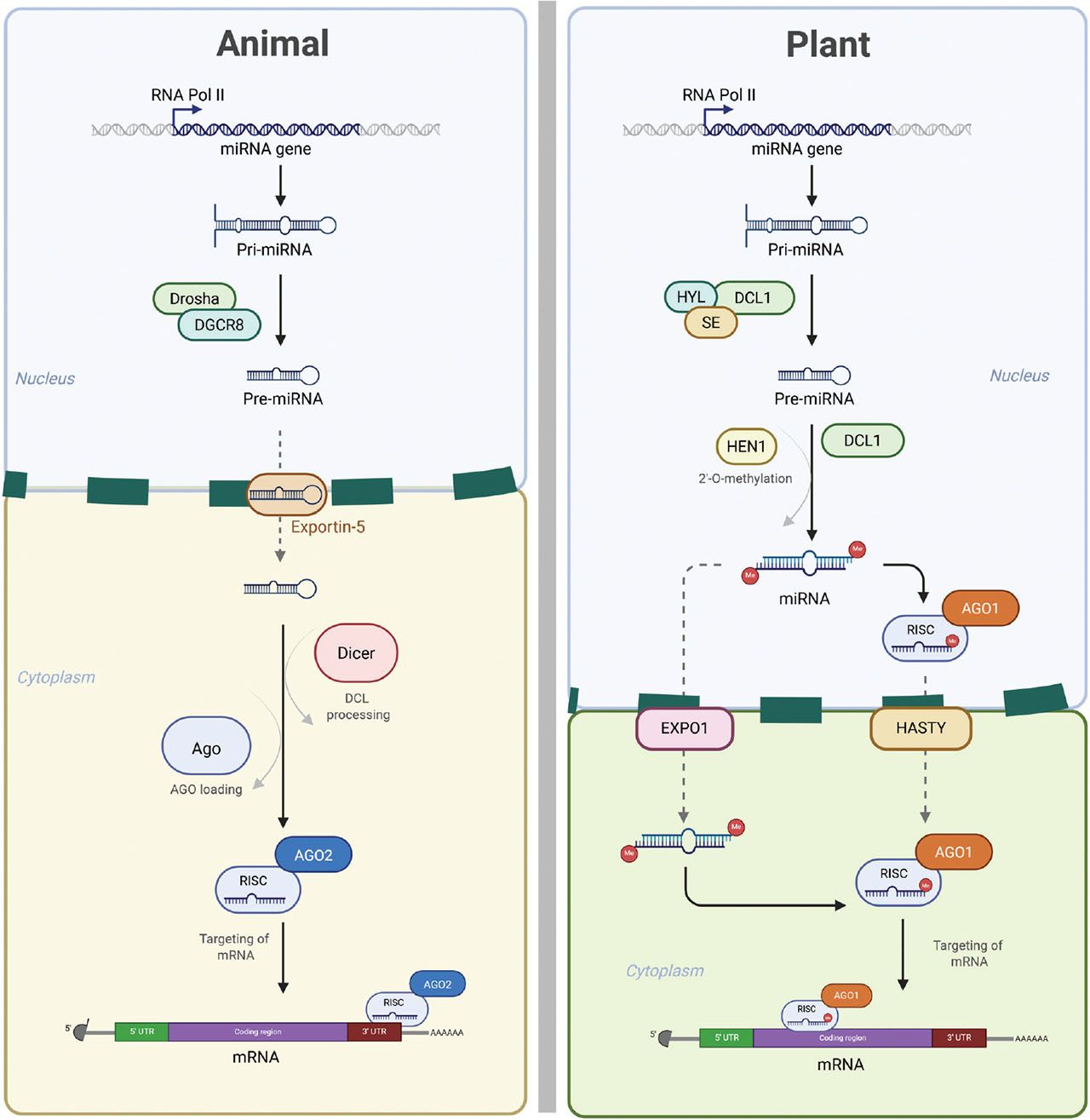
Figure 1:
Canonical miRNA biogenesis pathways in animals and plants. miRNA synthesis begins with the transcription of pri-miRNAs, which are then cleaved into pre-miRNAs by different enzymes. These precursors are subsequently processed into mature miRNAs—within the nucleus in plants, but in the cytoplasm in animals. The resulting miRNA duplexes are then loaded onto different AGO proteins, with distinct AGO associations in plants versus animals. AGO, argonaute; miRNAs, microRNAs; pre-miRNAs, precursor miRNAs; pri-miRNAs, primary miRNAs.
Table 1:
Distinguishing characteristics inherent to miRNA and siRNA.
| Feature | miRNA | siRNA |
|---|---|---|
| Origin | Endogenous | Endogenous and exogenous |
| Structure | Hairpin precursor | Long dsRNA |
| Processing enzymes | Dicer1 or DCL1 (in nucleus, mostly) | Dicer2 or DCL4 (also DCL2, DCL3 depending on siRNA class) |
| Target complementarity | Partial (often with central mismatches) or near perfect | Usually perfect or near-perfect |
| Function | Post-transcriptional gene regulation (mRNA degradation or translational inhibition) | Gene silencing, antiviral defense, transposon suppression, RdDM |
| Target specificity | Often targets multiple genes in the same family | Highly specific to one or few targets |
Table 2:
Tools and databases commonly used in the study of non-model organisms’ miRNAs.
| Tool | Description | Access link | Reference |
|---|---|---|---|
| DATABASES | |||
| miRBase | The primary repository for miRNA sequences and annotation. | https://www.mirbase.org/ | Kozomara et al. (2019) |
| MirGeneDB | High-confidence, manually curated miRNA gene database. | https://mirgenedb.org/ | Clarke et al. (2025) |
| Rfam | Database of ncRNA families from a wide array of species. | https://rfam.org | Kalvari et al. (2021) |
| TargetWormScan | Searchable database of predicted regulatory targets of worm miRNAs. | https://www.targetscan.org/worm_52/ | Lewis et al. (2005) |
| PmiREN | Comprehensive plant repository of plant miRNAs. | https://pmiren.com/ | Guo et al. (2020) |
| ncPlantDB | Database specialized in ncRNAs in plants. | https://bis.zju.edu.cn/ncPlantDB/index/ | Liu et al. (2025) |
| ExoCarta | Database containing information on exosomal proteins and RNAs including miRNAs. | http://exocarta.org/index.html | Keerthikumar et al. (2016) |
| miRTarBase | Comprehensive collection of validated miRNA-mRNA targets. | https://mirtarbase.cuhk.edu.cn/~miRTarBase/miRTarBase_2025/php/index.php | Cui et al. (2025) |
| miRecords | Resource for animal miRNA-target interactions including C.elegans. | http://c1.accurascience.com/miRecords/ | Xiao et al. (2009) |
| PREDICTION TOOLS | |||
| MirDeep2 | Most widely used tool for both known and novel miRNA prediction in animals and plants. | https://github.com/rajewsky-lab/mirdeep2 | Friedländer et al. (2012) |
| miRanalyzer | Tool for the detection of known, and prediction of new miRNAs, in high-throughput sequencing experiments. | http://bioinfo2.ugr.es/miRanalyzer/ | Hackenberg et al. (2011) |
| miRPlant | miRNA predictor utilizing plant-specific parameters (e.g., handling of diverse hairpin lengths and sequences). | https://sourceforge.net/projects/mirplant/ | An et al. (2014) |
| sRNAbench | Part of the sRNAToolKit suite for miRNA discovery and quantification using sRNASeq data. | http://bioinfo5.ugr.es/srnatoolbox/ | Aparicio-Puerta et al. (2022) |
| ShortStack | Highly accurate, plant-optimized, and supports multi-mapping small RNAs. | https://github.com/MikeAxtell/ShortStac | Axtell (2013) |
| miRPara | Predicted miRNA precursors based on structural and sequence features. | https://github.com/weasteam/miRPara | Wu et al. (2011) |
| RNAFold | Comprehensive collection of tools for folding, design and analysis of RNA sequences. | http://rna.tbi.univie.ac.at/cgi-bin/RNAWebSuite/RNAfold.cgi | Gruber et al. (2008) |
| TARGET PREDICTION | |||
| miRanda | An miRNA target scanner that aims to predict mRNA targets for miRNAs using dynamic-programming alignment and thermodynamics. | https://github.com/hacktrackgnulinux/miranda | Betel et al. (2010) |
| RNAHybrid | Tool for finding the minimum free energy hybridization of a long and a short RNA. | https://bibiserv.cebitec.uni-bielefeld.de/rnahybrid | Krüger and Rehmsmeier (2006) |
| psRNATarget | Specifically developed to identify target transcripts of plant regulatory sRNAs. | https://www.zhaolab.org/psRNATarget/ | Dai and Zhao (2011) |
| p-TarPMir | Deep learning model adapted for plant miRNA target prediction. | https://ptarpmir.cu-bic.ca | Ajila et al. (2023b) |
| miTAR | Animal trained hybrid deep learning approach to predict miRNA targets. | https://github.com/tjgu/miTAR | Gu et al. (2021) |