
Table 1.
Host status of winter cover crops and response of soybean after inoculation of the preceding cover crop with the root-knot nematode Meloidogyne enterolobii, Trial 1. Means (n = 8) followed by the same letter within each column are not significantly different at the 0.05 level.
| Plant species | Common name | Root galling in cover cropa | Soybean shoot weight (g) | Soybean root weight (g) | Soybean root galling severity |
|---|---|---|---|---|---|
| Hordeum vulgare | Barley | − | 41.4 bc | 52.0 abc | 0 c |
| Trifolium incarnatum | Crimson clover | + | 24.8 d | 38.8 c | 59.4 ab |
| Guillenia flavescens | Yellow mustard | + | 31.2 cd | 35.9 c | 48.1 b |
| Avena nuda | Streaker hulless oats | − | 42.6 bc | 51.1 abc | 0 c |
| Lolium multiflorum | Ryegrass | − | 50.8 b | 57.2 ab | 0 c |
| Secale cereale | Winter rye | − | 53.0 ab | 49.9 abc | 0 c |
| Vinca villosa | Hairy vetch | + | 26.4 cd | 51.4 abc | 67.9 a |
| Triticum aestivum | Spring wheat | − | 43.3 bc | 44.1 bc | 0 c |
| Lolium multiflorum | Ryegrass (non-inoculated) | − | 65.9 a | 67.0 a | 0 c |
| Trifolium incarnatum | Crimson clover (non-inoculated) | − | 65.6 a | 63.7 a | 0 c |
| P-valueb | <0.0001 | 0.0369 | <0.0001 | ||
| MSEc | 166.4 | 295.7 | 169.2 |
a Presence or absence of root galling was evaluated whereas presence was defined as root galling severity of ≥1 on a severity index scale of 0–10 (Bridge and Page 1980). ‘-’ indicates absence of galling, ‘+’ indicates presence of galling.
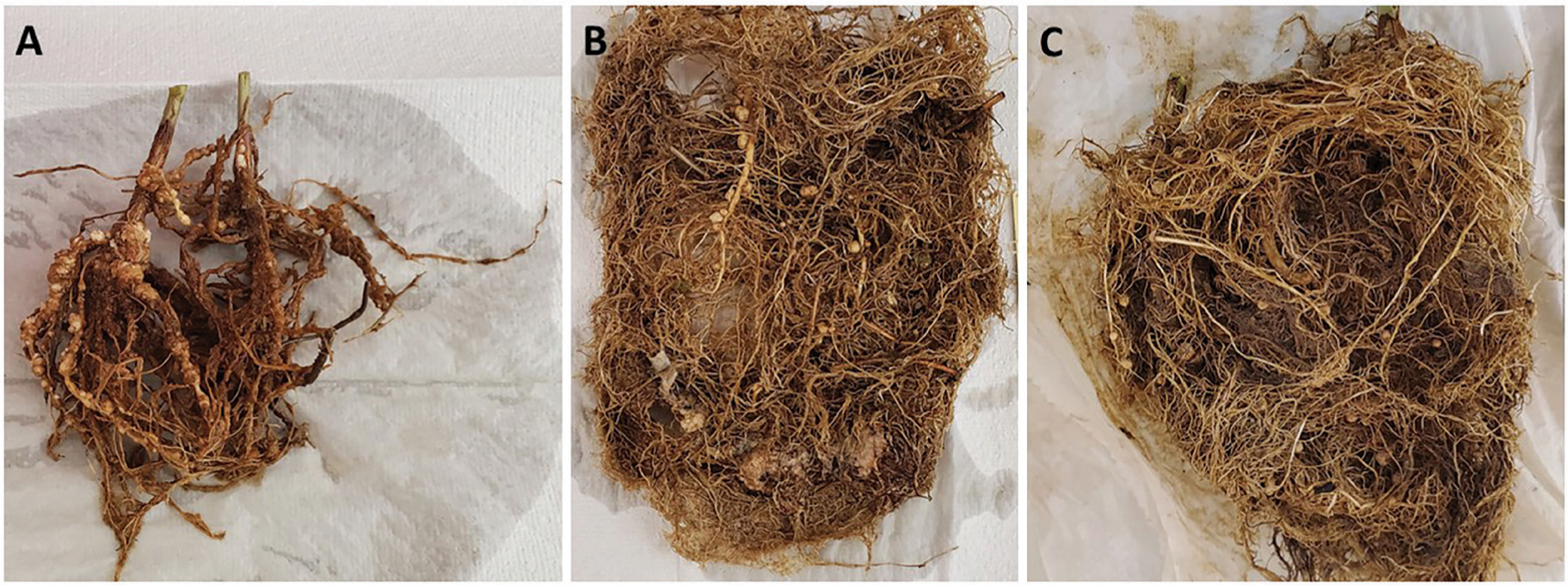
Figure 1:
Effect of preceding winter cover crop on soybean roots following (A) yellow mustard, (B) barley, and (C) ryegrass. Significant root galling was observed in soybean roots following yellow mustard, crimson clover, and hairy vetch, while no root galling was observed on the roots of barley, Streaker hulless oats, ryegrass, winter rye, or spring wheat.
Table 3.
Host status of winter cover crops and response of soybean after inoculation of the preceding cover crop with the root-knot nematode Meloidogyne enterolobii, Trial 2. Means (n = 8) followed by the same letter within each column are not significantly different at the 0.05 level.
| Plant species | Common name | Root galling in cover cropa | Soybean shoot weight (g) | Soybean root weight (g) | Soybean root galling severity |
|---|---|---|---|---|---|
| Hordeum vulgare | Barley | − | 14.92 | 31.59 | 0.3 d |
| Trifolium incarnatum | Crimson clover | + | 10.09 | 16.20 | 26.7 b |
| Guillenia flavescens | Yellow mustard | + | 10.09 | 18.83 | 14.6 c |
| Avena nuda | Streaker hulless oats | − | 11.39 | 20.32 | 0 d |
| Lolium multiflorum | Ryegrass | − | 6.35 | 17.71 | 0.3 d |
| Secale cereale | Winter rye | − | 12.65 | 22.15 | 0.3 d |
| Vinca villosa | Hairy vetch | + | 5.03 | 13.58 | 46.2 a |
| Triticum aestivum | Spring wheat | − | 8.31 | 20.01 | 0.3 d |
| Lolium multiflorum | Ryegrass (non-inoculated) | − | 11.99 | 20.12 | 0 d |
| Trifolium incarnatum | Crimson clover (non-inoculated) | − | 11.47 | 17.41 | 0 d |
| P-valueb | 0.070 (ns) | 0.063 (ns) | <0.0001 | ||
| MSEc | 33.1 | 88.0 | 121.5 |
a Presence or absence of root galling was evaluated whereas presence was defined as root galling severity of ≥ 1 on a severity index scale of 0–10 (Bridge and Page 1980). ‘-’ indicates absence of galling, ‘+’ indicates presence of galling.
Table 2.
Reproduction of Meloidogyne enterolobii on soybean after inoculation of preceding winter cover crop plants, Trial 1. Means (n = 8) followed by the same letter within each column are not significantly different at the 0.05 level.
| Plant species | Common name | Eggs per gram of soybean root tissue | RF moda |
|---|---|---|---|
| Hordeum vulgare | Barley | 10.1 b | 0.05 b |
| Trifolium incarnatum | Crimson clover | 1914.2 a | 7.84 a |
| Guillenia flavescens | Yellow mustard | 3104.3 a | 7.19 a |
| Avena nuda | Streaker hulless oats | 15.2 b | 0.07 b |
| Lolium multiflorum | Ryegrass | 6.8 b | 0.03 b |
| Secale cereale | Winter rye | 6.9 b | 0.04 b |
| Vinca villosa | Hairy vetch | 2195.3 a | 11.33 a |
| Triticum aestivum | Spring wheat | 6.5 b | 0.03 b |
| Lolium multiflorum | Ryegrass (non-inoculated) | 3.5 b | 0.02 b |
| Trifolium incarnatum | Crimson clover (non-inoculated) | 4.3 b | 0.02 b |
| P-valueb | 0.0001 | < 0.0001 | |
| MSEc | 2380380 | 19.5 |
Table 4.
Reproduction of Meloidogyne enterolobii on soybean after inoculation of different proceeding winter cover crop plants, Trial 2. Means (n = 8) followed by the same letter within each column are not significantly different at the 0.05 level.
| Plant species | Common name | Eggs per gram of soybean root tissue | RF moda |
|---|---|---|---|
| Hordeum vulgare | Barley | 13.7 c | 0.06 c |
| Trifolium incarnatum | Crimson clover | 6041.5 a | 7.13 a |
| Guillenia flavescens | Yellow mustard | 1452.4 bc | 3.71 b |
| Avena nuda | Streaker hulless oats | 3.7 c | 0.01 c |
| Lolium multiflorum | Ryegrass | 10.8 c | 0.02 c |
| Secale cereale | Winter rye | 5.0 c | 0.01 c |
| Vinca villosa | Hairy vetch | 2476.6 b | 2.15 bc |
| Triticum aestivum | Spring wheat | 9.2 c | 0.02 c |
| Lolium multiflorum | Ryegrass (non-inoculated) | 16.4 c | 0.02 c |
| Trifolium incarnatum | Crimson clover (non-inoculated) | 0 c | 0 c |
| P-valueb | < 0.0001 | 0.0003 | |
| MSEc | 2396198 | 11.1 |