
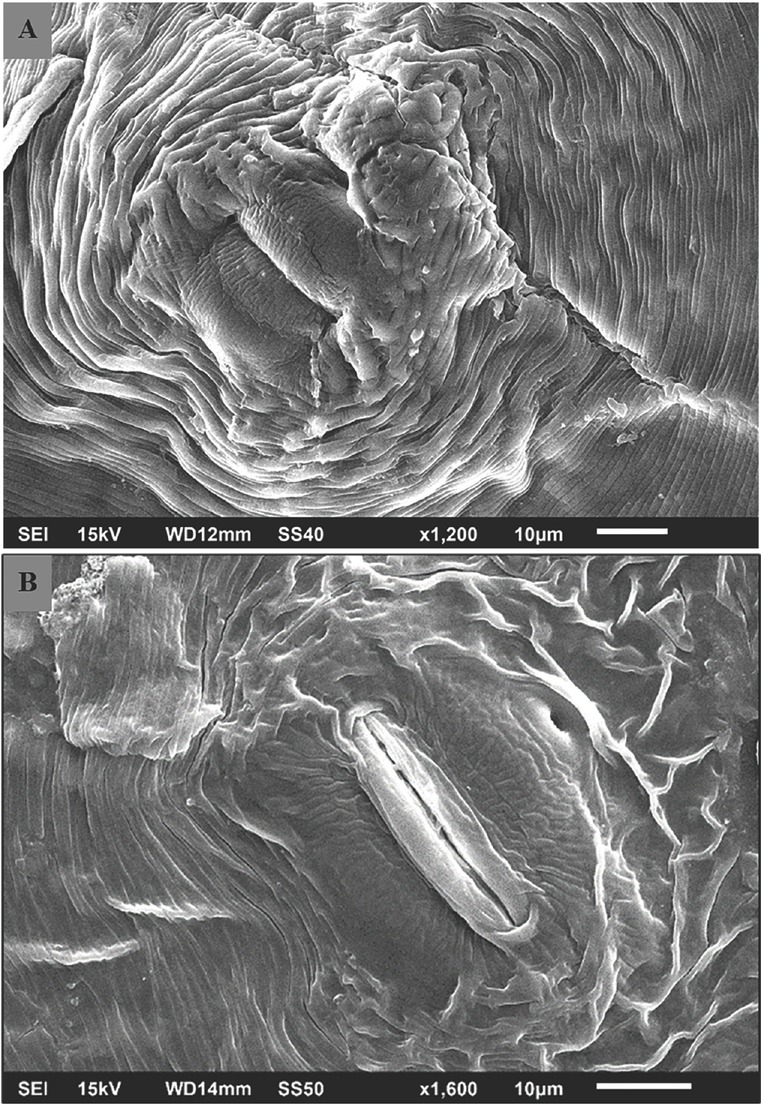
Figure 1
Scanning electron microscopy (SEM) images of the perineal pattern of M. javanica, which show a rounded to flattened dorsal arch and conspicuous lateral lines that separate the dorsal and ventral regions of the patterns. (A) A close view of the distinct lateral line in a perineal pattern distinguishes this species from other Meloidogyne spp. (B) An inner area was marked by coarsely broken striae and contained the vulva and anus.
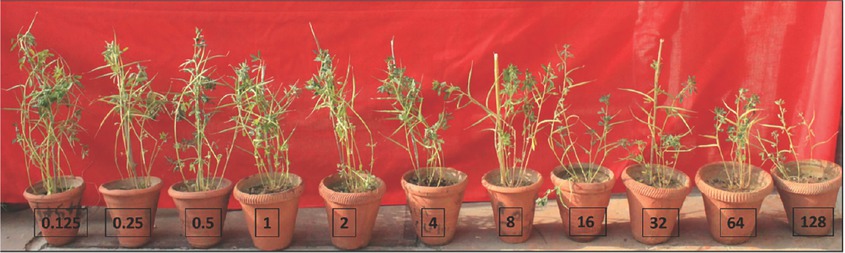
Figure 2
Effect of increasing nematode population densities (from 0.125 on the left to 128 J2s g-1 soil on the right) of M. javanica on the growth of fenugreek cv. UM-202, showing a reduction in plant growth. Symptoms of nematode attack (a marked reduction of plant growth) were evident at the Pi level of 8 J2s g-1 soil. However, the tolerance limits (T) of fenugreek plant shoot length were 1.3 J2s g-1 soil.
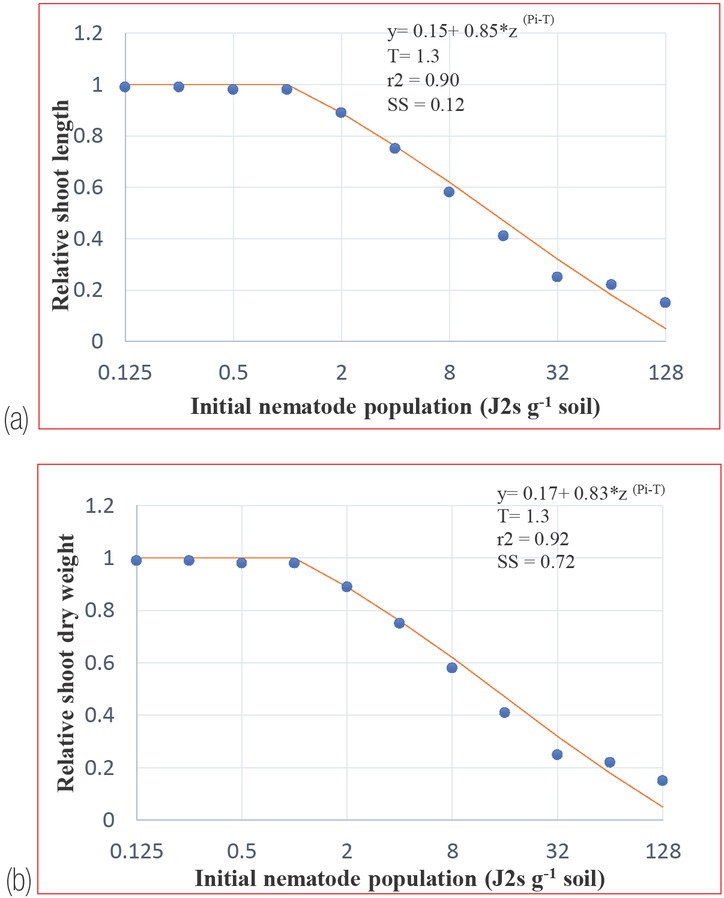
Figure 3
Relationship between initial population densities (Pi) of M. javanica and relative shoot length (A) and relative shoot dry weights (B) of fenugreek cv. UM-202, grown in pots under glasshouse conditions for 90 days. Each point represents the average of four replicated plants. Lines represent the predicted function calculated by fitting the Seinhorst model to data using the SeinFit program. Statistics for fitted models of shoot length and shoot dry weight were R2 = 0.90, sum of squares (SS) = 0.12; and R2 = 0.92, SS = 0.072, respectively.
Table 1
Relationship between the initial population of Meloidogyne javanica and root-knot index, final population density, reproduction factor in fenugreek cv. UM-202, 90 days after inoculation.
| Initial Nematode Population (Pi) (g-1 soil) | Nematode Population (P) per pot | Root-knot Index (RKI) | Final Nematode Population (g-1 soil) (Pf) | Reproduction Factor (RF= Pf / Pi) |
|---|---|---|---|---|
| 0 | 0 | 0.0 ± 0.00f | 0.0 ± 0.00i | 0.00 ± 0.00f |
| 0.125 | 125 | 0.6 ± 0.24e | 1.20 ± 0.20i | 9.60 ± 1.60d |
| 0.250 | 250 | 1.4 ± 0.24d | 2.80 ± 0.48i | 11.20 ± 1.95cd |
| 0.5 | 500 | 1.8 ± 0.20d | 9.60 ± 1.32h | 19.20 ± 2.65b |
| 1 | 1000 | 2.4 ± 0.24c | 19.80 ± 0.66g | 19.80 ± 0.66b |
| 2 | 2000 | 3.4 ± 0.24b | 63.20 ± 1.98d | 31.60 ± 0.99a |
| 4 | 4000 | 4.4 ± 0.24a | 52.40 ± 1.83e | 13.10 ± 0.45c |
| 8 | 8000 | 4.6 ± 0.24a | 136.80 ± 1.98a | 17.09 ± 0.49b |
| 16 | 16000 | 4.8 ± 0.20a | 92.60 ± 1.501b | 5.78 ± 0.10e |
| 32 | 32000 | 5.0 ± 0.00a | 39.20 ± 1.82f | 1.22 ± 0.05f |
| 64 | 64000 | 5.0 ± 0.00a | 55.00 ± 1.58e | 0.85 ± 0.02f |
| 128 | 128000 | 5.0 ± 0.00a | 71.00 ± 3.75c | 0.55 ± 0.02f |
| ANOVA TEST | ||||
| df | 11 | 11 | 11 | |
| SS | 192.8 | 97500 | 4252 | |
| MS | 17.52 | 8864 | 386.5 | |
| F | 95.6 | 592.2 | 293.6 | |
| P | 0.01 | 0.02 | 0.02 |
[i] Data present the mean ± standard deviation. Data are the averages of two trials, each with four replicate plants per treatment. The same letters within columns are not significantly different according to Duncan’s Multiple Range Test (DMRT) at P≤0.05. Whereas; SS (Sum of square); MS (Mean square); df (Degree of freedom); F (F-value);
P (significant value)