
Table 1
Morphometric data of studied and reference populations of Pratylenchus araucensis.
| Characteristic | Plantain, Zabaletas - Buenaventura | Plantain, Delfina - Buenaventura | Plantain, Caldas | Plantain, Calarcá - Quindío | Banana, Calarcá - Quíndio | Musa sp. Arauca, type population (Múnera et al., 2009) |
|---|---|---|---|---|---|---|
| n = 19 | n = 14 | n = 19 | n = 15 | n = 10 | n = 40 | |
| L | 456 ± 24.0 | 501.8 ±56.0 | 484.5 ± 24.7 | 549.2 ± 13.9 | 551.3 ± 13.5 | 462 ± 31 |
| (401.2 - 496.3) | (449.3-668.7) | (444.4 - 538.0) | (518.4-578.3) | (534.7 - 570.4) | (376-511) | |
| a | 26.3 ±2.1 | 28.2 ± 1.9 | 29.9 ±2.0 | 25.2 ±1.3 | 24.8 ± 1.4 | 23.9 ±2.3 |
| (20 - 29.8) | (23.5-31) | (23.0-32.8) | (21.6-26.9) | (21.6-26.3) | (19.6-29.2) | |
| b | 5.8 ±1.0 | 6.1 ±0.7 | 6.4 ±0.5 | 6.2 ±1.7 | 6.7 ±1.4 | 6.2 ±0.6 |
| (4.7-7.0) | (5.1 -6.9) | (4.9 - 7.3) | (5.1 -7.4) | (5.5-7.7) | (4.8 - 7.8) | |
| b' | 4.4 ±0.6 | 4.7 ±0.2 | 4.3 ±0.5 | 4.1 ±0.8 | 4.5 ±1.0 | 4.7 ±0.4 |
| (4.0-5.7) | (3.7-6.0) | (3.7-5.2) | (3.7-5.0) | (4.0 - 4.9) | (3.6 - 5.9) | |
| c | 17.3 ±1.2 | 18.2 ± 1.5 | 18.9± 1.3 | 18.3 ±1.0 | 17.5 ±0.4 | 17.6 ±1.4 |
| (14.1 -22.3) | (14.9-21.8) | (15.2-23.4) | (16.7-20.2) | (16.6-18.0) | (14.5-21.1) | |
| c' | 2.3 ±0.5 | 2.5 ±0.4 | 2.6 ± .02 | 2.1 ±0.1 | 2.2 ±0.1 | 2.3 ±0.3 |
| (1.4-2.8) | (1.7-3.0) | (1.9-3.1) | (2.0-2.3) | (2.1 -2.5) | (1.7-2.9) | |
| V% | 76.7 ±1.8 | 77.6 ± 1.1 | 80.1 ± 1.6 | 76.5 ± 1.95 | 74.7 ±0.6 | 78 ± 1.2 |
| (73.9-80.1) | (75.7 - 79.4) | (76.5 - 83.6) | (72.9-81.4) | (74.0 - 75.9) | (75 - 80) | |
| Stylet length | 12.1 ±0.6 | 12.6± 1.1 | 11.9 ±0.6 | 14.4 ±0.4 | 14.7 ±0.4 | 15.3 ±0.4 |
| (11.1 -13.1) | (10.7-14.0) | (10.6-12.9) | (13.5-14.9) | (14.2-15.6) | (14.7-15.9) | |
| Tail length | 26.3 ±2.0 | 27.5 ± 1.8 | 25.7 ± 1.8 | 30.1 ±2.0 | 31.5 ±0.8 | 26.3 ±2.5 |
| (20.9-29.6) | (24.0-31.1) | (22.0-29.4) | (27.1 -34.6) | (30.2-32.7) | (21.5-31.9) | |
| DGO | 2.8 ±0.6 | 2.9 ±0.5 | 2.6 ±0.4 | 2.3 ±0.1 | 2.5 ±0.1 | 2.7 ±0.4 |
| (2.3-4.1) | (2.1 -3.6) | (2.0-3.2) | (2.1 -2.5) | (2.3-2.6) | (1.8-3.1) | |
| Maximum body | 16.7 ±1.5 | 17.8 ±2.0 | 15.7 ± 1.2 | 21.8 ±1.4 | 22.3 ± 1.3 | 17.0 ±1.8 |
| diameter | (13.7-19.7) | (14.0-20.5) | (12.3-17.2) | (20.5-26.0) | (21.2-24.7) | (13.5-20.9) |
| Anal body | 11.1 ±0.8 | 11.6 ±0.9 | 10.2 ± 0.8 | 14.1 ±0.6 | 14.1 ± 0.6 | 11.4 ± 1.5 |
| diameter | (9.7-12.5) | (10.0-13.2) | (9.0 - 11.5) | (13.1 -15.2) | (13.2-14.8) | (8.6-17.2) |
| Number of head | 2.0 ±0.0 | 2.0 ±0.0 | 2.0 ±0.0 | 2.0 ±0.0 | 2.0 ±0.0 | |
| annuli | (2.0-2.0) | (2.0-2.0) | (2.0-2.0) | (2.0-2.0) | (2.0-2.0) | |
| Lip region width | 6.1 ±0.5 | 7.1 ±0.9 | 6.3 ±0.5 | 8.2 ±0.4 | 8.1 ±0.3 | 7.2 ±0.3 |
| (4.7-6.8) | (5.6-9.1) | (5.5 - 7.3) | (7.7-8.9) | (7.5-8.5) | (6.7 - 7.4) | |
| Lip region height | 2.5 ±0.6 | 2.8 ±0.3 | 2.5 ±0.4 | 2.1 ±0.2 | 2.4 ±0.2 | 2.5 ±0.7 |
| (1.5-3.6) | (2.3-3.2) | (1.8-3.1) | (1.8-2.4) | (1.9-2.6) | (2.0-4.0) | |
| Pharyngeal gland | 35.7 ±5.3 | 31.7 ± 1.4 | 32.8 ±4.7 | 28.6 ±3.6 | 40.5 ± 1.1 | 24.2 ± 7.7 |
| length | (25.8-45.7) | (30.1 -34.4) | (24.0-39.2) | (24.1 -33.8) | (38.9-42.2) | (10.4-46.6) |
| PUS | 18.5 ±5.5 | 31.2 ± 1.6 | 24.5 ±4.8 | 29.6 ±0.8 | 30.4 ± 1.2 | 18.1 ±4.0 |
| (8.4-27.3) | (29.8-33.2) | (14.8-32.0) | (28.6 - 31.4) | (28.8-32.0) | (9.8-24.5) |
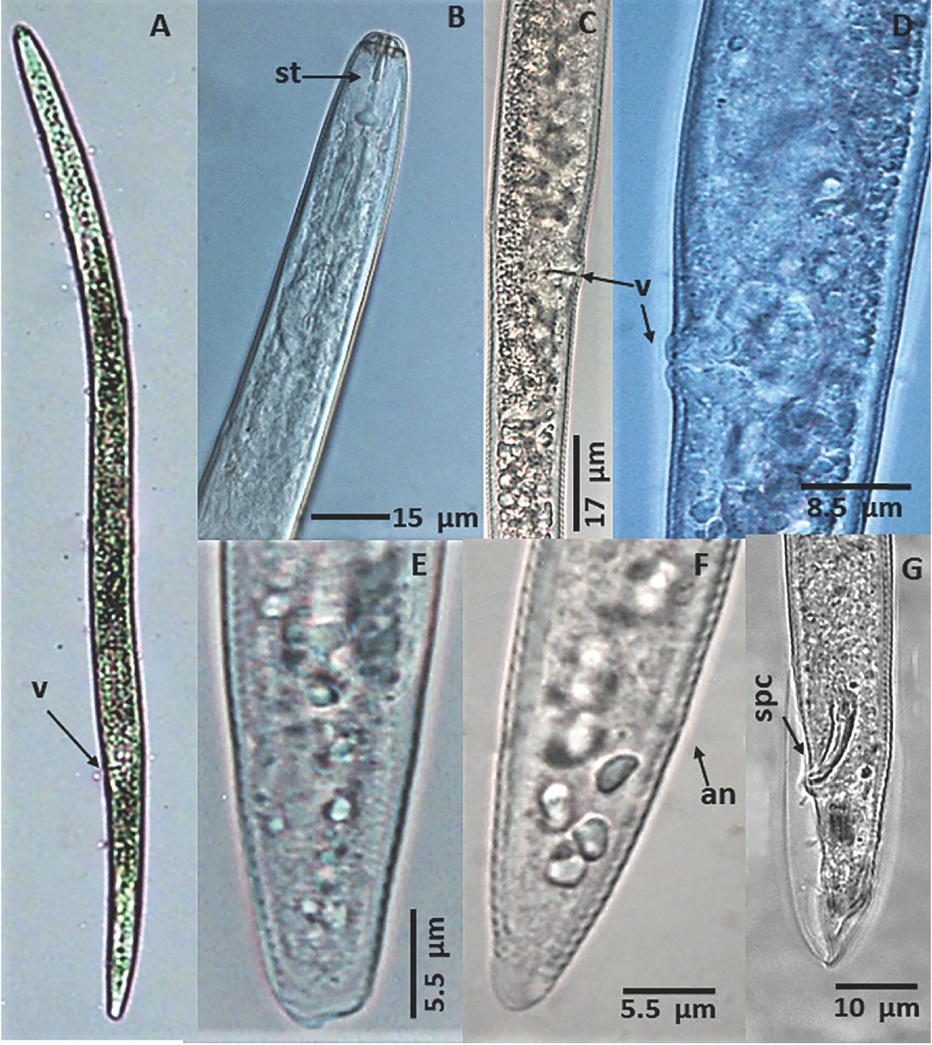
Figure 1
Pratylenchus araucensis. (A–F): Female. (A). Body of a female, (B). Anterior body region, (C and D). Vulval region. (E and F). Posterior region. (G). Posterior region of the body of a male. St = Stylet, v = Vulva, an = Anus, spc = Spicule.
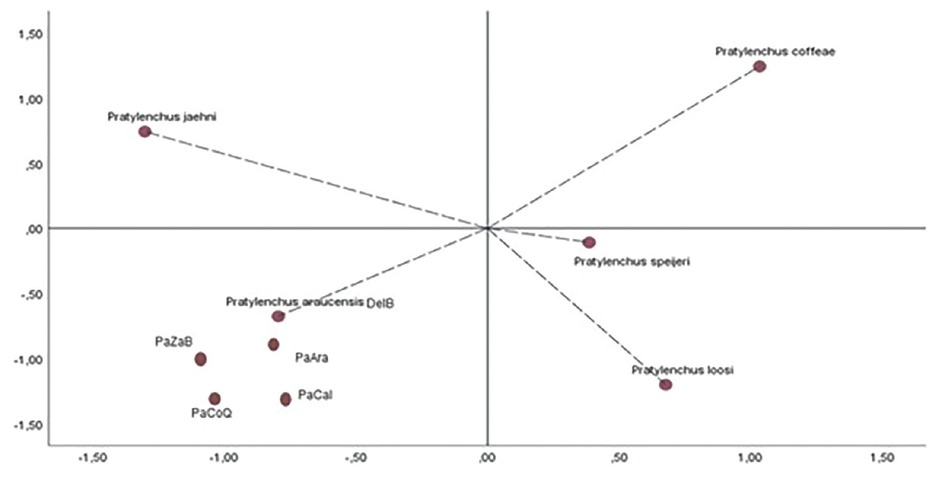
Figure 2
Biplot (separation) based on morphometric data of Pratylenchus araucensis populations. Populations of P. araucensis from Caldas, Quindío, and Valle del Cauca were assigned to their corresponding species based on morphometric data. The first two PCA axes are shown. Pa = Pratylenchus araucensis, Ara = Arauca, Cal = Caldas, CoQ = Quindío, ZaB = Zabaletas (Valle del Cauca [Buenaventura]), and DelB = Delfina (Valle del Cauca [Buenaventura]). PCA, principal component analysis.
Table 2
Correlations between the first three main components and the morphometric parameters of P. araucensis females.
| Prin1 | Prin2 | Prin3 | |
|---|---|---|---|
| Stylet length (μm) | 0.298 | 0.440 | -0.159 |
| Vulvar position (%) | -0.288 | 0.431 | 0.178 |
| Post-uterine sac length (μm) | 0.315 | 0.176 | 0.407 |
| Overall length | 0.330 | 0.370 | 0.245 |
| Tail length (μm) | 0.379 | -0.046 | 0.235 |
| Maximum body width (μm) | 0.396 | 0.005 | -0.182 |
| Width body anus (μm) | 0.377 | 0.133 | -0.188 |
| Head region width (μm) | 0.242 | -0.345 | 0.447 |
| Index a (μm) | -0.294 | 0.122 | 0.620 |
| Index c (μm) | -0.182 | 0.547 | -0.097 |
Table 3
Information of D2–D3 rDNA and COI mtDNA regions downloaded from GenBank and obtained in the present study.
| Species name | Location | D2–D3 (LSU) accession number | COI accession number | Reference or source |
|---|---|---|---|---|
| Pratylenchus araucensis | Colombia | MZ636668; MZ636669 MZ636670; MZ636671 MZ636672; MZ636673 MZ636674; MZ636675 MZ636676; MZ636677 MZ636678; MZ636679 MZ636680; MZ636681 MZ636682; MZ636683 | MZ636684; MZ636685 MZ636686; MZ636687 MZ636688; MZ636689 MZ636690; MZ636691 MZ636692; MZ636693 MZ636694; MZ636695 MZ636696; MZ636697 MZ636698; MZ636699 MZ636700 | Present study |
| P. araucensis | Colombia | FJ463262; FJ463261; FJ463260; FJ463275 | - | Múnera et al. (2009) |
| P. hippeastri | China | KR029084 | KY424099 | Wang et al. (2016) |
| P. hippeastri | China | KP161608 | KY424098 | Unpublished |
| P. hippeastri | South Africa | MH324472 | - | Shokoohi (2018) |
| P. hippeastri | Japan | KC796706; KC796707 | - | Wujian et al. (2014) |
| P. scribneri | USA | KX842632 | - | Huang and Yan (2017) |
| P. scribneri | China | MK209593 | - | Li et al. (2018) |
| P. scribneri | China | - | KY424093 | Unpublished |
| P. scribneri | China | - | KX349425 | Liu et al. (2016) |
| P. pseudocoffeae | Korea | KT175532; KT175533 | - | Kim et al. (2016) |
| P. pseudocoffeae | Costa Rica | KT971360 | - | Zamora et at. (2016) |
| P. pseudocoffeae | China | - | KY424089 | Unpublished |
| P. loosi | China | KF430796; KF430797 | - | Unpublished |
| P. loosi | Italy | - | LR215647; LR215648 | Unpublished |
| P. coffeae | China | MN592778; MN227243; MN588282 | Li et al. (2020) | |
| P. coffeae | China | - | KX349421 | Liu et al. (2016) |
| P. coffeae | China | - | MN366418 | Unpublished |
| P. coffeae | USA | - | KU198943; KU198942 | Troccoli et al. (2016) |
| P. speijeri | China | KF974701; KF974698; KF974697 | Unpublished | |
| P. speijeri | China | KY424088; KY424087 | Unpublished | |
| P. penetrans | USA | KY969632; KY969631 | Baidoo et al. (2017) | |
| P. penetrans | Korea | - | MN746802; MN746803; MN746801 | Mwamula et al. (2020) |
| P. kumamotoensis | Korea | KT175529; KT175530; KT175525 | - | Kim et al. (2016) |
| P. parazeae | China | KP903444; KP903445; KP903443; KP903442 | Wang et al. (2015) | |
| P. parazeae | China | KY424116; KX349424; KY424115 | Unpublished | |
| P. zeae | Brazil | MW363009; MW363001 | - | Abade (2020) |
| P. zeae | China | KX349414; KX349416; KX349419 | Liu et al. (2016) | |
| P. horti | Belgium | - | MK114154; MK114153; MK114152 | Nguyen et al. (2018) |
| P. brachyurus | China | - | KX349420; KY424082; KY424083; KY424080 | Unpublished |
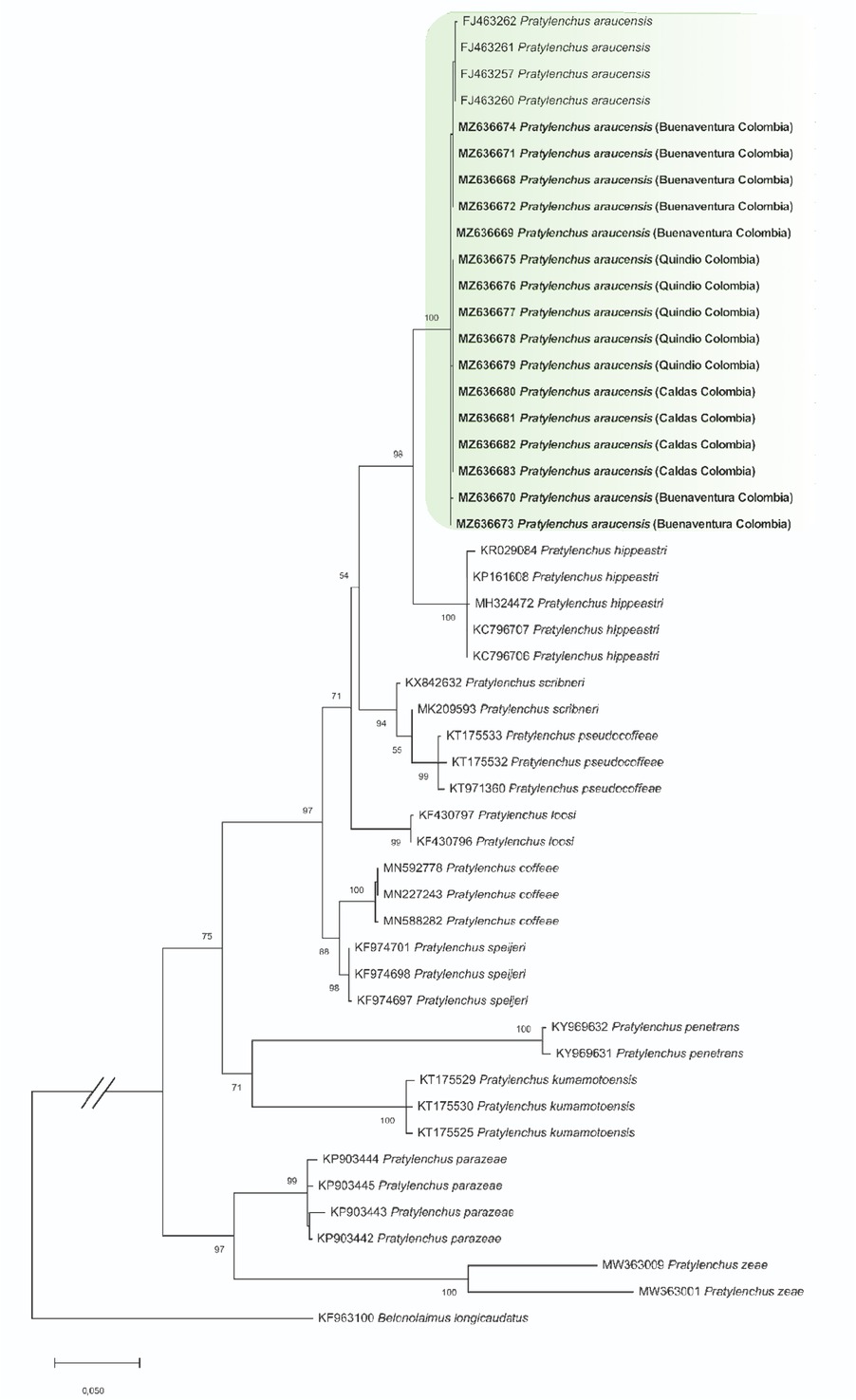
Figure 3
Phylogenetic tree obtained by maximum likelihood of the D2–D3 (LSU) partial region of species of the genus Pratylenchus. The isolates corresponding to this work are marked in bold. The numbers above nodes indicate bootstrap values >70%. LSU, large subunit.
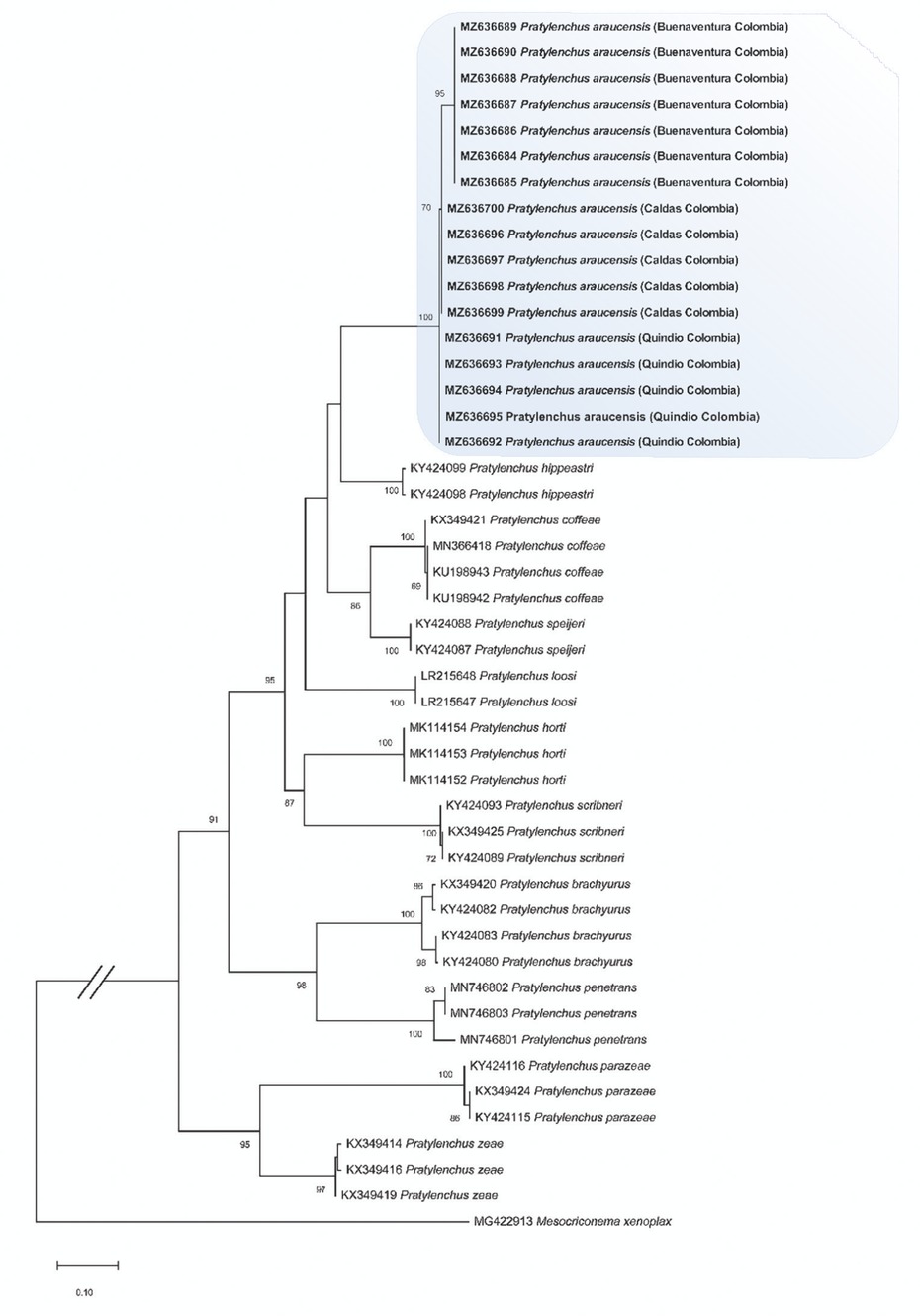
Figure 4
Phylogenetic tree obtained by maximum likelihood of the COI partial region of species of the genus Pratylenchus. The isolates corresponding to this work are marked in bold. The numbers above nodes indicate bootstrap values >70%.