
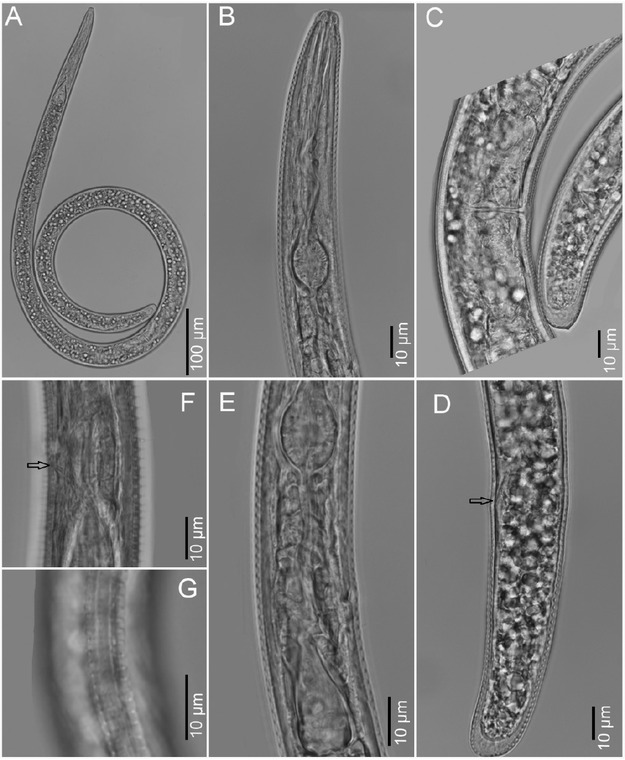
Figure 1
Photomicrographs of fresh and fixed females of Sauertylenchus maximus (Allen, 1955) Siddiqi, 2000 from Virginia. (A) Entire female (fresh); (B) anterior end of fixed female; (C) vulva and tail area of fresh female; (D) tail of fixed female, and the arrow points to the anal opening; (E) esophageal area of fixed female; (F) excretory pore (arrow pointing at it) of fixed female; (G) lateral view of fixed female with four incisures, the two lines being aerolated.
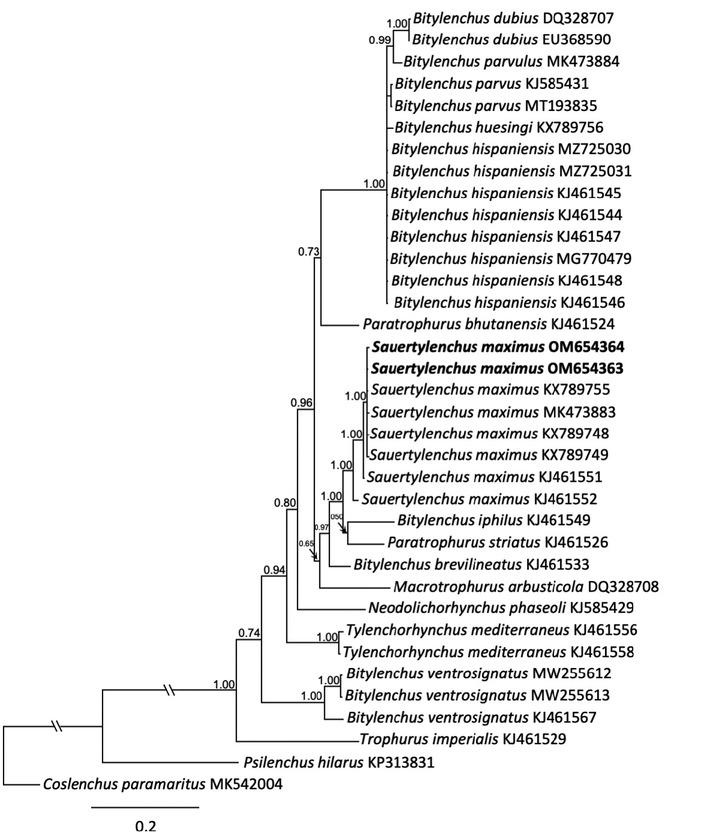
Figure 2
Phylogenetic relationships of Sauertylenchus maximus (Allen, 1955) Siddiqi, 2000 isolates with closely related Telotylenchinae (Allen, 1955) Siddiqi, 2000 species. Bayesian 50% majority rule consensus tree inferred from 28S rDNA D2–D3 sequences alignment under the general time-reversible model of sequence evolution, with correction for invariable sites and a gamma-shaped distribution (GTR + I + G). New sequences are shown in bold. PP are shown on appropriate branches. PP, posterior probabilities. GTR, general time reversible.
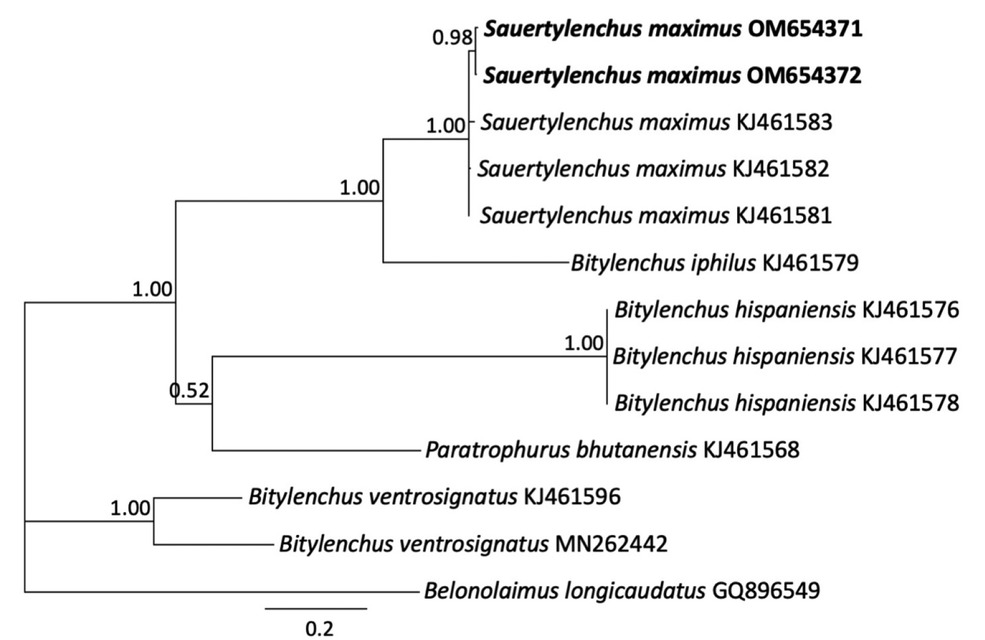
Figure 3
Phylogenetic relationships of Sauertylenchus maximus (Allen, 1955) Siddiqi, 2000 isolates with closely related Telotylenchinae Siddiqi, 1960 species. Bayesian 50% majority rule consensus tree inferred from ITS rRNA sequence alignment under the general time reversible model of sequence evolution, with correction for invariable sites and a gamma-shaped distribution (GTR + I + G). New sequences are shown in bold. PP are shown on appropriate branches. GTR, general time reversible; ITS, internal transcribed spacer; PP, posterior probabilities.
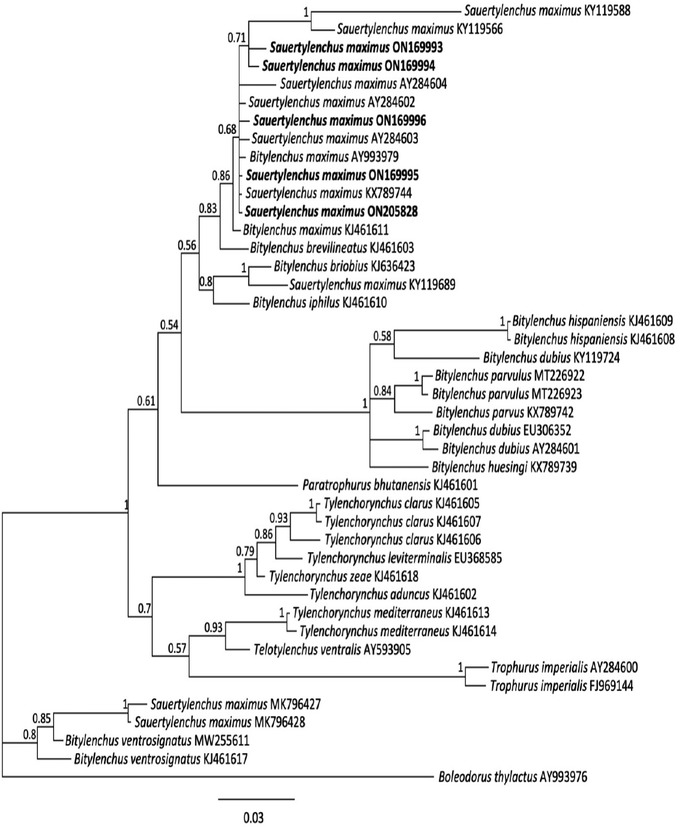
Figure 4
Phylogenetic relationships of Sauertylenchus maximus (Allen, 1955) Siddiqi, 2000 isolates with closely related Telotylenchinae Siddiqi, 1960 species. Bayesian 50% majority rule consensus tree inferred from 18S rRNA sequence alignment under the general time reversible model of sequence evolution, with correction for invariable sites and a gamma-shaped distribution (GTR + I + G). New sequences are shown in bold. PP are shown on appropriate branches. GTR, general time reversible; PP, posterior probabilities.
Table 1
Morphometrics of several populations of Sauertylenchus maximus Allen, 1955.
| Characteristic | S. maximus from Virginia(this paper) | S. maximusAfter Allen (1955) | S. maximusAfter Yildiz et al. (2012) | S. maximusAfter Geraert (2011) | |
|---|---|---|---|---|---|
| Fresh female specimens | Fixed female specimens (vial G-4280) | Females | Females | Females | |
| n | 6 | 9 | 12 | 10 | ? |
| L | 1,253.0 ± 95.3 (1,133–1,425) | 1,313.0 ± 60.7 (1,260–1,472) | 980–1,140 | 1,094.0 ± 95.1 (932–1,210) | 940–1,620 |
| A | 36.4 ± 2.0 (33.3–38.7) | 43.0 ± 1.7 (40.3–45.8) | 37–47 | 47.9±4.2 (41.6–53.7) | 28–58 |
| B | 9.1 ± 0.6 (8.3–9.9) | 8.0 ± 0.4 (7.5–9.0) | 5.4–8.1 | 7.0 ± 0.5 (6.2–8.0) | – |
| C | 19.4 ± 0.7 (18.6–20.8) | 21 ± 1 (19.4–22.3) | 16–20 | 19.2 ± 1.7 (17.2–23.0) | 16–26 |
| c’ | 2.5 ± 0.2 (2.2–2.8) | 2.8 ± 0.2 (2.6–3.1) | – | – | 1.9–4.1 |
| Stylet | 22 ± 1 (20–23) | 22 ± 1 (21–23) | 21.3–24.0 | 21.5 ± 0.95 (20.5–23.0) | 20.0–24.5 |
| Anal body diam. | 26 ± 2 (22–28) | 23.0 ± 1.5 (21–26) | – | 18.2 ± 1.6 (15.5–20.0) | – |
| Max. body diam. | 34 ± 3 (30–38) | 30.0 ± 1.7 (27.5–33.0) | – | 22.8 ± 2.0 (20–26) | 23–32 |
| Pharynx length | 137.5 ± 6.3 (130–150) | 160.0 ± 7.8 (150–172) | – | 156.0 ± 6.9 (150–70) | 153–192 |
| Anterior end to excretory pore | 113 ± 13 (101–135) | 128 ± 4 (122–135) | – | – | – |
| Tail length | 65 ± 5 (60–75) | 64.0 ± 2.8 (60–70) | – | 56.8 ± 5.4 (48–65) | 42–83 |
| V% | 50 ± 1 (49–52) | 52.0 ± 1.3 (50.2–54.0) | – | 52.5 ± 2.0 (48–65) | 47–58 |
| Lip annules | 5 | 5–7 | – | 5–7 | – |