
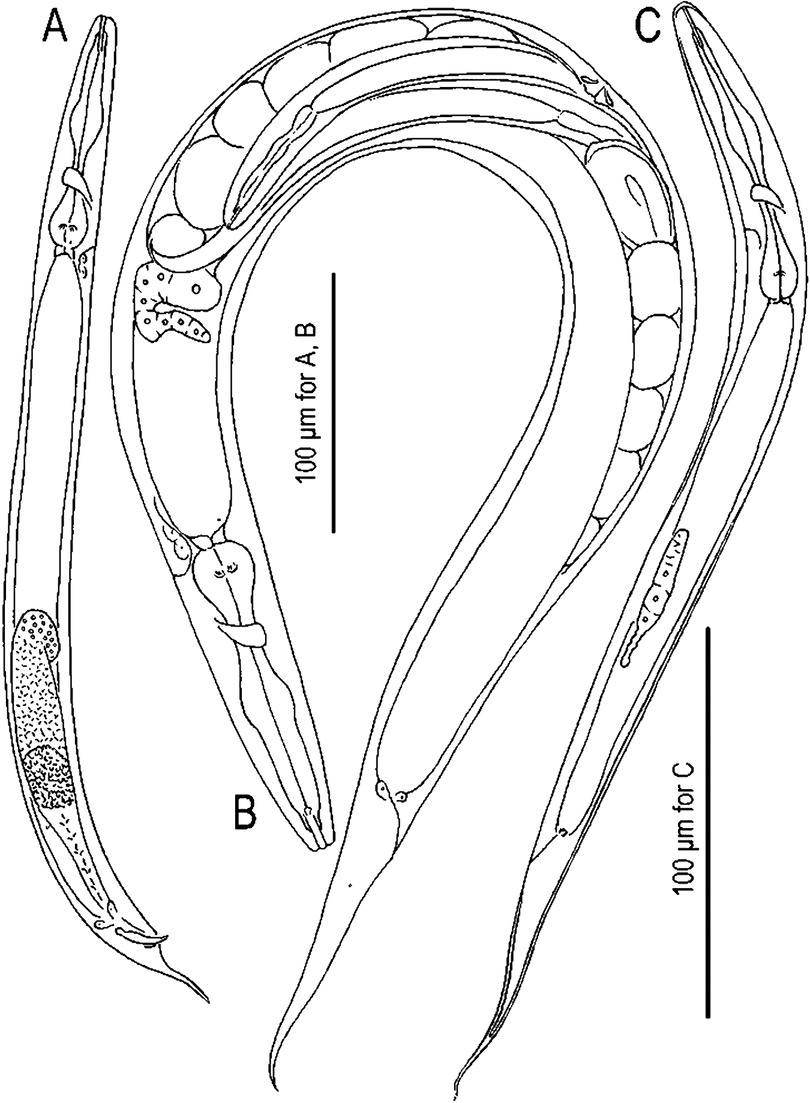
Figure 1
Mature male, hermaphrodite, and dauer juvenile of Tokorhabditis tauri n. sp. (A) Male. (B) Mature hermaphrodite. (C) Dauer juvenile.
Table 1
Morphometric values for Tokorhabditis tauri n. sp.
| Holotype male | Paratype males | Paratype hermaphrodites | Paratype females | Paratype dauers | |
|---|---|---|---|---|---|
| N | – | 9 | 10 | 10 | 10 |
| L | 364 | 352 ± 36 (309–415) | 905 ± 149 (720–1241) | 912 ± 80 (741–1021) | 286 ± 11 (263–299) |
| A | 15.5 | 17.5 ± 1.0 (15.5–19.0) | 15.0 ± 0.9 (13.8–16.6) | 12.6 ± 0.8 (11.5–14.1) | 21.0 ± 1.4 (18.5–22.9) |
| B | 4.1 | 4.3 ± 0.4 (3.9–4.9) | 8.0 ± 0.9 (6.6–9.7) | 8.6 ± 0.5 (7.3–9.1) | 3.8 ± 0.1 (3.5–4.0) |
| ca | 13.9 | 13.1 ± 1.6 (10.6–15.6) | 9.3 ± 1.0 (7.9–11.1) | 11.9 ± 1.2 (10.4–13.5) | 7.1 ± 0.6 (6.5–8.6) |
| c'a | 2.3 | 2.4 ± 0.2 (2.0–2.7) | 5.5 ± 0.5 (4.6–6.2) | 4.2 ± 0.5 (3.2–5.0) | 5.3 ± 0.3 (4.9–6.1) |
| Tb or V | 43.4 | 41.7 ± 2.4 (36.7–45.3) | 49.6 ± 1.2 (47.8–52.1) | 49.6 ± 1.0 (48.2–51.0) | – |
| Maximum body diam.c | 23.4 | 20.2 ± 2.8 (17.0–24.1) | 61 ± 10.3 (43–82) | 73 ± 8.8 (53–84) | 13.7 ± 0.6 (12.8–14.2) |
| Stoma diam. | 2.1 | 2.4 ± 0.3 (2.1–2.8) | 4.0 ± 0.4 (3.5–5.0) | 3.6 ± 0.3 (3.2–4.3) | – |
| Stoma depth | 11.7 | 11.5 ± 0.7 (9.9–12.4) | 14.5 ± 1.5 (12.8–18.4) | 15.1 ± 1.1 (13.5–17.0) | – |
| Stoma depth/diam. ratio | 5.5 | 4.7 ± 0.5 (4.0–5.5) | 3.6 ± 0.3 (3.2–4.0) | 4.2 ± 0.5 (3.6–5.3) | – |
| Anterior pharynx length | 36 | 34 ± 2.6 (30–37) | 46 ± 3.1 (42–53) | 42 ± 1.4 (40–44) | 31 ± 0.9 (30–32) |
| Posterior pharynx length | 41 | 37 ± 2.1 (34–41) | 52 ± 3.1 (49–58) | 49 ± 3.3 (44–55) | 32 ± 1.1 (30–33) |
| Anterior/posterior pharynx length ratio | 0.87 | 0.92 ± 0.06 (0.86–1.01) | 0.89 ± 0.04 (0.83–0.95) | 0.86 ± 0.07 (0.74–0.95) | 0.98 ± 0.02 (0.95–1.02) |
| Median bulb diam. | 10.6 | 10.4 ± 0.6 (9.2–11.3) | 17.0 ± 2.2 (14.0–21.1) | 20.4 ± 1.5 (18.7–22.2) | 6.0 ± 0.5 (5.0–6.4) |
| Basal bulb diam. | 14.2 | 13.2 ± 0.6 (12.4–14.2) | 20.4 ± 1.9 (17.5–23.4) | 25.3 ± 1.4 (22.2–26.9) | 6.9 ± 0.7 (5.7-7.8) |
| Nerve ring from anterior end | 60 | 56 ± 4.7 (50–64) | 79 ± 5.2 (71–90) | 72 ± 3.0 (64–74) | 50 ± 1.2 (48–51) |
| Secretory-excretory pore from anterior end | 81 | 78 ± 6.7 (71–90) | 113 ± 9.6 (102–131) | 106 ± 7.0 (95–115) | 58 ± 2.2 (54–61) |
| Cloacal or anal body diam. | 11.3 | 11.2 ± 0.7 (10.6–12.8) | 17.8 ± 2.3 (15.2–22.2) | 18.5 ± 0.9 (17.5–19.9) | 7.6 ± 0.7 (6.4–8.5) |
| Tail lengtha | 26.2 | 26.9 ± 1.5 (24.8–29.1) | 97 ± 12 (84–119) | 77 ± 8.4 (63–90) | 40 ± 3.0 (34–43) |
| Tail spike length | 15.6 | 17.7 ± 1.6 (15.6–21.3) | – | – | – |
| Whole gonad length | 158 | 147 ± 14 (125–165) | – | – | – |
| Reflex part of testis | 25 | 19 ± 5.2 (13–27) | – | – | – |
| Vas deferens lengthb | 54 | 56 ± 7.0 (47–70) | – | – | – |
| Percentage of vas deferens to whole gonad | 34.1 | 38.5 ± 3.7 (34.1–46.2) | – | – | – |
| Spicule length (curve) | 17.7 | 18.3 ± 1.3 (15–6–19.9) | – | – | – |
| Spicule length (chord) | 17.0 | 17.6 ± 1.3 (14.9–19.1) | – | – | – |
| Gubernaculum length (chord) | 9.2 | 10.4 ± 0.9 (9.2–12.1) | – | – | – |
| Anterior ovary length | – | 87 ± 15 (67–113) | 125 ± 6.4 (117-135) | – | |
| Posterior ovary length | – | 77 ± 14 (53–96) | 118 ± 10 (104–133) | – | |
| Anterior/posterior ovary length ratio | – | 1.15 ± 0.19 (0.91–1.45) | 1.06 ± 0.07 (0.92–1.15) | – | |
| Phasmid from anus | – | 16.7 ± 1.9 (14.0–19.9) | 13.6 ± 1.8 (10.5–16.4) | – | |
| Relative position of phasmid to anal body diam.d | – | 0.95 ± 0.11 (0.80–1.08) | 0.73 ± 0.10 (0.58–0.88) | – | |
| Relative position of phasmid to tail lengthe | – | 17.5 ± 2.9 (13.0–21.5) | 17.9 ± 2.9 (11.7–21.5) | – |
[i] aTail length including tail spike.
bGonad length including reflexed part and vas deferens.
cBody diam. is maximum at vulval position in hermaphrodite and female (vulval body diam. = maximum body diam.).
dCalculated as anus-phasmid distance/anal body diam.
eCalculated as ×100 anus-phasmid distance/whole tail length.
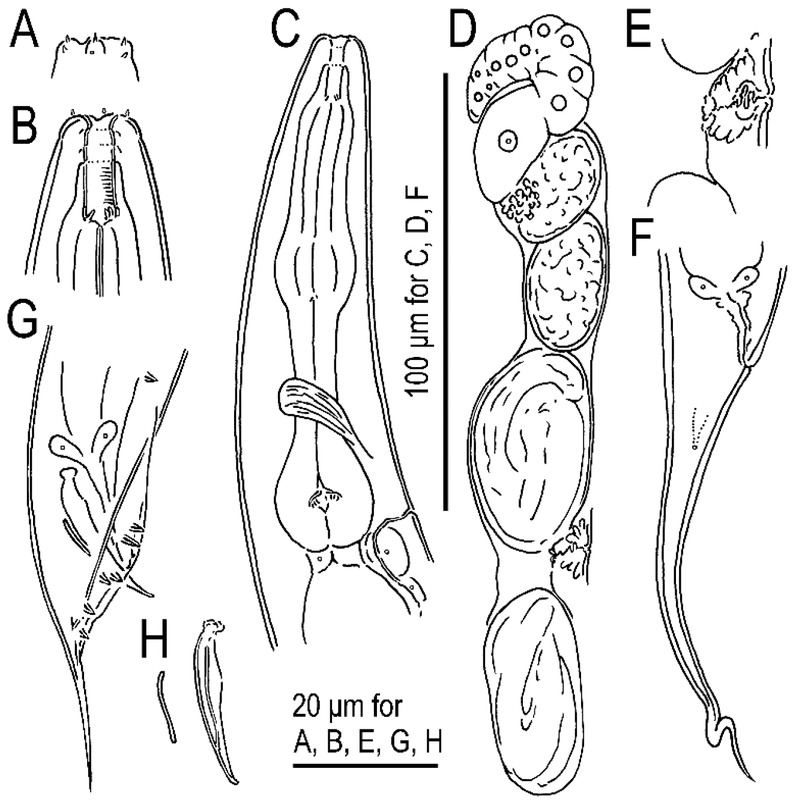
Figure 2
Hermaphrodite and male of Tokorhabditis tauri n. sp. All drawings are in right lateral view. (A) Surface of lip region of hermaphrodite. (B) Stomatal region of hermaphrodite. (C) Anterior part of hermaphrodite. (D) Anterior gonad of mature hermaphrodite. (E) Vulval region of young hermaphrodite. (F) Tail region of hermaphrodite. (G) Male tail region. (H) Spicule and gubernaculum.
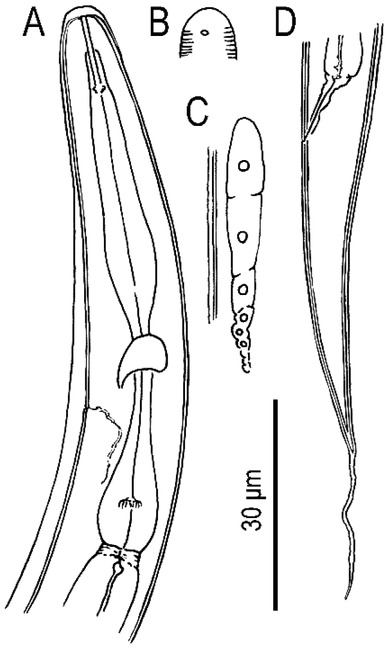
Figure 3
Dauer juvenile of Tokorhabditis tauri n. sp. All drawings are in left lateral view. (A) Anterior region. (B) Surface of lip region. (C) Genital anlagen. (D) Tail region.
Table 2
Morphometric values for Tokorhabditis atripennis n. sp.
| Holotype male | Paratype males | Paratype hermaphrodites | Paratype females | Paratype dauers | |
|---|---|---|---|---|---|
| n | – | 9 | 10 | 10 | 10 |
| L | 362 | 362 ± 13 (346–387) | 792 ± 32 (734–829) | 884 ± 69 (767–966) | 278 ± 6.7 (270–292) |
| a | 14.9 | 14.4 ± 0.6 (13.4–15.2) | 14.4 ± 0.7 (13.2–15.4) | 11.8 ± 0.9 (10.3–13.2) | 20.1 ± 0.7 (19.2–21.1) |
| B | 4.2 | 4.2 ± 0.1 (4.1–4.3) | 7.2 ± 0.2 (6.7–7.6) | 8.1 ± 0.5 (7.4–8.9) | 3.5 ± 0.1 (3.3–3.6) |
| ca | 11.8 | 13.2 ± 0.9 (11.8–14.7) | 6.0 ± 0.3 (5.5–6.3) | 6.3 ± 0.5 (5.4–6.9) | 7.1 ± 0.3 (6.8–7.6) |
| c'a | 2.6 | 2.3 ± 0.2 (2.0–2.6) | 8.4 ± 0.5 (7.5–9.1) | 8.0 ± 0.7 (6.9–9.3) | 4.8 ± 0.2 (4.5–5.3) |
| Tb or V | 41.3 | 43.6 ± 1.4 (40.8–44.7) | 46.2 ± 0.5 (45.4–47.0) | 46.3 ± 1.4 (44.6–49.2) | – |
| Maximum body diam.c | 24.3 | 25.1 ± 1.4 (23.4–28.1) | 55 ± 3.4 (50–59) | 75 ± 9.4 (58–90) | 13.8 ± 0.4 (13.3–14.3) |
| Stoma diam. | 2.2 | 1.8 ± 0.3 (1.4–2.5) | 3.2 ± 0.2 (2.9–3.3) | 3.2 ± 0.3 (2.6–3.6) | – |
| Stoma depth | 10.8 | 11.2 ± 0.5 (10.8–11.9) | 14.4 ± 0.3 (14.0–14.7) | 14.2 ± 0.6 (13.3–15.3) | – |
| Stoma depth/diam. ratio | 5.0 | 6.2 ± 0.9 (4.7–7.8) | 4.5 ± 0.3 (4.2–5.0) | 4.4 ± 0.5 (3.9–5.4) | – |
| Anterior pharynx length | 34 | 35 ± 2.2 (32–38) | 51 ± 2.7 (47–56) | 44 ± 2.2 (40–47) | 34 ± 0.8 (33–36) |
| Posterior pharynx length | 39 | 39 ± 1.5 (36–41) | 48 ± 1.1 (46–50) | 49 ± 1.7 (46–51) | 33 ± 0.9 (31–34) |
| Anterior/posterior pharynx length ratio | 0.86 | 0.91 ± 0.06 (0.82–0.99) | 1.07 ± 0.04 (1.00–1.17) | 0.90 ± 0.06 (0.80–1.02) | 1.05 ± 0.05 (1.01–1.17) |
| Median bulb diam. | 10.4 | 10.7 ± 0.3 (10.4–11.2) | 17.6 ± 0.4 (17.3–18.4) | 20.3 ± 1.5 (18.4–22.4) | 6.4 ± 0.3 (5.9–6.8) |
| Basal bulb diam. | 14.0 | 13.9 ± 0.4 (13.3–14.7) | 20.0 ± 0.7 (18.8–21.0) | 24.4 ± 1.3 (21.9–26.0) | 7.4 ± 0.2 (7.0–7.7) |
| Nerve ring from anterior end | 59 | 57 ± 2.5 (53–60) | 77 ± 3.2 (72–83) | 72 ± 3.3 (66–76) | 52 ± 1.1 (50–54) |
| Secretory-excretory pore from anterior end | 80 | 79 ± 1.8 (77–82) | 103 ± 3.5 (99–111) | 103 ± 4.1 (94–107) | 62 ± 2.6 (58–68) |
| Cloacal or anal body diam. | 11.9 | 11.9 ± 0.5 (11.2–12.6) | 15.8 ± 0.7 (14.7–16.9) | 17.8 ± 1.6 (14.8–19.9) | 8.2 ± 0.4 (7.6–8.7) |
| Tail lengtha | 30.6 | 27.5 ± 1.7 (24.8–30.6) | 132 ± 5.0 (124–141) | 142 ± 11.5 (126–158) | 39 ± 1.4 (37–42) |
| Tail spike length | 18.7 | 16.7 ± 2.0 (13.7–19.4) | – | – | – |
| Whole gonad lengthb | 150 | 157 ± 7.5 (150–171) | – | – | – |
| Reflex part of testis | 17 | 19 ± 2.4 (15–23) | – | – | – |
| Vas deferens length | 76 | 76 ± 7.3 (61–88) | – | – | – |
| Percentage of vas deferens to whole gonad | 50.6 | 48.2 ± 3.4 (41.0–53.0) | – | – | – |
| Spicule length (curve) | 21.2 | 21.5 ± 1.1 (20.1–23.4) | – | – | – |
| Spicule length (chord) | 19.8 | 20.4 ± 1.0 (19.1–21.6) | – | – | – |
| Gubernaculum length (chord) | 11.2 | 11.2 ± 0.7 (10.1–12.2) | – | – | – |
| Anterior ovary length | – | – | 104 ± 11 (94–126) | 126 ± 19 (100–158) | – |
| Posterior ovary length | – | – | 111 ± 10 (97–125) | 132 ± 21 (94–161) | – |
| Anterior/posterior ovary length ratio | – | – | 0.94 ± 0.07 (0.81–1.04) | 0.96 ± 0.11 (0.72–1.08) | – |
| Phasmid from anus | – | – | 17.2 ± 1.1 (15.5–19.1) | 15.3 ± 2.3 (11.2–18.9) | – |
| Relative position of phasmid to anal body diam.d | – | – | 1.09 ± 0.10 (0.98–1.25) | 0.86 ± 0.12 (0.76–1.09) | – |
| Relative position of phasmid to tail lengthe | – | – | 13.0 ± 1.1 (11.4–14.5) | 10.9 ± 1.9 (8.7–15.0) | – |
[i] aTail length including tail spike.
bGonad length including reflexed part and vas deferens.
cBody diam. is maximum at vulval position in hermaphrodite and female (vulval body diam. = maximum body diam.).
dCalculated as anus-phasmid distance/anal body diam.
eCalculated as ×100 anus-phasmid distance/whole tail length.
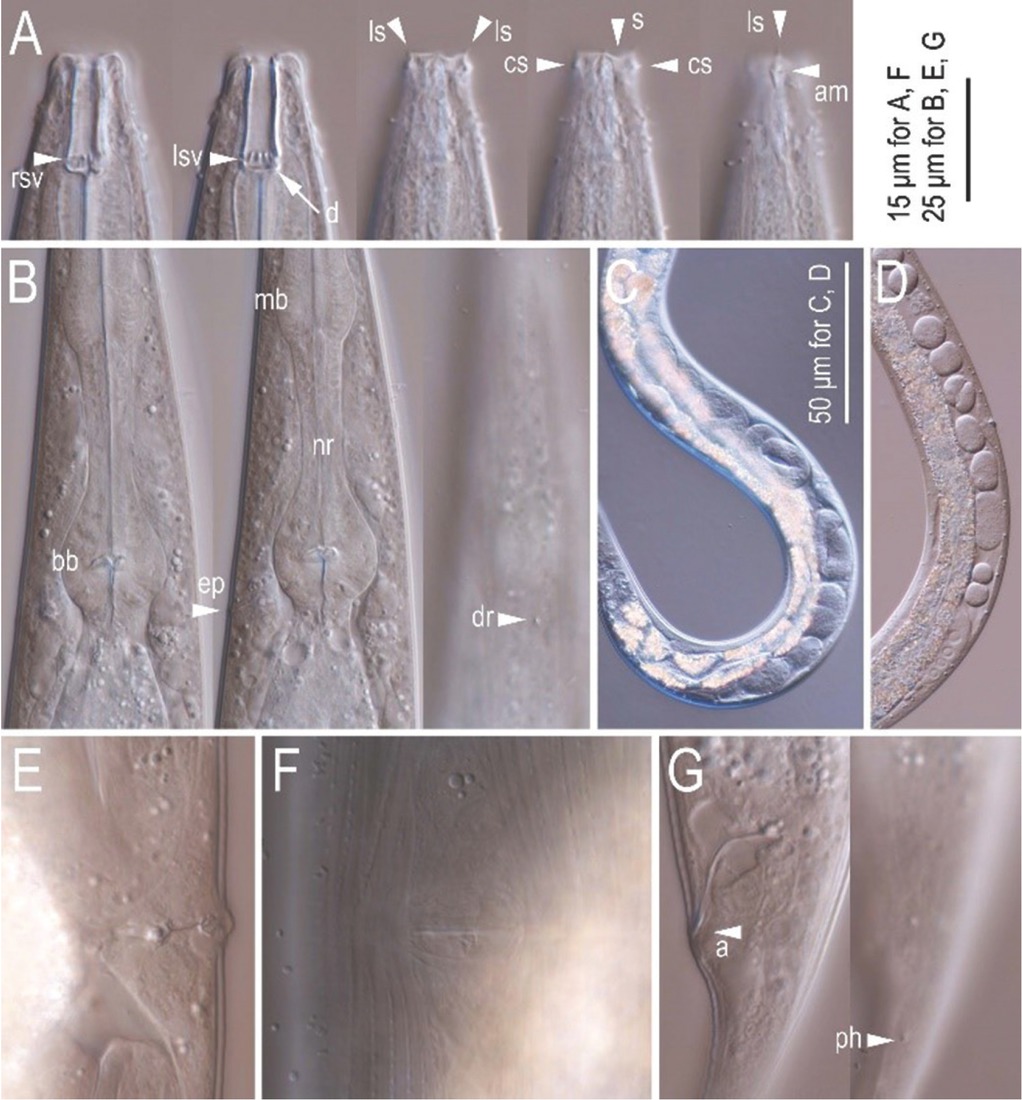
Figure 4
Differential interference contrast micrographs of the hermaphrodite and female of Tokorhabditis tauri n. sp. All imaged individuals are of hermaphrodite except for (D), showing female. (A) Lip and stomatal region in left lateral view in five focal planes. (B) Posterior pharynx region in left lateral view in three focal planes. (C) Entire gonad of mature hermaphrodite in right lateral view. (D) Gonadal region of overmature female in right lateral view. (E), (F). Vulval region of young hermaphrodite in right lateral (E) and ventral (F) views. (G). Anal region in left lateral view in two focal planes. a, anus; am, amphid; bb, basal bulb; cs, cephalic sensilla; dr, deirid; d, dorsal denticles; ep, excretory pore; ls, labial sensilla; lsv, left subventral denticles; mb, median bulb; nr, nerve ring; ph, phasmid; rsv, right subventral denticles.
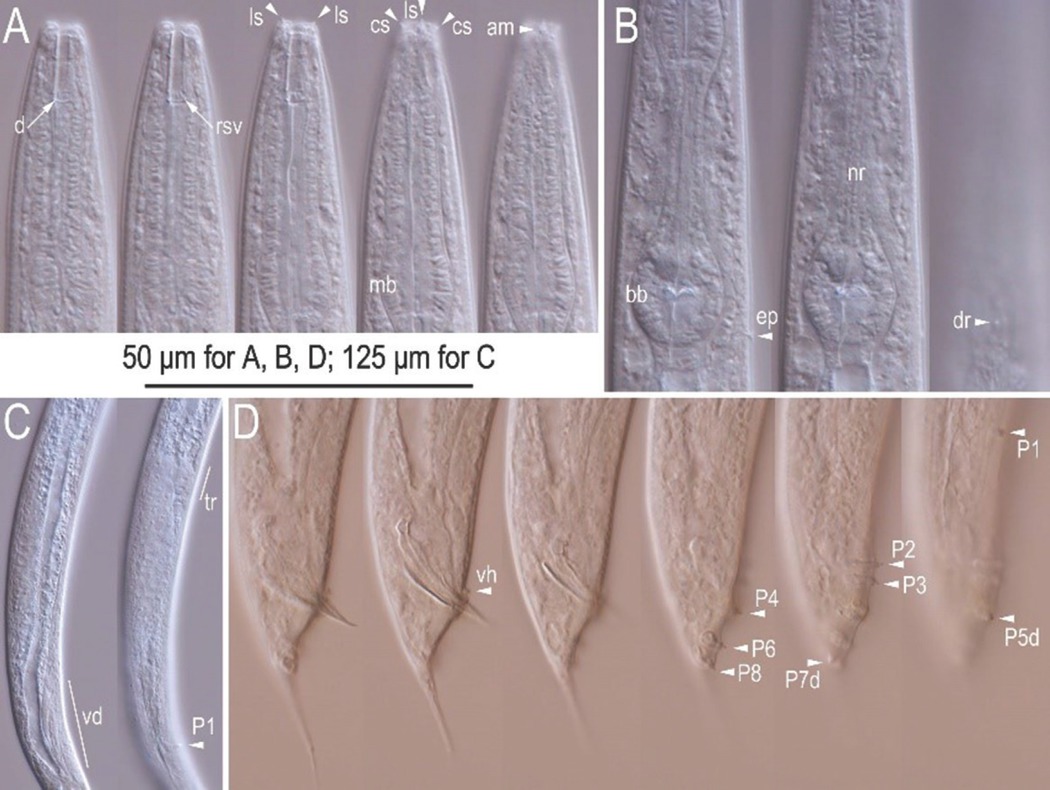
Figure 5
Differential interference contrast micrographs of the adult male of Tokorhabditis tauri n. sp. All images are in right lateral view. (A) Lip to anterior pharynx region in five focal planes. (B) Posterior pharynx region in three focal planes. (C) Entire gonad in two focal planes. (D) Tail region in six focal planes. Genital papillae are labeled with the prefix “P”; suffix “d” indicates papillae that open dorsally or laterally. am, amphid; bb, basal bulb; cs, cephalic sensilla; d, dorsal denticles; dr, deirid; ep, excretory pore; ls, labial sensilla; nr, nerve ring; tr, testis reflection; vd, vas deferens; vh, ventral precloacal hook.
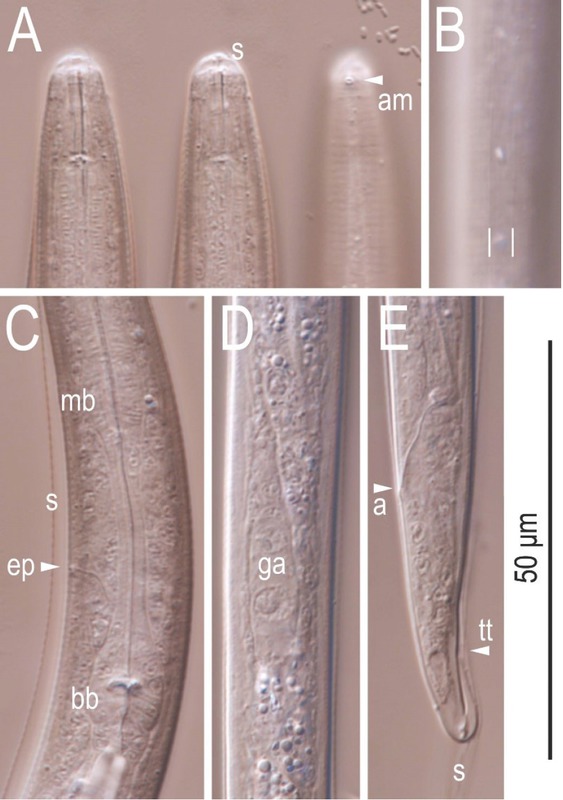
Figure 6
Differential interference contrast micrographs of the dauer juvenile of Tokorhabditis tauri n. sp. All images are in left lateral view. (A) Lip and stomatal region in three focal planes. (B) Surface structure of mid-body. Parallel lines mark lateral lines. (C) Middle to posterior part of pharynx. (D) Genital anlage. (E) Tail region. a, anus; am, amphid; bb, basal bulb; ga, genital anlage; ep, excretory pore; mb, median bulb; s, sheath; tt, tail tip.
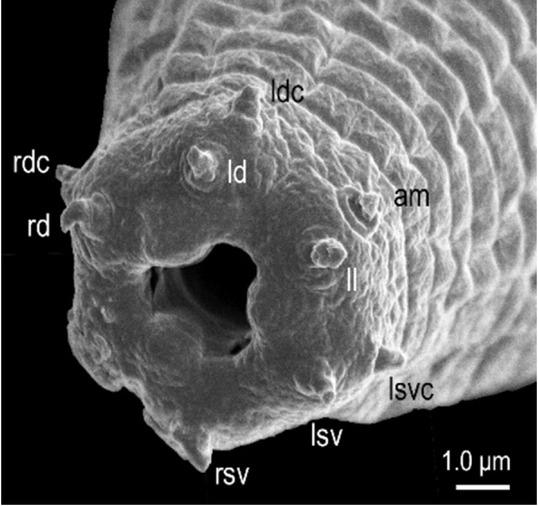
Figure 7
Scanning electron micrograph of the labial region of a female of Tokorhabditis tauri n. sp. am, amphid; ld, left dorsal labial sensillum; ldc, left dorsal cephalic sensillum; ll, left lateral labial sensillum; lsv, left subventral labial sensillum; lsvc, left subventral cephalic sensillum; rd, right dorsal labial sensillum; rdc, right dorsal cephalic sensillum; rsv, right subventral labial sensillum.
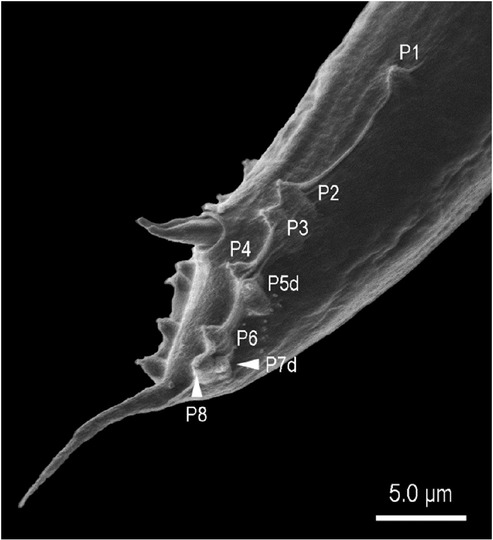
Figure 8
Scanning electron micrograph of the male tail of Tokorhabditis tauri n. sp. Genital papillae are labeled with the prefix “P”; suffix “d” indicates papillae that open dorsally or laterally.
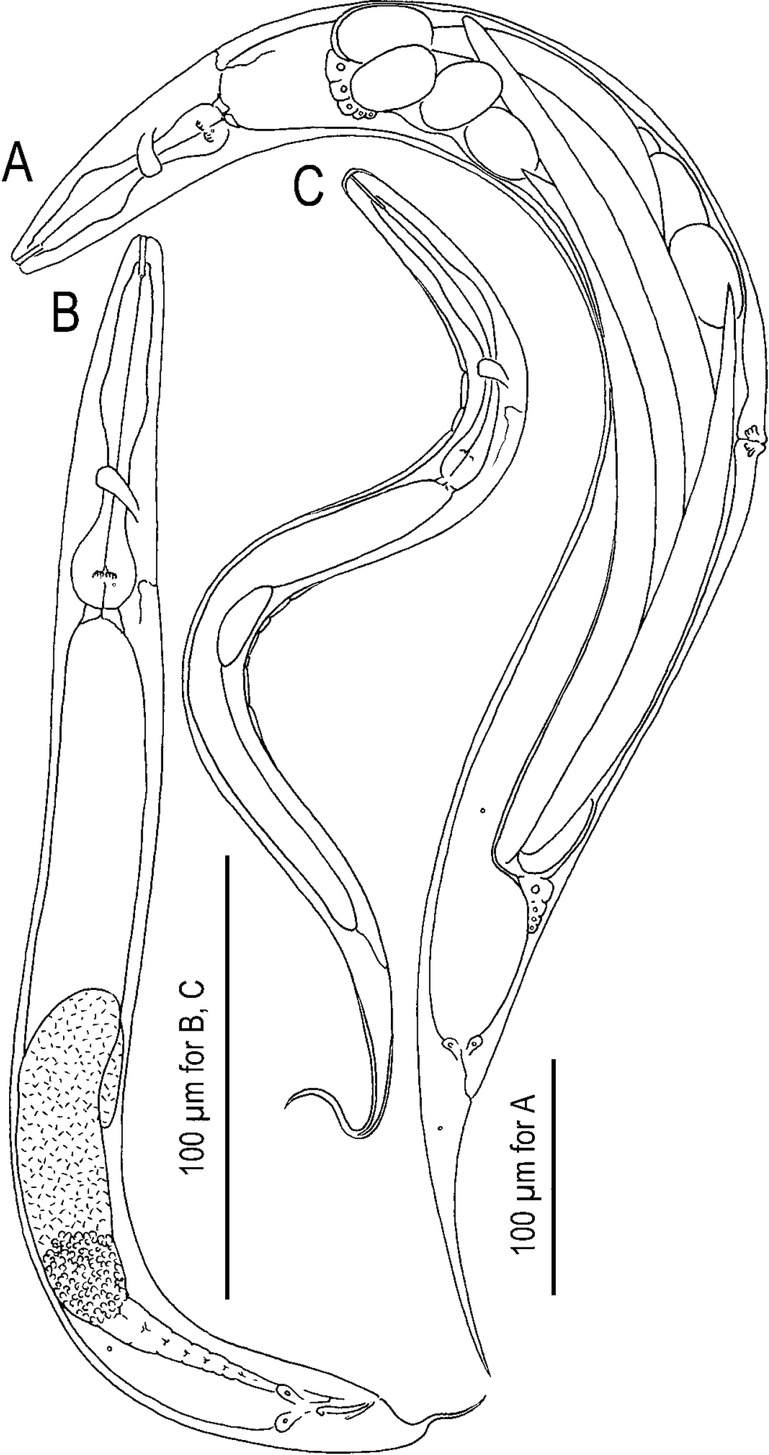
Figure 9
Mature hermaphrodite, male, and dauer juvenile of Tokorhabditis atripennis n. sp. (A) Mature hermaphrodite. (B) Male. (C) Dauer juvenile.
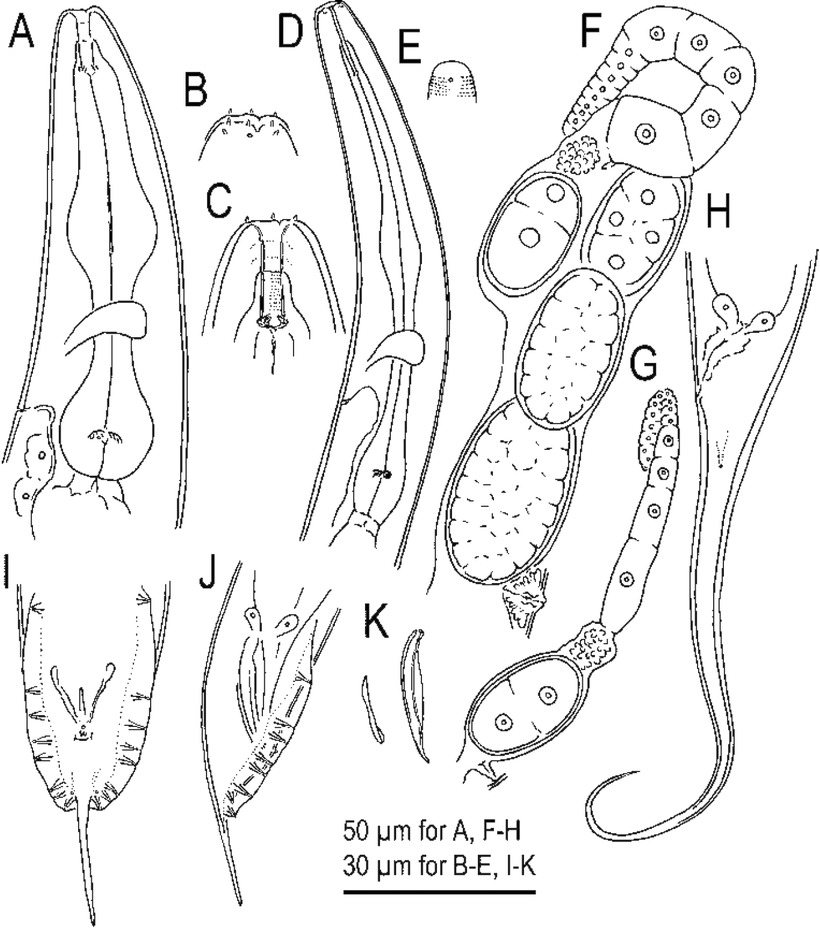
Figure 10
Hermaphrodite, male and dauer juvenile of Tokorhabditis atripennis n. sp. (A) Anterior part of hermaphrodite in left lateral view. (B) Surface of lip region of hermaphrodite. (C) Stomatal region of hermaphrodite in left lateral view. (D) Anterior part of dauer juvenile in left lateral view. (E) Surface of lip region of dauer juvenile. (F) Anterior gonad of mature hermaphrodite in right lateral view. (G) Anterior gonad of young hermaphrodite in right lateral view. (H) Tail region of hermaphrodite in left lateral view. (I) Male tail region in ventral view. (J) Male tail region in right lateral view. (K) Spicule and gubernaculum in right lateral view.
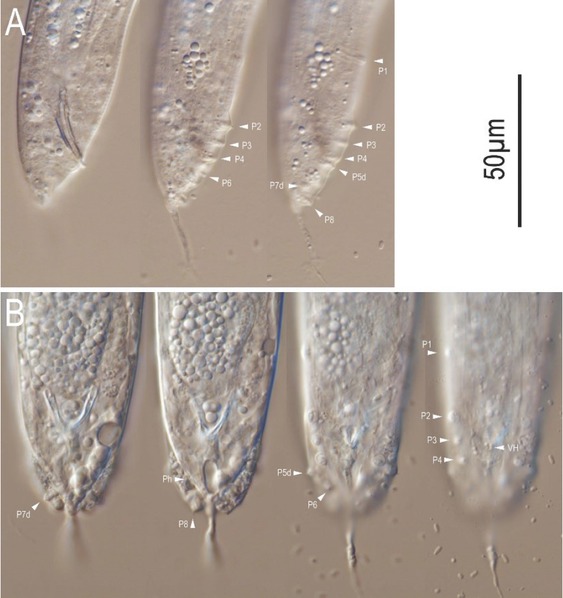
Figure 11
Differential interference contrast micrographs of the male tail region of Tokorhabditis atripennis n. sp. (A) Right lateral view in three focal planes. (B) Ventral view in four focal planes. Genital papillae are labeled with the prefix “P”; suffix “d” indicates papillae that open dorsally or laterally. Ph, phasmid.
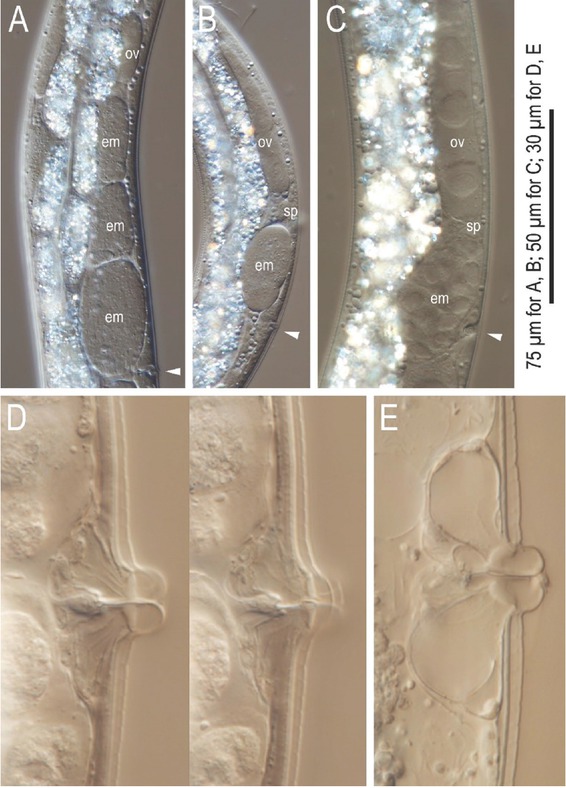
Figure 12
Differential interference contrast micrographs of the gonadal region of Tokorhabditis atripennis n. sp. hermaphrodites. All images are in right lateral view. (A)–(C) Anterior gonad of maturing adult (A), young adult (B), and fourth-stage juvenile (C). (D) Vulval region of young adult in two focal planes. (E) Vulval region of mature adult. em, embryos; ov, ovary; sp, sperm. Arrowhead marks vulva in (A)–(C).
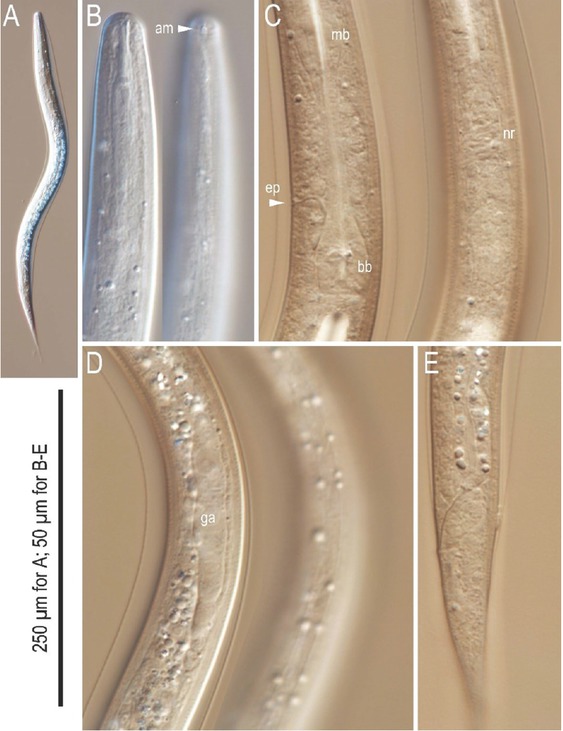
Figure 13
Differential interference contrast micrographs of the dauer juvenile of Tokorhabditis atripennis n. sp. All images in left lateral view. (A) Entire body. (B) Lip and anterior pharynx region in two focal planes. (C) Posterior pharynx region in two focal planes. (D) Mid-body region in two focal planes. (E) Anal region. am, amphid; bb, basal bulb; ep, excretory pore; ga, genital anlage; mb, median bulb; nr, nerve ring.
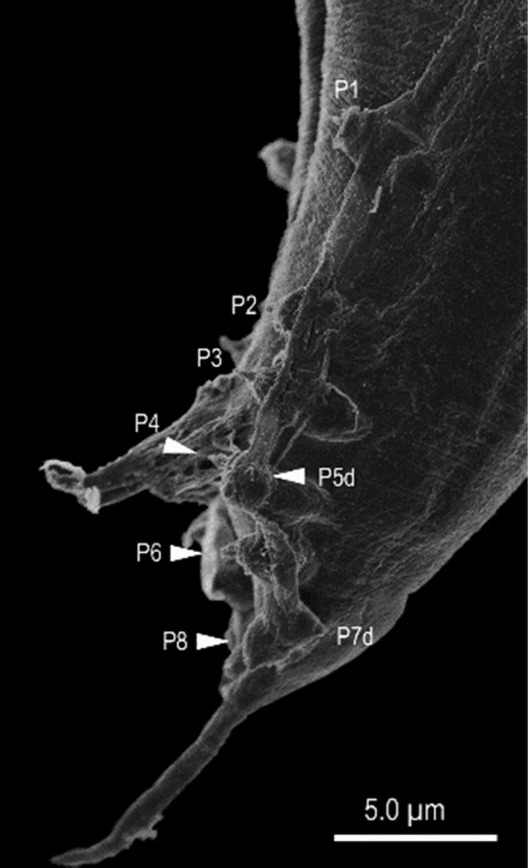
Figure 14
Scanning electron micrograph of the male tail of Tokorhabditis atripennis n. sp. Genital papillae are labeled with the prefix “P”; suffix “d” indicates papillae that open dorsally or laterally.