
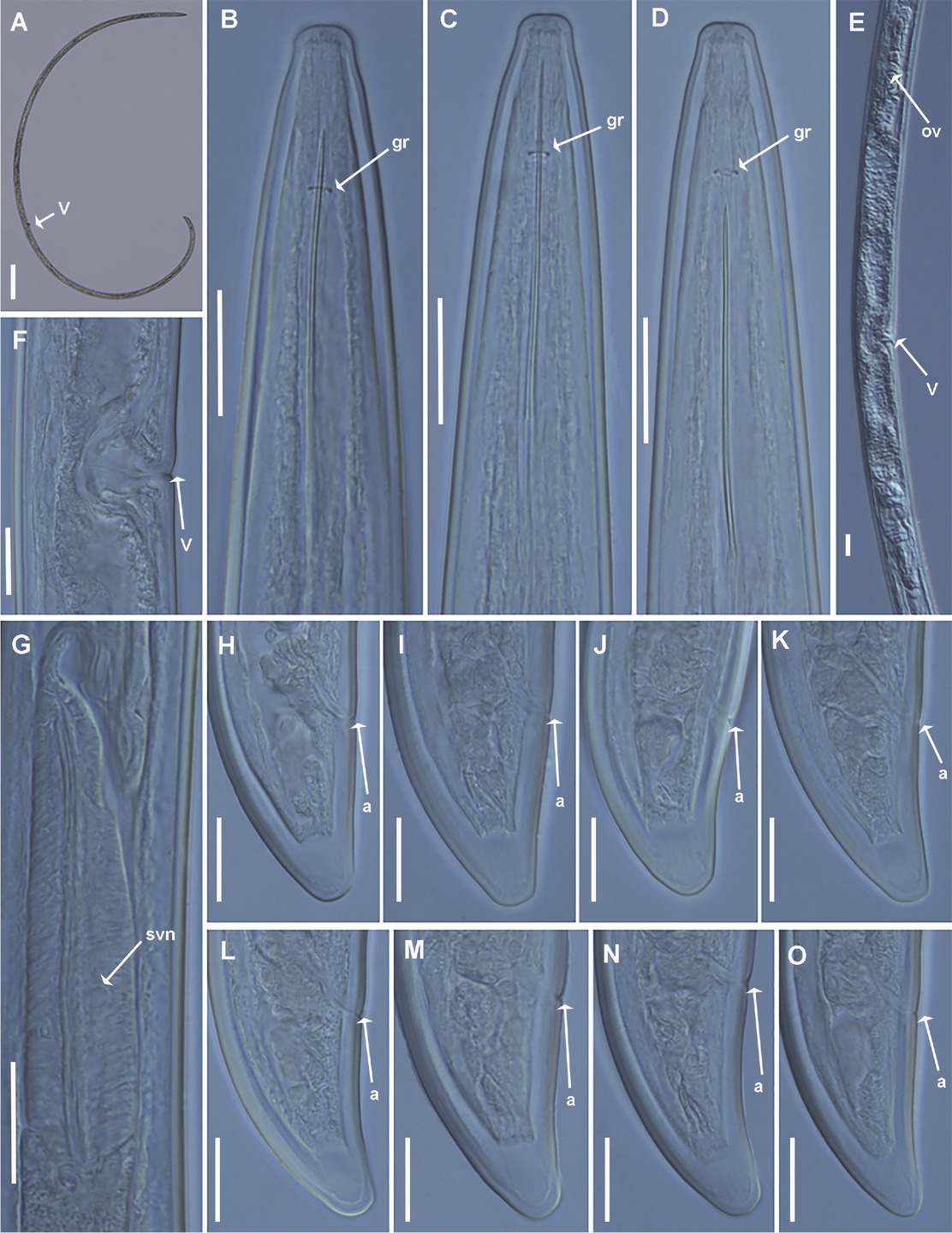
Figure 1
Light micrographs of Longidorus leptocephalus Hooper, 1961 from Greece (A–O). (A) Whole female, (B–D) female anterior regions, (E) detail of female reproductive system, (F) vulval region, (G) detail of basal bulb, and (H–O) female tail regions. a, anus; gr, guiding ring; ov, ovary; svn, ventrosublateral nucleus; V, vulva (Scale bars: A = 200 mm, B–O = 20 mm).
Table 1
Morphometrics of Longidorus leptocephalus Hooper, 1961 from Greece and type population.
| Thessaloniki, Greece | Highfield, Scotland | |
|---|---|---|
| Charactera | Females | Female paratypes |
| N | 10 | 16 |
| L (mm) | 4.9 ± 0.43 (4.25–5.53) | 4.2 (3.6–4.6) |
| A | 99.9 ± 8.1 (90.1–113.0) | 96.0 (83.0–121.0) |
| B | 14.3 ± 1.6 (12.2–17.3) | 12.0 (11.7–12.4) |
| C | 110.2 ± 17.4 (83.4–131.7) | 96.0 (78.0–105.0) |
| c’ | 1.4 ± 0.1 (1.2–1.5) | 1.25 |
| db | 2.8 ± 0.1 (2.6–2.9) | – |
| d’c | 2.0 ± 0.1 (1.9–2.1) | – |
| V | 49.0 ± 2.9 (45.1–55.0) | 54.0 (52.0–57.0) |
| Odontostyle length | 65.4 ± 4.3 (58.0–69.5) | 64 (60–70) |
| Odontophore length | 44.9 ± 5.0 (38–52) | 46 (41–56) |
| Total stylet length | 110.3 ± 8.3 (96–118) | – |
| Anterior end to guiding ring | 26.9 ± 1.0 (25.0–28.5) | 30 (29–32) |
| Hyaline part of tail | 14.7 ± 1.7 (12–17) | – |
| Body width at level of: | ||
| lip region | 9.7 ± 0.4 (9–10) | – |
| guiding ring | 19.0 ± 0.4 (18.0–19.5) | – |
| Anus | 32.5 ± 1.7 (29–35) | – |
| Tail length | 44.8 ± 3.9 (41.5–51.0) | – |
[i] Measurements in mm, at exception of L in mm.
aAbbreviations are defined in the study by Jairajpuri and Ahmad (1992).
bd = anterior to the guide ring/body width at the lip region (Brown et al., 1994).
cd’ = body width at the guide ring/body width at the lip region (Brown et al., 1994).
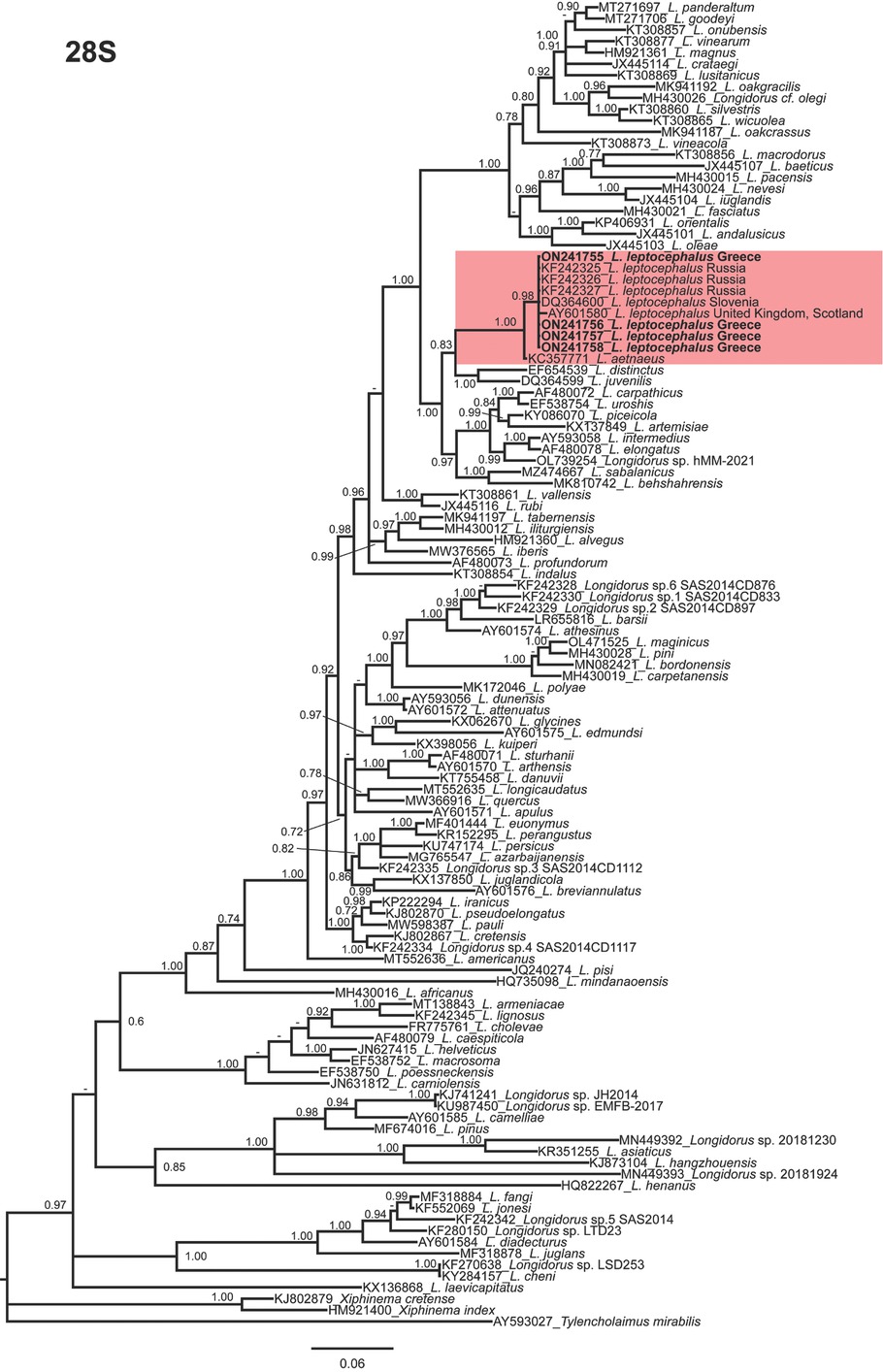
Figure 2
Phylogenetic relationships of Longidorus leptocephalus Hooper, 1961 within the genus Longidorus. Bayesian 50% majority rule consensus tree as inferred from D2 and D3 expansion domains of 28S rDNA sequence alignment under the general time-reversible model of sequence evolution with correction for invariable sites and a gamma-shaped distribution (GTR + I + G). Posterior probabilities more than 0.70 are given for appropriate clades. Newly obtained sequences in this study are shown in bold. Scale bar = expected changes per site. PP. posterior probabilities.
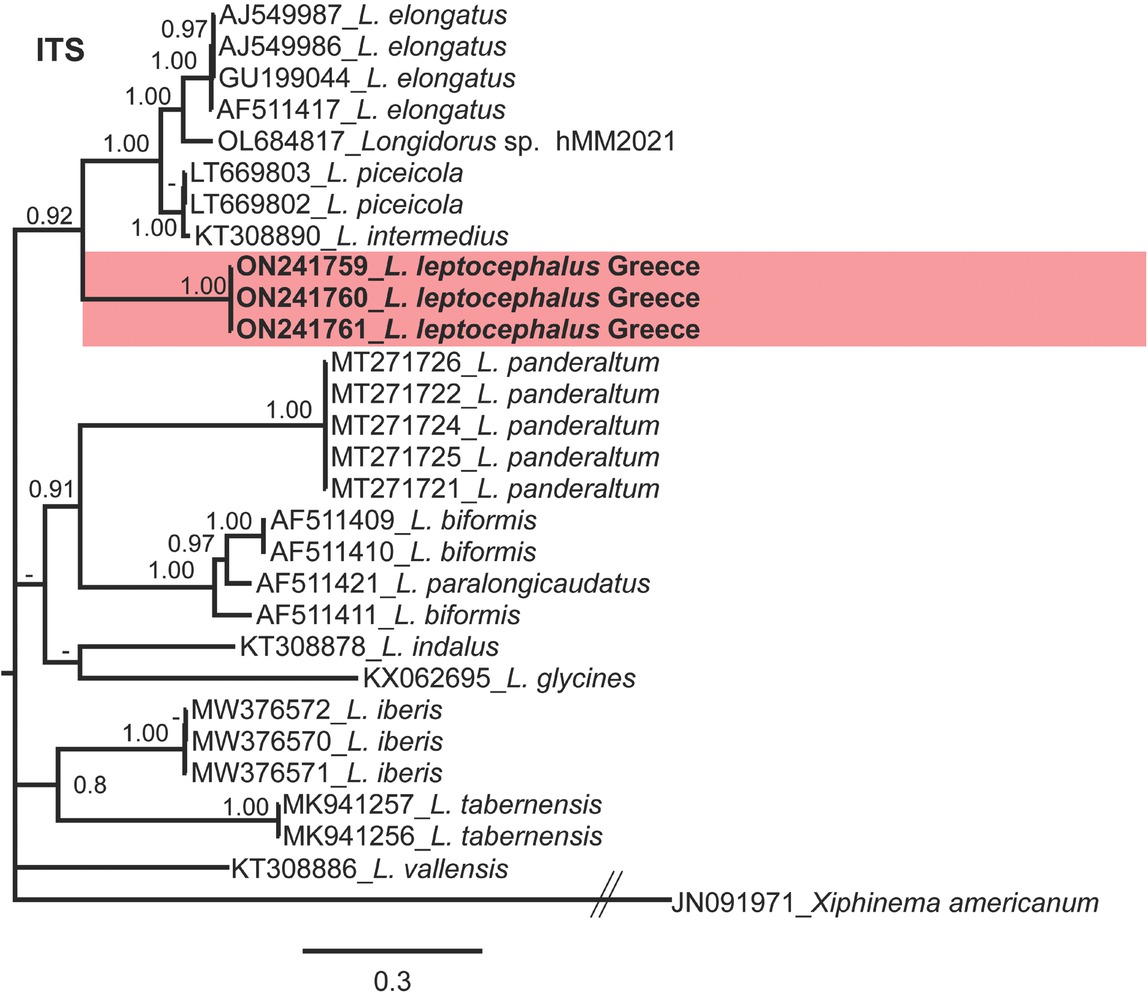
Figure 3
Phylogenetic relationships of Longidorus leptocephalus Hooper, 1961 from Greece within the genus Longidorus. Bayesian 50% majority rule consensus tree as inferred from ITS1 rDNA sequence alignment under the general time-reversible model of sequence evolution and a gamma-shaped distribution (GTR + G). Posterior probabilities more than 0.70 are given for appropriate clades. Newly obtained sequences in this study are shown in bold. Scale bar = expected changes per site. PP, posterior probabilities.
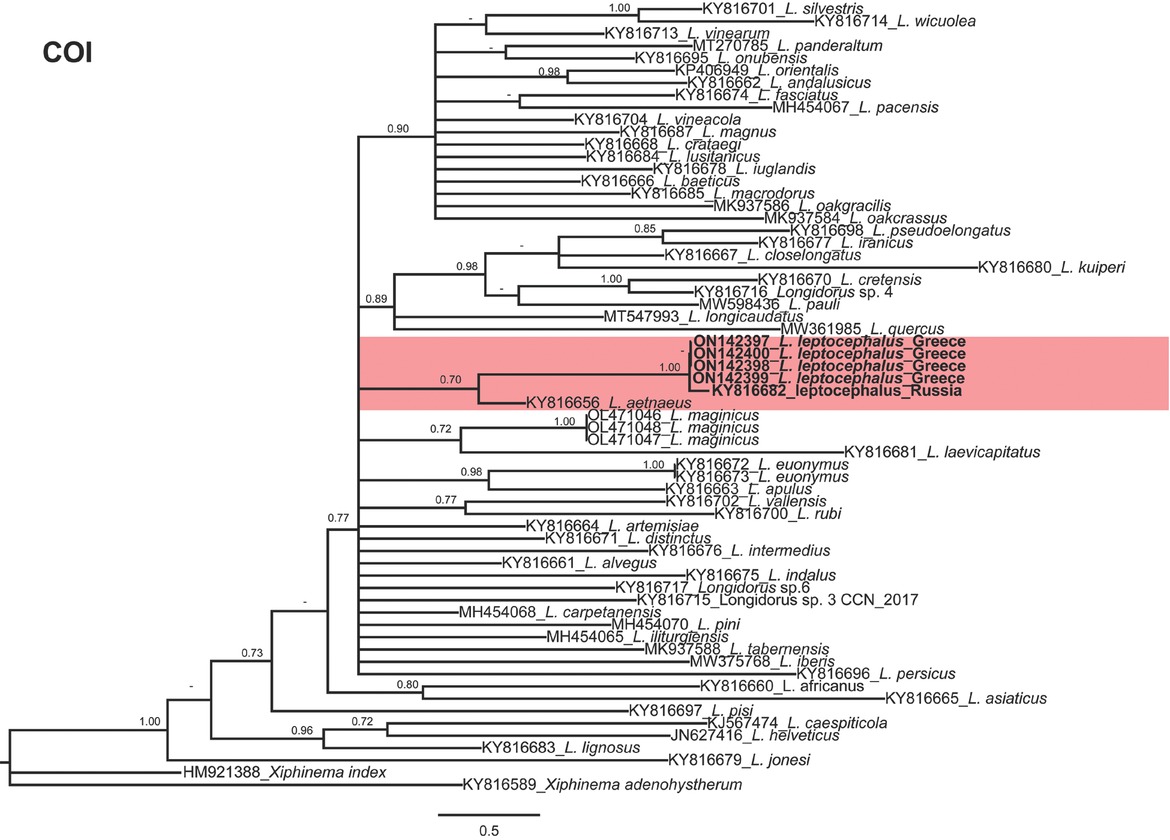
Figure 4
Phylogenetic relationships of Longidorus leptocephalus Hooper, 1961 from Greece within the genus Longidorus. Bayesian 50% majority-rule consensus trees as inferred from cytochrome c oxidase subunit I (COI mtDNA gene) sequence alignments under the TIM1 + G model. Posterior probabilities more than 0.70 are given for appropriate clades. Newly obtained sequences in this study are in bold letters. PP, posterior probabilities.