
Table 1
Comparison between different imaging modalities.
| Medical imaging modality | CT | US | MRI | EIT |
|---|---|---|---|---|
| Basic principle | X-rays | High frequency sound | Radio waves | Impedance |
| Types of radiation | Ionizing radiation | Non-Ionizing radiation | Non-Ionizing radiation | Non-Ionizing radiation |
| Contrast | High | Low | High | Low |
| Spatial Resolution | 50-200 μm | 50-500 μm | 25-100 μm | Low |
| Scanning time | <20 min | < 30 min | <40 min | <10 min |
| Cost | Moderate | Low | Very High | Low |
| Size | Non portable | Portable | Non portable | Portable |
| Advantages | Bone and tumor imaging, anatomic imaging | Visualize muscles, tendon and internal organs | Morphological and functional imaging | Rapid tomographic imaging, low cost, noninvasive |
| Disadvantages | High cost Ionizing radiation | Operator dependency | Noisy, cost, low sensitivity | Not mature yet |
Table 2
Electrical conductivity for Human tissues.
| Tissue | Conductivity (mS/m) |
|---|---|
| Cerebrospinal fluid | 1450 - 1800 |
| Blood | 500 - 650 |
| Scalp | 300 - 400 |
| Brain | 300 - 420 |
| Muscle | 200 - 400 |
| Fat | 50 |
| Bone | 6 |
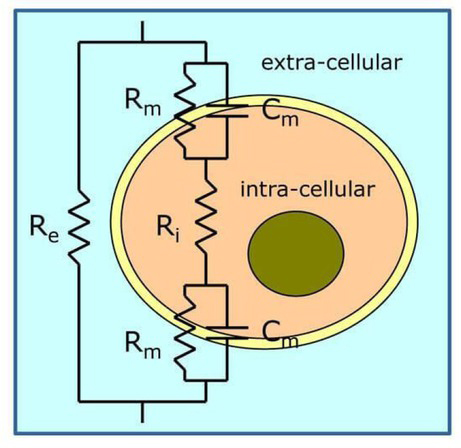
Fig.1
The equivalent electrical circuit model for tissues.
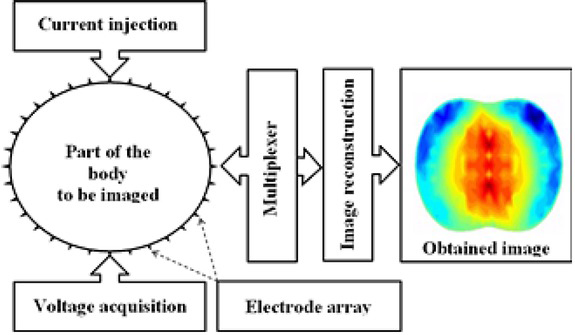
Fig. 2
Main parts of an EIT imaging system.
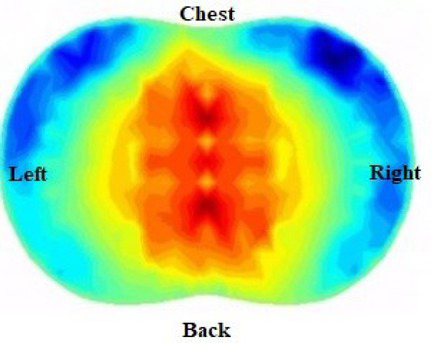
Fig. 3
Chest image reconstruction by EIT [21].
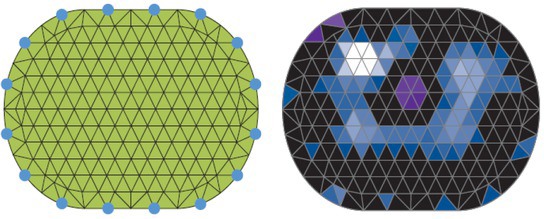
Fig. 4
FEM reconstruction, Left: 2D mesh with 340 finite elements for 16 surface electrodes. Right: FEM-based reconstruction of the bioimpedance distribution.
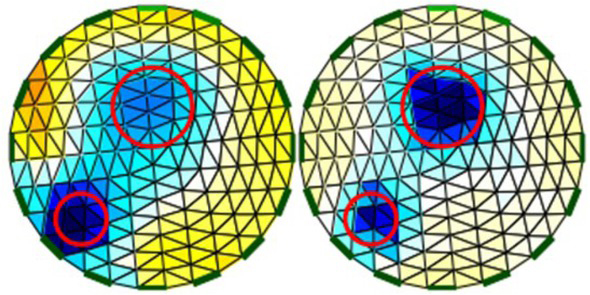
Fig. 5
Comparison of the phantom reconstruction obtained with the linear inverse solver (left), and the proposed method using ANN and PSO (right). Both targets are indicated by red circles [54].
Table 3
Image reconstruction algorithms.
| Reconstruction algorithm | Description |
|---|---|
| Linear approach | - Solves the forward problem - Iterations are limited |
| Simple stage reconstruction | - Solves the forward problem - Iterative processm - Very much used |
| Sheffield Back-projection | - Solves the forward problem - The best known for EITm - Not flexible |
| Newton-Raphson | - Solves the forward problem based on EMFm - Inverse problem thanks to matrix sensitivity |
| Optimization by particle swarms | - Solves the inverse problem |
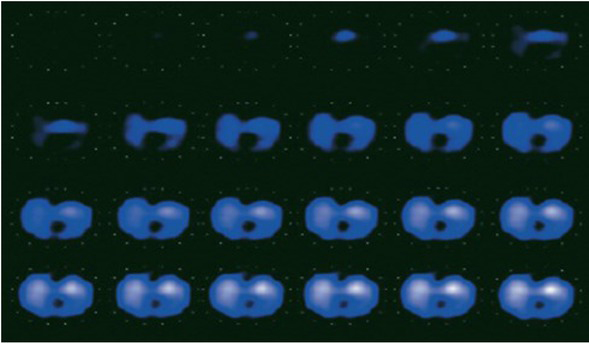
Fig. 6
Series of dynamic images showing air filling during inspiration by the PulmoVista500 system [81].
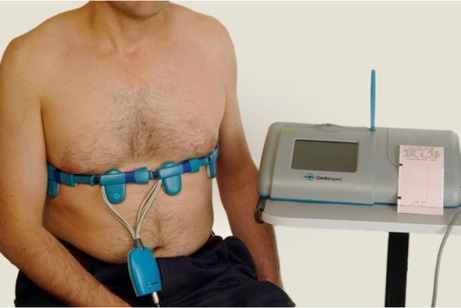
Fig. 7
Cardiac monitoring by CardioInspect system [88].