Have a personal or library account? Click to login
Deployment-related traumatic stressors and subclinical depression among peacekeeping veterans Cover

Deployment-related traumatic stressors and subclinical depression among peacekeeping veterans

Open Access
|Oct 2026
Read online

Figures & Tables

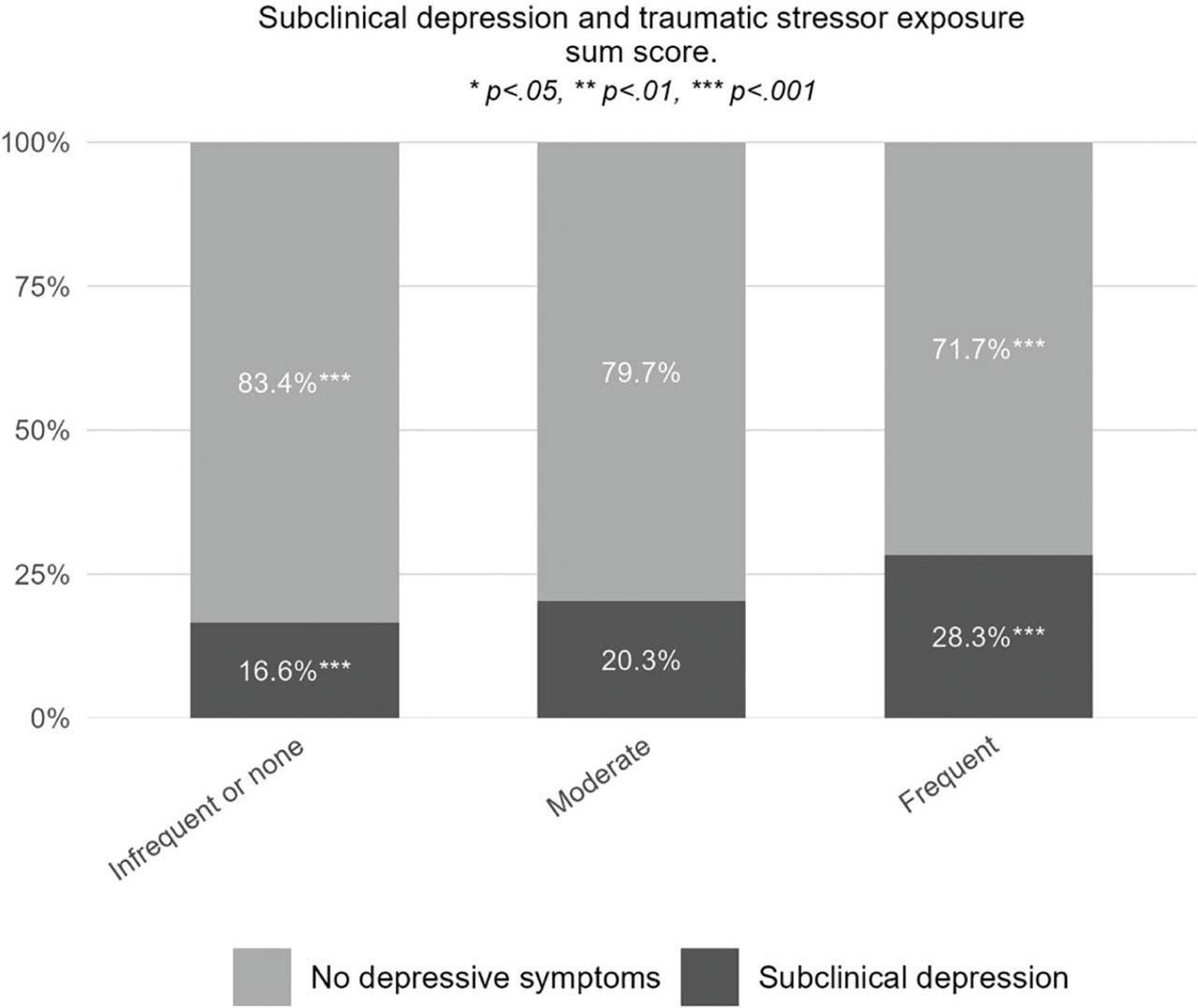
Fig. 1:

The connection between traumatic stressor experiences and subclinical depression (N = 2,258).

Tab. 1:

Variables significantly associated with subclinical depression.

Variableχ2dfpV
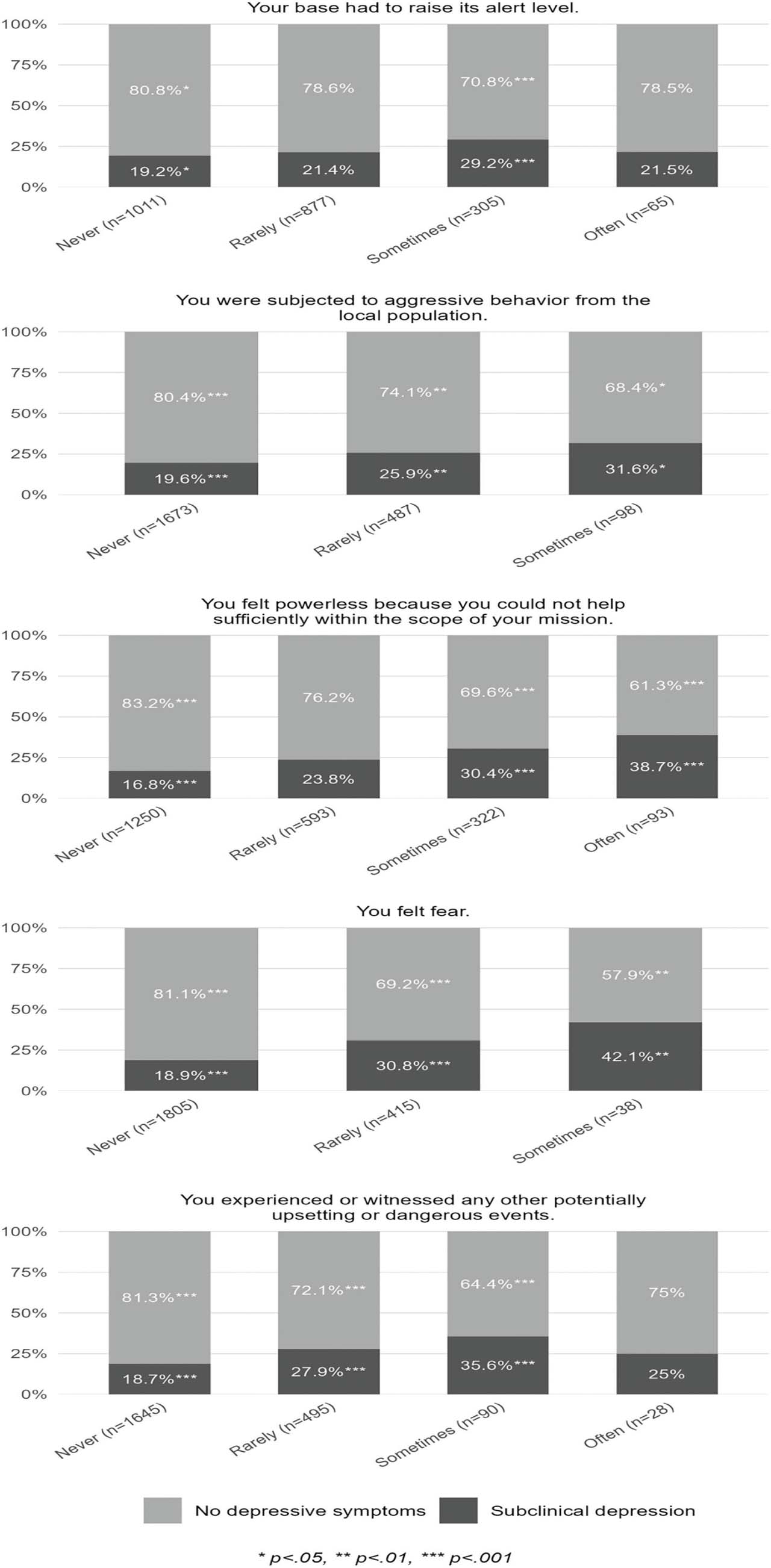
Your base had to raise its alert level.13.8730.003*0.08
You were subjected to aggressive behaviour from the local population.15.0520.001*0.08
You felt powerless because you could not help sufficiently within the scope of your mission.49.7730.001*0.15
You felt fear.38.3320.001*0.13
You experienced or witnessed any other potentially upsetting or dangerous events.30.2130.001*0.12

Note: χ2 = chi-square statistic; df = degrees of freedom; V = Cramer’s V effect size.

p-Values are uncorrected.

* p < 0.05 after Bonferroni correction for 16 comparisons (α = 0.003).

N = 2,258 for all analyses.

Fig. 2:

Associations between specific stressors and subclinical depression for the five stressors that remained statistically significant (N = 2,258).

DOI: https://doi.org/10.2478/jms-2026-0003 | Journal eISSN: 1799-3350 | Journal ISSN: 2242-3524
Language: English
Submitted on: Dec 5, 2025
Accepted on: Aug 19, 2026
Published on: Oct 30, 2026
Published by: National Defense University
In partnership with: Paradigm Publishing Services
Publication frequency: 1 issue per year

© 2026 Alex Siira, Toni Survonen, Petteri Simola, Sami Määttä, published by National Defense University
This work is licensed under the Creative Commons Attribution-NonCommercial-NoDerivatives 4.0 License.