
1. Introduction
In the context of promoting international stability, numerous states contribute personnel to peacekeeping operations across various regions (United Nations 2025). Peacekeepers experience varying levels of traumatic stressors depending on the mission’s location and danger, such as witnessing violence, seeing dead bodies and being attacked (Maguen et al. 2004; Forbes et al. 2016). Although most participants cope well with the stressors of deployment, multiple deployments or exposure to high-risk operations have been identified as risk factors for mental health disorders, such as major depression (Sareen et al. 2010; Forbes et al. 2016; Kaikkonen and Laukkala 2016). These issues with mental health can significantly impact peacekeeping veterans’ quality of life even if their symptoms fall below clinical thresholds set by diagnostic criteria (Yarvis and Schiess 2008).
One such phenomenon is subclinical depression, where an individual experiences depressive symptoms but does not meet the diagnostic criteria for a depressive disorder (Rodríguez et al. 2012). Subclinical depression is also recognised as a risk factor for the later development of major depression (Cuijpers and Smit 2004). This suggests that veterans who report subclinical symptoms are at an increased risk of developing more serious mental health problems if they do not receive the necessary support and treatment. Consequently, peacekeeping veterans suffering from subclinical depression are at risk of going unnoticed in check-ups and thereby not receiving the care they need. Despite this, research on peacekeeping forces has largely overlooked subclinical mental health conditions.
The present paper aims to bridge this gap by examining the connection between deployment-related traumatic stressors and subclinical depression among peacekeeping veterans. Furthermore, the purpose of the present paper is to identify which types of traumatic stressors are most strongly associated with symptoms of depression. This study aims to support the development of improved screening methods (Anyan et al. 2024) and targeted interventions for veterans experiencing subclinical mental health issues that nonetheless affect their overall wellbeing.
2. Background
2.1. Depression
One of the most common mental health disorders is depression: it is estimated that about 250,000 Finnish adults, or about 5–6% of the adult population, suffer from depression at any given time (Kampman et al. 2017). It is a multi-faceted mental health disorder characterised by core symptoms such as a depressed mood, reduced interest or pleasure and fatigue (Kampman et al. 2017). The effects of depression on both individual and societal levels are significant and severe. Mental health disorders are the most common reason for retirement on disability pension in Finland, with depression being the single largest cause: on average, nine Finns retire daily due to depression (Eläketurvakeskus 2022), and about half of Finland’s new mental health-based pensions are due to depression (Kampman et al. 2017).
2.2. Subclinical depression
Subclinical depression has many definitions, but it generally refers to a condition where an individual experiences two to four depressive symptoms for a minimum of 2 weeks without meeting the diagnostic criteria for clinical depression (Rodríguez et al. 2012). It has been recognised as being associated with a reduced quality of life, increased use of health services, comorbidity with other diseases and mental health disorders (Rodríguez et al. 2012), as well as an increased risk of mortality (Cuijpers et al. 2013). Individuals with subclinical depression are at heightened risk of being overlooked in research, as depression is commonly identified through prior clinical diagnoses or symptom screening scores that exceed established thresholds.
2.3. Peacekeeping veterans and mental health
Peacekeeping refers to activities aimed at maintaining or restoring international peace, protecting civilian populations, or supporting humanitarian relief efforts in conflict areas (Act on Military Crisis Management 2006). According to the Finnish Defence Forces (2026), Finland participates, for example, in the UN-led UNIFIL operation in Lebanon with a continuous presence of approximately 200 peacekeepers. Finnish peacekeepers are also deployed to Ukraine, Kosovo and Somalia, for instance, in various operations whose objectives range from training local security authorities to protecting the civilian population and carrying out engineering tasks (Finnish Defence Forces 2026).
Most participants in peacekeeping missions handle the stressors of the deployment well and do not experience elevated levels of mental health problems compared to the general population (Sareen et al. 2010; Kaikkonen and Laukkala 2016). For example, among Finnish peacekeeping veterans, the rates of depression and posttraumatic symptoms are below the averages of the general population (Sahramäki et al. 2024). This is in part due to selection processes that screen for highly functioning individuals (Saito et al. 2025) as well as other predeployment, deployment and postdeployment factors.
However, some studies have found peacekeeping operations to be associated with poor mental health (e.g. Litz et al. 1997; Asmundson et al. 2002; Forbes et al. 2016), with one study on Australian peacekeepers reporting posttraumatic stress disorder (PTSD) rates three times higher than those in the general population and an elevated suicide risk among peacekeeping veterans (Forbes et al. 2016). None of the aforementioned studies included Finnish peacekeepers. The operations examined in these studies included high exposure to traumatic stressors, which has been identified as the most consistent risk factor for distress among peacekeepers (Dirkzwager et al. 2005). The varied findings across studies on the mental health effects of peacekeeping operations are therefore most likely explained by differences in the nature and severity of traumatic stressor exposure across operations (Sareen et al. 2010; Souza et al. 2011)
Mental health problems in peacekeeping forces have also been observed over a longer period. Dutch peacekeepers showed worsening mental health over time, with more symptoms reported at 10 years post-deployment than 2-years post-deployment (van der Wal et al. 2023), demonstrating that mental health problems among peacekeeping veterans carry the risk of deteriorating over the long term. Despite the risk of more severe symptoms presenting only years after deployment, to date only one study has examined subclinical psychological symptoms among peacekeeper veterans, where it was found that veterans experiencing subclinical symptoms of PTSD were more likely to suffer from poor health and depression (Yarvis and Schiess 2008). No other similar studies on subclinical depression exist in current literature.
2.4. Traumatic stressors among peacekeeping veterans
The demands and risks associated with peacekeeping deployments vary significantly depending on the country of deployment and the specific nature of the tasks assigned during the mission. Peacekeeping forces are therefore exposed to varying levels of different traumatic stressors during deployment, which refer to actual or threatened death, severe injury, or sexual violence (American Psychiatric Association 2013). Examples of traumatic stressors on peacekeeping missions include operating in dangerous areas, combat exposure, witnessing shocking events, and handling bodies (Bartone et al. 1998; Maguen et al. 2004; Forbes et al. 2016). Exposure to unexpected and severe traumatic stressors, especially direct attacks and firefights, has been associated with a higher risk of PTSD and other psychological problems (Hoge et al. 2004).
Research on warzone traumatic stressors has traditionally focused on physical danger and bodily harm, whereas more recent studies have found that non-danger-based stressors, such as witnessing the suffering of others and exposure to moral stress, can be as traumatic as danger-based stressors (Jordan et al. 2017; Nordstrand et al. 2019). Moral stress occurs when an individual witnesses, participates in, or fails to prevent actions that transgress their core moral beliefs (Litz et al. 2009). Moral stress can lead to various mental health symptoms and psychological problems, referred to as moral injury (Litz et al. 2009). Killing in combat, for instance, has been shown to have a potentially morally injurious effect on peacekeepers (Nordstrand et al. 2025). In one study examining Norwegian veterans deployed to Afghanistan, non-danger-based stressors such as morally challenging events were found to be associated with a broader range of symptoms, including depression, whereas danger-based stressors were associated only with a rise in posttraumatic stress symptoms (Nordstrand et al. 2019).
Only one study has previously examined the relationship between traumatic stressor exposure and depression among Finnish peacekeeping veterans (Sahramäki et al. 2024), where the authors found that frequent or daily exposure was associated with depressive symptoms above the clinical threshold. The study by Sahramäki et al. (2024) was conducted using the same dataset as the present study. However, it did not examine subclinical depression, nor did it identify which specific types of stressors were associated with depression.
The present study aims to address these gaps by examining the associations between different types of traumatic stressors and subclinical depression among Finnish peacekeeping veterans, and by identifying whether certain stressor types carry a particularly elevated risk for subclinical depression relative to others.
3. Methods
3.1. Participants
Participants were selected from Finnish Peacekeeping veterans who answered the repatriation survey, administered via the Moodle online platform, between September 2015 and August 2020. The data used in this study were split from this larger survey dataset collected on Moodle. An overview of the entire dataset has been published by Sahramäki et al. (2024). The peacekeepers whose scores on the Depression Scale (DEPS) (Salokangas et al. 1995), indicated a high likelihood of clinical depression were excluded from this study (n = 59).
The final sample consisted of 2,258 participants. The peacekeepers were fairly evenly distributed across age groups, with 33% aged under 25, 24% aged 25–30, 23% aged 31–40, and 20% over 40 years old. Peacekeeping experience varied among participants, with nearly two-thirds (64%) on their first deployment, 18% on their second, 9% on their third, and 9% on their fourth or subsequent deployment. Almost all peacekeepers finished their deployment as planned (97%). When participants completed the survey, the majority had repatriated 1–3 months prior (67%), while 30% had repatriated 4–7 months prior, and only 3% had repatriated over 8 months prior.
3.2. Measures
Traumatic stressors were measured using a 16-item scale in the repatriation survey, including items such as ‘You felt fear’, ‘You saw dead people’, ‘You saw humanitarian distress or suffering’, and ‘You felt powerless because you could not help sufficiently within the scope of your mission’. Participants rated the frequency of each stressor experienced during deployment using a 5-point Likert-type scale ranging from never (0), rarely (1), sometimes (2), often (3), to daily (4).
First, a sum score was calculated by adding up all traumatic stressor item responses. The sum score was further divided into three categories based on the number of traumatic stressors experienced by the participants: ‘Infrequent or none’ (sum score ≤2), ‘Moderate’ (sum score 3–5), and ‘Frequent’ (sum score ≥6). These three categories were formed based on percentiles to ensure approximately equal numbers of participants in each group. This categorised variable of traumatic experiences was used in all analyses of association with depression.
Second, subclinical depression was assessed using the 10-item DEPS-scale in the repatriation survey. The DEPS-scale is a symptom questionnaire developed for depression screening (Salokangas et al. 1995). It includes statements such as ‘I am suffering from insomnia’ and ‘I felt that I have lost all joy from my life’. Participants rated the frequency of each symptom experienced during the previous month using a 4-point Likert-type scale ranging from ‘Not at all’ (0) to ‘Very much’ (3). Based on the DEPS-scale sum score, participants were classified into two categories: ‘No depressive symptoms’ (sum score 0–1) and ‘Subclinical depression’ (sum score 2–8). Those who score 9 or more points on DEPS are likely to meet the criteria for clinical depression (Salokangas et al. 1995), and therefore those participants (n = 59) were excluded from this study.
3.3. Statistical analysis
All statistical analyses were performed using R version 4.1.1 (R Foundation for Statistical Computing, Vienna, Austria) (R Core Team 2021). The following R packages were used: haven for data import (Wickham et al. 2023), Amelia (Honaker et al. 2011) and psych (Revelle 2023) for data inspection, dplyr for data preparation (Wickham et al. 2021), ltm for reliability analysis (Rizopoulos 2006), rcompanion for effect size calculations (Mangiafico 2024) and ggplot2 for visualisation (Wickham 2016).
The prevalence of specific traumatic stressors was assessed using cross-tabulation. The association between traumatic stressors and subclinical depression was examined using a chi-square test. The relationship between specific traumatic stressors and subclinical depression was also examined using chi-square tests. Post-hoc analysis of significant chi-square results was conducted using standardised residuals to identify which cells contributed most to the overall association.
4. Results
4.1. Descriptive results
Examination of the DEPS scale sum score histogram revealed a heavily right-skewed distribution (M = 0.9, SD = 1.6, range 0–8). Approximately 80% of participants (n = 1,773) reported 0–1 on the DEPS scale, while 20% (n = 485) scored between 2 and 8 on the DEPS scale. The traumatic stressor sum score histogram also revealed a positively skewed distribution (M = 4.6, SD = 4.2, range 0–30). However, compared to the DEPS scale, the skewness was more moderate. Approximately 38% of participants scored 0–2 points, 29% scored 3–5 points and 33% scored 6 points or higher. The distribution showed a clear pattern of decreasing frequency as stressor scores increased.
Assessment of specific traumatic stressor frequencies revealed considerable variation in what stressors were experienced during deployment (see Appendix for full item wording). For example, only two participants (0.1%) reported experiencing either of the following combat situations rarely or more frequently: ‘You fired at a target’ or ‘You fired a warning shot’. Similarly, very few participants (2%, n = 45) reported exposure to direct fire or having had to handle corpses. However, for all other stressors, at least 100 participants reported experiencing them rarely or more often.
4.2. The connection between traumatic stressor experiences and subclinical depression
First, the association between the prevalence of traumatic stressor experiences and subclinical depression was examined using a chi-square test of independence. Results revealed a significant association between traumatic stressor exposure and subclinical depression (χ2(2) = 33.10, p < 0.001, Cramer’s V = 0.12) with greater stressor exposure associated with higher levels of subclinical depression (see Figure 1). Post-hoc analysis using standardised residuals revealed that the association was primarily driven by an overrepresentation of subclinical depression in the frequent stressor exposure group (z = 5.48, p < 0.001) and an underrepresentation in the infrequent/no exposure group (z = −4.44, p < 0.001).
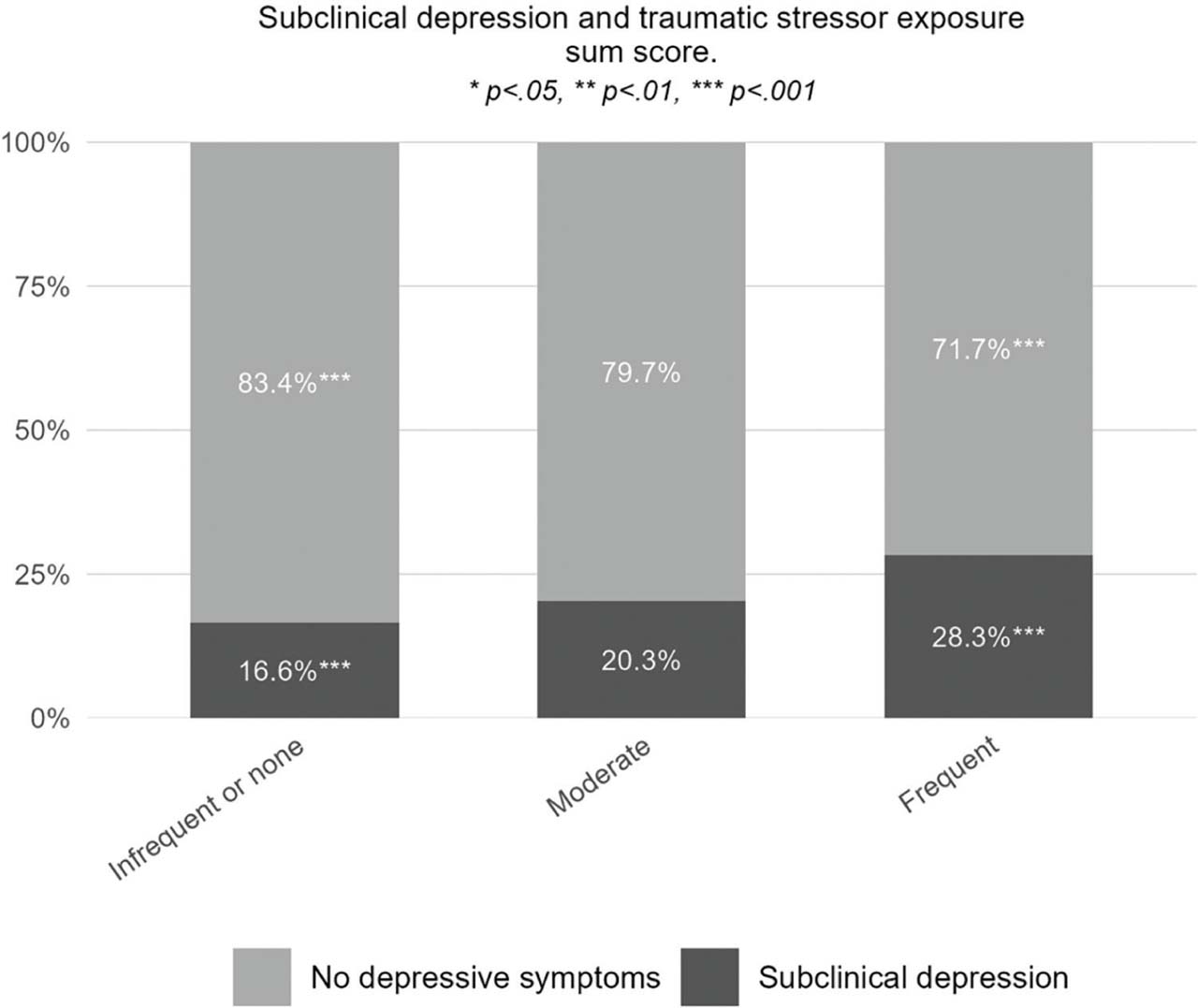
Fig. 1:
The connection between traumatic stressor experiences and subclinical depression (N = 2,258).
4.3. The connection between specific traumatic stressors and subclinical depression
The association between specific traumatic stressors and subclinical depression was assessed using chi-square tests of independence. Where expected cell frequencies fell below five, response categories were combined. Where combining categories was not meaningful (typically when a variable was near binary with fewer than 20 non-zero responses) Fisher’s exact test was used instead. Of the 16 traumatic stressor variables examined, six showed statistically significant associations with subclinical depression at α = 0.05. Given the multiple comparisons, Bonferroni correction was applied (α = 0.05/16 = 0.003). Five associations remained statistically significant after correction (see Table 1).
Tab. 1:
Variables significantly associated with subclinical depression.
| Variable | χ2 | df | p | V |
|---|---|---|---|---|
| Your base had to raise its alert level. | 13.87 | 3 | 0.003* | 0.08 |
| You were subjected to aggressive behaviour from the local population. | 15.05 | 2 | 0.001* | 0.08 |
| You felt powerless because you could not help sufficiently within the scope of your mission. | 49.77 | 3 | 0.001* | 0.15 |
| You felt fear. | 38.33 | 2 | 0.001* | 0.13 |
| You experienced or witnessed any other potentially upsetting or dangerous events. | 30.21 | 3 | 0.001* | 0.12 |
Post-hoc examination of standardised residuals was conducted for the five variables that remained significant after Bonferroni correction to identify which response categories contributed most to the associations with subclinical depression. Standardised residuals with absolute values ≥1.96 were considered indicative of significant deviations from expected frequencies (see Figure 2).
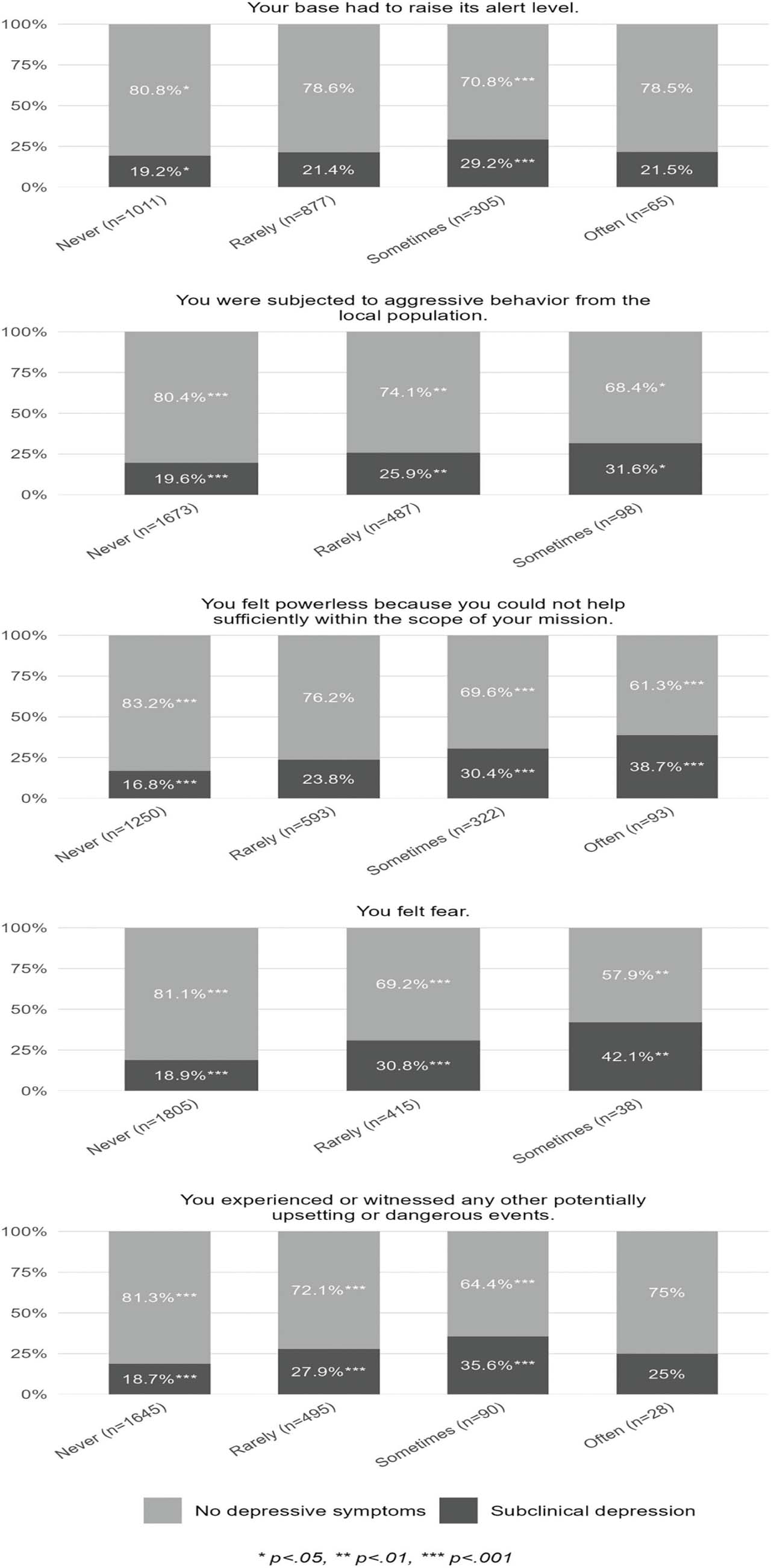
Fig. 2:
Associations between specific stressors and subclinical depression for the five stressors that remained statistically significant (N = 2,258).
As is seen in Figure 2, for base alert level increases, participants responding ‘sometimes’ demonstrated significantly higher subclinical depression rates than expected (standardised residual = 3.52), while those responding ‘never’ showed lower rates (standardised residual = −2.39). Similarly, exposure to aggressive behaviour from local populations revealed that participants who ‘never’ experienced such behaviour had lower subclinical depression rates (standardised residual = −3.67), whereas those experiencing it ‘sometimes’ had higher rates (standardised residual = 2.50).
Personal fear responses yielded strong associations with subclinical depression. Participants who ‘never’ felt fear during deployment had substantially lower subclinical depression rates (standardised residual = −5.98), while those feeling fear ‘rarely’ or ‘sometimes’ had higher rates (standardised residuals = 5.14 and 3.12, respectively).
General stressor exposure also showed significant associations, though the broad nature of ‘other potentially upsetting or dangerous events’ limits specific interpretation. Participants experiencing such events ‘rarely’ or ‘sometimes’ demonstrated elevated subclinical depression rates (standardised residuals = 3.92 and 3.32), while those never exposed showed lower rates (standardised residual = −5.22).
The most robust association emerged from feelings of powerlessness due to inability to help sufficiently within mission constraints (Cramer’s V = 0.15). Participants responding ‘sometimes’ or ‘often’ demonstrated elevated subclinical depression rates (standardised residuals = 4.23 and 4.13, respectively), while those ‘never’ experiencing such feelings showed substantially lower rates (standardised residual = −6.03).
5. Discussion
The aim of this study was to examine the relationship between traumatic stressors and subclinical depression in peacekeeping veterans. Where previous studies have often focused on depressive symptom scores exceeding clinical thresholds (e.g. van der Wal et al. 2023; Sahramäki et al. 2024) or major depression (e.g. Forbes et al. 2016) in peacekeeping veterans, the present study provides new insight into the field by examining subclinical depression.
Frequent exposure to traumatic stressors was associated with an increased risk of subclinical depression: the more traumatic stressors a participant reported, the more likely they were to also report subclinical depression. This aligns with prior research linking traumatic stressor exposure on peacekeeping missions to psychological distress, PTSD symptoms (Sareen et al. 2010) and post-deployment major depression (Forbes et al. 2016). Further analysis found significant associations between 5 out of 16 assessed stressors and symptoms of depression; the nature of these stressors ranged from base alert level raises to facing aggressive behaviour from local inhabitants. The other 11 stressors showed no significant associations with subclinical depression; these included rare combat-related events such as being targeted by indirect or direct fire, firing shots at hostile targets as well as handling corpses, which were infrequently reported in the peacekeeper sample.
One traumatic stressor had the strongest dose-response relationship with subclinical depression: a feeling of powerlessness from being unable to help sufficiently within one’s role, measured by the statement: ‘You felt powerless because you could not help sufficiently within the scope of your mission.’ Among veterans who reported having experienced this feeling often (n = 93), almost 40% also reported subclinical depression, while among those who reported never feeling it (n = 1,250), only roughly 17% reported subclinical depression. This relationship suggests a strong link between feelings of powerlessness stemming from moral transgressions and symptoms of depression.
Interestingly, feeling unable to help sufficiently within one’s role on military missions seems to fit the description of moral injury (Litz et al. 2009). The reported feeling of powerlessness could therefore reflect broader experiences of moral transgression and guilt, contributing to subclinical depression by the time of repatriation. This conclusion is supported by previous research indicating that especially non-danger-based stressors, such as moral injury, were found to be associated with symptoms of depression, whereas danger-based stressors were exclusively associated with symptoms of PTSD (Nordstrand et al. 2019). However, powerlessness was assessed with a single questionnaire item in the present study. Future research should employ validated moral injury measures such as the Moral Injury Outcome Scale (MIOS) (Litz et al. 2022) to sort out moral injury from other possible mechanisms, such as fear responses and learned helplessness.
Despite almost one in five peacekeepers in the sample reporting feelings of powerlessness at least sometimes, the peacekeepers in this study operated in relatively safe, non-combat conditions. Only 2% of participants reported coming under direct fire or handling corpses, and just two participants reported firing their weapon at someone. This contrasts with previous peacekeeper studies that have examined operations with much higher combat exposure (Hoge et al. 2004; Forbes et al. 2016). While danger-based stressors carry psychological risks of their own, peacekeeping missions are usually so safe that boredom has been established as a common stressor for peacekeepers (Raju 2014). One Finnish study even found that experiencing some potentially traumatic events was associated with a more positive outlook on the mission, perhaps through providing a sense of purpose as suggested by the authors (Sahramäki et al. 2024).
Our findings appear to support this conclusion: for two stressors in our analysis, participants in the most frequent exposure group showed unexpectedly lower levels of subclinical depression compared to groups of less frequent exposure. The two stressors in question were: ‘Your base had to raise its alert level’ and ‘You experienced or witnessed any other potentially upsetting or dangerous events’ (see Figure 2). This pattern may reflect the phenomenon described above, where frequent engagement with certain challenging aspects of the mission contributes to better psychological outcomes. These findings suggest that safe but unstimulating conditions may paradoxically increase the likelihood that peacekeepers feel powerless to adequately respond to the humanitarian distress they witness. This sense of powerlessness in relatively secure environments may in turn foster moral injury and contribute to subclinical depression.
Approximately 80% of participants (n = 1,773) belonged to the ‘No depressive symptoms’ -group, which is likely a consequence of adequate pre-selection and assessment: Finnish peacekeepers are typically healthy and well-functioning individuals who have voluntarily accepted the potential risks involved in the mission (Shemeikka et al. 2022). This result is consistent with previous studies, which have shown that most peacekeeping veterans return home without mental health disorders (Forbes et al. 2016; Kaikkonen and Laukkala 2016) and cope well with the stressors of the mission (Sareen et al. 2010). The finding also supports previous research indicating that Finnish peacekeeping forces rate their psychological well-being as good (Shemeikka et al. 2022).
However, roughly one in five participants (n = 485) reported subclinical depression. Depressive symptoms in peacekeeping veterans have been found to increase over time, with symptoms worsening many years after repatriation (van der Wal et al. 2023). Subclinical depression is also generally recognised as a risk factor for the later development of major depression (Cuijpers and Smit 2004). This suggests that veterans who report subclinical depression are at an increased risk of developing more serious mental health problems if not met with adequate support. Additionally, subclinical depression by itself has proven harmful both for the individual suffering from it as well as for the broader society (Rodríguez et al. 2012; Cuijpers et al. 2013). Social and healthcare services should therefore guide veterans with subclinical depression towards the necessary support, such as social workers or psychologists, before psychological problems develop into more serious conditions. By preventing more severe disorders through timely treatment and support, the financial costs of care can be minimised and individuals can receive the help they need promptly.
Operationalising subclinical depression proved challenging in this study. The concept is problematic because there is no consensus on its definition or diagnostic criteria (Cuijpers and Smit 2004; Rodríguez et al. 2012). In this study, individuals who scored 2–8 points on the DEPS scale were classified as experiencing subclinical depression. However, this category of people is highly heterogeneous in terms of their functioning and well-being, and is likely to include many healthy subjects. Future studies should place greater emphasis on distinguishing subclinically depressed individuals from those who are functionally healthy to avoid unnecessary strain on healthcare services and undue concern for individuals. Additionally, results obtained through the DEPS-scale, like other symptom questionnaires, are susceptible to various biases. For example, stigma has been shown to influence how peacekeeping veterans respond to surveys, making it more difficult to identify those in need of care (Ben-Zeev et al. 2012; Warner et al. 2011).
The problems with measuring depression are not limited to subclinical depression. Significant issues of validity and reliability in the diagnosis of mental health disorders have raised the need to shift from a diagnosis-centered perspective to a systems-theoretical perspective (Fried et al. 2022). Many researchers representing this perspective have highlighted how depression is a complex system composed of multiple factors and their interrelationships, rather than a disorder caused by a single factor (Kendler et al. 2011; Borsboom 2017; Robinaugh et al. 2020). Focusing solely on symptoms overlooks supportive factors, such as the sense of meaning a peacekeeper feels with regards to their operation. Future research on the mental health of peacekeeping veterans should thus aim to take a more holistic view to effectively address the psychological consequences of peacekeeping operations.
6. Conclusion
The present study suggests that exposure to traumatic stressors during deployment increases the risk of subclinical depression among peacekeeper veterans. A wide range of traumatic stressors revealed to be associated with symptoms of depression, with the strongest single predictor being a feeling of powerlessness from being unable to provide sufficient help within the peacekeeper role – a finding that points to moral injury as a likely factor in the development of subclinical depression. These results highlight the critical need for post-deployment care and mental health assessment that can identify and support veterans experiencing mild psychological symptoms before they progress to more severe conditions.
Notes
Appendices
Appendix
Survey items: Events during operation
How often did the following events happen to you personally during the crisis management operation? Response options: Never – Rarely – Sometimes – Often – Daily.
71. You were subjected to indirect fire.
72. You were subjected to direct fire.
73. You fired a warning shot.
74. You fired at a target.
75. Your base had to raise its alert level.
76. You saw wounded people.
77. You had to assist wounded people.
78. You saw dead people.
79. You had to handle dead bodies.
80. You had to travel on foot or by vehicle through mined areas.
81. You were subjected to aggressive behavior from the local population.
82. You witnessed violence directed at another person.
83. You saw humanitarian distress or suffering.
84. You felt powerless because you could not help sufficiently within the scope of your mission.
85. You felt fear.
86. You experienced or witnessed any other potentially upsetting or dangerous events.