
What makes a successful military operation? Some background
For military planners, this question has been, and still is, one of the most perplexing problems a military organisation can be confronted with. Many factors play into answering this question. Is it enough to have superior forces? Can a high fighting spirit ensure success? What role does information sharing have in planning?
The scientific research groups in North Atlantic Treaty Organization (NATO) have attempted to construct a model on how to adopt the most optimal approach to command and control in military operations regardless of force composition and mission type.
The concept is called Command and Control Agility or C2 Agility for short. The purpose was to look at military operations from the level of decision-making perspective in order to design the most optimal approach to organisation, decision-making, communications, command and control for any military organisation.
The conceptual tool of Command and Control Agility have been used for planning and executing of military operations. 1, 2, 3, 4, 5
The concept is defined as a conceptual tool to be adapted to any organisation (military or otherwise) engaged in a multitude of different tasks (not necessarily warfighting), and thus the concept may have been seen as a tool that may be valuable in specific cases but difficult to apply in a general manner.
However, the scientific basis of the NATO scientific task groups (SAS-065 and SAS-085 and SAS-104) has proven that the concept has merit in specific cases and scenarios as a tool to enhance the chance for a successful outcome in a military operation. However, these studies lack the statistical analysis required to answer whether the concept has merit as providing a statistical significance for a successful outcome in military operations.
The concept has been disseminated throughout most of the national militaries of NATO; however, it has not been adopted as universal doctrine nor is its correct application universally understood or indeed known by individual NATO officers and units. Part of this reason is that current research has lacked a significant statistical analysis on a data set with comparable cases to give a statistical significance of the concept’s importance in military operations.
Appendix B: Manoeuvre in the C2 Agility Space illustrated examples
Bibliography and Literature List
1. Thesis
Does having the capability of having agility within command and control have a statistically significant contribution to success in joint military operations?
This paper will investigate whether C2 Agility has a statistical significance 6 on the successful outcome of a joint military operation. The concept of C2 Agility will allow a force to be more effective if it selects the most appropriate approach to Command and Control for the given mission and the changing circumstances.
The purpose is to determine the significance of C2 Agility in joint military operations by giving a mathematical statistical basis for its potentially added value and thus investigating if C2 is worth investing in instead of having a one-type fits all C2 approach.
Agility is an organisation’s ability to cope with and/or exploit changes and C2 Agility is the ability to do so with the selection of the most appropriate C2 approach, as well as the ability to change C2 approach if the current one is no longer appropriate.
While other factors will also influence outcomes, adopting the most appropriate C2 approach enables entities to effectively and efficiently employ the resources they have promptly in a variety of missions and circumstances. 7 As such, C2 is considered the overarching binding effort of all the sub-elements of a military operation, and this paper will investigate if C2 Agility theory, with its definition given above, has a statistical significance on the successful outcome of a joint military operation by using statistical analysis on historical case studies.
Whether C2 Agility has a statistical significance for a successful outcome will be investigated by conducting a controlled study of 43 historical cases, which will be selected by a set of criteria which in order to get a data set that is comparable with reduce selection bias but still based on real operational data.
Agility is an organisation’s ability to cope with and/or exploit changes and C2 Agility is the ability to do so with the selection of the most appropriate C2 approach, as well as the ability to change C2 approach if the current one is no longer appropriate.
While other factors will also influence outcomes, C2 Agility enables entities to effectively and efficiently employ the resources they have in a timely manner in a variety of missions and circumstances. 8 As such C2 is considered the overarching binding effort of all the sub-elements of a military operation.
1.1. A note on relevancy
The conceptual theory of C2 Agility has been a feature in planning and executing of military operations throughout military history. 9, 10, 11, 12, 13 The theory can be adapted to any organisation (military or otherwise) engaged in a multitude of different tasks (not necessarily warfighting).
The concept of C2 Agility is not written to describe military command and control (or indeed any type of command and control) in a time specific era or for specific scenarios. It is a concept that describes the characteristics of organisations that are optimised for specific tasks or missions under specific assumptions about the operating environment, including the threat.
Command and Control Agility as a concept has also been applied in emergency management 14, 15, 16, 17 during natural disasters around the world. In these scenarios, it has been easier to measure the tangible effect of its application however this paper will focus only on the military application of the concept.
Generally, in the literature it is recognised as being most relevant for the industrial age (mid or late 18th century) to the 21st century. 18 Further Agility within C2 is not a new or recently discovered capability or property of humans or collection of humans as cite in and the application of military C2 Agility predates its written papers. 19 To confirm this, the oldest case study featured in NATO SAS-104 final report was the Battle of Trafalgar in 1805.
The scientific basis of the theory has been the focus of the NATO scientific task groups (SAS-065 and SAS-085, SAS-104 and latest SAS-143), and these reports have also investigated the merit of the C2 Agility concept by using a combination of case studies and simulations.
The NATO-STO report SAS-143 approaches the same problem as this paper on how to adopt the most appropriate C2 approach for multi-domain operations. SAS-143 used five detailed historical case studies and then ran several simulations. SAS-143 tested C2 Agility through 480 simulation runs in the Experimental Laboratory for the Instigation of Information sharing, collaboration and Trust (ELICIT) ecosystem developed by the US DoD Command and Control Research Program (DoD CCRP) to explore the appropriateness of different approaches to command and control under a variety of circumstances, stresses and conditions. 20
This method differs considerably from the method in this paper. This paper does not use simulated runs but instead uses 43 real operational cases set in authentic mission environments and using real scenarios and real operational frameworks. In short, this paper uses operational experience and historical operational performance when investigating the statistical significance of the C2 approach.
This paper does not use constructed or purposely designed scenarios in a controlled simulated environment. The data used for this paper is taken from actual operations with its associated records.
Forty-three cases are a smaller number of cases as opposed to 480 cases, but the applied mathematical statistical method selected for this paper takes the number of cases into consideration with appropriate validation test.
In addition to this SAS-143 featured five detailed case studies from recent actual operations. The method of case study for SAS-143 is the same as is used in this paper. However, the cases are presented with a summary and the findings only. It would be beyond the scope of this paper to feature a detailed study of each of the 43 cases.
It should be noted that the case studies presented so far in the literature of agility, including NATO STO-SAS-104 and NATO STO-SAS-143 have not been of a comparable nature with no uniformly defined common parameters and with a high risk of suffering from selecting bias. Thus, they are not suited, from a statistical point of view, to run a comparison statistical analysis.
This paper will use 43 case studies selected from a set of criteria that will ensure homogenous case selection. Each case will be studied in regard to if it was successful and if it employed the concept of C2 Agility. 21 It is important to note that this paper does not automatically assume that an appropriate C2 approach automatically guarantees success. It is also important to note that the case studies will be from the period 1940 to 1945.
The reason for selecting World War II (WWII) is that during the current Russo-Ukrainian war (initiated in February 2022), the question of C2 approach in a high-intensity warfare scenario against a near-peer opponent has again become highly relevant for the militaries of NATO.
1.2. The relevance of WWII scenarios with modern 21st-century combat scenarios
Despite the different eras, high-intensity combat against near-peer adversaries today shares several fundamental similarities with the combat situations faced during WWII. Both contexts involve complex, multidimensional operations requiring integrated land, sea, air and electronic warfare, often in environments characterised by intense engagement and rapidly shifting situations. While some of these elements were also present in counterinsurgency operations such as Vietnam, Iraq and Afghanistan, these types of operations had a several key components that differ considerably. As for NATO countries, the most recent prolonged (there are of course scenarios of shorter duration post-WWII) experience in high-intensity combat operations against a near-peer is WWII.
1.2.1. Combined arms and multi-domain operations
During WWII, campaigns featured extensive use of combined arms and joint operations including air, land and sea operations, airborne assaults, amphibious landings, irregular and Special Force operations all conducted jointly in a campaign integrated to achieve strategic and operational objectives. Most of these operational aspects were untried or in their infancy in 1940. The operations took place in an era of emergent technologies with the corresponding added complexity.
Similarly, modern near-peer conflicts, like the war in Ukraine involve synchronised operations across multiple domains: land, sea, air, cyberspace, Space and electromagnetic spectrum. With these new domains and new fighting technology being introduced, today’s operations are also in an era of emergent technologies with Drone warfare as a prime example.
The scale and complexity of coordinating such multi-domain operations remain comparable, demanding agile, flexible and adaptive command and control structures just like in 1940.
1.2.2. Technological challenges and evolving doctrines
Technology has always been a decisive factor. WWII introduced strategic bombers, radar and radio communications on a large scale, transforming battlefield command and situational awareness. In today’s context, new technologies such as drones (UCAVs), hybrid warfare tactics, cyber operations and electronic warfare are challenging traditional doctrines. These innovations demand new operational concepts, just as radio, radar and air power did during WWII, forcing militaries to adapt rapidly to maintain technological superiority.
1.2.3. Information and communication networks
Radio communication played a crucial role in WWII for coordinating operations over vast distances. Today, the battlefield is even more dependent on secure, real-time digital communications, cyberspace and electromagnetic spectrum management. Both eras illustrate the importance of command-and-control infrastructure in high-intensity combat, with cyber and electronic warfare becoming the new front lines.
1.2.4. Drawing the parallels
While technology and tactics have evolved, the core attributes of high-intensity warfare against a near-peer opponent with integrated multi-domain operations, complex coordination under threat and reliance on technological advantages remain fundamentally similar. Both WWII and modern conflicts demonstrate that adaptive, innovative thinking and robust command networks are vital for success in such challenging environments.
2. Definitions of key terminology
2.1. Agility
It is necessary to understand the key terminology by understanding what Agility is before we define what C2 Agility is.
Agility is the capability to successfully effect, cope with and/or exploit changes in circumstances. 22 While other factors will also influence outcomes, Agility enables entities to effectively and efficiently employ the resources they have on time. 23
Successfully is defined as operating within acceptable bounds. This includes defining the significance of ‘out of bounds performance’ as a function of both magnitude (how far) and duration (how long).
Change in Circumstances, includes changes to the condition of the other entities and the environment and/or to the condition of oneself. These changes are not restricted to the physical domain, but also include changes to variables in the information, cognitive and social domains as well. Further, in this context, changes of circumstances include changes of mission, strategy, or objectives within them.
Effect implies being proactive and therefore able to bring about a change in circumstances in order to improve performance, effectiveness or efficiency.
Cope with implies dealing with one or more of the above changes in circumstances that, if not appropriately addressed, would adversely affect performance (effectiveness and efficiency). 24
The aim is that increased C2 Agility contributes to mission success by enabling entities to adopt more appropriate approaches to C2 for the mission and to adjust their approaches as the mission and circumstances change. 25
2.2. C2 Agility
Having defined Agility, it is necessary to define C2 Agility, for while closely linked there are some differences. It is necessary to underline that C2 Agility definition is derived from Agility definition above.
C2 Agility is a function of C2 Approach Agility and C2 Manoeuvre Agility. 26
C2 Approach Agility is about adopting the most suitable C2 approach regarding mission, resources, capabilities, mission environment and complexity in the endeavour space. It is where an entity/unit can operate successfully by employing a given C2 approach. 27 The multiple C2 approaches and the way they are defined are illustrated in Figures 1 and 2 in the C2 approach space. No one approach will fit all missions and circumstances and the ability of an organisation to adopt the most appropriate C2 approach is a significant part of C2 Agility.
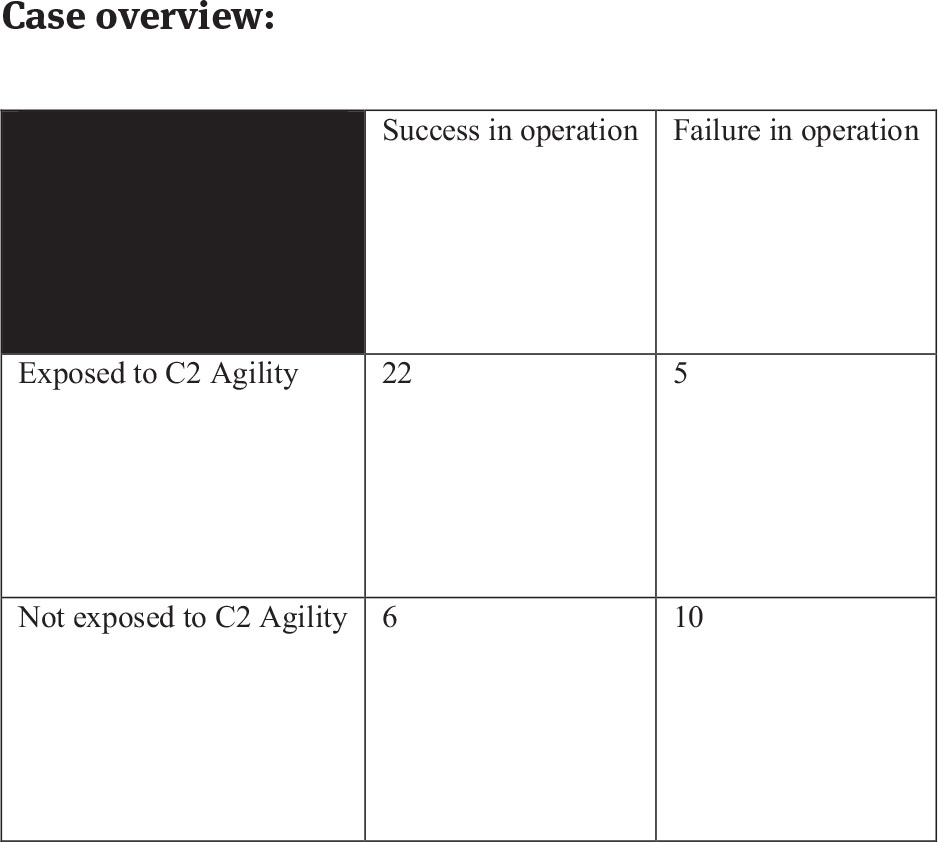
Fig. 1:
This figure shows the cases quantified by which case featured C2 Agility (at the coordinated, collaborated or edge approach) and which cases which did not feature C2 Agility. It also cross-references the cases in which were successful in achieving their objectives and which were unsuccessful.
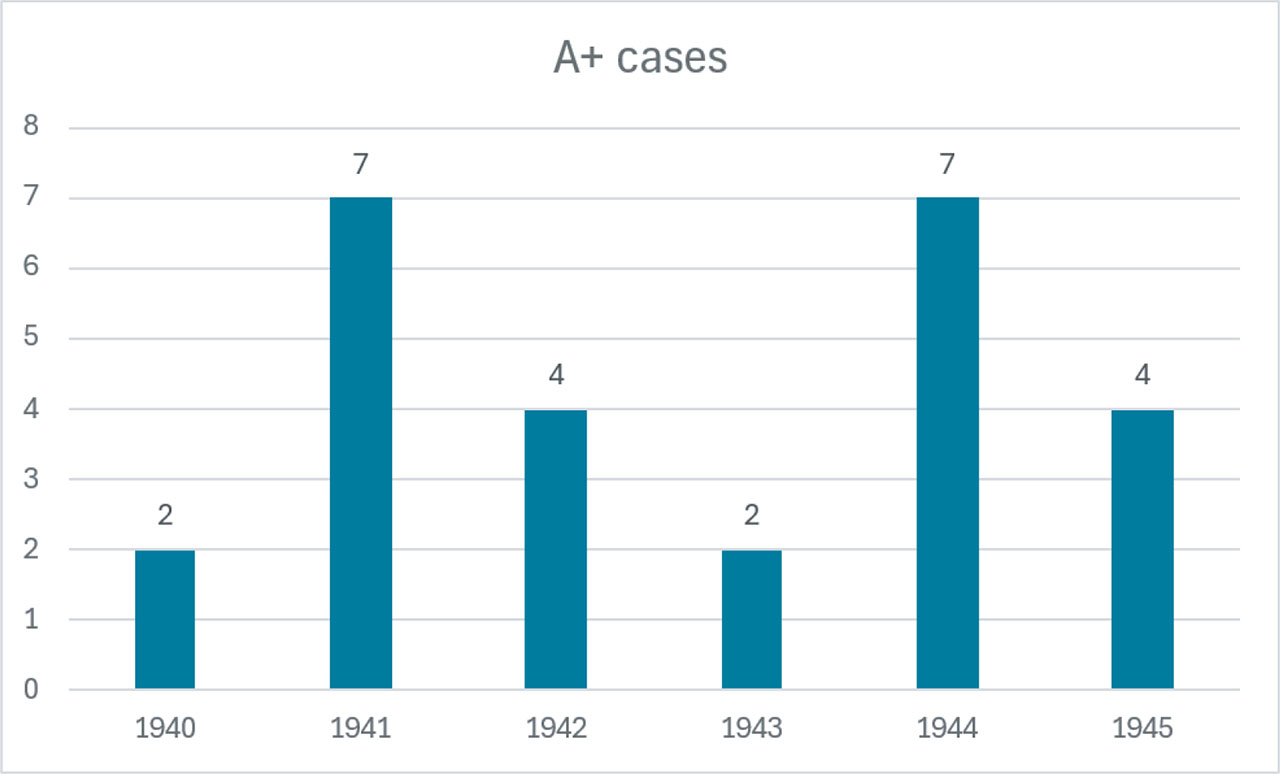
Fig. 2:
Illustrates all cases in which Agility was observed divided by year.
The other significant part of C2 Agility is C2 Manoeuvre Agility. C2 Manoeuvre Agility is about having the capabilities to employ the most appropriate C2 approach in the face of changing circumstances. Manoeuvre Agility involves the following abilities.
Recognise and understand that a change in circumstances has occurred and that the current approach to C2 is no longer appropriate.
Identifying and understanding which C2 approach is now the most appropriate.
Transition to this approach, in a timely manner. 28
3. Case assessment
3.1. Exposure to C2 Agility
Each case is assessed by two factors.
a) Was the organisation exposed to C2 Agility during the operation?
Exposure means that the organisation adopted an appropriate approach or was able to change to an appropriate approach to C2 as described in the concept of C2 Agility.
C2 Agility is quantifiable as confirmed, as it is defined as a capability. A capability is something an entity can have or not have. As previously explained, C2 Agility is about adopting the most appropriate C2 approach in relation to its mission/objective and associated requirements and being able to change C2 approach promptly. In the case studies, it is simple to quantify a change in C2 approach as it is evident in a changed chain of command, organisation, allocation of decision rights, sharing of information and level of cooperation between units. It is not based on an individual assessment of the effectiveness of the change, but just the fact that the C2 approach has changed. 29
It is more difficult to assess if the chosen start C2 approach is appropriate or not for the case. The basic stand is that the organisation can exercise C2 functions over its entities/units or not. This can be simplified as a quantitative question of whether the commanders and their staff and HQ are able to exercise their influence and control over their units/entities or not during the operation.
If the answer is yes, it will be recorded with an A+.
If the organisation did not employ an appropriate approach, it will be recorded with an A−.
3.2. Succes in achieving the operational objective
b) Was the operation a success according to the operational objectives?
Whether an operation was successful or not depends on the outcome of the operation’s closure compared with what was stated as operational objectives pre-mission along with other contemporary comments made of the desired objective of the operation. As such, we measure success as the level of performance displayed in each case with the required level of performance to make it quantifiable. By making, this comparison between required and achieved performance will give a measurement designed to reflect the successful accomplishment of the task or not. 30 To put it simply that success is the ability reach the pre-defined operational objectives or not.
Below are two detailed examples from two of the featured case studies.
The documentation is collected in most campaign accounts and studies published after the war. All relevant accounts are listed in the literature list at the end of the paper.
To give two examples:
3.2.1. Operation Market Garden
The operational objective as stated by September 14th 1944 by Field-Marshal Montgomery’s directive was to secure crossings over the Rhine and Maas in the general area Arnhem-Nijmegen-Grave by the use of Airborne troops and a rapid and violent thrust by Second Army: the army was then to establish itself in strength on a line between Zwollen and Arnhem, facing east with deep bridgeheads east of the Ijssel river. 31
By the closure of the Market Garden operation on the 27th of September 1944, these objectives were not achieved in full. Only crossings over the Maas in the general area of Grave-Nijmegen had been achieved. Because of the outcome of the operation, it (and the corresponding case) is recorded as unsuccessful for the case studies.
3.2.2. Operation plunder
Another example is Operation Plunder, the British Second Army crossing the river Rhine into Germany. This directive comes from 21st Army Group outlining the plan:
To cross the Rhine on a front of two armies between incl. Rheinberg and Rees, Ninth Army being on the right and Second Army being on the left.
To capture the communication centre of Wesel.
To expand the initial lodgment area on the east bank of the Rhine: (a) southwards for a sufficient distance to secure the road centre of Wesel from enemy ground action. (b) northwards to enable the river to be bridged at Emmerich and the road centre at that place to be used. (c) eastwards and north-east in order to secure rapidly a good and firm bridgehead from which further offensive operations can suitably be developed.
To position the three armies of the 21 Army Group east of the Rhine, and north of the Ruhr, so that further operations deeper into Germany can be developed quickly in any direction as may be ordered by Supreme H.Q. 32
The action commenced on the 23rd of March 1945, and by the closure of Operation Plunder on the 27th of March 1945, all the objectives were achieved.
Because of this outcome of the operation, it (and the corresponding case) is recorded as successful for the case studies.
In short, if the operation achieved a successful mission outcome by achieving its stated objectives defined during the pre-operational planning phase. It is important to note that the capture of ground or the degrading of enemy combat units does not in itself constitute a successful outcome. The operation must achieve its mission objectives, and it must be of operational or strategic relevance.
If the operation achieved its stated objectives, it will be recorded as a success. If the operation did not achieve its main objectives, it will be recorded as a failure.
In essence, it is the success in achieving the defined operational objectives from a Joint HQ.
3.3. Method limitations
This paper will apply statistical analysis by using a 2 × 2 Chi Square Test (and Ficher’s Exact Test) to analyse quantitively on the case study findings. Each case is selected from a set of rigid criteria to ensure a comparable and unbiased data selection.
Admittedly the risk of mixing qualitative analysis with this method is present. Much care has been taken to define the criteria as quantitively as possible. The two major points of measure (Agility and success) has been detailed in the previously section on how these are approached as quantifiable as possible.
Referring to the records of the operations featured in the case studies, these can be confirmed or denied by this closed-ended question based on the historically reported capability. It does carry some of the same hazards as using surveys in quantitative studies. It runs the risk of misinterpretation of old records and actions, as well as inaccurate recall.
Biased response is also a risk may intentionally or unintentionally give inaccurate answers due to social desirability, embarrassment about a topic, or a desire to frame a certain narrative.
Different sources on the same operation are used to minimise this as much as possible, and the case selection criteria are set to minimise biased sampling.
A limitation on using the 2 × 2 chi-square is that it does not determine the strength or direction of the relationship. It does not measure effectiveness in any way and neither does it give any explanation on how to achieve Agility for the individual organisations. It is limited to determining if there is a relationship or not in the hypothesis.
4. Case selection criteria and method
The method of statistical probability will be used on a series of cases to answer the thesis question of this paper. Each case has to fulfil the same five criteria in order to make sure the cases are comparable and share the same conditions as much as possible to test the thesis in an environment that is as equivalent as possible.
As this paper uses 43 cases, there is no scope for a detailed or in-depth study of each individual case; instead, the paper uses a quantitative approach to achieve statistical results on a wide number of cases.
The case selection criteria are given below.
4.1. Case selection criteria
To use the method of statistical analysis, the cases must be of a homogeneous nature. All the cases must be selected from exactly the same criteria, and in order to reduce selection bias, all cases fulfilling the case requirements must be included in the study.
In order to achieve this, the following criteria for case selection have been defined.
Each case has been selected from the following criteria.
The case must be either British-led or have a significant British presence and influence in the Joint Headquarters.
The case must be dated between 1940 and 1945.
The case must feature three components from either land, sea and air forces or air, land and airborne forces.
In addition to the above, the land element must be of a battalion-sized force or larger.
The operation in the case must take place against organised resistance.
4.2. Each criterion explained
1. The case must be either British-led or have a significant British presence and influence in the Joint Headquarters.
The operation featured in the case must be led by a senior British officer or have a significant British presence and influence on the planning and execution of the operation. Operations Overlord and Husky are both prime examples where representatives of the British armed forces had a significant influence in planning, organising and executing the operation in a joint headquarters.
Operations Avalanche and Shingle were operations that were more American-dominated, but both were ultimately supervised by a British theatre commander and provided substantially British units for the land, sea and air component.
For this paper, units from the British Commonwealth 33 are considered ‘British’ as they share the same organisation, doctrine and curriculum for training.
The reason for this restriction to British-centric operations is to have a uniformed basis in terms of organisation, culture, doctrine, training level and command/leadership style for comparison.
Naturally major changes took place within the British armed forces during the time period; however, the organisational culture, educational background, as well as staff working method remained comparable for the commanders, leading officers and the headquarters staff. This goes both for the purely led British operations and the joint operations with Americans and other partners. 34
2. The operation in the case must have been dated between 1940 and 1945
The timeframe is selected to include all active joint operations in the face of opposition during the Second World War. The timeframe has been selected to have all cases take place within a technological and cultural comparable period. The period was selected because of the high number of joint operations taking place by the British armed forces within a concentrated period of 5 years without a generation change (both age-related as well as years-in-service related).
3. The operation must feature three components of land, sea and air forces or air, land and airborne forces.
The operation must feature three components, which can be either land, sea and air components or air, land and airborne forces. In the parlance of NATO, this type of operation is termed joint operations. 35 Joint is an adjective used to describe activities, operations, organisations in which elements of at least two services participate. This case study will focus on operations conducted by three service elements in a joint venture with a joint headquarters.
Between 1940 and 1945 these types of operations were often termed combined operations by the British armed forces and often included, but not exclusively, amphibious operations. This paper will use the term Joint Operations regarding tri-service operations with or without amphibious operations.
The terminology is not critical to the analysis or case selection. The presence of three services is critical to the selection, however.
Tri-service joint operations were at the infancy in 1940, and it was the first major conflict that used Joint operations on a larger tactical and operational scale. It was the most complex type of operations that could be conducted between 1940 and 1945 due to its inherited complexity by combining three different branches of services each with a distinct set of capabilities, organisations and experience.
This is also relevant for airborne operations. With no previous training, doctrine or field experience, these types of operations had to be learned while on active operations. The unique feature with airborne operations is that they feature a ground-based land component, an air component and airborne land component operating entirely separately in terms of command and control from the ground-based land component until a link-up could be established. In order to be successful, the operation had to create a synergy between these three components to fulfil the operational objective.
It is the development of these types of operations that is the prime interest of the case studies.
Note: the deep-penetration operations in Burma are not included in this case study as they operated, tactically and in some cases also operationally, separated from the ground-based land component. As such they are classified as bi-service operations and do not qualify for this criterion.
4. In addition to the above, the land element must be of a battalion-sized force or larger.
The land component must be of battalion size or larger. There was a considerable number of smaller operations involving less than 100 troops in the land component and sometimes less than 10 troops. For the case studies to reach the desired level of complexity only larger joint operations with a battalion or larger in the land component will be studied because if a service element is too small it would not have a separate command it would become a bi-service or mono-service operation. With the land element to be of battalion size this would ensure all service elements would have their own command.
5. The operation in the case must take place against organised resistance.
The operation must face organised resistance from a hostile force. The operation need not suffer heavy casualties but there must be organised resistance. This makes the complexity of the operation considerable higher because there is a disruptive force that can seriously test and sometimes break the chosen the command-and-control approach in the operation.
The key to assessing how well the organisation handled the disruptive forces is essential to establish if the chosen command and control approach was suited for the mission and task. Operations that took place unopposed will not be considered as the complexity will be as low as a standard military manoeuvre or exercise and the chosen command and control approach would not be sufficiently tested or stressed in order to assess its suitability for agile command and control.
In these cases, the opposition would be either German, Japanese, Italian or Vichy French.
Some operations did not receive an official codename before the action started, such as the defensive operation of Crete in 1941. Such actions have been included in the case studies as long as they fulfil the five criteria.
It is also highly relevant that these operations took place against one or more opponents that are in terms of technology, size and organisation on a comparable level as the conductors of the operations.
Also, all operations take place in a high-intensity conventional warfare scenario. 36
The criteria have been chosen because this study will focus on the most complex cases in terms of command and control. The higher the level of complexity is, the higher stress there is on the chosen command and control approach and the higher the risk of failure in the operation. This study will look at the most complex cases in order to assess the optimal strength or weakness of the chosen C2 approach.
In military operations, there is an increased demand for a coordinated or collaborative command and control approach when several services are involved in the operation. In the period of 1940–1945, it was the joint operations with land, sea, air and airborne components that featured the most complex requirements for command and control because there had been very limited interservice training before 1940 and no coherent doctrine or practice existed prior to 1940. However, the most important operations could not be carried out without tri-service cooperation.
It was of necessity that the British armed forces and those of their allies learned and adapted while still in an operational environment. These are exactly the circumstances that require agility within command and control as per the theoretical concept of C2 Agility.
The need for the cases to feature organised resistance is also to ensure maximum complexity. Organised resistance would put the most severe stress on the chosen command and control approach and organisation as it is the most significant disrupting factor that would test the robustness and suitability of the chosen command and control approach. This could not be properly ascertained if there were no organised resistance.
There were other operations that did not involve all three services that also reach a very high level of disruption and complexity, but to ensure homogenous and consist of case selection this study has focused on the tri-service operations.
The period has been chosen for its high number of tri-service operations conducted within a compressed timeframe. Agility in command and control should be seen not only in the individual cases but also within the period of 1940–1945 as a whole. This is possible because this study is looking at the same parent organisation within the same generation that is based on the same level of the following parameters.
Doctrine
Education and training curriculum
Technology level
Organisational culture
It is within these parameters that the maturity and development of command and control can truly be studied on a qualitative scale. Something that is not possible with the framework for study was broader or more loosely defined.
4.3. Case overview
43 cases met the criteria and are divided according to the figure below.
5. Reducing confounding and bias
5.1. Confounding
A confounder is a variable, which can influence the case conclusion, but which is not related to C2 approach. 37 It has been addressed as much as possible when setting the case selection criteria.
5.2. Selection bias
Selection bias is a systematic error caused by non-random sampling of cases. It may result in biased samples, which include publication bias. 38 Selection bias can seriously affect the type of cases selected for study, something which all collective case studies to this point in the C2 Agility literature is at high risk of suffering from. To reduce selection bias, all conflict cases included, were selected from a fixed time – period and of same composition (see the section of ‘case selection criteria’). The selection of C2 Agility exposure status was performed before the outcome was known.
5.3. Information bias
Information bias is an error due to misclassification. 39 Hence, in order to reduce misclassification of C2 Agility exposure, case data for every conflict analysed were collected from published historical resources, detailed in the references. Data from these references were gathered by selection of cross-references for each case. None of the data was firsthand self-reported data. Outcome of conflicts (loose, win), were likewise gathered from the above resources. The quality of the data was relied upon by the authors and publishers.
6. Case analysis
The following section is not strictly related to the statistical analysis of the cases that use the 2 × 2 Chi Square. The section does offer a little more in-depth look at the trend that could be observed behind the cases when looking at them collectively. These observations are shared here.
Below are listed all cases that fulfil the case selection criteria. A+ means that agility was observed and A− means that Agility was not observed. S means operational success; objectives were achieved. F means operational
See Appendix A for more details on the individual cases.
While this paper will not offer a detailed study of each case, there are some points that are worth mentioning.
In 1940, there were two cases where Agility was not observed and were not successful. These were two joint operations in Norway and failure was not due to a lack of resources or technology but solely an inappropriate approach to C2. At Narvik, the C2 approach is changed during the operation to a more appropriate but it is not done in a timely manner. There was a failed naval evacuation as well.
The two cases where Agility was observed and which were successful were both Naval evacuations from France to the UK. Both operations featured a unified Naval command with Army and Air Force as subordinates. This was unlike in Norway, where the command structure was not unified with negative operational performance to follow.
| All cases | Year | A+/A− | S/F |
|---|---|---|---|
| Operation Sickle | 1940 | A− | F |
| Operation Rubert | 1940 | A− | S |
| Operation Dynamo | 1940 | A+ | S |
| Operation Cycle | 1940 | A− | S |
| Operation Aerial | 1940 | A+ | S |
| Operation Menace | 1941 | A− | F |
| Operation Abstention | 1941 | A− | F |
| Operations in Greece | 1941 | A− | F |
| Defense of Crete | 1941 | A+ | F |
| Operation Sabine | 1941 | A+ | S |
| Operation Exporter | 1941 | A+ | S |
| Litani River | 1941 | A+ | S |
| Operation Chronometer | 1941 | A+ | S |
| Operation Matador Malaya | 1941 | A− | F |
| Operation Archery | 1941 | A+ | S |
| Hong Kong | 1941 | A+ | F |
| Operation Chariot | 1942 | A+ | S |
| Operation Ironclad | 1942 | A+ | S |
| Operation Jubilee | 1942 | A− | F |
| Operation Agreement | 1942 | A− | F |
| Operations Stream, Line and Jane | 1942 | A+ | S |
| Operation Torch | 1942 | A− | S |
| Airborne Assault Beja | 1942 | A+ | S |
| Airborne Assault Oudna | 1942 | A− | F |
| Operation Husky | 1943 | A− | S |
| Operation Ladbroke | 1943 | A− | S |
| Operation Fustain | 1943 | A+ | F |
| Operation Slapstick | 1943 | A+ | F |
| Operation Avalanche | 1943 | A− | S |
| Operation Shingle | 1944 | A− | F |
| Operation Neptune | 1944 | A+ | S |
| Operations Tonga and Mallard | 1944 | A+ | S |
| Operation Rugby | 1944 | A− | S |
| Operation Market Garden | 1944 | A− | F |
| Operation Astonia | 1944 | A+ | F |
| Operation Manna | 1944 | A+ | S |
| Operation Switchback | 1944 | A+ | S |
| Operation Vitality | 1944 | A+ | S |
| Operation Infatuate | 1944 | A+ | S |
| Operation Romulus | 1945 | A+ | S |
| Operation Talon | 1945 | A+ | S |
| Operation Plunder | 1945 | A+ | S |
| Operation Varsity | 1945 | A+ | S |
| A+ cases | Year | S/F |
|---|---|---|
| Operation Dynamo | 1940 | S |
| Operation Aerial | 1940 | S |
| Defence of Crete | 1941 | F |
| Operation Sabine | 1941 | S |
| Operation Exporter | 1941 | S |
| Litani River | 1941 | S |
| Operation Chronometer | 1941 | S |
| Operation Archery | 1941 | S |
| Hong Kong | 1941 | F |
| Operation Chariot | 1942 | S |
| Operation Ironclad | 1942 | S |
| Operations Stream, Line and Jane | 1942 | S |
| Airborne Assault Beja | 1942 | S |
| Operation Fustain | 1943 | F |
| Operation Slapstick | 1943 | F |
| Operation Neptune | 1944 | S |
| Operations Tonga and Mallard | 1944 | S |
| Operation Astonia | 1944 | F |
| Operation Manna | 1944 | S |
| Operation Switchback | 1944 | S |
| Operation Vitality | 1944 | S |
| Operation Infatuate | 1944 | S |
| Operation Romulus | 1945 | S |
| Operation Talon | 1945 | S |
| Operation Plunder | 1945 | S |
| Operation Varsity | 1945 | S |
| A− Cases | Year | S/F |
|---|---|---|
| Operation Sickle | 1940 | F |
| Operation Rubert | 1940 | S |
| Operation Cycle | 1940 | S |
| Operation Menace | 1941 | F |
| Operation Abstention | 1941 | F |
| Operations in Greece | 1941 | F |
| Operation Matador Malaya | 1941 | F |
| Operation Jubilee | 1942 | F |
| Operation Agreement | 1942 | F |
| Operation Torch | 1942 | S |
| Airborne Assault Oudna | 1942 | F |
| Operation Husky | 1943 | S |
| Operation Ladbroke | 1943 | S |
| Operation Avalanche | 1943 | S |
| Operation Shingle | 1944 | F |
| Operation Rugby | 1944 | S |
| Operation Market Garden | 1944 | F |
In 1941, we see seven cases displaying Agility and four which do not. Of the seven cases displaying Agility there were a mix of raids (2), defence of isolated Islands (2 Crete and Hong Kong) and operations in the middle east (3). Despite a showing of Agility, all these cases were at the smaller end of the selection criteria, and this simplifies a lot of the practicalities of adopting an agile C2 approach as well as giving more room of freedom for the commanders and their staff. A prime example of this is the comparison between the defence of Singapore and Hong Kong. While both were failures, the defence of Hong Kong displayed a remarkable high level of Agility by changing the C2 approach as the situation dictated. The opposite happened in Singapore.
In 1942, there are mostly raids (5) and smaller-scale joint attacks (2) with Operation Torch as the one big operation. While successful, it was probably lucky that the opposition did not press the landing force harder, as there were a number of sub-optimal C2 arrangements that could have broken if under pressure.
The trend would continue into 1943, this time with larger and more ambitious joint operations, now featuring a multinational task force in the Mediterranean. This showed that the Allies were undergoing a steep learning curve at large-scale joint operations from Sicily to Salerno and beyond. The Allies were operating on a scale they had not tried before, and this put increased pressure on the C2 Approach, as was evident from the cases.
In 1944 and 1945, it is observed that the number of cases where Agility is displayed rises significantly, and so does the success rate in these operations, with seven cases displaying Agility in 1944 and four in 1945, opposite to three in 1944, which did not display Agility. This shows an increase in Agility displayed together with an increase in operational success in joint operations both in Europe and Asia.
The figure below shows the probability of the outcomes based on the case assessments. It gives a clear indication that by having the capability of Agility within C2 increases the organisation’s chances of successfully achieving their set operational objectives.
7. The statistical analysis – 2 × 2 Chi square
The Chi-square (χ2) statistic is a measure used in social science statistics to assess how well observed data fit an expected distribution (or behaviour) or to test for independence between categorical variables. It compares the observed frequencies in each category to the expected frequencies under a specific hypothesis.
In this paper, the Chi-square is used to test if the actual observed behavioural pattern matches an expected pattern and to examine whether two categorical variables are independent (test of independence).
The Chi-square method will statistically determine whether differences between observed and expected data are due to random chance or suggest a significant deviation.
It also provides a quantitative measure to support or refute hypotheses in categorical data analysis.
It is widely applicable because it requires only count data and does not assume the data are normally distributed.
The method is non-parametric. Does not require assumptions about the distribution of the data.
The statistical significance will be calculated with 95% certainty and 99% certainty to test the hypotheses. 40
Still the 2 × 2 Chi-Square and Fisher’s Exact test are beneficial because it is a versatile, non-parametric methods for determining if there’s an association between two categorical variables with two levels each, and it is robust against non-normal data distributions.
7.1. Statistical Analysis
The calculation is done using this online tool that calculates 2 × 2 Chi-square with raw data and it is available here Chi Square Calculator 2 × 2 (includes Yates correction) and used 17th of April 2025 and 8th of September 2025.
By entering the data from Figure 3 in the calculator (see link above) and setting the certainty to 95% (0.05 also known as the alpha level), the following result is obtained:
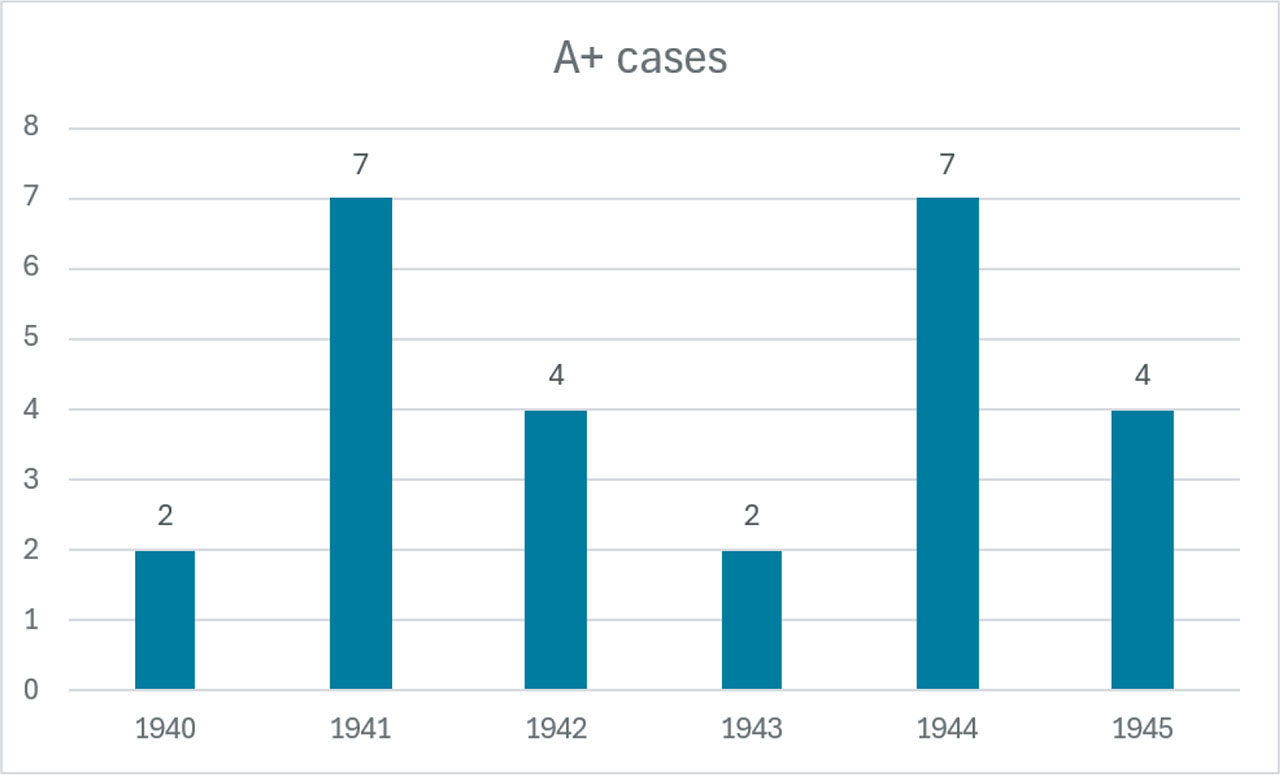
Fig. 3:
This figure illustrates all cases in which Agility was not observed divided by year.
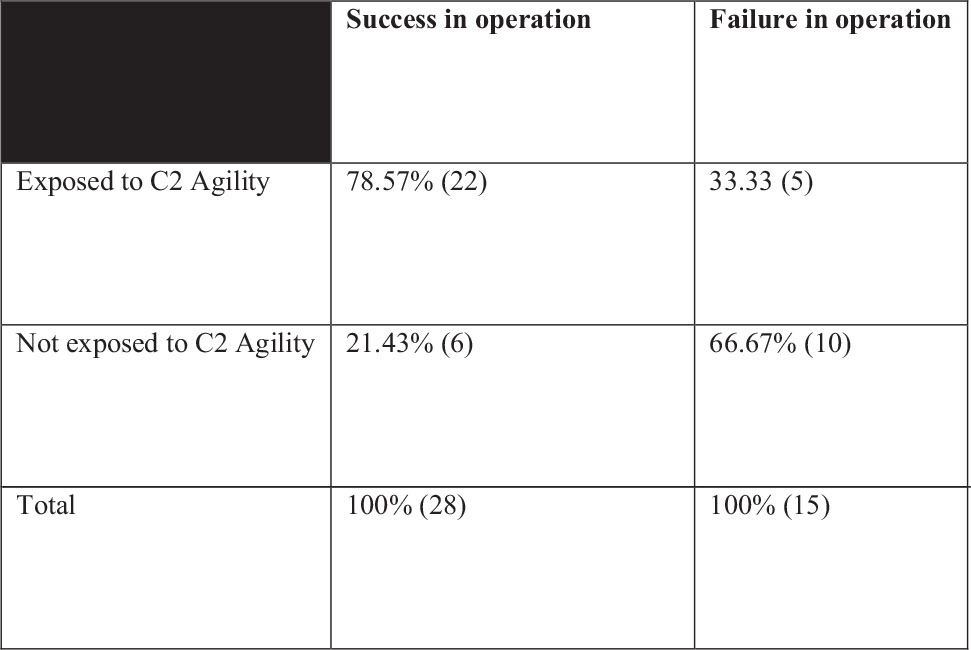
Fig. 4:
The column percentage of the outcome. It shows that, based on the case findings, that when one achieves success in joint operations there is a 78.57% chance of achieving that success with an Agile approach to C2. Likewise, it shows that if one failed in joint operations, there was a 66.67% chance that one did not have an Agile approach to C2.
The chi-square statistic is 8.5554. The p-value is.003445. The result is statistically significant because p < 0.05. 41
Translating the result into operational terms, the result is that with 95% certainty that adopting the most appropriate C2 approach and exercising agility within C2 is a statistically significant contributor to achieving operational objectives to a successful conclusion of a joint military operation.
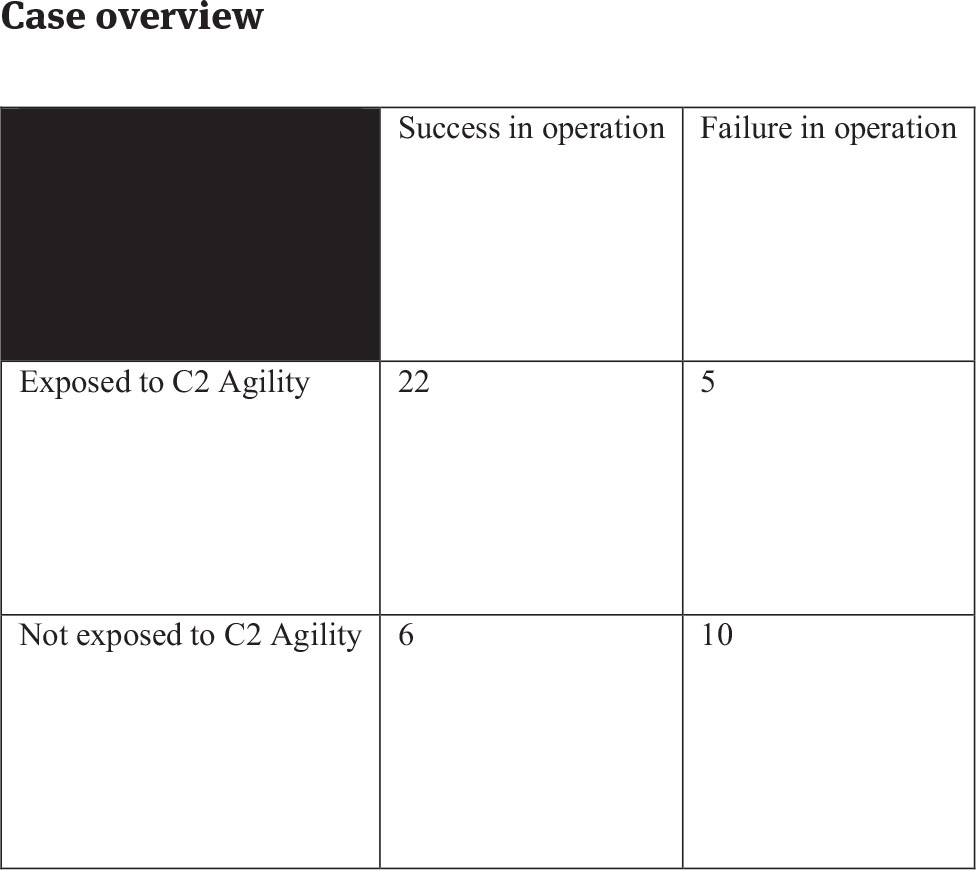
Figure 1 repeated 1:
This figure shows the cases quantified by which case featured C2 Agility (at the coordinated, collaborated or edge approach) and which cases which did not feature C2 Agility. It also cross-references the cases in which were successful in achieving their objectives and which were unsuccessful.
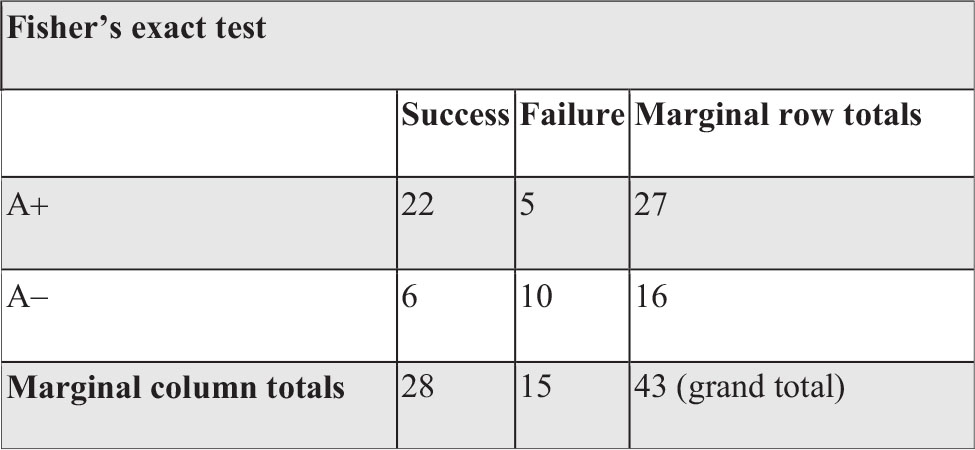
Fig. 5:
The Fisher’s exact test helps to determine whether there is a significant relationship between two categorical variables, especially when sample sizes are small. In this study it is used as an extra validation of the result.
Repeating this process with a 99% certainty (0.01 also known as the alpha level) and the following result is obtained.
The chi-square statistic is 8.5554. The p-value is .003445. The result is statistically significant because p < 0.01. 42
Translating the result into operational terms, the result is that with 99% certainty that adopting the most appropriate C2 approach and exercising agility within C2 has a statistically significant contributor to achieve operational objectives to a successful conclusion of a joint military operation.
7.1.1. Additional validation test of the statistical results
This paper conducted three different test to validate the mathematical results above. The conclusion from all three validation checks supports the result above. Please see Appendix A for further details.
7.1.2. Statistical conclusion
Applying C2 Agility results in more success in operations, with a strong positive relation between C2 Agility exposure and success.
7.1.3. Fisher’s exact test
Fisher’s exact test is used to check and validate the results.
To determine if there was a significant association between C2 Agility exposure and Operational outcome, Fisher’s Exact Test for 2 × 2 tables was applied, instead of chi-square. This was chosen, since one observation was equal to 5 (note Yates’s correction for continuity was not applied, since the total sample size was >40 and none of the cells were <5). 43 Fisher’s exact test showed a two-tailed p-value of 0.007, which was significant at p < 0.050 and 0.010. Hence, the association between the two rows of C2 Agility and Operation was statistically significant.
7.1.4. Phi coefficient
Phi is a coefficient, specifically applied for measuring the relative strength of an association in 2 × 2 contingency tables. The phi coefficient was calculated to +0.50, indicating a strong positive association between C2 Agility exposure and success in operation.
7.1.5. Relative risk
This is another extra validation of the results that is used to check the outcome of the statistical analysis of the case studies.
Here, the relative risk (RR) index is used to compare the likelihood of Success in Operation in cases exposed to C2 Agility versus cases not exposed to C2 Agility. 44 Since this was a retrospective cohort study, data from the above 2 × 2 contingency table was best analysed using the RR and not the Odds Ratio. 45 The RR was calculated to 2.1728, with a 95% confidence interval (CI) of 1.6856–2.6600. Since the RR > 1, the risk, of the outcome of Success is increased by the exposure to C2 Agility.
8. Conclusion
It can be said with 99% certainty that having the capability of agility within C2 and the organisations’ ability to effectively employ C2 Agility is a statistically significant element to achieve success in joint military operations. There is a statistical significance link between having the capability of agility within C2 and operational success.
This conclusion is based on 43 historical case studies carefully selected from a set defined by criteria to ensure a homogenous and unbiased selection – which eliminated the case selection bias as much as possible which in turn allowed this statistical analysis to take place, which would not have been possible with the currently published case studies.
See Appendix A for further validation of the calculated result.
This study covers the significance at the macro level. At the individual case-level, the C2 approach must be tailored to each individual operation and organisation regardless of time and place, and this study does not give specifics, although the conceptual model of C2 Agility does give some general direction in Appendix B reproduced to reference.
Regardless of the individual cases, this study shows with statistical significance that by adopting the most appropriate C2 approach and to be able to change the C2 approach in a timely manner as per C2 Agility increases (but not guarantee) a successful outcome statistically significantly in joint tri-service military operations against organised resistance. As such, there can be real value in operationalising C2 Agility into current joint tri-service operations of today.
To end this paper, it can be confirmed that having the capability of agility within command and control provides a statistically significant contribution to success in joint military operations against a near-peer opposition.
Appendices
Appendix A
Case overview
1940
Case title: Operation Sickle – Allied joint forces respond to the German invasion of Norway in Gudbrandsdalen 1940
Date: April 1940
Description of the operational performance:
On the 9th of April, German land, air and sea forces attacked Denmark and Norway in Operation Weserubung. The Allies decided to launch a joint operation to assist the Norwegian defence and to capture Trondheim. Operation Sickle was the British operation to dispatch a naval task force with both a small air component and a land force element (elements of the 148th and 15th Brigades).
The British Naval Task Force was strong, but the air and land components could not definitely stop the German advance from Oslo to Trondheim. The operation was plagued by conflicting instructions, which led to poor decision-making. The sharing of information and the allocation of decision rights were extremely constrained as there was no effective theatre HQ. The local commanders did not coordinate properly with coalition partners and had almost no decision rights. The various committees, sub-committees and the War Cabinet held the decision rights but were in no position to influence the campaign. The two operations, Sickle and Maurice, had no interaction with each other even though they were supposed to be a single joint operation to take Trondheim. Basic C2 functions at the joint level could not be executed and the C2 approach was inappropriate. The C2 approach was not changed. These factors led to the detrimental outcome of the operation. 46, 47
Success: The operation was unsuccessful
C2 Agility featured: A−
Case title: Operation Rupert – Allied joint forces to recapture Narvik 1940
Date: April–May 1940
Description of the operational performance:
The operation began with Navel success for the Royal Navy but quickly bogged down into a standstill with an intense disagreement between the land and sea components. The detached planning from London continued and it was not until May that an allied joint theatre command was appointed. However, after a longer period with inactivity the joint assault against Narvik enjoyed success due to a considerable effort from the tactical elements particular the Norwegian, French and Polish land forces. To summarise the C2 approach was inappropriate since C2 functions was not established with the Norwegians and did not produce measurable results in the amphibious operation. Both were changed during the operation to be more appropriate for the mission.
Tactical success came too late to have a strategic effect as the decision to evacuate Norway had already been taken in London. 48, 49 The results had no strategic outcome.
Success: The operation was tactical successful
C2 Agility featured: A−
Case title: Operation Dynamo – British evacuation from the European mainland
Date: May 1940
Description of the operational performance:
The evacuation of the British Expeditionary Force from the European mainland was a joint operation carried out by the Royal Navy, with the RAF providing air cover for the Naval component and the Army providing the essential security of the perimeter inland to cover the embarkation. Much has been written about this famous operation and agility displayed in the C2 approach including the land defence, the alternative use of civilian boats and the incredible close cooperation between the navel component and the land component. 50, 51, 52, 53, 54
Success: The operation was successful
C2 Agility featured: A+
Case title: Operation Cycle
Date: June 1940
Description of the operational performance:
This operation was intended to evacuate British and French troops from the ports of Le Havre and Valery-En-Caux in Northern France. The operation had many similarities with Operation Dynamo at Dunkirk although smaller in scale and without the fleet of little boats. Overall, the operation was successful but with serious consequences for failure to evacuate from Valery-En-Caux. A significant part of the 51st Highland Division had to surrender to the German forces. 55 Effective C2 function was not established at the joint level.
Success: The operation was successful
C2 Agility featured: A−
Case title: Operation Aerial
Date: June 1940
Description of operational performance:
Operation Aerial was the evacuation of Allied forces and civilians from ports in western France during the fall of France. British and Allied ships were covered from French bases by five Royal Air Force fighter squadrons and assisted by aircraft based in England, to lift British, Polish and Czech troops, civilians and equipment from Atlantic ports, particularly from St Nazaire and Nantes.
Many of the navel staff officers who planned this operation had also gathered experience from the evacuations from Dunkirk and Le Havre. The naval, land and air component corporation displayed an appropriate C2 function despite the loss of the Lancastria. 56
Success: The operation was successful
C2 Agility featured: A+
Case title: Operations Menace
Date: September 1940
Description of the operational performance:
This joint operation was an attempt to capture the port of Dakar by a large Anglo-French naval and air component support by a small amphibious force. The operation failed due to a lack of ability to exercise C2 functions at the joint level. The consequence was dispersed and uncoordinated application of force and by a gross underestimation of the Vichy will resist. 57
Success: The operation was unsuccessful
C2 Agility featured: A−
1941
Case title: Operations Abstention
Date: February 1941
Description of the operational performance:
Operation Abstention was the joint effort to take the Italian island of Kastelorizo off the Turkish Aegean coast, in February 1941. The objective was to establish a motor torpedo-boat base to challenge Italian naval and air supremacy on the Greek Dodecanese islands. Despite initial success, the British failed to properly follow-up on their success, which resulted in the British troops to re-embark amidst some confusion and led to recriminations between the commanders for failure to established C2 functions at the joint level, particularly among land and navy commanders. 58
Success: The operation was unsuccessful
C2 Agility featured: A−
Case title: The Expedition to Greece (including operation Demon)
Date: April 1941
Description of the operational performance:
This very short campaign, with the aim to provide Greece with British and Commonwealth military assistance against the German invasion, saw an uncoordinated deployment of land, sea and air forces that eventually led to the evacuation of the expeditionary force. The force could not exercise basic C2 functions at the joint level, resulting in little cooperation between land and air forces and the interaction with the Greek forces was inadequate. The navy component provided the movement by sea, including a moderately successful evacuation. Due to the campaign’s short duration, the entire campaign is viewed as one operation for case study purpose. 59, 60, 61
Success: The operation was unsuccessful
C2 Agility featured: A−
Case title: Defence of Crete
Date: Maj 1941
Description of the operational performance:
This case includes the British joint effort to defend the island of Crete against the German Airborne invasion. The ground forces are the major component of this battle but both naval and air assets played their part as well. It is an interesting case because the concept of agility was very much present in many of the units involved, but the overall unsuccessful outcome for the British was a case of confusion from the top leaders instead of a failed organizational performance, despite the dispute over defence of the airfields. 62 The C2 approach was changed during the operation to meet the changing circumstances; however, the retreat from Malme was more a cause of losing nerve than an inappropriate C2 approach.
There was a controversy over the lack of sharing of intelligence, particularly ULTRA intelligence. Despite this lack of information sharing, the units at the tactical level showed a high level of Agility and with the high level of battlefield performance by the ground element, it is questionable if the ULTRA intelligence would have made a major difference. 63
Success: The operation was unsuccessful
C2 Agility featured: A+
Case title: British Invasion of Iraq – Operation Sabine
Date: Maj 1941
Description of the operational performance:
This series of operations include the invasion of Iraq in the attempt to relieve the besieged RAF Habbaniya and to re-install an allied-friendly government in Iraq. The operation runs according to plan against relatively light resistance. 64 This operation displayed an appropriate approach to C2.
Success: The operation was successful
C2 Agility featured: A+
Case title: Operation Exporter
Date: June-July 1941
Description of the operational performance:
The operation, which featured a dominate land component with the sea and air component being in support, was ultimately a success. However, the initial C approach was inappropriate in achieving the objectives and further air, and land reinforcement was required together with a changed C2 approach during the campaign. The Commonwealth-contingent showed a high level of agility at the tactical level. 65
Success: The operation was successful
C2 Agility featured: A+
Case title: Litani River Raid – in support of Operation Exporter
Date: June 1941
Description of the operational performance:
No. 10 Commando was to land by sea on the coastline located just north of the Palestinian border inside Syria. This operation was to be coordinated with a land offensive of the 7th Australian Division. The task force had an appropriate C2 approach during the whole of the operation. The naval task force with HMS Glengyle as flagship carried the amphibious force to the Syrian coast without issues. However, intelligence about the suitability of the landing beach was shared very quickly and the original operation cancelled. In a remarkable display of interaction between the Naval component and the amphibious (Commando) component a new plan was devised and implemented. 66 The landing went without serious setbacks, and the objectives were secured. Vichy-French counter attacks were held off with the support of Naval fire and Air strikes. The Commando force linked up with the Australians as planned. During the operation the Commando force suffered heavy casualties at the cost of success. 67
Success: The operation was successful
C2 Agility featured: A+
Case title: Operation Chronometer
Date: June 1941
Description of the operational performance:
This operation was a joint operation to capture the airfields and other Italian installations at Assab, the main port of Eritrea, on the south-west coast of the Red Sea (10/15 June 1941). The operation involved elements of the RN Red Sea Force together with two RAF squadrons and an Indian Army infantry battalion. The operation achieved all its objectives against light Italian opposition by utilising an appropriate C2 approach between the air, land and navel component. In terms of joint operations, this was a small-scale operation against light opposition. 68
Success: The operation was successful
C2 Agility featured: A+
Case title: Operation Matador and the defence of Malaya
Date: December 1941–February 1942
Description of the operational performance:
The initial operations with the aim to protect Singapore in a proactive engagement with the Japanese, failed at the early stage of the campaign. A joint air, land and sea effort failed when each component was committed piecemeal with a completely inappropriate C2 approach at the joint level, resulting in no interaction or sharing of information at any level. Within each component, the allocation of decision rights was severely constrained, particularly among the land component. 69, 70 The defensive of Singapore never recovered from this initial tactical blow, which resulted in complete failure for the British and Commonwealth.
Success: The operation was unsuccessful
C2 Agility featured: A−
Case title: Operation Archery
Date: December 1941
Description of the operational performance:
This operation was the first operation from combined operations command that met serious resistance during the raid. British and Norwegian commandos conducted an amphibious assault under cover of naval and air assets. There had been an earlier raid called Operation Claymore, but it had not seen any opposition. The operation displayed an appropriate C2 approach and succeeded under difficult weather conditions and enemy organised opposition. The broad interaction between the three services both in planning and during execution of the operation serves to highlight the adaptability of the C2 approach shown during the operation. 71, 72
Success: The operation was successful
C2 Agility featured: A+
Case title: Defence of Hong Kong
Date: December 1941
Description of the operational performance:
The original plan for a joint land, sea and air defence was quickly defeated due to lack of resources and a constrained pattern of interaction between the land, sea and air components. The air component is the smallest in the garrison and is the first to be annihilated. The sea component is the second to be annihilated after a successful evacuation to the main island and an ill-fated attempt to disrupt the Japanese landing. The land component consisting of British, Indian, Chinese, Canadians and local volunteers. They conducted both static defence and repeated counterattacks in order to disrupt the Japanese freedom of movement and to stale the Japanese advance. The Hong Kong Garrison changed their C2 Approach to counter the Japanese attacks and holding off the Japanese until resources and reserves dwindled. 73
Success: The operation was unsuccessful
C2 Agility featured: A+
1942
Case title: Operation Chariot
Date: March 1942
Description of the operational performance:
The St Nazaire Raid or Operation Chariot was a British amphibious assault on the dry dock at St Nazaire in France during the Second World War. The operation was undertaken by the Royal Navy and British Commandos on 28 March 1942. It was a high-risk operation that succeeded in denying the German use of the dry dock for base and repair for the rest of the conflict. The interservice cooperation displayed an appropriate approach to C2. 74
Success: The operation was successful
C2 Agility featured: A+
Case title: Operation Ironclad
Date: May 1942
Description of the operational performance:
This was a joint operation to capture the port of Diego Suarez at the northern tip of Madagascar and to establish a bridgehead in Madagascar itself for future operations. The navel component provided both manoeuvre and fire support and the air component provided air cover and diversionary attacks. The land forces meet all their objectives but not without heavy ground combat. The operation was generally well-planned and executed but planners had underestimated the level of resistance from the Vichy French garrison. 75 The force had an appropriate C2 approach.
Success: The operation was successful
C2 Agility featured: A+
Case title: Operation Jubilee
Date: August 1942
Description of the operational performance:
This amphibious landing at Dieppe, Northern France was a joint operation with the objective to take an enemy-held port by direct assault. Overall, the operation was a failure. The air losses of the RAF were a factor two to the Luftwaffe defenders. The landing forces, mostly Canadian, suffered heavy casualties in a failed attack on Dieppe. The cause of failure was a lacking analysis of operational capabilities of the amphibious force compounded with vague and unclear orders with little opportunity for initiative. 76 At the joint level there was an inappropriate approach to C2 and it did not change during the operation.
Success: The operation was unsuccessful
C2 Agility featured: A−
Case title: Operations Agreement
Date: September 1942
Description of the operational performance:
Operation Agreement was an amphibious large-scale commando-styled operation carried out by British, Rhodesian and New Zealand forces on Axis-held Tobruk from 13 to 14 September 1942. The Tobruk raid was an Allied disaster; the British lost several 100 men killed and captured, 1 cruiser, 2 destroyers and dozens of small naval craft. The chief cause was an inappropriate approach to C2 between the land, navy and special forces components. 77
Success: The operation was unsuccessful
C2 Agility featured: A−
Case title: Operations Stream, Line and Jane
Date: September – November 1942
Description of the operational performance:
To capture the rest of Madagascar, the British executed three joint operations in tandem with each other (called Stream, Line and Jane). All operations were joined with Navel, air and land components providing both fire and manoeuvres at the tactical and operational level. The coordination of three separate sub-operations in a joint effort required more agile planning and organization than the British had had to perform before. However, in this case, they had an appropriate C2 approach with the ability to exercise basic C2 functions. 78 These three operations are considered as one as they were all co-dependent of each other and happened at the same time and space.
Success: The operation was successful
C2 Agility featured: A+
Case title: Operation Torch – the amphibious landings
Date: November 1942
Description of the operational performance:
Technically and tactically, the landing was a success, but Torch fell short of expectations. Tunis did not fall quickly to British and American forces. Their presence in North Africa and threatened assault of southern Europe also failed to draw away large numbers of Germans from the Eastern Front, a key strategic rationale given for the operation. At the joint level, the C2 approach was inappropriate since basic C2 functions could not be exercised with the assault upon Moroccan beaches revealed serious problems with the logistical, communication and command-and-control approaches the Navy and Army employed for this major amphibious operation. The sailors and soldiers were also fortunate to face Vichy French defenders who fought with limited tenacity. 79
Success: The operation was successful
C2 Agility featured: A−
The following cases of airborne assaults all took place in support of operation Torch, but each took place at a different time and space. Therefore, they are considered as three separate operations/cases. There were three but one did not meet opposition and will not be considered given the case study criteria.
Case title: Airborne Assault on Beja (in support of Operation Torch)
Date: November 1942
Description of the operational performance:
This operation was supporting Operation Torch seaborne invasion, by dropping the 1st battalion of 1st Parachute Brigade at Beja, Algeria. The airborne force had very little time to plan their operation and logistics, and the intelligence was very limited on the target. The cooperation between the US air element and the British airborne force was constrained due to no experience in conducting airborne operations. Resistance from Italian and German units were determined but despite of these setbacks the operation was a success due to close cooperation with local French forces, newly arrived American air, and ground units. This was an effective example of coalition cooperation with an appropriate C2 approach. 80, 81
Success: The operation was successful
C2 Agility featured: A+
Case title: Airborne Assault on Oudna (in support of Operation Torch)
Date: November 1942
Description of the operational performance:
This operation was supporting Operation Torch seaborne invasion by dropping the 2nd battalion of 1st Parachute Brigade at Oudna, Algeria. The airborne drop went well and Oudna was captured but a combination of strong German counter attacks, with a lack of changing to an appropriate C2 approach resulted in a lack of arial resupply and a complete abandonment of the reliving land element resulted in a complete failure. 82, 83
Success: The operation was unsuccessful
C2 Agility featured: A−
1943
Case title: Operation Husky – amphibious landings
Date: July 1943
Description of the operational performance:
The patterns of interaction between land, air and sea component were sufficiently effective to secure a successful landing. Overall planning has improved since Operation Torch the previous year. There were still shortcomings in the operational performance. The allocation of decision rights at the tactical level on land appeared constrained on several occasions, and the airborne landings were executed with little information and joint interaction of the services to be successful. 84
Success: The operation was successful
C2 Agility featured: A−
Case title: Operation Ladbroke (in support of Operation Husky)
Date: July 1943
Description of the operational performance:
This operation was to support the seaborne landings and to secure a beachhead on Sicily. The 1st Airlanding Brigade deployed for this mission but due to an extremely poor performance of the air element resulted in the Brigade becoming widely scattered and no command and control could be influenced over the Brigade. However, after the landing the force adopt a new C2 approach appropriated to the circumstances but only at the ground level and not at the joint level. On a tactical level the airlanding troops showed a high level of initiative and interaction during the operation which resulted in holding the Ponte Grande for long enough so that the amphibious force could reach it intact and secure the exits from the beachhead. 85 Despite insufficient planning and information sharing and insufficient cooperation between the army, navy and air forces involved and the fact that no organised C2 structure was in place, the operation achieved its objective. 86
Success: The operation was successful
C2 Agility featured: A−
Case title: Operation Fustian (follow-up operation in support of Operation Husky)
Date: July 1943
Description of the operational performance:
This operation was to facilitate a breakout of the Sicilian beachhead by capturing Primosole Bridge by an airborne assault later to be relieved by ground forces. The air element was not effectively executed as the drop was widely scattered. Still the airborne force took the bridge, but the land advance was not quick enough to prevent a German counterattack retaking the bridge. Further British attacks did secure the bridge, but this did not facilitate the rapid breakout as was planned and as such, the operation was an operational failure despite a tactical victory. The failure was caused largely by an inappropriate C2 approach. The operation saw poor interaction between the air element, ground element and airborne element that failed to deliver the synergy as was planned. 87, 88
Success: The operation was unsuccessful
C2 Agility featured: A−
Case title: Operation Slapstick
Date: September 1943
Description of the operational performance:
This operation was an amphibious landing carried out by the Royal Navy 12th Cruiser Squadron and the 1st Airborne Division with air support. The resistance was light, and the port of Taranto was quickly sized despite the loss of a ship. The C2 approach was appropriate. Broad allocation of decision rights within the land and naval components was displayed. 89 The operation secured the port of Taranto, but it did not provide the operational distraction to the organised German defence as the Allied High Command had planned for. The Germans did not commit heavy forces to the area that would help facilitate a rapid breakthrough at Salerno. The campaign had little consequence for the Italian campaign. 90
Success: The operation was unsuccessful
C2 Agility featured: A+
Case title: Operation Avalanche – landings at Salerno
Date September 1943
Description of the operational performance:
This operation had the intended aim of delivering allied troops to the Italian mainland. This did succeed but progress was slow, and casualties were heavy. During the German counterattack, there was a real danger that the landing force might be in peril. The navy component also suffered from heavy air attacks and for a limited time the navy capacity to deliver troops and to provide protection for the landings was severely limited. While the C2 approach was appropriate initially but it was not changed according to the changing circumstances.
During the first week of the operation there was a severe lack of interaction between the three services and the services internally. 91
Success: The operation was a success
C2 Agility features: A−
1944
Case title: Operation Shingle (landing at Anzio)
Date: January 1944
Description of the operational performance:
The operation failed at every level due to a lack of information sharing, particular about the lack of organised German defence in the initial landing, but also a lack of allocation of decision rights to tactical commanders. Shingle was extremely costly and failed to open the road to Rome during the battle of Monte Cassino. The Allied high command and their staff demonstrated little realization of the lessons of Sicily and Salerno, and the landing force was placed in extreme danger for an ambiguous objective. 92 The operation displayed an inappropriate C2 approach at the joint multinational level.
Success: The operation was unsuccessful
C2 Agility featured: A−
Case title: Operation Neptune (part of operation Overlord) – the amphibious landings
Date: June 1944
Description of the operational performance:
The biggest and arguably the most complex joint operation in military history. Prior to the launch, effort was made to ensure unconstrained sharing of information and broad interaction between services during planning and exercises. However, during the combat operations several critical situations were successfully concluded due to a free allocation of decision rights at tactical level, particular among the ground forces. 93, 94 The British and Canadian landings on Gold, Juno and Sword beach were, despite determined resistance, successful in establishing a Permanente beachhead and lodging on the European continent. The operation displayed an appropriate C2 approach during the operation.
Success: The operation was successful
C2 Agility featured: A+
Case title: Airborne drop into Normandy (Operations Tonga & Mallard)
Date: June 1944
Description of the operational performance:
These two operations are combined into one as it was the same divisional attack (Tonga was Parachute drop, and Mallard was glider landing) was the airborne assault by the 6th Airborne Division in support of operation Neptune.
The mission was to protect the eastern invasion flank. The air and airborne component displayed a relatively low level of interaction, which resulted in several misdrops of the paratroopers. However, the divisions’ objectives were achieved in a timely manner. The coordination and interaction with the land component and the air component on D-day was very high and the commanders, especially in the airborne component, had a broad allocation of decision rights. 95 The C2 approach was changed to meet the changing operational challenges.
Success: The operation was successful
C2 Agility featured: A+
Case title: Operation Rugby (part of Operation Dragoon)
Date: August 1944
Description of the operational performance:
This operation was an airborne assault in support of the allied landings in South of France as part of operation Dragoon. Not unlike operation Tonga, a lack of interaction between the air component and airborne land component caused several misdrops. During the operation the airborne component showed a broad level of decision rights at the tactical level. The German defence was not determined as in Normandy or Arnhem and the operation ended before the operation could exercise C2 agility at the joint level. 96
Success: The operation was successful
C2 Agility featured: A−
Case title: Operation Market Garden
Date: September 1944
Description of the operational performance:
The well-known ill-fated operation to force an allied crossing of the Rhine in 1944. This operation saw a distinct lack of all elements of C2 agility with an inappropriate C2 approach with no option of exercising basic C2 functions at the joint level. There are no evidence for a changing C2 approach during the operation. Interaction at the joint component level was lacking as was information sharing concerning intelligence and operational analysis and risks. There was also a limit allocation of decision rights at all levels during the operation. 97
Success: The operation was unsuccessful
C2 Agility featured: A−
Case title: Operation Astonia
Date: September 1944
Description of the operational performance:
The objective of this operation was to take Le Havre by a ground assault supported by both air and naval assets shortly after the Normandy breakout. The operation was a model-combined operation in which the British advantage in set-piece attacks backed by massed firepower was efficiently exploited. Broad allocation of decision rights was exercised together with unconstrained interaction between the services in order to exploit any sign that the defenders were collapsing.
Despite the operation being a success, it caused more than 5000 civilian casualties. Due to this fact, and the limited use of Le Harve as a port could be exploited due to destruction, this operation is considered a failure. 98
Success: The operation was unsuccessful
C2 Agility featured: A+
Case title: Operation Manna
Date: October 1944–January 1945
Description of the operational performance:
This operation was an airborne operation, followed by an amphibious task force to secure Greece and Athens during the German retreat and the chaos of the power vacuum caused by the retreat. The British airborne troops saw heavy direct action against mostly communist guerrillas. Air and sea component provided emergency relief and reinforcement that ensured stability in order for Greek authorities to take over. 99 An appropriate approach to C2 was displayed at all phases of the operation, even during changing circumstances.
Success: The operation was successful
C2 Agility featured: A+
Case title: Operation Switchback – The Scheldt
Date: October 1944
Description of the operational performance:
This operation was the first of three operations to clear the Scheldt estuary of German blocking forces in order to open the port of Antwerp. The air component provided with fire support, reconnaissance and interdiction of the opponent’s movements. The sea component was small, but a Canadian brigade (the 9th brigade of the 3rd Canadian division) was launched in an amphibious assault as an outflanking manoeuvre. This operation displayed broad patterns of interaction and broad allocation of decision rights between the different components, but also within the land component in particular. 100 At the joint level, there was an appropriate approach to C2.
Success: The operation was a success
C2 Agility featured: A+
Case title: Operation Vitality – The Scheldt
Date: October 1944
Description of the operational performance:
This operation was the second of three operations to clear the Scheldt estuary of German blocking forces in order to open the port of Antwerp. This offensive operation was led by Canadian and British ground forces with both air and naval support, particular in providing fire support and facilitating another amphibious landing.
This operation displayed and appropriate approach to C2, also during changing circumstances. The results were broad patterns of interaction and broad allocation of decision rights between the different components but also within the land component in particular. 101
Success: The operation was a success
C2 Agility featured: A+
Case title: Operation Infatuate – The Scheldt
Date: October – November 1944
Description of the operational performance:
This operation was the third of three operations to clear the Scheldt estuary of German blocking forces in order to open the port of Antwerp. This operation was led by Canadian and British ground forces with both air and naval support, particularly in providing fire support and facilitating amphibious landings on the Island of Walcheren.
This operation displayed an appropriate approach to C2 resulting in broad patterns of interaction and broad allocation of decision rights between the different components but also within the land component in particular. 102
Success: The operation was a success
C2 Agility featured: A+
1945
Case title: Operation Romulus – part of third Arakan offensive
Date: January 1945
Description of the operational performance:
See joint operational description under case ‘Operation Talon’
Success: The operation was successful
C2 Agility featured: A+
Case title: Operation Talon – third Arakan offensive
Date: January–February 1945
Description of the operational performance:
After the Japanese offensive towards Imphal and Kohima had been repulsed by the Indian and British Army, in an operation that can be described as an air-land battle, the priority was to eject the Japanese forces from Burma before Malaya and Singapore could be reclaimed.
The main thrust of the operation saw the Indian XV Corps with one Indian and two West African division conducting a deep-penetration operation against the Japanese base of operation and at the same time the Naval Task Force ‘W’ would facilitate an operational flanking manoeuvre by landing a Commando brigade with the aim to catch the Japanese in a pincher movement.
The whole operation was deeply dependent on the RAF for aerial resupply, reconnaissance and air support.
The operation achieved its primary objectives and was a deciding factor in the effort to eject the Japanese from Burma in 1945. This was in great contrast to the bloody and rather inconclusive operations in the Arakan the previous 3 years.
The main cause of operational high performance can be found in an appropriate approach to C2 as well as displaying the ability to change C2 approach when required by operational circumstances resulting in broad application of the principals of C2 Agility, including broad patterns of interaction between all services and units of very different cultural backgrounds. A free sharing of information particular regarding operational analysis during the planning phase. Broad pattern of interaction on all command-levels enabling a very high operational tempo and quick exploration of operational and tactical opportunities These changes had been developed over a longer period of time after the early defeats in 1941 and 1942. First implemented in the 1944 operations, this was the primary method of the British-Indian armed forces during the defence of India and the reconquest of Burma. 103, 104
Success: The operation was successful
C2 Agility featured: A+
Case title: Operation Plunder (Rhine Crossing included are the three Corp-sized crossing operations)
Date: March 1945
Description of the operational performance:
Operation Plunder was the Allied assault across the river Rhine support by an airborne landing behind the German defences (Operation Varsity). The Naval element was rather small in contrast to the other cases, but a ‘riverine element’ was a part of this operation on a grander scale than the other allied river crossing operations including a naval staff to plan and execute the river operation.
The ground and air elements were substantial, and this operation bore many similarities with amphibious operations. The operation had an appropriate approach to C2 displaying also manoeuvre C2 agility by changing C2 approach. As a result, the broad interaction between land and ‘sea’ and air elements worked unconstrained. A broad allocation of decision rights among the tactical ground forces further ensured a positive conclusion of the operation. 105, 106
Success: The operation was successful
C2 Agility featured: A+
Case title: Operation Varsity (airborne operation in support of Plunder)
Date: March 1945
Description of the operational performance:
Operation Varsity saw the largest single-day parachute drop and glider landing by the US 17th and British 6th division in support of the river-crossing of Operation Plunder. Many lessons learned from Operation Market Garden were implemented and interaction between the airborne element, air element and ground element were also increased from Market Garden. The operation had an appropriate approach to C2 and it displayed the ability to change the C2 approach during the different phases of the operation. The airborne force did suffer heavy casualties during their direct assault, but all objectives were achieved. 107
Success: The operation was successful
C2 Agility featured: A+
Appendix B
Manoeuvre in the C2 Agility Space illustrated examples
There are several examples of C2 Manoeuvre Agility (see the cases marked with A+). This is a case where the organisation changes its approach to command and control during the operation.
A prime example for a successful manoeuvre within the different approaches to command and control (see appendix A for an overview) is Operation Varsity (March 1945 air assault at the Rhine) where there was a very tight C2 approach with limited options for information sharing and decision making during the fly-in phase of the operation. There was operational reasoning for this approach, and it facilitated a controlled and well-timed arrival of the planes and gliders over the target area, and it allowed for a precise co-ordination of operation Plunder, the River crossing operation. Once the drop commenced C2 fractured into small groups of Airborne infantries operating independently from higher headquarters but all working towards the same objective. The groups interacted together whenever possible, and individuals (not just officers) had a broad decision competency.
At the end of the day, the groups formed into divisions and operated under a formal command structure and chain of command, both internally, but with the ground forces coming across the Rhine and with the component. This had the characteristics of a collaborative C2 approach and allowed for further operations into Germany in collaboration with the rest of the Allied Armies.
Another example is the Narvik operation in 1940. The initial C2 approach has the signs of a de-conflicted approach with little coordination with the Norwegian Forces and some heated arguments between the Army and Navy component commanders. This did change during the campaign and a more coordinated C2 approach was adopted. While some successes were achieved at land and in the sea, it was not in a timely manner, and the campaign ultimately was a failure.
Another interesting example is Operation Neptune/Overlord Normandy 1944. At first there is a de-conflicted approach to C2 as the Amphibious task force manoeuvre into position and delivers the seaborne assault. During the landings, the forces fractured and the standard chain of command of the land forces is inappropriate. Small groups gather ad hoc and junior commanders make significant decisions on the spot. The free interactions and broad decision allocation to junior commanders had often been tried before the operation. It worked well on the first day and for D + 1 formal command structure was established resembling the which resembled a coordinated C2 approach. However, increasing resistance and a very difficult terrain required a general change to the C2 approach to better utilise the various assets and resources available and a C2 approach resembling a collaborated C2 approach was adopted before the end of the campaign.
When viewing the cases collectively, there are strong indicators that the British staff learn how to adopt the most appropriate C2 approach and to change it when encountering stiff resistance and negative change of various kinds. They also learn to do this on large-scale joint operations with multiple nations, which the data from 1944 to 1945 supports.
It is important to underline that this paper DOES NOT argue that one kind of C2 approach is better, more effective or otherwise superior to other kinds of C2 approach. This is such that an Edge C2 approach is superior to a De-conflicted C2 approach is NOT part of the scope of this paper.