
1. Introduction
Militaries worldwide are facing significant recruitment challenges that threaten national security and operational readiness. The U.S. Military, for example, missed its fiscal 2023 recruiting goal by more than 41,000 recruits, with Army Major General Johnny K. Davis describing the situation as ‘one of the toughest recruiting landscapes I’ve seen in over 33 years of service’ (Garamone 2023). Similarly, Germany’s military (called ‘Bundeswehr’) experienced a 7% decline in new recruits in 2023 compared to the previous year (Deutsche Welle [DW] 2024). To mitigate these shortfalls, both the U.S. Military and the German Bundeswehr view the inclusion of women, who constitute nearly 50% of the population, as a strategic solution (Hlad 2023; Spiegel 2024). However, despite this strategic focus and various initiatives that have been undertaken to increase the representation of women, these institutions remain predominantly male-dominated (Graf and Kuemmel 2021). In 2023, women comprised 17.3% of the U.S. Military (DoD 2023), compared with 13.4% in the Bundeswehr (Statista 2023). This indicates that attracting women to a traditionally male-dominated field requires innovative and tailored recruitment strategies that address specific concerns such as career advancement, work–life balance and the ability to maintain femininity while serving in the armed forces (Brown 2012; Taniguchi et al. 2023). In this context, social media platforms such as Instagram, Facebook and YouTube have become indispensable tools for addressing these concerns. These platforms enable the military to effectively engage with younger demographics, including women, by showcasing stories and content that highlight an inclusive military culture and equal opportunities (Brown 2006; Peralta and Caporusso 2020). Short-form videos, in particular, have emerged as a highly effective medium for delivering concise and engaging messages to audiences (Wyzowl 2024).
Given the potential of these digital tools in shaping public opinion, this study compares the portrayal of women in the recruitment efforts of the German Bundeswehr and the U.S. militaries through YouTube Shorts. These short-form videos, inspired by the popularity of platforms such as TikTok and Instagram Reels, allow militaries to have female soldiers directly address potential recruits. While research indicates that female recruits respond positively to female-specific recruitment efforts, such as having female recruiters and targeted advertising campaigns (Yeung et al. 2017; Taniguchi et al. 2023), there is limited understanding of how militaries portray women’s integration and experiences in their recruitment efforts. Thus, building on existing research on gender, visual representation and military recruitment (e.g., Brown 2012; Jester 2021; Stengel and Shim 2022), the analysis of this study primarily examines the role of women in increasing the appeal of military service. In this context, ‘appeal’ refers to the performative dimension of how military life is presented rather than how it is perceived or received by the audience, which is beyond the scope of my analysis (Freistein and Gadinger 2020). To explore how women and military life are presented in military recruitment, this research is guided by the following questions:
(1) How do the U.S. Army and the German Bundeswehr portray female soldiers in their YouTube Shorts recruitment videos?
(2) How is military life visually and audio-visually represented in these videos, and do these portrayals reinforce or challenge the current construction of military service as a male-dominated space?
(3) What similarities and differences exist in the portrayal of military life between the two sets of videos?
To address these questions, the study uses post-constructivist feminist theory. This perspective assumes that gender is relational and performative, meaning that it is constructed through interactions and relationships rather than being an inherent characteristic (Butler 1990). This theoretical framework enables a nuanced analysis of how military recruitment videos shape and represent gender roles, particularly in their portrayal of women within the military context.
The comparative approach provides insights into the strategies employed by two Western countries that share the same objective of recruiting more women but differ significantly in their attitudes towards the military. The United States proudly celebrates its military, with 60% of citizens expressing positive views (Pew Research Center 2024). By contrast, Germany’s pacifist stance, influenced by the ‘never again’ mantra post-World War II, continues to shape public opinion despite recent efforts by former Chancellor Olaf Scholz to change this perception of military service (Kampfner 2024). This makes these cases an interesting choice for comparison on the portrayal of women in military service. Moreover, it lays the foundation for my argument.
This study argues that the distinct cultural and historical contexts of the United States and Germany shape the portrayal of women in military recruitment videos. Despite these differences, both militaries use female soldiers to directly engage potential female recruits by presenting them as integral to military life. This approach aims to challenge the male-dominated image of the military, which Graf and Kuemmel (2021) identify as an ‘Achilles heel’ that weakens efforts to recruit more women. However, by feminising certain aspects of military life, these videos obscure the reality that the military’s core function is rooted in state-sponsored violence (Mann 2003). While this sanitised portrayal may attract women, it creates contradictions by promoting an idealised version of military life that hides the real challenges women may face in service.
The argument is embedded in previous research on gender and military recruitment, yet this study makes two primary contributions: First, it is the first study to focus specifically on YouTube Shorts in the context of women and military recruitment. This decision is supported by recent statistics showing that YouTube, with 2.53 billion users, is the second most popular social media platform globally (after Facebook) and offers the widest variety of video content among all platforms (Vora 2024). Second, although feminist scholars have developed a substantial body of literature on women in the military (e.g. Stiehm 1989; Duncanson and Woodward 2016; Enloe 2016), much of this literature focuses on how the military constructs masculinity and reinforces dominant gender norms. However, very little of this scholarship specifically examines recruitment materials. The narrow strand that focuses on military recruitment and gender tends to emphasise military masculinities (e.g. Brown 2012; Peralta and Caporusso 2020; Szitanyi 2020; Jester 2021; Stengel and Shim 2022). This study adds to the existing literature by comparing how two military organisations (the U.S. Military and the German Bundeswehr) portray women and their experiences in military life.
Data for this study were collected from the official YouTube channels ‘Go Army’ and ‘Bundeswehr Exclusive’. I chose ‘Go Army’ as the representative channel for the U.S. Military because it is the most popular compared with other branches. I analyse all Shorts featuring women in the thumbnail using a multimodal discourse analytical approach (Norris 2004). This method is particularly well-suited for this study, as it accounts for the interplay of visuals, audio, text and gestures in the process of meaning-making. It provides insights into the recruitment strategies used by both militaries to increase female participation.
First, the study begins with contextualising the historical and cultural background of women’s integration into the U.S. Military and the German Bundeswehr. Then, it reviews the literature on gender, military recruitment and the use of social media, highlighting the necessity for military organisations to reshape their narratives to attract more women. This section also examines the benefits and drawbacks of utilising social media for recruitment. Next, the study outlines the methodology and finally concludes with the findings and conclusions.
2. Contextualising women’s integration in the U.S. Military and the Bundeswehr
Understanding the cultural and historical contexts of the U.S. and German militaries is essential for analysing their different approaches to gender integration and recruitment.
2.1. The U.S. Military
The role of women in the U.S. Military has undergone substantial evolution over the past century. Initially, women’s participation was limited to nursing and clerical work during World War I and World War II. Although the formation of the Women’s Army Corps (WAC) during World War II officially allowed women to serve in the U.S. Army, their roles remained largely confined to non-combat duties. Post-World War II, the Women’s Armed Services Integration Act of 1948 marked a significant milestone. It granted women permanent status in the military but imposed a 2% cap on their representation, reflecting societal reluctance to fully embrace women in military roles. This hesitation persisted through the Korean War and into the 1960s, with women primarily assigned to administrative and support roles (Schaefer et al. 2015).
The establishment of the All-Volunteer Force (AVF) in 1973 marked a turning point. The end of conscription necessitated a broader recruitment strategy, including the integration of women into a wider range of roles. Legislative changes in the 1970s and 1980s, such as opening service academies to women and abolishing the WAC, further facilitated women’s promotions and career advancement (Moore 2020). Despite these advancements, integrating women into combat roles remained a contentious issue. Opponents cited physical differences, unit cohesion and women’s subordinate status to justify restrictions, while advocates highlighted women’s capabilities and contributions, arguing for equal opportunities (Segal 1995; Duncanson and Woodward 2016). A landmark decision was made in December 2015, when Defence Secretary Ashton Carter announced that all military roles and occupations would be open to women without exclusions (Pellerin 2015). This formalised full integration. By 2023, women comprised 17.3% of the U.S. Military, with 4.2% serving in the combat arms branch (Brook 2023; DoD 2023).
While the military continues to adapt policies and practices to integrate women, public opinion of its societal value has declined, especially among younger demographics. Research shows that 7 in 10 adults aged ≥50 years view the military positively, as do 57% of those aged 30–49 years. However, among adults <30 years, a majority (53%) now views the military negatively, which may influence enlistment rates (Pew Research Center 2024). This trend highlights the need for targeted recruitment strategies to improve views among younger people.
2.2. The German Bundeswehr
By contrast, the German Bundeswehr’s cultural and historical context is rooted in Germany’s postwar commitment to antimilitarism. Established in 1955 as a deterrent against the Warsaw Pact, the Bundeswehr sought to break from Germany’s militaristic past. This was reflected in the leadership philosophy of Innere Führung (Inner Leadership), which promoted the ideal of the ‘citizen in uniform’ committed to democratic values and the rule of law (Graf and Kuemmel 2021; Stengel and Shim 2022). Integration into Western security institutions, particularly NATO, and constitutional limits on military deployment reinforced its defensive posture. This framework shaped the Bundeswehr’s strategic culture, emphasising civil–military relations and a clear departure from past militarism, which had been marked by authoritarianism, expansionism and the dominance of military elites (Leonhard 2019).
Following the end of the Cold War and reunification, the Bundeswehr expanded its participation in international peacekeeping and counterterrorism missions, necessitating adaptation to new global security environments. A key transformation occurred in 2011 with the suspension of conscription, which converted the Bundeswehr into an AVF. This shift introduced new challenges in recruitment and retention, as public scepticism towards military operations, especially combat missions, remained high (Seyda 2018).
Women’s integration into the Bundeswehr lagged behind other Western militaries due to constitutional barriers that limited them to non-combat roles. These legal restrictions were lifted in 2001, following the landmark case of Tanja Kreil (Graf and Kuemmel 2021). Kreil, an electronics technician, challenged her exclusion from combat roles. The European Court of Justice ruled the ban violated EU anti-discrimination laws, prompting constitutional changes that opened all roles to women. Since then, female representation has steadily grown. By 2020, women comprised 12% of the total military personnel, slightly above the NATO average, and by 2023, this figure had increased to 13.4% (Statista 2024). Despite this slow but steady increase, making the Bundeswehr an attractive career option for women remains challenging due to significant public scepticism towards the armed forces.
2.3. Gender representation in military recruitment
The way in which organisations present gender roles can significantly influence how potential applicants perceive their fit within the organisation and may affect their interest in the position and their decision to apply (Taniguchi et al. 2023). This is particularly relevant for military organisations aiming to appeal to women. Recent studies indicate that women generally show a lower propensity to enlist compared with men, largely due to concerns about military sexual harassment and the perceived subordinate status of women in the armed forces (Kümmel 2017; Yeung et al. 2017). These concerns stem from the historical perception of military organisations as gendered institutions characterised by a predominant masculine identity (Sasson-Levy 2011). Such masculinisation is embedded in the social interactions and institutional practices of the military (Acker 1990). Traditional perceptions of masculinity and femininity, therefore, profoundly influence how both men and women perceive military service.
The Combat Masculine-Warrior (CMW) paradigm further illustrates this dynamic by demonstrating how military culture prioritises a narrow concept of masculinity associated with combat readiness, warrior identity and physical fitness (Dunivin 1994). According to Wright et al. (2019), military environments promote an aggressive, stoic and tough ideal of masculinity, thereby reinforcing traditional gender roles by portraying men as protectors and women as those needing protection. This environment glorifies traits such as strength, courage and assertiveness (Connell 2005), which elevates men who embody these traits and positions them as superior to those who do not conform, including women (Sjoberg 2010; Wright et al. 2019). Consequently, women may perceive themselves as unfit for military service (Taniguchi et al. 2023) and are less likely to apply for military jobs (Yeung et al. 2017).
By understanding how traditional masculine portrayals within the military impact women’s perceptions, military organisations can recognise the barriers that deter women from enlisting. Studies on recruitment materials from the U.S. Military and the German Bundeswehr, however, have highlighted that masculinity has played a crucial part in military recruitment efforts in the past. For example, Brown (2012) analysed and compared more than 300 print ads, TV commercials and recruiting websites from the early 1970s to 2007 from the U.S. Military branches and revealed that masculinity remains a key element of recruitment appeals. She finds that the U.S. Army’s advertisements often emphasise physical strength and toughness by portraying soldiers as embodiments of the ‘warrior ethos’. A notable example is the ‘Army Strong’ campaign, which prominently featured images of male soldiers in intense physical training and combat scenarios, reinforcing traditional masculine ideals. However, more recent research, such as Jester (2021), who compares video recruitment advertising from the U.S. and UK militaries, suggests that newer U.S. advertisements reject hegemonic military masculinity and position the U.S. Military as progressive and inclusive. The ‘What’s Your Warrior?’ campaign, for instance, showcases a diverse range of roles within the Army, including cyber warfare and medical services, which feature both men and women. This approach broadens the appeal and challenges traditional gender norms associated with military service. This apparent evolution underscores the need for further research on women’s representation in the U.S. Military’s recruitment materials and how these portrayals reinforce or disrupt the current construction of military service as a male-dominant space.
In Germany, Stengel and Shim (2022) analysed the Bundeswehr’s YouTube series ‘Die Rekruten’ (‘The Recruits’), highlighting its complex portrayal of military masculinities that both reinforces and challenges traditional masculine images. This portrayal, with its ‘markedly civilian character’, can be seen as an attempt to attract a more diverse audience by reshaping the military’s image of the strong masculine warrior. In addition to examining masculine portrayals, Graf and Kuemmel (2021) used multivariate survey data to identify individual-level perceptions, such as the organisational image of gender equality, which play a significant role in women’s decisions to consider military careers. This includes beliefs about the treatment of women in the military and their career prospects within the organisation. Graf and Kuemmel (2021) conclude that for militaries to effectively recruit more women, they must improve and actively communicate their efforts towards achieving gender equality.
This is where my research comes in. By examining how the Bundeswehr and U.S. Army portray female soldiers in YouTube Shorts, I aim to understand how these portrayals aim to appeal to potential female recruits and counteract or reinforce potential negative perceptions of military service. Moreover, a comparison between these two armies has not yet been conducted, which makes this study a novel contribution to understanding military recruitment strategies, gender and the use of social media.
3. Social media in military recruitment
Social media platforms, such as X, Instagram and YouTube, play a central role in military recruitment and branding. These platforms are especially effective in reaching younger audiences, which is important because 43% of potential military recruits are ≤25 years old (Le Menestrel and Kizer 2019). YouTube, in particular, stands out due to its massive reach and engagement, with users watching more than 1 billion hours of video each day (Fazeli et al. 2023). This makes it a key space for militaries to present themselves as modern, relatable and inclusive. To illustrate these efforts, both the U.S. Army and the Bundeswehr’s YouTube channels have more than 200,000 subscribers and 60 million views. By leveraging such platforms, the military not only expands its recruitment pool but also responds to public and political pressure to promote gender equality (Moehlecke de Baseggio et al. 2019; Rinaldo and Holmberg 2020).
However, despite these opportunities, social media can also reinforce and reproduce traditional stereotypes and expose the military to the rapid spread of misinformation. Fisher and Foust (2022) observed that the U.S. Army Esports (USAE) team’s social media presence often depicted female members in stereotypical roles, such as #GirlGamers in gender-specific events or supportive, non-gaming contexts. Such portrayals risk perpetuating gender biases that discourage women from pursuing military careers, while misinformation spread through these platforms can damage the military’s credibility and undermine recruitment efforts (Giroux 2021).
In summary, while platforms such as YouTube offer unique opportunities to modernise recruitment strategies and broaden appeal, particularly to women, they can also reinforce existing stereotypes and be vulnerable to the spread of misinformation. This dual impact underscores the need for a more nuanced analysis of how these platforms shape gender roles and influence public perceptions within the military recruitment context.
4. Research design
This study uses a multimodal discourse analytical approach with an interpretive lens to examine YouTube Shorts published by the official ‘Go Army’ and ‘Bundeswehr Exclusive’ channels. Both ‘Go Army’ and ‘Bundeswehr Exclusive’ serve as official YouTube recruitment channels of the U.S. Army and the Bundeswehr, respectively. Their primary purpose is to attract potential recruits by showcasing military life, values and career opportunities. As institutional communication outlets, they are comparable in scope and target similar audiences, that is, primarily young adults considering a career in the military. This comparability ensures that differences observed in the portrayal of female soldiers reflect broader cultural and organisational approaches to recruitment, rather than differences in the channels’ missions or objectives. The analysis covers the period from September 2022 to July 2024, reflecting the full timeframe of data collection and beginning with the first U.S. Army Short featuring a woman in the thumbnail (published on 3 September 2022). Although the Bundeswehr launched its first Shorts in 2021, it did not feature women in thumbnails until 9 January 2023, when regular uploads resumed. During the study period, ‘Go Army’ released 135 Shorts and ‘Bundeswehr Exclusive’ 122 Shorts. I manually selected those with women in thumbnails, yielding 38 U.S. Army Shorts (28.15%) and 37 Bundeswehr Shorts (30.33%). Thumbnails were chosen because they serve as key visual entry points that shape the viewer’s first impression. Thus, featuring women in thumbnails signals a deliberate effort by the military to highlight female representation and promote women as central to modern military service. While some videos include women without showing them in thumbnails, this analysis prioritises the initial visual framing as a key recruitment strategy. To provide a balanced comparison and to understand how the military recruits in general versus how they recruit women in particular, I also selected a random sample of 10 Shorts from each army featuring men in the thumbnail. 1 This combined approach allows for a comprehensive analysis of women’s portrayal in military recruitment strategies (see Figures 1 and 2).
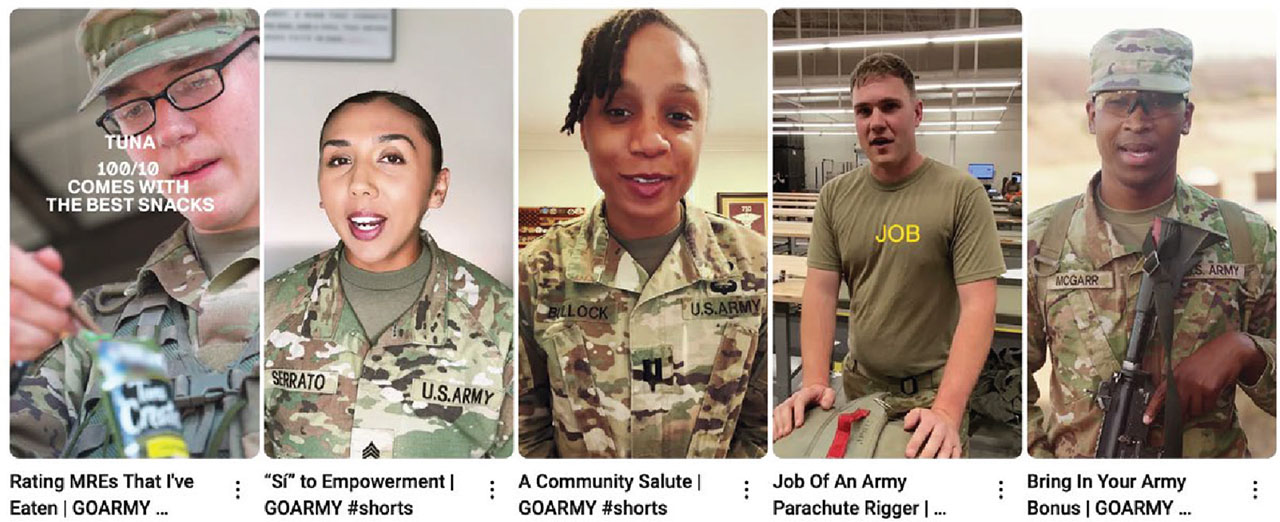
Fig. 1:
Thumbnails sample ‘Go Army’.
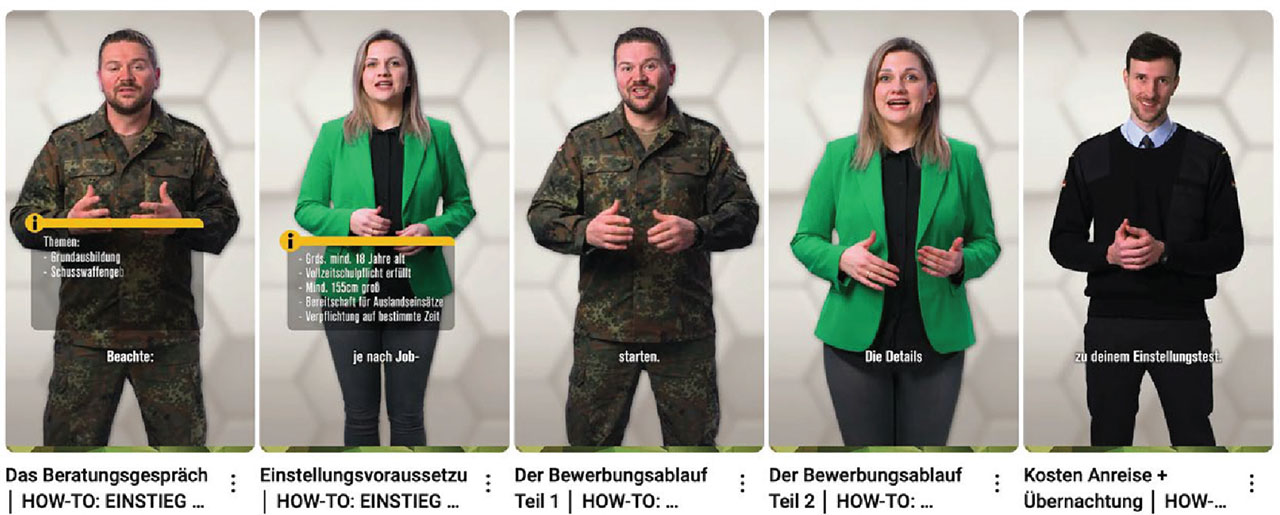
Fig. 2:
Thumbnails sample ‘Bundeswehr Exclusive’.
Research on the representation of female soldiers in YouTube Shorts must consider the unique characteristics of this Internet-based narrative, and occasionally, fictional multimedia format. This format, limited to ≤60 s, is designed to quickly capture the viewer’s attention with concise and engaging content. However, the vast number of videos and their multimodal nature present specific challenges for researchers, as they require simultaneous analysis of text, video, music and imagery (Kuhn 2017; Stengel and Shim 2022). Moreover, the U.S. Army and the Bundeswehr employ distinct strategies in their YouTube Shorts. The U.S. Army organises its content around themes such as adventure, personal narratives and recruitment advice, whereas the Bundeswehr relies on structured series and highlights only a few recurring female figures. Thus, I adopt a multimodal discourse analytical approach with an interpretive lens. This flexible method enables the identification of communicative elements across the Shorts and responds to recent calls to expand visual analysis in international relations (Norris 2004; Bleiker 2018; Stengel and Shim 2022). In line with this approach, I developed guiding questions drawing on prior research on gender representation in media (e.g. Stan 2023) and scholarship on discourse analysis and media texts (Carvalho 2000). These questions establish a coding framework that guides the analysis of female soldier representation and military service, while also incorporating the specific attributes of the YouTube Shorts format (van Munster and Sylvester 2016; Stengel and Shim 2022) (see Table 1). This builds upon the framework proposed by Stengel and Shim (2022) but adapts it to a comparative cross-national analysis. To ensure inter-coder reliability and minimize bias, a male researcher also applied the coding framework to a random sample of five Shorts per army (n = 10), representing approximately 13% of the dataset. Involving a male coder was intentional to counterbalance potential gendered blind spots and to strengthen the credibility of the analysis. Any interpretive differences were discussed and resolved through reflexive dialogue until consensus was reached. Most differences were minor and concerned emphasis within a category. For example, in one case of Thematic Focus, one coder emphasised teamwork while the other emphasised career development. These differences were reconciled through discussion and systematically integrated. This process enhanced transparency, reduced the risk of gendered bias and aligned with best practices in qualitative multimodal analysis, where attention to visuals, audio and text requires reflexive interpretation.
Tab. 1:
Coding framework
| Aspect | Guiding questions for coding |
|---|---|
| Visual representation |
|
| Audio and dialogue |
|
| Thematic focus |
|
| Narrative structure |
|
| Gender representation |
|
Drawing on poststructuralist feminist theory, especially Butler’s concept of gender performativity, I understand gender as relational and constructed through repeated actions and discourse (Butler 1990). This lens helps examine how military recruitment videos portray women in ways that either challenge or reinforce dominant masculine norms. It also allows for a focus on how meaning is created across linguistic and audiovisual elements (MacKenzie 2020; Stengel and Shim 2022). To give an example, in one YouTube Short from the U.S. Army, a female soldier showcases her new tanker boots, how to put them on and off, and explains their importance. At the end of the video, she says, ‘Remember, the Army wants you to be all you can be, and you can be stylish as well’ (Go Army, 2023a, 0:50–0:53). The use of the word ‘stylish’ suggests that women in the military can retain their femininity while serving. This challenges the traditional masculine image of the military and reinforces the idea that military service is compatible with being fashionable, a trait typically associated with femininity (Braizaz 2018).
Equally important to the stylistic and discursive elements is the consideration of the overall storyline. To this end, I incorporate insights from visual narrative analysis (Freistein and Gadinger 2020). Narrative approaches assume that people are natural storytellers who easily recognise and connect with the stories they tell and experience (Somers 1994). Images and metaphors are key elements that weave together storylines, highlight specific plots and convey emotions. Therefore, a visual narrative approach must consider both the images and text, as well as their explicit and implicit connections to a larger (political) message (Freistein and Gadinger 2020). Here, the random sample of male-focused videos is especially revealing in assessing whether the distinct narrative style seen in female-focused videos is unique to them or applies to recruitment videos in general. If the latter is true, it speaks of a broader shift in recruitment strategies. This approach helps us understand how YouTube Shorts, as a medium, diverges from traditional recruitment videos by offering more room for storytelling. This is particularly evident in the Shorts, where individual female soldiers share their personal success stories, as well as in the short-form video series produced by the Bundeswehr. These strategies effectively humanise the soldiers by presenting them as real people with whom potential recruits can identify.
4.1. Ethical considerations and limitations
This study examines publicly available YouTube Shorts. While public access implies a degree of consent, ethical standards still require respecting the dignity and privacy of those portrayed (Hu 2019). Personal identifiers such as names and ranks are excluded, and the analysis focuses strictly on discursive and multimodal strategies.
To minimise subjectivity in interpretation, a second coder independently applied the analytical framework to a random sample of videos from both armies. This step helps ensure intercoder reliability and reduces bias.
A main limitation is the focus on videos featuring women in the thumbnail, which may exclude subtler portrayals in other content. To balance this, the study includes a comparative sample of 10 male-centred videos from each military. Yet, the analysis does not cover the full range of Shorts, which limits the generalisability of findings. Future studies should include all available videos to provide a more comprehensive view of gender representation in military recruitment.
4.2. Findings
This section highlights selected examples from the YouTube Shorts to illustrate how female soldiers and military service are portrayed. Due to space limits, not all videos are discussed. Each example is referenced by year, appendix letter and time stamp. Key findings are summarised in Table 2.
Tab. 2:
Summary of findings
| Aspect | Guiding questions for coding | U.S. Army | Bundeswehr |
|---|---|---|---|
| Visual representation |
|
|
|
| Audio and dialogue |
|
|
|
| Thematic focus |
|
|
|
| Narrative structure |
|
|
|
| Gender representation |
|
|
|
Taking both visual and discursive elements into account, a stark contrast emerges in the construction of the female soldier between the U.S. Army and the Bundeswehr. While both militaries showcase their female soldiers with makeup and varied hairstyles, the U.S. Army distinctly emphasises featuring women from diverse ethnic backgrounds, a focus notably absent in the Bundeswehr’s representations. In the very first Short published in 2022, a 19-s video showcases a Black woman running in a sweater that says ‘Army’, alongside images of a diverse group of men and women engaging in various activities such as gliding down from a helicopter, flying an airplane and carrying weapons. The slogan, ‘When we say we’re in the army, that is what we mean’ (Go Army, 2022a, 0:05), reinforces the message that the Army is an inclusive and adventurous place where everyone is welcome. This theme is prevalent throughout the U.S. YouTube Shorts, where more than two-thirds of the women sharing their experiences are Black, Hispanic, or Asian, and only four white women are featured.
For instance, in one short, a Black woman explains what it means to be ‘unlimited’ and emphasises that the Army has helped her adopt a mindset of overcoming obstacles to achieve her goals. Another Black woman describes how her rich heritage as the first African-American of her family to join the Army inspires her to ‘be all I can be every single day I show up in this uniform’ (Go Army, 2024a, 0:06–0:08). In another example, a female soldier of Asian origin compares military service with ballet dancing (Go Army, 2023b). This analogy not only humanises the military experience but feminises the military organisation as a whole. These examples use personal and relatable narratives to appeal to female recruits, emphasising that women can thrive and maintain their feminine identities in the military.
These visual and discursive elements highlight several key aspects of the construction of female soldiers in the U.S. Army:
First, featuring women from diverse backgrounds shows the Army’s desire to appeal to diverse potential recruits. However, the portrayal of diversity in these videos sharply contrasts with the actual demographics of women in the U.S. Army. According to a U.S. Army report (2022), 53.6% of women in the Army are white, 20.1% are Black, and other ethnicities make up <7%. Statista (2024) provides similar insights, showing that >54% of military women are white, 28% are Black, and 21% are Hispanic, with other ethnicities accounting for <5%. Despite this demographic reality, the videos portray female soldiers as resilient and capable leaders who transcend racial barriers. This representation promotes an inclusive and empowering image of military service, aiming to attract women from various backgrounds by showing that they, too, can achieve success and recognition in the Army. This is supported by a Short that features an Asian-American woman, a field state officer, who conveys a message of strength and resilience, stating, ‘You are strong enough for whatever you set your mind to’ (Go Army, 2023d, 0:02– 0:03). She shares her experience as a first-generation Chinese-American and the first in her family to join the Army. Moreover, she expresses pride in her accomplishments and highlights the unexpected achievements she has made. This narrative not only showcases her personal success but also emphasises the transformative power of the Army in helping individuals realise their potential, regardless of gender. By demasculinising traits traditionally associated with being male, such as strength and resilience (Connell 2005), the video demonstrates that these qualities are also inherent in women. This creates a compelling and inclusive narrative designed to appeal to women who might otherwise perceive themselves as unfit for military service (Yeung et al. 2017). Moreover, these discursive elements suggest that the U.S. Army is actively engaging in a performative reconstruction of gender roles, where female soldiers embody traditional military virtues while redefining them through a feminine lens. This approach aligns with Butler’s concept of gender performativity, which posits that gender identity is continuously produced and redefined through repeated social performances (Butler 1990). This is further exemplified by examples that present a more balanced perspective on military life. For instance, a female soldier states that the military understands that to be a good soldier, there are ‘certain things’ that have to become a priority in a person’s life. This statement is accompanied by an image of a male soldier playing with his child (Go Army, 2023e). This illustrates that responsibilities and values traditionally associated with femininity are also integral to the male soldier’s identity. This leads to the second key aspect: the Shorts depict male and female soldiers in equal relationships. The strategic choice of showing a picture of the man playing with his child humanises the male soldier and softens the traditional image of military masculinity. While male soldiers are depicted in nurturing roles, the videos simultaneously highlight women in leadership positions. This contrast may underscore a deliberate effort to challenge conventional gender norms. For example, a Black woman describes her daily life as an S-1 while leading a group of young white male soldiers (Go Army, 2022e, 0:21–0:26). This visual strategy aims to counteract fears of racial discrimination (Yeung et al. 2017) and demonstrates that women, irrespective of their ethnic background, are integral to military life by actively challenging perceptions of gender hierarchy between male and female soldiers. This aligns with Jester’s (2021) findings that the U.S. Military uses diverse female imagery in traditional recruitment materials to appeal to a broader demographic and challenge militarised masculinity. Lastly, the pride expressed in wearing the uniform underscores its symbolic value. The uniform is presented not just as attire but as a source of strength and identity. Although the uniform was long seen as a symbol of militarised masculinity (Wright et al. 2019), by featuring female soldiers with makeup proudly identifying as soldiers, these YouTube shorts counter those traditional gender norms that view military roles as incompatible with femininity (Mitchell 1998). Thus, the uniform, in combination with makeup, becomes a performative act that redefines military identity as it suggests women can embody military virtues while maintaining femininity (Butler 1990).
By contrast, the Bundeswehr’s videos do not strongly emphasise diversity and inclusion in their portrayal of female soldiers. The analysis reveals limited ethnic diversity, featuring only two Black women and a few women who appear to have Eastern European backgrounds. This absence of ethnic diversity is particularly striking given Germany’s increasingly multicultural society. As of 2024, approximately 30% of Germany’s population has a migrant background – encompassing significant communities of Turkish, Middle Eastern, African, Asian and Eastern European descent (Statista 2024). Major cities such as Berlin, Frankfurt and Hamburg are especially diverse, with substantial ethnic minority populations. Despite this demographic reality, the Bundeswehr’s recruitment materials predominantly feature white German soldiers and fail to reflect the nation’s ethnic diversity. By not showcasing women from diverse backgrounds, the Bundeswehr may be missing a critical opportunity to appeal to a broader spectrum of potential recruits and to build a military that truly represents German society. The stark contrast with the U.S. Army’s deliberate emphasis on diversity highlights a potential shortcoming in the Bundeswehr’s recruitment strategy.
The overall depiction of female soldiers in the Bundeswehr primarily unfolds through its different YouTube Shorts series, each following a distinct structure. For example, the series ‘Zivile Karrierewege’ opens every episode with the phrase ‘Your entry to the Bundeswehr’, and systematically covers topics like job requirements, the application process, physical exam preparation and career paths within the military. This makes the Bundeswehr’s Shorts much more formal and straightforward compared with the U.S. Army, where Shorts are loud, colourful and lively with engaging background music and personal background pictures of the soldiers. Some Bundeswehr shorts feature music at the beginning to capture attention, but as soon as the woman starts talking, almost no background music is used. ‘Zivile Karriereweg’, however, offers limited insights into the construction of gender due to its formal approach, which features a single speaker without additional visual elements. By contrast, the series ‘Save’ provides a more nuanced portrayal by showcasing women in roles such as medical, firefighting and emergency response. Unlike the U.S. Army Shorts, which often highlight dynamic and overly positive aspects of military life, the Bundeswehr’s approach in ‘Save’ emphasises authenticity by focusing on the challenges and rewards of these professions. For example, a woman remarks, ‘The job is not easy; the job is exhausting. However, the job also gives much back’ (Bundeswehr Exclusive, 2023p, 0:16–0:18). By concentrating on professional and service-oriented roles, the narrative shifts from the traditional emphasis on military pride, combat and physical prowess to roles associated with care and support (Sasson-Levy 2011). These observations lead to several key differences in the construction of female soldiers in the German Bundeswehr compared with the U.S. Army: First, the Bundeswehr focuses on professional or casual attire instead of military uniforms, which reflects Germany’s cultural and historical commitment to anti-militarism (Graf and Kuemmel 2021; Stengel and Shim 2022). For example, the woman who moderates several episodes of ‘Zivile Karrierewege’ is shown wearing a green blazer, black pants and a black shirt – colours that hint at a uniform but are casual clothes (e.g. Bundeswehr Exclusive, 2023a; Image 2). Or, in the ‘Explorer – Roadtrip’ through the Bundeswehr’ series, which follows four young content creators (two boys and two girls) touring the country in a camper van, visiting various Bundeswehr locations and completing challenges, the women are dressed casually in sweatpants and T-shirts (e.g. Bundeswehr Exclusive, 2024c). These stylistic choices emphasise a different approach to representing military life compared with the U.S. Army. It highlights more room for individuality instead of a collective military identity. This choice also signals a preference for portraying female soldiers in roles that emphasise civilian skills and support functions rather than frontline combat, which aligns with broader societal values that prioritise civilian life over military engagement. Therefore, the portrayal of women in civilian roles suggests a cultural reluctance to fully integrate women into combat positions. This becomes especially clear when considering that male soldiers in their Shorts are predominantly featured in military uniforms, with only a few exceptions.
Second, teamwork and collaboration form the foundation of how the Bundeswehr constructs the female soldier. In most of the Shorts where female soldiers share stories of personal growth and professional success, these achievements are consistently linked to their contributions to the team and the support they receive from colleagues. For instance, one woman says, ‘As a leader, I depend on my team because, without them, we wouldn’t be able to manage the task’ (Bundeswehr Exclusive, 2023d, 0:31–0:33). This reinforces the idea that individual success results from collective effort. While trust and teamwork are fundamental values in all military organisations, highlighting the importance of teamwork through women’s participation portrays them as integral members whose value is amplified through collaboration. Moreover, it suggests that relationships between men and women in the Bundeswehr are based on an equal foundation, where trust and collaboration play central roles rather than traditional gender dynamics. By emphasising trust and teamwork, the Bundeswehr aims to reassure potential female recruits that they will join a supportive and dependable environment where their contributions are valued, and their success is intertwined with that of their colleagues. This strategy aligns with broader societal values in Germany that prioritise collectivism and social harmony (Hofstede 2001), and it contrasts with the U.S. Army’s emphasis on individual achievement encapsulated in its ‘Be All You Can Be’ narrative.
This leads to the third point: The Bundeswehr explicitly states that gender is not a differentiating factor within its ranks. For example, a female soldier states, ‘Being a woman and being in the Bundeswehr go together because gender doesn’t matter at all!’ (Bundeswehr Exclusive, 2024d, 0:11–0:16). She emphasises that what truly matters is ‘capability, suitability and performance’. She also discusses the balance between private life and military service, concluding with, ‘It suits you better than you think’ (0:37). This approach presents the female soldier as an equal and essential member of the military, where her contributions are valued based on her skills and performance, not her gender. Such a performative act reinforces the Bundeswehr’s narrative that gender is not a defining characteristic in military service, but rather, individual merit and capability are what truly matter.
While both armies aim to demasculinise their narratives to appeal to women in different ways, they both omit an important aspect of the military: violence is a core component of military service (Basham 2013). By focusing on military life as a journey of personal growth rather than one inherently tied to conflict and state-sanctioned violence, they aim to reframe public perception of military service. Yet there are distinct differences in how male and female soldiers are portrayed within this framework. In the U.S. Army, while male-focused Shorts do not depict active violence, they feature weaponry far more frequently than Shorts featuring women. This indicates a need for further research into these differences. In the Bundeswehr, weapons are less emphasised overall, but male soldiers are predominantly shown in uniform, while women are rarely depicted wearing one. By omitting the violence intrinsic to military service, these representations create an image of military life as ‘fun’ (Stengel and Shim 2022). This is exemplified in a U.S. Army Short that features the tagline, ‘POV: You join the army, find your dream career, and travel the world’ (Go Army, 2022b, 0:02), accompanied by energising music and visuals of smiling soldiers (men and women) engaging in activities like standing in front of waterfalls, skiing in the mountains and sitting around a campfire. Similarly, other videos highlight light-hearted events, such as a gingerbread house competition (Go Army, 2022d) or soldiers sharing their favourite memories from social gatherings like New Year’s Eve celebrations (Go Army, 2022c). The Bundeswehr adopts a similar approach in its ‘Explorer’ series, where different aspects of military life are playfully highlighted. In these Shorts, viewers follow a group of four content creators as they engage in competitions and visit, for example, a head chef in a barracks (Bundeswehr, 2024a) or go skydiving in Cologne (Bundeswehr Exclusive, 2024b). The series even subverts traditional gender norms by assigning the girls’ team the colour blue, challenging the classic gender-colour dichotomy that traditionally associates blue with males (Bridges 1993). Such representations create a contradiction between the reality of military service and the idealised, almost recreational image presented in these recruitment videos.
Overall, the analysis demonstrates that both the U.S. Army and the Bundeswehr construct female soldiers as essential and capable members of the military, but they do so in markedly different ways. The U.S. Army places a strong emphasis on self-improvement, the collective pride in wearing the uniform and a shared military identity that transcends gender and ethnicity. By contrast, the Bundeswehr highlights individuality, professional competence and a more civilian-oriented approach, reflecting Germany’s anti-militarist cultural values. While both militaries seek to demasculinise their narratives to attract female recruits, they also gloss over the inherent violence of military service, presenting a sanitised, often idealised view of military life. This selective portrayal shapes how potential recruits and the broader public perceive the role of women in the military.
5. Conclusion
This comparative analysis of the U.S. Army and the German Bundeswehr’s YouTube Shorts has offered critical insights into how female soldiers and military life are portrayed within their recruitment strategies. Both military organisations are leveraging YouTube Shorts to challenge the traditional perception of the military as a male-dominated space and to attract female recruits. This study argues that while these recruitment videos incorporate women to reshape public perceptions and promote gender diversity, the portrayals are strongly influenced by each nation’s historical and cultural context. Furthermore, both militaries strategically omit the inherent violence of military service and instead opt to present a more sanitised and appealing vision of military life that aligns with their recruitment goals.
The U.S. Army’s YouTube Shorts emphasise ethnic diversity, personal success stories and empowerment to project an inclusive image that challenges traditional gender norms. By highlighting female soldiers as resilient leaders who embody both military virtues and feminine qualities, the U.S. Army aligns with a broader shift away from military masculinity (Jester 2021). By contrast, the Bundeswehr focuses on professional roles, teamwork and trust, portraying military service as an extension of civilian life. This approach, consistent with Germany’s anti-militarist values (Stengel and Shim 2022), often reinforces traditional gender roles by depicting women in non-combat and supportive positions (Sasson-Levy 2011). While this strategy may reassure potential female recruits of a supportive environment, it also reflects a more conservative approach that may limit the Bundeswehr’s ability to fully challenge traditional gender norms. The inclusion of a random sample of male-focused Shorts strengthens the findings by highlighting how representations of male soldiers often focus more on physical fitness and weaponry. However, it also underscores the need for future research to examine the broader narrative strategies employed in military recruitment videos.
Future studies could also expand the sample size as more Shorts are published, explore how these portrayals evolve over time, and assess their impact on recruitment and retention, particularly among women. Understanding how potential recruits receive these videos and the real-world experiences of those influenced by them would provide valuable insights into the effectiveness and authenticity of these strategies.
In conclusion, while the U.S. Army and the Bundeswehr have made concerted efforts to portray a more inclusive and gender-diverse image, it is crucial that these portrayals translate into real-world experiences for female soldiers. Achieving a genuinely diverse and inclusive military requires that the inclusive images presented in recruitment campaigns are reflected in the day-to-day realities of military life.
Notes
Author Biography
Laura Homann-Charette was born and raised in Germany and is currently a PhD candidate in Global Studies at the University of Massachusetts Lowell. Her research focuses on gender integration in the military, recruitment strategies and the visual representation of female soldiers in digital and institutional media.
Appendices
Appendix
Dataset
| No. | Channel | Video ID | Title | URL |
|---|---|---|---|---|
| 1 | Go Army | 2022a | This is the Unites States Army | https://www.youtube.com/shorts/wPba_2qwNlY |
| 2 | Go Army | 2022b | POV. Army edition. | https://www.youtube.com/shorts/irToAmUzijE |
| 3 | Go Army | 2022c | Happy New Year 2023 | https://www.youtube.com/shorts/o47Qch1NHBs |
| 4 | Go Army | 2022d | Gingerbread House Competition | https://www.youtube.com/shorts/rsrKwsr60TA |
| 5 | Go Army | 2022e | Day in the life of an S-1 | https://www.youtube.com/shorts/EkNOGCdypt0 |
| 6 | Go Army | 2022f | Motivation from Maj. Brager | https://www.youtube.com/shorts/VaHGrwR77So |
| 7 | Go Army | 2022g | Explore Your Passion for Adventure | https://www.youtube.com/shorts/R8hBnC60_Qw |
| 8 | Go Army | 2022h | Three things you need to know before basic training | https://www.youtube.com/shorts/ElV_U0mmYKY |
| 9 | Go Army | 2022i | Army 2022 Memories | https://www.youtube.com/shorts/Cl33aXmuG1M |
| 10 | Go Army | 2023a | Tanker boots in the army | https://www.youtube.com/shorts/xj5ceyCM4pQ |
| 11 | Go Army | 2023b | Similarities between ROTC and Dance | https://www.youtube.com/shorts/Nqlqr9qKxeE |
| 12 | Go Army | 2023c | “Sí to Empowerment” | https://www.youtube.com/shorts/cvFr_RAunaQ |
| 13 | Go Army | 2023d | Take control of your legacy | https://www.youtube.com/shorts/wtUD_7TQdoM |
| 14 | Go Army | 2023e | Tips to finding balance in the Army | https://www.youtube.com/shorts/q9rTixcMiBg |
| 15 | Go Army | 2023f | Get a Jump Start to ROTC | https://www.youtube.com/shorts/x1BPylO2A9Y |
| 16 | Go Army | 2023g | Mind over Matter | https://www.youtube.com/shorts/CwcBzJBZ2ig |
| 17 | Go Army | 2023h | Redefine your Legacy | https://www.youtube.com/shorts/wYgQEbY9GaU |
| 18 | Go Army | 2023i | Becoming a Army nurse | https://www.youtube.com/shorts/tAWOvB3ME4g |
| 19 | Go Army | 2023j | Do more with Army reserve | https://www.youtube.com/shorts/Yy62yIdGW5E |
| 20 | Go Army | 2023k | Army tips for better sleep | https://www.youtube.com/shorts/CpynL-AAm70 |
| 21 | Go Army | 2023l | Cook with culinary specialist | https://www.youtube.com/shorts/6hDRSjbW-XU |
| 22 | Go Army | 2023m | Celebration of strength | https://www.youtube.com/shorts/pcYdYHCAUYg |
| 23 | Go Army | 2023n | Make your own motivation | https://www.youtube.com/shorts/Umug_j9B7aM |
| 24 | Go Army | 2023o | Step in formation | https://www.youtube.com/shorts/fsh5xUiwaeM |
| 25 | Go Army | 2023p | Stew with your crew | https://www.youtube.com/shorts/f0-BS9YkK6Y |
| 26 | Go Army | 2024a | On the path to become an Army Chaplain | https://www.youtube.com/shorts/hWGYgdODG4g |
| 27 | Go Army | 2024b | Army Mentorship | https://www.youtube.com/shorts/PgHc5Cc2jI8 |
| 28 | Go Army | 2024c | U.S. Army Black History Month | https://www.youtube.com/shorts/zVH_BnNAtC8 |
| 29 | Go Army | 2024d | Maj Young. What’s your why? | https://www.youtube.com/shorts/ma7j0c-FE8s |
| 30 | Go Army | 2024e | MSG Jenkinsfarmer – What’s your why? | https://www.youtube.com/shorts/JglMEKJx8Pw |
| 31 | Go Army | 2024f | The puzzle of being a logistic officer | https://www.youtube.com/shorts/wATzbkliZIU |
| 32 | Go Army | 2024g | What preventive medicine specialist really do | https://www.youtube.com/shorts/ZGOUKdIqumE |
| 33 | Go Army | 2024h | A community Salute | https://www.youtube.com/shorts/eYF-XmI1H0w |
| 34 | Go Army | 2024i | Physical Therapist in the Army | https://www.youtube.com/shorts/pRGTSUqX1mQ |
| 35 | Go Army | 2024j | Unexpected Jobs in the Army | https://www.youtube.com/shorts/ZJCBj3YVIyE |
| 36 | Go Army | 2024k | Tell the Army’s story in public affairs | https://www.youtube.com/shorts/_wcuK0tjMJY |
| 37 | Go Army | 2024l | The Best MREs in the Army | https://www.youtube.com/shorts/-l3tF6DusX4 |
| 38 | Go Army | 2024m | Pride for Campbell | https://www.youtube.com/shorts/jGkJilcVDi8 |
| 1 | Go Army (Male) | 2024n | Army Advice for leaders | https://www.youtube.com/shorts/EFA36aIOk5A |
| 2 | Go Army (Male) | 2024o | How do Mortars work? | https://www.youtube.com/shorts/gqE66G5pM0k |
| 3 | Go Army (Male) | 2022j | Army Soldiers Goals 2023 | https://www.youtube.com/shorts/olJRUc9lpwc |
| 4 | Go Army (Male) | 2023q | Find your Army Strength | https://www.youtube.com/shorts/zoERhgeMcEE |
| 5 | Go Army (Male) | 2023r | Train to make Gains | https://www.youtube.com/shorts/WomcGOJStc0 |
| 6 | Go Army (Male) | 2023s | Bring in your army bonus | https://www.youtube.com/shorts/tzNKxdcGCNY |
| 7 | Go Army (Male) | 2022k | Making an impact as an army leader | https://www.youtube.com/shorts/gjcfMusMr_0 |
| 8 | Go Army (Male) | 2023t | Army Advice from a soldier | https://www.youtube.com/shorts/5ibegDoW-qU |
| 9 | Go Army (Male) | 2023u | Lead your way through Army ROTC | https://www.youtube.com/shorts/cEJ3LppjFaQ |
| 10 | Go Army (Male) | 2022l | Answering your most searched army questions | https://www.youtube.com/shorts/wodsQ0nW7Ds |
| 1 | Bundeswehr Exclusive | 2023a | Zivilie Berufsausbildung.#17 | https://www.youtube.com/shorts/QgL-N4zD_K4 |
| 2 | Bundeswehr Exclusive | 2023b | Das Herr | https://www.youtube.com/shorts/cgilcuLyhvM |
| 3 | Bundeswehr Exclusive | 2023c | Die Rechtspflege | https://www.youtube.com/shorts/KyyWoVjEAco |
| 4 | Bundeswehr Exclusive | 2023d | Die Technik | https://www.youtube.com/shorts/Ba6whTku86I |
| 5 | Bundeswehr Exclusive | 2023e | Zivilie Berufsausbildung.#2 | https://www.youtube.com/shorts/4DULY7QNSsg |
| 6 | Bundeswehr Exclusive | 2023f | Zivilie Berufsausbildung.#4 | https://www.youtube.com/shorts/mOg7Z0nC6HI |
| 7 | Bundeswehr Exclusive | 2023g | Zivilie Berufsausbildung.#6 | https://www.youtube.com/shorts/LgJWXS238Wg |
| 8 | Bundeswehr Exclusive | 2023h | SAVE – Teaser | https://www.youtube.com/shorts/ZsYJf_dVPns |
| 9 | Bundeswehr Exclusive | 2023i | SAVE – Eure Angewohnheiten mit dem Sanitätsdienst | https://www.youtube.com/shorts/AtDgKej2h7Q |
| 10 | Bundeswehr Exclusive | 2023j | SAVE- Woche 3 | https://www.youtube.com/shorts/aQMlaWFQn-k |
| 11 | Bundeswehr Exclusive | 2023k | SAVE- Was tun beim Krankenwagen im Einsatz? | https://www.youtube.com/shorts/J0jgZfhPwCs |
| 12 | Bundeswehr Exclusive | 2023l | SAVE- Woche 9 | https://www.youtube.com/shorts/AyVelk6R-UY |
| 13 | Bundeswehr Exclusive | 2023m | SAVE- So funktioniert die Notaufnahme | https://www.youtube.com/shorts/Hg2H9O_5TNw |
| 14 | Bundeswehr Exclusive | 2023n | SAVE- Folge 12 | https://www.youtube.com/shorts/tCaTQlqJ8 × 8 |
| 15 | Bundeswehr Exclusive | 2023o | SAVE- Woche 5 | https://www.youtube.com/shorts/JC6LPPmKIyE |
| 16 | Bundeswehr Exclusive | 2023p | SAVE-Was magst du an deinem Job am liebsten? | https://www.youtube.com/shorts/lvgDohgUdUs |
| 17 | Bundeswehr Exclusive | 2023q | SAVE- Special 5 | https://www.youtube.com/shorts/JJVyMbFYGmA |
| 18 | Bundeswehr Exclusive | 2023r | SAVE- Story | https://www.youtube.com/shorts/vAqphTZITkY |
| 19 | Bundeswehr Exclusive | 2023s | Für alle deren Komfortzone irgendwo da draussen ist | https://www.youtube.com/shorts/5N3EC-gJuJA |
| 20 | Bundeswehr Exclusive | 2023t | SAVE – Get ready mit Lea | https://www.youtube.com/shorts/cfgYH-QXnMQ |
| 21 | Bundeswehr Exclusive | 2024a | Team Blau macht den Küchencheck | https://www.youtube.com/shorts/MVy7griSenY |
| 22 | Bundeswehr Exclusive | 2024b | Wie wird Sprunggeschirr angelegt? | https://www.youtube.com/shorts/IfdWPNwfOgw |
| 23 | Bundeswehr Exclusive | 2024c | Die Mädels checken den Multi2 aus | https://www.youtube.com/shorts/v2U_aAdLaDU |
| 24 | Bundeswehr Exclusive | 2024d | Als Frau zu Bundeswehr? Klar doch! | https://www.youtube.com/shorts/b6x_tyWtORo |
| 25 | Bundeswehr Exclusive | 2024e | Explorers-Roadtrip through the Bundeswehr. Teaser | https://www.youtube.com/shorts/AxaXlzIaTF4 |
| 26 | Bundeswehr Exclusive | 2024f | Team Blau lernt sich kennen | https://www.youtube.com/shorts/WuTKQpp6Htg |
| 27 | Bundeswehr Exclusive | 2024g | Enge Räume, noch engere Duschen | https://www.youtube.com/shorts/8V0DGbLEAXc |
| 28 | Bundeswehr Exclusive | 2024h | Minentaucher und Atemkünste | https://www.youtube.com/shorts/oStxzAX2QN4 |
| 29 | Bundeswehr Exclusive | 2024i | Praktikum bei der Bundeswehr | https://www.youtube.com/shorts/rprvSW6skfQ |
| 30 | Bundeswehr Exclusive | 2024j | Wo läuft die Serie? | https://www.youtube.com/shorts/31WE5_kKr6w |
| 31 | Bundeswehr Exclusive | 2024k | Das war Woche 1 | https://www.youtube.com/shorts/DZLlOuwEQc0 |
| 32 | Bundeswehr Exclusive | 2024l | Steuern des Crayler | https://www.youtube.com/shorts/Fyh6ijkgRt8 |
| 33 | Bundeswehr Exclusive | 2024m | Flugbereitschaft in Köln | https://www.youtube.com/shorts/l4iLfh1ZcfA |
| 34 | Bundeswehr Exclusive | 2024n | Grund-und Fitnessübung | https://www.youtube.com/shorts/dtgu69HRbcw |
| 35 | Bundeswehr Exclusive | 2024o | Bravo, Rucksack richtig | https://www.youtube.com/shorts/QbZnr8L26SE |
| 36 | Bundeswehr Exclusive | 2024p | Stimmt es das es mit der Grundausbildung körperlich ziemlich fordernd ist? | https://www.youtube.com/shorts/NNpU1dbd6fo |
| 37 | Bundeswehr Exclusive | 2024q | Vegetarisch essen | https://www.youtube.com/shorts/4igs5GwlwfU |
| 1 | Bundeswehr Exclusive (Male) | 2023u | SAVE – Urlaub? Diese Impfungen solltet ihr mitnehmen | https://www.youtube.com/shorts/_Yk8dFodDS |
| 2 | Bundeswehr Exclusive (Male) | 2024r | Hast du schon nen Plan was nach dem Schulabschluss kommt? | https://www.youtube.com/shorts/Npofg8Mzz_w |
| 3 | Bundeswehr Exclusive (Male) | 2024s | Die Hindenisbahn in Rheine | https://www.youtube.com/shorts/i3tFM3hMvyY |
| 4 | Bundeswehr Exclusive (Male) | 2023v | Der CAT | https://www.youtube.com/shorts/xmc1WnLhTNI |
| 5 | Bundeswehr Exclusive (Male) | 2023w | Die Sondertests | https://www.youtube.com/shorts/VnsY8Us8mV8 |
| 6 | Bundeswehr Exclusive (Male) | 2023x | Für alle die sich was beweisen wollen | https://www.youtube.com/shorts/u31AwAqWKmg |
| 7 | Bundeswehr Exclusive (Male) | 2023y | Die lieblings-krankenhausserie | https://www.youtube.com/shorts/yfS4PSp5FSY |
| 8 | Bundeswehr Exclusive (Male) | 2023z | Freiwleiger wehrdienst | https://www.youtube.com/shorts/mWG0i6wFugM |
| 9 | Bundeswehr Exclusive (Male) | 2024t | Tina und Selma lernen den AGSHO simulator kennen | https://www.youtube.com/shorts/WA97w41CnP8 |
| 10 | Bundeswehr Exclusive (Male) | 2021a | Fluglotse Christian | https://www.youtube.com/shorts/xVxDAsh |