
1. Introduction
Logistics has been an integral part of warfare for centuries (Serrano et al. 2023, pp. 6–14). Today, logistics and supply chains are vital parts of the nature of modern warfare (Kress 2016, p. 2), enabling the deployment and sustainment of force elements in exercises and operations, whether in the home country or in overseas operations (NATO 2025).
The logistics and supply chains of modern military organisations are closely connected to civilian contractors and private companies (Kılıç 2024, pp. 103–105). In international operations in particular, the usage rate of civilian logistics assets can be high (Moore 2016, pp. 16–17), optimising a military organisation’s own logistics resources and enhancing mission success.
In some cases, it is more economical to contract, arrange and produce certain supplies or support services through local logistics operators rather than through military logistics organisations. However, the direct use of contractor support in international operations that depend on host nation resources requires careful planning and coordination. Otherwise, if host nation resources are limited, there is a risk that the required military support will compete with the essential needs of the local population (Council of the European Union 2014, pp. 15–19).
What then is the role of logistics in Host Nation Support (HNS)? Logistics enables the deployment, reception, staging, onward movement (RSOM), sustainment and rearward movement, staging and dispatch (RMSD) of visiting friendly forces. These are all functions in which logistics plays a key role in the HNS framework (NATO 2021, pp. 24–26).
In terms of supply chains, there are multiple cooperation areas from the HNS point of view. For example, airports, seaports and railways are typically operated by civilian personnel and resources. If required, it is possible for military personnel to operate some of these points of entry into the country. In general, receiving friendly force elements requires sufficient infrastructure and a logistics service offering in the host nation (NATO 2012, pp. 73, 83–84).
Inevitably, complexity increases because some aspects of host nation logistics services are produced through multi-tier civilian supply chains, and others through the host nation’s military logistics organisation. Moreover, the security requirements for supply chains are affected by the nature of the society and environment in the host nation. On the contrary, standardisation has been facilitated to achieve better interoperability. This has enhanced the ability to organise and control the required support from the host nation, including supply chain risk management (NATO 2025).
2. Broader statement of the goals of the study
This paper anticipates and discusses the logistics development in Finland from the HNS logistics perspective over the next 20 years, up to 2040. The continuous changes in the operating environment, along with uncertainty about the future, are some of the motivations behind this focus.
Currently, there are multiple articles discussing ways in which to conduct HNS logistics in the present and near future (<10 years). However, more future-oriented academic articles, papers or books focusing on HNS logistics development over the next 20 years are limited, particularly in Finland. In light of this shortfall, there is scope for academic research on this theme (Nokipii and Uusipaavalniemi 2023, pp. 26–27), with logistics trends research providing valuable insights into the future operating environment.
In Finland, the logistics system of the Finnish Defence Forces (FDF) is a combination of both civilian and military components (Finnish Defence Forces Logistics Command 2024a). This same combination of logistics systems can also be found in other countries (Ti 2018), highlighting the importance of researching civilian logistics development. In smaller nations such as Finland, many logistics resources are dependent upon the civilian sector. Research on the status of the Finnish logistics-operating environment has a long tradition, particularly in examining civilian logistics conditions and business capabilities (Solakivi et al. 2023). Given the future-oriented nature of the research topic, it is essential to incorporate futures studies (Chugh 2021) and military sciences (National Defence University 2024) into the study’s research strategy.
This study aims to research the trends that will affect the HNS operational environment in Finland over the next 20 years from the logistics point of view. To this end, the research questions that will be addressed are: What are the key logistics trends up to 2040? and What kind of impact will the key trends have on Host Nation Support logistics?
The main goal of the research is to enhance understanding of HNS logistics futures by exploring the key trends that will lead to changes and have an impact on the logistics environment in Finland. This goal is divided into two sub-goals: (1) identifying important logistics trends and (2) assessing the influence of these key trends on logistics development in Finland.
3. HNS and logistics
The nature of war has become more complex and rapid with the advent of new technology (Nokipii and Uusipaavalniemi 2023, p. 19). It is therefore important to establish procedures that define the general principles of HNS logistics (NATO 2021), particularly in a situation where the host nation has a small economy and faces the risk of shortfalls in HNS capabilities.
A small nation’s military capabilities to provide large-scale logistics services may be limited (Antai et al. 2023, pp. 85–86). To address this, civil–military cooperation, using civilian-operated logistics infrastructure, can enhance HNS capabilities. This underlines the need for pre-coordination between partner nations to ensure the relevant level of HNS (Otzulis and Ozoliņa 2017, p. 98). Without logistics capabilities, operational activities cannot be conducted for any length of time (Kress 2016, pp. 9–10).
Logistics is at the heart of HNS. One of the principles of HNS logistics is to use the host nation’s resources as effectively and economically as possible, which requires considerable pre-planning and coordination (Ministry of Defence 2022, p. 4).
While the operating environment and nature of war have changed, countries such as the United States and Australia have, in recent years, focused on developing their military logistics capabilities from an interoperability point of view. This has assisted logistics operational planning in multinational operations. Standardisation has been one of the key factors in achieving more effective interoperability (Ashurst and Beaumont 2020).
Yet despite aspirations to improve interoperability, there are numerous national military logistics capabilities (Lis and Jałowiec 2015, p. 36) and business logistics capabilities that pose challenges to logistics planning in international operations, particularly during the RSOM phase (Dimitrov 2019, pp. 54–55). Essentially, all of these aspects need to be considered when planning HNS logistics (NATO 2012, p. 24).
In recent conflicts, multiple contractors and private companies have played a vital role in military supply chain networks. While these solutions have conserved military logistics resources, they have also increased both the risks associated with and reliance on external logistics resources and assets provided by global companies and service providers (Moore 2016, pp. 16–17). This course of action has sidestepped the need for a nation to expend military logistics resources in international operations. If this were not the case, military logistics would have to build all of the necessary assets within its own logistics capability pool (Uttley 2005, pp. 13–17).
Military logistics planners play a key role in efficiently facilitating HNS logistics. A thorough understanding of a partner’s logistics capabilities and supply chain structures will minimise the risk of sustainment failure from the HNS perspective (NATO 2021, pp. 17–19). From the perspective of the military logistics of international operations, interoperability is also one of the key areas of concern (European Parliament 2023).
Another important consideration from the global HNS logistics perspective is the European Commission’s Military Mobility Action Plan, which provides a financial framework for the years 2021–2027, including 1.5 billion EUR in funding. The Plan, for example, increases synergies in dual-use transport infrastructure and streamlines customs formalities for border crossings (European Commission 2021). It influences HNS logistics in Europe in multiple ways, ostensibly enhancing the deployment phase for visiting forces in particular. This venture is worth highlighting when focusing on and exploring the logistics development in the military context in Europe over the next 20 years.
3.1. HNS and logistics in Finland
The security situation in the Nordic countries has changed considerably in recent years. Finland (2023) and Sweden (2024) were the last countries in the Nordic region to join NATO, unlike Denmark, Iceland and Norway, which joined after the Second World War (Græger 2025, pp. 317–318). Based on this legacy, Norway and Denmark in particular have been able to develop their interoperability with NATO for many years.
A significant step towards international military logistics interoperability in Finland, particularly in terms of HNS, was taken on 4 September 2014 when a Memorandum of Understanding (MoU) was signed between the government of the Republic of Finland and Headquarters Supreme Allied Commander Transformation, as well as Supreme Headquarters Allied Powers Europe regarding the provision of HNS for the execution of NATO operations, exercises and similar military activities (Ministry of Defence 2014). This MoU defines the general principles of the HNS, such as the required documentation, and notes the logistics arrangements, including the responsibilities for organising support through civil and commercial services.
In Finland, the logistics system of FDF integrates military logistics with civilian logistics assets and services to ensure economical operation in all states of readiness. This solution improves resilience and comprehensive crisis response capability at the societal level (Finnish Defence Forces Logistics Command 2024a). This type of national and international partnership enables the FDF to focus on its main tasks more effectively (Finnish Defence Forces Logistics Command 2024b).
Since 2017, the statutory tasks of FDF have included the ability to receive military assistance in the form of material, troops and sharing of situation picture, for example. In addition, Finland may provide military assistance to a State, the European Union (EU) or an international organisation. Assistance may be provided or received based on a separate political decision (Finnish Defence Forces Logistics Command 2024c).
Later, in 2022, Finland signed the technical arrangement (TA) with NATO (Ministry of Defence 2022), which supplemented the HNS arrangements based on the HNS MoU.
The pragmatic way to increase military mobility and HNS logistics capabilities is through international exercises (Finnish Defence Forces Logistics Command 2024c). In 2024, the FDF were involved in multiple international exercises, one of the aims of which is to increase various competences and interoperability (Ministry of Defence 2024a). Overall, this can be seen as a way in which to improve Finnish HNS capabilities.
An interesting observation is that in Finland, the Ministry of the Interior (2015) has contributed to HNS logistics in its own administrative area. In 2015, it published its own procedure for conducting HNS, based on Decision No. 1313/2013/EU of the European Parliament and the Council of the European Union (2013). This document subsequently formed the basis of the guidelines in the Manual for support measures of the host nation of Southwest Finland Emergency Services (Mattila 2021). This manual includes detailed procedures for how to conduct HNS based on the EU Civil Protection Mechanism, and bears many similarities (such as certain concepts) to NATO’s (2021) AJP-4.3 Allied Joint Doctrine for Host-Nation Support (Allied Joint Publication, AJP).
In summary, global HNS logistics and Finnish HNS logistics have a number of similarities, not least collaboration with civilian logistics operators and aspirations to improve interoperability. Added to this, the logistics structures are constantly changing both globally and nationally, giving rise to requirements for coordination, planning and the continuation of international exercises to ensure the adequate implementation of HNS logistics in the changing world (Ministry of Defence 2024b, p. 9).
4. Methodology
The study has been designed to focus on the logistics trends that have an interactive relationship between civil society logistics and the host nation’s military logistics. Hence, the research gap that the paper aims to fill is the achievement of a comprehensive understanding of the change factors in the logistics environment in Finland.
The purpose of trend research is to highlight the potential trends that may emerge in the coming years (Kuosa 2012, p. 37). In this paper, the timeline extends from the present to 2040, and it is therefore possible that supply chains will undergo multiple changes during this period (Kalaitzi et al. 2021, p. 4). When a society such as Finland undergoes comprehensive change, its logistics structures are also transformed.
Military sciences are multidisciplinary (National Defence University 2024). In this research, the theoretical framework combines futures studies and military sciences, drawing on approaches from futures studies methodology and military science research methods when addressing the research problem. In this sense, the methodology is partly pragmatic, syntactic and semantic, and the adopted approach is qualitative (Malaska 2017, p. 18). Due to the qualitative nature of the research phenomena (Marshall and Rossman 2011, pp. 57–59), the chosen research methods were both theoretical and empirical, combining a literature review with semi-structured interviews.
The PESTE framework was applied when collecting the data for the study, which enabled a comprehensive scan of the future operating environment. PESTE refers to political, economic, social, technological and environmental factors (Meristö 2017, pp. 172–174; Sitra 2024). Several related frameworks also exist, such as STEEP (Foresight University 2023) and other versions of PESTE, including PESTEL, where L stands for legal (de Bruin 2016). STEEP has the same factors but in different order than in PESTE. In this study, legal aspects (like regulation) were integrated into the political category, based on the understanding that legislation is more of a consequence than a trend itself and is influenced by the other PESTE factors.
In a study of this nature, it is important to scan the whole operating environment, as exploring just one category of trends could lead to important change factors being overlooked. When the research focus is future-oriented, it is essential to adopt a comprehensive approach (Hiltunen 2013, pp. 54–55), which the PESTE framework readily provides.
The literature review aimed to identify the most relevant sources that contribute to long-term logistics trends and, if possible, to correlate them with the PESTE categories (Meristö 2017, p. 174). The goal of the semi-structured interviews was to identify key logistics trends and to assess their significance from the Finnish logistics perspective.
For the empirical part of the study, respondents were selected based on at least two of the following criteria: (1) experience in futures studies, (2) experience in supply chain management, (3) experience in supply chain future planning and (4) experience in logistics operations. Respondents needed to have at least 10 years’ experience in their areas of expertise. Gender was not used as a selection criterion. All respondents were Finnish citizens.
Prior to the interviews, the interview questions were reviewed, tested and subsequently modified. The interview template was also updated to be more detailed and unambiguous. The questions were grouped thematically according to the PESTE framework.
The empirical research involved 10 participants. Nine interviews were conducted online, and one in person. Due to the anticipated complexity of the research theme, the semi-structured interview method was considered more productive than the unstructured approach.
During the interviews, respondents were asked to identify the three most important trends in Finnish logistics up to 2040 for each PESTE category. For example, in the political category, the interview question was: ‘What are the most important political trends that will affect logistics by 2040?’ Respondents then identified the three most important trends in this category and ranked them in order of priority. After this, they provided justifications for the significance of each trend. Any additional remarks by the respondents, such as reasons for their opinions or predictions of possible shock points, were also documented. The same approach was applied to the remaining PESTE categories.
The interviews were conducted between 28 September 2021 and 25 October 2021. Respondents were given time to familiarise themselves with the interview questions in advance, and all interviews were documented. The interview results were anonymised.
The research results are divided into two parts. In the first part, the literature review findings are reported using the PESTE framework, and according to the occurrence of the trends in the literature reviewed. For this purpose, the trends have not been ranked in any particular order.
The second part comprises the empirical results, with the trends classified under each PESTE theme according to the frequency with which they occurred in the interview material. The trends that were extracted from the literature review and the interview data were then summarised by applying the PESTE framework and using abductive reasoning.
4.1. Review of existing literature
The concepts related to the literature review were the following: HNS, Host Nation Support, logistics, supply chain, military logistics, military supply chain, future, trends, logistics trends, military logistics trends, supply chain trends and military supply chain trends. Based on these concepts, the search queries were divided into two categories from the HNS perspective – civilian logistics and military logistics. These queries are listed below.
4.2. Civilian logistics search words
CIV 1 ‘Host Nation Support’ AND ‘logistics’ OR ‘Supply Chain*’ OR ‘future logistics’ OR ‘future supply chain*’ OR ‘logistics trends’ OR ‘future logistics trends’ OR ‘future supply chain* trends’.
CIV 2 ‘HNS’ AND ‘logistics’ OR ‘Supply Chain*’ OR ‘future logistics’ OR ‘future supply chain*’ OR ‘logistics trends’ OR ‘future logistics trends’ OR ‘future supply chain* trends’.
4.3. Military logistics search words
MIL 1 ‘HNS’ AND ‘future military logistics’ OR ‘future military supply chain*’ OR ‘military logistics trends’ OR ‘future military logistics trends’ OR ‘future military supply chain* trends’.
MIL 2 ‘Host Nation Support’ AND ‘future military logistics’ OR ‘future military supply chain*’ OR ‘military logistics trends’ OR ‘future military logistics trends’ OR ‘future military supply chain* trends’.
In addition to civilian and military logistics queries, the search was expanded with two general search queries – ‘logistics trends’ 2040 and ‘supply chain* trends’ 2040. The literature review was conducted without time limitations. The reviewed databases were Scopus, ProQuest Ebook, Google Scholar, Taylor & Francis and Science Direct. Table 1 shows the original search results and the relevant results.
Tab. 1:
Literature review results for different search items (situation in week 39/2021; Scopus, Taylor & Francis, Google Scholar and Science-Direct databases were searched again in weeks 6 and 7/2022)
| Research query | Scopus | ProQuest Ebook | Google Scholar | Taylor & Francis | ScienceDirect | |||||
|---|---|---|---|---|---|---|---|---|---|---|
| Results | Relevant | Results | Relevant | Results | Relevant | Results | Relevant | Results | Relevant | |
| CIV 1 | 14 | 1 | 48* | 1 | 1,060 | >5 | 39,509* | <5 | 106,159 | <5 |
| CIV 2 | 671 | 0 | 2* | 0 | 1,480 | >5 | 13,219* | <5 | 106,214 | <5 |
| MIL 1 | 0 | 0 | 96* | 1 | 1 | 0 | 0 | 0 | 0 | 0 |
| MIL 2 | 0 | 0 | 82* | 0 | 2 | 0 | 0 | 0 | 0 | 0 |
| ‘logistics trends’ 2040 | 5 | 1 | 4** | 1 | 91 | 4 | 1 | 0 | 3 | 1 |
| ‘supply chain* trends’ 2040 | 2 | 0 | 5** | 1 | 30 | 2 | 0 | 0 | 1 | 0 |
* In the Taylor & Francis and ProQuest databases, the search clauses did not operate in the same way as in Google Scholar. The Taylor & Francis and ProQuest databases had a different search logic in that every search word was its own parameter. This was the reason for the high results. The HNS search word was, in some cases, linked to medical science terms and was therefore not relevant. Hence, it was expanded to include the word ‘military’.
Despite using different search queries, nearly identical results were consistently obtained from the same database. As anticipated, in some cases, the same results were also found across different databases. Due to the lack of future-oriented sources, the search was partially repeated in January and February 2022. During the study’s revision phase in 2025, two updated sources (NATO 2023; United Kingdom Ministry of Defence 2024) were incorporated into the literature review results.
Relevant articles were filtered mainly by reading their abstracts. Compared to the high original search results, the volume of relevant literature relating to the research theme was significantly smaller (see Table 1). Even when it came to the rigorous search queries, most of the results were not future logistics-oriented and did not relate to HNS in particular. They referred more generally to different types of armed conflict, the nature of war, humanitarian logistics, functions of logistics or general logistics development, and hence they were not considered relevant. This observation underlines the need for more academic research on HNS logistics futures from the military perspective, as the paucity of relevant results had a negative effect on the internal reliability and validity of the study.
5. Literature review results
This section aims to answer the research question, What are the key logistics trends up to 2040?, based on the literature review results. There are numerous papers and articles dealing with the HNS logistics topic in general. Some of the literature was also related to national experiences based on different international exercises where HNS functions were applied, for example, from the perspective of Bulgaria (Dimitrov 2019), Poland (Rzadkowska and Ziółkowsk 2016) or the Baltic countries (Otzulis and Ozoliņa 2017).
The literature contributing specifically to the research theme in question was limited. One interesting finding was the article by Kalaitzi et al. (2021) on Megatrends and Trends Shaping Supply Chain Innovation. The authors identified megatrends from a commercial logistics point of view, but the study did not contribute directly to HNS logistics.
In NATO’s (2023, pp. 4–7) Strategic Foresight Analysis, there are reportedly dozens of different sub-trends across the seven main drivers of change: (1) climate breakdown and loss of biodiversity, (2) resource scarcity driving instabilities, (3) the age of artificial intelligence: emerging and disruptive technologies converging, (4) geoeconomics fuelling polarisation, (5) empowered human networks and (6) the scramble for the commons. The seventh driver is the international order in transition, which influences all six of the previous drivers of change.
Norheim-Martinsen (2015, pp. 6–17) identified key global trends and assessed their influence on nine different mission types in the future. These comprised demographic changes in the West, economic trends (labour shortages, fewer consumers) and technological trends (information, nano- and biotechnology). From the logistics and HNS perspectives, the book underlines adaptation and interoperability between US and European forces.
The United Kingdom Ministry of Defence (2024, pp. 23–25) publication Global Strategic Trends: Out to 2055 has identified six global drivers of change: (1) global power competition, (2) demographic pressures, (3) climate change and pressure on the environment, (4) technological advances and connectivity, (5) economic transformation and energy transition and (6) inequality and pressure on governance. These drivers of change are expected to continue influencing developments in the 2040s.
Bury (2020, pp. 131–132) concludes that emerging areas in military logistics in the future will include new technology solutions such as delivery drones, and autonomous and robotic transport systems. Artificial intelligence and blockchain technology were also defined as emerging technologies. These technologies, along with the rest of supply chain management, challenge the resilience aspects.
Very similar emerging technologies were identified as part of the Industrial Revolution 4.0 (Paksoy et al. 2020). They also included cyber-physical systems and the Internet of Things among the emerging technologies in logistics.
Pryiatelchuk et al. (2021) also underlined the role of artificial intelligence in Industry 4.0 and supply chains. When it comes to HNS logistics, these factors have the potential to both increase efficiency and decrease certainty.
In terms of HNS planning, one finding was the digital-based discrete simulation model by Foltin et al. (2018), which enables the training of logistics staff and the preparation of the RSOM process. The model is applied to test logistics support implementation plans and scenarios.
From the perspective of the civilian component, studies conducted by Schiffer and Dörr (2020) and Kalaitzi et al. (2021) identified developments at the economic, political and societal levels that will affect supply chain management in multiple ways over the next 20 years. These include new demands on manufacturing as a result of individualisation, as well as challenges to the physical supply chain due to climate change and resource scarcity. In addition to these trends, megatrends like protectionism, a global trade shift, urbanisation, demographic changes, sustainability, servitization and digitalisation will also play a role in shaping supply chain management.
Topics such as sustainability, green logistics and the need to plan and design better information and communications technology (ICT) solutions to control emissions in cities, duly reducing last-mile logistics emissions, also appeared in the literature (Bates et al. 2018). From the perspective of HNS logistics, some studies contributed findings on sea logistics (Spaniol and Rowland 2022, p. 6) and port logistics development (Lappalainen 2016, pp. 105–107).
In addition, regulation, the demand for greater transparency, better connectivity between products and the rise of local-for-local manufacturing are transforming supply chains. Technological developments are shaping supply chain management to better handle fluctuations in demand (Mangan and McKinnon 2019, pp. 19–20).
Table 2 summarises the trends based on the most recurrent literature review results in each PESTE category.
Tab. 2:
Summary of trends gathered from the literature review based on occurrence
| Political trends | Economic trends | Social trends | Technological trends | Environmental trends |
|---|---|---|---|---|
| Global shift in power balance, protectionism, global trade shift, polarisation | Demographic changes, localisation, labour shortage, increasing inequality | Urbanisation, individual consumption, increasing inequality, servitisation | Digitalisation, artificial intelligence, Industry 4.0, cyber-physical systems, blockchain technology | Climate change, resource scarcity, circular economy, sustainability, zero emissions, natural disasters |
6. Interview results
This section addresses the research question, What are the key logistics trends up to 2040?, based on the interview results, and describes the significant logistics trends from the Finnish perspective.
6.1. PESTE theme: Political
According to the interview results, the most important political trends affecting logistics in Finland by 2040 would be the West–East power balance, protectionism and regulation. Although largely external, these trends have a multi-tier influence on Finnish logistics. The West–East power balance would affect the trade balance, as well as supply chain routes and structures. Protectionism and regulation are also external trends that have significance for logistics. EU-level legislation has a particular impact on carbon emission controls, thereby affecting the transport system. Overall, these three political trends will have long-lasting effects on the logistics environment.
6.2. PESTE theme: Economic
According to the results of the interviews, the most important economic trends affecting logistics by 2040 would be an ageing population, localisation and the circular economy. Finland’s demographic structure demonstrates that the population is ageing, and internal migration means that people are moving to the southern areas of Finland. This has an impact on logistics structures, the logistics labour supply and service providers, reducing them in rural areas in particular. The influence and significance of other trends stems from external sources. Localisation, for example, exerts an influence at the broader economic level, such as the EU level. Localisation, coupled with the circular economy, is reshaping the supply chain structures. To this end, some interviewees suggested that supply chains would become shorter in the coming years.
6.3. PESTE theme: Social
According to the interview results, the most important social trends affecting logistics by 2040 would be demographic changes, urbanisation and individual consumption. The first trend is similar to ageing populations, but has a broader impact, illustrating the interdependencies between the social and economic spheres. The demographic structure affects consumer behaviour, which in turn affects demand in different business areas. This likewise impacts providers. Urbanisation leads to dense service provider networks, a trend that shapes the potential to address the individual consumption trend and generate new business models for logistics companies.
6.4. PESTE theme: Technological
According to the interview findings, the three most important technological trends affecting logistics by 2040 would be digitalisation, autonomy and artificial intelligence. All three have a multi-tier influence on logistics. Digitalisation can be assessed as a holistic trend that is increasingly transforming how logistics operations are planned, managed and conducted. Supply chain transparency increases through digitalisation, thereby enhancing both the speed and precision of controlling and managing logistics operations. Blockchain technology and the Internet of Things are pillars for more efficient asset management in the digital domain, while autonomy and artificial intelligence are ways of facilitating data-based decision-making in logistics.
The number of autonomy solutions is set to increase in the coming years, particularly in warehouses, storage depots, ports and in those industrial areas where the physical environment is stable enough. Connectivity between different software interfaces will be enhanced. Interviewees differed in their views on issues such as robotics, quantum computing and innovations in materials technology. These were largely assessed as enabler technologies in logistics, but some respondents considered that their influence would be limited.
6.5. PESTE theme: Environmental
According to the interview results, the three most important environmental trends affecting logistics by 2040 would be climate change, the circular economy and carbon emission control. Climate change is the most impactful trend from an environmental perspective. The circular economy and controlling carbon emissions are more like sub-trends of the climate change trend, but they also have significant implications for logistics. Resource scarcity at the global level and climate change will both influence the growth of the circular economy. This, in turn, will alter the supply chain structures in Finland and increase the attention paid to supply chain resilience. The adaptability and resilience of the supply chain are key pillars in a rapidly changing environment.
Table 3 summarises the key trends based on the most recurring interview responses in each PESTE category. According to the respondents, these trends will be the most significant for Finnish logistics up to 2040.
Tab. 3:
Summary of the recurring key trends that will have an impact on Finnish logistics up to 2040
| Key trends | Political trends | Economic trends | Social trends | Technological trends | Environmental trends |
|---|---|---|---|---|---|
| 1 | West-East power balance | Ageing population | Demographic changes | Digitalisation | Climate change |
| 2 | Protectionism | Localisation | Urbanisation | Autonomy | Circular economy |
| 3 | Regulation | Circular economy | Individual consumption | Artificial Intelligence | Zero emissions |
7. Summary of the impact of key logistics trends on HNS logistics in Finland
The objective of this section is to summarise the answers to the research questions: What are the key logistics trends up to 2040? and What kind of impact will the key trends have on Host Nation Support logistics? The analysis of the influence of the key trends on HNS logistics in Finland was performed by applying abductive reasoning. The aim was to identify the most influential key trends in the interview data and literature review results. This was achieved by enumerating the trends through the PESTE dimensions in order of significance. The impact on HNS logistics was assessed through the HNS phases (RSOM, sustainment and RMSD).
Figure 1 summarises the key trends that have an impact on HNS logistics. Some of these trends overlap and are highly interdependent. One observation based on the results was that the answers given by Finnish experts correlated for the most part with the literature review results. This could be explained by Finland’s strong connection to global markets and logistics.
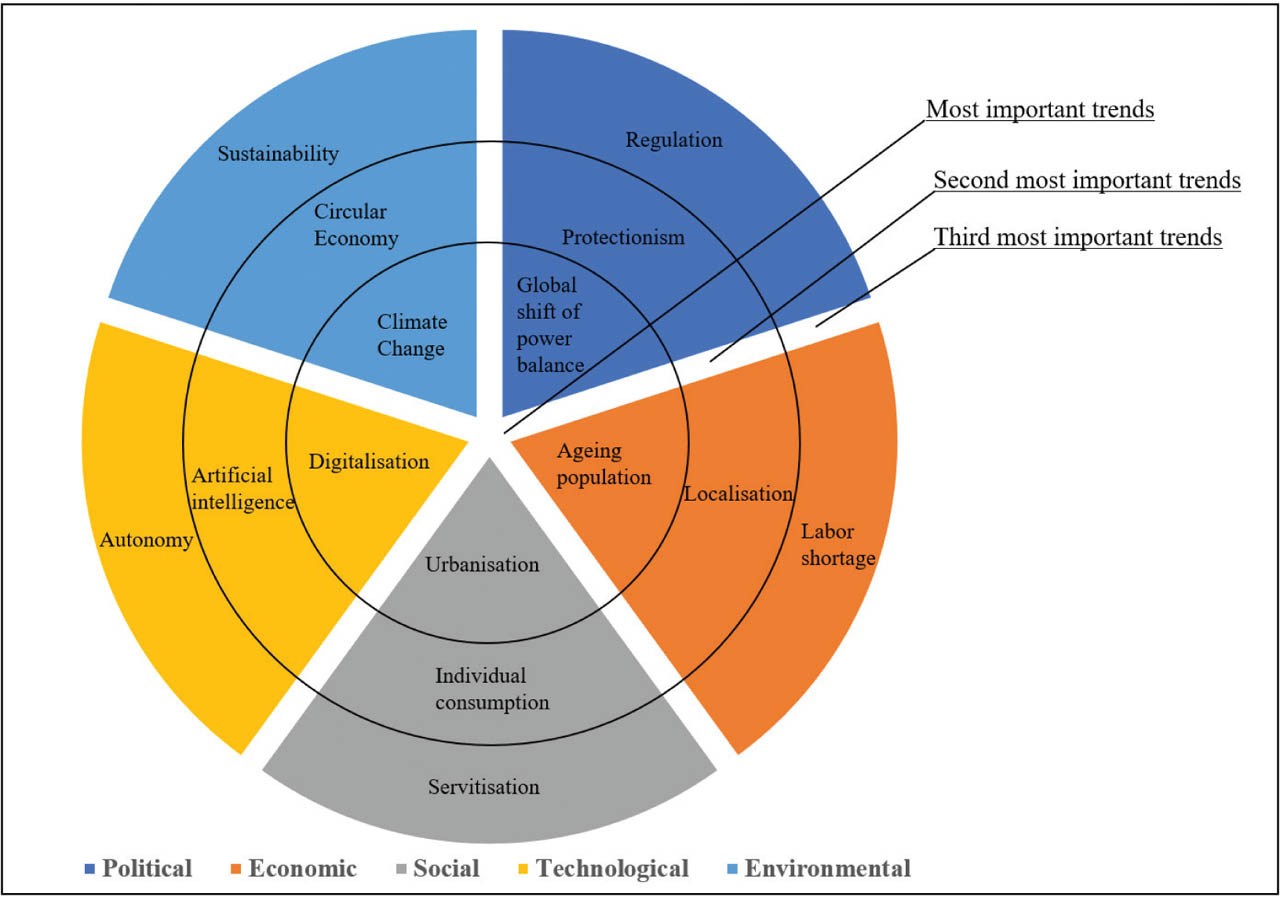
Fig. 1:
Summary of the key trends that have an impact on HNS logistics. HNS, host nation support.
The three key political trends have an indirect impact on HNS logistics in Finland. The shift in the global balance of power between West and East, with a general increase in protectionism, may affect Finland’s export and import balance and volumes. This, in turn, affects Finnish ports. In addition, the impact may be more long-term than previously thought. Regulation has a particular impact on the transport system, as it is related to zero-emission programmes. In the short term, this will increase transportation and manufacturing costs because logistics operators will have to invest more in zero-emission solutions. The effects could be seen in new zero-emission vehicles.
From the perspective of key economic trends, an ageing population, localisation and labour shortages will affect the host nation’s potential to provide sufficient support. In Finland, however, the demographic structure may have a wider impact than merely challenging the potential to supply human resources for future logistics operations. Localisation, coupled with the circular economy as an economic and environmental trend, can generate new business models that enhance support capabilities and make them more specialised. This trend correlates with the trend towards individual consumption, as it requires updated manufacturing and delivery capabilities.
The key social trends of urbanisation, individual consumption and servitisation are highly interconnected. affects the networks and positioning of logistics service providers. Urbanisation serves to generate dense service operator networks, a trend which in turn feeds into the individual consumption trend. Moreover, it gives rise to new business models for logistics companies to cope with changing consumer behaviour. These social trends impact every HNS phase, but particularly logistics in the sustainment phase. In Finland, this could mean that some urban areas will have a dense service network. However, rural areas may only have mandatory services, which have implications for logistics planning and execution. Channelling the required support in sparsely populated areas will pose a challenge for logistics managers in the future.
The most significant technology trends are digitalisation, artificial intelligence and autonomy. These trends enable new procedures and agile methods for supply chain management. This generates the potential to ensure adequate HNS logistics with better logistical agility throughout the Finnish society and economy. Artificial intelligence-supported ICT systems may streamline clearance and other customs processes. This affects the RSOM and RMSD phases in particular, accelerating the processes. Autonomy can enhance the capabilities of ports to operate more smoothly in various conditions, especially when it comes to cargo-handling equipment.
The three most significant environmental trends are climate change, the circular economy and sustainability. Climate change affects every phase of HNS logistics. In Finland, the weather conditions may become wetter and windier, which will have an effect on the operational capacity of seaports and airports. In order to regulate the effects of climate change, companies will be forced to pay much greater attention to sustainability aspects. This will have multi-tier effects, starting with the type of transportation fleets. For example, if vehicles become more hydrogen and electric-powered, this will have a considerable impact on HNS logistics. The charging network will have to be expanded from the present level. Moreover, the circular economy extends the lifecycle of products. This will create new requirements for reverse logistics capabilities. From the HNS perspective, it could imply greater potential for various logistics operators.
8. Conclusions
This study aimed to investigate the trends that will affect the HNS operational environment in Finland over the next 20 years from a logistics perspective. Based on the results, this aim was largely achieved.
The main goal of the study was to increase knowledge of HNS logistics futures by exploring the key trends that will engender changes and impacts with regard to the logistics environment in Finland. This goal was divided into two sub-goals: (1) identifying important logistics trends and (2) assessing the influence of these key trends on logistics development in Finland. Both sub-goals were largely accomplished. However, the lack of relevant academic literature and publications on HNS logistics futures was a limitation, especially from the Finnish perspective. Another limitation was the number of suitable respondents when it came to the empirical data collection.
Exploring trends is one step in the foresight process. It applies to topics, such as business logistics and military logistics, and can be applied from the HNS logistics perspective. One research approach is to define only the most significant trends with the greatest influence in the chosen research area. This was the baseline in this study.
According to the findings of the literature review and the interviews, these existing trends have a multi-tier influence on Finnish logistics. The pace of development and direction of the trends can be scanned, giving logistics more time to adapt to the new operating environment. This calls for comprehensive and continuous anticipation capabilities from both companies and state-owned organisations.
With regard to the goal of improving knowledge of HNS logistics development in Finland, the findings indicate that the trends identified in the literature review are consistent with those in the interview data. Accordingly, the overall trend research results and analysis of the 2040 operating environment enhance understanding of those capabilities that can be procured from the civilian sector and those that must be designed and developed by the military organisation. This will help ensure a sufficient level of HNS in the future.
Looking ahead to the 2040s, climate change is likely to be one of the most influential trends in logistics globally, and hence it will impact HNS logistics in Finland as well. Climate change has multiple interdependencies with other trends – political, technological and social. For example, regulations on zero-carbon manufacturing or zero-emission vehicles have emerged directly in response to climate change. As a result, the national logistics infrastructure may undergo significant updates. This may involve airports and seaports becoming fossil fuel-free and operating with the support of augmented reality, robotics and autonomous cargo-handling systems.
Digitalisation has implications for customs clearance and other cross-border smart solutions, which may also incorporate blockchain technology. This type of technology can process the RSOM and RMSD phases more swiftly and reduce the declaration time for visiting forces’ material and personnel. Similarly, emerging technologies such as autonomous vehicles or artificial intelligence may enhance agility and efficiency. However, they may also increase the vulnerability of supply chains from a cyber-security perspective.
HNS logistics is naturally related to the host nation’s logistics system. This relationship means that the development of national business logistics, including the nation’s defence industry, is also correlated with the military logistics systems. Military logistics capabilities are linked to business logistics accordingly. This relationship makes the supply chains more multinational and optimised, but this mode of operation also incurs potential risks, which must be tackled by increasing resilience. However, if global supply chains function well, the logistics costs will be lower and the logistics operations smoother. In short, this aspect should be considered when planning military logistics capabilities.
Global resource scarcity and individual consumer behaviour will affect supply chains over the next 20 years. Some production can be transferred to other countries, and supply chains may be rerouted via new stakeholders. The circular economy may grow, changing supply chain structures and likely shortening some parts of the supply chains as goods will be manufactured more locally. This will increase local logistics facilities, as well as the potential for better sustainment of visiting friendly forces across the host nation. Urbanisation will likewise shape these trends.
Multinational supply chains are vital links in every nation’s ability to provide HNS, both now and in the 2040s. In this kind of environment, much depends on the supply chain managers, both military and civilian. New outcomes with other authorities, such as interior ministries coupled with the emergency services, could increase HNS logistics coverage and enhance logistics resources as a consequence.
These conclusions were drawn from the Finnish perspective, but can readily be applied to the global context as well. Many of the identified trends have a multi-tier influence on logistics systems globally, which points to the need to continue to research HNS logistics in the future.
More specifically, further research could focus on scanning wild cards and weak signals in the HNS logistics context. This type of research could enrich understanding of possible futures, both complementing and supplementing the existing research.
Acknowledgements
The author received a grant for this study from the Lieutenant Colonel Vilho Wäiniö Foundation for Logistics Officers.