
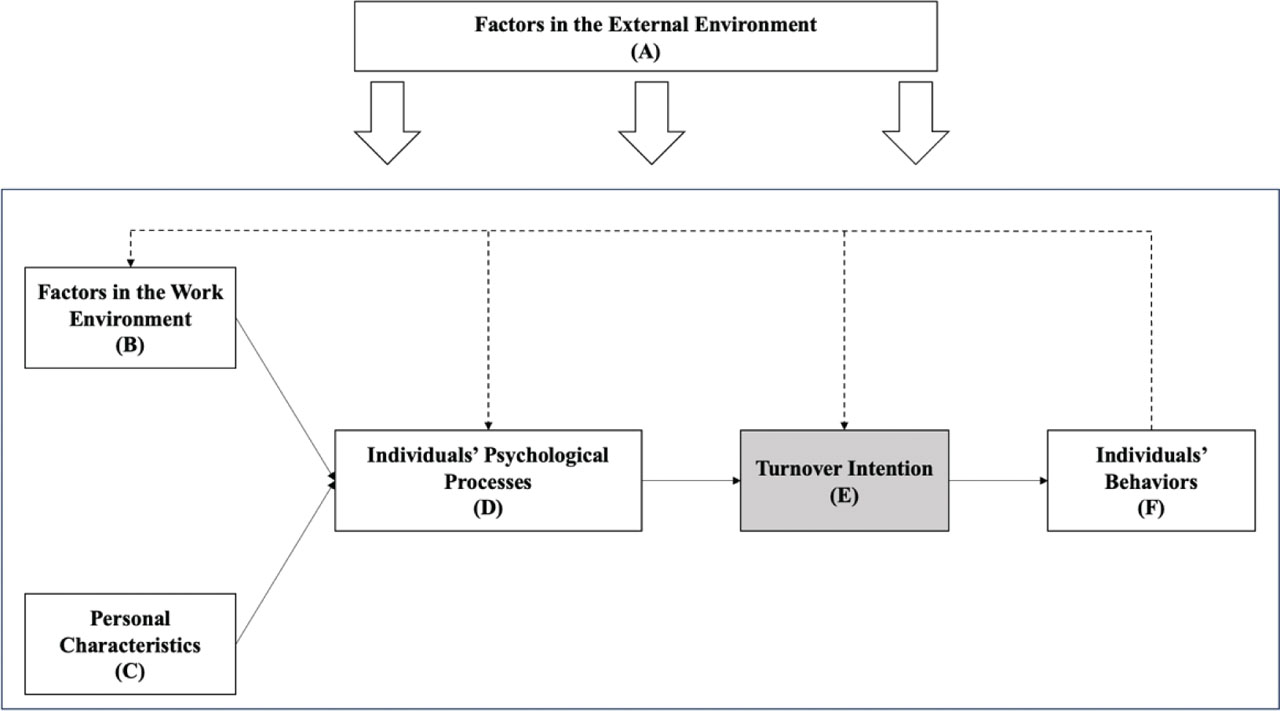
Fig. 1:
A model of employee behaviour.

Fig. 2:
PRISMA 2020 flow diagram.
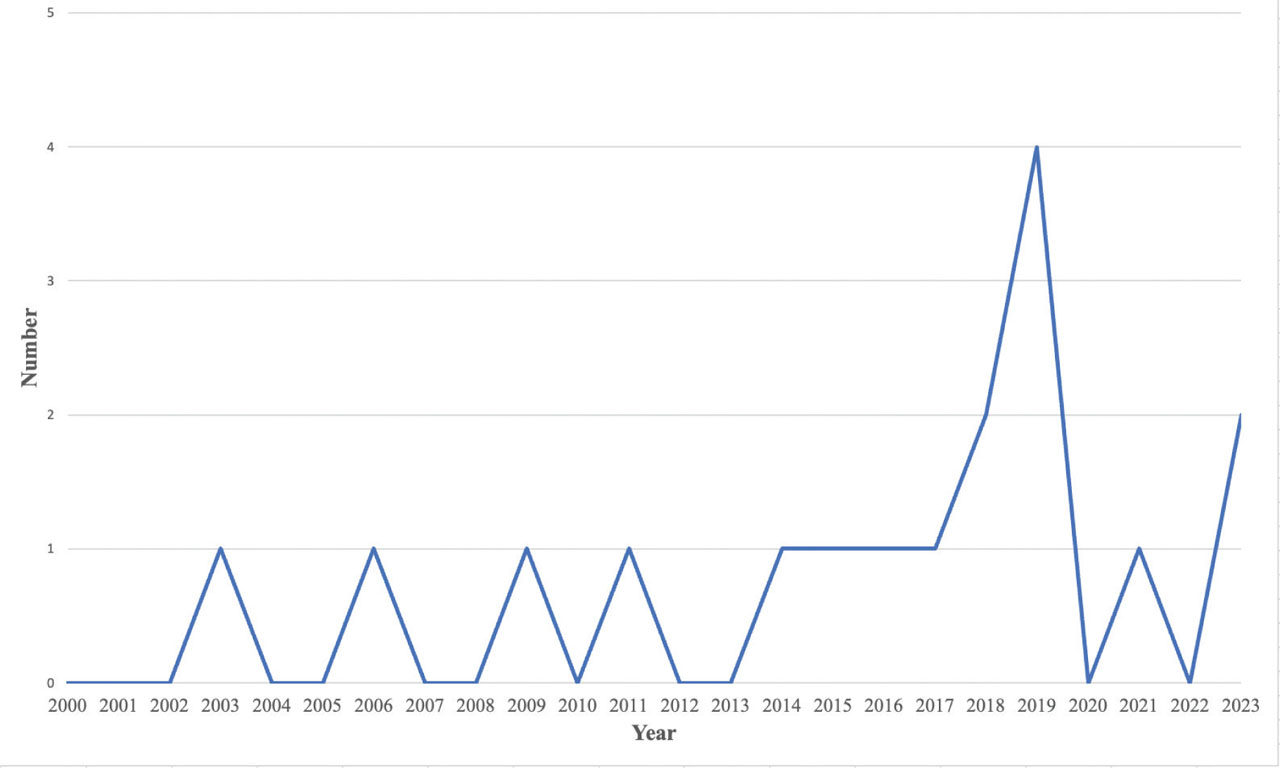
Fig. 3:
Trends in studies on the turnover intention of military personnel in Taiwan.
Tab. 1:
Summary of included studies: types of evidence
| Year | Author | n | Data source | Research design | Analytic approach |
|---|---|---|---|---|---|
| 2003 | Shih and Tseng | 826 | Survey | Relational; cross-sectional | Regression |
| 2006 | Lo and Chou | 399 | Survey | Relational; cross-sectional | Regression |
| 2009 | Lin and Chung | 400 | Survey | Relational; cross-sectional | Regression |
| 2011 | Day and Huang | 246 | Survey | Relational; cross-sectional | t-test; one-way ANOVA; regression |
| 2014 | Wu | 186 | Survey | Relational; cross-sectional | t-test; one-way ANOVA; regression |
| 2015 | Hsu and Tsai | 314 | Survey | Relational; cross-sectional | Regression |
| 2016 | Tsai and Lee | 313 | Survey | Relational; cross-sectional | t-test; one-way ANOVA |
| 2017 | Chang et al. | 281 | Survey | Relational; cross-sectional | SEM |
| 2018 | Liu and Chen | 179 | Survey | Relational; cross-sectional | Conditional process analysis |
| 2018 | Wang and Huang | 176 | Survey | Relational; cross-sectional | t-test; regression |
| 2019 | Chen and Huang | 994 | Survey | Relational; cross-sectional | Hierarchical regression analysis |
| 2019 | Hsu and Chiang | 345 | Survey | Relational; cross-sectional | t-test; one-way ANOVA |
| 2019 | Li | 285 | Survey | Relational; cross-sectional | Regression |
| 2019 | Cheng | 248 | Survey | Relational; cross-sectional; | One-way ANOVA |
| 2021 | Lee et al. | 318 | Survey | Relational; cross-sectional | MSEM |
| 2023 | Chang and Hsiung | 444 | Survey | Relational; cross-sectional | SEM |
| 2023 | Lee et al. | 302 | Survey | Relational; sequential | Conditional process analysis |
Tab. 2:
Summary of included studies: main findings
| Year | Author | X | M | W | C | Focus |
|---|---|---|---|---|---|---|
| 2003 | Shih and Tseng |
| Social support acquisition | b, d | ||
| 2006 | Lo and Chou | Perceived supervisor support |
|
| b, c, d | |
| 2009 | Lin and Chung |
|
| b, d | ||
| 2011 | Day and Huang |
| b, c | |||
| 2014 | Wu |
| c, d | |||
| 2015 | Hsu and Tsai | Co-worker incivility | Surface acting |
| b, c, d | |
| 2016 | Tsai and Lee |
| c | |||
| 2017 | Chang et al. | Practicality of perceived policies | Perceived organisational support | Rank | b, c | |
| 2018 | Liu and Chen | Organisational socialisation | Person–organisation fit | Leadership style | b | |
| 2018 | Wang and Huang |
| c, d | |||
| 2019 | Chen and Huang | Job stress | Well-being organisational commitment |
| b, c, d | |
| 2019 | Hsu and Chiang |
| c | |||
| 2019 | Li |
|
| b, d | ||
| 2019 | Cheng |
| c | |||
| 2021 | Lee et al. | Social responsibility | Organisational identification |
| b, c | |
| 2023 | Chang and Hsiung | Work-family conflict | Job burnout | Grit | b, c, d | |
| 2023 | Lee et al. |
| Organisational frustration | Authoritarian leadership |
| b, c, d |
Tab. 3:
Comparing factors in the work environment
| Year | Author | Findings |
|---|---|---|
| 2006 | Lo and Chou | Perceived supervisor support ≈ job loading |
| 2011 | Day and Huang | Organisational culture ≈ leadership style, physical work environment, job characteristics and peer collaboration |
| 2017 | Chang et al. | Perceived organisational support perceived practicality of policies |
| 2018 | Liu and Chen | Person-organisation fit ≈ organisational socialisation |
| 2023 | Lee et al. | Person-job fit ≈ uncertainty |
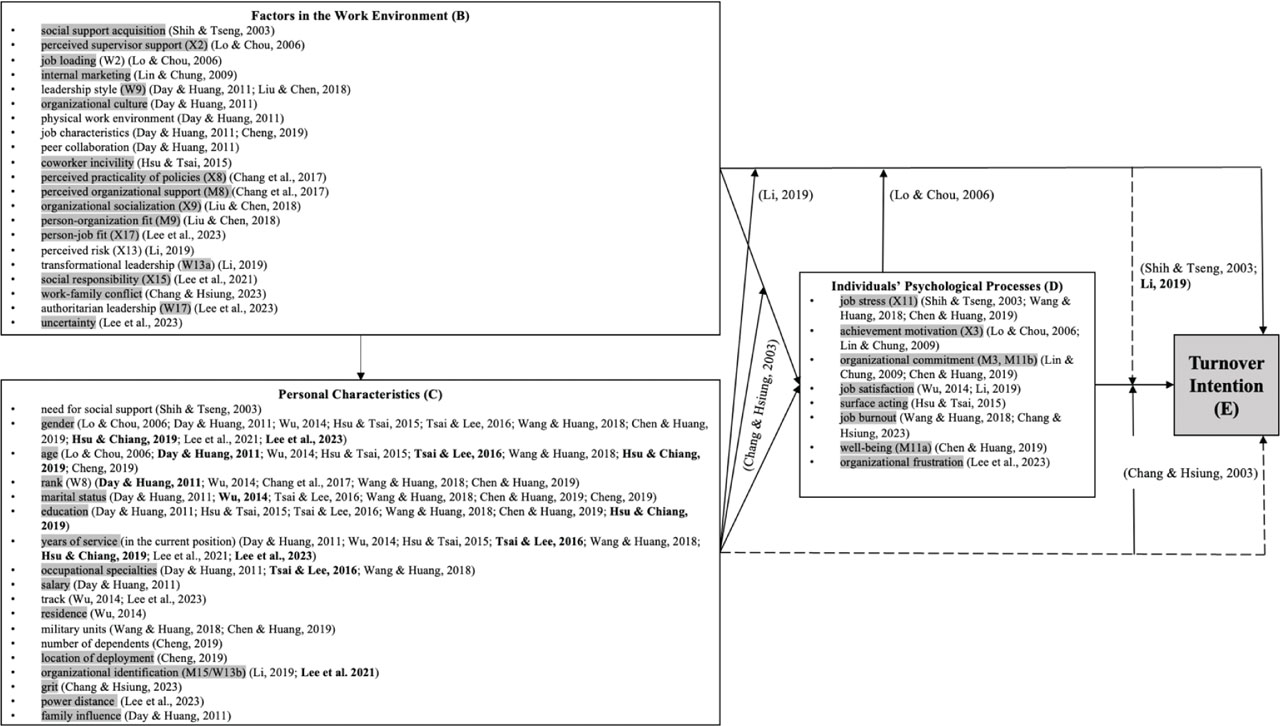
Fig. 4:
Hypothesised model and empirical findings [3].
Tab. 4:
Factors in the work environment and three psychological needs
| Factors in the work environment | Psychological needs |
|---|---|
| Social support acquisition | Relatedness |
| Perceived supervisor support | Competence; relatedness |
| Job loading | Competence |
| Internal marketing | Relatedness |
| Organisational culture | Relatedness |
| Co-worker incivility | Relatedness |
| Perceived practicality of policies | Competence, relatedness |
| Perceived organisational support | Competence, relatedness |
| Organisational socialisation | Relatedness |
| Person-organisation fit | Relatedness |
| Person-job fit | Competence |
| Social responsibility | Autonomy; competence; relatedness |
| Work-family conflict | Autonomy |
| Uncertainty | Competence |