
TABLE 1.
Recent studies using AI models for predicting AF
| Year | Study | Journal | AI method | Dataset | Key findings |
|---|---|---|---|---|---|
| 2024 | Lin et al.6 | Med | DL, HBBIs | 23,763 24-h Holter ECG recordings | HBBI-AI effectively predicted AF risk using only HBBI information through evaluating autonomic imbalance. |
| 2023 | Hygrell et al.7 | EP Europace | CNN | 478 963 single-lead ECGs | A single-lead ECG machine learning can identify individuals at risk of undetected paroxysmal AF. |
| 2023 | Hill et al.8 | European Heart Journal | ML | Medical records | The AF risk-prediction algorithm was effective in identifying participants at high risk of undiagnosed AF. |
| 2023 | Chen et al.9 | Helyion | DL | 443,053 CCTA images | Automatically filling defects assessment of LAA on CT images detecting clinical or subclinical AF |
| 2021 | Grout et al.10 | BMC Med Inform Decis Mak | ML | Electronic health data | Using only pre-existing electronic health records, this streamlined model for predicting the risk of undiagnosed atrial fibrillation within a 2-year period achieved a C-statistic of 0.81. |
| 2020 | Baek et al.11 | European Heart Journal | RNN | 2,585 ECGs from hospital patients | AI identified AF with an AUC of 0.79, recall of 82%, and overall accuracy of 72.8%; useful in identifying AF in patients with unexplained strokes. |
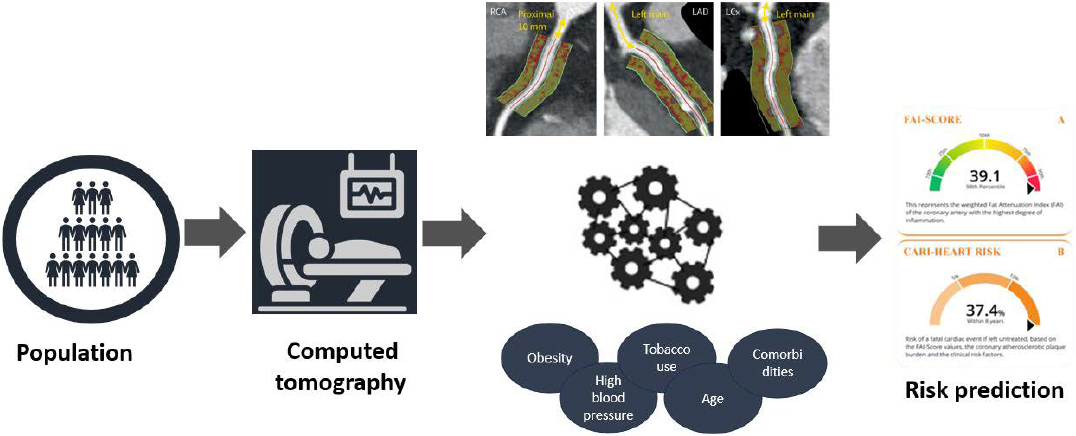
FIGURE 1.
ORFAN study diagram.