
1. Introduction
Muscle-invasive bladder cancer (MIBC) is an aggressive malignancy accounting for approximately 25 to 30% of newly diagnosed bladder cancer cases worldwide and is associated with significant morbidity and mortality. Long-term outcomes are largely determined by disease stage at presentation and the ability to deliver definitive multimodality treatment. Radical cystectomy with pelvic lymph node dissection, with or without neoadjuvant chemotherapy, has traditionally been the standard treatment for operable disease, while definitive bladder-preserving chemoradiotherapy has emerged as an established alternative in appropriately selected patients.
Randomized trials from high-income countries have demonstrated a modest but consistent survival benefit with platinum-based neoadjuvant chemotherapy, leading to its adoption in international guidelines. In parallel, long-term data from bladder preservation studies have shown that trimodality therapy can achieve oncologic outcomes comparable to surgery in selected patients while maintaining bladder function. However, the applicability of these data to low- and middle-income countries remains uncertain due to differences in disease burden, patient characteristics, and access to specialized oncologic care.
In low- and middle-income settings, patients with MIBC frequently present with advanced and high-grade disease, and treatment selection is often constrained by comorbidities, renal dysfunction, and limited surgical and systemic therapy resources. Consequently, real-world management frequently diverges from guideline-based recommendations, with greater reliance on bladder-preserving approaches, radiotherapy alone, or palliative treatment. Despite this, long-term survival data reflecting these real-world practices from low- and middle-income institutions remain limited.
To address this gap, we performed a decade-long retrospective analysis of patients with muscle-invasive bladder cancer treated at a tertiary cancer center. The primary objective was to evaluate treatment patterns and long-term overall survival across contemporary management strategies in a real-world low- and middle-income setting, with secondary objectives including stage-stratified survival and identification of independent prognostic factors using Cox regression analysis.
2. Materials and Methods
2.1. Study Design and Setting
This was a retrospective observational cohort study conducted at a tertiary comprehensive cancer center in Pakistan. Consecutive adult patients diagnosed with muscle-invasive bladder cancer (MIBC) and treated between January 2010 and December 2020 were included. The study was approved by the Institutional Review Board of Shaukat Khanum Memorial Cancer Hospital and Research Centre, Lahore, Pakistan (IRB number EX-14-01-26-01). The requirement for informed consent was waived due to the retrospective nature of the study.
2.2. Patient Selection
Adult patients aged 18 years or older with histologically confirmed muscle-invasive bladder cancer (T2 or higher) were eligible. Both urothelial carcinoma and variant histologies were included. Patients with incomplete survival data or missing essential treatment details were excluded. Patients presenting with distant metastatic disease at diagnosis were included and analyzed separately. Stage IV disease comprised both metastatic and locally advanced unresectable tumors, with treatment intent determined on an individual basis through multidisciplinary assessment.
2.3. Data Collection and Baseline Variables
Clinical data were extracted from institutional electronic medical records. Baseline variables included age, sex, histological subtype, tumor grade, clinical T stage, nodal status, metastatic status, and AJCC stage at presentation. Clinical staging was based on available radiological and pathological findings at the time of diagnosis.
2.4. Treatment Classification
Patients were categorized by their initial treatment strategy into the following groups: neoadjuvant chemotherapy followed by radical cystectomy; neoadjuvant chemotherapy followed by definitive chemoradiotherapy; upfront radical cystectomy; definitive chemoradiotherapy; definitive radiotherapy alone; and palliative radiotherapy.
Neoadjuvant chemotherapy consisted predominantly of platinum-based regimens and was administered according to institutional protocols and patient fitness. Definitive radiotherapy and chemoradiotherapy were delivered with curative intent, while palliative radiotherapy was administered using hypofractionated schedules for symptom control. Due to inconsistent documentation, detailed treatment response, pathological downstaging, and chemotherapy-related toxicity data were not included in outcome analyses.
Definitive radiotherapy was delivered to the bladder with or without elective pelvic lymph nodes based on disease extent. Radical dose radiotherapy typically ranged from 60 to 66 Gy, delivered using conventional fractionation or biologically equivalent hypofractionated schedules, with three-dimensional conformal or intensity-modulated techniques. Concurrent chemotherapy, most commonly cisplatin administered on weekly or three-weekly schedules, was given to patients with adequate performance status and renal function.
2.5. Outcome Measures and Follow-up
Patients were followed from the date of diagnosis until death or last documented follow-up. The primary outcome measure was overall survival, defined as the interval from diagnosis to death from any cause or last follow-up. Patients alive at last follow-up were censored.
2.6. Statistical Analysis
Descriptive statistics were used to summarize baseline characteristics. Continuous variables were reported as medians with interquartile range or range, while categorical variables were expressed as frequencies and percentages. Overall survival was estimated using the Kaplan-Meier method, and comparisons across treatment groups were performed using the log-rank test. Survival analyses were conducted for the overall cohort and, where appropriate, stratified by treatment group and disease stage. A two-sided p-value less than 0.05 was considered statistically significant. All analyses were performed using IBM SPSS Statistics for Windows.
3. Results
3.1. Patient Characteristics
A total of 349 patients with muscle-invasive bladder cancer were included. The median age at diagnosis was 57 years (IQR 47–65; range 22–89), with a marked male predominance (287 patients, 82.2%). Urothelial carcinoma accounted for 337 cases (96.6%), while variant histology was identified in 12 patients (3.4%), including squamous, adenocarcinoma, and micropapillary subtypes. High-grade disease was present in 309 patients (88.5%).
Locally advanced disease was common at presentation. Clinical T stage distribution included cT2 in 80 patients (22.9%), cT3 in 232 (66.4%), and cT4 in 37 (10.6%). Regional nodal involvement was observed in 109 patients (31.2%), while distant metastases at diagnosis were present in 42 patients (12.0%). According to AJCC staging, Stage III disease predominated (212 patients, 60.7%), followed by Stage II (79 patients, 22.6%) and Stage IV (58 patients, 16.6%). At last follow-up, 237 patients (67.9%) were alive, and 112 (32.1%) had died. Baseline characteristics are summarized in Table 1.
Table 1.
Baseline Patient and Tumor Characteristics (N = 349).
| Characteristic | Category | n | % |
|---|---|---|---|
| Age (years) | Median (IQR) | 57 | 47–65 |
| Range | 22–89 | — | |
| Gender | Male | 287 | 82.2 |
| Female | 62 | 17.8 | |
| Histology | Urothelial (TCC) | 337 | 96.6 |
| Variant histology* | 12 | 3.4 | |
| Tumor Grade | High grade (G3) | 309 | 88.5 |
| Intermediate/Low (G2) | 40 | 11.5 | |
| Clinical T stage | cT2 | 80 | 22.9 |
| cT3 | 232 | 66.4 | |
| cT4 | 37 | 10.6 | |
| Clinical N stage | cN0 | 240 | 68.8 |
| cN+ (N1-N3) | 109 | 31.2 | |
| Metastatic status | cM0 | 307 | 88.0 |
| cM1 | 42 | 12.0 | |
| AJCC Stage | Stage II | 79 | 22.6 |
| Stage III | 212 | 60.7 | |
| Stage IV | 58 | 16.6 |
3.2. Treatment Characteristics
Patients were managed using a range of treatment strategies based on disease stage, renal function, performance status, comorbidities, and multidisciplinary assessment. The majority received curative intent treatment, while a substantial proportion required palliative therapy. Treatment distribution is summarized in Table 2.
3.3. Neoadjuvant Chemotherapy
Neoadjuvant chemotherapy was administered to patients planned for either radical cystectomy or definitive bladder-preserving treatment. Platinum-based regimens were used, including cisplatin–gemcitabine, carboplatin–gemcitabine, and dose-dense MVAC (methotrexate, vinblastine, doxorubicin, and cisplatin). Regimen selection was individualized according to renal function and performance status. Cisplatin-based therapy was used in eligible patients, while carboplatin-based regimens were used in cisplatin-ineligible patients. Dose-dense MVAC was administered in selected fit patients. The number of cycles ranged from three to five. Survival analyses were based on treatment intent and final treatment pathway rather than response to neoadjuvant chemotherapy.
3.4. Definitive Chemoradiotherapy and Radiotherapy
Definitive chemoradiotherapy was delivered to 87 patients (24.9%) with radical intent. Radiotherapy was administered to the bladder with or without pelvic lymph nodes based on disease extent, with concurrent chemotherapy, predominantly cisplatin, in patients with adequate performance status and renal function. An additional 34 patients (9.7%) received definitive radiotherapy alone, primarily due to comorbidities or renal dysfunction precluding concurrent chemotherapy. Patients receiving radical-dose radiotherapy (≥60 Gy EQD2 [equivalent dose in 2 Gy fractions]) were analyzed within definitive treatment groups, while those treated with hypofractionated palliative schedules were categorized separately.
3.5. Patterns of Disease Relapse
During follow-up, 130 patients (37.2%) experienced disease relapse, while 219 (62.8%) remained relapse-free. Distant metastasis was the most common pattern of failure (61%), followed by locoregional relapse (25%) and isolated local recurrence (14%). Relapse outcomes were reported descriptively due to inconsistent documentation of relapse timing.
3.6. Overall Survival
Kaplan-Meier analysis demonstrated significant differences in overall survival across treatment groups (log-rank p < 0.001) (Figure 1). Median overall survival was not reached in any curative intent treatment group. Patients treated with palliative intent had inferior outcomes, with a median overall survival of 30 months. Mean overall survival exceeded 100 months across all definitive treatment strategies and is summarized in Table 3.
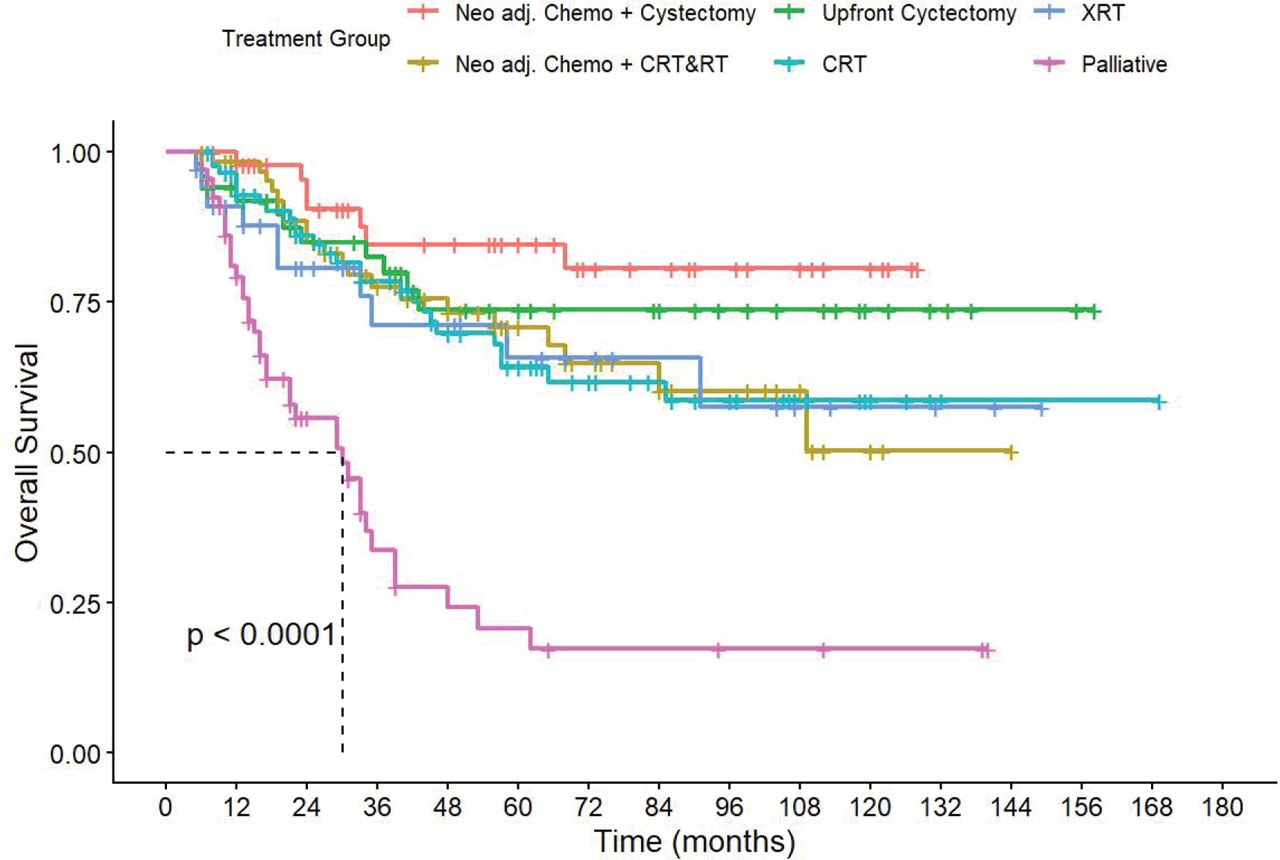
Figure 1.
Overall survival by treatment modality Kaplan-Meier overall survival curves stratified by treatment modality, showing significant differences across groups (log-rank p < 0.0001).
Table 3.
Overall Survival by Treatment Group (median OS not reached in curative-intent groups).
| Treatment Group | Deaths / N | Mean OS (months) | 95% CI |
|---|---|---|---|
| NAC → cystectomy | 7 / 47 | 109.9 | 97.7–122.1 |
| NAC → CRT/RT | 20 / 64 | 99.5 | 84.0–114.9 |
| Upfront cystectomy | 11 / 50 | 122.9 | 104.8–141.0 |
| Definitive CRT | 26 / 87 | 114.6 | 97.9–131.2 |
| Definitive RT | 10 / 34 | 101.9 | 78.5–125.3 |
| Palliative | 38 / 67 | 45.1 | 30.7–59.5 |
3.7. Stage Stratified Survival
Overall survival declined progressively with advancing stage. Patients with Stage II disease demonstrated excellent long-term survival with definitive treatment, while Stage III disease remained potentially curable with aggressive multimodality therapy. Stage IV disease, including metastatic and locally advanced unresectable presentations, was associated with significantly inferior survival compared with Stage II and III disease (Figure 2). Stage-wise survival outcomes are summarized in Table 4.
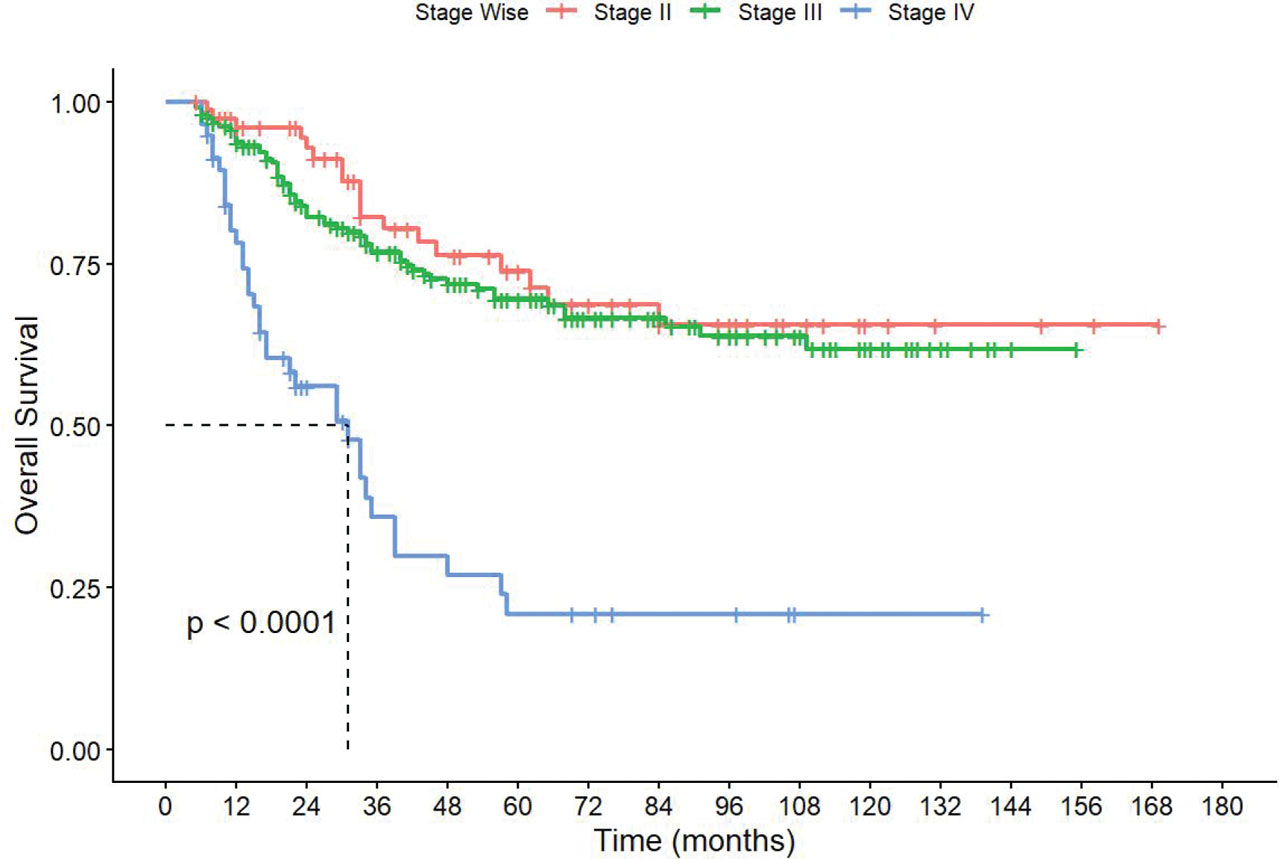
Figure 2.
Overall survival by stage at diagnosis Kaplan-Meier overall survival curves stratified by clinical stage, demonstrating progressively worse survival with advancing stage (log-rank p < 0.0001).
3.8. Univariate Analysis
On univariate Cox regression analysis, Stage IV disease was associated with significantly inferior overall survival compared with Stage II (HR 4.64, 95% CI 2.62–8.22; p < 0.001). Palliative treatment was also associated with an increased hazard of death compared with upfront cystectomy (HR 5.33, 95% CI 2.70–10.50; p < 0.001). Age and sex were not significantly associated with overall survival, and no statistically significant differences were observed among definitive local treatment strategies. Univariate analysis is summarized in Table 5.
3.9. Multivariate Analysis
On multivariate Cox regression analysis adjusting for age, sex, stage, and treatment group, Stage IV disease remained independently associated with inferior overall survival (adjusted HR 2.41, 95% CI 1.33–4.37; p = 0.0039), as did palliative treatment (adjusted HR 3.30, 95% CI 1.49–7.31; p = 0.0034). Stage III disease was not independently associated with survival compared with Stage II. No statistically significant differences in overall survival were observed between definitive surgical and bladder preserving treatment modalities after adjustment. Multivariate analysis is summarized in Table 6.
4. Discussion
This large single-institution retrospective cohort provides one of the most comprehensive long-term outcome analyses of muscle-invasive bladder cancer from a low- and middle-income country to date. The key findings of this study are that curative-intent treatment is associated with durable long-term survival even in a population enriched for high-risk disease; disease stage at presentation remains the strongest independent prognostic factor; and bladder-preserving chemoradiotherapy achieves survival outcomes comparable to radical cystectomy in appropriately selected patients.
The disease profile of this cohort reflects the real-world biology of muscle-invasive bladder cancer in resource-constrained settings, with a high prevalence of advanced and high-grade disease. Nearly ninety percent of patients had Grade III tumors and the majority presented with Stage III or IV disease. This contrasts with many series from high-income countries where earlier stage presentation is more common, underscoring the importance of generating outcome data from low- and middle-income settings rather than extrapolating from Western populations (1,2,3).
Despite adverse baseline characteristics, patients treated with definitive intent demonstrated durable survival, with median overall survival not reached across curative treatment modalities. These outcomes compare favorably with contemporary population-based data from high-income countries, where five-year overall survival following definitive treatment typically ranges from 45% to 65% (4,5,6). These findings suggest that when delivered within specialized, high-volume centers, effective multimodality management of muscle-invasive bladder cancer is achievable in low- and middle-income settings.
Neoadjuvant chemotherapy was integrated into both surgical and bladder-preserving pathways using contemporary platinum-based regimens. While favorable long-term outcomes were observed in patients receiving neoadjuvant therapy followed by definitive local treatment, treatment modality did not retain independent prognostic significance on multivariable analysis. This likely reflects the retrospective design, non-randomized treatment allocation, and the absence of uniform pathological response data, limiting precise estimation of chemotherapy-specific benefit. Nevertheless, the observed outcomes are consistent with randomized trial evidence demonstrating modest but clinically meaningful survival benefits with platinum-based neoadjuvant chemotherapy (7,8,9).
A central observation of this study is the absence of a statistically significant difference in overall survival between radical cystectomy and definitive bladder-preserving chemoradiotherapy after adjustment for disease stage and treatment intent. This finding should not be interpreted as therapeutic equivalence. Rather, it reflects comparable long-term outcomes achieved in carefully selected patients within a multidisciplinary clinical framework. Treatment selection was influenced by performance status, renal function, comorbidities, and patient preference, factors that inherently introduce selection bias in retrospective analyses (10,11,12,13).
Disease stage emerged as the dominant determinant of outcome. Patients with Stage IV disease experienced significantly inferior survival on both univariate and multivariable analyses. This group represented a biologically heterogeneous population, including patients with distant metastatic disease and those with locally advanced unresectable tumors. Selected patients within this group received definitive-intent treatment, contributing to variability in survival outcomes and highlighting the need for cautious interpretation of stage-based survival estimates in real-world cohorts (14,15,16).
From a health systems perspective, these findings have important implications for low- and middle-income countries. The demonstrated effectiveness of bladder-preserving strategies provides a viable definitive treatment option in settings where surgical resources, perioperative care, or patient fitness may limit cystectomy. The comparable outcomes achieved across definitive modalities emphasize the importance of multidisciplinary decision-making and individualized treatment selection rather than rigid adherence to a single treatment paradigm.
This study has limitations inherent to its retrospective design. Treatment allocation was non-randomized and influenced by clinical factors including performance status, renal function, and comorbidities. Detailed toxicity, quality-of-life, and functional outcome data were inconsistently documented and could not be reliably analyzed. Pathological response following neoadjuvant chemotherapy was not uniformly available. Relapse outcomes were reported descriptively due to incomplete documentation of relapse timing. Despite these limitations, the large cohort size, extended follow-up duration, and consistent institutional treatment practices provide robust real-world evidence on long-term outcomes of management of muscle-invasive bladder cancer in a resource-constrained setting.
In conclusion, this decade-long single-institution experience demonstrates that long-term survival in muscle-invasive bladder cancer is achievable in low- and middle-income settings when definitive treatment is delivered within a multidisciplinary framework. Disease stage and treatment intent remain the primary determinants of outcome, while bladder-preserving chemoradiotherapy represents a valid definitive treatment option in appropriately selected patients. These findings support individualized, resource-adapted management strategies for muscle-invasive bladder cancer. Earlier diagnosis, timely referral, improved access to multimodal care, and prospective studies that incorporate toxicity, quality of life, and functional outcomes are needed.
Notes
[2] Contributed by Authors Contributions
Conceived and designed the analysis: FRR, AR, ATA.
Collected the data: IT, AA, TS, ZHH, AM.
Contributed data or analysis tools: AR, MK, ATA.
Performed the analysis: FRR, MK.
Wrote the paper: FRR, AR, ATA, IT, AA, TS, ZHH, MK, AM.