
Table 1
Comparison of some propolis extraction optimization research with the study
| Previous study | Input variables | Output variables | Optimization method |
|---|---|---|---|
| Yingjuan et al. (2007) | Ethanol concentration Extracting time Extracting power Ratio of liquid to propolis | Flavones | Response Surface Methodology (RSM) |
| Wang et al. (2009) | Ethanol concentration Ratio of liquid The holding time of pressure Pressure to propolis | Flavones | RSM |
| Kim et al. (2009) | Ethanol concentration Extraction time | Total polyphenol content (TPC) Total flavonoid content (TFC) | RSM |
| Li et al. (2012) | Microwave treatment time Microwave power Ethanol concentration Temperature Time Solvent-to-solid | Total flavonoid yield | RSM |
| Yuan et al. (2013) | Ratio of lipid to drug Ratio of soybean phospholipid to cholesterol Speed of injection | Propolis flavonoids liposome (PFL) | RSM |
| Zhao et al. (2012) | Extraction time Ethanol concentration Solid-liquid ratio Distilling frequency Distilling temperature | Extraction ratio TFC | RSM |
| Oldoni et al. (2015) | Ethanol ratio Temperature Time | TPC DPPH | 23 factorial design |
| Nichitoi et al. (2019) | Particle size Solvent type (ethanolic aqueous) Extraction duration | TPC TFC Antioxidant capacity | Partial Least Squares Regression |
| Our study | Ethanol content Extraction time | TPC (Single objective) FRAP activities (Single objective) TPC and FRAP (Multi-objective) | ANN and MFO |
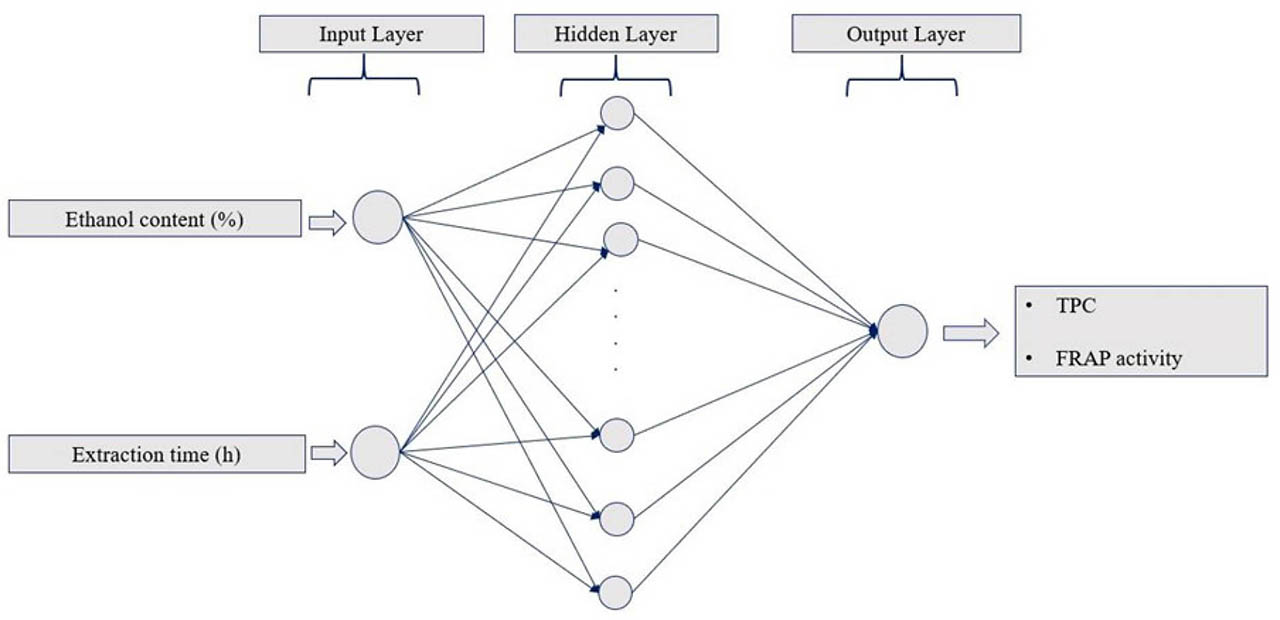
Fig. 1
The layers of this study.
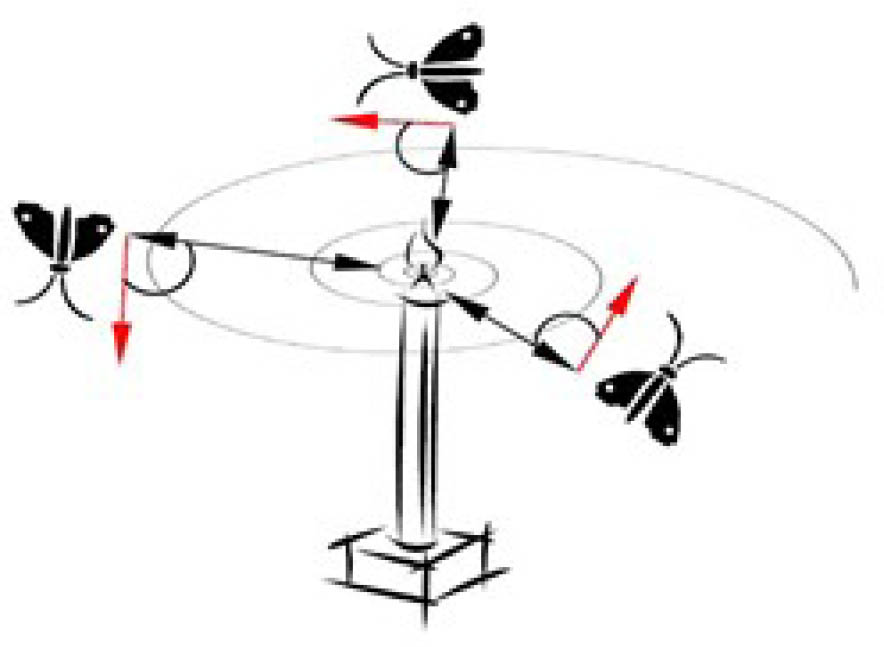
Fig. 2
Spiral flying path around close light sources (Mirjalili, 2015).
Table 2
MFO algorithm architecture
| Parameters | Value |
|---|---|
| Number of search agents | 20 |
| Maximum number of iterations | 30 |
| Run Number | 100 |
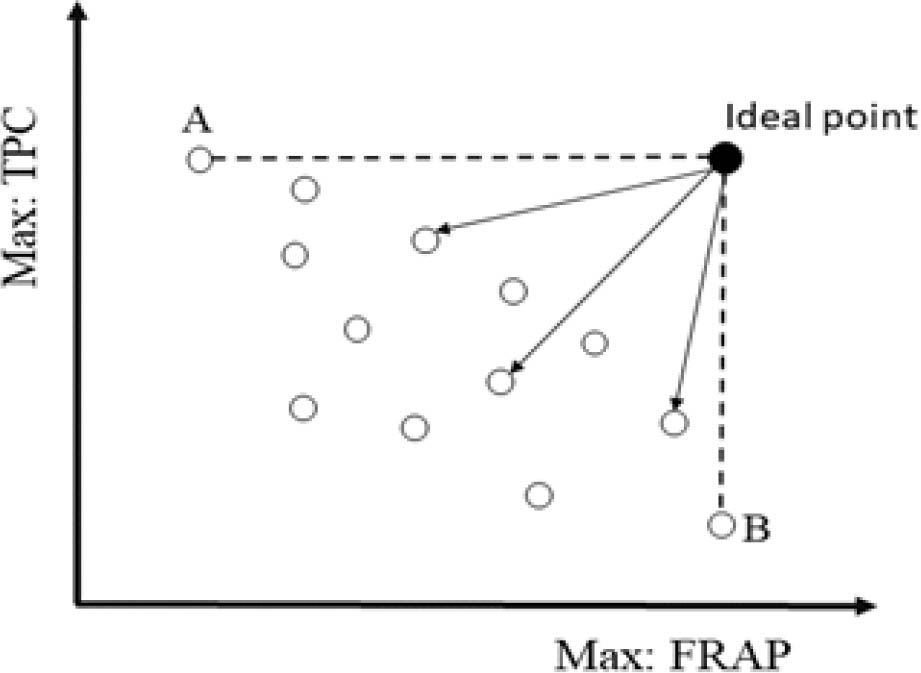
Fig. 3
Euclidean distance approach of this study.
Table 3
TPC and FRAP activities of propolis ethanol extracts
| Experiment number | Ethanol content (%) | Extraction time (h) | TPC (mg GAE/g) | FRAP (μmol FeSO4·7H2O/g) |
|---|---|---|---|---|
| 1 | 40 | 8 | 27.56±1.82a | 239.85±6.83a |
| 2 | 40 | 10 | 32.69±0.87b | 239.76±3.82a |
| 3 | 40 | 12 | 24.19±0.68a | 233.80±0.65a |
| 4 | 40 | 16 | 24.85±0.90a | 227.25±2.33a |
| 5 | 40 | 20 | 34.39±0.82b | 277.01±1.21b |
| 6 | 40 | 24 | 47.20±0.24c | 311.79±2.83c |
| 7 | 50 | 8 | 61.64±0.82def | 353.72±0.00d |
| 8 | 50 | 10 | 57.83±0.45d | 306.93±0.72c |
| 9 | 50 | 12 | 64.51±2.50fgh | 359.25±3.75d |
| 10 | 50 | 16 | 59.33±0.19de | 350.92±0.68d |
| 11 | 50 | 20 | 66.42±0.72ghi | 346.92±3.30d |
| 12 | 50 | 24 | 68.32±1.42hij | 430.37±38.90e |
| 13 | 60 | 8 | 83.95±3.61no | 646.89±10.04no |
| 14 | 60 | 10 | 62.53±3.87efg | 462.13±5.16f |
| 15 | 60 | 12 | 85.35±0.90o | 578.34±1.92jk |
| 16 | 60 | 16 | 70.07±1.60ij | 587.76±3.89kl |
| 17 | 60 | 20 | 81.14±0.09no | 512.79±9.11gh |
| 18 | 60 | 24 | 74.95±0.69kl | 568.41±2.03j |
| 19 | 70 | 8 | 82.06±4.46no | 657.25±2.44o |
| 20 | 70 | 10 | 64.04±4.32fgh | 527.87±17.85hi |
| 21 | 70 | 12 | 59.28±1.28de | 501.61±3.76g |
| 22 | 70 | 16 | 85.31±3.33o | 632.80±1.34mn |
| 23 | 70 | 20 | 75.49±3.02kl | 587.75±7.73kl |
| 24 | 70 | 24 | 76.44±1.73lm | 597.94±5.31l |
| 25 | 80 | 8 | 80.01±2.09mn | 617.95±0.00m |
| 26 | 80 | 10 | 64.34±0.18fgh | 618.87±13.44m |
| 27 | 80 | 12 | 71.56±0.47jk | 495.96±11.87g |
| 28 | 80 | 16 | 64.45±3.01fgh | 591.99±11.57kl |
| 29 | 80 | 20 | 64.28±6.16fgh | 543.13±9.23i |
| 30 | 80 | 24 | 85.25±2.24o | 623.19±14.57m |
[i] Means followed by different letter(s) differ significantly at p<0.05 (Duncan’s multiple range test)
Table 4
Performance of the best models
| Studied assay | Performance of model | Training | Validation | Test | All |
|---|---|---|---|---|---|
| TPC | MAPE | 4.51 | 4.48 | 8.19 | 5.12 |
| MSE | 17.02 | 6.46 | 51.67 | 21.74 | |
| R2 | 0.97 | 0.99 | 0.96 | 0.96 | |
| FRAP activity | MAPE | 1.41 | 0.69 | 9.23 | 2.45 |
| MSE | 81.91 | 12.73 | 3929.23 | 624.12 | |
| R2 | 0.99 | 0.99 | 0.96 | 0.98 |
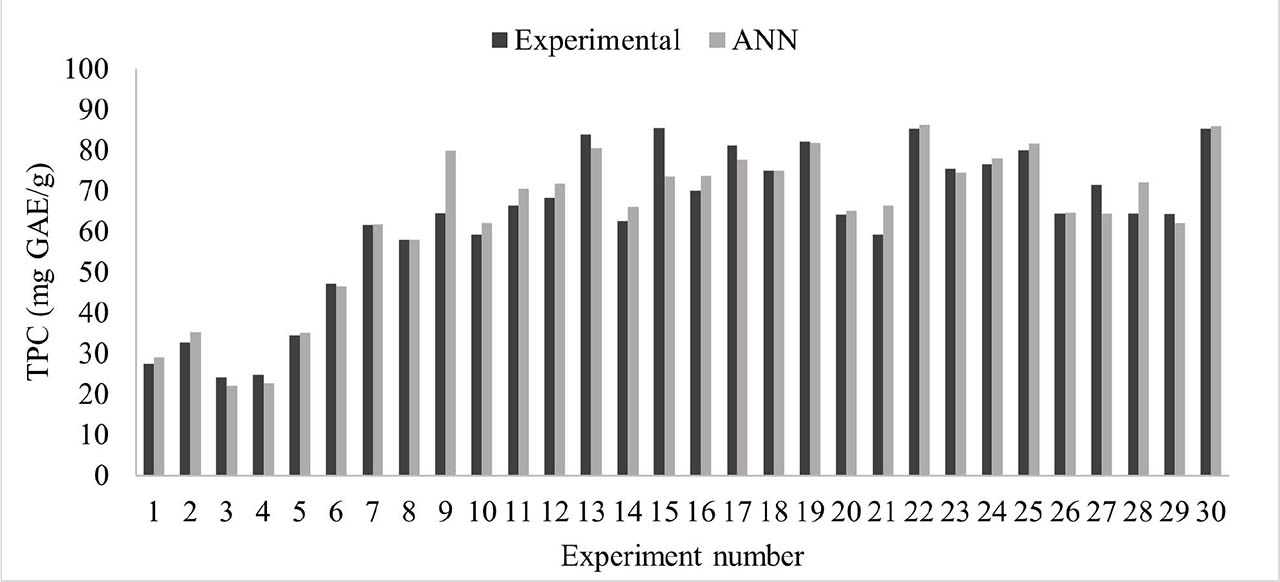
Fig. 4
Experimental and ANN results for TPC.
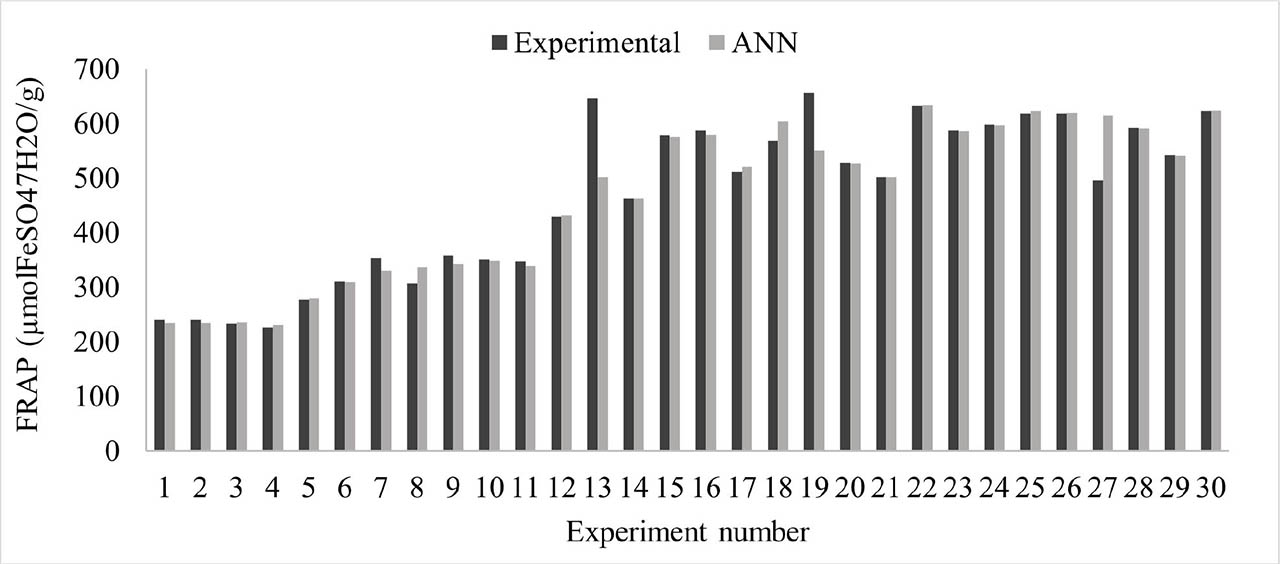
Fig. 5
Experimental and ANN results for FRAP.
Table 5
The optimum extraction parameters obtained from single objective optimization
| Assay | Ethanol content (%) | Extraction time (h) | Estimated value | Unit |
|---|---|---|---|---|
| TPC | 57.50 | 13.96 | 91.19 | mg GAE/g |
| FRAP | 72.03 | 18.04 | 673.05 | μmol FeSO47H2O/g |
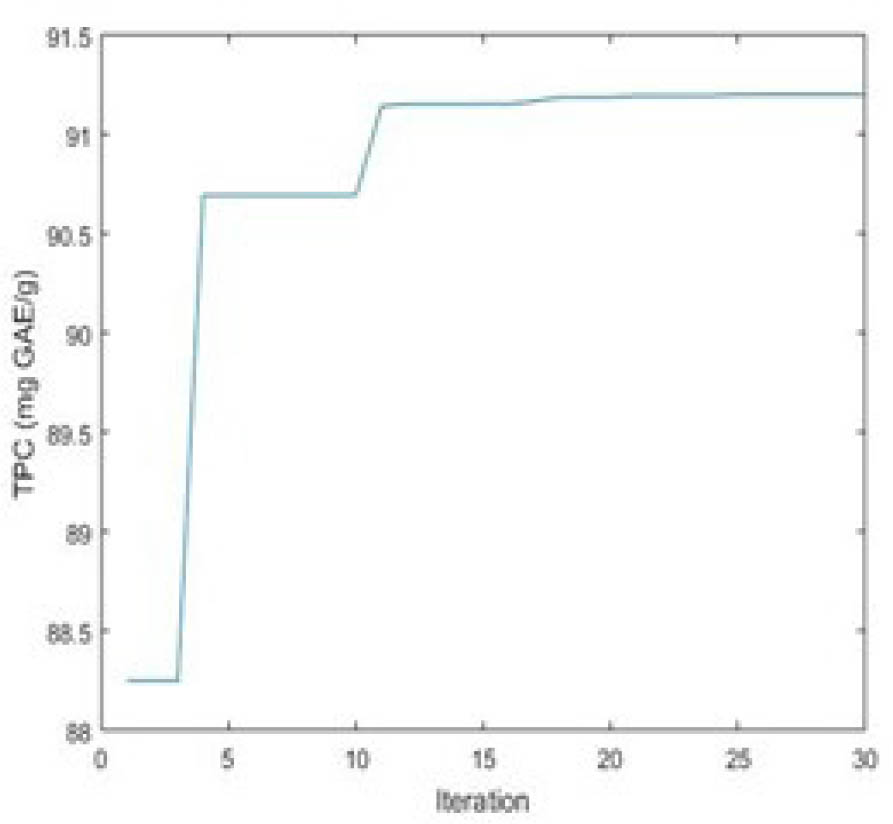
Fig. 6
Optimization course for TPC.
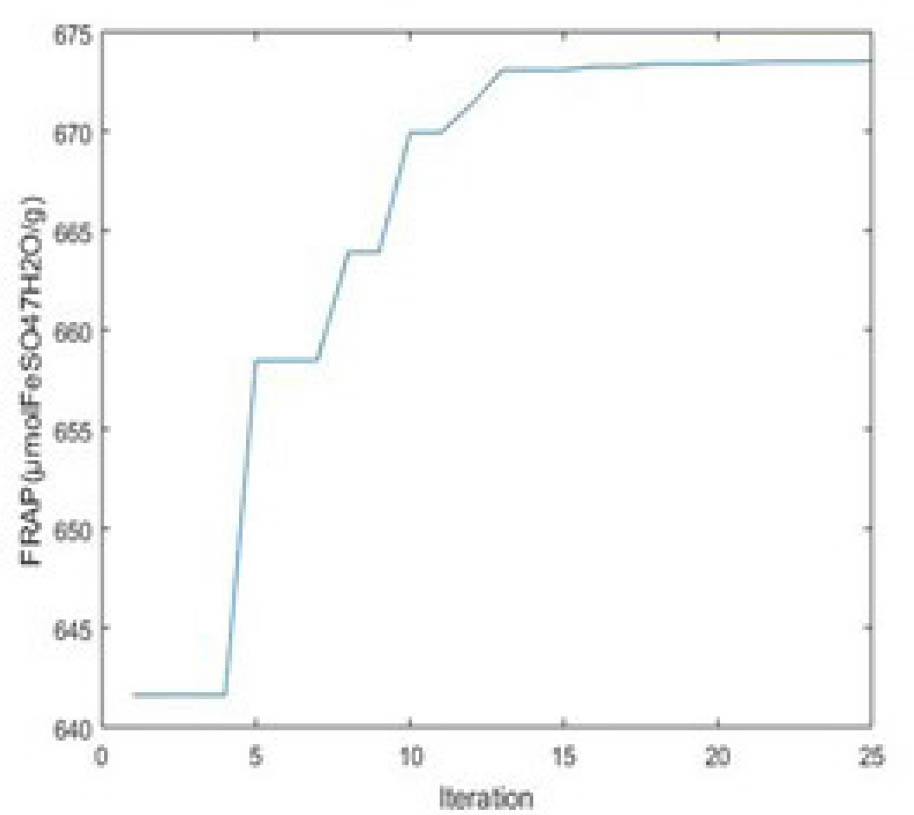
Fig. 7
Optimization course for FRAP.