
Table 1
Characteristics by migrant status
| (1) | (2) | (3) | (4) | |
|---|---|---|---|---|
| Overall | Ever migrate | Never migrate | P-value (2) = (3) | |
| Panel A | ||||
| Husband characteristics | ||||
| Age | 46.119 | 38.934 | 50.720 | 0.000*** |
| [12.921] | [9.339] | [12.800] | ||
| Years of education | 5.104 | 6.219 | 4.391 | 0.000*** |
| [3.940] | [3.517] | [4.030] | ||
| Can read or write | 0.763 | 0.877 | 0.690 | 0.000*** |
| [0.365] | [0.270] | [0.398] | ||
| Wife characteristics | ||||
| Age | 41.650 | 35.076 | 45.859 | 0.000*** |
| [12.143] | [9.016] | [12.020] | ||
| Years of education | 2.513 | 3.770 | 1.708 | 0.000*** |
| [3.545] | [3.790] | [3.125] | ||
| Can read or write | 0.527 | 0.677 | 0.431 | 0.000*** |
| [0.401] | [0.369] | [0.391] | ||
| N | 2,508 | 979 | 1,529 | 2,508 |
| Panel B | ||||
| Household characteristics | ||||
| No. of resident household members | 3.483 | 3.629 | 3.386 | 0.000*** |
| [1.854] | [1.745] | [1.916] | ||
| Resident mother-in-law | 0.230 | 0.316 | 0.174 | 0.000*** |
| [0.421] | [0.465] | [0.379] | ||
| Resident father-in-law | 0.159 | 0.232 | 0.110 | 0.000*** |
| [0.365] | [0.422] | [0.313] | ||
| Resident daughter-in-law | 0.185 | 0.084 | 0.251 | 0.000*** |
| [0.388] | [0.277] | [0.434] | ||
| Shocks | ||||
| Natural disaster (nonearthquake) | 0.044 | 0.039 | 0.047 | 0.092* |
| [0.206] | [0.194] | [0.213] | ||
| Serious illness | 0.223 | 0.213 | 0.230 | 0.074* |
| [0.416] | [0.409] | [0.421] | ||
| Death of household member | 0.055 | 0.053 | 0.056 | 0.630 |
| [0.228] | [0.225] | [0.230] | ||
| Falling agricultural prices | 0.131 | 0.109 | 0.146 | 0.000*** |
| [0.338] | [0.312] | [0.353] | ||
| Decrease in income | 0.155 | 0.134 | 0.170 | 0.000*** |
| [0.362] | [0.341] | [0.375] | ||
| Loss of employment | 0.023 | 0.020 | 0.025 | 0.178 |
| [0.151] | [0.141] | [0.156] | ||
| Mercalli scale 2015 earthquake | 6.926 | 6.870 | 6.962 | 0.000*** |
| [0.505] | [0.525] | [0.488] | ||
| N | 7,572 | 3,013 | 4,559 | 7,572 |
[i] Notes: This table reports mean values with standard deviations in brackets. Column 1 includes all households, Column 2 is limited to households in which the husband migrates at some point, and Column 3 is limited to households in which the husband has not reported migrating during any survey round. Column 4 reports the p-value for a t-test of differences between columns 2 and 3. In panel A, data are at the household level and characteristics are defined using the mean over time (2014–2018) for each household. Data in panel B are pooled 2014–2018 values. The nonearthquake shock averages represent the fraction of households that experienced a given event (e.g., death of a household member) since the previous round of data were collected.
Table 2
Outcomes by migrant status
| (1) | (2) | (3) | (4) | |
|---|---|---|---|---|
| Overall | Ever migrate | Never migrate | P-value (2) = (3) | |
| Panel A: Decision-making over all categories | ||||
| Husband alone | 0.136 | 0.105 | 0.156 | 0.000*** |
| [0.209] | [0.187] | [0.220] | ||
| Husband and wife jointly | 0.338 | 0.304 | 0.361 | 0.000*** |
| [0.313] | [0.313] | [0.310] | ||
| Wife alone | 0.108 | 0.177 | 0.062 | 0.000*** |
| [0.208] | [0.256] | [0.152] | ||
| Panel B: Income and financial behavior | ||||
| Annual income | 11.562 | 11.826 | 11.388 | 0.000*** |
| [3.117] | [2.931] | [3.223] | ||
| Savings deposited in past month | 4.425 | 4.699 | 4.244 | 0.000*** |
| [3.056] | [3.036] | [3.055] | ||
| Currently borrowing | 6.922 | 7.049 | 6.838 | 0.128 |
| [5.886] | [5.855] | [5.906] | ||
| Currently lent | 1.630 | 1.945 | 1.421 | 0.000*** |
| [4.006] | [4.307] | [3.780] | ||
| Panel C: Expenditures | ||||
| Temptation goods | 4.124 | 3.528 | 4.515 | 0.000*** |
| [3.685] | [3.677] | [3.638] | ||
| Health care | 5.971 | 5.765 | 6.107 | 0.000*** |
| [3.404] | [3.428] | [3.381] | ||
| Ceremonies or celebrations | 7.111 | 7.063 | 7.143 | 0.143 |
| [2.298] | [2.357] | [2.259] | ||
| Child education | 5.128 | 5.856 | 4.641 | 0.000*** |
| [3.381] | [2.961] | [3.553] | ||
| Child clothing | 5.184 | 5.860 | 4.730 | 0.000*** |
| [2.985] | [2.518] | [3.181] | ||
| Adult women clothing | 6.330 | 6.424 | 6.268 | 0.000*** |
| [1.626] | [1.464] | [1.721] | ||
| N | 7,572 | 3,013 | 4,559 | 7,572 |
[i] Notes: This table reports mean values with standard deviations in brackets. Column 1 includes all households, Column 2 is limited to households in which the husband migrates at some point, and Column 3 is limited to households in which the husband has not reported migrating during any survey round. Column 4 reports the p-value for a t-test of differences between columns 2 and 3. The data are at the household level and are pooled 2014–2018 values. Decision-making variables are the fractions of decisions over which the decision-making power is distributed as described out of all categories included in the analysis: temptation goods, health care, ceremonies, children's education, children's clothing, and adult women's clothing. See Section C of the Appendix for more details on how these variables are composed. All rupee amounts are transformed by the inverse hyperbolic sine.
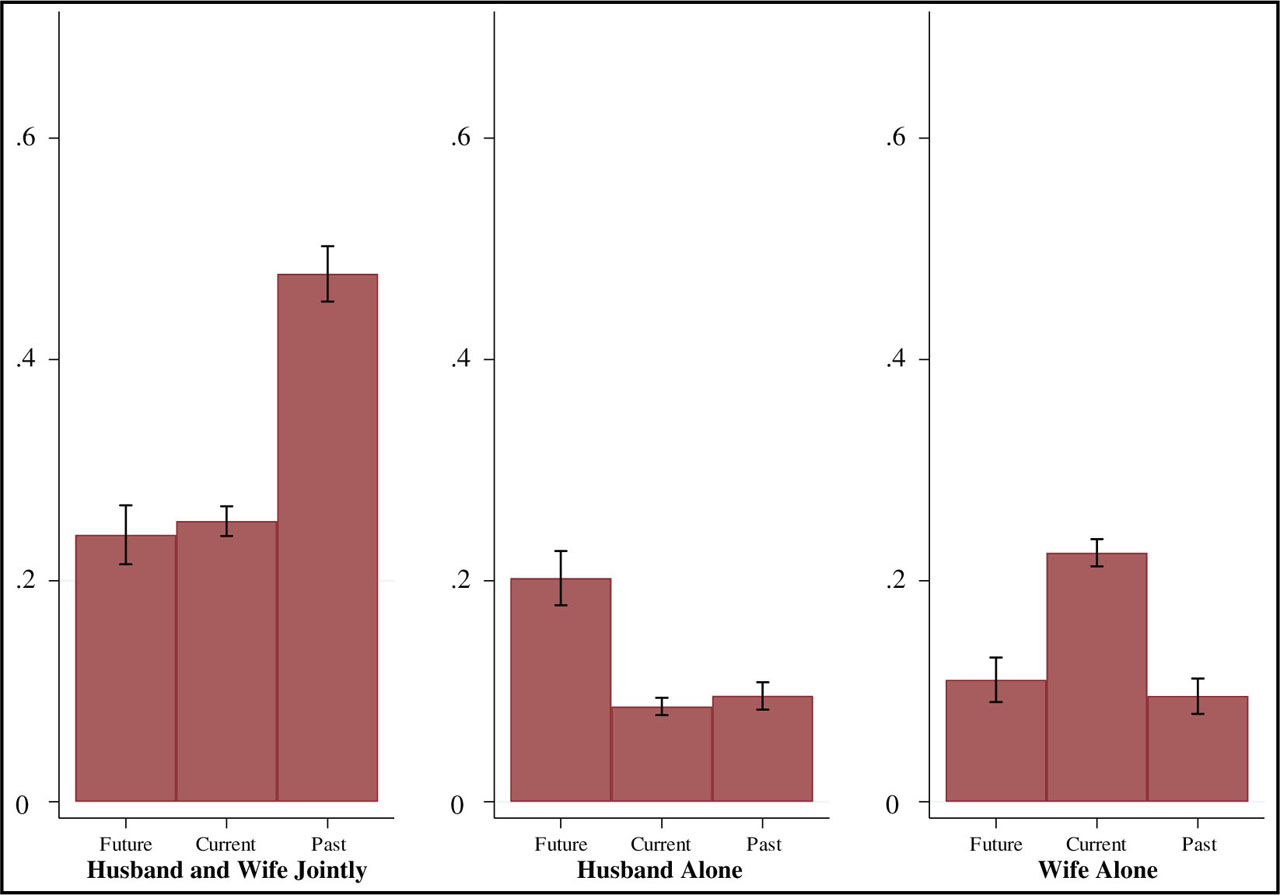
Figure 1
Fraction of decisions made jointly/alone across husband's migration status.
Table 3
Shifts in decision-making power as the husband's migrant status changes
| (1) | (2) | (3) | (4) | |
|---|---|---|---|---|
| Panel A: all categories | ||||
| Husband alone | −0.042*** (0.010) | −0.038*** (0.010) | −0.039*** (0.009) | −0.019 (0.016) |
| Husband and wife jointly | −0.092*** (0.014) | −0.112*** (0.016) | −0.104*** (0.016) | −0.125*** (0.026) |
| Wife alone | 0.101*** (0.011) | 0.107*** (0.013) | 0.110*** (0.014) | 0.108*** (0.019) |
| N | 7,569 | 7,569 | 3,010 | 3,010 |
| Panel B: Disaggregated by category | ||||
| Temptation goods | ||||
| Husband alone | −0.065*** (0.014) | −0.064*** (0.016) | −0.067*** (0.016) | −0.065** (0.027) |
| Husband and wife jointly | −0.037*** (0.009) | −0.052*** (0.011) | −0.044*** (0.012) | −0.055*** (0.018) |
| Wife alone | 0.017*** (0.005) | 0.018*** (0.005) | 0.016*** (0.006) | 0.009 (0.011) |
| N | 7,524 | 7,524 | 2,993 | 2,993 |
| Health care | ||||
| Husband alone | −0.038*** (0.013) | −0.035** (0.014) | −0.031** (0.013) | −0.005 (0.022) |
| Husband and wife jointly | −0.131*** (0.018) | −0.161*** (0.020) | −0.147*** (0.022) | −0.161*** (0.040) |
| Wife alone | 0.140*** (0.017) | 0.160*** (0.020) | 0.155*** (0.022) | 0.154*** (0.031) |
| N | 7,564 | 7,564 | 3,009 | 3,009 |
| Ceremonies or celebrations | ||||
| Husband alone | −0.037*** (0.012) | −0.031** (0.012) | −0.030** (0.012) | −0 (0.023) |
| Husband and wife jointly | −0.104*** (0.019) | −0.126*** (0.021) | −0.114*** (0.022) | −0.130*** (0.037) |
| Wife alone | 0.119*** (0.014) | 0.127*** (0.017) | 0.127*** (0.018) | 0.118*** (0.028) |
| N | 7,537 | 7,537 | 2,999 | 2,999 |
| Child education | ||||
| Husband alone | −0.043*** (0.016) | −0.036** (0.015) | −0.038*** (0.015) | −0.016 (0.024) |
| Husband and wife jointly | −0.091*** (0.023) | −0.099*** (0.024) | −0.108*** (0.027) | −0.137*** (0.045) |
| Wife alone | 0.135*** (0.018) | 0.139*** (0.022) | 0.153*** (0.023) | 0.147*** (0.031) |
| N | 7,415 | 7,415 | 2,978 | 2,978 |
| Child clothing | ||||
| Husband alone | −0.043*** (0.014) | −0.038*** (0.014) | −0.037*** (0.014) | −0.013 (0.023) |
| Husband and wife jointly | −0.106*** (0.023) | −0.114*** (0.026) | −0.127*** (0.027) | −0.181*** (0.041) |
| Wife alone | 0.153*** (0.018) | 0.159*** (0.023) | 0.172*** (0.023) | 0.171*** (0.033) |
| N | 7,469 | 7,469 | 2,995 | 2,995 |
| Adult women clothing | ||||
| Husband alone | −0.034** (0.014) | −0.023 (0.015) | −0.031** (0.015) | −0.002 (0.025) |
| Husband and wife jointly | −0.147*** (0.023) | −0.177*** (0.025) | −0.164*** (0.026) | −0.202*** (0.049) |
| Wife alone | 0.150*** (0.018) | 0.167*** (0.022) | 0.167*** (0.023) | 0.167*** (0.040) |
| N | 7,553 | 7,553 | 3,008 | 3,008 |
| Household and year FE | Yes | Yes | Yes | Yes |
| Controls | No | Yes | Yes | Yes |
| Limited sample | No | No | Yes | Yes |
| HH-specific time trends | No | No | No | Yes |
Notes: Robust standard errors clustered at the VDC level are in parentheses. Each coefficient displayed is from a separate regression and represents the coefficient on a binary variable indicating that the husband is currently migrating. All columns include household FE and year FE. The first column reports the results without any controls. The second and remaining columns include a control set: a separate dummy each for various shocks (the household experienced a natural disaster aside from the 2015 earthquake, serious illness, death of a household member, falling agricultural prices, decrease in income, or loss of employment), a Mercalli scale measure of earthquake intensity at the VDC level, a dummy indicating whether the husband has migration experience, a dummy indicating a resident mother-in-law, a dummy indicating a resident father-in-law, and a separate dummy each indicating when the control is missing. Zeros are imputed for missing values. Columns 3 and 4 are limited to the sample of households wherein the husband migrates in any of the four rounds. Column 4 includes household-specific time trends. Outcome variables are fractions of decisions over which the decision-making power is distributed as described. Note that children's clothing includes expenditures on school uniforms. See Appendix (Section C) for more details on how these variables are composed.
FE, fixed effects; HH, household; VDC, Village Development Committees.
Table 4
Shifts in expenditures (asinh) as the husband's migrant status changes
| (1) | (2) | (3) | (4) | |
|---|---|---|---|---|
| Temptation goods | −1.053*** (0.168) | −1.204*** (0.178) | −1.184*** (0.176) | −1.196*** (0.308) |
| N | 7,417 | 7,417 | 2,940 | 2,940 |
| Health care | −0.009 (0.142) | −0.035 (0.166) | −0.031 (0.173) | 0.257 (0.301) |
| N | 7,145 | 7,145 | 2,850 | 2,850 |
| Ceremonies or celebrations | 0.044 (0.105) | 0.014 (0.100) | 0.067 (0.109) | −0.196 (0.237) |
| N | 7,407 | 7,407 | 2,948 | 2,948 |
| Child education | 0.170* (0.101) | 0.272*** (0.104) | 0.181* (0.108) | −0.190 (0.178) |
| N | 7,339 | 7,339 | 2,954 | 2,954 |
| Child clothing | 0.385*** (0.096) | 0.442*** (0.104) | 0.437*** (0.109) | 0.176 (0.167) |
| N | 7,349 | 7,349 | 2,965 | 2,965 |
| Adult women clothing | −0.071 (0.063) | −0.057 (0.064) | −0.029 (0.065) | 0.016 (0.124) |
| N | 7,548 | 7,548 | 3,005 | 3,005 |
| Household and year FE | Yes | Yes | Yes | Yes |
| Controls | No | Yes | Yes | Yes |
| Limited sample | No | No | Yes | Yes |
| HH-specific time trends | No | No | No | Yes |
Notes: Robust standard errors clustered at the VDC level are in parentheses. Each coefficient displayed is from a separate regression and represents the coefficient on a binary variable indicating that the husband is currently migrating. All columns include household FE and year FE. The first column reports the results without any controls. The second and remaining columns include a control set: a separate dummy each for various shocks (the household experienced a natural disaster aside from the 2015 earthquake, serious illness, death of a household member, falling agricultural prices, decrease in income, or loss of employment), a Mercalli scale measure of earthquake intensity at the VDC level, a dummy indicating whether the husband has migration experience, a dummy indicating a resident mother-in-law, a dummy indicating a resident father-in-law, and a separate dummy each indicating when the control is missing. Zeros are imputed for missing values. Columns 3 and 4 are limited to the sample of households wherein the husband migrates in any of the four rounds. Column 4 includes household-specific time trends. All amounts are in rupees and transformed by the inverse hyperbolic sine.
FE, fixed effects; HH, household; VDC, Village Development Committees.
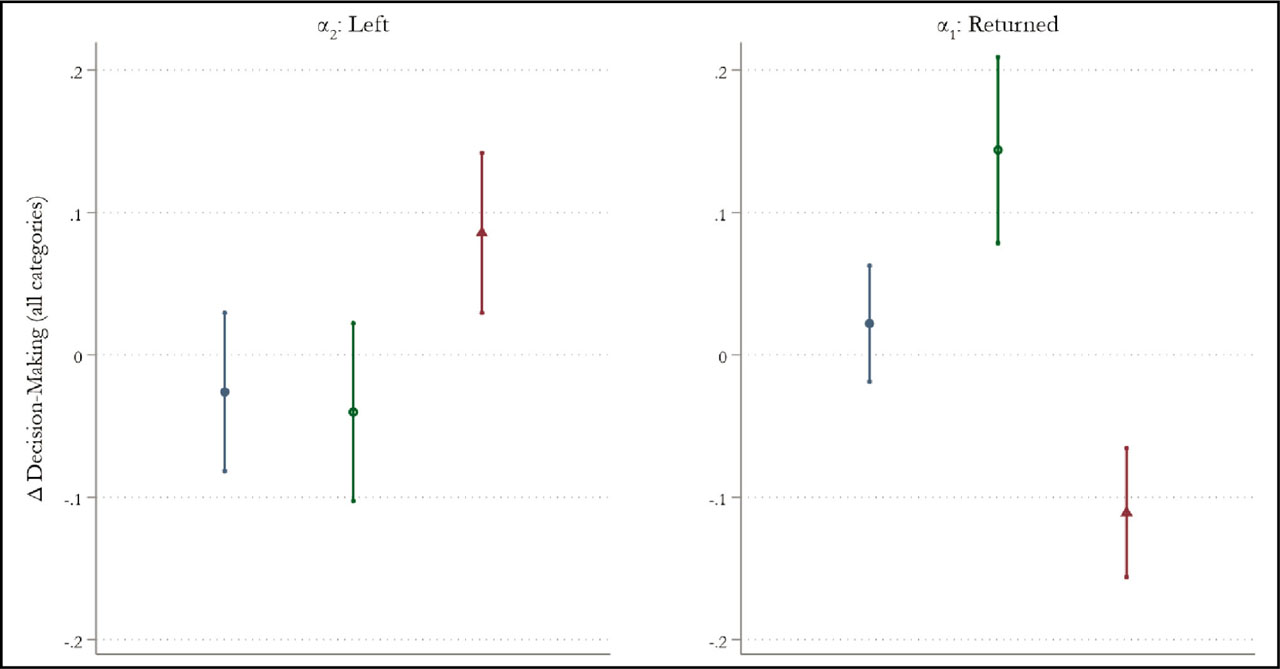
Figure 2
Persistence in women's decision-making power.
Fraction of Decisions Made by
•Husband Alone ○Husband+Wife ▴Wife Alone.
Table 5
Dynamic shifts in expenditures: first-difference approach (asinh)
| α1: returned | α2: left | P-value: |α1| = |α2| | N | |
|---|---|---|---|---|
| Δ Temptation goods | 1.084*** (0.361) | −0.952** (0.386) | 0.819 | 3,491 |
| Δ Health care | 0.328 (0.369) | 0.672** (0.329) | 0.467 | 3,368 |
| Δ Ceremonies or celebrations | −0.403 (0.286) | −0.909*** (0.299) | 0.163 | 3,473 |
| Δ Child education | −0.310 (0.236) | −0.450* (0.258) | 0.615 | 3,389 |
| Δ Child clothing | −0.107 (0.213) | −0.119 (0.243) | 0.955 | 3,407 |
| Δ Adult women clothing | −0.027 (0.153) | −0.120 (0.165) | 0.693 | 3,563 |
Notes: Robust standard errors clustered at the VDC level are in parentheses. Each row represents a separate regression where Returned and Left represent dummies that describe the change in the husband's migrant status between the previous and current periods. The P-value is from an F-test testing for equality between the absolute values of the Returned coefficient and the Left coefficient. Controls for the base period are included. The control set across all regressions includes a separate dummy each for various shocks (the household experienced a natural disaster aside from the 2015 earthquake, serious illness, death of a household member, falling agricultural prices, decrease in income, or loss of employment), a Mercalli scale measure of earthquake intensity at the VDC level, a dummy indicating whether the husband has migration experience, a dummy indicating a resident mother-in-law, a dummy indicating a resident father-in-law, and a separate dummy each indicating when the control is missing. Zeros are imputed for missing values. All amounts are in rupees and transformed by the inverse hyperbolic sine.
Table 6
Heterogeneity by trip length: change in decision-making (all categories)
| (1) | (2) | (3) | (4) | |
|---|---|---|---|---|
| Dependent variable: husband alone | ||||
| Migrant | 0.00525 (0.0145) | 0.00860 (0.0152) | 0.00735 (0.0148) | 0.0209 (0.0257) |
| Migrant × ≥ 6 months | −0.0619*** (0.0144) | −0.0616*** (0.0152) | −0.0600*** (0.0152) | −0.0541** (0.0224) |
| N | 7,569 | 7,569 | 3,010 | 3,010 |
| Dep. variable: husband and wife jointly | ||||
| Migrant | −0.0784*** (0.0212) | −0.0975*** (0.0232) | −0.0905*** (0.0242) | −0.105*** (0.0356) |
| Migrant × ≥ 6 months | −0.0180 (0.0231) | −0.0184 (0.0224) | −0.0176 (0.0225) | −0.0274 (0.0362) |
| N | 7,569 | 7,569 | 3,010 | 3,010 |
| Dep. variable: wife alone | ||||
| Migrant | 0.0645*** (0.0178) | 0.0700*** (0.0194) | 0.0738*** (0.0210) | 0.0631* (0.0322) |
| Migrant × ≥ 6 months | 0.0478** (0.0221) | 0.0485** (0.0224) | 0.0467** (0.0224) | 0.0606* (0.0330) |
| N | 7,569 | 7,569 | 3,010 | 3,010 |
| Household FE | Yes | Yes | Yes | Yes |
| Controls | No | Yes | Yes | Yes |
| Limited sample | No | No | Yes | Yes |
| HH-specific time trends | No | No | No | Yes |
Notes: Robust standard errors clustered at the VDC level are in parentheses. Each column refers to different specifications, as noted. For each specification, we regress three different dependent variables: the fraction of decisions over which the husband solely, the husband and wife jointly, or the wife solely has control. For each regression, we report the coefficient on the dummy for the situation that a husband is currently migrating and the coefficient on this variable interacted with a dummy indicating that the migrant spell is at least 6 months long. As before, the control set across all regressions includes a separate dummy each for various shocks (the household experienced a natural disaster aside from the 2015 earthquake, serious illness, death of a household member, falling agricultural prices, decrease in income, or loss of employment), a Mercalli scale measure of earthquake intensity at the VDC level, a dummy indicating whether the husband has migration experience, a dummy indicating a resident mother-in-law, a dummy indicating a resident father-in-law, and a separate dummy each indicating when the control is missing. Zeros are imputed for missing values.
HH, household; VDC, Village Development Committees.
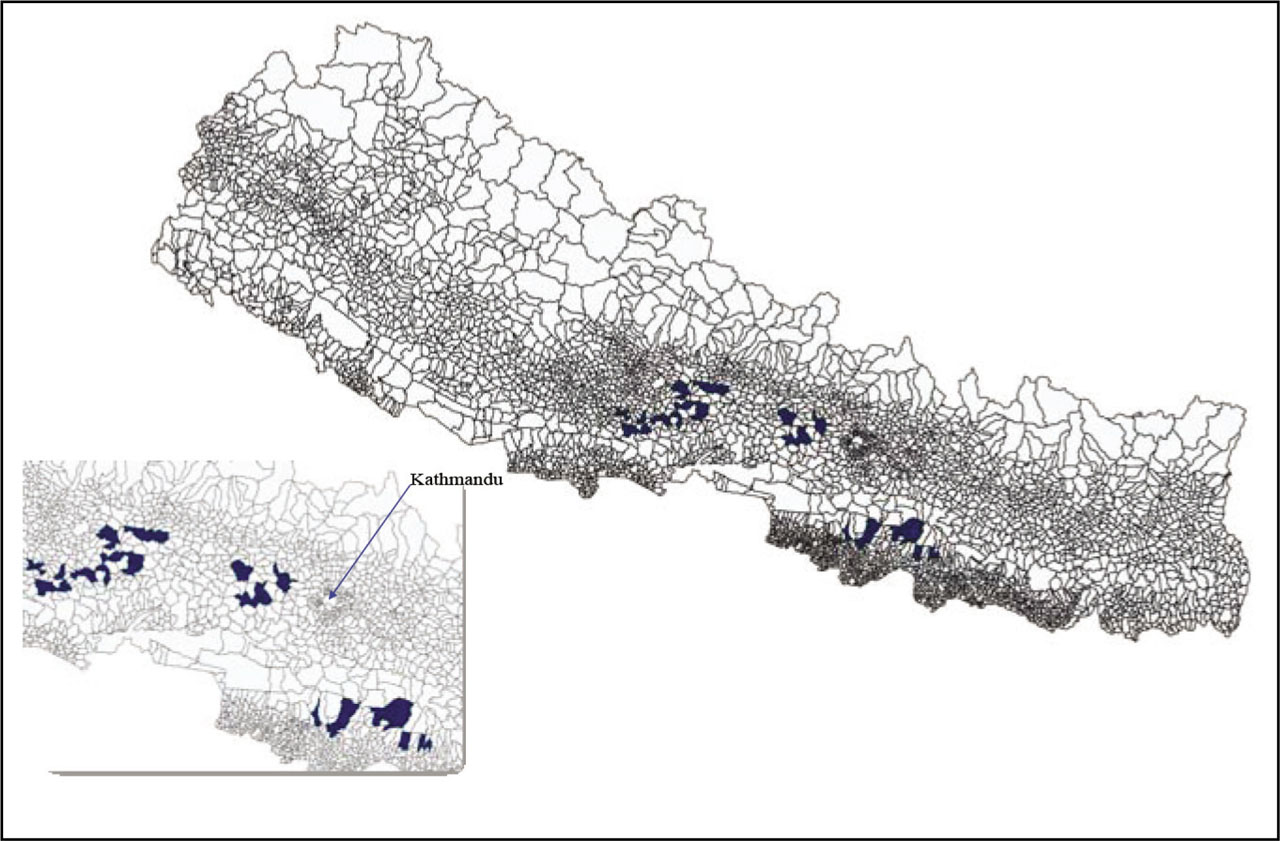
Figure A1
Village development committees representing seven districts in our data.
Note: The seven districts are Dhading, Mahotari, Nuwakot, Palpa, Rautahat, Sarlahi, and Tanahu.
Table A1
Changes in income and financial behavior (asinh) as the husband's migrant status changes
| (1) | (2) | (3) | (4) | |
|---|---|---|---|---|
| Annual income | 0.280** (0.130) | 0.173 (0.134) | 0.204 (0.135) | 0.004 (0.232) |
| N | 7,572 | 7,572 | 3,013 | 3,013 |
| Savings deposited in past month | 0.122 (0.085) | 0.092 (0.100) | 0.071 (0.112) | −0.173 (0.207) |
| N | 7,524 | 7,524 | 2,996 | 2,996 |
| Currently borrowing | 0.056 (0.217) | 0.269 (0.240) | 0.324 (0.269) | 0.139 (0.490) |
| N | 7,572 | 7,572 | 3,013 | 3,013 |
| Currently lending | −0.073 (0.184) | 0.016 (0.197) | −0.043 (0.224) | −0.299 (0.432) |
| N | 7,572 | 7,572 | 3,013 | 3,013 |
| Household and year FE | Yes | Yes | Yes | Yes |
| Controls | No | Yes | Yes | Yes |
| Limited sample | No | No | Yes | Yes |
| HH-specific time trends | No | No | No | Yes |
Notes: Robust standard errors clustered at the VDC level are in parentheses. Each coefficient displayed is from a separate regression and represents the coefficient on a binary variable indicating that the husband is currently migrating. All columns include household FE and year FE. The first column reports the results without any controls. The second and remaining columns include a control set: a separate dummy each for various shocks (the household experienced a natural disaster aside from the 2015 earthquake, serious illness, death of a household member, falling agricultural prices, decrease in income, or loss of employment), a Mercalli scale measure of earthquake intensity at the VDC level, a dummy indicating whether the husband has migration experience, a dummy indicating a resident mother-in-law, a dummy indicating a resident father-in-law, and a separate dummy each indicating when the control is missing. Zeros are imputed for missing values. Columns 3 and 4 are limited to the sample of households in which the husband migrates in any of the four rounds. Column 4 includes household-specific time trends. All amounts are in rupees and transformed by the inverse hyperbolic sine.
FE, fixed effects; HH, household; VDC, village development committee.
Table B1
Shifts in decision-making power as son's migration status changes
| (1) | (2) | (3) | (4) | |
|---|---|---|---|---|
| Panel A: All categories | ||||
| Husband alone | −0.042*** (0.010) | −0.038*** (0.010) | −0.039*** (0.009) | −0.019 (0.016) |
| Husband and wife jointly | 0.010 (0.012) | 0.008 (0.012) | 0.010 (0.012) | 0.012 (0.021) |
| Wife alone | 0.011 (0.008) | 0.011 (0.008) | 0.012 (0.008) | 0.004 (0.015) |
| N | 7,569 | 7,569 | 4,025 | 4,025 |
| Panel B: Disaggregated by category | ||||
| Temptation goods | ||||
| Husband alone | 0.011 (0.011) | 0.008 (0.011) | 0.006 (0.011) | 0.029 (0.022) |
| Husband and wife jointly | 0.004 (0.011) | 0.005 (0.011) | 0.002 (0.011) | −0.008 (0.021) |
| Wife alone | 0.010 (0.007) | 0.010 (0.007) | 0.009 (0.008) | 0.004 (0.015) |
| N | 7,524 | 7,524 | 4,009 | 4,009 |
| Health care | ||||
| Husband alone | 0.001 (0.013) | 0.001 (0.013) | −0.004 (0.012) | −0.017 (0.018) |
| Husband and wife jointly | 0.023 (0.017) | 0.020 (0.017) | 0.023 (0.018) | 0.040 (0.031) |
| Wife alone | 0.012 (0.010) | 0.012 (0.010) | 0.014 (0.010) | 0 (0.017) |
| N | 7,564 | 7,564 | 4,020 | 4,020 |
| Ceremonies or celebrations | ||||
| Husband alone | 0.001 (0.012) | 0.001 (0.012) | −0.004 (0.012) | −0.007 (0.018) |
| Husband and wife jointly | 0.035** (0.016) | 0.031* (0.016) | 0.032* (0.017) | 0.044 (0.027) |
| Wife alone | 0.015 (0.013) | 0.015 (0.013) | 0.016 (0.013) | −0.002 (0.020) |
| N | 7,537 | 7,537 | 4,013 | 4,013 |
| Child education | ||||
| Husband alone | −0.003 (0.014) | −0.005 (0.014) | −0.009 (0.014) | −0.032 (0.019) |
| Husband and wife jointly | −0.043** (0.020) | −0.045** (0.020) | −0.035* (0.020) | −0.035 (0.035) |
| Wife alone | 0.010 (0.012) | 0.012 (0.013) | 0.016 (0.013) | 0.009 (0.023) |
| N | 7,415 | 7,415 | 3,897 | 3,897 |
| Child clothing | ||||
| Husband alone | 0.004 (0.013) | 0.002 (0.013) | −0.004 (0.012) | −0.023 (0.018) |
| Husband and wife jointly | −0.007 (0.020) | −0.009 (0.020) | 0.001 (0.020) | 0.007 (0.032) |
| Wife alone | 0.009 (0.013) | 0.012 (0.013) | 0.012 (0.013) | 0 (0.024) |
| N | 7,469 | 7,469 | 3,938 | 3,938 |
| Adult women clothing | ||||
| Husband alone | 0.008 (0.014) | 0.007 (0.014) | 0.001 (0.013) | −0.015 (0.020) |
| Husband and wife jointly | 0.013 (0.020) | 0.011 (0.020) | 0.011 (0.019) | −0.010 (0.038) |
| Wife alone | 0.008 (0.018) | 0.007 (0.018) | 0.012 (0.018) | 0.022 (0.025) |
| N | 7,553 | 7,553 | 4,013 | 4,013 |
| Household and year FE | Yes | Yes | Yes | Yes |
| Controls | No | Yes | Yes | Yes |
| Limited sample | No | No | Yes | Yes |
| HH-specific time trends | No | No | No | Yes |
Notes: Robust standard errors clustered at the VDC level are in parentheses. Each displayed coefficient is from a separate regression and represents the coefficient on a binary variable indicating that at least one son in the household is currently migrating. All columns include household FE and year FE. The first column reports the results without any controls. The second and remaining columns include a control set: a separate dummy each for various shocks (the household experienced a natural disaster aside from the 2015 earthquake, serious illness, death of a household member, falling agricultural prices, decrease in income, or loss of employment), a Mercalli scale measure of earthquake intensity at the VDC level, a dummy indicating whether the husband has migration experience, a dummy indicating a resident mother-in-law, a dummy indicating a resident father-in-law, and a separate dummy each indicating when the control is missing. Zeros are imputed for missing values. Columns 3 and 4 are limited to the sample of households wherein the husband migrates in any of the four rounds. Column 4 includes household-specific time trends. Outcome variables are fractions of decisions over which the decision-making power is distributed as described. Note that children's clothing includes expenditures on school uniforms. See Section C in the Appendix for more details on how these variables are composed.
FE, fixed effects; HH, household; VDC, village development committee.
Table B2
Shifts in expenditures (asinh) as son's migration status changes
| (1) | (2) | (3) | (4) | |
|---|---|---|---|---|
| Temptation goods | 0.176 (0.134) | 0.189 (0.129) | 0.134 (0.134) | 0.201 (0.243) |
| N | 7,417 | 7,417 | 3,956 | 3,956 |
| Health care | 0.221 (0.147) | 0.236 (0.149) | 0.199 (0.144) | 0.219 (0.275) |
| N | 7,145 | 7,145 | 3,811 | 3,811 |
| Ceremonies or celebrations | 0.122 (0.127) | 0.111 (0.129) | 0.111 (0.128) | 0.009 (0.221) |
| N | 7,407 | 7,407 | 3,939 | 3,939 |
| Child education | −0.351*** (0.128) | −0.357*** (0.128) | −0.262** (0.132) | −0.211 (0.177) |
| N | 7,339 | 7,339 | 3,845 | 3,845 |
| Child clothing | −0.089 (0.107) | −0.079 (0.106) | 0.006 (0.107) | −0.086 (0.160) |
| N | 7,349 | 7,349 | 3,839 | 3,839 |
| Adult women clothing | −0.059 (0.077) | −0.055 (0.076) | −0.045 (0.076) | −0.076 (0.136) |
| N | 7548 | 7548 | 4010 | 4010 |
| Household and year FE | Yes | Yes | Yes | Yes |
| Controls | No | Yes | Yes | Yes |
| Limited sample | No | No | Yes | Yes |
| HH-specific time trends | No | No | No | Yes |
Notes: Robust standard errors clustered at the VDC level are in parentheses. Each coefficient displayed is from a separate regression and represents the coefficient on a binary variable indicating that at least one son in the household is currently migrating. All columns include household FE and year FE. The first column reports the results without any controls. The second and remaining columns include a control set: a separate dummy each for various shocks (the household experienced a natural disaster aside from the 2015 earthquake, serious illness, death of a household member, falling agricultural prices, decrease in income, or loss of employment), a Mercalli scale measure of earthquake intensity at the VDC level, a dummy indicating whether the husband has migration experience, a dummy indicating a resident mother-in-law, a dummy indicating a resident father-in-law, and a separate dummy each indicating when the control is missing. Zeros are imputed for missing values. Columns 3 and 4 are limited to the sample of households in which the husband migrates in any of the four rounds. Column 4 includes household-specific time trends. All amounts are in rupees and transformed by the inverse hyperbolic sine.
FE, fixed effects; HH, household; VDC, village development committee.
Table B3
Changes in income and financial behavior (asinh) as son's migration status changes
| (1) | (2) | (3) | (4) | |
|---|---|---|---|---|
| Annual income | 0.497*** (0.156) | 0.524*** (0.163) | 0.541*** (0.164) | 0.509* (0.287) |
| N | 7,572 | 7,572 | 4,028 | 4,028 |
| Savings deposited in past month | 0.034 (0.082) | 0.027 (0.080) | 0.047 (0.080) | 0.110 (0.191) |
| N | 7,524 | 7,524 | 4,005 | 4,005 |
| Currently borrowing | 0.523*** (0.197) | 0.482** (0.196) | 0.496** (0.213) | 0.833** (0.405) |
| N | 7,572 | 7,572 | 4,028 | 4,028 |
| Currently lending | −0.117 (0.168) | −0.180 (0.167) | −0.164 (0.170) | 0.008 (0.275) |
| N | 7,572 | 7,572 | 4,028 | 4,028 |
| Household and year FE | Yes | Yes | Yes | Yes |
| Controls | No | Yes | Yes | Yes |
| Limited sample | No | No | Yes | Yes |
| HH-specific time trends | No | No | No | Yes |
Notes: Robust standard errors clustered at the VDC level are in parentheses. Each coefficient displayed is from a separate regression and represents the coefficient on a binary variable indicating that at least one son in the household is currently migrating. All columns include household FE and year FE. The first column reports the results without any controls. The second and remaining columns include a control set: a separate dummy each for various shocks (the household experienced a natural disaster aside from the 2015 earthquake, serious illness, death of a household member, falling agricultural prices, decrease in income, or loss of employment), a Mercalli scale measure of earthquake intensity at the VDC level, a dummy indicating whether the husband has migration experience, a dummy indicating a resident mother-in-law, a dummy indicating a resident father-in-law, and a separate dummy each indicating when the control is missing. Zeros are imputed for missing values. Columns 3 and 4 are limited to the sample of households in which the husband migrates in any of the four rounds. Column 4 includes household-specific time trends. All amounts are in rupees and transformed by the inverse hyperbolic sine.
FE, fixed effects; HH, household; VDC, village development committee.
Table B4
Characteristics by migrant status
| (1) | (2) | (3) | (4) | |
|---|---|---|---|---|
| Overall | Husband ever migrate | Son ever migrate | P-value (2) = (3) | |
| Panel A | ||||
| Husband characteristics | ||||
| Age | 46.119 | 38.934 | 51.839 | 0.000*** |
| [12.921] | [9.339] | [10.627] | ||
| Years of education | 5.104 | 6.219 | 4.553 | 0.000*** |
| [3.940] | [3.517] | [3.882] | ||
| Can read or write | 0.763 | 0.877 | 0.729 | 0.000*** |
| [0.365] | [0.270] | [0.377] | ||
| Wife characteristics | ||||
| Age | 41.650 | 35.076 | 47.247 | 0.000*** |
| [12.143] | [9.016] | [9.852] | ||
| Years of education | 2.513 | 3.770 | 1.584 | 0.000*** |
| [3.545] | [3.790] | [2.849] | ||
| Can read or write | 0.527 | 0.677 | 0.449 | 0.000*** |
| [0.401] | [0.369] | [0.378] | ||
| N | 2,508 | 979 | 1,317 | 1,923 |
| Panel B | ||||
| Household characteristics income (asinh) | 11.562 | 11.826 | 11.6073 | 0.000*** |
| [3.117] | [2.931] | [3.183] | ||
| No. of resident household members | 3.483 | 3.629 | 3.323 | 0.000*** |
| [1.854] | [1.745] | [1.877] | ||
| Resident mother-in-law | 0.230 | 0.316 | 0.158 | 0.000*** |
| [0.421] | [0.465] | [0.365] | ||
| Resident father-in-law | 0.159 | 0.232 | 0.088 | 0.000*** |
| [0.365] | [0.422] | [0.284] | ||
| Resident daughter-in-law | 0.185 | 0.084 | 0.308 | 0.000*** |
| [0.388] | [0.277] | [0.462] | ||
| Shocks | ||||
| Natural disaster (nonearthquake) | 0.044 | 0.039 | 0.052 | 0.011** |
| [0.206] | [0.194] | [0.222] | ||
| Serious illness | 0.223 | 0.213 | 0.223 | 0.214 |
| [0.416] | [0.409] | [0.417] | ||
| Death of household member | 0.055 | 0.053 | 0.054 | 0.959 |
| [0.228] | [0.225] | [0.226] | ||
| Falling agricultural prices | 0.131 | 0.109 | 0.128 | 0.000*** |
| [0.338] | [0.312] | [0.335] | ||
| Decrease in income | 0.155 | 0.134 | 0.154 | 0.003*** |
| [0.362] | [0.341] | [0.361] | ||
| Loss of employment | 0.023 | 0.020 | 0.023 | 0.251 |
| [0.151] | [0.141] | [0.150] | ||
| Mercalli scale 2015 earthquake | 6.926 | 6.870 | 6.922 | 0.006*** |
| [0.505] | [0.525] | [0.512] | ||
| N | 7,572 | 3,013 | 4,028 | 5,888 |
[i] Notes: This table reports mean values with standard deviations in brackets. Column 1 includes all households, Column 2 is limited to households in which the husband migrates at some point, and Column 3 is limited to households in which a son migrates at some point. Column 4 reports the p-value for a t-test of differences between columns 2 and 3. In Panel A, data are at the household level and characteristics are defined using the mean value over time (2014–2018) for each household. Data in Panel B are pooled 2014–2018 values. The averages of the nonearthquake shocks represent the fraction of households that experienced a given event (e.g., death of a household member) since the past round of data were collected.
Table C1
Decision-making outcomes by migrant status
| (1) | (2) | (3) | (4) | |
|---|---|---|---|---|
| Overall | Ever migrate | Never migrate | P-value (2) – (3) | |
| Panel A: All categories | ||||
| Husband alone | 0.136 | 0.105 | 0.156 | 0.000*** |
| [0.209] | [0.187] | [0.220] | ||
| Husband and wife jointly | 0.338 | 0.304 | 0.361 | 0.000*** |
| [0.313] | [0.313] | [0.310] | ||
| Wife alone | 0.108 | 0.177 | 0.062 | 0.000*** |
| [0.208] | [0.256] | [0.152] | ||
| Panel B: Disaggregated by category | ||||
| Temptation goods | ||||
| Husband alone | 0.192 | 0.157 | 0.214 | 0.000*** |
| [0.293] | [0.274] | [0.302] | ||
| Husband and wife jointly | 0.107 | 0.080 | 0.125 | 0.000*** |
| [0.254] | [0.224] | [0.270] | ||
| Wife alone | 0.042 | 0.044 | 0.040 | 0.268 |
| [0.146] | [0.151] | [0.143] | ||
| Health care | ||||
| Husband alone | 0.120 | 0.087 | 0.141 | 0.000*** |
| [0.274] | [0.234] | [0.296] | ||
| Husband and wife jointly | 0.418 | 0.364 | 0.454 | 0.000*** |
| [0.437] | [0.434] | [0.435] | ||
| Wife alone | 0.110 | 0.193 | 0.056 | 0.000*** |
| [0.277] | [0.348] | [0.199] | ||
| Ceremonies or celebrations | ||||
| Husband alone | 0.124 | 0.093 | 0.144 | 0.000*** |
| [0.288] | [0.252] | [0.308] | ||
| Husband and wife jointly | 0.479 | 0.432 | 0.510 | 0.000*** |
| [0.438] | [0.438] | [0.435] | ||
| Wife alone | 0.137 | 0.211 | 0.089 | 0.000*** |
| [0.300] | [0.359] | [0.241] | ||
| Child education | ||||
| Husband alone | 0.131 | 0.097 | 0.154 | 0.000*** |
| [0.325] | [0.283] | [0.348] | ||
| Husband and wife jointly | 0.387 | 0.391 | 0.384 | 0.528 |
| [0.474] | [0.475] | [0.474] | ||
| Wife alone | 0.128 | 0.245 | 0.049 | 0.000*** |
| [0.324] | [0.419] | [0.206] | ||
| Child clothing | ||||
| Husband alone | 0.124 | 0.096 | 0.144 | 0.000*** |
| [0.311] | [0.278] | [0.330] | ||
| Husband and wife jointly | 0.385 | 0.381 | 0.387 | 0.556 |
| [0.466] | [0.467] | [0.465] | ||
| Wife alone | 0.140 | 0.262 | 0.058 | 0.000*** |
| [0.331] | [0.424] | [0.216] | ||
| Adult women clothing | ||||
| Husband alone | 0.130 | 0.100 | 0.149 | 0.000*** |
| [0.336] | [0.301] | [0.356] | ||
| Husband and wife jointly | 0.459 | 0.382 | 0.510 | 0.000*** |
| [0.498] | [0.486] | [0.500] | ||
| Wife alone | 0.236 | 0.342 | 0.166 | 0.000*** |
| [0.424] | [0.474] | [0.372] | ||
| N | 7,572 | 3,013 | 4,559 | 7,572 |
[i] Notes: This table reports the mean values with standard deviations in brackets. Column 1 includes all households, Column 2 is limited to households in which the husband migrates at some point, and Column 3 is limited to households wherein the husband has not reported migrating during any survey round. Column 4 reports the p-value for a t-test of differences between columns 2 and 3. The data are at the household level and are pooled 2014–2018 values. Decision-making variables are fractions of decisions over which the decision-making power is distributed as described out of all categories included in the analysis: temptation goods, health care, ceremonies, children's education, children's clothing, and adult women's clothing. See the text of this section (Appendix Section C) for more details on how these variables are composed.
Table D1
Changes in income and financial behavior (asinh) as the husband's migrant status changes – only considering migration spells outside of Nepal and lasting >6 months
| (1) | (2) | (3) | (4) | |
|---|---|---|---|---|
| Annual income | 0.361** (0.169) | 0.267 (0.165) | 0.245 (0.174) | 0.076 (0.226) |
| N | 7,572 | 7,572 | 2,197 | 2,197 |
| Savings deposited in past month | 0.245** (0.101) | 0.235** (0.109) | 0.332*** (0.120) | 0.062 (0.254) |
| N | 7,524 | 7,524 | 2,184 | 2,184 |
| Currently borrowing | −0.010 (0.271) | 0.152 (0.282) | 0.063 (0.310) | 0.022 (0.560) |
| N | 7,572 | 7,572 | 2,197 | 2,197 |
| Currently lending | 0.228 (0.214) | 0.362 (0.232) | 0.311 (0.258) | −0.026 (0.489) |
| N | 7,572 | 7,572 | 2,197 | 2,197 |
| Household and year FE | Yes | Yes | Yes | Yes |
| Controls | No | Yes | Yes | Yes |
| Limited sample | No | No | Yes | Yes |
| HH-specific time trends | No | No | No | Yes |
Notes: Robust standard errors clustered at the VDC level are in parentheses. Each coefficient displayed is from a separate regression and represents the coefficient on a binary variable indicating that the husband is currently migrating. All columns include household FE and year FE. The first column reports the results without any controls. The second and remaining columns include a control set: a separate dummy each for various shocks (the household experienced a natural disaster aside from the 2015 earthquake, serious illness, death of a household member, falling agricultural prices, decrease in income, or loss of employment), a Mercalli scale measure of earthquake intensity at the VDC level, a dummy indicating whether the husband has migration experience, a dummy indicating a resident mother-in-law, a dummy indicating a resident father-in-law, and a separate dummy each indicating when the control is missing. Zeros are imputed for missing values. Columns 3 and 4 are limited to the sample of households in which the husband migrates in any of the four rounds. Column 4 includes household-specific time trends. All amounts are in rupees and transformed by the inverse hyperbolic sine.
FE, fixed effects; HH, household; VDC, village development committee.
Table D2
Shifts in decision-making power as the husband's migrant status changes – only considering migration spells outside of Nepal and lasting >6 months
| (1) | (2) | (3) | (4) | |
|---|---|---|---|---|
| Panel A: all categories | ||||
| Husband alone | −0.059*** (0.011) | −0.055*** (0.010) | −0.056*** (0.010) | −0.050*** (0.014) |
| Husband and wife jointly | −0.095*** (0.017) | −0.105*** (0.018) | −0.105*** (0.019) | −0.103*** (0.032) |
| Wife alone | 0.115*** (0.014) | 0.116*** (0.016) | 0.121*** (0.016) | 0.121*** (0.025) |
| N | 7,569 | 7,569 | 2,194 | 2,194 |
| Panel B: disaggregated by category | ||||
| Temptation goods | ||||
| Husband alone | −0.102*** (0.013) | −0.101*** (0.014) | −0.105*** (0.014) | −0.107*** (0.024) |
| Husband and wife jointly | −0.031*** (0.010) | −0.041*** (0.012) | −0.039*** (0.013) | −0.034* (0.020) |
| Wife alone | 0.014** (0.006) | 0.014** (0.006) | 0.012* (0.007) | 0.005 (0.015) |
| N | 7,524 | 7,524 | 2,184 | 2,184 |
| Health care | ||||
| Husband alone | −0.037** (0.015) | −0.032** (0.015) | −0.032** (0.015) | −0.028 (0.020) |
| Husband and wife jointly | −0.152*** (0.023) | −0.171*** (0.021) | −0.167*** (0.023) | −0.163*** (0.048) |
| Wife alone | 0.158*** (0.021) | 0.168*** (0.021) | 0.170*** (0.023) | 0.169*** (0.037) |
| N | 7,564 | 7,564 | 2,194 | 2,194 |
| Ceremonies or celebrations | ||||
| Husband alone | −0.049*** (0.016) | −0.044*** (0.016) | −0.046*** (0.016) | −0.033 (0.021) |
| Husband and wife jointly | −0.095*** (0.023) | −0.103*** (0.024) | −0.106*** (0.025) | −0.100** (0.047) |
| Wife alone | 0.130*** (0.019) | 0.132*** (0.021) | 0.140*** (0.023) | 0.130*** (0.039) |
| N | 7,537 | 7,537 | 2,184 | 2,184 |
| Child education | ||||
| Husband alone | −0.063*** (0.019) | −0.056*** (0.017) | −0.049*** (0.016) | −0.036 (0.022) |
| Husband and wife jointly | −0.087*** (0.027) | −0.088*** (0.027) | −0.094*** (0.029) | −0.108** (0.048) |
| Wife alone | 0.161*** (0.023) | 0.160*** (0.025) | 0.170*** (0.027) | 0.181*** (0.037) |
| N | 7,415 | 7,415 | 2,171 | 2,171 |
| Child clothing | ||||
| Husband alone | −0.071*** (0.018) | −0.067*** (0.017) | −0.063*** (0.017) | −0.053** (0.023) |
| Husband and wife jointly | −0.121*** (0.029) | −0.123*** (0.030) | −0.127*** (0.031) | −0.152*** (0.048) |
| Wife alone | 0.186*** (0.025) | 0.186*** (0.028) | 0.194*** (0.030) | 0.206*** (0.045) |
| N | 7,469 | 7,469 | 2,182 | 2,182 |
| Adult women clothing | ||||
| Husband alone | −0.049** (0.020) | −0.040** (0.019) | −0.042** (0.020) | −0.035 (0.024) |
| Husband and wife jointly | −0.162*** (0.023) | −0.180*** (0.022) | −0.175*** (0.024) | −0.190*** (0.047) |
| Wife alone | 0.170*** (0.018) | 0.179*** (0.020) | 0.185*** (0.020) | 0.196*** (0.045) |
| N | 7,553 | 7,553 | 2,192 | 2,192 |
| Household and year FE | Yes | Yes | Yes | Yes |
| Controls | No | Yes | Yes | Yes |
| Limited sample | No | No | Yes | Yes |
| HH-specific time trends | No | No | No | Yes |
Notes: Robust standard errors clustered at the VDC level are in parentheses. Each coefficient displayed is from a separate regression and represents the coefficient on a binary variable indicating that the husband is currently migrating. All columns include household FE and year FE. The first column reports the results without any controls. The second and remaining columns include a control set: a separate dummy each for various shocks (the household experienced a natural disaster aside from the 2015 earthquake, serious illness, death of a household member, falling agricultural prices, decrease in income, or loss of employment), a Mercalli scale measure of earthquake intensity at the VDC level, a dummy indicating whether the husband has migration experience, a dummy indicating a resident mother-in-law, a dummy indicating a resident father-in-law, and a separate dummy each indicating when the control is missing. Zeros are imputed for missing values. Columns 3 and 4 are limited to the sample of households wherein the husband migrates in any of the four rounds. Column 4 includes household-specific time trends. Outcome variables are fractions of decisions over which the decision-making power is distributed as described. Note that children's clothing includes expenditures on school uniforms. See Section C of the Appendix for more details on how these variables are composed.
FE, fixed effects; HH, household; VDC, village development committee.
Table D3
Shifts in expenditures (asinh) as the husband's migrant status changes – only considering migration spells outside of Nepal and lasting >6 months
| (1) | (2) | (3) | (4) | |
|---|---|---|---|---|
| Temptation goods | −1.325*** (0.180) | −1.427*** (0.179) | −1.482*** (0.170) | −1.589*** (0.328) |
| N | 7,417 | 7,417 | 2,144 | 2,144 |
| Health care | −0.051 (0.194) | −0.089 (0.217) | −0.090 (0.229) | 0.035 (0.354) |
| N | 7,145 | 7,145 | 2,083 | 2,083 |
| Ceremonies or celebrations | 0.135 (0.111) | 0.124 (0.114) | 0.137 (0.109) | −0.179 (0.225) |
| N | 7,407 | 7,407 | 2,155 | 2,155 |
| Child education | 0.226** (0.112) | 0.312*** (0.114) | 0.285** (0.111) | −0.078 (0.182) |
| N | 7,339 | 7,339 | 2,155 | 2,155 |
| Child clothing | 0.338*** (0.108) | 0.360*** (0.109) | 0.320*** (0.107) | 0.204 (0.175) |
| N | 7,349 | 7,349 | 2,161 | 2,161 |
| Adult women clothing | 0.043 (0.073) | 0.069 (0.077) | 0.064 (0.082) | 0.165 (0.148) |
| N | 7,548 | 7,548 | 2,191 | 2,191 |
| Household and year FE | Yes | Yes | Yes | Yes |
| Controls | No | Yes | Yes | Yes |
| Limited sample | No | No | Yes | Yes |
| HH-specific time trends | No | No | No | Yes |
Notes: Robust standard errors clustered at the VDC level are in parentheses. Each coefficient displayed is from a separate regression and represents the coefficient on a binary variable indicating that the husband is currently migrating. All columns include household FE and year FE. The first column reports the results without any controls. The second and remaining columns include a control set: a separate dummy each for various shocks (the household experienced a natural disaster aside from the 2015 earthquake, serious illness, death of a household member, falling agricultural prices, decrease in income, or loss of employment), a Mercalli scale measure of earthquake intensity at the VDC level, a dummy indicating whether the husband has migration experience, a dummy indicating a resident mother-in-law, a dummy indicating a resident father-in-law, and a separate dummy each indicating when the control is missing. Zeros are imputed for missing values. Columns 3 and 4 are limited to the sample of households in which the husband migrates in any of the four rounds. Column 4 includes household-specific time trends. All amounts are in rupees and transformed by the inverse hyperbolic sine.
FE, fixed effects; HH, household; VDC, village development committee.
Table D4
Changes in expenditures, income, and financial behavior as the husband's migrant status changes – log(x+1)
| (1) | (2) | (3) | (4) | |
|---|---|---|---|---|
| Panel A: expenditures | ||||
| Temptation goods | −0.951*** (0.153) | −1.086*** (0.161) | −1.066*** (0.159) | −1.072*** (0.280) |
| N | 7,417 | 7,417 | 2,940 | 2,940 |
| Health care | −0.013 (0.131) | −0.035 (0.152) | −0.032 (0.158) | 0.233 (0.275) |
| N | 7,145 | 7,145 | 2,850 | 2,850 |
| Ceremonies or celebrations | 0.035 (0.097) | 0.006 (0.092) | 0.056 (0.102) | −0.187 (0.220) |
| N | 7,407 | 7,407 | 2,948 | 2,948 |
| Children's education | 0.154* (0.092) | 0.246** (0.096) | 0.163* (0.099) | −0.176 (0.162) |
| N | 7,339 | 7,339 | 2,954 | 2,954 |
| Children's clothing | 0.351*** (0.088) | 0.401*** (0.094) | 0.399*** (0.098) | 0.163 (0.151) |
| N | 7,349 | 7,349 | 2,965 | 2,965 |
| Adult women's clothing | −0.062 (0.058) | −0.049 (0.059) | −0.022 (0.059) | 0.022 (0.115) |
| N | 7,548 | 7,548 | 3,005 | 3,005 |
| Panel B: income and financial behavior | ||||
| Annual income | 0.281** (0.124) | 0.177 (0.128) | 0.208 (0.129) | 0.023 (0.221) |
| N | 7,572 | 7,572 | 3,013 | 3,013 |
| Savings deposited in past month | 0.109 (0.076) | 0.085 (0.090) | 0.064 (0.102) | −0.155 (0.189) |
| N | 7,524 | 7,524 | 2,996 | 2,996 |
| Currently borrowing | 0.055 (0.204) | 0.254 (0.225) | 0.304 (0.253) | 0.131 (0.461) |
| N | 7,572 | 7,572 | 3,013 | 3,013 |
| Currently lending | −0.068 (0.173) | 0.016 (0.185) | −0.040 (0.210) | −0.282 (0.406) |
| N | 7,572 | 7,572 | 3,013 | 3,013 |
| Household and year FE | Yes | Yes | Yes | Yes |
| Controls | No | Yes | Yes | Yes |
| Limited sample | No | No | Yes | Yes |
| HH-specific time trends | No | No | No | Yes |
Notes: Robust standard errors clustered at the VDC level are in parentheses. Each coefficient displayed is from a separate regression and represents the coefficient on a binary variable indicating that the husband is currently migrating. All columns include household FE and year FE. The first column reports the results without any controls. The second and remaining columns include a control set: a separate dummy each for various shocks (the household experienced a natural disaster aside from the 2015 earthquake, serious illness, death of a household member, falling agricultural prices, decrease in income, or loss of employment), a Mercalli scale measure of earthquake intensity at the VDC level, a dummy indicating whether the husband has migration experience, a dummy indicating a resident mother-in-law, a dummy indicating a resident father-in-law, and a separate dummy each indicating when the control is missing. Zeros are imputed for missing values. Columns 3 and 4 are limited to the sample of households in which the husband migrates in any of the four rounds. Column 4 includes household-specific time trends.
FE, fixed effects; HH, household; VDC, village development committee.
Table D5
Changes in expenditures, income, and financial behavior as the husband's migrant status changes – top-coded at the 99th percentile
| (1) | (2) | (3) | (4) | |
|---|---|---|---|---|
| Panel A: expenditures | ||||
| Temptation goods | −120.197** (53.600) | −123.775** (53.349) | −103.070* (58.289) | −84.433 (89.528) |
| N | 7,417 | 7,417 | 2,940 | 2,940 |
| Health care | −142.523 (209.494) | 67.791 (208.082) | 37.156 (213.112) | 384.495 (441.580) |
| N | 7,145 | 7,145 | 2,850 | 2,850 |
| Ceremonies or celebrations | −61.221 (200.328) | −98.690 (207.853) | −101.441 (244.901) | −69.571 (428.462) |
| N | 7,407 | 7,407 | 2,948 | 2,948 |
| Children's education | 46.994 (70.327) | 57.460 (80.099) | 32.590 (86.554) | −17.220 (91.988) |
| N | 7,339 | 7,339 | 2,954 | 2,954 |
| Children's clothing | 66.530*** (19.940) | 66.780*** (19.517) | 68.799*** (21.046) | 43.934 (46.406) |
| N | 7,349 | 7,349 | 2,965 | 2,965 |
| Adult women's clothing | −12.056 (17.752) | −11.160 (18.640) | −5.324 (18.132) | 22.142 (36.732) |
| N | 7,548 | 7,548 | 3,005 | 3,005 |
| Panel B: income and financial behavior | ||||
| Annual income | 47,989.637*** (10,443.880) | 42,926.326*** (10,572.657) | 40,291.132*** (12,732.178) | 46,886.496** (20,457.034) |
| N | 7,572 | 7,572 | 3,013 | 3,013 |
| Savings deposited in past month | 26.565 (117.086) | 65.817 (133.244) | 33.088 (151.638) | 63.081 (288.894) |
| N | 7,524 | 7,524 | 2,996 | 2,996 |
| Currently borrowing | −4,592.633 (5,078.635) | −4,186.492 (5,943.972) | −7,271.935 (6,512.158) | −4,250.191 (11,469.621) |
| N | 7,572 | 7,572 | 3,013 | 3,013 |
| Currently lending | −499.550 (1,535.515) | 538.604 (1,651.946) | 154.814 (1,959.374) | −2,634.804 (3,550.470) |
| N | 7,572 | 7,572 | 3,013 | 3,013 |
| Household and year FE | Yes | Yes | Yes | Yes |
| Controls | No | Yes | Yes | Yes |
| Limited sample | No | No | Yes | Yes |
| HH-specific time trends | No | No | No | Yes |
Notes: Robust standard errors clustered at the VDC level are in parentheses. Each coefficient displayed is from a separate regression and represents the coefficient on a binary variable indicating that the husband is currently migrating. All columns include household FE and year FE. The first column reports the results without any controls. The second and remaining columns include a control set: a separate dummy each for various shocks (the household experienced a natural disaster aside from the 2015 earthquake, serious illness, death of a household member, falling agricultural prices, decrease in income, or loss of employment), a Mercalli scale measure of earthquake intensity at the VDC level, a dummy indicating whether the husband has migration experience, a dummy indicating a resident mother-in-law, a dummy indicating a resident father-in-law, and a separate dummy each indicating when the control is missing. Zeros are imputed for missing values. Columns 3 and 4 are limited to the sample of households in which the husband migrates in any of the four rounds. Column 4 includes household-specific time trends.
FE, fixed effects; HH, household; VDC, village development committee.
Table D6
Changes in expenditures, income, and financial behavior as the husband's migrant status changes – top-coded at the 95th percentile
| (1) | (2) | (3) | (4) | |
|---|---|---|---|---|
| Panel A: expenditures | ||||
| Temptation goods | −126.360*** (38.072) | −137.050*** (38.904) | −117.563*** (39.783) | −103.698 (63.795) |
| N | 7,417 | 7,417 | 2,940 | 2,940 |
| Health care | −75.066 (133.753) | −3.897 (121.987) | −36.762 (119.550) | 154.302 (255.985) |
| N | 7,145 | 7,145 | 2,850 | 2,850 |
| Ceremonies or celebrations | −91.457 (92.147) | −121.699 (94.857) | −98.522 (116.511) | −163.506 (172.497) |
| N | 7,407 | 7,407 | 2,948 | 2,948 |
| Children's education | 47.410 (37.658) | 58.955 (41.153) | 29.104 (44.499) | −70.578 (63.297) |
| N | 7,339 | 7,339 | 2,954 | 2,954 |
| Children's clothing | 47.525*** (16.438) | 46.156*** (16.379) | 48.749*** (17.297) | 22.596 (34.274) |
| N | 7,349 | 7,349 | 2,965 | 2,965 |
| Adult women's clothing | −7.454 (13.565) | −3.645 (14.699) | 1.919 (14.565) | 13.527 (27.480) |
| N | 7,548 | 7,548 | 3,005 | 3,005 |
| Panel B: income and financial behavior | ||||
| Annual income | 42,899.597*** (7,854.542) | 40,695.726*** (8,243.078) | 39,730.933*** (10,362.565) | 48,730.244***(15,369.961) |
| N | 7,572 | 7,572 | 3,013 | 3,013 |
| Savings deposited in past month | 11.375 (23.572) | 18.660 (28.278) | 10.282 (33.734) | −5.363 (56.177) |
| N | 7,524 | 7,524 | 2,996 | 2,996 |
| Currently borrowing | 1,178.234 (3,369.408) | 2,149.937 (3,874.228) | 201.140 (4,213.134) | −2,007.624 (8,311.890) |
| N | 7,572 | 7,572 | 3,013 | 3,013 |
| Currently lending | 53.964 (667.219) | 536.425 (749.997) | 120.092 (909.763) | −1,694.717 (1,763.982) |
| N | 7,572 | 7,572 | 3,013 | 3,013 |
| Household and year FE | Yes | Yes | Yes | Yes |
| Controls | No | Yes | Yes | Yes |
| Limited sample | No | No | Yes | Yes |
| HH-specific time trends | No | No | No | Yes |
Notes: Robust standard errors clustered at the VDC level are in parentheses. Each coefficient displayed is from a separate regression and represents the coefficient on a binary variable indicating that the husband is currently migrating. All columns include household FE and year FE. The first column reports the results without any controls. The second and remaining columns include a control set: a separate dummy each for various shocks (the household experienced a natural disaster aside from the 2015 earthquake, serious illness, death of a household member, falling agricultural prices, decrease in income, or loss of employment), a Mercalli scale measure of earthquake intensity at the VDC level, a dummy indicating whether the husband has migration experience, a dummy indicating a resident mother-in-law, a dummy indicating a resident father-in-law, and a separate dummy each indicating when the control is missing. Zeros are imputed for missing values. Columns 3 and 4 are limited to the sample of households in which the husband migrates in any of the four rounds. Column 4 includes household-specific time trends.
FE, fixed effects; HH, household; VDC, village development committee.
Table D7
Shifts in expenditures (asinh) as the husband's migrant status changes – only considering the first two rounds of data
| (1) | (2) | (3) | |
|---|---|---|---|
| Temptation goods | −0.921*** (0.228) | −1.154*** (0.232) | −1.400*** (0.319) |
| N | 4,352 | 4,352 | 1,540 |
| Health care | 0.052 (0.189) | 0.029 (0.224) | −0.012 (0.371) |
| N | 4,016 | 4,016 | 1,426 |
| Ceremonies or celebrations | 0.113 (0.135) | −0.134 (0.137) | −0.086 (0.222) |
| N | 4,338 | 4,338 | 1,554 |
| Child education | 0.149 (0.155) | 0.415** (0.180) | 0.543** (0.242) |
| N | 4,270 | 4,270 | 1,558 |
| Child clothing | 0.289** (0.140) | 0.423*** (0.161) | 0.456** (0.209) |
| N | 4,286 | 4,286 | 1,572 |
| Adult women clothing | −0.053 (0.098) | 0.071 (0.107) | 0.160 (0.186) |
| N | 4,530 | 4,530 | 1,618 |
| Household and year FE | Yes | Yes | Yes |
| Controls | No | Yes | Yes |
| Limited sample | No | No | Yes |
| HH-specific time trends | No | No | No |
Notes: Robust standard errors clustered at the VDC level are in parentheses. Each coefficient displayed is from a separate regression and represents the coefficient on a binary variable indicating that the husband is currently migrating. All columns include household FE and year FE. The first column reports the results without any controls. The second and remaining columns include a control set: a separate dummy each for various shocks (the household experienced a natural disaster aside from the 2015 earthquake, serious illness, death of a household member, falling agricultural prices, decrease in income, or loss of employment), a Mercalli scale measure of earthquake intensity at the VDC level, a dummy indicating whether the husband has migration experience, a dummy indicating a resident mother-in-law, a dummy indicating a resident father-in-law, and a separate dummy each indicating when the control is missing. Zeros are imputed for missing values. Columns 3 and 4 are limited to the sample of households in which the husband migrates in any of the four rounds. All amounts are in rupees and transformed by the inverse hyperbolic sine.
FE, fixed effects; HH, household; VDC, village development committee.
Table E1
Attrition over time
| (1) | (2) | (3) | (4) | |
|---|---|---|---|---|
| 2014 | 2016 | 2017 | 2018 | |
| Full sample | 2,508 | 2,281 | 1,456 | 1,327 |
| Attrition (not found) | . | 227 | 165 | 294 |
| Attrition (dropped) | . | 0 | 887 | 887 |
[i] Notes: The table reports the number of women in each category. Women leave the sample because either the surveyors could not locate the household/respondent or the households were purposely dropped (due to either the earthquake or other reasons necessary for the randomized evaluation's study design). Attrition numbers are cumulative (the columns will always add up to the full sample in 2014). See Section E in the Appendix for more details.
Table E2
Husband's migration and household attrition
| (1) | (2) | (3) | (4) | |
|---|---|---|---|---|
| Absent in next round | −0.020 (0.019) | 0.002 (0.022) | 0.046** (0.022) | −0.042 (0.038) |
| N | 6,225 | 6,225 | 2,465 | 2,465 |
| Not found | −0.002 (0.015) | 0.019 (0.017) | 0.024 (0.018) | −0.042 (0.038) |
| N | 6,225 | 6,225 | 2,465 | 2,465 |
| Dropped | −0.017 (0.016) | −0.017 (0.016) | 0.022 (0.015) | - |
| N | 6,225 | 6,225 | 2,465 | - |
| Household and year FE | Yes | Yes | Yes | Yes |
| Controls | No | Yes | Yes | Yes |
| Limited sample | No | No | Yes | Yes |
| HH-specific time trends | No | No | No | Yes |
Notes: Robust standard errors clustered at the VDC level are in parentheses. Each coefficient displayed is from a separate regression and represents the coefficient on a binary variable indicating that the husband is currently migrating. The control set across all regressions includes a separate dummy each for the situation that the household experienced a natural disaster (aside from the 2015 earthquake), serious illness, death of a household member, falling agricultural prices, decrease in income, or loss of employment, a Mercalli scale measure of earthquake intensity at the VDC level, and a separate dummy each indicating when the control is missing. Zeros are imputed for missing values. Even columns limit the sample to households in which the husband migrates in any of the four rounds. The last two columns include household-specific time trends, in addition to the control set. Absent in next round – dropped is not estimated in the final two columns because the outcome is perfectly collinear with household-specific time trends. See Section E of the Appendix for more detail.
FE, fixed effects; HH, household; VDC, village development committee.
Table E3
Selection into attrition by migration status over time
| (1) | (2) | (3) | (4) | (5) | (6) | |
|---|---|---|---|---|---|---|
| Not found | Dropped | Current migrant | Not found × current migrant | Dropped × current migrant | N | |
| Household characteristics | ||||||
| No. of resident household members | 0.042 | 0.098 | 0.270*** | 0.103 | −0.152 | 6,245 |
| Resident mother-in-law | 0.020 | −0.019 | 0.144*** | 0.121*** | 0.020 | 6,245 |
| Resident father-in-law | 0.009 | −0.010 | 0.113*** | 0.089** | 0.049 | 6,245 |
| Resident daughter-in-law | 0.040* | −0.015 | −0.165*** | −0.041 | 0.012 | 6,245 |
| Household shocks | ||||||
| Natural disaster (nonearthquake) | −0.002 | 0.028** | −0.008 | 0.005 | −0.004 | 6,227 |
| Serious illness | 0.039* | 0.023 | −0.029** | −0.083* | 0.061 | 6,231 |
| Death of household member | 0.018 | 0.019* | −0.016** | 0.026 | 0.017 | 6,229 |
| Falling agricultural prices | −0.007 | 0.205*** | −0.021* | −0.049** | −0.046 | 6,116 |
| Decrease in income | −0.016 | 0.243*** | −0.039*** | −0.032 | −0.045 | 6,130 |
| Loss of employment | 0.014 | 0.013* | −0.014*** | −0.006 | −0.013 | 6,217 |
| Mercalli scale 2015 earthquake | −0.264 | 5.278*** | −0.229** | 0.710** | 0.037 | 6,245 |
Notes: Each row represents a different regression in which the outcome variable is either a household characteristic or shock. Robust standard errors clustered at the VDC level are in parentheses. Column 1 lists the coefficient on a dummy for the situation that the respondent was absent in the next period because they could not be located. Column 2 lists the coefficient on the dummy if the respondent was absent in the next round because they were dropped from the sample on purpose. Column 3 lists the coefficient on a variable indicating that the husband is migrating during the current time period. The fourth and fifth columns show the interactions between the previous columns. The sixth column lists the sample size for each regression.
VDC, village development committee.
Table F1
Dynamic shifts in decision-making power between husband and wife: first-difference approach
| α1: returned | α2: left | P-value: |α1| = |α2| | N | |
|---|---|---|---|---|
| Panel A: Δ All categories | ||||
| Husband alone | 0.022 (0.020) | −0.026 (0.028) | 0.919 | 3,580 |
| Husband and wife jointly | 0.144*** (0.032) | −0.040 (0.031) | 0.036** | 3,580 |
| Wife alone | −0.111*** (0.023) | 0.086*** (0.028) | 0.557 | 3,580 |
| Panel B: Δ disaggregated by category | ||||
| Δ Temptation goods | ||||
| Husband alone | 0.079*** (0.025) | −0.024 (0.036) | 0.208 | 3,566 |
| Husband and wife jointly | 0.044* (0.026) | −0.031 (0.027) | 0.767 | 3,566 |
| Wife alone | −0.015 (0.017) | 0.013 (0.018) | 0.963 | 3,566 |
| Δ Health care | ||||
| Husband alone | 0.004 (0.025) | −0.024 (0.034) | 0.646 | 3,579 |
| Husband and wife jointly | 0.193*** (0.047) | −0.036 (0.048) | 0.035** | 3,579 |
| Wife alone | −0.149*** (0.032) | 0.121*** (0.041) | 0.646 | 3,579 |
| Δ Ceremonies | ||||
| Husband alone | 0.022 (0.025) | −0.019 (0.034) | 0.945 | 3,571 |
| Husband and wife jointly | 0.160*** (0.047) | −0.057 (0.050) | 0.202 | 3,571 |
| Wife alone | −0.127*** (0.039) | 0.106** (0.048) | 0.784 | 3,571 |
| Δ Child education | ||||
| Husband alone | −0.008 (0.032) | −0.063 (0.044) | 0.262 | 3,456 |
| Husband and wife jointly | 0.154*** (0.056) | −0.039 (0.055) | 0.185 | 3,456 |
| Wife alone | −0.167*** (0.044) | 0.085** (0.039) | 0.234 | 3,456 |
| Δ Child clothing | ||||
| Husband alone | 0.010 (0.033) | −0.041 (0.043) | 0.624 | 3,495 |
| Husband and wife jointly | 0.168*** (0.056) | −0.071 (0.051) | 0.238 | 3,495 |
| Wife alone | −0.169*** (0.048) | 0.109** (0.046) | 0.453 | 3,495 |
| Δ Adult women clothing | ||||
| Husband alone | 0.006 (0.036) | −0.003 (0.036) | 0.963 | 3,572 |
| Husband and wife jointly | 0.247*** (0.057) | −0.102* (0.052) | 0.078* | 3,572 |
| Wife alone | −0.195*** (0.045) | 0.099** (0.045) | 0.202 | 3,572 |
Notes: Robust standard errors clustered at the VDC level are in parentheses. Each row represents a separate regression where Returned and Left represent dummies that describe the change in the husband's migrant status between the previous and current periods. The P-value is from an F-test testing for equality between the absolute value of the Returned coefficient and Left coefficient. Controls for the base period are included. The control set across all regressions includes a separate dummy each for various shocks (the household experienced a natural disaster aside from the 2015 earthquake, serious illness, death of a household member, falling agricultural prices, decrease in income, or loss of employment), a Mercalli scale measure of earthquake intensity at the VDC level, a dummy indicating whether the husband has migration experience, a dummy indicating a resident mother-in-law, a dummy indicating a resident father-in-law, and a separate dummy each indicating when the control is missing. Zeros are imputed for missing values. Outcome variables are fractions of decisions over which the decision-making power is distributed as described. Note that children's clothing includes expenditures on school uniforms. See Section C of the Appendix for more details on how these variables are composed.
VDC, village development committee.
Table F2
Dynamic shifts in decision-making power between husband and wife: first-difference approach with the dummy Gone
| α1: returned | α2: left | α3: gone | P-value: |α1| = |α2| | N | |
|---|---|---|---|---|---|
| Panel A: Δ all categories | |||||
| Husband alone | 0.019 (0.032) | −0.029 (0.038) | −0.005 (0.039) | 0.879 | 3,580 |
| Husband and wife jointly | 0.123*** (0.045) | −0.063 (0.042) | −0.042 (0.050) | 0.440 | 3,580 |
| Wife alone | −0.109*** (0.030) | 0.088** (0.037) | 0.004 (0.039) | 0.730 | 3,580 |
| Panel B: Δ disaggregated by category | |||||
| Δ Temptation goods | |||||
| Husband alone | 0.081*** (0.029) | −0.022 (0.047) | 0.005 (0.040) | 0.344 | 3,566 |
| Husband and wife jointly | 0.017 (0.036) | −0.060* (0.036) | −0.053 (0.048) | 0.523 | 3,566 |
| Wife alone | −0.028 (0.022) | −0.000 (0.023) | −0.025 (0.028) | 0.136 | 3,566 |
| Δ Health care | |||||
| Husband alone | 0.001 (0.041) | −0.027 (0.047) | −0.006 (0.049) | 0.741 | 3,579 |
| Husband and wife jointly | 0.159** (0.062) | −0.072 (0.065) | −0.066 (0.064) | 0.436 | 3,579 |
| Wife alone | −0.103** (0.040) | 0.170*** (0.053) | 0.090 (0.055) | 0.418 | 3,579 |
| Δ Ceremonies | |||||
| Husband alone | 0.035 (0.041) | −0.005 (0.051) | 0.026 (0.054) | 0.724 | 3,571 |
| Husband and wife jointly | 0.182*** (0.059) | −0.034 (0.064) | 0.042 (0.065) | 0.188 | 3,571 |
| Wife alone | −0.137*** (0.039) | 0.095* (0.056) | −0.019 (0.060) | 0.630 | 3,571 |
| Δ Child education | |||||
| Husband alone | −0.019 (0.049) | −0.075 (0.055) | −0.021 (0.057) | 0.254 | 3,456 |
| Husband and wife jointly | 0.105 (0.064) | −0.091 (0.073) | −0.095 (0.077) | 0.909 | 3,456 |
| Wife alone | −0.168*** (0.055) | 0.084 (0.053) | −0.002 (0.062) | 0.390 | 3,456 |
| Δ Child clothing | |||||
| Husband alone | 0.004 (0.052) | −0.048 (0.056) | −0.012 (0.059) | 0.660 | 3,495 |
| Husband and wife jointly | 0.104 (0.072) | −0.139** (0.066) | −0.125* (0.074) | 0.766 | 3,495 |
| Wife alone | −0.150** (0.060) | 0.129** (0.054) | 0.037 (0.061) | 0.835 | 3,495 |
| Δ Adult women clothing | |||||
| Husband alone | 0.003 (0.058) | −0.005 (0.056) | −0.005 (0.072) | 0.984 | 3,572 |
| Husband and wife jointly | 0.247*** (0.075) | −0.103 (0.071) | −0.001 (0.077) | 0.262 | 3,572 |
| Wife alone | −0.195*** (0.060) | 0.099 (0.062) | −0.002 (0.075) | 0.382 | 3,572 |
Notes: Robust standard errors clustered at the VDC level are in parentheses. Each row represents a separate regression where Returned and Left represent dummies that describe the change in the husband's migrant status between the previous and current periods. Gone is a dummy indicating that the migrant was gone in both the base period and the current period. The P-value is from an F-test testing for equality between the absolute value of the Returned coefficient and Left coefficient. Controls for the base period are included. The control set across all regressions includes a separate dummy each for various shocks (the household experienced a natural disaster aside from the 2015 earthquake, serious illness, death of a household member, falling agricultural prices, decrease in income, or loss of employment), a Mercalli scale measure of earthquake intensity at the VDC level, a dummy indicating whether the husband has migration experience, a dummy indicating a resident mother-in-law, a dummy indicating a resident father-in-law, and a separate dummy each indicating when the control is missing. Zeros are imputed for missing values. Outcome variables are fractions of decisions over which the decision-making power is distributed as described. Note that children's clothing includes expenditures on school uniforms. See Section C of the Appendix for more details on how these variables are composed.
VDC, village development committee.