
I. Introduction
The risk landscape confronting households has shifted in ways that the modern retirement system was not designed to absorb. For decades, the default guidance for retirement investing has been straightforward: diversify across long-only mutual funds, contribute consistently, and rely on time to smooth out market volatility. That framework assumes severe drawdowns are episodic, recoveries are timely, and the long-run trajectory of broad equity markets will reliably compensate investors for interim losses. While the buy-and-hold approach has mostly worked in the past, the current environment increasingly challenges those assumptions. This paper argues that, given today’s converging structural risks and the heightened probability of extended market stress, retirement portfolios should incorporate carefully constrained, defined-risk option strategies—not as speculation, but as prudent risk management.
Several macro forces are amplifying the probability and severity of adverse investment outcomes. First, risks arising from breaching planetary boundaries (Planetary Boundaries Science (PBScience), 2025) are no longer confined to environmental discussions; they translate directly into economic instability through supply-chain disruption, food and energy price volatility, insurance repricing, infrastructure impairment, and migration pressures. These forces can propagate inflation, fiscal stress, and abrupt asset repricing. Second, the widening economic divide between the top 1% and the rest of the population increases social fragility and can reshape the policy and institutional conditions under which markets operate (Furman & Stiglitz, 1998). Third, political polarization raises the likelihood of policy whiplash, characterized by sharp shifts in taxation, trade, energy policy, industrial strategy, or monetary-fiscal coordination that can generate market discontinuities (Stiglitz, 2023). Fourth, economic and geopolitical instability, ranging from regional conflicts to fragmentation of trade and capital flows, creates correlated shocks that diversification alone may not reliably mitigate. Finally, markets are experiencing massive, concentrated investment and elevated valuations in AI-related firms, creating conditions historically associated with boom-bust dynamics, including narrative-driven pricing, crowded positioning, and systemic exposure through index concentration and passive flows.
These structural risks matter most for retirement investors because households face a distinctive vulnerability: sequence of returns risk. Large drawdowns early in retirement, or during the final accumulation years, can permanently impair lifetime outcomes, even if markets eventually recover. Historical experience demonstrates that long periods of underperformance are plausible, not hypothetical. The extended stagnation from August 2000 to February 2013, during which the S&P 500 delivered negative returns, illustrates how a buy-and-hold approach can fail precisely when households are making the most consequential retirement decisions. Ray Dalio’s “Big Cycle” (2021; 2022) framework underscores a related concern: late-stage cycles tend to coincide with rising internal conflict, external conflict, and constraints on traditional policy tools, increasing the likelihood of regime shifts and fatter-tailed market outcomes. Whether or not one adopts Dalio’s full thesis, the implication for retirement planning is clear: tail risks and prolonged drawdowns cannot be treated as remote possibilities.
Despite this reality, the regulatory and institutional framework governing retirement accounts remains misaligned with a modern understanding of risk. In the United States, retirement accounts do not uniformly prohibit options, but they commonly restrict strategies that depend on borrowing, margin debits, or undefined obligations. In Individual Retirement Accounts (IRAs), prohibited transaction rules and custodial implementation typically limit option usage to structures that are fully collateralized or that involve defined risk, while strategies that rely on naked positions or margin are excluded. In employer-sponsored defined contribution plans, participant-directed option trading is uncommon because Employee Retirement Income Security Act of 1974 (ERISA) fiduciaries are governed by broad mandates for plan diversification and the prudent person rule. The ambiguous nature of ERISA regulations, without a clear statement on the use of financial derivatives for risk mitigation, has led fiduciaries to offer simplified investment menus for 401(k) and 403(b) plans that exclude operationally complex instruments to avoid litigation risk. The resulting framework is instrument-based rather than risk-based; it permits substantial unhedged equity exposure while discouraging defined-risk overlays that could reduce drawdowns and mitigate sequence-of-returns risk. The concerns raised are not unique to the United States. The 2026 OECD Annual Survey of Investment Regulation of Pension Providers (OECD, 2026) shows that many other OECD and non-OECD jurisdictions regulate the use of financial derivatives through explicit purpose restrictions, usually permitting their use only for risk reduction, hedging, currency-risk management, or efficient portfolio management, while imposing limits on exposure, counterparty collateral, or value at risk.
This paper argues for a more coherent approach in the U.S. that is both feasible and consistent with existing legal principles. Rather than expanding retirement accounts into unrestricted derivatives platforms, policymakers and plan sponsors could formalize a narrow class of defined-risk option strategies structures characterized by bounded losses, no leverage amplification, and standardized disclosure. Properly constrained, these strategies can serve two retirement objectives: (i) downside protection designed to reduce the magnitude of portfolio drawdowns, and (ii) income-generating overlays designed to enhance cash-flow resilience without exposing households to unlimited liability. Such a framework would align with tax law constraints and ERISA fiduciary duties while modernizing the retirement toolkit to match contemporary risk conditions.
The remainder of the paper is organized as follows. To ensure accessibility to a broad audience, Section II introduces essential option concepts and terminology needed to understand option strategies appropriate for retirement. Section III presents a set of defined-risk option strategies suitable for retirement portfolios and explains how they limit losses, avoid leverage amplification, and provide consistent cash flows. Section IV connects these strategies to the retirement investor’s central vulnerabilities, such as drawdowns, sequence-of-returns risk, and prolonged stagnation. It also proposes regulatory and fiduciary reforms that would enable plan sponsors to integrate clearly defined, retirement-appropriate option overlays within a prudent fiduciary framework.
II. Background: Options Fundamentals
A. Call and Put Options
A stock option is a financial contract that grants the contract holder the right to buy or sell the stock underlying the contract at a predetermined price—known as the exercise or strike price—over the life of the contract. The life of the contract, referred to as days to expiration (DTE), can range from days to months or years. A call grants the right to buy, whereas a put gives the right to sell the underlying stock at the strike price either at any time before the expiration of the contract (American option) or only at the expiration of the contract (European option). Most stock options traded on the exchanges are American options. Investors can buy or sell options traded on the exchange. If they sell an option, they have an obligation to the option buyers when the buyers want to exercise the option’s contractual right.
For exchange-traded stock options, the option contract’s strike prices and DTE are set by the option exchange. The exchange usually lists options with multiple DTE and strike prices set at fixed intervals above and below the current stock price.1
B. At-the-Money, In-the-Money, and Out-of-the-Money Options
An option is considered at-the-money (ATM) when its strike price equals the current stock price. For a call option, which grants the right to buy, it is in-the-money (ITM) if the current stock price exceeds the strike price, and out-of-the-money (OTM) if the stock price is below the strike price. For a put option, which grants the right to sell, it is ITM if the current stock price is below the strike price, and OTM if the stock price is above the strike price. An option that is ITM is profitable. While exercising (the contractual right of) the option before it expires realizes the profit of an ITM option, it also terminates the contract prematurely, potentially forfeiting the remaining time value. Time has a value because as long as there is time remaining, there is a chance that price might move in a favorable way for the person holding the option. Therefore, selling the ITM option is often preferred2 over exercising it, as its market price will reflect the sum of both the intrinsic (potential gains arising from the exercise of the option) and time value.
C. Option Valuation and Probability of Profit (POP)
The option premium or value of an option is, in theory, the present value—that is today’s value—of the expected cash flows generated by the option contract. To illustrate, consider a simplified example in a risk-neutral world in which the stock price can either go up or down over a given time period. Suppose the risk-free rate is 3% over this period and the current stock price is $100. The stock can rise to $110 with 70% probability or drop to $95 with a 30% chance. Consider a call option with a $100 strike price that will expire at the end of the period. If the stock price rises to $110 at expiration, the call will have a gain of $10 from exercising the right to buy the stock at $100 and selling it in the market immediately for $110. Conversely, if the stock price falls to $95, the option is worthless and provides zero gain. The expected cash flow at the end of the period is therefore 70%*$10 + 30%*$0 which is $7. The option premium today is the present value of the expected cash flows. Using the risk-free rate of 3% to calculate the present value of the expected profit yields $7/(1+0.03), or $6.796, for the call option premium.
A common approach to estimate the call option premium (C) is to use the Black-Scholes-Merton option pricing equation3 stated below.
where
So = current stock price
X = strike price
r = continuously compounded risk — free rate
T = time to expiration
N(d1), N(d2) = cumulative normal probabilities
σ = annualized standard deviation of the continuously compounded(log) return on the stock
Black and Scholes (1973) and Robert Merton (1973) wrote the two canonical papers on option pricing. Unlike in the example above, they solved the option pricing problem in continuous time rather than in discrete time steps. While the Black-Scholes-Merton option pricing equation looks complicated, it is a statement of the concept from the above example: the option premium is the present value of the expected cash flows from the option.
In the equation, the term N(d2) is the risk-neutral probability of profit (POP) for buying (longing) a call. It is the probability that the stock price will exceed the call strike price by a penny or more for the long call strategy. In other words, the likelihood that the long call strategy will be ITM or profitable. Consequently, the probability that the long call is OTM is [1-N(d2)]. When the long call is OTM, a short position of the same call will be profitable. Hence, the POP from selling (shorting) this call is [1-N(d2)]. Figures A1 and A2 in the Appendix show how switching from buying to selling an option changes the POP.
Figure A1 compares the POP for buying (left panel) versus selling (right panel) a call. In this example, the POP is 24% for buying a SPX call with a strike price of $7,200 that expires on March 19th, 2026. As expected, the POP is 76% for selling the same call. An option investor buying (selling) this call would pay (receive) an option premium of $44.50 per option. Each exchange-traded stock option contract is standardized for 100 options, so this trade would provide the seller with $4,450. There is a 76% risk-neutral probability that this call will be OTM, and the seller will keep $4,450 minus transaction costs. Figure A2 further illustrates this point for a put option by comparing the POP for buying versus selling a put with a strike price at $6,700 that expires on March 19th, 2026. The POP is 85% for selling the SPX put and 15% for buying it. The option premium is $69.40, so there is an 85% risk-neutral probability that the seller will make a profit of $6,940, minus transaction costs. This example highlights a unique feature of options that is not available in stocks: investors can tweak the probability of profit by simply choosing a different strike price.
Retail brokerage platforms rarely provide information on N(d2), the POP, but most provide N(d1), also known as Delta. Delta, one of the Options Greeks, estimates how much the option price will change for a small change in the underlying stock price. As N(d1) and N(d2) are correlated, professional option traders often use the delta as a rough approximation for the POP. Given that d2 is a function of d1, which in turn is a function of the strike price (X), stock price (S), volatility (σ), time to expiration (T), and the risk-free rate (r), this means that anyone can adjust the POP, by simply choosing a different strike price and time to expiration, to better suit their risk tolerance. The buyer of the call or put can attain a higher POP by simply choosing to buy a lower strike price call or higher strike price put. This is illustrated in figure A3 in the Appendix, which shows that the POP increases from 15% to 45% when the strike price of the put increases from $6,700 to $7,200. In contrast, investors have no way to adjust the probability of profit of their trades when trading stocks. The next section applies these concepts to illustrate how to formulate risk-defined option strategies that complement retirement portfolios.
III. Methodology: Defined-Risk Option Strategies for Retirement Portfolios
As discussed in Section I, the conventional buy-and-hold approach to retirement investing is insufficient to address the financial risks faced by investors today. The following subsections examine situation-appropriate, defined-risk option strategies that households can employ to protect their retirement portfolios from severe drawdowns and generate income while being exposed to such risks. These defined-risk option strategies are summarized in Appendix table A1.
A. Managing Prolonged Stagnation: Covered Call
A recent example of a prolonged stagnation in the market is the “lost decade” in the U.S. from August 2000 to February 2013, during which the S&P 500 delivered a negative return. In August 2000, the S&P 500 closed at 1,517.68 and did not climb above this level persistently until after February 2013 when it reached 1,514.68. In retrospect, following the conventional retirement strategy to buy-and-hold a diversified portfolio like the S&P 500 over this period would have been ill-advised.
Clearly most would not have anticipated that the market would remain stagnated over such an extended period and that it would take over a decade for the S&P 500 to recover from the slump. There is a simple option strategy that still allows households to participate in the market upsides while generating consistent cash flows as they wait for the market to turn around. This is the covered call4 strategy that involves selling call options on the S&P 500 fund, commonly held in retirement portfolios.
Looking back at August 2000, households could have sold the SPX call options with a strike price set at approximately 10% above 1,517.68. Doing so would have allowed households to enjoy a 10% gain had the market went up while earning the call premium from selling the call. The point is not to time the market but to repeatedly sell monthly OTM call options with this strategy to provide a consistent stream of cash flow. The disadvantage is that the household will not benefit from any gain above 10%. However, historically, S&P 500 monthly returns exceeding 10% have been relatively rare. Over the period from December 1925 to December 2024, the S&P 500 monthly return exceeded 10% less than 3 percent of the time (31 out of 1,189 monthly observations5). There were only seven occasions over this period that the monthly return exceeded 15%. Nevertheless, this strategy does not provide any protection from severe drawdown beyond the cushion provided by the steady income from selling the call. The next subsection discusses a different option strategy for protecting against large drawdowns.
B. Mitigating Severe Drawdowns in Bear Markets: Protective Put
Investors understand that a 5% loss requires a subsequent 10% gain to break even. From December 1925 to December 2024, the S&P 500 returned less than -5% about 11 percent of the time (129 out of 1,189 observations). Continuing with the August 2000 example in the section above, to protect against a loss greater than 5%, households could implement the protective put6 strategy by buying S&P 500 puts at a strike price that is 5% below 1,517.68. Repeating this strategy monthly would allow the households to cap their losses at no more than 5%. This would allow for a more rapid recovery compared to not doing anything.
The primary disadvantage of this strategy is the cost associated with buying the put options. There is a way for households to reduce the expense associated with buying the puts. Subsection C presents a strategy that combines the approaches outlined in sub-sections A and B to reduce the cost of protecting your retirement portfolio.
C. Reducing the Cost of Protection in Bear Markets: Collar versus Cash-secured/fiduciary Call
A collar7 strategy involves buying an OTM put and selling an OTM call on the asset held in the portfolio. The purpose is to use the premium earned from selling the call to offset the expense of buying the put. The strike price of the OTM put and call can be chosen to best suit household risk preferences, but the choice will impact on cost and degree of protection. Generally, selling a call with strike price further away from the current price will generate a smaller option premium, while buying an OTM put with a strike price closer to the current price level will incur a higher premium.
An alternative strategy to a collar is the cash-secured call or fiduciary call.8 With the cash-secured call, the investor does not hold the S&P 500 fund; instead, the money is invested in a risk-free asset and a small fraction of the money is used to buy a sufficient number of call options on the S&P 500 to replicate the effects of holding the S&P 500 index. Due to the convexity of the option pricing curve, this strategy will reduce the size of the loss in the event of a crash compared to holding the S&P 500 directly. For instance, if the delta of the call initially is 0.7, when the market crashes, the call will be further OTM and the delta will reduce. If the delta reduces to 0.3, the call option premium will lose 30 cents for every dollar loss in the S&P 500. Since the bulk of the money is invested in a risk-free asset, the investor will earn interest from the risk-free asset and the losses from the crash will arise solely from the decline in call premium, which will be minimal. Conversely, in a bull run, rising S&P 500 prices level will push the call further ITM, causing its delta to increase. If the delta increases to 0.9 from 0.7, the option premium will increase 90 cents for every dollar gain in the S&P 500. This asymmetry between the gains and losses benefits the investor. If the long call remains OTM, the call premium will decline over time to zero; this effect is commonly known as time decay.
D. Other Defined-risk Option Strategies: Vertical Spreads and Cash-secured Puts
Other useful defined-risk option strategies include vertical spreads9 and cash-secured puts.10 As an example, the bear call spread,11 a type of vertical spread, could be used in place of a short call in the covered call strategy. A bear call spread entails shorting an OTM call at a lower strike price and buying another OTM call at a higher strike price. The tradeoff for this modification to the covered call is that the premium received will be lower compared to a short call; however, using a bear call spread in conjunction with a long position on the underlying asset permits participation in the upside if a strong bull run pushes price above the higher strike price.
The cash-secured put is appropriate when the underlying asset is perceived to be overvalued. This strategy involves selling puts that are fully collateralized by cash. For instance, if an investor believes the S&P 500 is overvalued and wants to acquire more shares when its price drops below a certain level, utilizing this strategy would generate cash flow while the price stays above that level and the opportunity to buy the underlying asset at a reduced price when price drops below the desired level.
E. Transaction Costs
The trading commissions and fees are miniscule relative to the size of the contract. For example, Interactive Brokers charges $1.55 for one SPX option contract on one leg of the strategy and each contract is for 100 options. Hence for a contract with a strike price of $7,000, the commission is $1.55/$7,000*100 = 0.00022%. The commission per contract is reduced as more contracts are added to each leg. A more important consideration is the spread between the bid and ask quotes. To minimize transaction costs due to wide bid-ask spread, traders should focus on liquid options that have large trading volume and open interest.
IV. Discussion
The strategies discussed in Section III do not perform equally well across all market environments. Conventional buy-and-hold strategies excel during sustained bull markets but experience large drawdowns during bear regimes. In contrast, covered calls underperform in strong bull markets due to capped upside, but outperform on a risk-adjusted basis during sideways or mildly bearish periods, while offering no protection against severe drawdowns. Protective puts provide the strongest defense in bear markets, materially reducing drawdowns, but suffer option premium decay in flat or bull markets. Like protective puts, collars offer strong defensive characteristics in bear markets, materially reducing drawdowns at the cost of some upside participation. The cash secured calls or fiduciary calls, provide convex upside exposure, but like protective puts, suffer from option premium time decay in flat or bear markets.
These regime asymmetries underscore why retirement portfolios can benefit from combining traditional assets with option-based overlays rather than relying on a single buy-and-hold strategy across all market environments. Yet employer-sponsored retirement plans, such as 401(k) and 403(b), often restrict options trading due to concerns over margin risk and, perhaps, the mistaken perception that options are inherently risky speculative instruments. But as laid out in table A1, none of the suggested defined-risk strategies will expose households to margin risk.
Employer-sponsored plans like 401(k) and 403(b) are governed by ERISA. Under ERISA, plan fiduciaries must: (i) act prudently, (ii) diversify plan investments, and (iii) act solely in the interest of plan participants.12 This standard applies ex ante, before any investment option is offered. Although ERISA does not prohibit options explicitly, it makes fiduciaries legally liable if an offered investment option is judged imprudent for the average participant. As a result, most plan sponsors exclude options altogether to avoid litigation risk, leaving households restricted to the limited selection of funds chosen by the sponsors. These constraints create a paradox: retirement investors are often steered toward unhedged equity exposure (or static target-date allocations) while being barred from using defined-risk overlays that could reduce sequence-of-returns risk and drawdowns and generate income in stagnated market.
The policy question is not whether options are “good” or “bad” in the abstract; it is whether retirement plans regulations distinguish between defined risk, collateralized overlays and speculation that relies on undefined risk and leverage. There is a need for reform. The reform agenda should not attempt to normalize unrestricted option trading inside retirement plans. Instead, it should formalize a safe list of appropriate defined-risk strategies for retirement plans and provide clear fiduciary guidance for plan sponsors.
Rather than permitting unrestricted derivatives trading in retirement accounts, reform should establish a narrow class of defined-risk option strategies, characterized by bounded losses, full collateralization, and explicit disclosure. Such a framework would align with existing IRS prohibitions on borrowing13 and ERISA’s process-based fiduciary standard, while allowing households to use option overlays for downside protection and income generation. By shifting the regulatory focus from financial instrument labels to payoff-based risk characteristics, retirement policy can reduce risk without increasing leverage or promoting speculation.
We propose a pragmatic reform agenda with five elements.
(i). Proposed Regulatory Definition for Defined-risk Option Strategies
Defined-risk retirement option strategies are option-based investment strategies used within tax-advantaged retirement accounts that satisfy all of the following conditions:
Maximum loss is known and bounded ex ante: the strategy’s maximum potential loss is determinable at inception and does not exceed the capital explicitly allocated to the strategy.
No margin borrowing or leverage amplification: the strategy does not rely on margin borrowing, margin debits, short selling of the underlying asset, or any obligation that exceeds the account’s available assets.
Full collateralization or structural risk limitation: any short option position is either (a) fully collateralized by cash or the underlying asset, or (b) paired with offsetting option positions such that losses are contractually capped.
Standardized, exchange-traded contracts: the strategy employs exchange-traded options cleared through a registered clearinghouse, with transparent pricing and standardized contract terms.
Purpose consistent with retirement objectives: the strategy is implemented for one or more of the following purposes: downside risk mitigation, income generation with defined risk, disciplined asset accumulation, or volatility management.
Explicit disclosure and position limits: the strategy is subject to standardized disclosures, position sizing limits, and risk controls appropriate for long-term retirement portfolios.
Strategies that satisfy these criteria shall be presumed consistent with prudent retirement investment practice, provided they are implemented in accordance with fiduciary oversight and participant safeguards.
(ii). Define a Safe List for Appropriate Defined-risk Option Strategies
Explicitly permit (for IRAs and plan brokerage windows, where applicable) the defined-risk strategies summarized in table A1. These strategies align with the operational constraints that IRA custodians already enforce (e.g., no margin borrowing and no naked options), making the policy shift mainly one of clarity and standardization, not radical permissiveness.
(iii). Prohibit leverage amplification rather than the use of options per se
Maintain clear prohibitions on:
margin borrowing or margin debits inside retirement accounts,
uncovered (naked) option selling, and
short stock in retirement accounts.
The defined-risk option strategies in table A1 reflect these restrictions. The restrictions are consistent with IRA operational constraints and support the broader goal of preventing retirement accounts from incurring obligations that exceed account assets.
(iv). ERISA fiduciary safe harbor for offering defined-risk overlays
For 401(k) and 403(b) plans, create a safe harbor stating that offering access to the defined-risk safe list in table A1, together with standardized disclosures and guardrails, is presumptively consistent with ERISA prudence and monitoring duties, provided:
strategies are collateralized or defined-risk by design,
position sizing limits are enforced (e.g., maximum notional exposure per month),
participant education and acknowledgment are required,
plans provide default, model implementations (e.g., a collar sleeve), but also permit participants who are knowledgeable to implement appropriate defined-risk option strategies from table A1 themselves.
This framework addresses fiduciaries’ concerns that offering options creates litigation exposure, even if the strategies are designed to reduce risk.
(v). Standardize retirement-specific disclosures
Require a short, uniform disclosure for each strategy:
payoff diagram,
maximum loss,
worst-case scenarios (e.g., -20%, -35%, -50% underlying),
assignment mechanics and collateral requirements.
Such disclosures are especially important for defined-risk option strategies (covered calls and cash-secured puts) that entail short positions in options where losses can be large if improperly sized, even when collateralized.
In conclusion, this paper argues that it is imprudent to limit retirement plans participants to strictly buy-and-hold strategies. A more balanced approach is to educate participants about defined-risk option overlays appropriate for retirement plans while providing fiduciary clarity to plan sponsors on offering option overlay strategies. The CBOE Options Institute14 and the Options Industry Council15 provide valuable resources for the general public to learn about options.
Notes
[1] See for example https://finance.yahoo.com/quote/%5ESPX/options/?straddle=true
[2] There are some circumstances that will justify exercising options prior to expiration. For a call, if there will be an unexpected large dividend payment that will reduce the call option value by more than the time value, it would be wise to exercise the call option prior to the ex-dividend date. For a put option, it is best to exercise it when the put is deep ITM as the time value will be miniscule and exercising it will release the profits for other investments.
[3] See for example chapter 5 in Chance and Brooks (2015).
[4] See for example https://www.optionseducation.org/strategies/all-strategies/covered-call-buy-write
[6] See for example https://www.optionseducation.org/strategies/all-strategies/protective-put-married-put
[7] See for example https://www.optionseducation.org/strategies/all-strategies/collar-protective-collar
[8] See for example https://www.optionseducation.org/strategies/all-strategies/cash-backed-call-cash-secured-call
[9] See table A1 for the various types of vertical spreads.
[10] See for example https://www.optionseducation.org/strategies/all-strategies/cash-secured-put
[11] See for example https://www.optionseducation.org/strategies/all-strategies/bear-call-spread-credit-call-spread
[12] U.S. Department of Labor. (n.d.). Fiduciary responsibilities. https://www.dol.gov/general/topic/retirement/fiduciaryresp
[13] Internal Revenue Service. (2025). Retirement topics – Prohibited transactions. https://www.irs.gov/retirement-plans/plan-participant-employee/retirement-topics-prohibited-transactions
[14] Cboe Options Institute. (n.d.). Options 101. https://www.cboe.com/optionsinstitute/options_basics/options_101/
[15] The Options Industry Council. (n.d.). Getting started with options. https://www.optionseducation.org/optionsoverview/getting-started-with-options/
Appendix
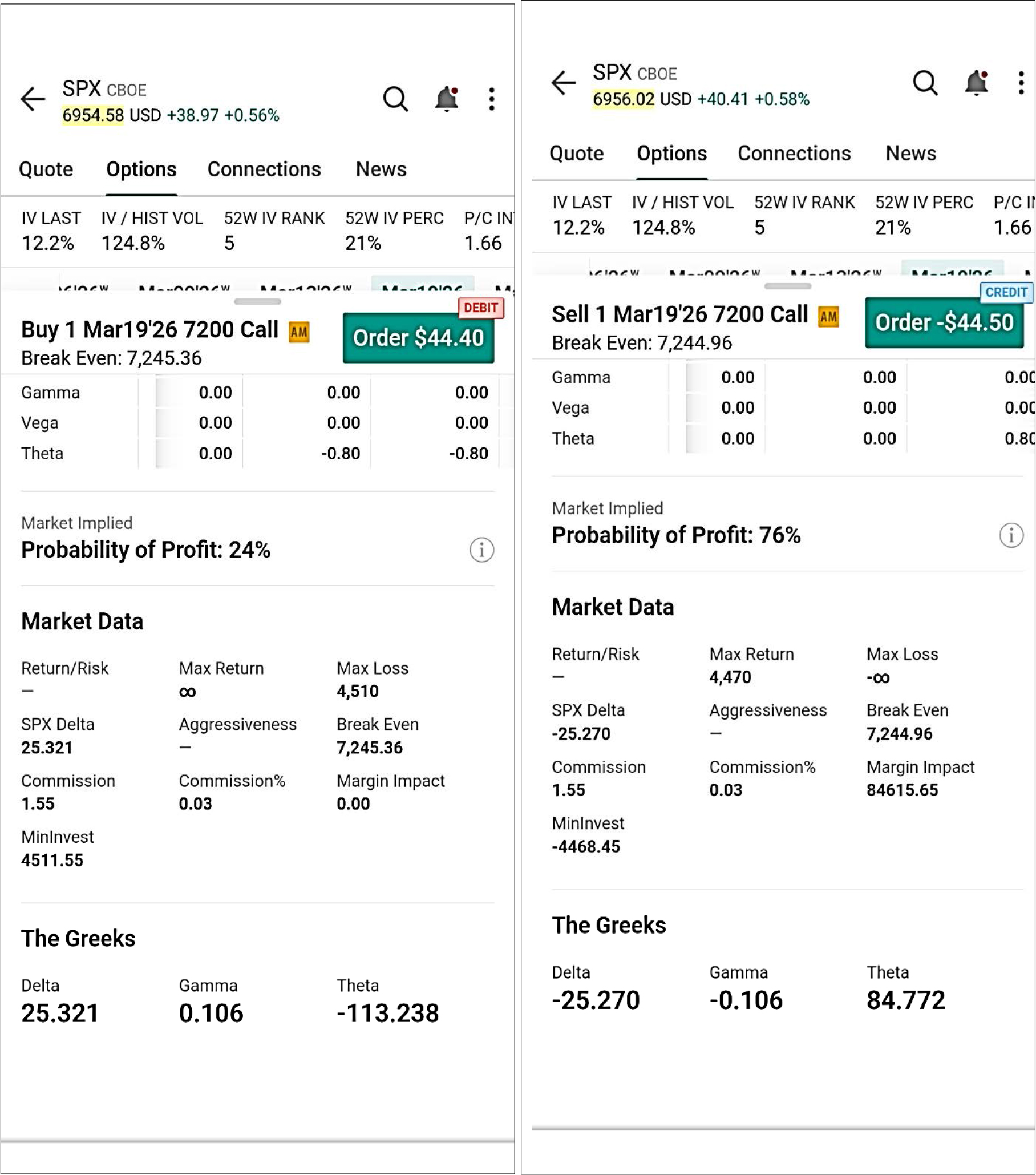
Figure A1.
Comparing buying to selling a call with the same strike price and DTE.
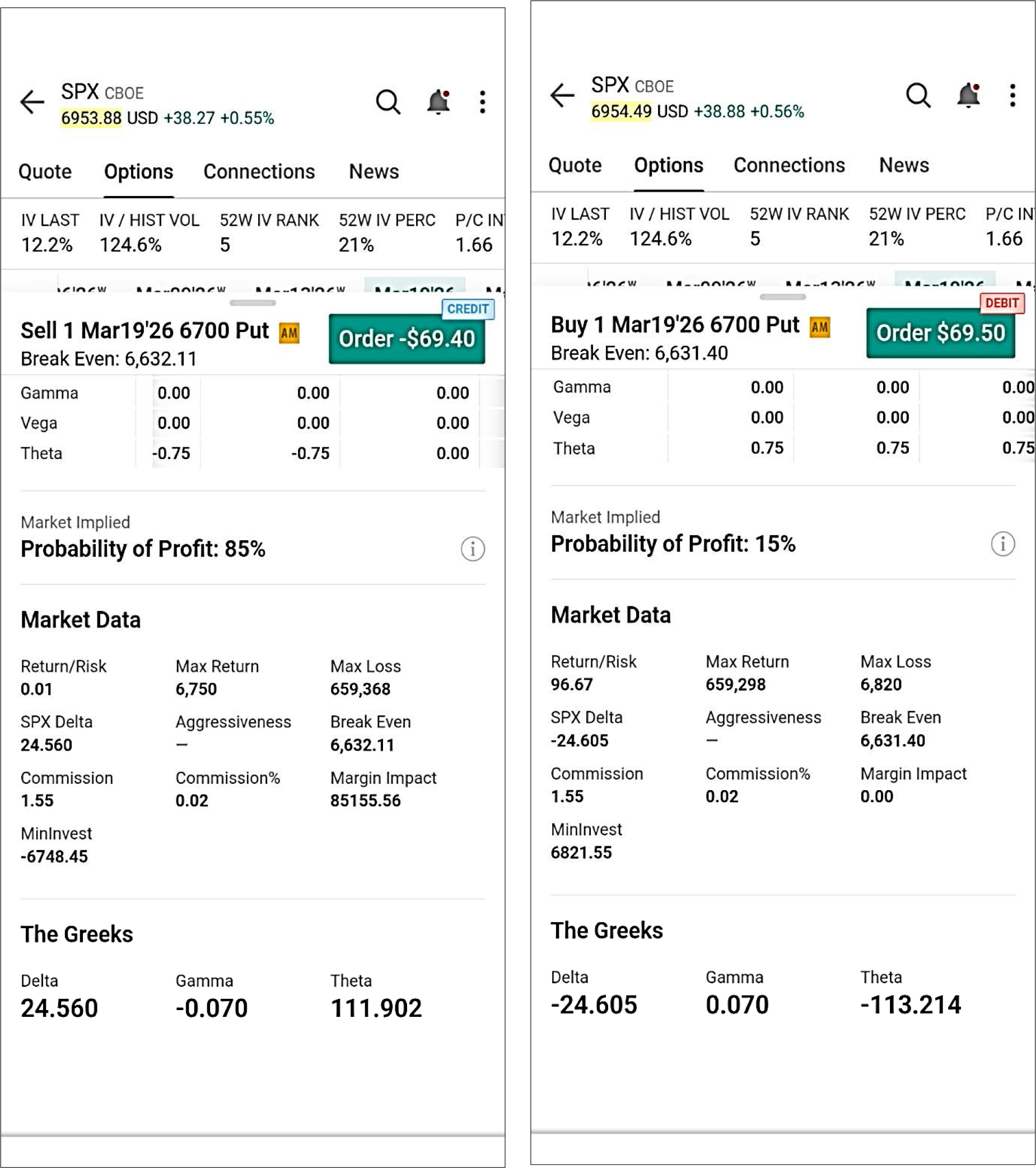
Figure A2.
Comparing the probability of profit between buying and selling a SPX put with strike price at $6,700.
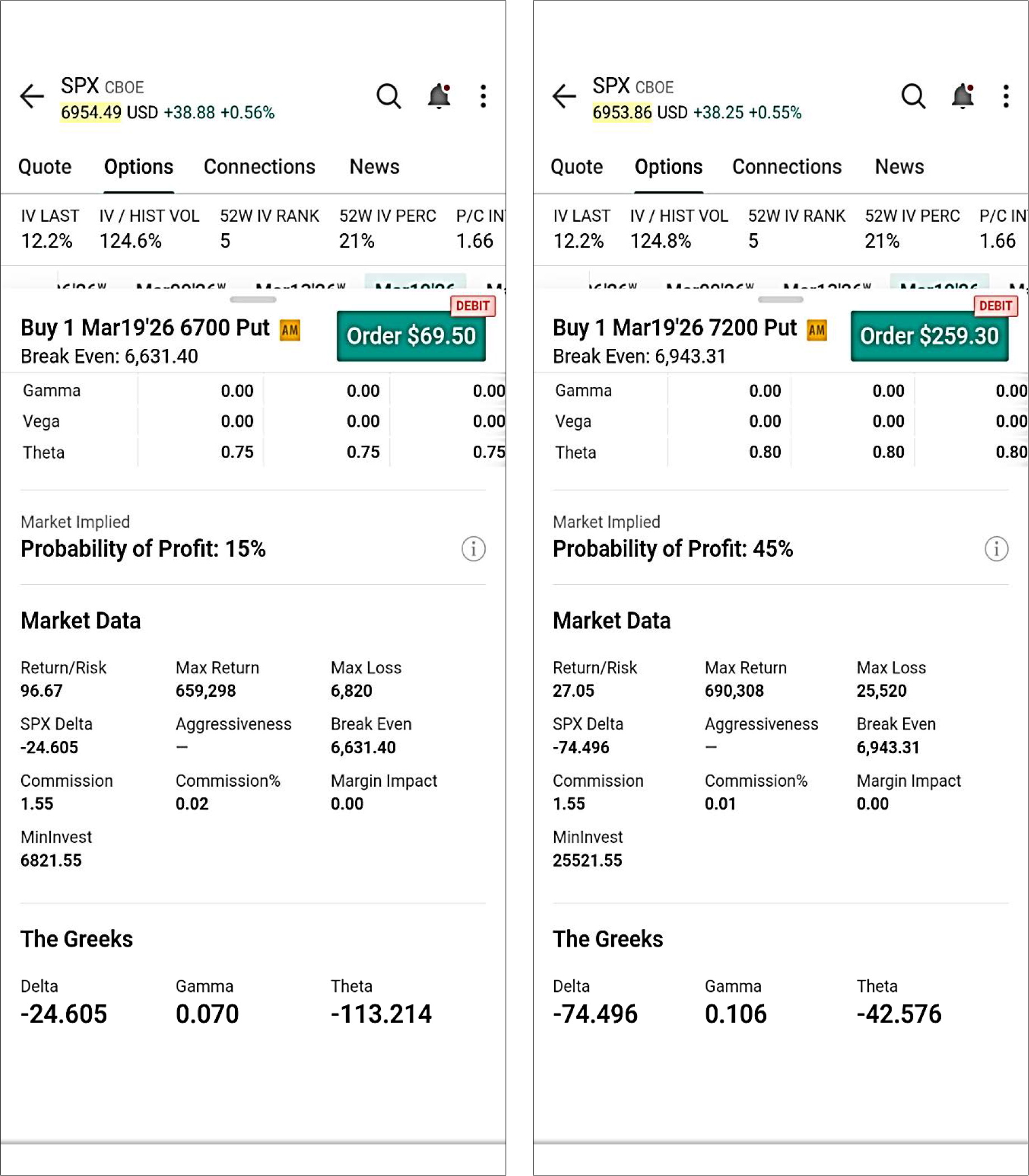
Figure A3.
Comparing the probability of profit from buying a SPX put with a strike price at $6,700 versus $7,200. The SPX was trading around $6,954.
Table A1.
Defined-risk option strategies
| Strategy | Notes |
|---|---|
| Generate Cash Flow in Stagnated or Sideways Market | |
| Covered call: hold the underlying asset and sell OTM call |
|
| Protect Underlying Asset from Severe Drawdowns | |
| Protective put: hold the underlying asset and buy OTM (or ATM) put |
|
| Protect Underlying Asset from Severe Drawdowns at Reduced Cost | |
| Collar: hold the underlying asset, buy OTM put and sell OTM call |
|
| Mitigate Severe Drawdowns by Using Cash Secured Call | |
| Cash secured call/Fiduciary call: buy call and invest cash in risk-free asset |
|
| Limited Upside (Bull Spread) or Downside (Bear Spread) Participation with Preset Losses | |
| Bull Spread i. Call spread: buy call at X1 and sell at X2 where X2 > X1 |
|
| ii. Put spread: buy put at X1 and sell at X2 where X2 > X1 |
|
| Bear Spread i. Put spread: sell call at X1 and buy at X2 where X2 > X1 |
|
| ii. Call spread: sell put at X1 and buy at X2 where X2 > X1 |
|