
I. Introduction
Existing studies on general financial understanding and education have focused on assessing financial consumers’ financial literacy, the importance of financial literacy, and the effects of financial literacy (Kaiser & Lusardi 2024; Hastings, Madrian & Skimmyhorn, 2012; Lusardi, 2011; Lusardi & Mitchell, 2009; Bernheim & Garrett, 2003). Among these, studies on the impact of financial education on financial literacy or financial competency are comparatively rare (Lusardi 2024), and most such studies compare the short-term differences in competency between those who have received financial education and those who have not. In other words, research on differences in financial literacy between those who have received financial education is rare. Additionally, research on insurance literacy is rare (Tennyson, 2011; Ferguson et al., 2000), and research on the influence or effect of insurance education on insurance literacy appears to be even more rare (James et al., 2024).
This study aims to compare and analyze the educational effectiveness of risk management and insurance (RMI) education among university students who received it, and to identify significant factors influencing this. To achieve these research objectives the study conducts a survey of university students who received RMI education offered at four-year universities nationwide in Korea, to assess educational outcomes from this education and to identify the factors influencing educational outcomes.
A research model was developed by comprehensively organizing the hypotheses derived from a literature review of previous research on factors affecting educational effectiveness. Based on this model the survey collected responses on three key factors hypothesized to be related to educational effectiveness: student characteristics (self-efficacy, achievement motivation), faculty characteristics (expertise, passion, interaction), and educational environment characteristics (educational system characteristics, physical educational environment characteristics). Reliability and validity of the collected responses was assured through factor analysis and Cronbach’s α values to verify the suitability of the data for analysis. Structural equation modeling (SEM) analysis using AMOS 18.0 was used to estimate the model fit and path coefficients of the variables.
The research will be presented as follows. Key concepts and existing research on RMI education and comprehension. The research model and hypotheses used in the empirical study, along with the survey subjects, measurement tools, research methods, and questionnaire, will be briefly introduced. The hypotheses will be evaluated based on the research model validation and empirical analysis results, and the conclusions and implications will be presented.
II. Key Concepts
A. Insurance literacy
The broader concept of financial literacy, beyond insurance literacy, and its measurement methods have been defined and used in various literature and scholars. Lusardi and Mitchell (2013) defined financial literacy as the ability to process economic information and make informed decisions regarding financial planning, wealth accumulation, debt, and pensions, and proposed a method for assessing financial literacy using a test of understanding the so-called Big Three (inflation, compound interest, and diversification). Furthermore, Atkinson and Messy (2012) defined financial literacy as the combination of financial awareness, knowledge, skills, attitudes, and behaviors necessary to make sound financial decisions and achieve personal financial well-being. In other words, financial literacy is defined as the ability to use the knowledge and skills to effectively manage one’s financial resources to achieve financial stability (Jump$tart, 2015).
Meanwhile, insurance literacy can be defined as a combination of risk awareness, insurance-related knowledge, skills, attitudes, and behaviors (Tennyson, 2011; Sanjeewa & Hongbing, 2019). Specifically, compared to financial literacy, insurance literacy involves assessing the extent of one’s exposure to risk, or recognizing risk itself. Risk awareness here differs from the risks associated with other financial products. While "risk awareness" in the context of investment product purchases refers to the risks associated with purchasing the product, risk awareness, as discussed in general insurance literacy, refers to assessing the nature and extent of one’s exposure to risk (Byeon & Lee, 2015).
B. Educational Effectiveness
The definition of educational effectiveness varies widely across research studies, depending on their emphasis and perspective. It can be defined as the extent to which desirable changes in students and improvements in their developmental levels occur as a result of educational interventions and resources implemented to achieve the intended educational goals of a school (An, 2011). It can also be defined as the degree of learning attainment perceived by individual learners (Park & Kim, 2004), the personal changes or benefits students experience as a result of their learning (Nusche, 2008), or participant benefits obtained through active engagement in education (Boone, 1985).
Existing research findings indicate that while educators emphasize the importance of evaluating educational effectiveness (Goldstein, 1991; Rynes & Rosen, 1995), they also point out the challenges of associated with its assessment (Carnevale & Schulz, 1990). The measurement of effectiveness has varied depending on the subjects and objectives of the evaluation, and there has been considerable debate over whether objective or subjective indicators should be used to assess effectiveness (Kim, 1996). Therefore, it is essential to clearly define the targets and scope of evaluation when assessing educational effectiveness.
Based on previous studies such as Bloom (1956), Bogue & Hall (2003), Beauchamp (1975), Gagne (1987), Figlio & Ladd (2008), and Jeong (2011), this study examines not only objective indicators of knowledge acquisition through education but also changes in affective and non-cognitive domains – including attitudes, values, and behaviors – to evaluate the overall effectiveness of education. The factors determining educational effectiveness can be categorized into student characteristics, faculty characteristics, and the educational environment.
Student characteristics, such as the learner’s level of need, academic interest, understanding of the curriculum, and prior learning experience, are recognized as major determinants of educational effectiveness (Colquitt et al., 2000). Students’ self-efficacy, achievement motivation, and gender have been identified as significant predictors of educational outcomes (Chen et al., 2004; Vansteenkiste et al., 2006). Faculty characteristics include the professor’s expertise, teaching motivation, and interactions with students (Kwon, 2006; Kunter et al., 2008; Gläser-Zikuda & Fuß, 2008; Kim, 2013). The educational environment can be further divided into the physical environment and the systematic environment (Kim, 2011; Cheon, 2011).
III. Research Design and Data
A. Research Hypothesis
In order to develop a relationship model among student characteristics, faculty characteristics, and educational environment characteristics that affect the effectiveness of RMI education for university students, the following research hypotheses are established based on previous studies.
H1. Student characteristics have a direct impact on insurance literacy.
H2. Faculty characteristics directly influence student characteristics and insurance literacy.
H3. Faculty characteristics indirectly influence insurance literacy through student characteristics.
H4. Educational environment characteristics directly influence teaching characteristics, student characteristics, and insurance literacy.
H5. Educational environment characteristics indirectly influence insurance literacy through faculty and student characteristics.
The resulting research model is depicted in the Appendix (Figure A1).
B. Survey
A self-administered questionnaire survey was conducted among students enrolled in insurance-related courses at four-year universities across the nation by convenience sampling based on contacts. The questionnaire measured student characteristics including self-efficacy and achievement motivation; faculty characteristics including expertise, enthusiasm, and levels of student interaction; characteristics of the educational environment including the physical environment and educational system characteristics; and insurance literacy including attitudes, knowledge, and behaviors.
All characteristics were measured using constructs with proven reliability and validity based on prior research, and were selected, adapted or modified for this study. A balanced 7-point Likert scale was used for all measurement items in the questionnaire. The latent variables, number of items, and sources of the measurement tools used in this study are presented in the Appendix (Table A1).
C. Sample Characteristics
Data collection was conducted in two rounds. The first survey was distributed to students at the beginning of the semester, and the second survey was administered at the end of the course. 1 A total of 960 questionnaires was distributed for both rounds. In the first round, 751 responses were returned, and after excluding incomplete or invalid responses, 737 were used for analysis. In the second round, 741 responses were collected, and 720 valid responses were used. By matching the responses from both surveys on a one-to-one basis, 452 paired samples were used for the final analysis. The characteristics of the final sample are summarized in Appendix Table A2. Among the 452 participants, males accounted for 53% (239 students) and females for 47% (213 students), indicating a relatively even gender distribution.
IV. Analysis Results
A. Educational Effects
As a sub-concept of educational effectiveness, the knowledge domain was analyzed by comparing the correct answer rate for insurance knowledge questions before and after receiving education (at the beginning of the semester and at the end of the semester). The questions and correct response rates are shown in Appendix Table A3.
Before education, the correct answer rates for knowledge-related questions ranged from 14.2% to 84.5%. After education, they ranged from 17.3% to 92.5%, indicating a clear improvement across items. Overall, the average correct answer rate increased by more than 10% after receiving education compared to before (except for four items). In particular, items related to basic risk concepts and the fundamental principles of insurance showed high correct answer rates both before and after training, as well as large improvements following the training. On the other hand, items related to the social insurance system tended to have low correct answer rate even after education.
B. Reliability and Validity of Measurement Tools
Since this study used a questionnaire survey, it was essential to verify the reliability of the collected data to ensure consistency and minimize measurement error. 2 Reliability refers to the degree of consistency obtained when the same construct is measured repeatedly under similar conditions. Cronbach’s α was employed to assess the internal consistency of each construct. This coefficient is widely used to evaluate the reliability of scales consisting of multiple items measuring the same or related concepts, and its value range from 0 to 1, with higher values indicating greater internal consistency. The result of the reliability analysis showed that the Cronbach’s α coefficients ranged from 0.86 to 0.94, which demonstrates that the measurement tools used in this study possess an acceptable level of reliability (Bagozzi & Yi, 1988; Nunnally, 1978).
Validity is a concept that shows how accurately the concept or attribute it is intended to measure is measured. It can be said to show how accurately a tool for measuring a concept or characteristic represents the characteristic or attribute. In this study, confirmatory factor analysis (CFA) was performed using a covariance matrix on items that had previously undergone reliability analysis. CFA is a means of confirming inherent factor dimensions and hypotheses based on the researcher’s knowledge (Kim, 2009).
Analyzing the independent variables, after dividing the constructs into categories and conducting a CFA, items 1 and 2 of the educational system characteristics were determined to be detrimental to the model’s fit. They were removed, and a further CFA was conducted. Factor loadings were examined for all variables, and the composite concept reliability (CCR) and average variance extracted (AVE) were calculated. Turning to the dependent variables measuring insurance literacy, factor loadings and model fit using CFA can only be calculated when the number of indicators is four or more (Lee, 2009). Therefore, because insurance knowledge was reconstructed as a single item, confirmatory factor analysis was not performed. Initial CFA on the insurance literacy construct showed that items 5 and 6 of the attitudes were judged to be detrimental to the model’s fit. They were removed, and CFA was conducted again. All variables showed good factor loadings and the CR value (t-statistic) confirmed statistical significance. The AVE value was slightly lower than accepted standards, but the reliability (Cronbach’s α) and standardized factor loadings were above the standards, and the CCR was also high at over 0.7, so it was determined that there were no issues with validity.
C. Research Model Verification
To investigate causal relationships among multiple independent and dependent variables, structural equation modeling (SEM) was conducted. This corresponds to steps 5 and 6 of the analysis procedure proposed by Hair et al. (2009) and is the step for analyzing the validity of the structural model. The estimated standardized path coefficients and goodness-of-fit statistics for the structural model established in the hypotheses are shown in Appendix Figure A2. Table 1 below reports estimation results from the structural model to verify the research hypotheses, analyzing the direct and indirect effects of the student characteristics, faculty characteristics, characteristics of the educational environment, and insurance literacy.
Table 1.
Direct, Indirect, and Total effects in the Structural Model
| Hypothesis channel | Direct Effect | Indirect Effect | Total Effect | |||
|---|---|---|---|---|---|---|
| Standardized coefficient | p-value | Standardized coefficient | p-value | Standardized coefficient | p-value | |
| Student characteristics → Insurance literacy | .196 | .045 | .000 | .000 | .196 | .045 |
| faculty characteristics → Student characteristics | .663 | .000 | .000 | .000 | .663 | .000 |
| Faculty characteristics → Insurance literacy | .429 | .005 | .130 | .059 | .559 | .010 |
| Educational environment → faculty characteristics | .717 | .000 | .000 | .000 | .717 | .000 |
| Educational environment → student characteristics | −.139 | .186 | .475 | .002 | .336 | .003 |
| Educational environment → Insurance literacy | −.237 | .101 | .374 | .011 | .137 | .148 |
Estimated direct effects are reported in the first column of the table. Key findings are as follows. First, we hypothesized that student characteristics would directly influence insurance literacy. Analysis of the influence of these variables revealed a statistically significant effect of student characteristics on insurance literacy (path coefficient .196, CR = 2.007, p<.05). Second, we hypothesized that faculty characteristics would have a statistically significant effect on student characteristics and insurance literacy. Analysis confirmed this hypothesis student characteristics and insurance literacy. The direct effect of faculty characteristics on student characteristics was significant at .663 (p<.01), and the direct effect on insurance literacy was significant at .429 (p<.01), indicating a positively significant effect.
Third, we hypothesized that educational environment characteristics would directly influence teaching characteristics, student characteristics, and insurance literacy. However, educational environment characteristics were found to have a statistically significant effect only on faculty characteristics (path coefficient .717, p<.01) and did not directly influence student characteristics or insurance literacy. Therefore, the educational environment characteristics would have a direct effect on teaching characteristics, was supported. However, characteristics of the educational environment did not show a direct effect on student characteristics or insurance literacy – only on teaching characteristics – while teaching characteristics were found to directly and significantly influence both student characteristics and insurance literacy.
The second column of the table reports estimated indirect effects. Results shows that student characteristics have only a direct effect on insurance literacy and faculty characteristics have only a direct effect on student characteristics. However, the relationship between faculty characteristics and insurance literacy has both a direct effect (path coefficient .429, p < .01) and an indirect effect (path coefficient .130, p < .10), for a total effect (path coefficient .559, p < .05), indicating that student characteristics had a statistically significant indirect effect on the relationship between faculty characteristics and insurance literacy.
Additionally, faculty characteristics have a statistically significant indirect effect on the relationship between educational environment characteristics and student characteristics, with a direct effect (path coefficient −.139, p>.10), an indirect effect (path coefficient .475, p<.01), and a total effect (path coefficient .336, p<.01).
Lastly, faculty characteristics and student characteristics have a significant effect on the relationship between educational environment characteristics and insurance literacy. The direct effect (path coefficient −.237, p>.10), indirect effect (path coefficient .374, p<.05), and total effect (path coefficient .137, p>.01) were all statistically significant. Thus, it can be concluded that educational environment characteristics do not have a direct effect on insurance literacy but have a significant indirect effect.
Overall, student characteristics had a significant direct effect on insurance literacy, while faculty characteristics significantly influenced student characteristics. Furthermore, faculty characteristics were found to have both direct and indirect effects on insurance literacy. Educational environment characteristics did not appear to have a direct effect on student characteristics or insurance literacy. However, educational environment characteristics influenced student characteristics through faculty characteristics, and both faculty and student characteristics had a statistically significant effect on insurance literacy.
V. Conclusion
The purpose of this study was to analyze the educational effectiveness of insurance and risk management courses at universities and to examine structural relationships among the variables influencing this effectiveness. To achieve this, a survey was conducted among students who had completed insurance and risk management courses at four-year universities across the country. Structural equation modeling was employed to identify causal relationships among the variables.
Changes in insurance literacy through these courses were found to be significant. Student characteristics, faculty characteristics, and educational environment characteristics all had statistically significant effects on insurance literacy. Student characteristics had a direct influence on insurance literacy, faculty characteristics had both direct and indirect effects, while educational environment characteristics did not show a direct effect but exhibited an indirect influence through other variables. There are several implications of the influence between the variables identified in this study.
First, teaching behaviors enhance students’ academic self-efficacy and motivation for achievement, leading to educational effectiveness. Therefore, instructors should create an environment where students can approach class with a sense of agency by using learning strategies and structuring classes to strengthen students’ motivation and sense of efficacy. This is consistent with the research findings of Reeve et al. (2004), which stipulate that when students are completing assignments, instructors should explain why they need to learn specific content so that they understand it. Such efforts are one example of how instructors can foster and strengthen students’ motivation for achievement through interaction with students. It can be said that efforts are required in teaching behaviors that foster students’ desire to learn, motivation, and confidence.
Next, student characteristics directly influence the effectiveness of insurance literacy. Student motivation for achievement is not merely a passing interest; it is an influential variable that continuously fuels energy throughout the course. The influence of motivation in education can also be seen in Yair’s (2000) introduction to the US education reform project, which points out that educational failure stems from overlooking student motivation. He argues that strengthening individual student motivation leads to greater educational effectiveness.
The characteristics of the educational environment directly influence teaching behavior, fostering student motivation and academic self-efficacy, and thus impacting the effectiveness of RMI instruction, making them crucial. To enhance educational effectiveness, a well-established educational management system and educational environment must be in place (Merriam, 2001; Cho, 2013). While university classes typically utilize lecture-style instruction, teaching methods such as lectures, discussions, and presentations should be appropriately blended depending on the specific nature of the class. Furthermore, the appropriate student body size must be maintained, and a classroom environment appropriate to this need must be provided.
Despite some limitations, this study is significant in that it confirmed that student, faculty, and educational environment characteristics can enhance the effectiveness of RMI education. Furthermore, it illuminated the relationships between faculty and students and between the environment and faculty, which can enhance RMI effectiveness. Furthermore, by segmenting educational effectiveness into attitudes, knowledge, and behavior, and analyzing the impact of teaching behaviors, results suggest that it is necessary to foster teaching behaviors and an educational environment that promotes student efficacy and motivation in RMI education settings to enhance educational effectiveness. Suggestions for follow-up research based on the limitations of this study include analysis of the continuity of educational effects, evaluation by external evaluators, analysis of social and psychological factors, improvement of the insurance literacy measurement tool, and expansion of the target to elementary, middle, and high school students.
Appendices
Appendix
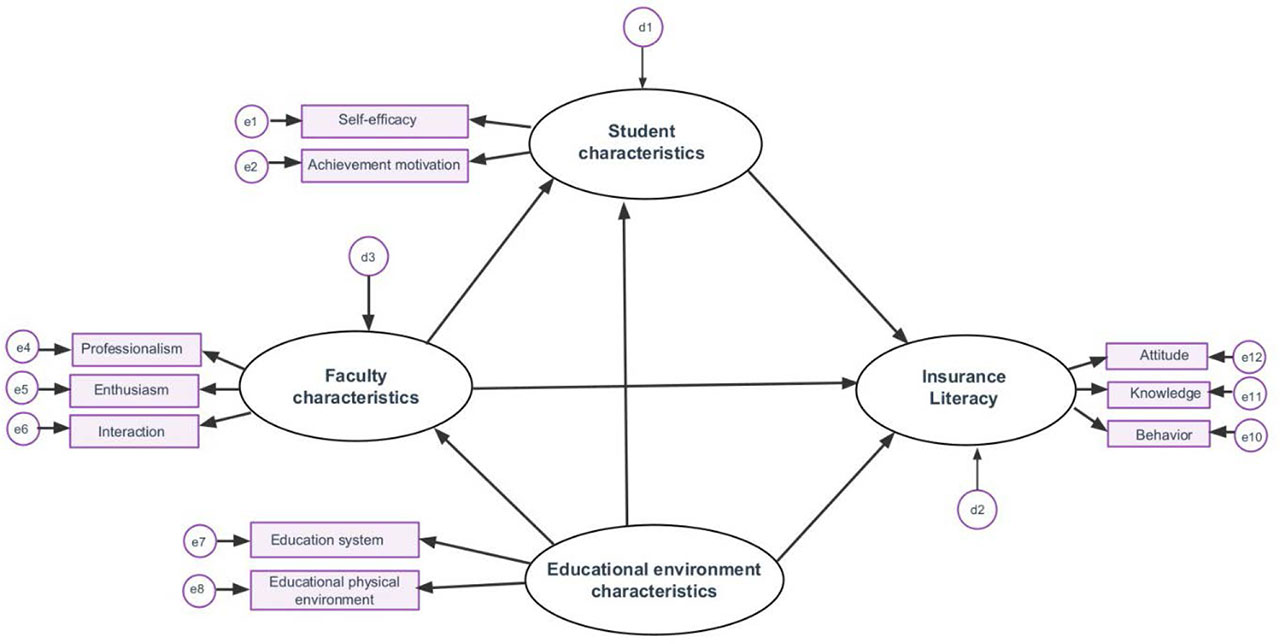
Figure A1.
Research Model
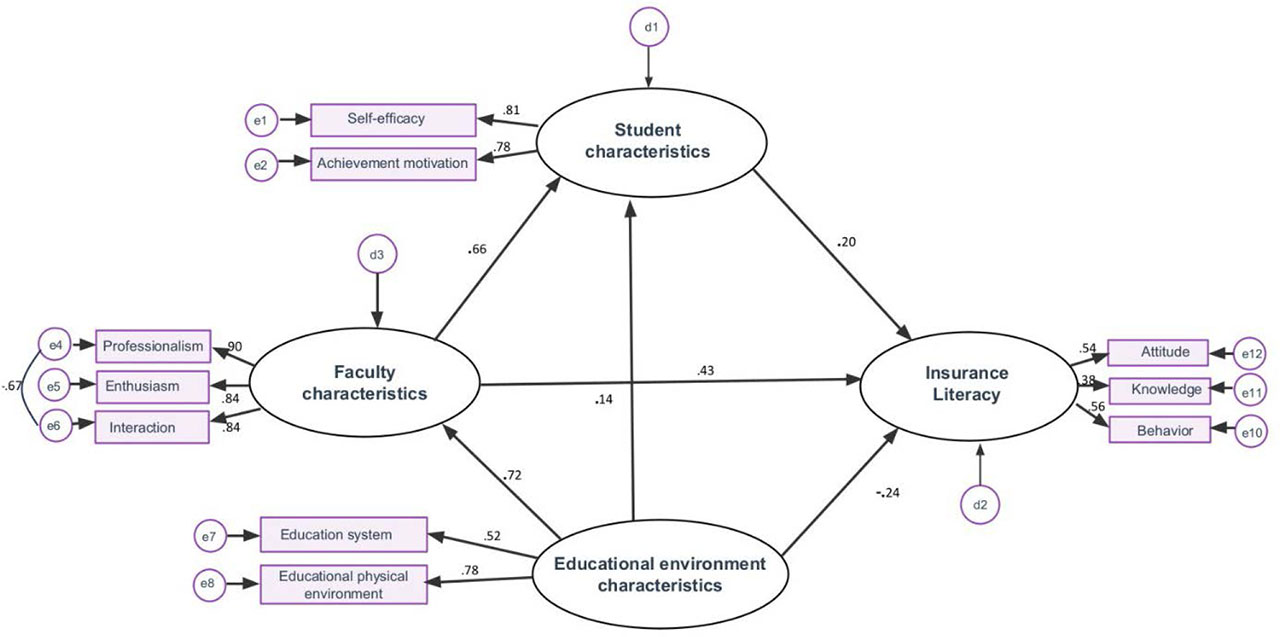
Figure A2.
Structural Model and Standardized Path Coefficients
Table A1.
Composition of Measurement Tools
| Latent Variable | Observed Variable | No. of Items | Source |
|---|---|---|---|
| Student Characteristics | Self-efficacy | 8 | Kim & Park (2001), Ha (2005) |
| Achievement motivation | 7 | Ha (2005), Yu & Yang (1994), Yoo (1996) | |
| Faculty Characteristics | Professionalism | 7 | Kwon (2006), Feldman (2007) |
| Passionate attitude | 6 | Kwon (2006), Saunders (1999), Marsh & Ware (1982), Kunter et al. (2008) | |
| Interaction | 6 | Kwon (2006), Feldman (2007) | |
| Education and Environment Characteristics | Educational system | 4 | Hwang (2004) |
| Physical environment | 2 | Shin & Lee (2008), Kim (2009) | |
| Insurance Literacy | Attitudes | 4 | Kim (2011), Cheon (2011) |
| Knowledge | 20 | Kim (2011), Cheon (2011), Tennyson (2011) | |
| Behavior | 6 | Kim (2011), Cheon (2011) |
Table A2.
Characteristics of Survey Respondents
| Category | Division | Responses (N) | Percent (%) |
|---|---|---|---|
| Gender | Man | 239 | 52.9 |
| Woman | 213 | 47.1 | |
| University | Gyeongnam National Univ. | 35 | 7.7 |
| Daegu Univ. | 51 | 11.3 | |
| Dong-eui Univ. | 51 | 11.3 | |
| Seowon Univ. | 36 | 8.0 | |
| Sungkyunkwan Univ. | 73 | 16.2 | |
| Jeonju Univ. | 27 | 6.0 | |
| Hyupsung Univ. | 37 | 8.2 | |
| Hongik Univ. | 95 | 21.0 | |
| Hongik Univ. (Sejong) | 47 | 10.4 | |
| Grade level | 1st year | 66 | 14.6 |
| 2nd year | 125 | 27.7 | |
| 3rd year | 142 | 31.4 | |
| 4th year | 119 | 26.3 | |
| Previous insurance course registration | Yes | 234 | 51.8 |
| No | 215 | 47.6 | |
| Experience with insurance company compensation services | Yes | 291 | 64.4 |
| No | 154 | 34.1 | |
| Family in insurance industry | Yes | 95 | 21.0 |
| No | 356 | 78.8 |
Table A3.
Correct Answer Rates for Insurance Knowledge Questions
| No. | Knowledge Item | Before % | After % | Change (%p) | Change (%) |
|---|---|---|---|---|---|
| 1 | Hazard refers to a condition that increases the probability or occurrence of loss. (o) | 69.0 | 87.2 | 18.1 | 26.3 |
| 2 | Insurance is a representative risk management method, a contract in which an insurance premium is paid in exchange for transferring the exposed risk to an insurance company. (o) | 84.5 | 92.5 | 8.0 | 9.4 |
| 3 | The distinction between static and dynamic risks is based on whether the nature or frequency of occurrence of the risk changes over time. (o) | 61.3 | 69.0 | 7.7 | 12.6 |
| 4 | Savings insurance is a type of insurance product that has a risk protection function and allows you to save a fixed amount each month and receive a lump sum upon maturity. (o) | 73.2 | 73.2 | 0.0 | 0.0 |
| 5 | A person who enters into a contract with an insurance company and provides insurance is called an insurer. (x) | 61.9 | 72.8 | 10.8 | 17.5 |
| 6 | If retired parents do not enroll in local health insurance, their children will not be covered. (o) | 14.2 | 17.3 | 3.1 | 21.9 |
| 7 | Life (death) insurance is more necessary for people with children than for those without. (o) | 71.2 | 81.9 | 10.6 | 14.9 |
| 8 | Personal insurance products are protected from insolvency by the depositor protection system. (o) | 52.4 | 59.3 | 6.9 | 13.1 |
| 9 | To receive compensation for damage to your car in a traffic accident, you must subscribe to comprehensive insurance. (o) | 24.1 | 37.6 | 13.5 | 56.0 |
| 10 | Individuals can choose from a variety of options regarding benefit levels and amounts paid under the National Pension. (x) | 33.6 | 42.3 | 8.6 | 25.7 |
| 11 | A high deductible in an insurance contract is disadvantageous to the policyholder because the insurance company compensates only a small amount of the damage incurred. (x) | 42.5 | 46.9 | 4.4 | 10.4 |
| 12 | Variable annuity insurance has a higher investment return than general annuity insurance, so it is advantageous from a long-term perspective (x) | 21.2 | 33.0 | 11.7 | 55.2 |
| 13 | In non-life insurance, the principle of compensation for actual loss is established. (o) | 74.3 | 88.9 | 14.6 | 19.6 |
| 14 | Insurance premiums are the money paid by the insurance company to the policyholder in the event of an accident. (o) | 65.5 | 74.8 | 9.3 | 14.2 |
| 15 | After the initial payment of the insurance premium, the insurance contract cannot be cancelled. (x) | 56.9 | 62.8 | 6.0 | 10.5 |
| 16 | Insurance is a risk management method used for risks with a high frequency of loss and small scale of loss. (x) | 68.1 | 69.7 | 1.5 | 2.3 |
| 17 | A life table shows how the number of people living from birth decreases each year, assuming they are alive at beginning of year. It is also called a death table. (o) | 31.9 | 53.3 | 21.5 | 67.4 |
| 18 | Insurable risks are generally speculative risks with unlimited loss and are often static risks. (x) | 51.5 | 61.9 | 10.4 | 20.2 |
| 19 | Even if the damage amount includes only mental or personal values that cannot be objectively quantified in economic terms, it is still covered by insurance. (x) | 51.3 | 52.4 | 1.1 | 2.2 |
| 20 | Risk consists of the magnitude and likelihood of loss. (o) | 71.5 | 74.3 | 2.9 | 4.0 |
[i] Notes: (o) indicates the statement is true; (x) indicates the statement is false. Change (%p) shows the raw difference in percent of correct responses before and after education (pafter – pbefore). Change (%) shows the percentage differences in correct responses rates before and after education (pafter – pbefore)/pbefore.