
I. Introduction
The rapid growth of digital transformation has changed the way we live, work and communicate, bringing both convenience and new security challenges into our day-to-day lives. This has created an urgent need for systems and facilities, necessitating the development of secure and reliable access control solutions [1,2]. Places such as government buildings, hospitals, data centers and corporate offices handle sensitive information and resources that require high security. Traditional methods such as PINs, passwords and physical keys were adequate but are no longer sufficient. They are easy to steal, copy and prone to errors gradually. People can forget their PINs or guess them, hackers can get into passwords, and people can lose or copy physical keys. These flaws make it possible for unauthorized individuals to access critical systems and interfere with their operation [3,4,5]. To get rid of these problems, biometric authentication has now become a popular choice. It uses unique human traits such as fingerprints, iris patterns or voice signatures, which make it much harder for intruders to get around. Fingerprint recognition is one of the best methods because it is accurate, easy to use and not very expensive [6]. It works by looking at the unique patterns of ridges and valleys on a person’s finger, which are very hard to copy. Fingerprint sensors are now built into most smartphones and widely available in embedded systems. This makes the technology both easy to use and useful for everyday security purposes [7,8].
Unlike traditional biometric systems that rely on a single fingerprint or combined fingerprint authentication with PIN-based verification, the proposed system introduces sequential biometric authentication, where multiple fingerprints must be scanned in a predefined order. This approach effectively creates a biometric passcode system in which both the identity of the fingerprint and the order of presentation are required for successful authentication. The sequence length of four fingerprints was selected to balance security and usability. Increasing the sequence length increases security but also increases authentication time and user complexity. Experimental testing indicated that four fingerprints provide strong resistance against unauthorized access while maintaining practical usability for everyday access control applications.
Fingerprint systems are not perfect. Using fake or molded fingerprints to fool sensors is one way to trick them. Researchers have investigated multi-factor and multi-modal biometric systems that use more than one type of identifier, such as fingerprints and face or voice recognition, to make protection stronger. These systems work well, but they often need expensive sensors and complicated processing, which makes them hard to use in cheap or portable security setups. This shows the need for a simpler yet equally secure solution that balances cost and reliability [9].
The research objective is to use an Arduino Uno, an R307 fingerprint sensor, a relay and a solenoid lock to design and improve a multi-layer biometric access control system. The proposed approach adds a number of new layers of security:
Sequential fingerprint verification, requiring four or more fingerprints.
A two-layer authentication mechanism.
A reset fingerprint mechanism.
Authorized users’ system access.
The rest of this paper is set up like this: Section II examines pertinent literature and artifact detection methodologies; Section III delineates the proposed system architecture; Section IV showcases results and facilitates discussion; and Section V concludes the study, outlining prospective research avenues.
II. Related Works
Recent advances in biometric technology have made authentication systems more secure, intelligent and adaptable. Traditional passwords and PINs are being replaced by self-authenticating systems that use biological and behavioral traits for identification. Modern biometric systems now incorporate multi-layered security mechanisms, dynamic passkeys and cryptographic methods to combat rising threats such as unauthorized access, data breaches and identity theft [10]. One promising innovation involves using speech biometrics as dynamic passkeys. Unlike static passwords, voice recognition adapts to variations in tone and speech patterns, making it much harder to replicate or intercept. When combined with other biometric features such as fingerprints and facial scans, this approach creates a more reliable and resilient authentication framework [11].
Another key advancement involves combining fingerprint biometrics with cryptographic key generation. In this method, fingerprints are used not only for identification but also for creating encryption keys that protect sensitive data. This dual-layer process adds an extra barrier against cyberattacks and strengthens overall access control. As digital systems continue to expand, this integration of biometric and cryptographic technologies provides a crucial layer of protection against unauthorized entry and data theft [12].
Researchers are also exploring new and unconventional biometric modalities. For instance, keystroke dynamics, how a person types, have been studied for use in hybrid nanogenerator systems that rely on artificial intelligence. These artificial intelligence (AI)-driven systems can learn user behavior over time, improving both accuracy and efficiency while remaining energy-efficient for portable devices [13]. Similarly, the integration of biometric systems within the Internet of Things (IoT) environment has gained traction. Using field-programmable gate arrays, biometric data can be securely processed and stored in IoT-based applications such as smart homes, healthcare devices and surveillance systems, ensuring privacy and data integrity [14,19].
Some of the latest studies focus on combining multiple biometric features, such as multi-finger scans or the fusion of heart signals (ECG) with fingerprint recognition. These hybrid methods add another level of protection, ensuring that even if one biometric trait is compromised, it cannot be exploited without the corresponding encryption key or matching physiological data [15,16,17,18,19,20].
While previous multi-modal biometric systems, such as those using voice, iris and facial recognition, have achieved high accuracy, they often require expensive sensors and complex computations. The proposed system offers a practical and cost-effective alternative: a multi-layer sequential fingerprint authentication design that achieves comparable security with simpler hardware. A unique reset fingerprint layer further strengthens defense by locking the system after repeated failed attempts, effectively blocking brute-force attacks. Implemented using an Arduino Uno and R307 fingerprint sensor, the prototype achieved 95% accuracy, a false acceptance rate (FAR) of 0.8%, a false rejection rate (FRR) of 4.2% and an average response time of 1.8 s. These results confirm that the system is not only secure and efficient but also ready for real-world applications, bridging the gap between academic research and practical deployment.
Recent research has also explored advanced security frameworks for protecting critical infrastructures. For example, Yoosuf et al. [21] proposed a Distributed Multi-Layer Intrusion Detection System for securing healthcare infrastructures, demonstrating the importance of layered security mechanisms in protecting sensitive environments. Similarly, Shakir [22] introduced improvements in the Electronic Personal Synthesis Behavior (EPSBV01) algorithm, incorporating time-series analysis to improve user differentiation and behavioral authentication reliability. These studies highlight the importance of multi-layered security strategies, which align with the philosophy of the proposed sequential biometric authentication system.
Additionally, recent advancements in biometric analytics and sensor-based recognition systems have been explored in works such as Wu et al. [23], which reviews federated learning techniques for sensor-based human activity recognition, and Yaro et al. [24], which improves fingerprint-based localization accuracy using optimized clustering algorithms. These studies emphasize the growing importance of efficient biometric data processing and secure authentication frameworks.
a. Artifact detection methods
One of the prime objectives of the Multi-Layer Biometric Access Control System is to achieve a higher security level through biometric verification in conjunction with a sequential fingerprint input mechanism. A major drawback with the use of biometric systems is that they are highly susceptible to spoofing attacks, wherein the attacker tries to utilize artificial or molded fake fingerprints as an authorized user. In order to counter such a threat, the system combines several artifact detection methods. These ensure that the fingerprints meant to be verified are not spoofed or artificially generated. In addition to sequential verification, the system incorporates operational safeguards such as attempt monitoring, timeout-based sequence reset and administrative reset authentication to reduce the risk of spoofing and brute-force attacks. While the R307 fingerprint sensor performs template matching internally, the system architecture adds procedural security layers that prevent repeated guessing attempts and unauthorized recovery.
a.i. Sequential fingerprint authentication
The system uses sequential fingerprint authentication, wherein at least four registered fingerprints must be entered in the correct sequence. This further makes access complex for the attackers. The biometric verification is added along with a method of sequential input in which the fingerprint is used to give a code-like method with no spoofing, making it highly secure [25]. The system makes use of the R307 Fingerprint Sensor for storing and matching. It transfers data to an Arduino Uno for processing. The correct sequence controls a solenoid lock through the relay module. Testing showed 95% accuracy and a 100% lockout rate for wrong sequences. Sequential authentication eliminates the weakness of traditional systems, making it difficult for attackers to replicate the correct sequence. Moreover, multi-factor authentication [26] further enhances security by integrating sequential input with other factors such as passwords or behavioral biometrics. This defines a new standard for secure access control lockout mode.
a.ii. Attempt monitoring and lockout mechanism
As shown in Figure 1, the advanced version of the system includes a sophisticated attempt monitoring and lock-out mechanism to prevent misuse. All attempts are recorded, and this method increases the attempt counter with every wrong fingerprint sequence entered. If the number of attempts exceeds three, the system enters the lock-out phase and won’t allow further access until a reset procedure is undertaken. The reset mechanism requires a specifically registered reset fingerprint, resetting the attempt counter and allowing access attempts to resume. The system enters into a main loop continuously scanning for valid entries. After a user provides some fingerprints, they are matched against a pre-registered passkey sequence. If all the prints match, the relay unlocks the solenoid lock for a short period to allow entry. In case of failure, the number of attempts is incremented. When the reset fingerprint is not input within the permitted attempts, the system beeps to require the resetting fingerprint to reset the attempt counter; otherwise, it goes into lockout mode.
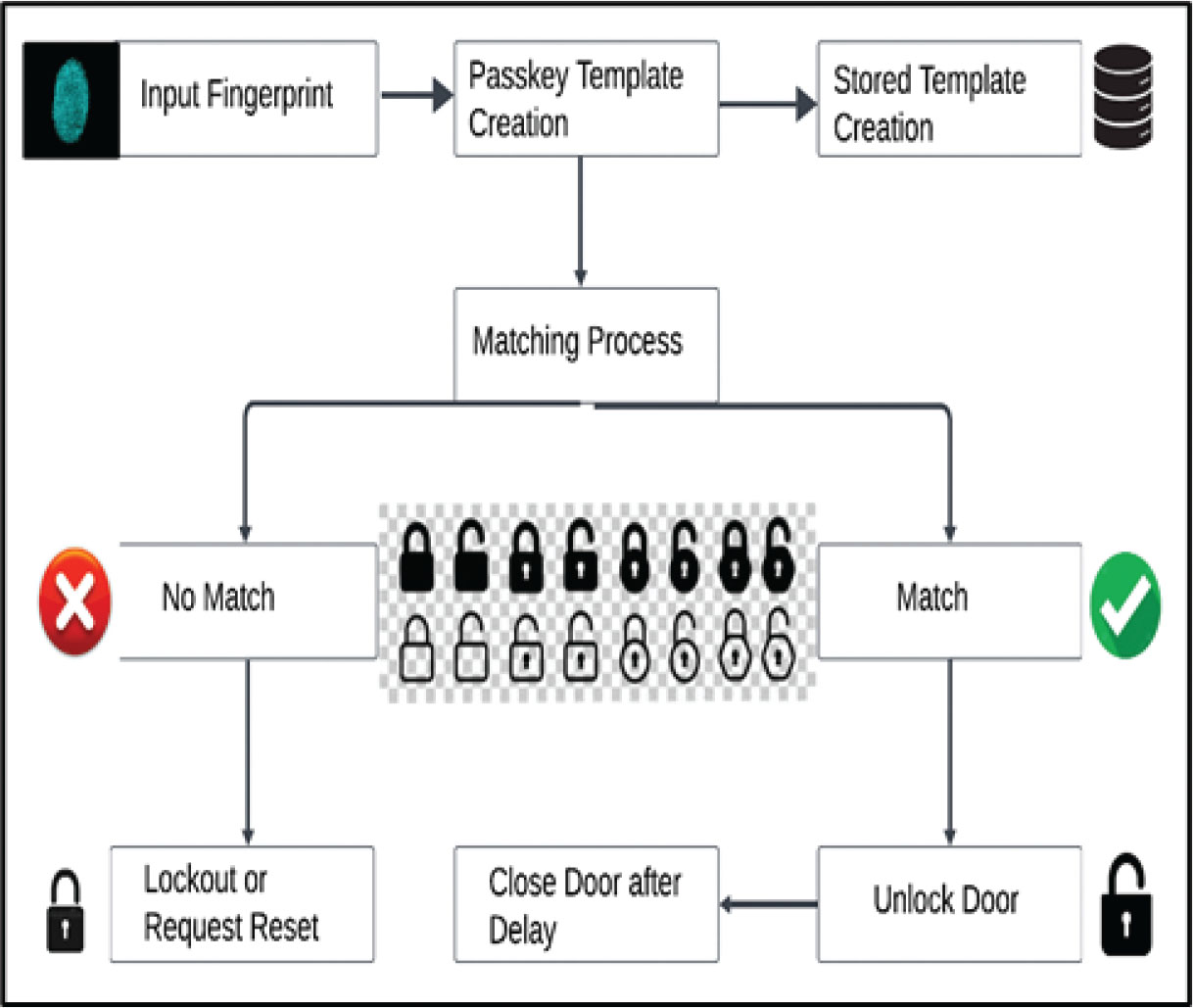
Figure 1:
Mechanism of the biometric system.
This mechanism brings to mind concepts explored in studies on real-time monitoring of biometric systems. In particular, anomaly and repeated incorrect input detection methods are used to inform when an unauthorized action has occurred. Lockout functions in a similar way, acting as a deterrent against brute-force attacks and locking out unauthorized individuals after multiple failed attempts to prevent further exploitation [27]. Moreover, this two-layer verification mechanism-reset fingerprint combined with sequential fingerprint authentication ensures that an intruder cannot defeat the system even with access to counterfeit biometric data. The lockout mechanism increases the difficulty of bypassing security by requiring precise biometric data and correct sequencing. It also guards against repeated unauthorized attempts [28].
a.iii. Quality analysis of fingerprint image
The system examines singular points such as cores and deltas to enhance the accuracy of classification. It checks the clarity of fingerprint images before the authentication process to reduce false rejection and acceptance rates while ensuring a reliable sequence of fingerprints. This quality control process results in low error rates and higher accuracy [29]. Clear image clarity can be considered a requirement to make fingerprint-based authentication effective, as studies have shown this to be an important factor; thus, the system ensures more probable fingerprint matching and overall improved performance within biometric security [30].
a.iv. Reset fingerprint mechanism
To prevent brute-force authentication attempts, the system incorporates a reset fingerprint recovery protocol. During system initialization, a designated administrator’s fingerprint is enrolled separately from the normal authentication sequence. When three consecutive authentication failures occur, the system automatically enters a lockout state in which normal authentication attempts are disabled. In this state, only the administrator’s reset fingerprint is accepted. Once verified, the system clears the failed attempt counter and restores normal operation without unlocking the door. This ensures that the reset process cannot be used to bypass authentication while still allowing legitimate users to safely recover access after repeated errors. [31,32].
a.v. Authentication workflow
The authentication workflow operates through a sequential verification process. First, the user scans a fingerprint using the biometric sensor. The sensor internally compares the scanned fingerprint with stored templates and transmits the identified template identification (ID) to the microcontroller. The microcontroller then verifies whether the scanned fingerprint corresponds to the next required position in the predefined sequence. If the fingerprint matches the expected sequence position, the system proceeds to the next step. If the fingerprint does not match the required order, the attempt is recorded as a failure. Once the complete sequence of four fingerprints is successfully verified, the system activates the relay module to unlock the solenoid door lock. If three consecutive failures occur, the system enters a temporary lockout state.
b. Fusion of fingerprint and passkey system
The “Multi-Layer Biometric Access Control System” adds more security layers. It would at least require a user to enter four registered fingerprints in succession. This would make it hard for intruders because, in addition to fingerprinting, they also have to replicate the sequence of fingerprinting. This system has biometric input along with passkey sequences and uses multiple layers of verification in an attempt to reduce vulnerabilities before allowing access [33].
Although the sequential process would be slower, the added security does make it worthwhile. The print-passkey sequence is ideal in high-security environments, such as corporate offices and data centers, providing a robust solution, limiting potential intruders [34].
The system uses an Arduino Uno, solenoid lock, relay module and R307 fingerprint sensor. Once authenticated, the Arduino unlocks the solenoid lock. Moreover, the system resets after three failed attempts, requiring a reset fingerprint to regain access, which further minimizes unauthorized access while maintaining user convenience.
III. The Proposed Approach
The Arduino Uno, R307 fingerprint sensor, relay module, solenoid lock and a 12V battery supply are several key components of the proposed biometric access system, illustrated in Figure 2, to create a secure, multi-layered authentication setup. Once powered on, the system initializes communication among all the components and prepares for two main operations: fingerprint registration and user verification.
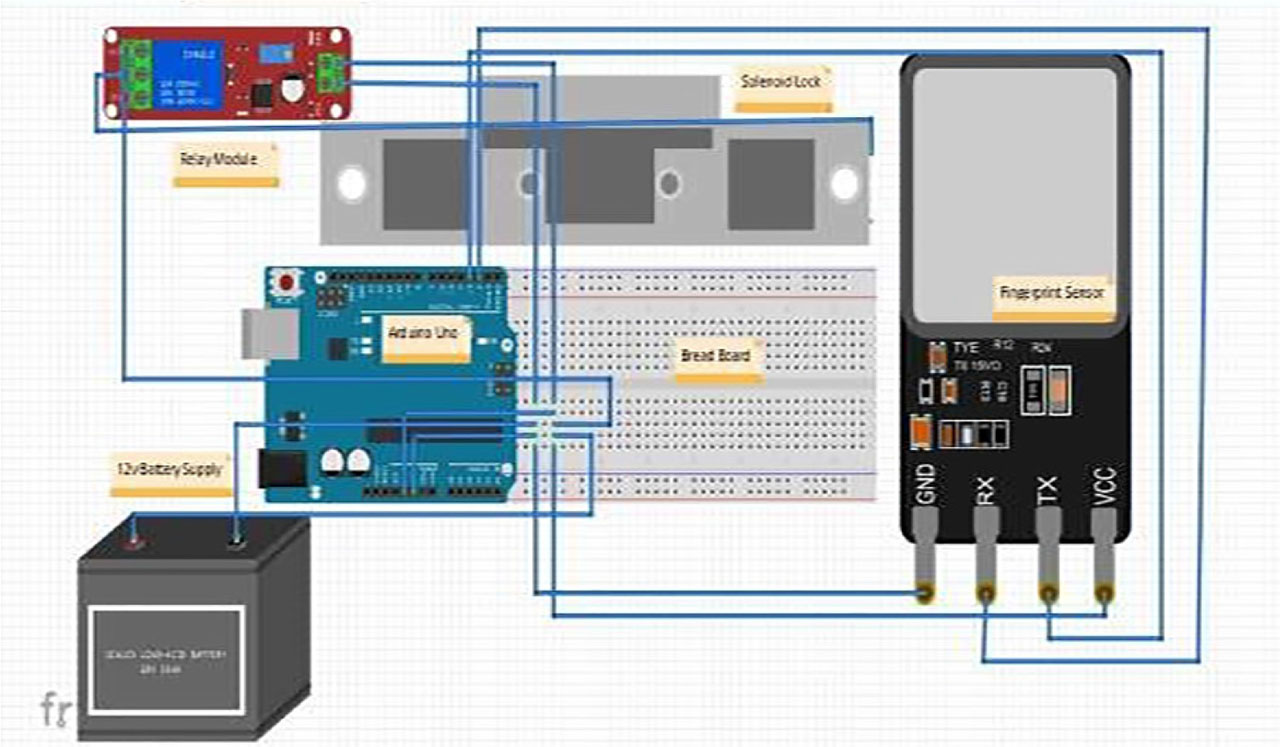
Figure 2:
The proposed multi-layer authentication system.
Each authorized user, during registration, records their fingerprints, which are then converted into a unique biometric “passkey.” These fingerprint templates are stored in the Arduino’s memory and later used for comparison whenever an access attempt is made. To enter into the restricted zone, a user must scan their fingerprints in the same predefined sequence as stored in the system. This sequential fingerprint input greatly enhances security, ensuring that even if one fingerprint is compromised, unauthorized access remains nearly impossible.
The Arduino acts as the central controller, linking the fingerprint sensor, relay module and solenoid lock. Once the correct fingerprint sequence is entered, the Arduino sends a signal to the relay, which then energizes the solenoid and unlocks the door. In case of an incorrect attempt, the verification counter increases, tracking the number of failed trials. If multiple failures occur, the system requires a “reset fingerprint” from an authorized user to clear the counter and restore normal operation. This prevents brute-force or random access attempts.
The system’s software logic includes built-in timing controls to enhance security. For instance, the expression millis() – lastFingerprintTime > timeout ensures that if more than 10 s pass between fingerprint inputs, the sequence entry automatically resets. This timeout feature minimizes the risk of incomplete or delayed authentication attempts.
By combining real-time biometric matching, sequence verification and reset functionality, the system ensures continuous monitoring and protection. Even under repeated unauthorized attempts, it remains resilient, automatically locking out users and requiring manual reset authentication. The integration of hardware and intelligent software logic results in a dependable, user-friendly and highly secure biometric access control system, ideal for environments requiring strong, layered protection—such as offices, laboratories and restricted facilities.
Figure 3 explains how the fingerprint access control system works through a process of steps aimed at using fingerprint recognition in ensuring safe access. It first initializes; during this process, the Arduino, relay and fingerprint sensor are powered up, getting the fingerprint sensor ready for enrollment and recognition. The solenoid lock is programmed to a locked default state. In registration mode, the user creates a passkey by registering a sequence of four unique fingerprints to authenticate access. A reset fingerprint is also created to allow users to clear the attempt counter and restart without experiencing a lockout in case of multiple incorrect fingerprints. This system design is based on the principles of embedded systems for biometric access. Studies show that the Arduino Uno microcontroller can be used to make real-time, secure biometric door-locking solutions.
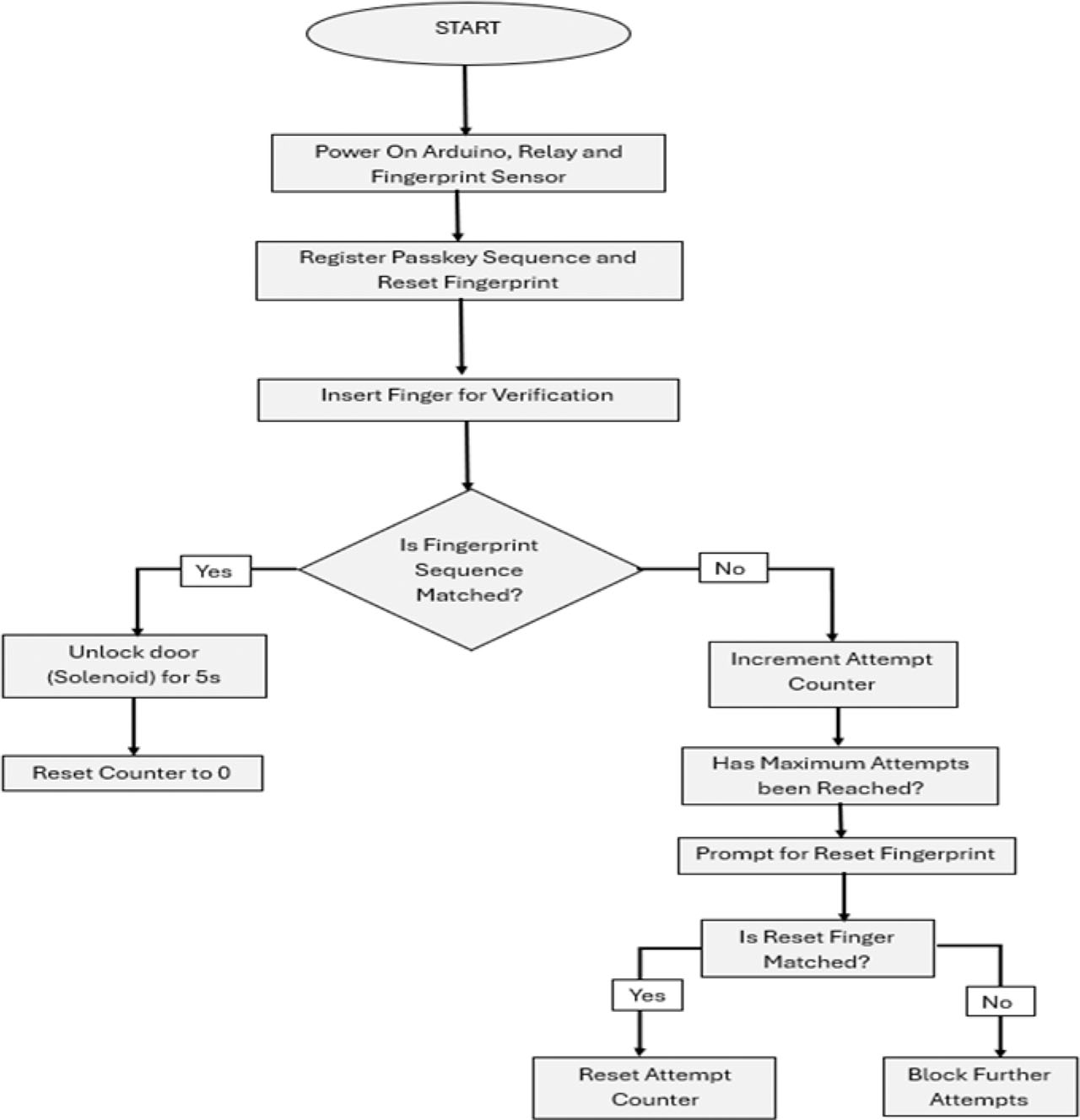
Figure 3:
Flowchart of the biometric system.
After successful registration, it goes into “attempt” mode, where it compares the fingerprints to the stored passkey. It has an attempt counter that counts how many times verification has failed. There is also a passkey sequence counter that checks to see if each fingerprint in the passkey has a matching print in storage.
If the system finds a fingerprint scan that matches all of the fingerprints in the sequence, it unlocks the solenoid lock and allows the user for a set amount of time, say 5 s. After that, the relay switch turns off and the solenoid lock locks back up. After the successful opening of the solenoid lock, both the counters reset to be ready again to receive the next attempt to access it. Biometric technologies, for instance, ensure secure access control and guard against unauthorized entry, demonstrating the strength of biometric systems against security breaches through errors in fingerprints.
Once registration has taken place, the system enters attempt mode and is prepared to scan fingerprints against the passkey stored in its memory. The system then initializes an attempt counter, which tracks how many times verification fails, and a passkey sequence counter, tracking the number of prints in the passkey sequence that successfully match at least one stored fingerprint. In this, when a user reveals his fingerprint to be checked, the system will cross-match those fingerprints in the passkey sequence. If all the fingerprints in the sequence match, then the system will unlock the solenoid lock by switching on the relay and hence allowing access into the room. This time, the lock remains unlocked for a fixed time, say 5 s, then the relay is switched off and the solenoid lock relocks. Once unlocked successfully, both the attempt counter and the passkey sequence counter are reset, and the system is then readied to receive the next access attempt.
This process ensures safe access control with a resultant safeguard through the reset fingerprint, such that even when several attempts of wrong fingerprints are made, unauthorized access is prevented.
In Figure 4, the fingerprint sensor is an integral part of the system to capture and verify user fingerprints for guaranteed secure access. It is powered through its VCC pin by a stable 5V power supply to receive the voltage required for operation. The ground (GND) pin is commonly connected to the ground of the system as a reference point for the circuit. To the microcontroller, for communication, the transmit (TX) pin of the fingerprint sensor in Pin 2 is connected, while the receive (RX) pin is in Pin 3. It will allow for bidirectional communication as it allows the microcontroller to send some commands to the sensor, as well as acquire fingerprint data for authentication. In capturing and transmitting fingerprint data accurately, the sensor forms the backbone of security. The relay module is an electronic switch that relays the operation of the solenoid lock. The voltage at common collector (VCC) pin is connected to a 5V power supply, which will let it activate its inner mechanism to fulfill its work. At the microcontroller’s ground, the GND pin is connected to maintain stability and consistency in the circuit.
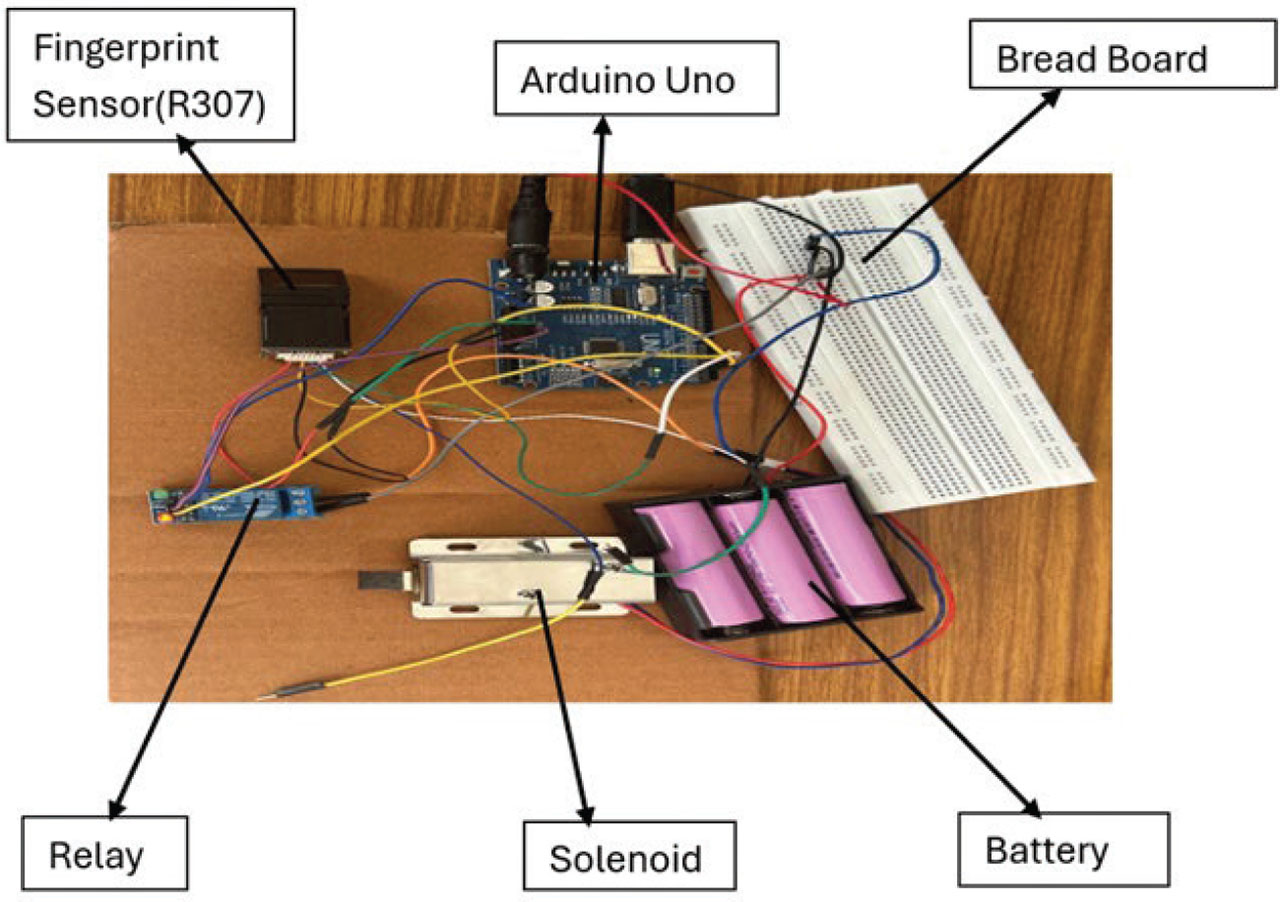
Figure 4:
Circuit level of the proposed system.
The hardware used in the suggested biometric access control system is shown in Table 1, which also includes information on each component’s features, specifications and role in maintaining system dependability, security and performance.
Table 1:
Hardware components and specifications
| Component | Specification | Purpose |
|---|---|---|
| Arduino Uno | Microcontroller board, ATmega328P, 5V operating voltage | Central controller for the system |
| Fingerprint sensor | R307, optical sensor, 256 × 288 resolution, UART interface, 3.3–5V operating voltage | Captures and stores fingerprints for verification |
| Relay module | 5V single-channel relay, 10 A/250V AC | Switches the solenoid lock based on Arduino signals |
| Solenoid lock | 12V DC lock, pull type, 1.2 A operating current | Provides a physical locking mechanism |
| Breadboard | Standard 830 tie-points | Prototyping and connecting components |
| Connecting wires | Male-to-male and male-to-female jumper wires | Establish electrical connections |
| Battery | 12V rechargeable battery | Backup power supply for portability |
The relay’s input (IN) pin is connected to a digital pin of the microcontroller, which sends commands to the relay depending on the outcome of fingerprint authentication. On detecting a valid fingerprint sequence, the microcontroller sends a high signal to the IN pin, turning on the relay and thus passing the current to the solenoid lock.
The solenoid lock is connected directly to the relay module for controlled operation. Connect the normally open (NO) terminal of the lock to the relay’s output pin (Pin 4). Now, connect the common (COM) terminal of the lock to the positive leg of a 12V power supply. Connect the negative leg of this power supply to the system ground. Once the relay is energized, this circuit between the 12V power supply and solenoid lock closes in order to allow the lock to disengage and gain entry. In passkey and reset fingerprint registration, a user registered a sequence of four fingerprints as a passkey and a reset fingerprint to delete the failed attempts if needed. Each fingerprint is captured in sequence such that later matching accuracy is ensured. This integration ensures that solenoid locks activate only after a correct fingerprint sensor verification of an authorized sequence, offering high security and reliability. Algorithms 1 and 2 describe the entire procedure for fingerprint-based access validation and system control process.
Algorithm 1:
Fingerprint-based access validation
1. Initialize:
serial communication with the fingerprint sensor and verify its functionality.
2. Initialize System Parameters:
□ Attemptcounter = 0
□ SystemLocked = false
3. Register:
‘N’authorised fingerprints as ‘registeredFingerprints[i]’, where i ∈ [0, N-1].
4. Assign:
One specific fingerprint ID as the reset fingerprint (‘resetFingerprintID’).
5. During an access attempt,
capture a sequence of scanned fingerprints as ‘currentFingerprints[i].
∀I ∈ [0,N − 1],currentFingerprints[i]= registeredFingerprints[i]
6. Perform:
Sequence Verification:
7. If Sequence matches with registered patterns:
SystemLocked
Algorithm 2:
System reset and lockout management
1. If the time elapsed since the last input exceeds the permissible period,
millis() - startTime > TIMEOUT,
resets the process.
2. If the sequence mismatches:
increment the failure counter.
□ If the failure counter exceeds the limit
(‘MAX_ATTEMPTS’), enable the lockout.
□ If attempt counter > MAX_ATTEMPTS= SYSTEM LOCKED.
4. If the reset fingerprint is sensed:
failure counter resets and system status is UNLOCKED.
IV. Results and Discussion
The experimental evaluation of the system involved 200 authentication trials conducted under different operating conditions. These tests included correct fingerprint sequences, incorrect fingerprint attempts, incorrect sequence order attempts and delayed scanning attempts to evaluate timeout functionality. Multiple users participated in the testing process to simulate realistic usage scenarios. The experiments were conducted to evaluate authentication accuracy, response time and system reliability under practical operating conditions. The system is designed to provide enhanced security and ease of use by combining sequential fingerprint verification with a reset option. To check for accuracy, false acceptance and rejection rates, response time and overall reliability, several test cases are run. The results showed that the system worked well all the time, even in an adverse environment.
a. System performance and quantitative analysis
The performance of the proposed authentication system was evaluated using standard biometric evaluation metrics, including FAR and FRR. FAR represents the probability that an unauthorized user is incorrectly granted access, while FRR represents the probability that a legitimate user is incorrectly rejected by the system. Experimental testing demonstrated a FAR of approximately 0.8% and an FRR of 4.2%, resulting in an overall authentication accuracy of approximately 95%. The estimated equal error rate, which represents the point where FAR and FRR are equal, was observed to be approximately 2.5%. It took an average of only 1.8 s for the system to scan a fingerprint and unlock the solenoid lock. This shows that it works well in real time and is a good choice for secure entry points.
To check the performance, the system was tested again in various environments, such as normal indoor light and dim light. The accuracy remained above 90% in all cases, showing that it was stable even when the environment changed. These results show that the R307 fingerprint sensor works very well with the Arduino Uno controller. When used together, they make a biometric access solution that is fast, reliable and energy-efficient. It can run all the time and still provide the level of security and responsiveness needed for real-world access control.
b. System functionality and validation
As shown in Figure 5, the system starts in a locked state. When users scan the correct sequence of registered fingerprints, the solenoid lock activates and unlocks the system, as illustrated in Figure 6. The fingerprints must be entered in the right order within 5 s; otherwise, the system resets automatically. Users are allowed up to three incorrect attempts. After three failures, access is disabled, and only the registered reset fingerprint can reactivate the system.
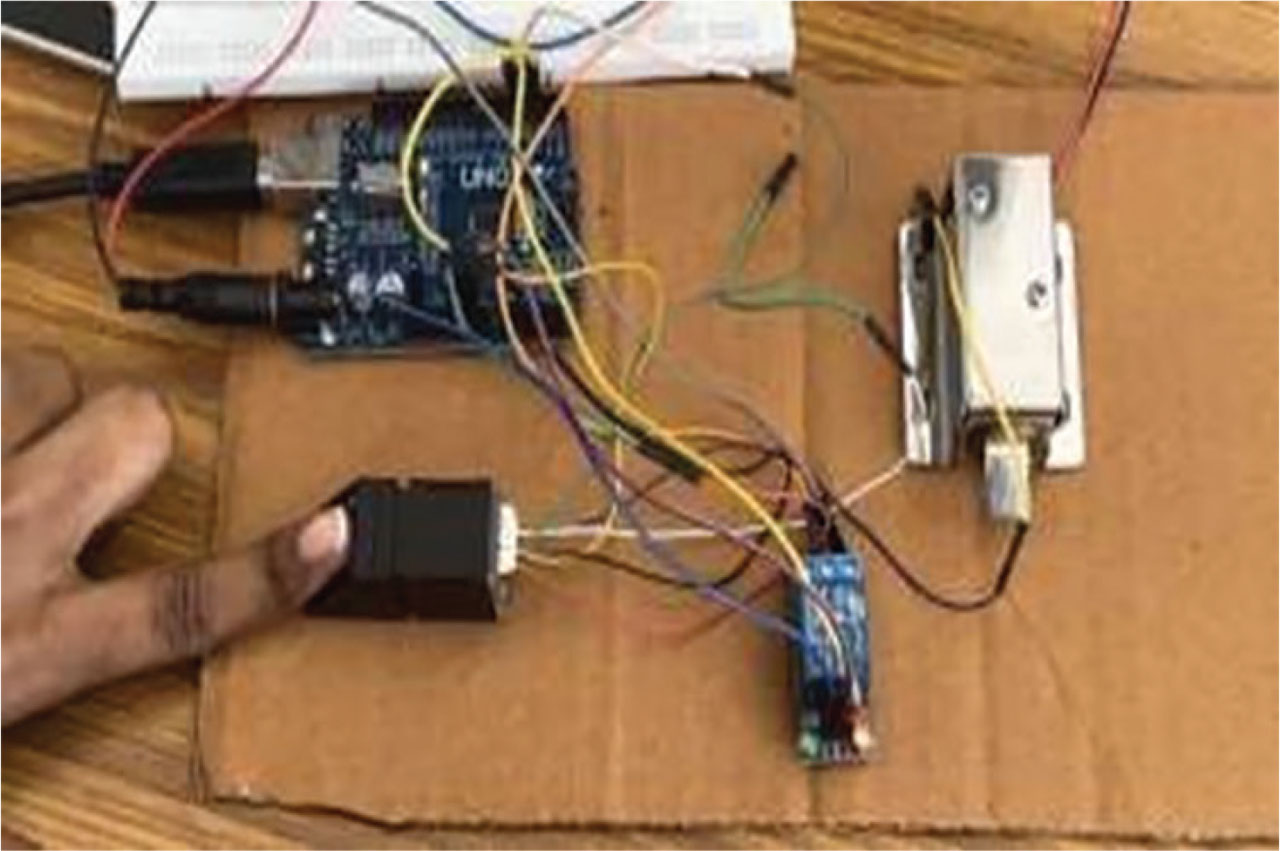
Figure 5:
Proposed system is locked.
Figure 6A shows a successful authentication as the scanned fingerprints matched the registered sequence, which opened the solenoid lock. Figure 6B, on the other hand, illustrates a failed attempt where the mismatch instigated a reset prompt to appear after three attempts. Figure 6C shows how to recover access to the system for real users using the reset fingerprint. This proposed layered security design effectively prevents brute-force attacks since intruders must not only copy valid fingerprints but also present them in the right sequence. The reset fingerprint adds another level of security by preventing repeated failures and making sure that only authorized reactivation is conceivable.
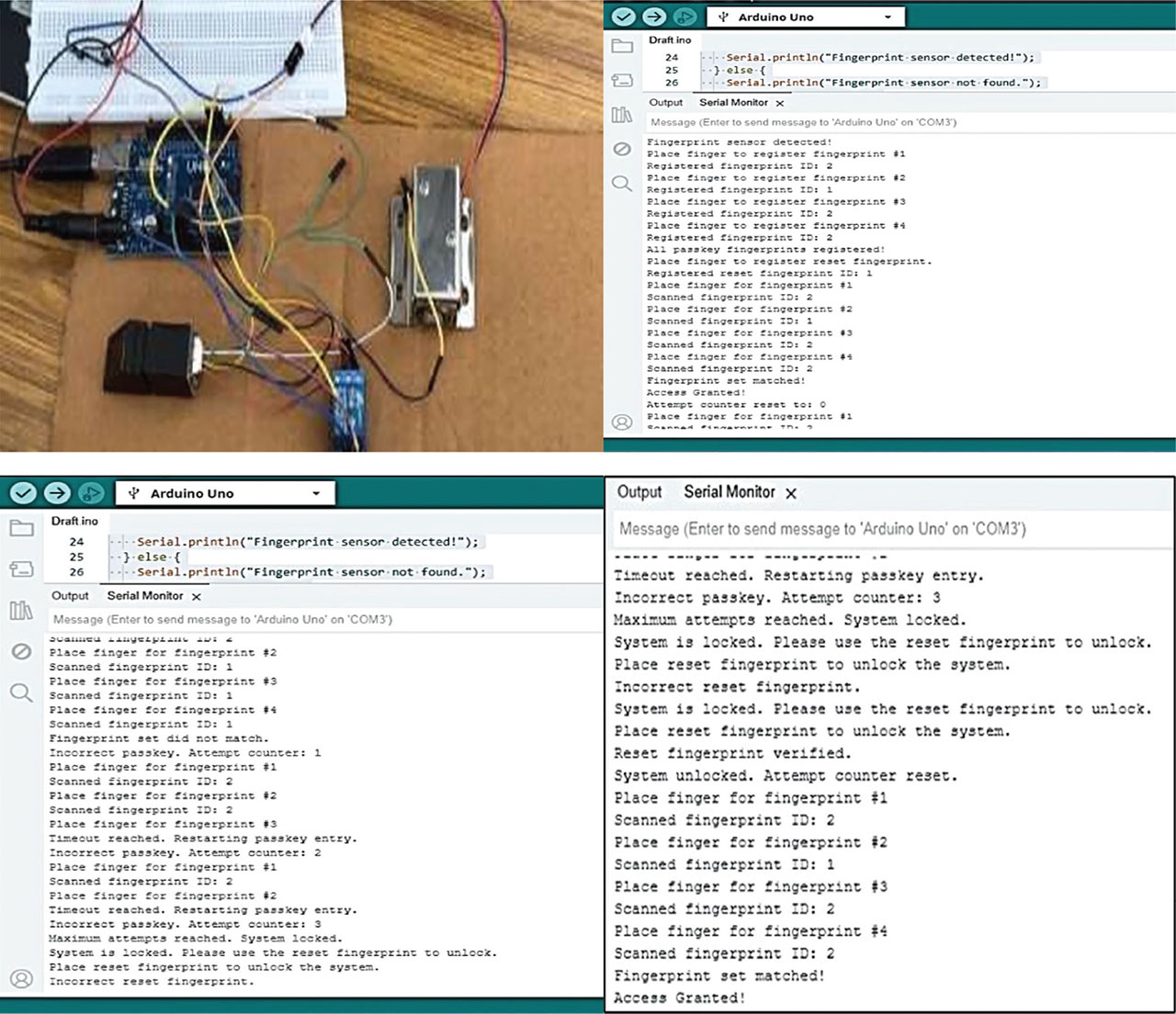
Figure 6:
Proposed system is opened. (A) Scanned finger print set is matched with the registered fingerprint set. (B) Scanned finger print set is not matched with the registered fingerprint set. (C) Scanned finger print set matched after the reset fingerprint.
Table 2 offers a thorough examination of diverse scenarios assessed with the proposed biometric system, highlighting authentication outcomes, error rates, security efficacy and resilience to spoofing, thereby guaranteeing robustness and practical dependability across applications.
Table 2:
Analysis of the proposed system with different test cases
| Scenario | Fingerprint 1 | Fingerprint 2 | Fingerprint 3 | Fingerprint 4 | Door (solenoid) | Outcome |
|---|---|---|---|---|---|---|
| Case 1 (Compared with the registered fingerprint sequence set) | Matched | Matched | Matched | Matched | Unlock | Successful access |
| Case 2 (Incorrect fingerprint set) | Matched | Matched | Matched | Not matched | Locked | Access denied |
| Case 3 (Timeout) | Matched | Matched | Matched | Timeout | Restart | Attempt reset |
| Case 4 (Reset mechanism) | Matched | Matched | Not matched | Reached limit | Resets | Counter reset and access restored |
The results clearly show that the multi-layer sequential fingerprint system makes security for access control much better. With real-time feedback and tracking of attempts, authorized users can easily get access while the process keeps intruders out. The proposed design strikes a good balance between security, speed and cost, which is shown below.
c. Discussion of comparative results
The scalability of the proposed authentication system primarily depends on the storage and processing capabilities of the fingerprint sensor. The R307 fingerprint sensor supports storage of up to 1,000 fingerprint templates and performs matching operations internally, allowing the microcontroller to focus only on sequence verification. As a result, increasing the number of enrolled users does not significantly increase computational overhead in the microcontroller. This architecture ensures that the system can scale efficiently while maintaining consistent authentication response times.
Power consumption measurements show that the Arduino Uno consumes approximately 50 mA during operation, while the R307 fingerprint sensor consumes around 60 mA during scanning. The relay and solenoid lock consume higher current only during actuation, typically between 300–500 mA for a short duration. During idle operation, the total system consumption remains around 110 mA, making the system suitable for continuous embedded operation.
Although the primary focus of the proposed system is authentication security, several physical attack considerations were analyzed. All electronic components, including the microcontroller, relay module and wiring connections, are enclosed within a protected casing to prevent direct tampering. Additionally, the communication between the fingerprint sensor and the microcontroller occurs through internal UART connections, reducing exposure to external manipulation. Future implementations can further improve physical security through tamper detection mechanisms and encrypted communication protocols.
Table 3 shows how the proposed sequential fingerprint system compares to multi-modal systems such as fingerprint + face or fingerprint + iris combinations. The proposed system is less expensive in terms of hardware and operation, but it offers similar levels of security. The system works well, with a FAR of 0.8% and a FRR of 4.2%. This means that it keeps both unauthorized access and false denials to a minimum. It needs several fingerprints in a row, but the average response time of 1.8 s makes it quick and useful for everyday use. Also, its layered design has sequential input, lockout protection and reset fingerprint validation. This feature makes a full and strong security system that stops spoofing and brute-force attacks without needing complicated biometric fusion or cloud processing.
Table 3:
Comparison of the proposed system with the related existing systems
| Biometric system | Accuracy (%) | FAR (%) | FRR (%) | Response time (s) | Security level | User convenience | Cost | Application suitability |
|---|---|---|---|---|---|---|---|---|
| Fingerprint + face [18,20] | 93 | 1.5 | 3.5 | 2.1 | Moderate to high | High (non-intrusive, familiar to users) | Moderate | General access control, mobile devices |
| Fingerprint + voice [11,12] | 90 | 2.2 | 4.8 | 2.4 | Moderate | High (natural interaction for users) | Low to moderate | Phone-based authentication, personal devices |
| Fingerprint + iris [20,29] | 97 | 0.5 | 2.0 | 2.0 | Very high | Moderate (requires steady positioning) | High | High-security facilities, banking and government |
| Proposed sequential fingerprint system | 95 | 0.8 | 4.2 | 1.8 | High | Moderate (multiple prints required) | Low to moderate | Door locks, data centers, restricted areas |
V. Conclusion
The suggested biometric authentication system combines sequential fingerprint authentication with a reset fingerprint feature to create a safe, dependable and affordable way to control access. It stops spoofing and unauthorized entry while being easy for users to use. The test data shows that it is 95% accurate, has a FAR of 0.8%, a FRR of 4.2% and an average response time of 1.8 s. The findings indicate that the system performs effectively in real time and is appropriate for deployment in residential, institutional and business contexts. Even in different lighting conditions, the accuracy stayed above 90%, indicating that the system is robust as well as adaptable. This design offers the same level of security as traditional and multi-modal biometric systems, but at a much lower cost. The system is safe and easy to use since it has a layered structure with sequential fingerprint entry, monitoring attempts and reset protection. Long-term reliability is supported through the ability to re-enroll fingerprints when necessary and manage stored templates within the sensor memory. The fingerprint sensor supports a large number of scanning cycles and allows templates to be deleted or updated, enabling the system to adapt to changes in user fingerprints over time and preventing memory saturation.
Future work will further explore integrating physiological signals such as Electrocardiogram (ECG) or facial recognition and the application of machine learning to improve accuracy and responsiveness for larger-scale applications.
Notes
[5] Contributed by Author Contribution
Rashmi Ranjan Das: conceptualization, methodology of the study, reviewed and edited the manuscript. Deepika Rani Sona: conceptualization, methodology of the study, supervision. Gouni Sai Bhavuktha Reddy: software implementation, writing original draft.Araveti Greeshma: validation and analysis, writing – review & editing. Rajula Balaji: hardware and software validations.