
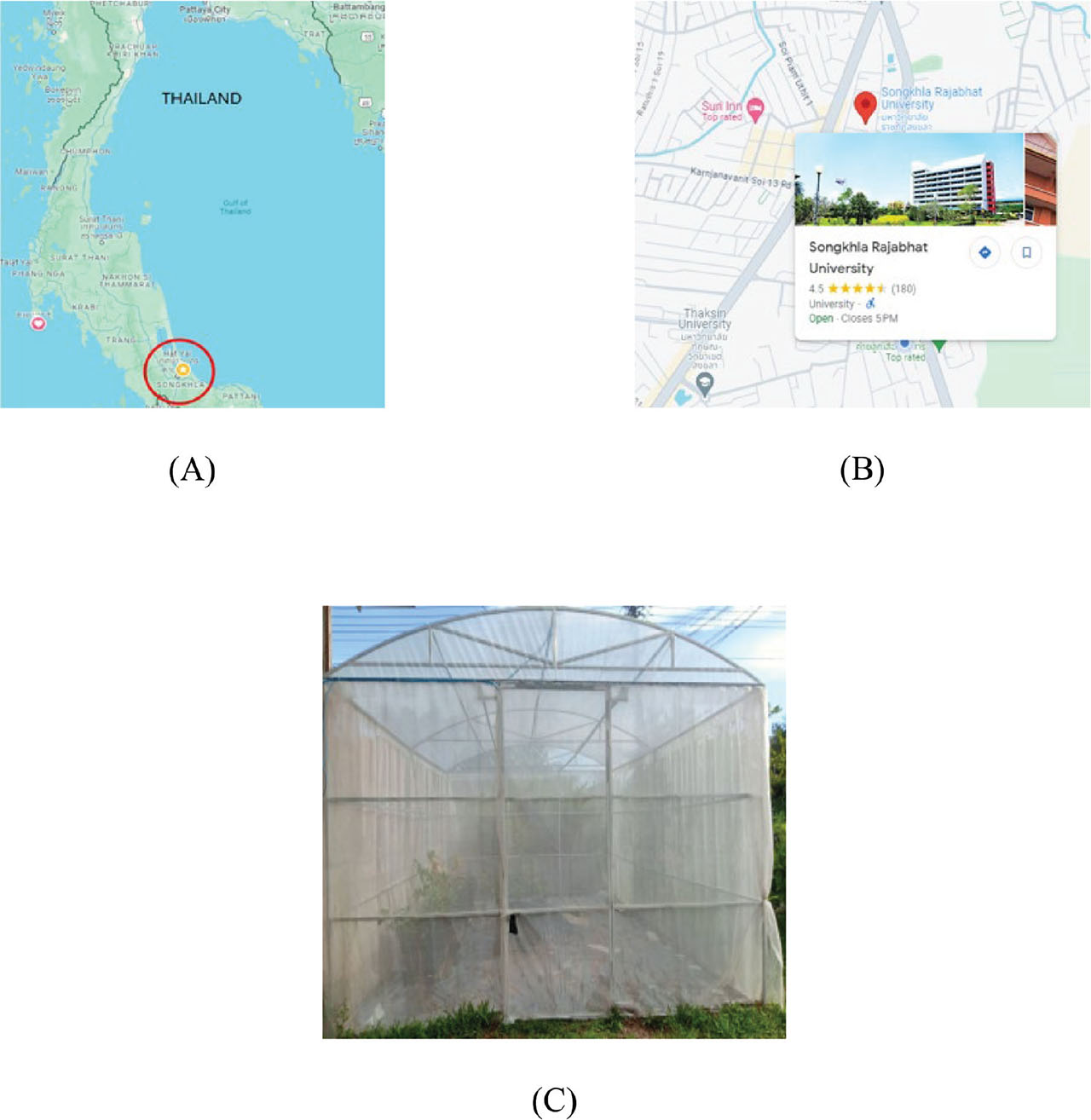
Figure 1:
Research locations: (A) the red circle on the map of Thailand indicates Songkhla Province, (B) the red pin on the map shows Songkhla Rajabhat University, and (C) experimental greenhouse.
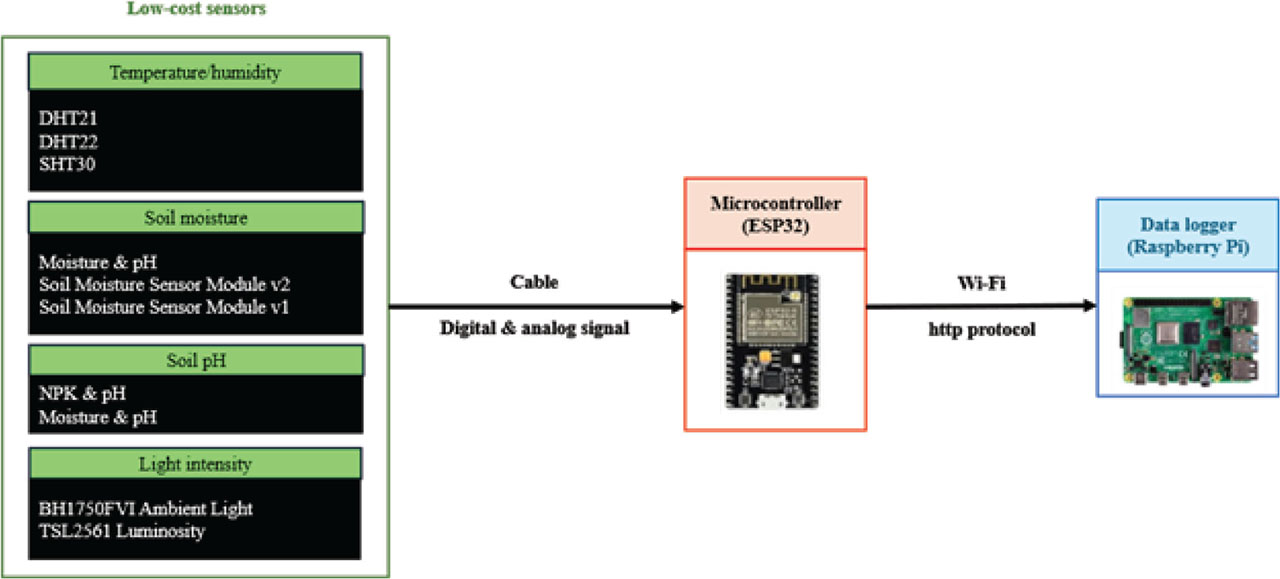
Figure 2:
Low-cost sensor connection architecture for environmental measurement.
Table 1:
Comparison of average temperature between the standard device and the sensors
| Sensors/device | N | x̅ | SD | Multiple comparisons Sig. | F | ANOVA Sig. |
|---|---|---|---|---|---|---|
| DHT21 | 672 | 28.16 | 0.996 | 0.083 | 1.197 | 0.315 |
| DHT22 | 672 | 28.05 | 1.013 | 0.173 | ||
| SHT30 | 672 | 27.85 | 1.013 | 0.494 | ||
| Standard device | 672 | 27.65 | 1.013 |
Table 2:
Average relative humidity comparison between the standard device and the sensors
| Sensors/device | N | x̅ | SD | Multiple comparisons Sig. | F | ANOVA Sig. |
|---|---|---|---|---|---|---|
| DHT21 | 672 | 84.75 | 4.42 | 0.683 | 0.067 | 0.977 |
| DHT22 | 672 | 84.62 | 4.57 | 0.748 | ||
| SHT30 | 672 | 84.37 | 5.35 | 0.884 | ||
| Standard device | 672 | 84.16 | 5.27 |
Table 3:
Average soil moisture comparison between sensors and standard measuring devices
| Sensors/device | N | x̅ | SD | Multiple comparisons Sig. | F | ANOVA Sig. |
|---|---|---|---|---|---|---|
| Soil moisture detection | 672 | 84.58 | 4.53 | 0.579 | 0.126 | 0.944 |
| Soil moisture sensor Module v2 | 672 | 84.66 | 4.45 | 0.620 | ||
| Moisture & pH | 672 | 84.29 | 5.33 | 0.770 | ||
| Standard device | 672 | 83.87 | 5.30 |
Table 4:
Average soil pH comparison between sensors and standard measuring devices
| Sensors/device | N | x̅ | SD | Multiple comparisons Sig. | F | ANOVA Sig. |
|---|---|---|---|---|---|---|
| NPK & pH | 504 | 6.13 | 0.047 | 0.072 | 1.830 | 0.168 |
| Moisture & pH | 504 | 6.14 | 0.056 | 0.164 | ||
| Standard device | 504 | 6.16 | 0.049 |
Table 5:
Average light intensity comparison between sensors and standard measuring devices
| Sensors/device | N | x̅ | SD | Multiple comparisons Sig. | F | ANOVA Sig. |
|---|---|---|---|---|---|---|
| BH1750FVI ambient light | 504 | 1,448.08 | 1,797.70 | 0.597 | 0.294 | 0.747 |
| TSL2561 luminosity | 504 | 1,556.42 | 1,875.93 | 0.460 | ||
| Standard device | 504 | 1,177.25 | 1,613.67 |
Table 6:
Selected low-cost sensors and validation results compared with standard devices
| Parameter | Selected sensor | Reference device | ANOVA p-value | Validation result |
|---|---|---|---|---|
| Temperature (°C) | SHT30 | Digital thermometer (Ref) | 0.49 > 0.05 | Validated |
| Humidity (%) | SHT30 | Hygrometer (Ref) | 0.88 > 0.05 | Validated |
| Soil moisture (%) | Moisture & pH sensor | Standard soil moisture meter | 0.77 > 0.05 | Validated |
| Soil pH | Moisture & pH sensor | Laboratory pH meter | 0.16 > 0.05 | Validated |
| Light intensity (lx) | BH1750FVI | Lux meter | 0.59 > 0.05 | Validated |
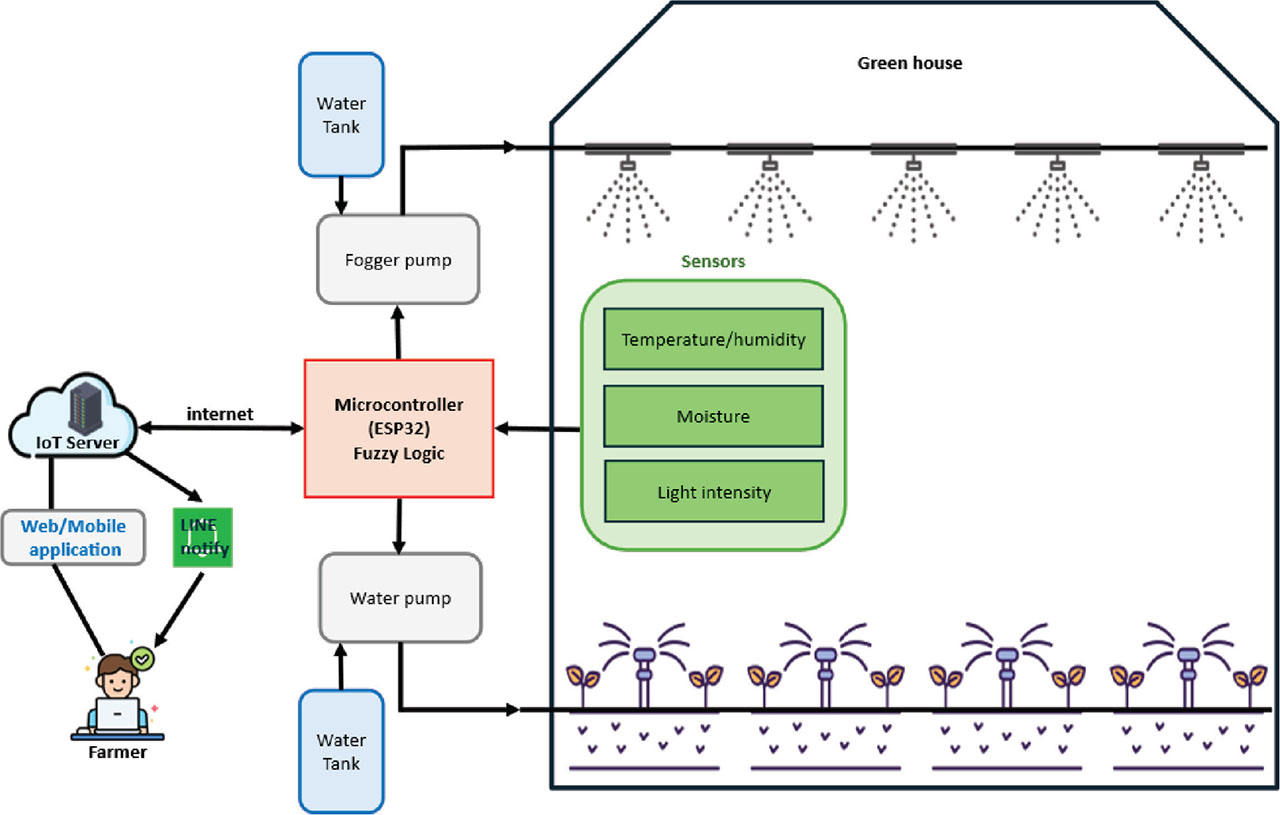
Figure 3:
Schematic diagram revealing the monitoring and control system for the greenhouse.
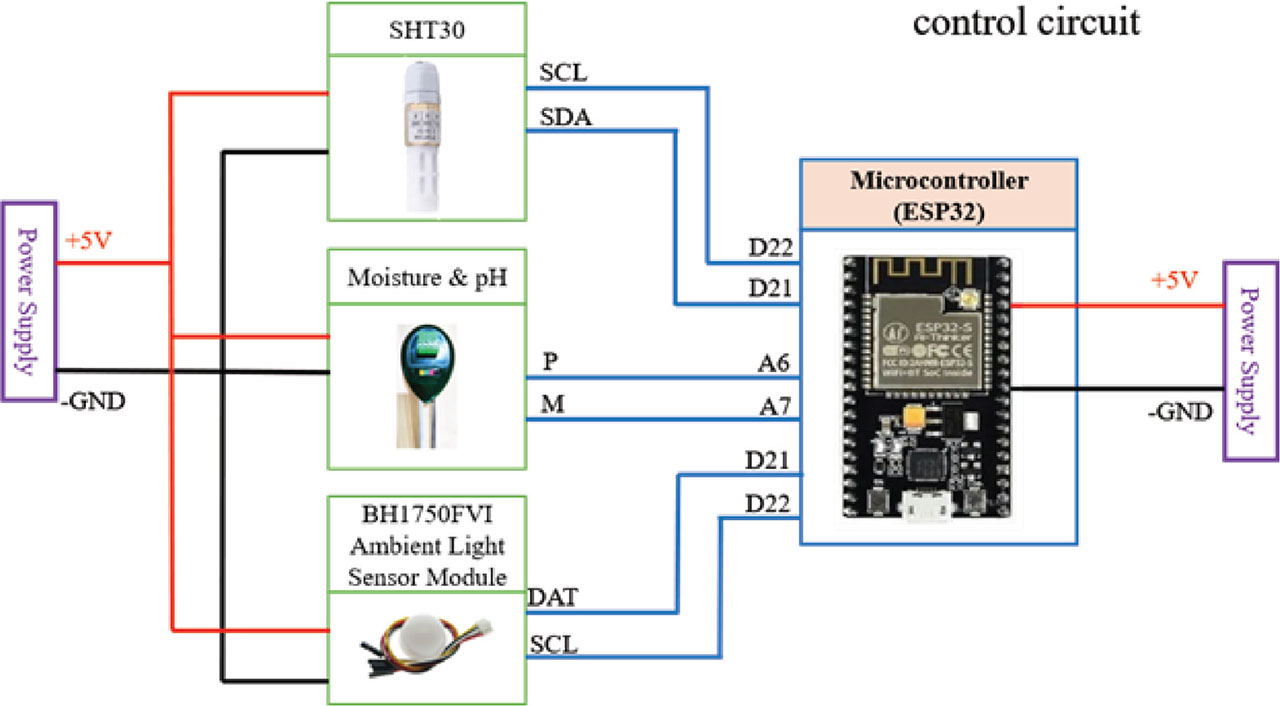
Figure 4:
The electronic circuit presents the integration of the sensor with the ESP32 microcontroller. Here DAT = Data Line, GND = Ground, SCL = Serial Clock Line, and SDA = Serial Data Line.
Table 7:
The costs required to develop the prototype
| No. | Sensors/device | Price/unit (US$) |
|---|---|---|
| 1 | SHT30 sensor | 8.67 |
| 2 | Moisture & pH sensor | 11.96 |
| 3 | BH1750FVI ambient light module sensor | 4.49 |
| 4 | ESP32 board | 5.38 |
| 5 | LCD | 3.29 |
| 6 | Power breaker | 1.50 |
| 7 | Relay 2 channel | 1.20 |
| 8 | Terminal wires | 1.35 |
| 9 | Power adapter | 1.79 |
| 10 | Plastic box | 7.47 |
| Total price | 47.10 |
Table 8:
Cost-level comparison between previous studies and the proposed system
| Study | Hardware architecture | Sensor type | System complexity | Approx. cost/evidence | Cost level |
|---|---|---|---|---|---|
| Ting et al. (2015) | Industrial ZigBee (JN5139), WSN nodes, GPRS server | Industrial sensors (0–5 V, 4–20 mA), LI-6400XT CO2 analyzer | Multi-node industrial WSN + cloud | Lab-grade instruments (CO2 analyzer alone > US$10,000) | High |
| Wang & Wang (2020) | CC2530 ZigBee network, GPRS module, host PC | DS18B20, DHT11, BH1750 | Multi-node WSN + fuzzy-PID + PC platform | Multiple ZigBee nodes + base station (higher than low-cost MCUs) | High–medium |
| Simo et al. (2022) | ATmega328P + ESP8266 + multi-sensor platform | SHT31, BH1750, CCS811, pH sensor | Environmental + electrical monitoring | 178 € + 147 € ≈ US$340 | Medium |
| Kayadibi (2025) | ESP32 + multi-sensors | AHT10, CJMCU-811, MQ135, capacitive soil sensor | IoT monitoring + basic actuator control | Estimated US$60–90 | Medium |
| Naeem & Aly (2024) | Raspberry Pi 3 + Arduino + camera | DHT11, soil moisture, pH, CO2 | Multi-sensor monitoring | ~70–80US$ | Medium–low |
| This study (2025) | ESP32 microcontroller | Validated low-cost sensors (SHT30, soil moisture, BH1750) | IoT monitoring + fuzzy automation | US$47.10 (actual prototype cost) | Low |
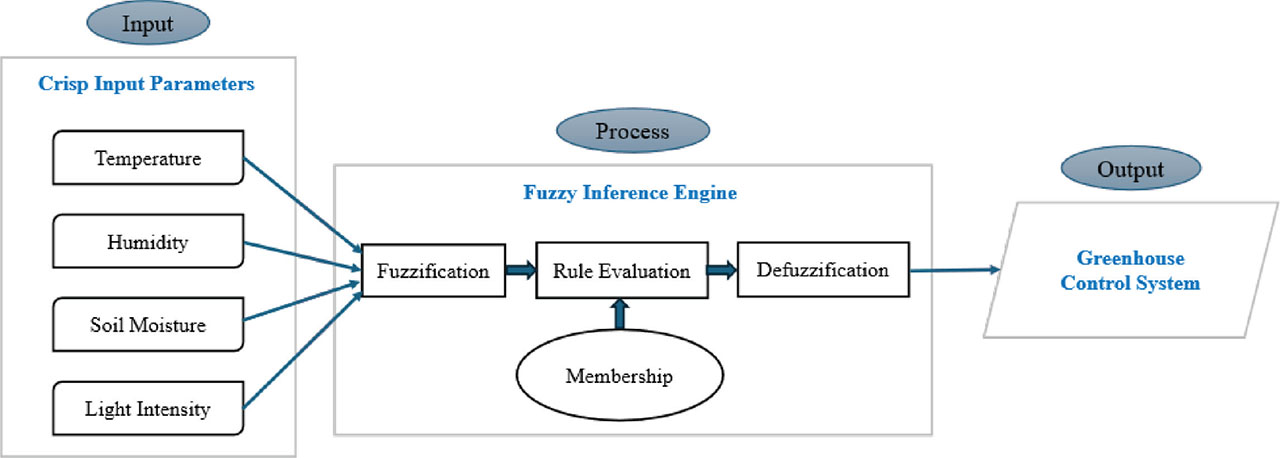
Figure 5:
FL flow diagram for greenhouse environmental control. FL, fuzzy logic.
Table 9:
Fuzzy input variables and their membership function characteristics
| Variables | Range | Membership functions | Shape |
|---|---|---|---|
| Soil moisture (%) | 0–100 | Low, medium, high | Triangular |
| Temperature (°C) | 15–45 | Low, medium, high | Triangular |
| Humidity (% RH) | 30–100 | Low, medium, high | Triangular |
| Light intensity (lx) | 0–5000 | Very low, low, medium, high | Trapezoidal |
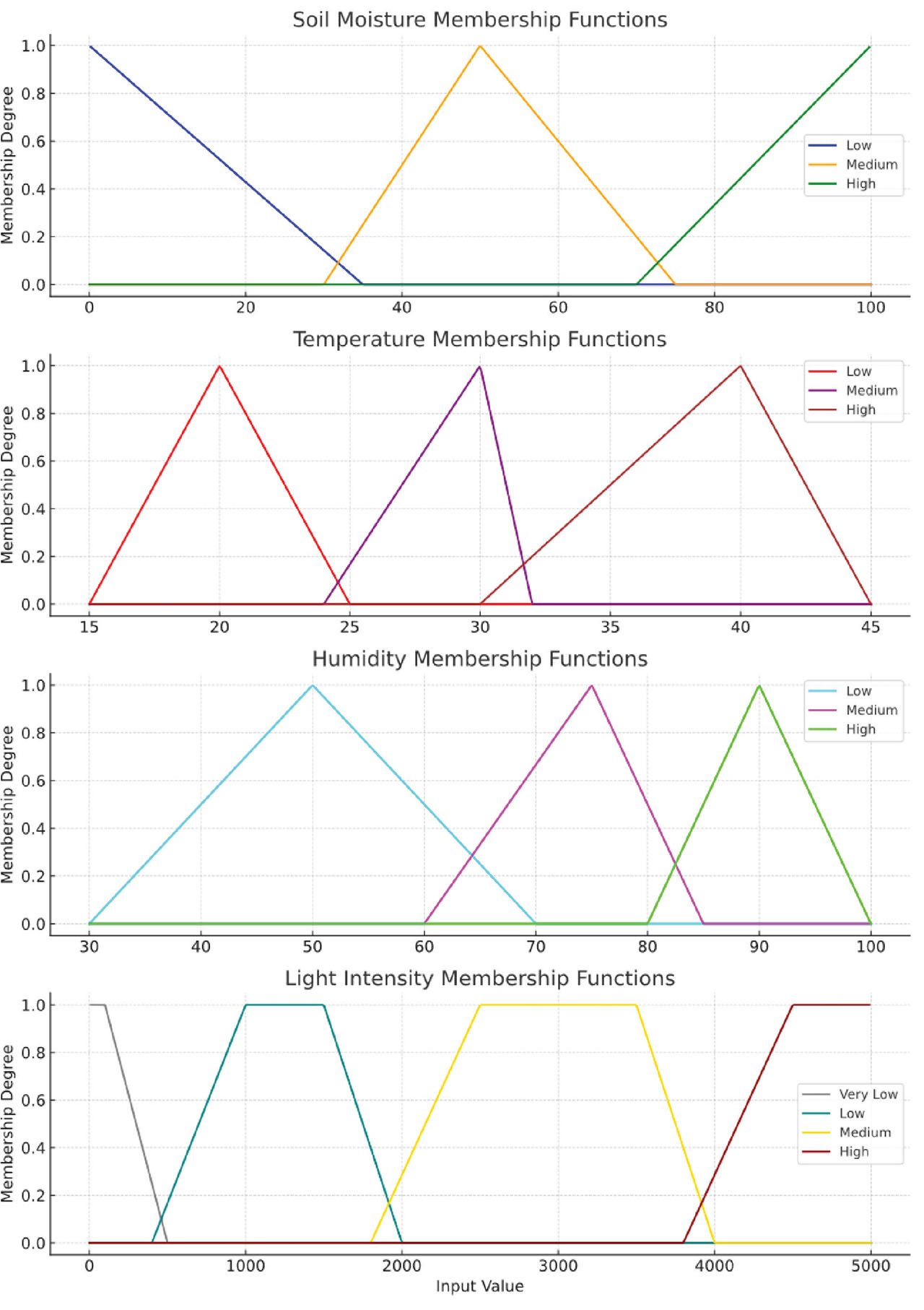
Figure 6:
Fuzzy input variable membership functions.
Table 10:
Input membership function thresholds
| Parameter | Low | Medium | High |
|---|---|---|---|
| Soil moisture (%) | 0–35 | 30–75 | 70–100 |
| Temperature (°C) | 20–25 | 24–32 | 30–40 |
| Humidity (%) | 50–70 | 60–85 | 80–100 |
Table 11:
Proposed action for greenhouse environmental management
| Soil moisture (%) | Temperature (°C) | Humidity (%) | Action |
|---|---|---|---|
| Low (0–35) | Low (20–25) | Low (50–70) | Increase watering, increase temperature, increase humidity |
| Medium (30–75) | Medium (24–32) | Medium (60–85) | Maintain watering, maintain temperature, maintain humidity |
| High (70–100) | High (30–40) | High (80–100) | Decrease watering, decrease temperature, decrease humidity |
Table 12:
Output membership function parameters (normalized 0–1)
| Output variable | Membership level | Range | Parameters (a, b, c) |
|---|---|---|---|
| Pump (fogger) | Low | 0.0–0.3 | (0.0, 0.0, 0.3) |
| Medium | 0.2–0.7 | (0.2, 0.5, 0.7) | |
| High | 0.6–1.0 | (0.6, 1.0, 1.0) | |
| Pump (watering) | Low | 0.0–0.4 | (0.0, 0.0, 0.4) |
| Medium | 0.3–0.7 | (0.3, 0.5, 0.7) | |
| High | 0.6–1.0 | (0.6, 1.0, 1.0) |
Table 13:
Proposed FL rules for greenhouse environmental management
| Rule No. | Temperature | Humidity | Soil moisture | Watering | Spray mist |
|---|---|---|---|---|---|
| R1 | High | Low | Medium | OFF | ON |
| R2 | High | High | Medium | OFF | OFF |
| R3 | Medium | Low | Medium | OFF | ON |
| R4 | Medium | High | Medium | OFF | OFF |
| R5 | Low | Low | Medium | OFF | ON |
| R6 | Low | High | Medium | OFF | OFF |
| R7 | - | - | Low | ON | OFF |
| R8 | - | - | Medium | OFF | OFF |
| R9 | - | - | High | OFF | OFF |
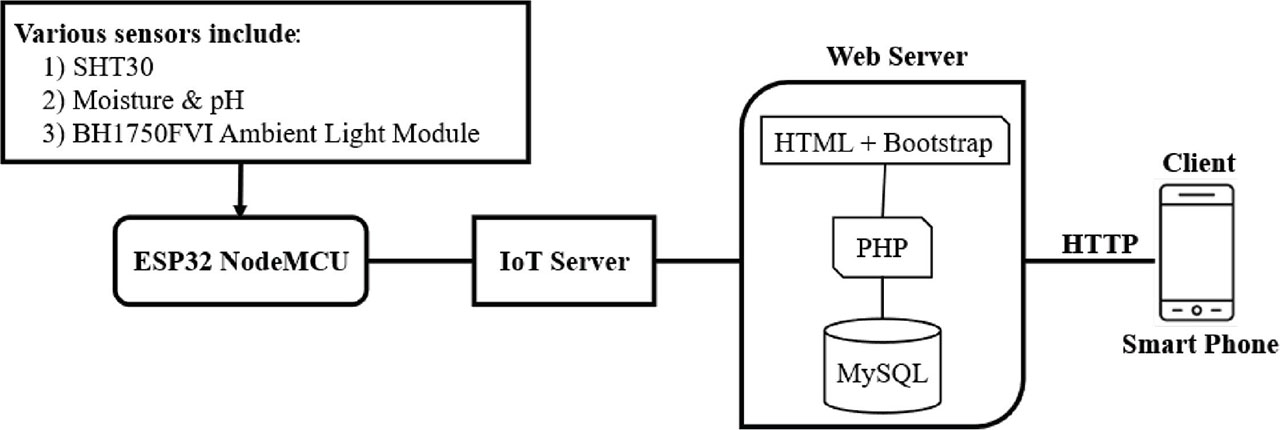
Figure 7:
Web application system architecture that allows monitoring in real time.
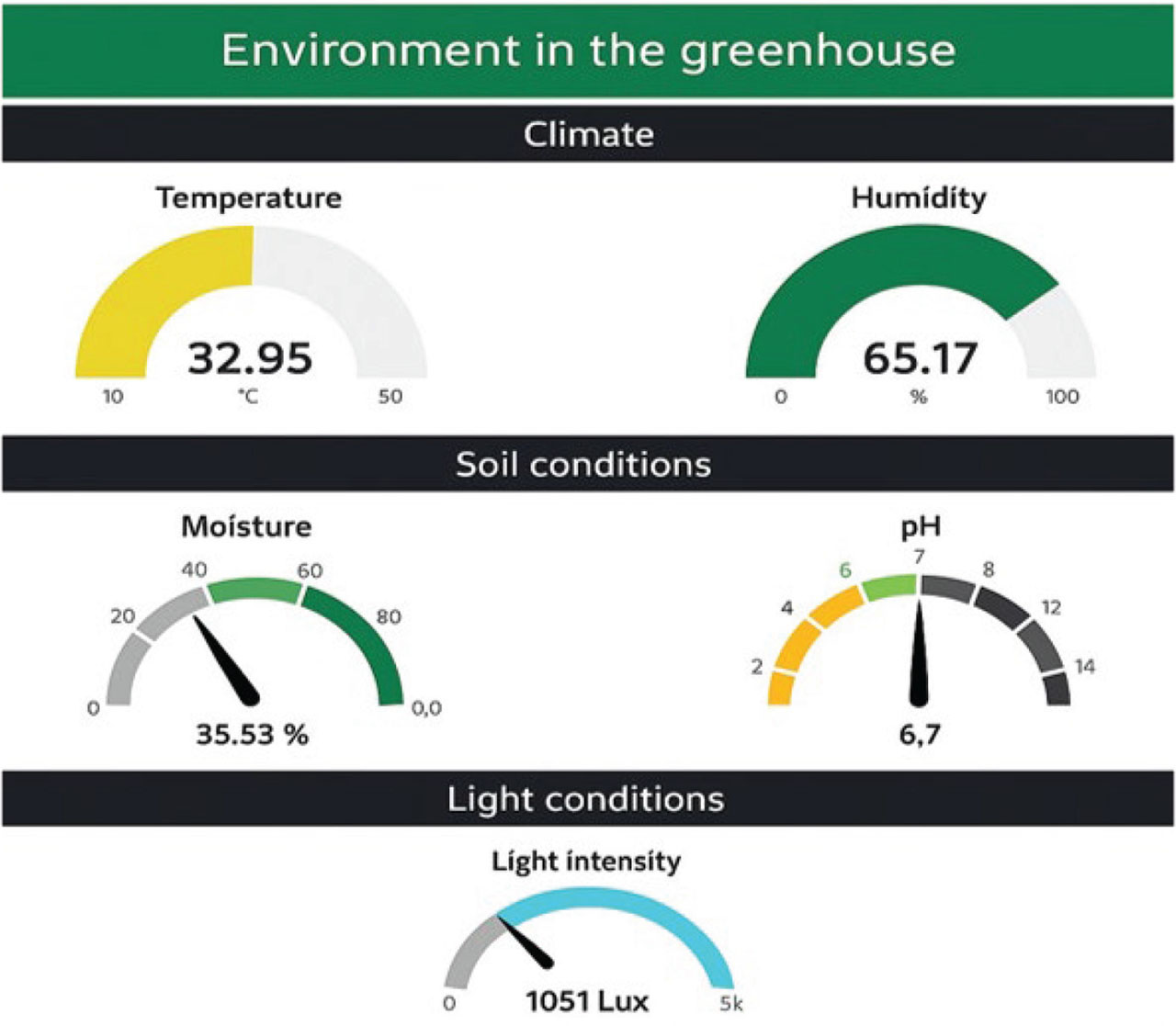
Figure 8:
Web application interface displaying greenhouse environmental data.

Figure 9:
Control system interface of the web application for manual and automatic operations.
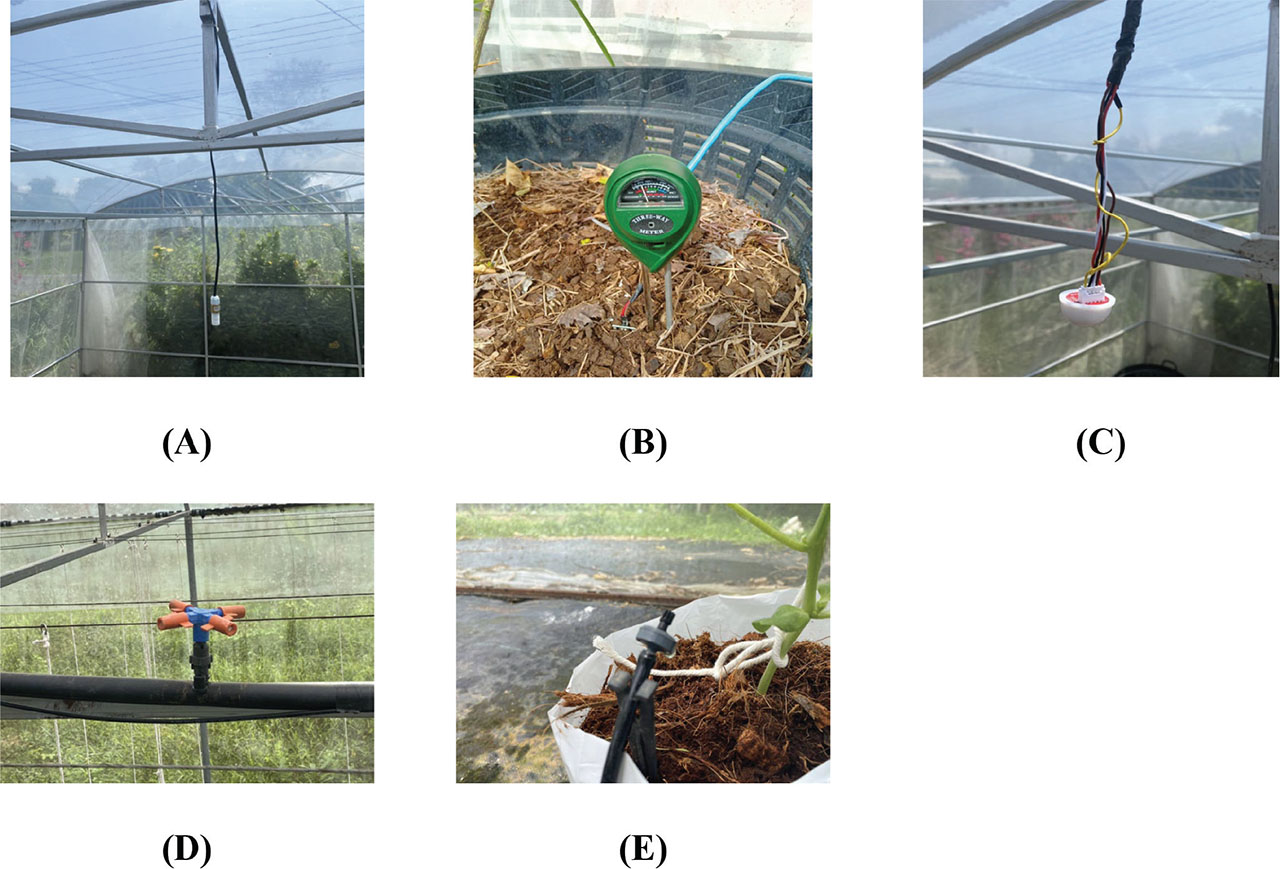
Figure 10:
Sensor installation inside the greenhouse: (A) SHT30 Sensor to measure temperature and humidity, (B) Moisture & pH Sensor, (C) BH1750FVI Ambient Light Sensor, (D) misting device for temperature and humidity control, and (E) watering system for soil moisture regulation.
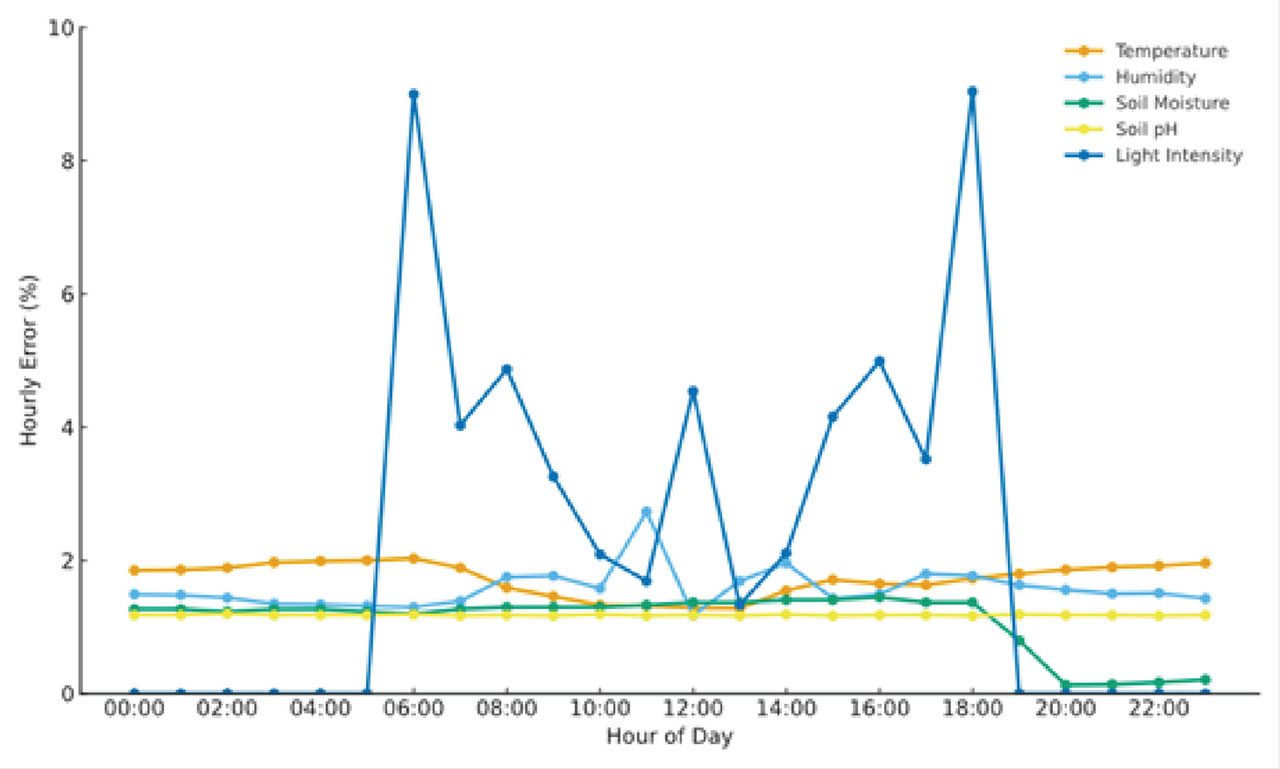
Figure 11:
Hourly error distribution.
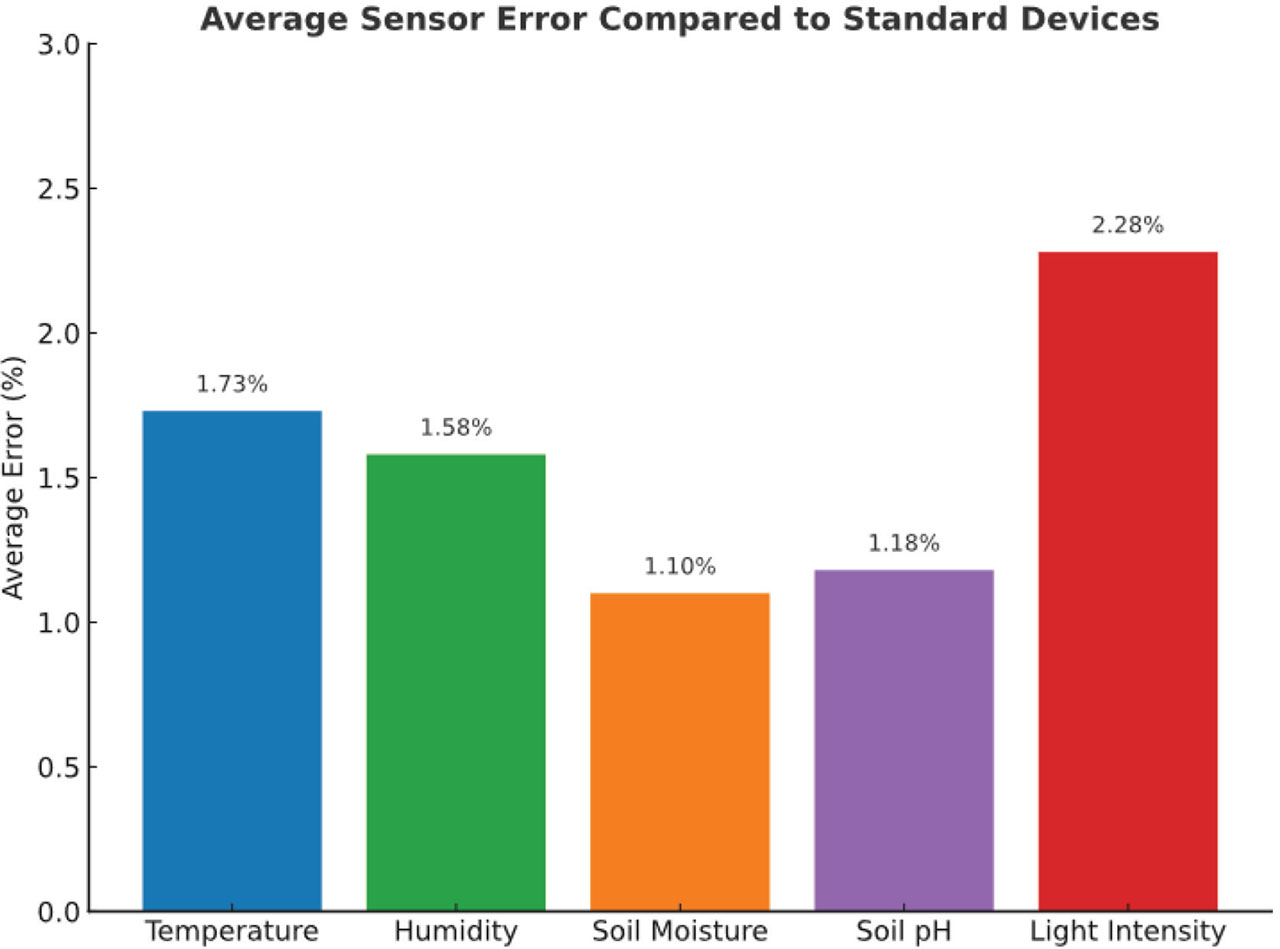
Figure 12:
Average% error of each sensor compared to standard equipment.
Table 14:
Results of testing the operation of the control system
| Working style | Number of tests (times) | Accuracy of work orders and controls (times) | Accuracy (%) |
|---|---|---|---|
| 1. Manual operation mode | |||
| 1.1 Turn on the water pump with the push button | 90 | 90 | 100 |
| 1.2 Turn off the water pump with the push button | 90 | 90 | 100 |
| 1.3 Turn on the fogger pump with the push button | 90 | 90 | 100 |
| 1.4 Turn off the fogger pump with the push button | 90 | 90 | 100 |
| 2. Automatic operating mode | |||
| 2.1 If the moisture is higher than specified: Turn off the watering pump | 90 | 90 | 100 |
| 2.2 If the moisture is lower than specified: Turn on the watering pump | 90 | 90 | 100 |
| 2.3 If the temperature is higher than specified: Turn on the fogger pump | 90 | 90 | 100 |
| 2.4 If the temperature is lower than specified: Turn off the fogger pump | 90 | 90 | 100 |
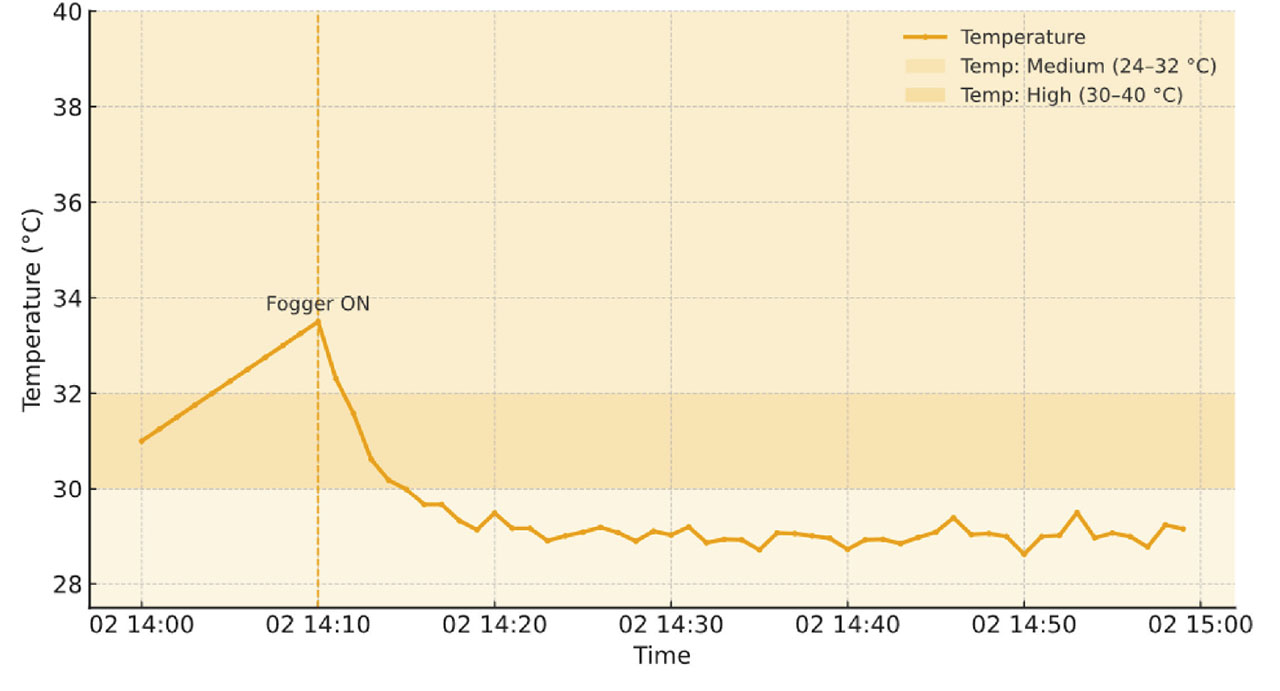
Figure 13:
Temperature response and fuzzy membership regions.
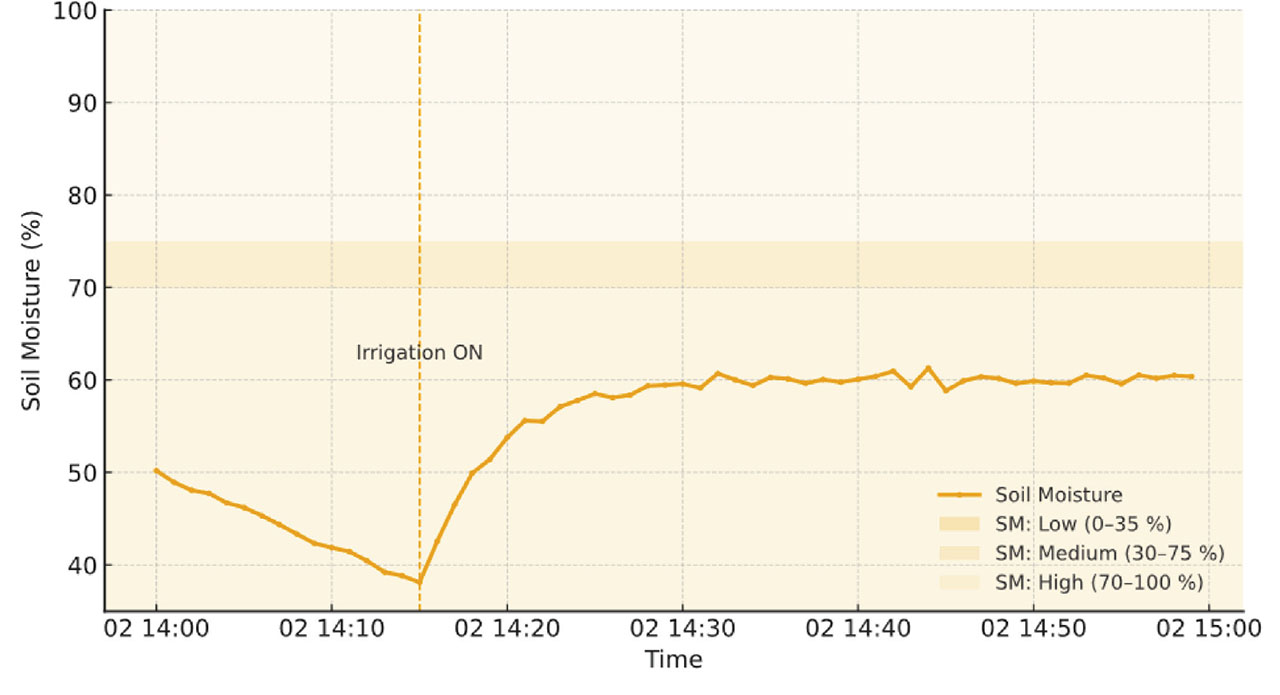
Figure 14:
Soil moisture response and fuzzy membership regions.