
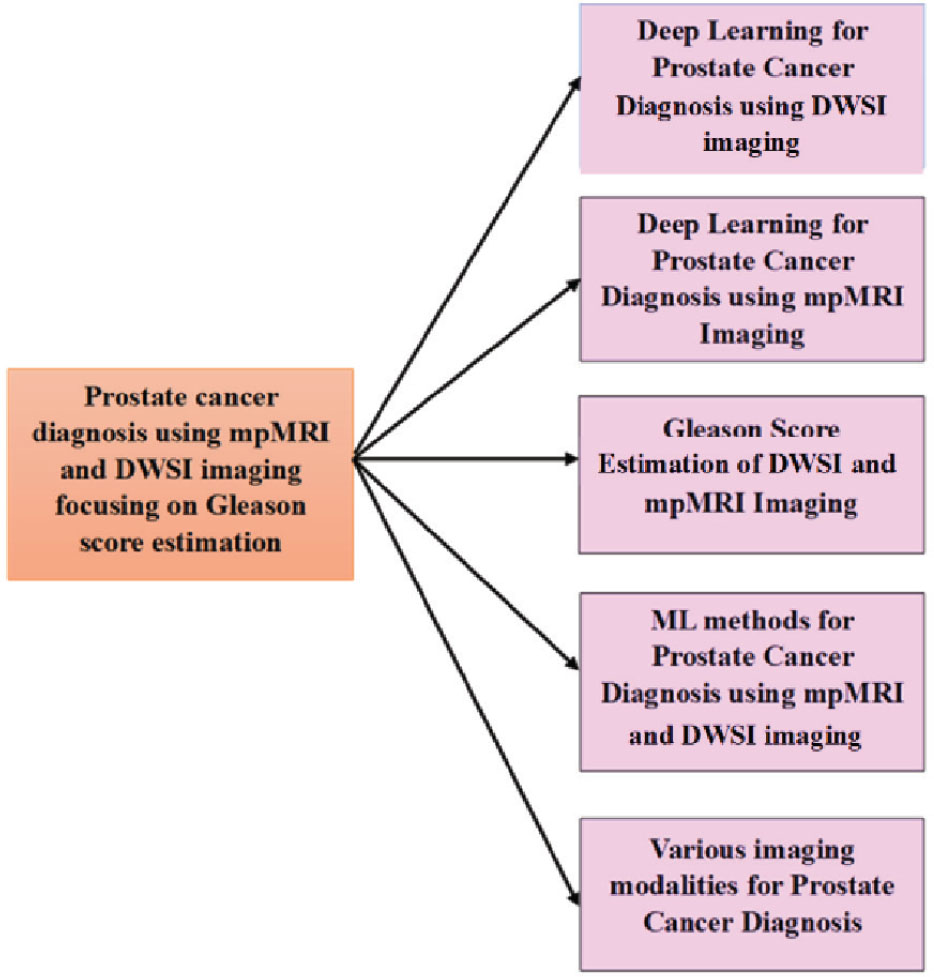
Figure 1:
Directions for reviewing improved prostate cancer diagnosis using mpMRI and DWSI. DWSI, diffusion-weighted synthetic imaging; mpMRI, multiparametric magnetic resonance imaging.
Table 1:
Review on DL for prostate cancer diagnosis using mpMRI
| Ref. No. | Technique name | Significance | Limitation |
|---|---|---|---|
| [16] | U-net with attention mechanism | Improved accuracy in prostate cancer detection by reducing over-detection. | Did not explore the combination of features from different modalities (T2w and ADC), which poses challenges. |
| [17] | SEMRCNN | Autonomously extracts prostate cancer regions, combining ADC and T2W images for better segmentation. | Boundaries of lesions can overlap with normal tissues, reducing segmentation precision. |
| [18] | MiniSegCaps | Multi-branch network with CapsuleNet’s attention map for improved segmentation and PI-RADS classification. | Did not address specific PI-RADS categories due to sample size limitations, limiting risk stratification. |
| [19] | SegDGAN | Multi-scale feature extraction in GAN-based model improves segmentation accuracy and reliability. | False positives persist, marking healthy tissue as cancerous despite high Dice similarity coefficients. |
| [20] | U-Net-based Fusion Technique | Improves cancer visibility and fusion accuracy by using a weighted distribution strategy to reduce artifacts and energy loss. | Fusion process accuracy depends on the consistency and quality of the supplied images. |
| [21] | U-Net with LSTM | U-Net segmentation combined with LSTM for temporal relationship classification, improving diagnostic accuracy. | Data inconsistencies and model interpretation challenges, requiring collaboration and standardization. |
| [22] | CAT | Improved segmentation by identifying cross-slice correlations, enhancing local and global information. | Relies on T2WI, which may not have enough contrast for precise segmentation; multispectral MRI could help. |
| [23] | EfficientNet-based Transfer Learning | Combines transfer learning and DL to improve feature extraction from various MRI sequences. | Limited by reliance on pretrained models and might miss subtle cancer features in diverse cases. |
| [24] | DNN-based CAD | Uses an ensemble learning technique to enhance classification accuracy through multi-modal MRI images. | Reliance on limited mpMRI sequences can miss relevant features, leading to misclassification in some cases. |
| [25] | ProstAttention-Net | End-to-end architecture with attention mechanism for accurate segmentation and grading. | Limited by reliance solely on mpMRI data; could be enhanced by incorporating other imaging modalities like PET. |
[i] ADC, apparent diffusion coefficient; CAT, cross-slice attention transformer; DL, deep learning; DNN, deep neural network; LSTM, long short-term memory; mpMRI, multiparametric magnetic resonance imaging; MRI, magnetic resonance imaging; PET, positron emission tomography; PI-RADS, prostate imaging reporting and data system; SEMRCNN – spatial encoding mask region-based convolutional neural network.
Table 2:
Review on DL methods for prostate cancer diagnosis using DWSI imaging
| Ref. No. | DL technique | Significance | Limitation |
|---|---|---|---|
| [26] | CRNN-DWI | Improves productivity and efficiency by reducing scan durations while maintaining image quality. | Does not inherently perform cancer segmentation; requires integration with segmentation models for full cancer detection. |
| [27] | DL-CAD | zDWI shows higher true positive detection rate due to lower ADC values and higher contrast-to-noise ratio (CNR). | Needs further validation across patient categories and has possible generalizability issues. |
| [28] | DnCNN | Enhances image quality by reducing noise in DWI images, helping with prostate cancer detection. | Relies on estimated high b-value images, leading to uncertainty in model training. |
| [29] | CNN: AlexNet & VGGNet | Combines multiple features for accurate segmentation and detection of prostate cancer. | Does not determine optimal b-value combinations for the best accuracy. |
| [30] | 3D U-Shaped CNN | Utilizes multi-b-value DWI images for better diffusion contrast and incorporates uncertainty analysis. | Excludes DWI image derivatives, limiting segmentation accuracy. |
| [31] | 3D U-Net CNN | Provides automated, high-throughput LN segmentation for prostate cancer patients. | Limited to pelvic LNs; requires further validation for broader clinical use. |
| [32] | Multilayer U-Net (ResNet-101) + Bi-LSTM | Enhances prostate cancer identification with precise segmentation and localization. | High computational overhead, requiring powerful hardware for real-time applications. |
| [33] | DLR | Improves lesion conspicuity, SNR, and CNR, potentially reducing scan time without sacrificing diagnostic accuracy. | Does not assess long-term clinical impact on treatment or patient outcomes. |
| [34] | GAN | Generates synthetic high-b-value DWSI from lower b-value acquisitions, potentially improving diagnostic accuracy. | Performance degrades with moderate or severe distortions or motion artifacts. |
| [35] | Modified U-Net | Improves segmentation on smaller datasets and adapts models for different cancer types. | Does not calculate prostate volume, which is essential for clinical assessments. |
[i] ADC, apparent diffusion coefficient; CNR, contrast-to-noise ratio; DL-CAD, deep learning–computer-aided detection DLR, deep learning reconstruction; DnCNN, denoising convolutional neural network; DWSI, diffusion spectrum-weighted imaging; LNs, lymph nodes; SNR, signal-to-noise ratio; zDWI, zoomed-field-of-view.
Table 3:
Review on GS estimation in DWSI and mpMRI imaging
| Ref. No. | Technique name | Significance | Limitation |
|---|---|---|---|
| [36] | DEFs with CNNs | Improves texture and variability analysis; uses Shannon entropy for feature generation; reduces human intervention | Non-linear correlations and interactions between features not well captured, affecting feature selection. |
| [37] | Multi-label ensemble deep-learning classifier | Addresses label inconsistencies and improves Gleason grading accuracy using transfer learning and patch-based classifiers. | Loss of finer details at the pixel level, which may impact grading accuracy. |
| [38] | 3D Retina U-Net for detection and segmentation | Fully automated approach for segmentation and GGG estimation from mpMRI. | Potential limitations in processing highly complex or noisy images. |
| [39] | Semantic segmentation with 3D-CNN | Segmentation isolates the prostate, improving the precision of GS prediction and reducing the need for biopsies. | Needs further improvement for enhancing prostate cancer diagnosis non-invasively. |
| [40] | DWI/ADC parameters | Found significant correlations between DWI/ADC parameters and GS, helping to assess prostate cancer aggressiveness. | Requires more studies to refine interpretation variability and uniformity in radiology standards. |
| [41] | CNN-based Gleason pattern region segmentation | Enhances Gleason grading accuracy by segmenting Gleason pattern regions using multi-scale convolutions. | Increased computational complexity due to the combination of multiple convolutions and post-processing. |
| [42] | CDBN-EHO with CRF segmentation | Enhances prostate cancer detection, which improves the accuracy of both Gleason grading and epithelial cell identification, leading to better differentiation of cancerous tissues. | Struggles with fine-grained classification in challenging cases with subtle patterns or poorly differentiated tissue. |
| [43] | ML models (DT, SVM, kNN, EM) using radiomic features | Improved accuracy in categorizing prostate cancer lesions by using multiple feature types, reducing inter-reader variability. | Feature selection is not robust in all clinical situations, leading to potential misclassification. |
| [44] | Hybrid DL system with pretrained CNNs and U-Net | Early and accurate prostate cancer classification and segmentation. | Dependence on accurate segmentation for diagnosis; challenges with model generalization. |
[i] DEFs, deep entropy features, DL, deep learning; DT, decision tree; DWI, diffusion-weighted imaging; DWI/ADC, diffusion-weighted imaging / apparent diffusion coefficient; DWSI, diffusion spectrum-weighted imaging; EL, Extreme Learning; EM, Expectation-Maximization; GGG, Gleason grade group; GS, Gleason score; KNN, k-nearest neighbor; ML, machine learning; mpMRI, multiparametric magnetic resonance imaging; SVM, support vector machines.
Table 4:
Review on ML methods for prostate cancer diagnosis using mpMRI and DWSI imaging
| Ref. No. | ML technique | Significance | Limitation |
|---|---|---|---|
| [45] | Ridge regression with linear SVM | Improved robustness and feature relevance; better model training and generalization. | Linear SVM struggles with representing complex non-linear relationships. |
| [46] | SVM-PCa-EDD | Early prostate cancer diagnosis, overcoming late diagnosis and underdiagnosis. | Time-consuming feature selection process, complexity in harmonizing outcomes. |
| [47] | Radiomics with RF and RFE | Non-invasive prediction of biological traits; combines clinical data with MRI methods. | Manual lesion segmentation subject to inter-observer variability. |
| [48] | SVM | Improved diagnostic accuracy for PI-RADS-3 lesions. | Combining PZ and TZ lesions mask cancer detection in specific areas. |
| [49] | Bayesian approach with spatial models (NNGP, chimeric antigen receptor (CAR)) | Enhanced accuracy and localization of cancerous areas. | Developed for 2-D data, challenges with 3-D MRI and histopathology co-registration. |
| [50] | RF and multilayer perceptron. | Effective prediction of clinically significant prostate cancer. | Manual MRI segmentation introduces labor intensity and variability. |
| [51] | ML classifiers (SVM, KNN, EL) | Automated and precise evaluations of prostate cancer using mpMRI. | Struggles with generalization to diverse patient populations. |
| [52] | ML models with RF | Accurate Gleason grade prediction; reduces unnecessary biopsies. | No augmentation or oversampling used, which could improve robustness. |
| [53] | PESFC | Early cancer detection with improved segmentation accuracy. | Difficulties in accurately defining cancer boundaries, especially with ambiguous regions. |
[i] CAR, chimeric antigen receptor; DWSI, diffusion spectrum-weighted imaging; EL, extreme learning; KNN, k-nearest neighbor; ML, machine learning; mpMRI, multiparametric magnetic resonance imaging; MRI, magnetic resonance imaging; NNGP, neural network gaussian process; PESFC, possibilistic exponential spatial fuzzy clustering, PI-RADS-3, prostate imaging reporting and data system, category 3 RF, PZ, peripheral zone; random forest, RFE, recursive feature elimination, SVM, support vector machines; SVM-PCa-EDD, support vector machine – prostate cancer – early detection & diagnosis; TZ, transitional zone.
Table 5:
Review on various imaging modalities for prostate cancer diagnosis
| Ref. No. | Imaging modality | Significance | Limitation |
|---|---|---|---|
| [54] | Gene Expression Data (LSTM-DBN) | Captures sequential dependencies and hierarchical features for accurate diagnosis. | Limited to gene expression data; not applicable for imaging data. |
| [55] | PET/CT Images (U-Net CNN) | Enhances accuracy in detecting lesions of varying sizes, intensities, and locations. | Difficulties in detecting lesions near the bladder due to signal interference. |
| [56] | Ultrasound Images (S-Mask R-CNN, Inception-v3) | Accurate segmentation and lesion identification with enhanced mask R-CNN. | Challenges in handling 3D ultrasound images and volumetric data. |
| [57] | PET/CT Images (68Ga-PSMA-11) | Automates LN segmentation and real-time decision support in surgery. | Does not fully address extra-nodal fatty tissue involvement in cancer detection. |
| [58] | Ultrasound and MRI Images | Combines multiple DL models for detecting prostate cancer from both modalities. | Struggles with inconsistent imaging protocols and equipment differences, resulting in performance degradation in real-world applications. |
| [59] | Micro-ultrasound Images (MicroSegNet) | High-resolution micro-US images and improved boundary detection. | Limited adaptability to varying device configurations. |
| [60] | MRI Images (3D CNN, Faster RCNN) | Detects lesions and predicts GS using high-resolution MRI. | Misses small cancer, especially near difficult-to-image anatomical areas. |
| [61] | MRI Images (Z-SSMNet) | Integrates CNN modules for enhanced diagnosis through self-supervised learning. | Pretraining dependency limits generalizability with varying input data. |
| [62] | DWI | Uses NMF for feature extraction and CNNs for cancer detection from ADC maps. | Affected by DWI image quality and artifacts, impacting segmentation accuracy. |
| [63] | CT Images (3D CNN) | Detects clinically significant prostate cancer from incidental CT scans. | CT scans lack soft tissue contrast compared to MRI, impacting detection accuracy. |
Table 6:
Clinical validation summary
| Ref. No. | Method/model | Imaging modality | Clinical validation summary |
|---|---|---|---|
| [16] | U-Net with Attention | mpMRI | Evaluated on 55 patient scans with biopsy confirmation; internal clinical dataset used |
| [24] | DNN-based CAD | mpMRI | Used PROSTAREx database; lacks external validation in clinical settings |
| [31] | 3D U-Net CNN (Lymph Node Segmentation) | DWI | Limited to pelvic region; broader clinical testing required |
| [37] | Ensemble DL Classifier | Histology | Evaluated on SICAPv2 dataset; lacks biopsy confirmation |
| [40] | DWI/ADC Parametric Correlation | mpMRI | Shows statistical correlation with GS; lacks prospective validation |
| [47] | RF + RFE + Radiomics | mpMRI | Evaluated by radiologists; manual segmentation introduces variability |
| [48] | Radiomic SVM | mpMRI | Improves PI-RADS-3 classification; limited by small sample size |
| [55] | U-Net CNN (PET/CT) | PET/CT | Challenges with bladder interference; clinical performance noted |
| [59] | MicroSegNet (Micro-US) | Micro-Ultrasound | High-resolution results; clinical standardization still lacking |
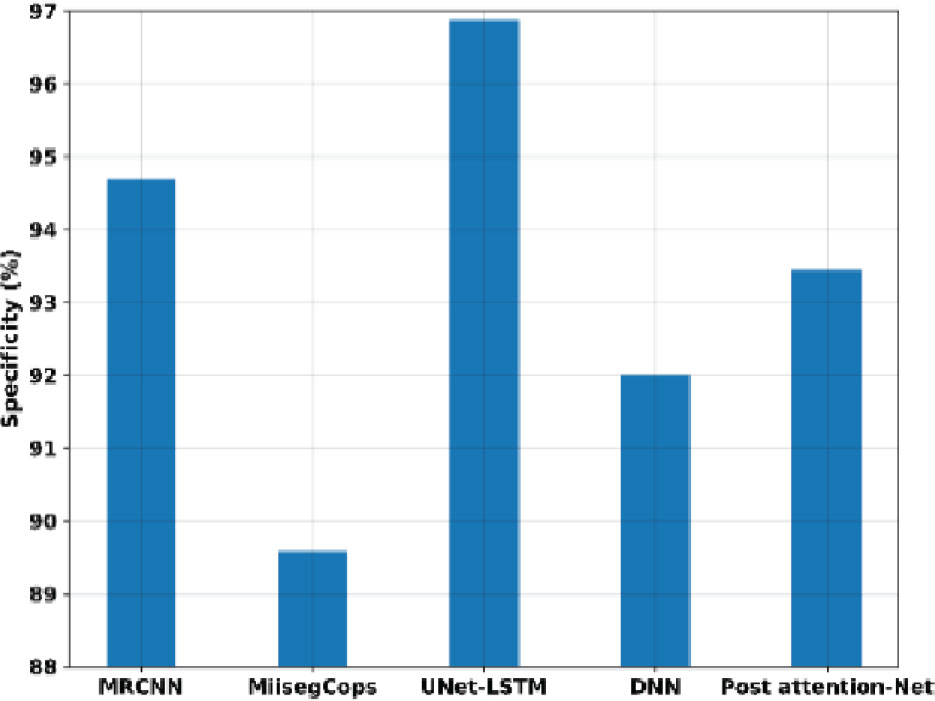
Figure 2:
Specificity comparison of various DL approaches. DL, deep learning.
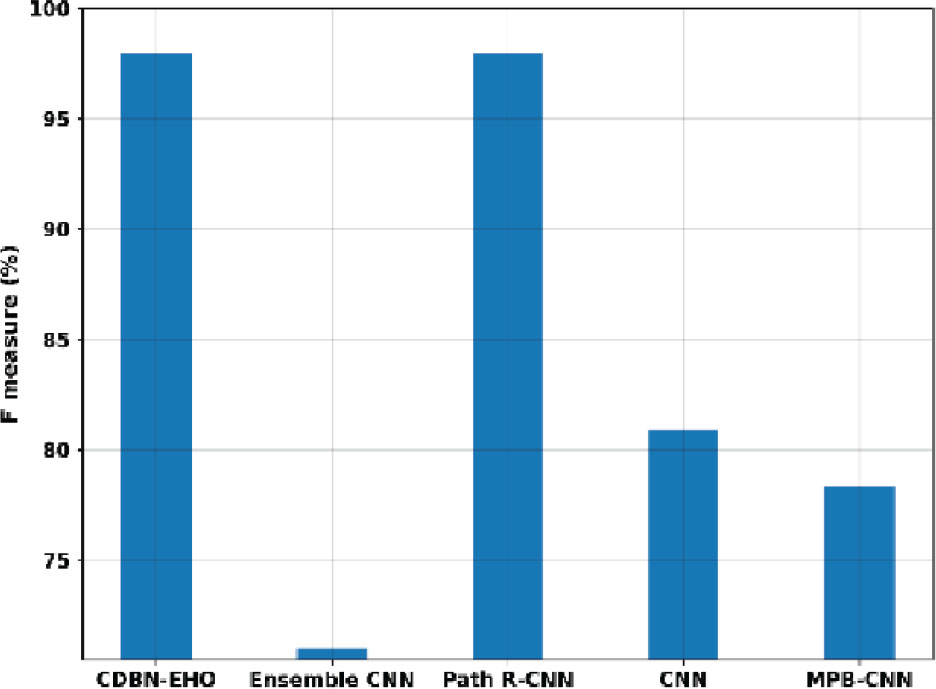
Figure 3:
Comparison of F-measure in existing DL methods. DL, deep learning.
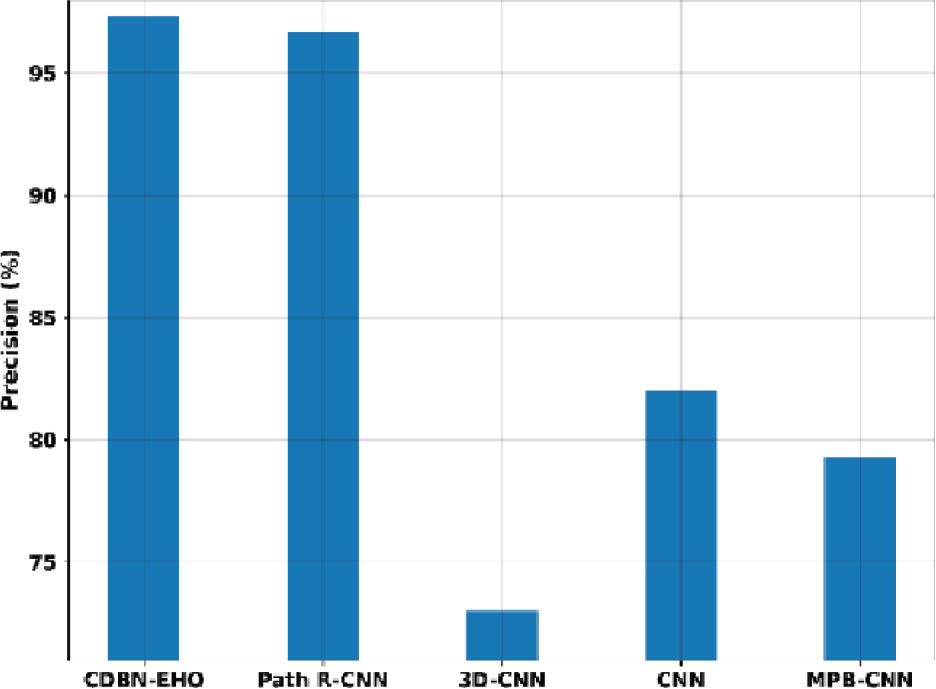
Figure 4:
Comparison of precision of existing DL approaches. DL, deep learning.
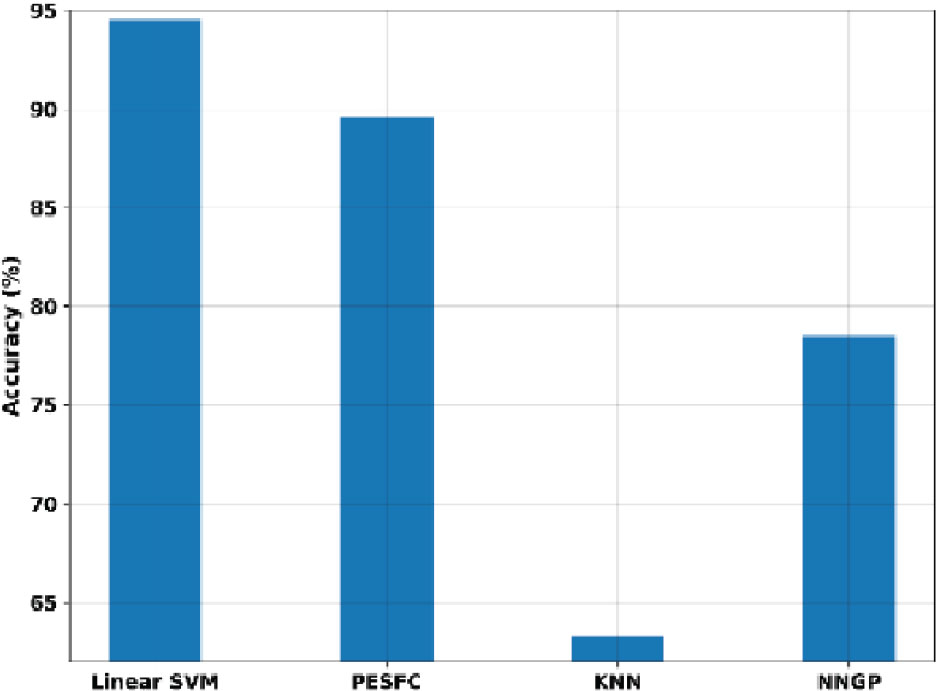
Figure 5:
Comparison of accuracy of existing ML approaches. DL, deep learning; ML, machine learning.
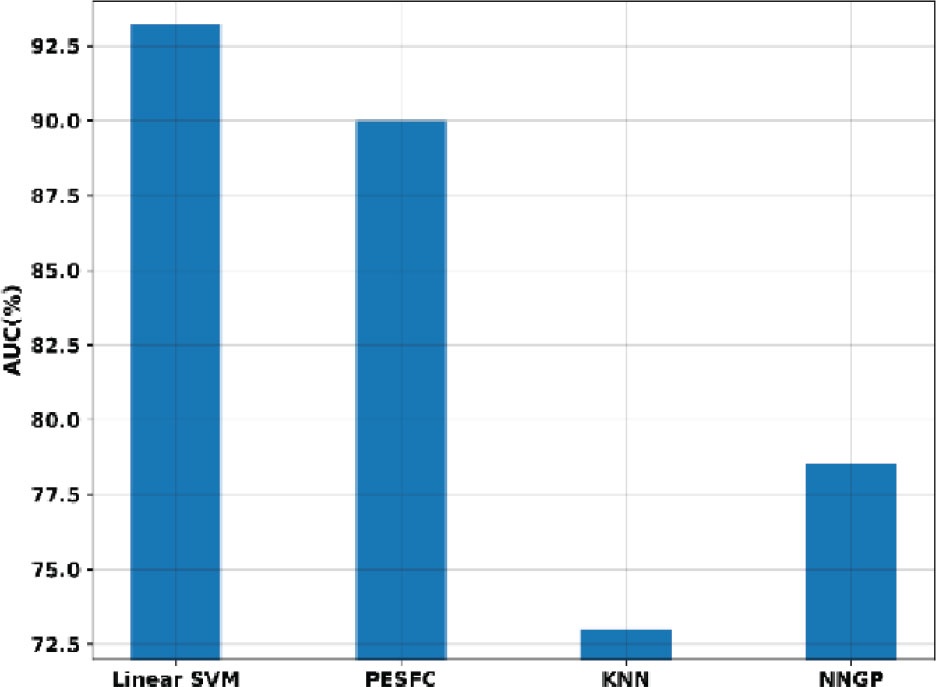
Figure 6:
Comparison of AUC of existing ML approaches. ML, machine learning.