
I. Introduction
Prostate cancer is one of the most widely prevalent cancers among men and, thereby, has health implications worldwide. According to the World Health Organization, it is the second most diagnosed cancer in men, and the incidence rates remain steadily rising, particularly among the older population. Despite great improvements in diagnostic techniques, diagnosis and staging of prostate cancer remain a complex and error-prone process. Current techniques suffer from several significant shortcomings, including low sensitivity, interobserver variability, misdiagnosis, and overtreatment [1, 2]. There is now increasing need for more accurate, noninvasive and reliable diagnostics for prostate cancer. Over the past 10 years, multiparametric magnetic resonance imaging (mpMRI) has emerged as a significant breakthrough in prostate cancer detection, giving precise anatomical and functional information. Integration of techniques in mpMRI typically include T2-weighted imaging, diffusion-weighted imaging, dynamic contrast-enhanced imaging, and, at times, magnetic resonance spectroscopy. Among these, increasing understanding of DWI, the advanced version, along with the usage of diffusion spectrum-weighted imaging (DWSI) provide strong insights about the viability of lesions in assessing tissue microstructure. These imaging modalities note that water molecules within the tissues move randomly and try to provide the apparent diffusion coefficient (ADC) values from that, which in turn has proven to be sensitive to the tissue density-serious characteristics of cancers. Prostate cancer usually exhibits a process of heterogeneous growth. Therefore, incorporating DWSI into mpMRI will allow for a more thorough analysis of the prostate tissue, which should allow for a more rapid diagnosis and better categorization of cancerous growths [3,4,5].
While DWSI provides a more thorough analysis of prostate cancer lesions, one of its major challenges is the high noise accompanying high b-value images that can hamper image quality and, hence, diagnostic precision. Recent developments in magnetic resonance (MR) techniques have diminished these disadvantages and included contemporary noise reduction methods combined with high spatial resolution for the purpose of promoting more durable and dependable DWSI implementations for improved visualization and characterization of prostate cancer lesions. Furthermore, the move to non-Gaussian models from the traditional mono-exponential diffusion models has shown potential in enhancing the quantitative assessment of tissue features, especially in terms of distinguishing malignant from benign tissues. However, even with these remarkable advancements in imaging techniques, interpretation of data derived from mpMRI continues to fall victim to human error and variability. Manual print interpretation can introduce frankly substantial interobserver variability, complicating clinical decision-making [6,7,8,9]. Gleason score (GS) estimation is one of the most important aspects of prostate cancer diagnosis in that it helps provide insight into cancer aggressiveness, which will provide direction for treatment options.
Traditionally, Gleason scoring has been a subjective process under the supervision of a pathologic looking at tissue samples under the microscope. This has a high tendency toward subjectivity with considerable interobserver variation. In recent times, machine learning (ML) and deep learning (DL) approaches have shown enormous potential to transform mpMRI and DWSI scan interpretation mechanisms. Such systems automate the whole process of data analysis with utmost perfection, rendering humans less able and reducing human errors, to ensure homogeneously consistent superior quality pathologic pigment-free slides. Support vector machines (SVM), random forest (RF), and the k-nearest neighbor (KNN) algorithm are some of those neural networks that have been successful in distinguishing malignant and benign cancers. These methods rely upon characteristic feature extraction, which determines the number of characteristics possessed by certain lesions, including texture, shape, and intensity patterns about regions of interest (ROI) to differentiate cancerous or benign lesions. Yet the issue calls for DL models, especially convolutional neural networks (CNNs), which have some intrinsic qualities that are fortuitously well-suited to the perceptual complexities of mpMRI images and are capable of learning spatial hierarchies and discerning minute patterns within imaging data. These DL procedures turn out to be particularly well-suited to the specific task of lesion detection in mpMRI and DWSI, thereby autonomously and with high accuracy enabling segmentation and classification [10,11,12].
Recent advances in DL and ML techniques have made it possible to automate GS estimation, allowing for a decrease in subjectivity and improved consistency of this key diagnostic parameter. Using DL models like CNNs and RNNs, researchers have developed systems that accurately predict GSs from mpMRI and DWSI images. Such systems perform some feature extraction from images, learn patterns that correlate with the histopathological properties of the tissue, and produce a GS estimate that aids the clinician in deciding the best course of treatment. The capacity for automated Gleason scoring to function with mpMRI and DWSI imaging represents an innovative leap forward in prostate cancer diagnosis. The technologies could ensure better risk stratification and personalized treatment planning by providing a consistent, reproducible, and objective GS. Furthermore, when combined, advanced imaging modalities, automated scoring systems, and ML/DL techniques build an integrated diagnostic pipeline that can improve early detection and reduce the heavy dependence on invasive biopsy procedures and facilitate more informed decisions for treatment [13,14,15]. However, a comprehensive review focusing on the integration of mpMRI and DWSI imaging, along with the automation of GS estimation using ML/DL methods, has not been adequately explored. Despite the advances in individual modalities, there is a lack of synthesized research combining these technologies to create an integrated diagnostic pipeline. The main contributions of the review paper on enhancing prostate cancer diagnosis using advanced imaging techniques are as follows:
The paper provides an extensive review of various approaches, including DL and ML techniques, for improving prostate cancer diagnosis using mpMRI and DWSI.
Discusses the automation of GS estimation through DL models and also emphasizes the integration of different imaging modalities, highlighting its potential to reduce subjectivity and improve consistency in prostate cancer diagnosis.
This review assesses the advantages of automated techniques in interpreting mpMRI data compared with manual methods, focusing on their potential to improve diagnostic precision, address implementation challenges, and explore future directions for enhancing prostate cancer diagnosis.
The content of the paper is organized as follows: Section 2 presents the literature review of various approaches for enhancing prostate cancer diagnosis; Section 3 provides comparative analysis; Section 4 discusses the results; Section 5 concludes the paper; and finally, Section 6 provides the future perspective.
II. Literature Review
The literature review section explores the latest advancements and challenges in prostate cancer diagnosis using advanced imaging techniques such as Diffusion-Weighted Synthetic Imaging (DWSI) and mpMRI. It covers a range of approaches including DL, ML, and the integration of various imaging modalities to enhance diagnostic accuracy. The review highlights key topics such as GS estimation, the use of molecular biomarkers, and the development of clinical decision support systems. The directions for reviewing the various approaches for improving prostate cancer diagnosis using mpMRI and DWSI are shown in Figure 1.
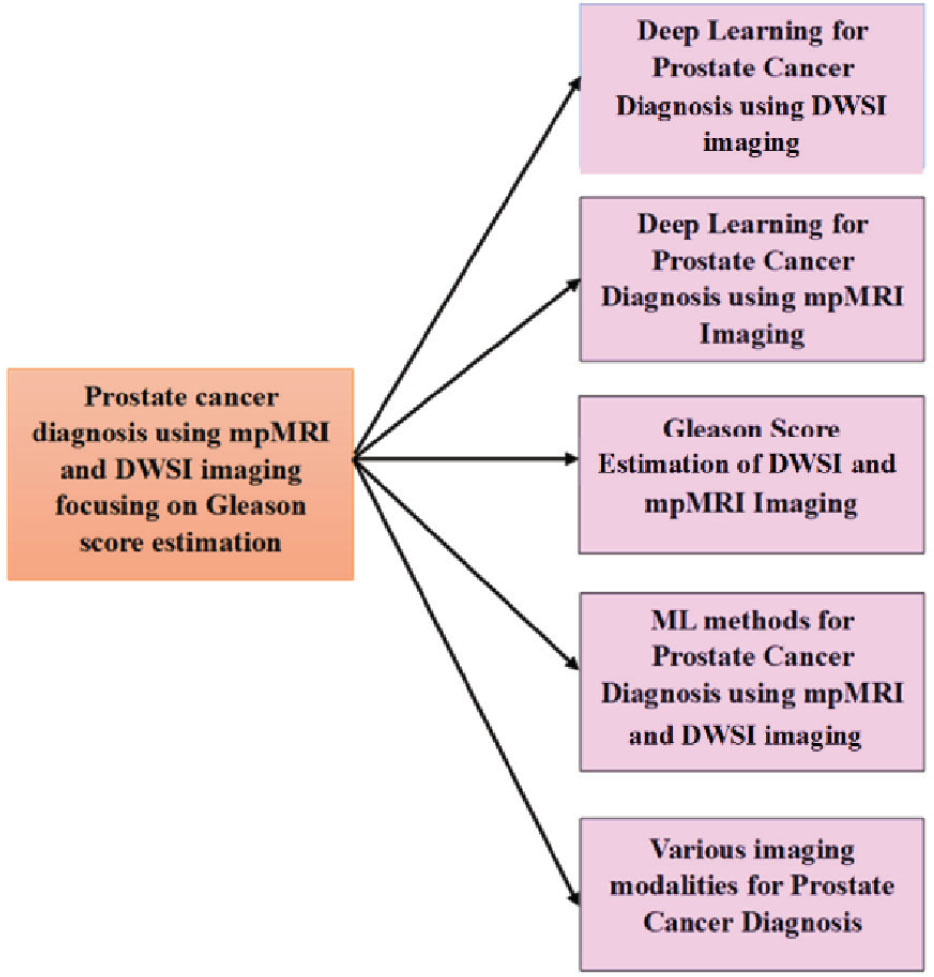
Figure 1:
Directions for reviewing improved prostate cancer diagnosis using mpMRI and DWSI. DWSI, diffusion-weighted synthetic imaging; mpMRI, multiparametric magnetic resonance imaging.
It also emphasizes the importance of overcoming technological and clinical hurdles, such as dataset heterogeneity and interobserver variability. Ultimately, the goal is to improve patient care through more accurate and effective diagnostic and treatment strategies.
a. Review on DL for prostate cancer diagnosis using mpMRI
Recent advances in DL have significantly improved prostate cancer detection using mpMRI, focusing on segmentation, classification, and risk assessment. Machireddy et al. [16] developed a U-Net with attention, achieving improved malignancy detection across 55 biopsy-confirmed cases. However, the model lacked integration of ADC and T2W modalities, limiting its diagnostic depth. Similarly, Soni et al. [17] offered SEMRCNN that exploited both ADC and T2W images through parallel convolutions. While enhancing segmentation, it suffered from poor lesion boundary precision due to overlapping tissue. In both cases, lesion detection was improved but not fully reliable across tissue types. The absence of multimodal harmonization reduced the models’ real-world robustness. Therefore, combining features across image sequences remains an open avenue.
In a related effort, Jiang et al. [18] introduced MiniSegCaps, a lightweight capsule-based architecture for segmentation and PI-RADS classification. The model effectively distinguished between high- and low-grade lesions using fewer parameters. However, dataset limitations prevented it from executing detailed lesion grading or stratification. Similarly, Wang et al. [19] proposed SegDGAN, a GAN-driven segmentation model that delivered high Dice scores. Nonetheless, false positives were frequent due to poor delineation of tumor margins, confusing healthy tissue for cancerous regions. Both approaches reflect how lightweight and adversarial models can enhance detection. Yet, segmentation fidelity remains hindered by anatomical complexity and limited datasets. This highlights the need for models that pair accuracy with boundary sensitivity across clinical variations.
Fusion-based models have also been explored to improve visibility and diagnostic consistency in mpMRI. Huang et al. [20] designed a U-Net-based image fusion method to enhance lesion contrast by combining multiple MRI sequences. Its success, however, was heavily influenced by image quality, making it less effective under noisy or variable scan conditions. Likewise, Gavade et al. [21] applied U-Net for ROI segmentation, followed by classification, stressing the importance of interpretability. These models indicate that fusion improves feature representation but depends greatly on acquisition consistency. They also call attention to the need for standardized imaging pipelines. While accuracy was enhanced, clinical applicability was constrained. Thus, deep fusion remains promising but requires robustness across scanners and centers.
Hung et al. [22] developed a Cross-slice Attention Transformer (CAT) that addressed anatomical precision by attending across 2D slices of T2W MRI scans. The model improved segmentation of transitional and peripheral zones but was limited by its reliance on T2W alone. In parallel, Mehmood et al. [23] adopted EfficientNet-based transfer learning across T2W, ADC, and DWI using a triple-branch network. This multi-sequence integration improved classification stability under diverse imaging conditions. Both models exemplify the value of sequence-aware transformers and pretraining. Yet, challenges remain in generalizing to unseen institutions or varied equipment. Incorporating attention has shown meaningful gains, but external validation is often absent. More studies must explore how transformer backbones perform in real diagnostic environments.
Yi et al. [24] proposed a deep neural network (DNN)-based computer-aided diagnosis (CAD) system that incorporated multiple mpMRI modalities. While showing potential, the method lacked advanced scoring features for atypical presentations, reducing sensitivity in less common cases. Similarly, Duran et al. [25] developed ProstAttention-Net, a CNN architecture that fused lesion grading with segmentation using attention mechanisms. Its end-to-end design was effective, yet it only utilized mpMRI, missing potential enhancement from hybrid imaging like PET/MRI. Both approaches reflect the growing trend of joint learning frameworks in CAD. However, their clinical reliability still hinges on modality expansion and performance across patient subgroups. These models reveal that multi-task learning is feasible but requires stronger validation.
Table 1 depicts the techniques, advantages, and limitations in the context of prostate cancer detection and segmentation using mpMRI. In this study, several DL techniques have been applied, such as U-net with attention mechanisms, SEMRCNN, and SegDGAN, for prostate cancer detection and segmentation from mpMRI images. The models provide advantages in terms of improved accuracy, better lesion localization, and enhanced segmentation through the integration of multi-modal data along with attention mechanisms. Despite all of the above, there are some challenges: the segmentation cannot be done properly because the boundary overlaps with the normal tissue; the reliance on very few imaging modalities like T2WI; and false positives. Although some methods like ProstAttention-Net and MiniSegCaps improve the performance of segmentation and classification, they still have problems regarding data quality and require further multi-modal integration. The problems here include inconsistent data, small sample size, and misclassification due to incomplete feature extraction. Image quality remains problematic, and cancer boundaries are far from clear; other modes of imaging are usually required to improve detection and segmentation.
Table 1:
Review on DL for prostate cancer diagnosis using mpMRI
| Ref. No. | Technique name | Significance | Limitation |
|---|---|---|---|
| [16] | U-net with attention mechanism | Improved accuracy in prostate cancer detection by reducing over-detection. | Did not explore the combination of features from different modalities (T2w and ADC), which poses challenges. |
| [17] | SEMRCNN | Autonomously extracts prostate cancer regions, combining ADC and T2W images for better segmentation. | Boundaries of lesions can overlap with normal tissues, reducing segmentation precision. |
| [18] | MiniSegCaps | Multi-branch network with CapsuleNet’s attention map for improved segmentation and PI-RADS classification. | Did not address specific PI-RADS categories due to sample size limitations, limiting risk stratification. |
| [19] | SegDGAN | Multi-scale feature extraction in GAN-based model improves segmentation accuracy and reliability. | False positives persist, marking healthy tissue as cancerous despite high Dice similarity coefficients. |
| [20] | U-Net-based Fusion Technique | Improves cancer visibility and fusion accuracy by using a weighted distribution strategy to reduce artifacts and energy loss. | Fusion process accuracy depends on the consistency and quality of the supplied images. |
| [21] | U-Net with LSTM | U-Net segmentation combined with LSTM for temporal relationship classification, improving diagnostic accuracy. | Data inconsistencies and model interpretation challenges, requiring collaboration and standardization. |
| [22] | CAT | Improved segmentation by identifying cross-slice correlations, enhancing local and global information. | Relies on T2WI, which may not have enough contrast for precise segmentation; multispectral MRI could help. |
| [23] | EfficientNet-based Transfer Learning | Combines transfer learning and DL to improve feature extraction from various MRI sequences. | Limited by reliance on pretrained models and might miss subtle cancer features in diverse cases. |
| [24] | DNN-based CAD | Uses an ensemble learning technique to enhance classification accuracy through multi-modal MRI images. | Reliance on limited mpMRI sequences can miss relevant features, leading to misclassification in some cases. |
| [25] | ProstAttention-Net | End-to-end architecture with attention mechanism for accurate segmentation and grading. | Limited by reliance solely on mpMRI data; could be enhanced by incorporating other imaging modalities like PET. |
[i] ADC, apparent diffusion coefficient; CAT, cross-slice attention transformer; DL, deep learning; DNN, deep neural network; LSTM, long short-term memory; mpMRI, multiparametric magnetic resonance imaging; MRI, magnetic resonance imaging; PET, positron emission tomography; PI-RADS, prostate imaging reporting and data system; SEMRCNN – spatial encoding mask region-based convolutional neural network.
b. Review on DL methods for prostate cancer diagnosis using DWSI imaging
Zhong et al. [26] presented a convolutional recurrent neural network for diffusion-weighted imaging (CRNN-DWI) that combines CNNs for spatial feature extraction and RNNs for temporal or directional analysis to reconstruct heavily undersampled DWI datasets. While effective in enhancing reconstruction quality, the model does not directly support prostate cancer segmentation. Integration with segmentation frameworks is required to provide a complete diagnostic solution. This limitation reduces its standalone utility in end-to-end clinical workflows. Similarly, Hu et al. [27] compared two DWI acquisition strategies zoomed-field-of-view (zDWI) and full-field-of-view (fDWI), within DL-based CAD systems. Although improved delineation was achieved using zDWI, the model’s performance lacked validation across diverse patient populations. This indicated poor generalizability, restricting broader application. Further research was encouraged to strengthen model resilience for robust real-world deployment.
Kaye et al. [28] explored the acceleration of prostate DWI imaging by reducing averages and applying a guided DnCNN denoising network to preserve image fidelity. The absence of a true noise-free reference for DWI or ADC maps necessitated the use of surrogate high b-value images, which introduced training uncertainty. This limitation led to inconsistent results, especially for subtle lesions. In response, the authors recommended exploring noise2noise training paradigms that do not require clean ground truths. Similarly, Abdelmaksoud et al. [29] introduced a CAD system using non-negative matrix factorization (NMF) for integrating multi-b-value DWI-derived features. Although their method accurately localized the prostate region, statistical analysis for optimal b-value selection was not conducted. Reducing b-values could improve computational efficiency without significant accuracy loss. These studies underscore the importance of balancing image quality with acquisition speed and processing demands.
In related work, Mao et al. [30] implemented a 3D U-shaped CNN model for automatic prostate segmentation using DWSI. The approach used multi-b-value DWSI images to capture rich diffusion contrast, aiding in robust tissue delineation. Furthermore, uncertainty maps were employed to highlight regions of confident predictions, improving treatment planning reliability. However, the model did not include derivative maps like ADC or b0 gradients, limiting its diagnostic completeness. Likewise, Liu et al. [31] developed a 3D U-Net CNN for lymph node (LN) detection from pelvic DWSI images in prostate cancer cases. While the model successfully segmented suspicious LNs >0.8 cm, its use was limited to the pelvic region. Additional validation was recommended to generalize the method to other anatomical regions and patient cohorts. These studies highlight the emerging role of 3D CNNs in diffusion-weighted segmentation but reveal application scope limitations.
Alhassan [32] proposed a novel system that segments prostate lesions using preprocessing and ROI-based extraction to isolate potentially malignant areas. The system was built upon a multi-level bidirectional long short-term memory network (Bi-LSTM) with attention mechanisms to refine focus within suspicious regions. Although promising in theory, the method incurs high computational overheads, making it unsuitable for real-time deployment without powerful hardware. In continuation, Jeong et al. [33] applied deep learning reconstruction (DLR) to DWI enhancement, improving lesion visibility and signal-to-noise ratio (SNR). Their study also noted the potential for reducing scan duration without degrading diagnostic accuracy. However, the clinical impact of DLR, including long-term patient outcomes or treatment modification, remains unexplored. Therefore, while reconstruction methods improve visual quality, their contribution to diagnostic or prognostic accuracy needs further clinical correlation.
Hu et al. [34] presented a GAN-based framework for synthesizing high-b-value DWSI images from standard acquisitions to enhance lesion conspicuity. The system offered a pathway to improved diagnosis without the need for extended scan times. However, performance under moderate to severe motion artifacts was not evaluated, limiting its reliability under real-world scanning variability. Similarly, Motamed et al. [35] proposed a transfer learning-enhanced U-Net for segmenting prostate zones, namely, the whole gland (WG) and transitional zone (TZ). While segmentation accuracy was achieved, the study did not provide prostate volume calculations—a crucial clinical parameter for prognosis and therapy monitoring. Together, these efforts demonstrate that while advanced DL architectures can improve imaging outputs, practical clinical metrics and generalizability are essential for full adoption.
Clearly from Table 2, it has been noticed that some techniques of DL have used DWSI in prostate cancer diagnostics such as CRNN, 3D U-Net CNN, and Modified U-Net. Among the quality enhancement in terms of detection improvement of cancer through their increased segmentation accuracy of the cancer area, important gains occurred over accelerated scan time which were needed for use in a clinic. However, disadvantages include issues like the problem of having a noise-free ground truth for training, inadequate validation across various patient populations, and necessity for further model refinement when applying it clinically. The two approaches with integration of uncertainty quantification and multi-modal learning approaches present promising outcomes but are mostly computationally expensive, limiting the practicability in real-time. Further research and improvements are needed to overcome these challenges and enhance clinical applicability for prostate cancer detection.
Table 2:
Review on DL methods for prostate cancer diagnosis using DWSI imaging
| Ref. No. | DL technique | Significance | Limitation |
|---|---|---|---|
| [26] | CRNN-DWI | Improves productivity and efficiency by reducing scan durations while maintaining image quality. | Does not inherently perform cancer segmentation; requires integration with segmentation models for full cancer detection. |
| [27] | DL-CAD | zDWI shows higher true positive detection rate due to lower ADC values and higher contrast-to-noise ratio (CNR). | Needs further validation across patient categories and has possible generalizability issues. |
| [28] | DnCNN | Enhances image quality by reducing noise in DWI images, helping with prostate cancer detection. | Relies on estimated high b-value images, leading to uncertainty in model training. |
| [29] | CNN: AlexNet & VGGNet | Combines multiple features for accurate segmentation and detection of prostate cancer. | Does not determine optimal b-value combinations for the best accuracy. |
| [30] | 3D U-Shaped CNN | Utilizes multi-b-value DWI images for better diffusion contrast and incorporates uncertainty analysis. | Excludes DWI image derivatives, limiting segmentation accuracy. |
| [31] | 3D U-Net CNN | Provides automated, high-throughput LN segmentation for prostate cancer patients. | Limited to pelvic LNs; requires further validation for broader clinical use. |
| [32] | Multilayer U-Net (ResNet-101) + Bi-LSTM | Enhances prostate cancer identification with precise segmentation and localization. | High computational overhead, requiring powerful hardware for real-time applications. |
| [33] | DLR | Improves lesion conspicuity, SNR, and CNR, potentially reducing scan time without sacrificing diagnostic accuracy. | Does not assess long-term clinical impact on treatment or patient outcomes. |
| [34] | GAN | Generates synthetic high-b-value DWSI from lower b-value acquisitions, potentially improving diagnostic accuracy. | Performance degrades with moderate or severe distortions or motion artifacts. |
| [35] | Modified U-Net | Improves segmentation on smaller datasets and adapts models for different cancer types. | Does not calculate prostate volume, which is essential for clinical assessments. |
[i] ADC, apparent diffusion coefficient; CNR, contrast-to-noise ratio; DL-CAD, deep learning–computer-aided detection DLR, deep learning reconstruction; DnCNN, denoising convolutional neural network; DWSI, diffusion spectrum-weighted imaging; LNs, lymph nodes; SNR, signal-to-noise ratio; zDWI, zoomed-field-of-view.
c. Review on GS estimation in DWSI and mpMRI imaging
Chaddad et al. [36] proposed a radiomics approach to estimate GS using deep entropy features (DEFs) derived from mpMRI through nine pretrained CNNs, such as NASNet-Mobile. These features captured tissue texture and variability from intermediate layers of CNNs, enhancing lesion characterization. However, the method fell short in capturing complex non-linear feature interactions. This limitation reduced its predictive robustness in high-grade tumor cases. Similarly, Butt et al. [37] developed a multi-label ensemble deep-learning classifier for GS prediction in histopathology using the SICAPv2 dataset. Although patch-level accuracy was enhanced, pixel-level granularity was absent, compromising diagnostic precision. Moreover, majority voting-induced label inconsistencies remained an issue. Future extensions may address pixel-wise classification for finer GS discrimination.
Pellicer-Valero et al. [38] introduced a fully automated framework using 3D Retina U-Net for mpMRI-based prostate cancer detection, segmentation, and Gleason Grade Group (GGG) estimation. The RetinaNet component facilitated one-shot lesion localization, while the U-Net managed pixel-wise delineation. Classification and bounding box refinement were guided by intermediate activation maps. While this multi-task model demonstrated promising GGG prediction, integration with clinical workflows remains to be validated. In continuation, Yoshimura et al. [39] combined semantic segmentation with a 3D-CNN to estimate GS directly from diagnostic MRI. The method aimed to replace invasive biopsies with non-invasive, image-driven assessment. While it improved accuracy through tissue segmentation, its broader application in early diagnosis and treatment guidance is still evolving.
Khalek et al. [40] emphasized the strong correlation between DWI/ADC parameters and GS for prostate cancer aggressiveness evaluation. Their findings underscored the potential of quantitative diffusion metrics as imaging biomarkers for tumor grading. However, clinical applicability demands further study to improve reproducibility and standardization. Similarly, Li et al. [41] developed a CNN-based architecture that used multiscale standard convolutions and atrous spatial pyramid pooling (ASPP) to segment and grade Gleason patterns. Post-processing via conditional random fields (CRFs) enhanced precision, but also increased computational burden. Although segmentation performance improved, balancing efficiency and clinical scalability remains a challenge. These works reinforce the growing role of hybrid CNN models in pathology-grade prediction.
Mary et al. [42] proposed a hyperparameter-optimized deep belief network (CDBN-EHO) for joint Gleason grading and prostate cancer classification in histopathological images. Their approach combined Elephant Herding Optimization with a multi-task prediction framework, improving training efficiency. Nonetheless, the method showed weaknesses in subtle or heterogeneous patterns, often misclassifying poorly differentiated tissues. Similarly, Nai et al. [43] integrated mpMRI and PET features with ML classifiers like SVM, kNN, and Ensemble Models for GS prediction. Despite achieving high accuracy using eight selected radiomic features, essential discriminative traits may have been omitted. The robustness of this minimal feature set across diverse clinical scenarios warrants further scrutiny.
In related work, Balaha et al. [44] introduced a two-stage DL pipeline for prostate cancer classification and segmentation using mpMRI. The framework first localized diseased areas via U-Net-based segmentation, followed by classification for accurate diagnosis. This combination enabled early identification and delineation of malignant zones, supporting targeted therapy planning. However, generalizability to unseen datasets and integration with biopsy data were not addressed. Furthermore, real-time inference speed and hardware requirements remain critical for clinical application.
As illustrated in Table 3, various techniques have been devised for the estimation of GS in prostate cancer by using DWSI and mpMRI imaging. These techniques include DEFs with CNNs, multi-label ensemble DL classifiers, and 3D Retina U-Net, which contribute to significant improvements in texture analysis, label consistency, and fully automated segmentation in the estimation of GGG. However, these techniques have limitations such as a failure to capture non-linear correlations, loss of finer pixel-level details, struggling with complex or noisy images, and increased computational complexity. Although semantic segmentation and CNN-based region segmentation improve the grading accuracy, there is still room for further refinement. DWI/ADC parameters indicate promising aspects of assessing cancer aggressiveness, but it needs more standardization. ML models involving radiomic features reduce inter-reader variability but can err in some clinical situations. Further work is still needed in order to sharpen and expedite these techniques for estimating the GS.
Table 3:
Review on GS estimation in DWSI and mpMRI imaging
| Ref. No. | Technique name | Significance | Limitation |
|---|---|---|---|
| [36] | DEFs with CNNs | Improves texture and variability analysis; uses Shannon entropy for feature generation; reduces human intervention | Non-linear correlations and interactions between features not well captured, affecting feature selection. |
| [37] | Multi-label ensemble deep-learning classifier | Addresses label inconsistencies and improves Gleason grading accuracy using transfer learning and patch-based classifiers. | Loss of finer details at the pixel level, which may impact grading accuracy. |
| [38] | 3D Retina U-Net for detection and segmentation | Fully automated approach for segmentation and GGG estimation from mpMRI. | Potential limitations in processing highly complex or noisy images. |
| [39] | Semantic segmentation with 3D-CNN | Segmentation isolates the prostate, improving the precision of GS prediction and reducing the need for biopsies. | Needs further improvement for enhancing prostate cancer diagnosis non-invasively. |
| [40] | DWI/ADC parameters | Found significant correlations between DWI/ADC parameters and GS, helping to assess prostate cancer aggressiveness. | Requires more studies to refine interpretation variability and uniformity in radiology standards. |
| [41] | CNN-based Gleason pattern region segmentation | Enhances Gleason grading accuracy by segmenting Gleason pattern regions using multi-scale convolutions. | Increased computational complexity due to the combination of multiple convolutions and post-processing. |
| [42] | CDBN-EHO with CRF segmentation | Enhances prostate cancer detection, which improves the accuracy of both Gleason grading and epithelial cell identification, leading to better differentiation of cancerous tissues. | Struggles with fine-grained classification in challenging cases with subtle patterns or poorly differentiated tissue. |
| [43] | ML models (DT, SVM, kNN, EM) using radiomic features | Improved accuracy in categorizing prostate cancer lesions by using multiple feature types, reducing inter-reader variability. | Feature selection is not robust in all clinical situations, leading to potential misclassification. |
| [44] | Hybrid DL system with pretrained CNNs and U-Net | Early and accurate prostate cancer classification and segmentation. | Dependence on accurate segmentation for diagnosis; challenges with model generalization. |
[i] DEFs, deep entropy features, DL, deep learning; DT, decision tree; DWI, diffusion-weighted imaging; DWI/ADC, diffusion-weighted imaging / apparent diffusion coefficient; DWSI, diffusion spectrum-weighted imaging; EL, Extreme Learning; EM, Expectation-Maximization; GGG, Gleason grade group; GS, Gleason score; KNN, k-nearest neighbor; ML, machine learning; mpMRI, multiparametric magnetic resonance imaging; SVM, support vector machines.
d. Review on ML methods for prostate cancer diagnosis using mpMRI and DWSI imaging
Varan et al. [45] introduced a binary classification framework for prostate cancer detection by integrating ridge regression-based feature selection with a linear SVM. Four selection strategies correlation coefficient, forward-sequential, backward-sequential, and significance-based ensured robustness and relevance in chosen features. Their method improved training performance and generalization. However, reliance on linear SVM restricted the capture of non-linear data relationships. Extending the approach with kernelized models may enhance performance. Similarly, Akinnuwesi et al. [46] developed SVM-PCa-EDD for early differential diagnosis from non-imaging clinical datasets. Despite promising classification of positive and negative patients, harmonizing multiple feature selection outputs proved complex and time-consuming.
Fan et al. [47] devised a radiomic approach combining mpMRI and clinical data to predict biologically relevant features of prostate cancer, including Ki67, S100, and perineural invasion (PNI). After normalization, Reconstruction Feature Elimination with RFs was used for selecting key features. While insightful, manual lesion segmentation introduced interobserver variability, limiting reproducibility. Gaudiano et al. [48] investigated ML-enhanced radiomics to improve PI-RADS-3 lesion classification using ADC map features. Feature selection used least absolute shrinkage and selection operator (LASSO) and Wilcoxon tests before SVM classification. However, failure to stratify peripheral and TZs reduced specificity. Anatomical variation in lesion characteristics warrants zone-wise modeling in future work.
Jin et al. [49] presented a voxel-wise prostate cancer classifier using a Bayesian model that incorporated spatial correlation and patient-level heterogeneity. By integrating Gaussian processes, autoregressive models, and hierarchical priors, this method improved lesion localization. Although effective, the model operated on 2D slices due to limitations in co-registering 3D MRI with histopathology. In related work, Chen et al. [50] developed ML-based radiomics models using ADC, DWI, and T2-weighted data to predict clinically significant prostate cancer (csPCa) and general prostate cancer. RF and multilayer perceptron models were used. Manual segmentation increased variability and labor overhead, necessitating automation for scalability.
Tang et al. [51] developed a computer-aided diagnostic system utilizing mpMRI-derived geometric, topological, and texture features. The extracted features Minkowski functionals, gray-level co-occurrence matrix/gray-level gradient co-occurrence matrix (GLCM/GLGCM) textures, and wavelet descriptors were input into ML classifiers like KNN and SVM. While effective, generalization to diverse patient populations remains a challenge due to specificity of extracted features and model dependencies. In a similar domain, Zandie et al. [52] investigated mpMRI-based radiomic models to predict GGGs using optimal classifier-feature combinations. Despite reduced biopsy needs, absence of augmentation strategies limited class balance and overall model robustness.
Garg and Juneja [53] proposed using Possibilistic Exponential Spatial Fuzzy Clustering (PESFC) for malignant prostate capsule segmentation based on ADC, dynamic contrast-enhanced (DCE), and T2w imaging. The model leveraged spatial and fuzzy information to detect early-stage malignancies, contributing to reduced mortality. However, accurately distinguishing blurred boundaries between malignant and benign tissues remained a core limitation. Addressing this could further enhance diagnostic precision. Overall, these studies reveal strong advances in ML and radiomics for prostate cancer detection, while highlighting the persistent challenges in segmentation accuracy, model generalizability, and clinical integration across diverse data modalities.
As mentioned in Table 4, various ML techniques have been used to provide improved diagnosis of prostate cancer using mpMRI and DWSI imaging. Such methods include ridge regression with linear SVM, SVM-PCa-EDD, and Bayesian spatial models in enhancing diagnostic potential with regard to feature relevance, early diagnosis, and cancer localization. Radiomics, RF, and recursive feature elimination (RFE) allow for the non-invasive prediction of traits of the cancer, but manual segmentation continues to suffer from heterogeneity. Techniques like PESFC have improved segmentation accuracy, yet challenges remain with defining cancer boundaries. Overall, while these approaches show promise, limitations they face include a need for manual segmentation, difficulties in generalizing, and sub-optimal representation of non-linear complex relations among the features. Added to this is difficulty in handling high-dimensional 3-D MRI data, thereby keeping malignancy borders accurate. Such challenges make these ML-based approaches very much the basis for further fine-tuning and optimization.
Table 4:
Review on ML methods for prostate cancer diagnosis using mpMRI and DWSI imaging
| Ref. No. | ML technique | Significance | Limitation |
|---|---|---|---|
| [45] | Ridge regression with linear SVM | Improved robustness and feature relevance; better model training and generalization. | Linear SVM struggles with representing complex non-linear relationships. |
| [46] | SVM-PCa-EDD | Early prostate cancer diagnosis, overcoming late diagnosis and underdiagnosis. | Time-consuming feature selection process, complexity in harmonizing outcomes. |
| [47] | Radiomics with RF and RFE | Non-invasive prediction of biological traits; combines clinical data with MRI methods. | Manual lesion segmentation subject to inter-observer variability. |
| [48] | SVM | Improved diagnostic accuracy for PI-RADS-3 lesions. | Combining PZ and TZ lesions mask cancer detection in specific areas. |
| [49] | Bayesian approach with spatial models (NNGP, chimeric antigen receptor (CAR)) | Enhanced accuracy and localization of cancerous areas. | Developed for 2-D data, challenges with 3-D MRI and histopathology co-registration. |
| [50] | RF and multilayer perceptron. | Effective prediction of clinically significant prostate cancer. | Manual MRI segmentation introduces labor intensity and variability. |
| [51] | ML classifiers (SVM, KNN, EL) | Automated and precise evaluations of prostate cancer using mpMRI. | Struggles with generalization to diverse patient populations. |
| [52] | ML models with RF | Accurate Gleason grade prediction; reduces unnecessary biopsies. | No augmentation or oversampling used, which could improve robustness. |
| [53] | PESFC | Early cancer detection with improved segmentation accuracy. | Difficulties in accurately defining cancer boundaries, especially with ambiguous regions. |
[i] CAR, chimeric antigen receptor; DWSI, diffusion spectrum-weighted imaging; EL, extreme learning; KNN, k-nearest neighbor; ML, machine learning; mpMRI, multiparametric magnetic resonance imaging; MRI, magnetic resonance imaging; NNGP, neural network gaussian process; PESFC, possibilistic exponential spatial fuzzy clustering, PI-RADS-3, prostate imaging reporting and data system, category 3 RF, PZ, peripheral zone; random forest, RFE, recursive feature elimination, SVM, support vector machines; SVM-PCa-EDD, support vector machine – prostate cancer – early detection & diagnosis; TZ, transitional zone.
e. Review on various imaging modalities for prostate cancer diagnosis
Sethi et al. [54] proposed an LSTM-DBN-based model for evaluating gene expression in prostate cancer diagnosis and classification. The model learned complex interactions in gene-expressed data and was optimized using the Enhanced Whale Herd Optimization (EWHO) method. This ensured high accuracy and sensitivity for molecular-level detection. In continuation, Xu et al. [55] developed a fully automated CNN-based system using U-Net for detecting metastatic prostate lesions in PET/CT images. A weighted Dice loss function improved segmentation of lesions across diverse anatomical contexts. However, lesions near the bladder posed challenges due to signal overlap. Addressing this proximity issue is crucial for improving detection precision and clinical reliability.
Liu et al. [56] combined S-Mask R-CNN and Inception-v3 to detect prostate cancer from ultrasound images with improved segmentation. The approach enabled accurate identification of candidate regions, addressing limitations in 2D-to-3D ultrasound transitions. However, handling volumetric data remains computationally intensive and may hinder real-time application. Similarly, Rovera et al. [57] used k-means clustering for lymph-node identification in intraoperative 68Ga-PSMA-11 PET/CT scans. Although effective in segmenting nodal structures, the approach lacked the ability to detect extra-nodal disease in fatty tissues. Incorporating pathological variability could enhance this model’s diagnostic comprehensiveness.
Hassan et al. [58] developed a multi-modal DL classifier integrating pretrained DL models for prostate cancer detection using ultrasound and MRI data. This architecture improved performance across different image modalities. However, inconsistencies in imaging protocols and equipment across clinical setups reduced model generalizability. In related work, Jiang et al. [59] introduced MicroSegNet for high-resolution prostate segmentation in micro-ultrasound images. While it improved segmentation precision, its dependence on specific hardware limited its adaptability. Broader applicability would require fine-tuning for a range of devices and imaging configurations in clinical use.
Singh et al. [60] utilized a 3D-CNN model to detect prostate cancer and estimate GS from MRI data, focusing on epithelial tissues. The model localized lesions with high accuracy but struggled with small or anatomically complex tumors. Missed detections near difficult-to-image zones such as the bladder remain a challenge. Similarly, Yuan et al. [61] proposed Z-SSMNet, a zonal-aware self-supervised mesh network using bi-parametric MRI. It captured both inter- and intra-slice variations through 2D, 2.5D, and 3D CNN modules. However, reliance on zonal masks from specific T2-weighted imaging/apparent diffusion coefficient (T2WI/ADC) configurations reduced generalizability when data properties changed significantly.
Abdelmaksoud et al. [62] introduced a CAD framework that detected prostate cancer using DWI images collected at multiple b-values. Feature extraction was performed using NMF to isolate patterns indicative of cancerous tissue. While segmentation accuracy improved, the system’s dependency on DWI image quality limited robustness. Similarly, Korevaar et al. [63] suggested a 3D-CNN model for incidental detection of prostate cancer in routine abdominal CT scans. The framework leveraged spatial patterns in volumetric data for cancer identification. Despite its strong performance, low soft tissue contrast in CT images remains a limiting factor for detection accuracy.
From Table 5, it becomes clear that various imaging modalities are employed for the diagnosis of prostate cancer, with each modality having its advantages and drawbacks. An analysis of gene expression data provides an advantage in modeling sequential dependencies and hierarchical characteristics but is limited to non-imaging data. PET/CT enables better visibility of lesions, yet the proximity of lesions to the bladder complicates interpretation. The ultrasound and micro-ultrasound modalities demonstrate high-definition segmentation; yet, there are constraints posed by 3D data and device configuration. It gives a good quality of high-contrast images of the cancer with MRI and DWI; however, some small cancers are still missed or masked by artifacts. Again, the CT scan, although very useful, will not provide the same soft tissue contrast. Combining these modalities with DL algorithms shows better prospects for enhancing the accuracy of diagnosis.
Table 5:
Review on various imaging modalities for prostate cancer diagnosis
| Ref. No. | Imaging modality | Significance | Limitation |
|---|---|---|---|
| [54] | Gene Expression Data (LSTM-DBN) | Captures sequential dependencies and hierarchical features for accurate diagnosis. | Limited to gene expression data; not applicable for imaging data. |
| [55] | PET/CT Images (U-Net CNN) | Enhances accuracy in detecting lesions of varying sizes, intensities, and locations. | Difficulties in detecting lesions near the bladder due to signal interference. |
| [56] | Ultrasound Images (S-Mask R-CNN, Inception-v3) | Accurate segmentation and lesion identification with enhanced mask R-CNN. | Challenges in handling 3D ultrasound images and volumetric data. |
| [57] | PET/CT Images (68Ga-PSMA-11) | Automates LN segmentation and real-time decision support in surgery. | Does not fully address extra-nodal fatty tissue involvement in cancer detection. |
| [58] | Ultrasound and MRI Images | Combines multiple DL models for detecting prostate cancer from both modalities. | Struggles with inconsistent imaging protocols and equipment differences, resulting in performance degradation in real-world applications. |
| [59] | Micro-ultrasound Images (MicroSegNet) | High-resolution micro-US images and improved boundary detection. | Limited adaptability to varying device configurations. |
| [60] | MRI Images (3D CNN, Faster RCNN) | Detects lesions and predicts GS using high-resolution MRI. | Misses small cancer, especially near difficult-to-image anatomical areas. |
| [61] | MRI Images (Z-SSMNet) | Integrates CNN modules for enhanced diagnosis through self-supervised learning. | Pretraining dependency limits generalizability with varying input data. |
| [62] | DWI | Uses NMF for feature extraction and CNNs for cancer detection from ADC maps. | Affected by DWI image quality and artifacts, impacting segmentation accuracy. |
| [63] | CT Images (3D CNN) | Detects clinically significant prostate cancer from incidental CT scans. | CT scans lack soft tissue contrast compared to MRI, impacting detection accuracy. |
III. Comparison of performance of various ML and DL techniques for prostate cancer diagnostics
The comparison analysis of various ML and DL techniques for enhance prostate cancer diagnostics is discussed in this section.
Table 6 represents the clinical validation summary with different methods along with the imaging modality.
Table 6:
Clinical validation summary
| Ref. No. | Method/model | Imaging modality | Clinical validation summary |
|---|---|---|---|
| [16] | U-Net with Attention | mpMRI | Evaluated on 55 patient scans with biopsy confirmation; internal clinical dataset used |
| [24] | DNN-based CAD | mpMRI | Used PROSTAREx database; lacks external validation in clinical settings |
| [31] | 3D U-Net CNN (Lymph Node Segmentation) | DWI | Limited to pelvic region; broader clinical testing required |
| [37] | Ensemble DL Classifier | Histology | Evaluated on SICAPv2 dataset; lacks biopsy confirmation |
| [40] | DWI/ADC Parametric Correlation | mpMRI | Shows statistical correlation with GS; lacks prospective validation |
| [47] | RF + RFE + Radiomics | mpMRI | Evaluated by radiologists; manual segmentation introduces variability |
| [48] | Radiomic SVM | mpMRI | Improves PI-RADS-3 classification; limited by small sample size |
| [55] | U-Net CNN (PET/CT) | PET/CT | Challenges with bladder interference; clinical performance noted |
| [59] | MicroSegNet (Micro-US) | Micro-Ultrasound | High-resolution results; clinical standardization still lacking |
Figure 2 depicts the comparison of specificity of various DL approaches such as mask region-based convolutional neural network (MRCNN) [17], MinisegCops [18], UNet-LSTM [21], DNN [24], and Postattention-Net [25]. From this comparison, it is obvious that the specificity comparison among different models reveals that UNet-LSTM achieves the highest specificity at 96.88%, followed by MRCNN with 94.7%. DNN and Post attention-Net both show strong performance with specificity values of 92% and 90%, respectively. MinisegCops performs slightly lower at 89.58%, indicating a reduced ability to correctly identify non-cancerous regions compared with other models.
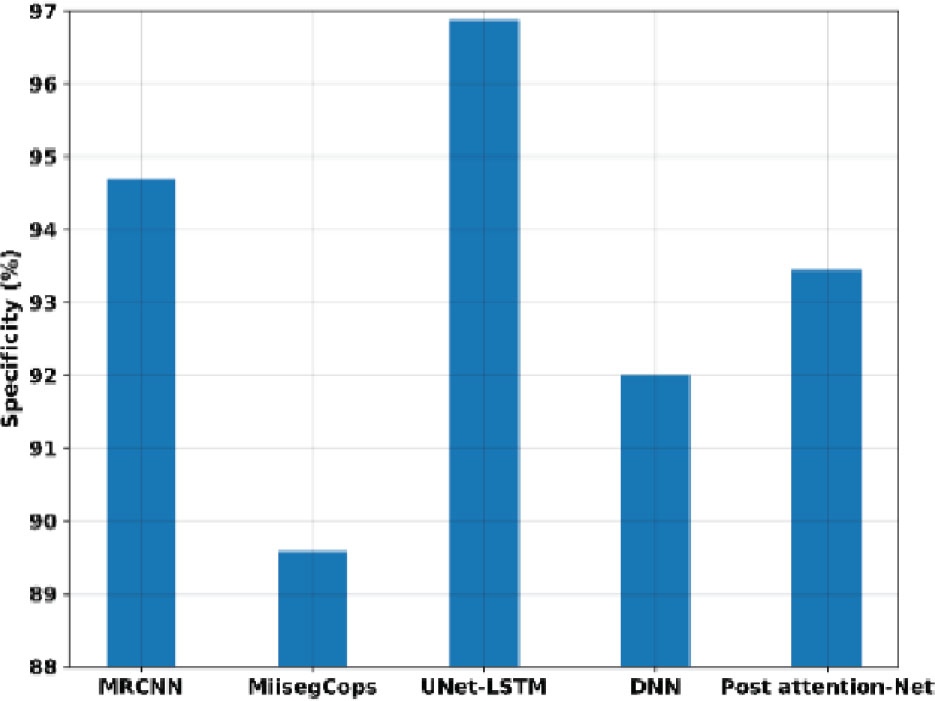
Figure 2:
Specificity comparison of various DL approaches. DL, deep learning.
Figure 3 depicts the comparison of F-measure in existing DL approaches such as chaotic dynamic butterfly-head electromagnetic hunter optimization (CDBH-EHO) [42], Ensemble CNN [37], Path R-CNN [42], CNN [41], and multi-path branched convolutional neural network (MPB-CNN) [41]. The F-measure comparison among the models shows CDBH-EHO with the highest performance at 97.95%, followed by Path R-CNN, which also achieves 97.95%. Ensemble CNN achieves a notable 71%, while CNN and MPB-CNN fall behind at 80.92% and 78.34%, respectively. This highlights the superior effectiveness of CDBH-EHO and Path R-CNN in prostate cancer diagnosis.
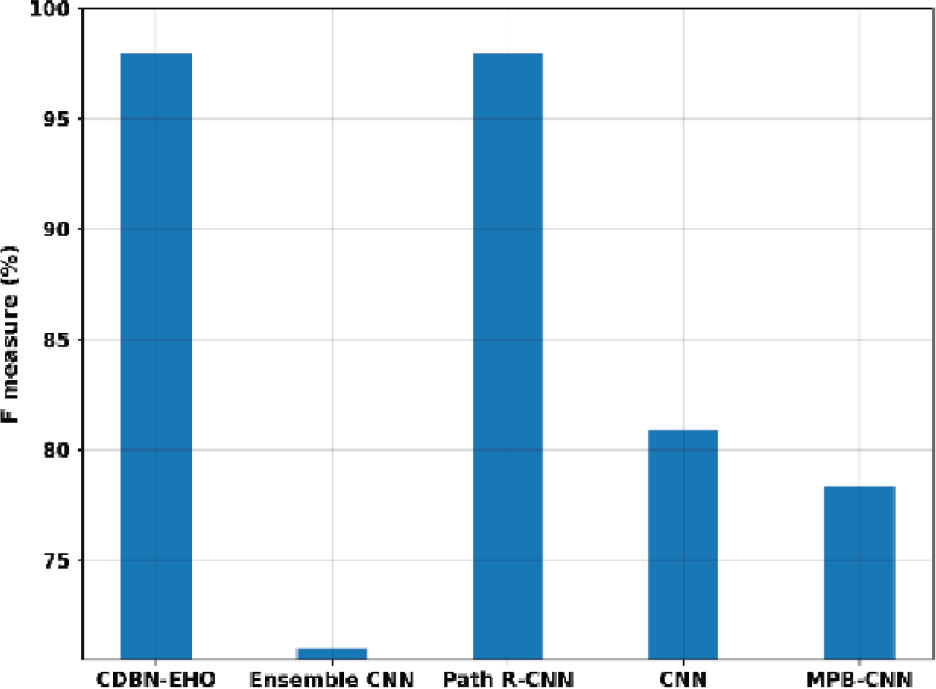
Figure 3:
Comparison of F-measure in existing DL methods. DL, deep learning.
Figure 4 shows the throughput of various existing federated learning (FL) models for prostate cancer diagnosis. The precision comparison of various models shows convolutional deep belief network-elephant herding optimization (CDBN-EHO) achieving the highest performance at 97.82%, followed by Path R-CNN at 96.67%. CNN and MPB-CNN offer lower precisions at 82% and 79.32%, respectively. 3D-CNN [39] shows the least precision at 73%, indicating a significant gap in performance between these models.
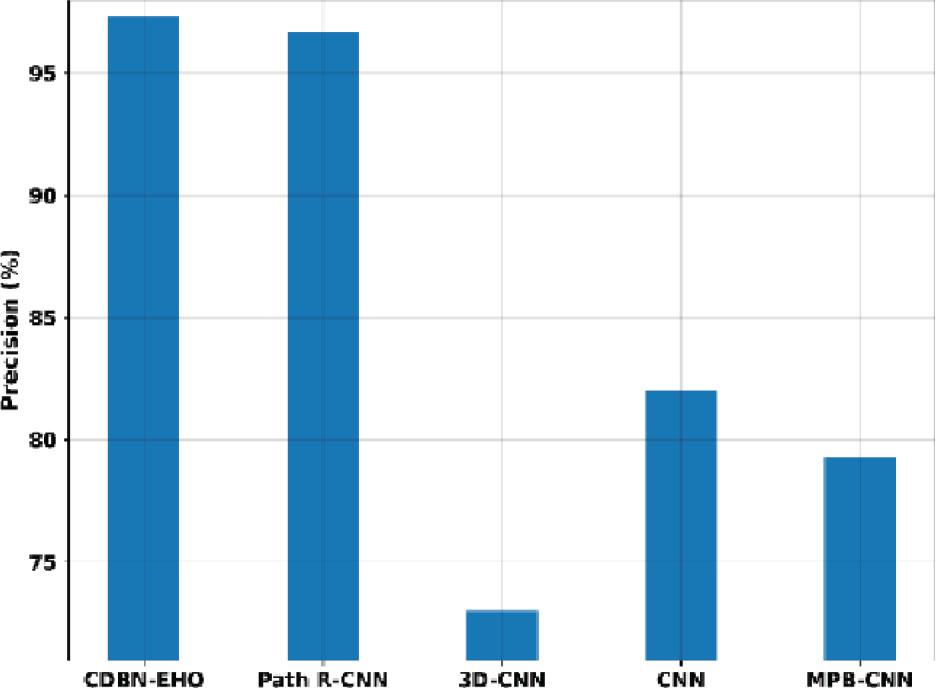
Figure 4:
Comparison of precision of existing DL approaches. DL, deep learning.
Figure 5 illustrates the accuracy comparison of various ML approaches for prostate cancer diagnosis. The Linear SVM [45] achieved the highest accuracy at 94.55%, followed by NNGP [49] with 78.5%. PESFC [53] performed at 89.63%, and KNN [51] had the lowest accuracy at 63.3%. These results emphasize the effectiveness of linear SVM in achieving superior performance in comparison to other methods. The accuracy variation highlights the significance of choosing the appropriate ML model for accurate prostate cancer diagnosis.
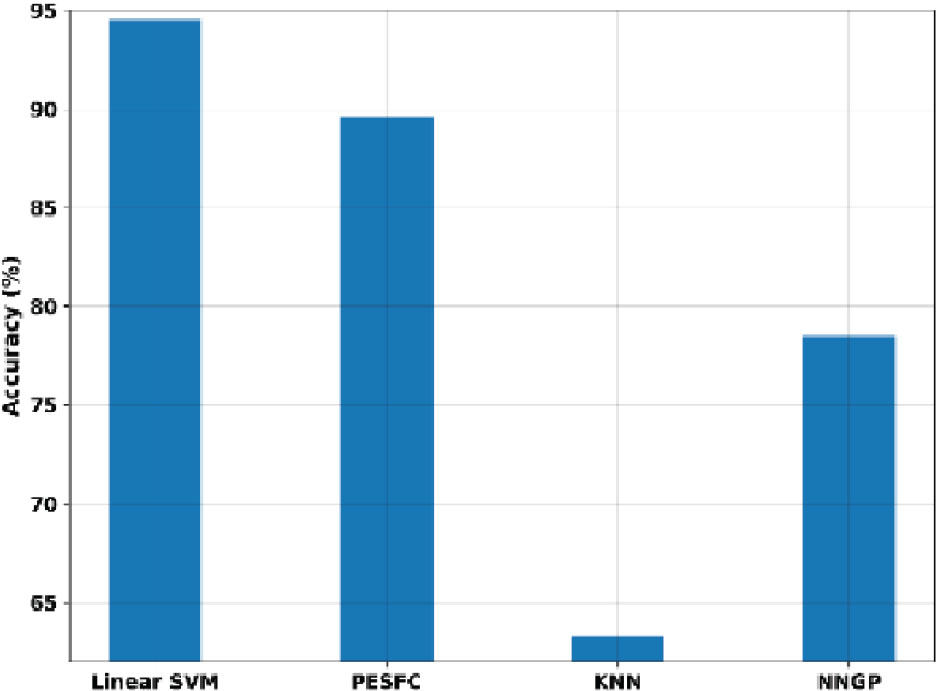
Figure 5:
Comparison of accuracy of existing ML approaches. DL, deep learning; ML, machine learning.
Figure 6 presents the area under curve (AUC) (%) comparison of various ML approaches for prostate cancer diagnosis. The Linear SVM model achieves the highest AUC of 93.2%, indicating strong performance. PESFC follows with an AUC of 90%, demonstrating effective classification. The KNN model shows a lower AUC of 73%, suggesting a moderate diagnostic ability. The NNGP model also performs well with an AUC of 78.5%, reflecting competitive accuracy. Overall, Linear SVM outperforms the other models, while PESFC remains a robust alternative.
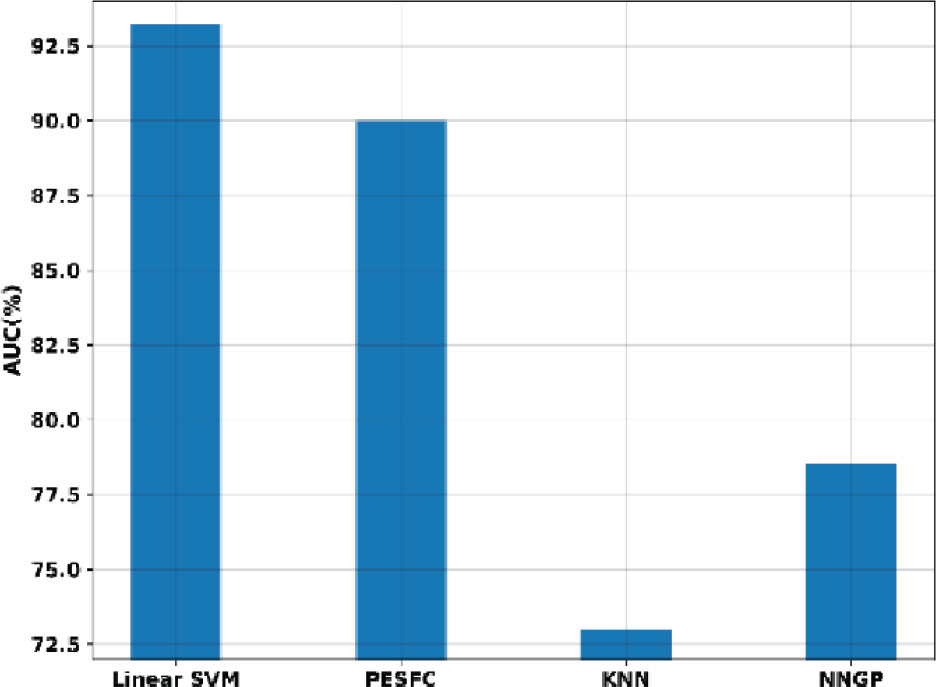
Figure 6:
Comparison of AUC of existing ML approaches. ML, machine learning.
Overall, the comparison analysis of various ML and DL techniques for prostate cancer diagnosis using mpMRI and DWI has been presented. However, there were some challenges encountered in achieving consistent accuracy and reliability in GS estimation and overall diagnostic performance. Hence, these techniques require further refinement to enhance their effectiveness, reduce misclassification rates, and improve metrics such as specificity and precision. Addressing these issues will be crucial for developing more robust models that can provide accurate and timely diagnoses in clinical settings.
IV. Result and Discussion
The analyzed summary of advanced approaches for enhanced prostate cancer diagnostics using mpMRI and DWSI images are explained as follows:
Various DL techniques such as U-Net with attention mechanisms, GAN, SEMRCNN, and MiniSegCaps have advanced prostate cancer detection from mpMRI images, improving segmentation accuracy and lesion localization. However, challenges remain with unclear lesion boundaries, overlapping with normal tissues which impacts segmentation precision. Transfer learning approaches with EfficientNet enhanced feature extraction, though subtle cancer features can still be missed.
Various DL techniques such as CRNN, 3D U-Net CNN, DnCNN, GAN, and transfer learning methods enhanced prostate cancer detection by improving image quality, segmentation, and feature extraction. However, they faced limitations such as the need for additional integration with segmentation models, high computational requirements, uncertainty in model training, lack of broader clinical validation, and struggled with image distortions and motion artifacts.
The techniques for GS estimation using DWSI and mpMRI imaging, such as DEFs with CNNs, Multi-label Ensemble Deep-Learning Classifiers, and 3D Retina U-Net, showed improvements in texture analysis, label consistency, and automated segmentation. However, they had limitations, including failure to capture non-linear feature interactions and loss of finer pixel-level details. Additionally, ML models using radiomic features improved cancer categorization, and feature selection was not robust in all clinical situations.
The ML methods for prostate cancer diagnosis using mpMRI and DWSI imaging, including ridge regression with linear SVM, SVM-PCa-EDD, and radiomics with RF and RFE, have shown significant improvements in feature selection and non-invasive prediction. However, they face limitations such as difficulties in representing complex non-linear relationships, time-consuming feature selection processes, and interobserver variability in lesion segmentation and accurate cancer boundary definition remains challenging in ambiguous regions.
Various imaging modalities such as PET/CT, Ultrasound, MRI, DWI, and CT scans have been utilized for prostate cancer diagnosis, with each offering unique benefits in lesion detection and segmentation. However, there are limitations such as difficulty in detecting cancer lesions near sensitive anatomical regions (e.g., bladder), challenges in handling 3D data, and low soft tissue contrast in CT that has difficulty in detecting small or subtle cancers.
Overall the DL models such as U-Net, generative adversarial networks (GANs), and MiniSegCaps have demonstrated high performance in prostate segmentation using mpMRI, achieving accuracies between 85% and 96% and Dice coefficients ranging from 0.82 to 0.89. Their classification capabilities also reported strong results, with AUC values reaching up to 0.95. Models utilizing DWI and variants like EfficientNet showed similarly strong performance, with accuracy ranging from 83% to 94% and AUC values between 0.86 and 0.92.
GS estimation techniques, including 3D Retina U-Net and DEFs with CNNs, achieved 84% to 93% accuracy but showed limitations in preserving pixel-level detail. ML methods using SVM, RF, and feature selection strategies like RFE achieved 78%–91% accuracy and AUCs between 0.82 and 0.90, though they often suffered from limited generalizability and reliance on handcrafted features.
Radiomic-based models, while improving classification, depended heavily on manual feature extraction. Multi-modal imaging approaches such as PET/CT, ultrasound, and fusion-based systems showed 80%–92% accuracy, but their performance varied across imaging environments. Overall, DL models outperformed ML models in segmentation and classification tasks. Despite these advances, challenges remain in clinical validation, robustness, and scalability of these techniques. Enhancing real-world applicability will require further work in generalization, real-time integration, and regulatory alignment.
a. Clinical validation in reviewed approaches
The success of DL and ML methods in prostate cancer diagnosis from imaging data is often demonstrated through performance metrics such as accuracy, specificity, and Dice similarity coefficient. This section highlights a methodological evaluation based on the use of real clinical datasets, the level of external testing, and whether they were compared against expert or biopsy-confirmed outcomes.
V. Conclusion
In this review, a study has been done on various DL and ML techniques improving prostate cancer diagnosis using mpMRI and DWSI. This study reviewed the application of DL techniques for prostate cancer diagnosis using DWI and mpMRI imaging, focusing on GS estimation from these imaging modalities. It also examined the use of ML for enhancing prostate cancer diagnosis with mpMRI and DWSI, as well as evaluated a range of imaging modalities to assess their capabilities in accurate detection and diagnosis of prostate cancer. A comparison of the performance of various automated techniques in terms of specificity, F-measure, precision, accuracy, and AUC, and GS estimation for prostate cancer diagnosis using mpMRI and DWSI has been provided. Furthermore, the review identified five key aspects of advanced approaches for enhancing prostate cancer diagnostics using mpMRI and DWI, discussing their significance and the challenges they face. This comprehensive analysis aims to equip researchers and practitioners with a deeper understanding of the current landscape in prostate cancer diagnosis, ultimately fostering greater innovation and improvement in this critical area of medical research.
VI. Future Scope
From the abovementioned limitations, the research can be developed in the future by analyzing each direction. Future research can be done based on the following suggestions:
Future research should enhance cancer’s lesion boundary detection using advanced attention mechanisms, like multi-scale or spatial-temporal attention networks (e.g., Multi-Scale U-Net, Transformer-based networks). Incorporating multi-scale feature extraction and adaptive thresholding improve segmentation accuracy by handling unclear boundaries and overlapping tissues. Self-supervised learning, such as contrastive learning, could help with data inconsistencies and boost model generalization.
As DL models for prostate cancer detection often require high computational power, future research should focus on optimizing model architectures and using lightweight models, such as MobileNet or EfficientNet, to reduce computational cost without compromising accuracy. The development of model pruning, quantization, or knowledge distillation methods help optimize these models for real-time clinical applications, reducing both memory and processing requirements.
Future research should focus on advanced ensemble methods and meta-learning techniques to address challenges in representing complex non-linear relationships, such as stacking multiple models or incorporating neural network-based feature extractors with traditional ML algorithms.
Develop advanced automated feature selection techniques using reinforcement learning or evolutionary algorithms, which efficiently identify optimal feature sets for accurate cancer boundary delineation and classification, reducing time-consuming manual processes. Moreover, incorporating explainable AI (XAI) methods into these ML models will enhance the interpretability of predictions, particularly in addressing interobserver variability.
To improve detection near-sensitive anatomical regions, multi-modal imaging integration enhance the identification of subtle lesions. Techniques like cross-modality fusion, multi-task learning, and advanced image registration or motion compensation methods increase lesion visibility. Additionally, exploring dual-energy or spectral CT improve soft tissue contrast for better detection accuracy, especially for small lesions.
Abbreviations
- AUC:
Area Under the Curve;
- Bi-LSTM:
Bidirectional Long Short-Term Memory;
- CAD:
Computer-Aided Detection;
- CAR:
Conditional Auto Regressive;
- CDBH-EHO:
Chaotic Dynamic Butterfly-Head Electromagnetic Hunter Optimization;
- CNNs:
Convolutional Neural Networks;
- CNR:
Contrast-to-Noise Ratio;
- CRFs:
Conditional Random Fie;
- CRNN:
Convolutional Recurrent Neural Network;
- csPCa:
Clinically Significant Prostate Cancer;
- CT:
Computed Tomography;
- DCE:
Dynamic Contrast-Enhanced;
- DL-CAD:
Deep Learning–Computer-Aided Detection;
- DnCNN:
Denoising Convolutional Neural Network;
- DT:
Decision Tree;
- DWI:
Diffusion-Weighted Imaging;
- DWI/ADC:
Diffusion-Weighted Imaging / Apparent Diffusion Coefficient;
- EL:
Extreme Learning;
- EM:
Expectation-Maximization;
- FL:
Federated Learning;
- GANs:
Generative Adversarial Networks;
- GLCM/GLGCM:
Gray-Level Co-occurrence Matrix / Gray-Level Gradient Co-occurrence Matrix;
- LASSO:
Least Absolute Shrinkage and Selection Operator;
- LSTM:
Long Short-Term Memory;
- LSTM-DBN:
Long Short-Term Memory – Deep Belief Network;
- MPB-CNN:
Multi-Path Branched Convolutional Neural Network;
- MR:
Magnetic Resonance;
- MRCNN:
Mask Region-Based Convolutional Neural Network;
- MRI:
Magnetic Resonance Imaging;
- NNGP:
Neural Network Gaussian Process;
- PET:
Positron Emission Tomography;
- PET/CT:
Positron Emission Tomography / Computed Tomography;
- PET/MRI:
Positron Emission Tomography / Magnetic Resonance Imaging;
- PI-RADS:
Prostate Imaging Reporting and Data System;
- PI-RADS-3:
Prostate Imaging Reporting and Data System, Category 3;
- PNI:
Perineural Invasion;
- PZ:
Peripheral Zone;
- R-CNN:
Region-Based Convolutional Neural Network;
- RNNs:
Recurrent Neural Networks;
- SEMRCNN:
Spatial Encoding Mask Region-Based Convolutional Neural Network;
- SVM-PCa-EDD:
Support Vector Machine – Prostate Cancer – Early Detection & Diagnosis;
- T2WI/ADC:
T2-Weighted Imaging / Apparent Diffusion Coefficient.