
Table 1:
Data label category, count, and interpretation
| Data label category | Count | Interpretation |
|---|---|---|
| Opinion | 461 | Positive, negative, or neutral |
| Praising | 293 | Positive sentiments |
| Queries | 246 | Questions and doubts |
| Undefined | 205 | Unable to determine or irrelevant |
| Hybrid | 185 | Multiple categories |
| Total | 1390 |
Table 2:
Polarity score for some tweets
| Clean text | Polarity_score | Replaced value | ||
|---|---|---|---|---|
| Negative | Neutral | Positive | ||
| Educate heavy machinery operator farm constrc… | 0.044 | 0.393 | 0.962 | 1 |
| Dream best initiative innovative | 0.000 | 0.099 | 0.901 | 1 |
| Want house build house make happen | 0.000 | 0.794 | 0.206 | 0 |
| Research publish recently also show cool effect… | 0.000 | 0.840 | 0.160 | 0 |
| Say nutrition comparison ground grow food conc… | 0.000 | 0.805 | 0.195 | 0 |
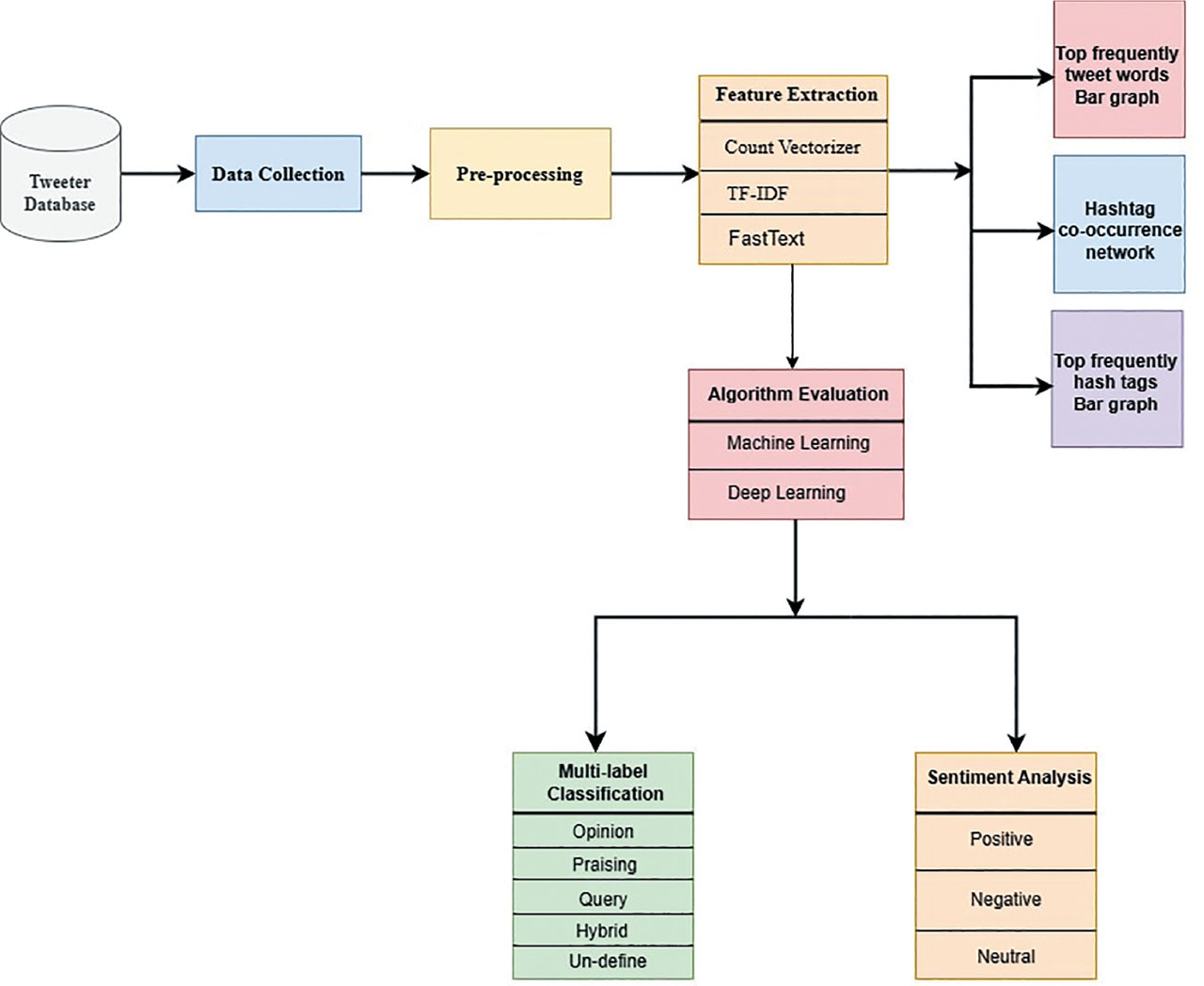
Figure 1:
The proposed model.
Table 3:
Model results using TF-IDF
| Model | Accuracy | Precision | Recall | F1-score |
|---|---|---|---|---|
| LR | 0.91 | 0.91 | 0.91 | 0.90 |
| RFC | 0.86 | 0.86 | 0.86 | 0.85 |
| SVC | 0.83 | 0.81 | 0.83 | 0.78 |
| Multinomial NB | 0.81 | 0.78 | 0.81 | 0.76 |
| Extra Trees Classifier | 0.86 | 0.86 | 0.86 | 0.86 |
| Decision Tree Classifier | 0.84 | 0.79 | 0.82 | 0.84 |
[i] LR, logistic regression; NB, Naïve Bayes; RFC, random forest classifier; SVC, support vector classifier; TF-IDF, term frequency-inverse document frequency.
[ii] These results reflect that the model is effective for understanding sentiments in tweets, with TF-IDF + LR showing the best performance.
[v] Precision (91%) → When the model predicted a sentiment (e.g., positive), it was correct 91% of the time.
[vii] F1-score (90%) → A balance between precision and recall, indicating strong overall performance.
Table 4:
Model results using count vectorizer
| Model | Accuracy | Precision | Recall | F1-score |
|---|---|---|---|---|
| LR | 0.87 | 0.88 | 0.87 | 0.85 |
| RFC | 0.84 | 0.84 | 0.84 | 0.81 |
| SVC | 0.82 | 0.85 | 0.82 | 0.77 |
| Multinomial NB | 0.79 | 0.78 | 0.79 | 0.70 |
| Extra Trees Classifier | 0.87 | 0.88 | 0.87 | 0.86 |
| Decision Tree Classifier | 0.82 | 0.81 | 0.82 | 0.82 |
Table 5:
Model results using FastText
| Model | Accuracy | Precision | Recall | F1-score |
|---|---|---|---|---|
| LR | 0.85 | 0.85 | 0.85 | 0.83 |
| RFC | 0.81 | 0.82 | 0.81 | 0.77 |
| SVC | 0.82 | 0.82 | 0.82 | 0.79 |
| Multinomial NB | 0.81 | 0.80 | 0.81 | 0.78 |
| Extra Trees Classifier | 0.82 | 0.83 | 0.82 | 0.77 |
| Decision Tree Classifier | 0.74 | 0.75 | 0.74 | 0.75 |
Table 6:
Deep learning model results using FastText
| Model | Accuracy | Precision | Recall | F1-score |
|---|---|---|---|---|
| LSTM FastText | 0.76 | 0.74 | 0.76 | 0.74 |
| GRU FastText | 0.77 | 0.73 | 0.77 | 0.74 |
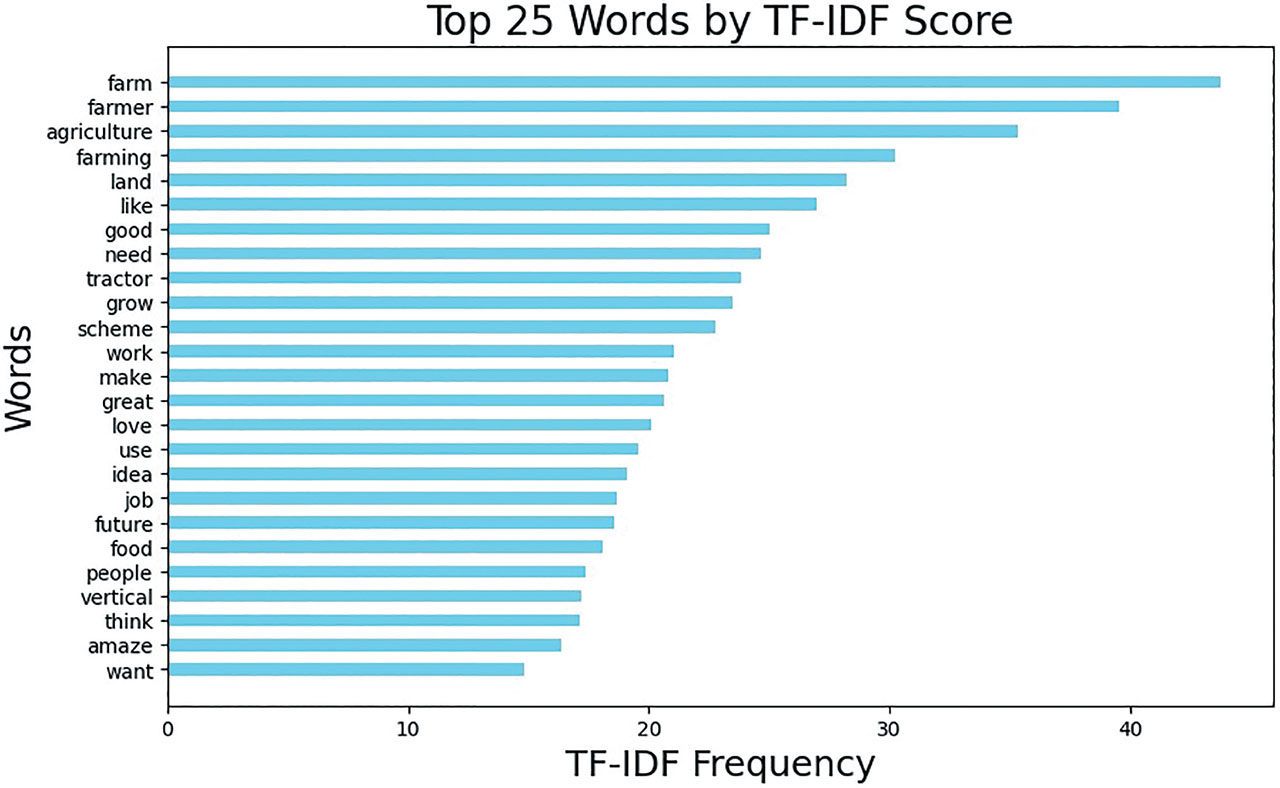
Figure 2:
Frequency bar graph of top words.
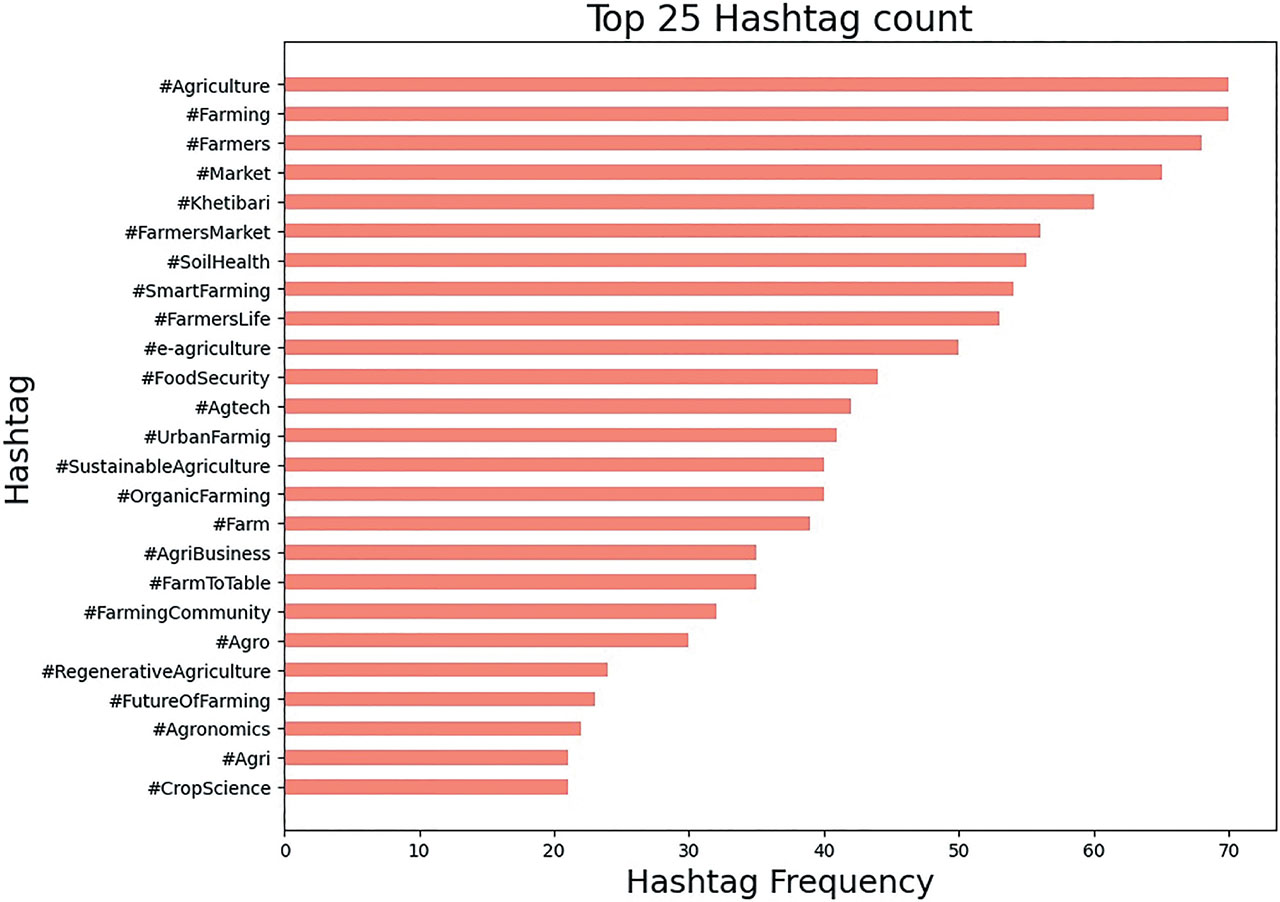
Figure 3:
Frequency bar graph of top hashtag.
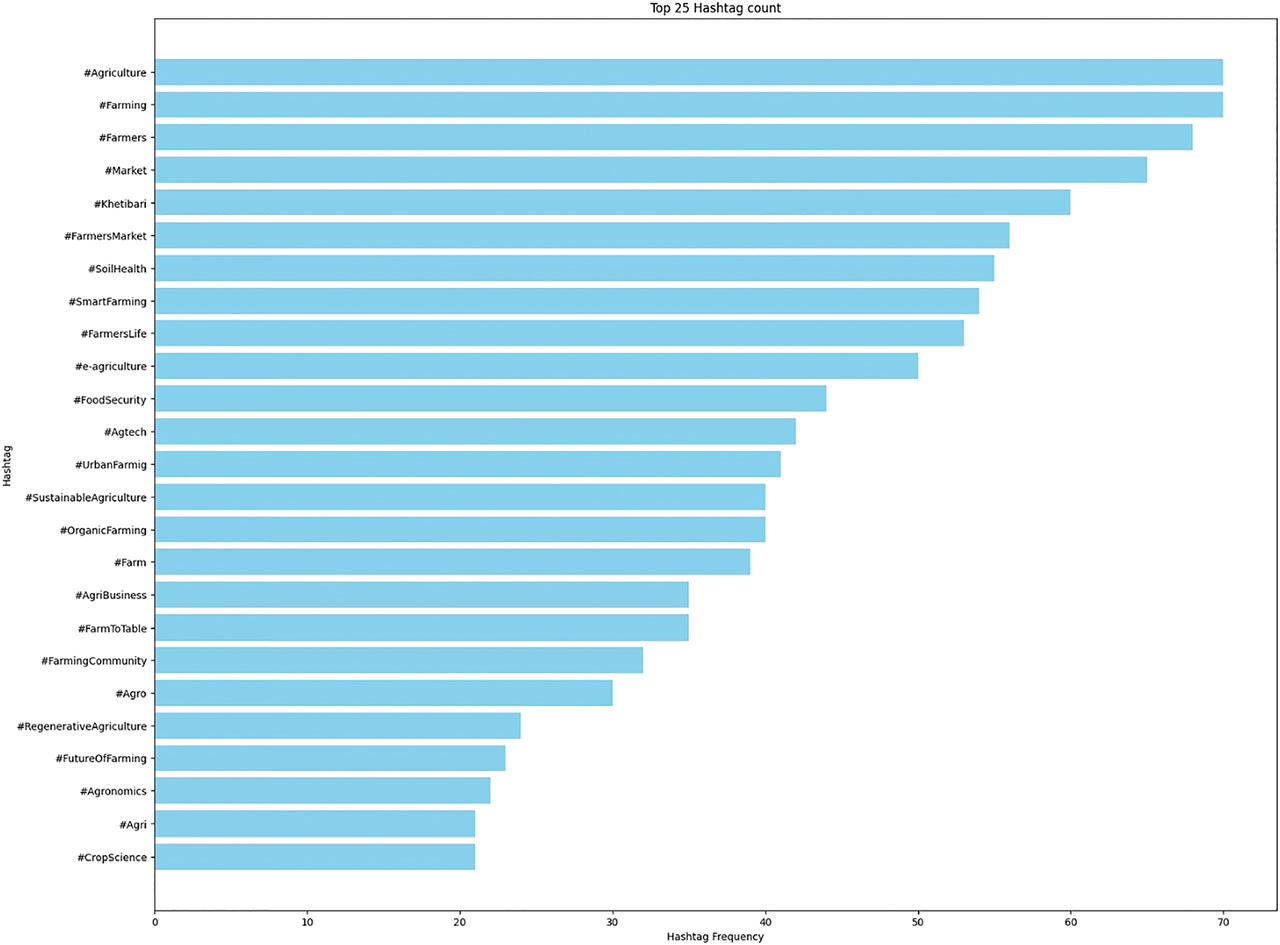
Figure 4:
Frequency bar graph of top hashtag.
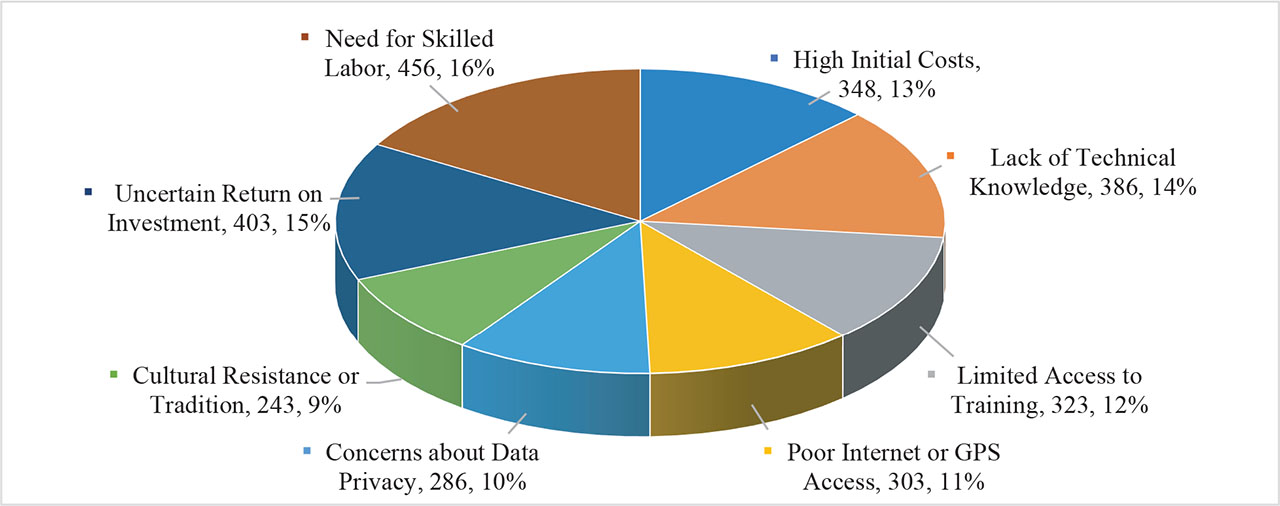
Figure 5:
Primary challenges in the adoption of new farming technologies.
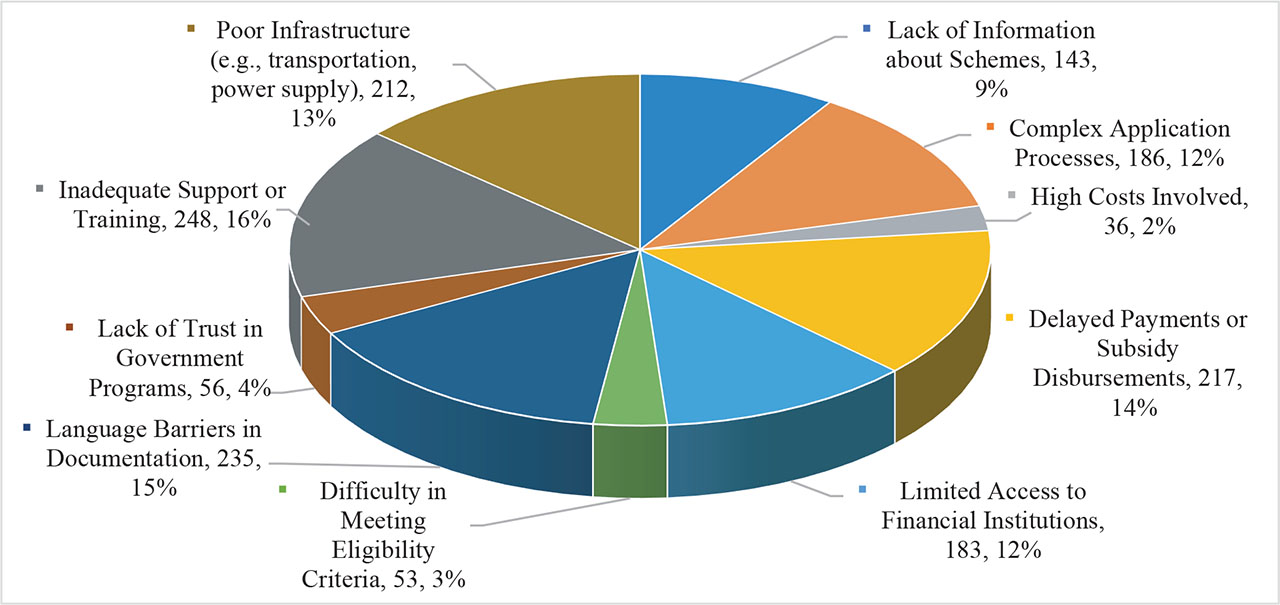
Figure 6:
Primary challenges in the adoption of farming schemes.
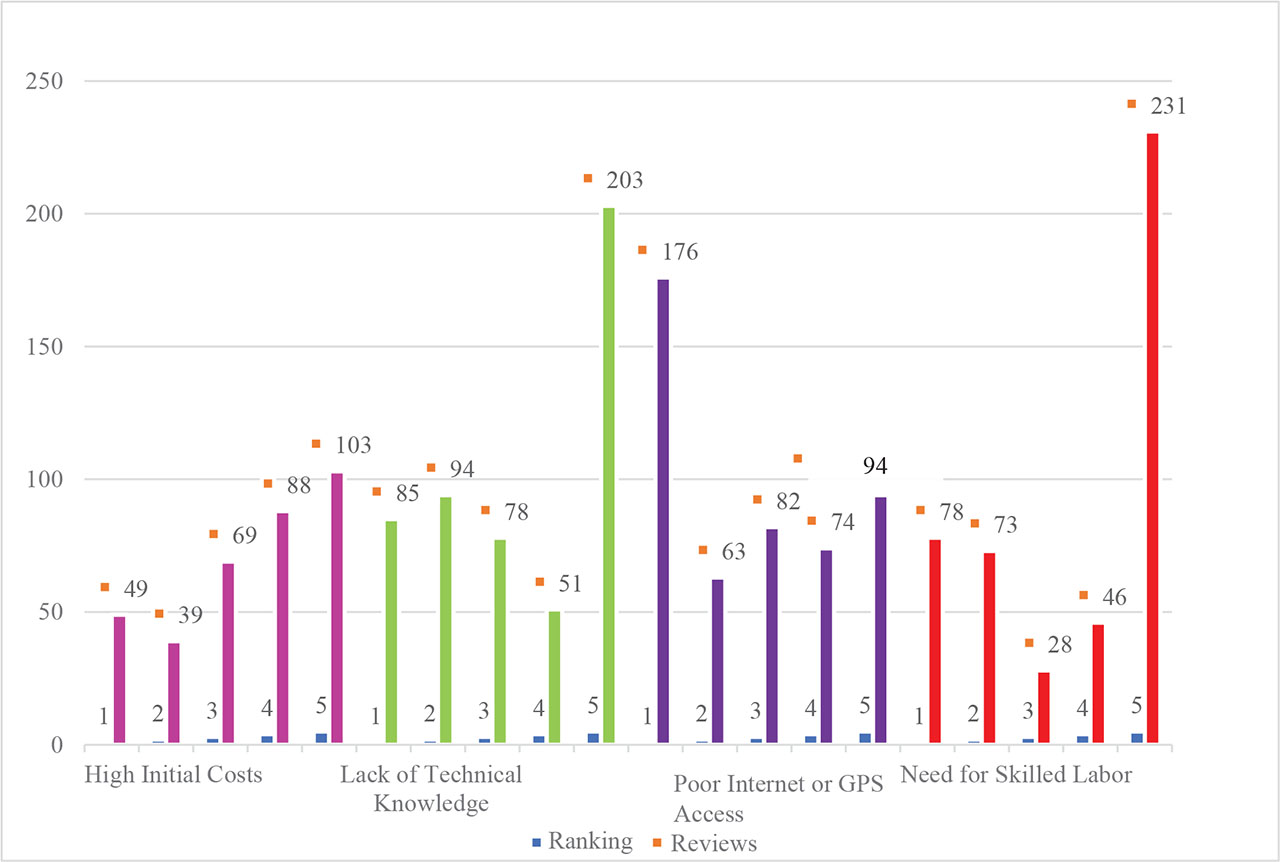
Figure 7:
Farmers’ rating in the adoption of new farming technology.
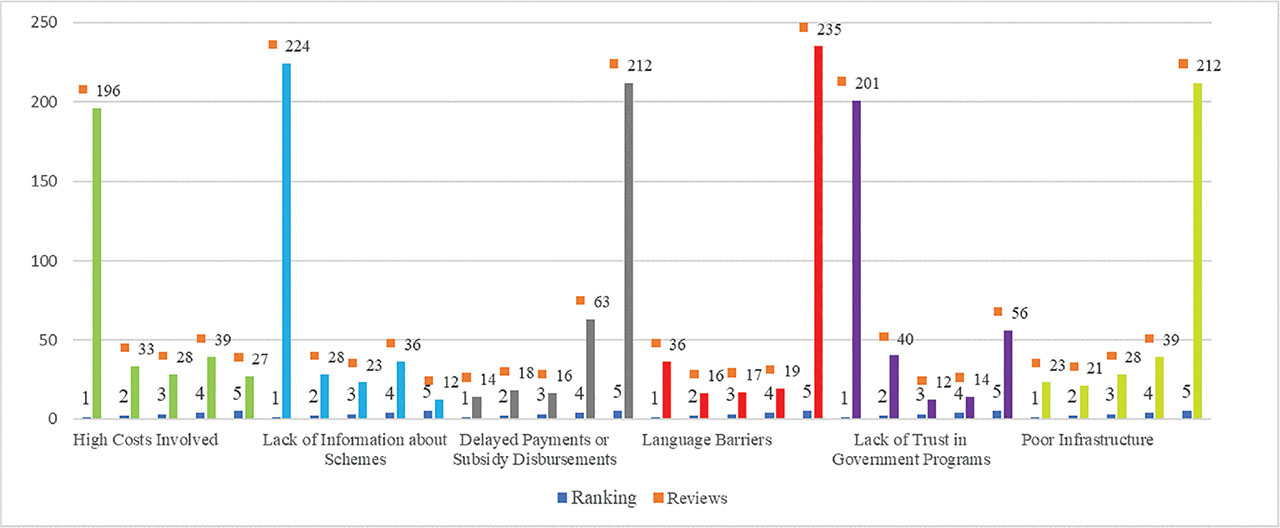
Figure 8:
Farmers’ rating in the adoption of farming schemes.
Table 7:
Label of tweets and their polarity
| S. no. | Tweets | Label | Polarity |
|---|---|---|---|
| 1. | PMKISAN scheme aimed at providing direct income support to farmers has ensured support for their sustenance. | Opinion | Positive |
| 2. | Farmers highlighting the importance of organic farming, soil health, and reducing chemical inputs. | Opinion | Positive |
| 3. | Irrigation & insurance have both seen huge improvement through agriculture schemes. | Praising | Positive |
| 4. | The PMFBY has provided farmers with financial security, mitigating risks associated with crop loss. | Praising | Positive |
| 5. | Farmers are committing suicide due to water scarcity, and individuals like you are directly responsible for the deaths of farmers in Maharashtra. | Opinion | Negative |
| 6. | Not all farmers in India know about the agricultural schemes launched by the GoI. As a result, most farmers do not avail themselves of the benefits of these schemes. | Opinion | Negative |
| 7. | What is crop insurance? | Query | Neutral |
| 8. | What is Pradhan Mantri Kisan Samman Nidhi? | Query | Neutral |
| 9. | Organic farming combines with precision agriculture, using drone monitoring to enhance yields while maintaining eco-friendly practices. | Hybrid | Positive |
| 10. | Sustainable agriculture is not only about safeguarding the planet—it’s also about increasing farmers’ profitability by using fewer resources. | Hybrid | Positive |
| 11. | Agriculture is changing, and we must prepare for it. | Undefine | Neutral |
| 12. | Greater innovation in farming is essential to address major challenges. | Undefine | Neutral |
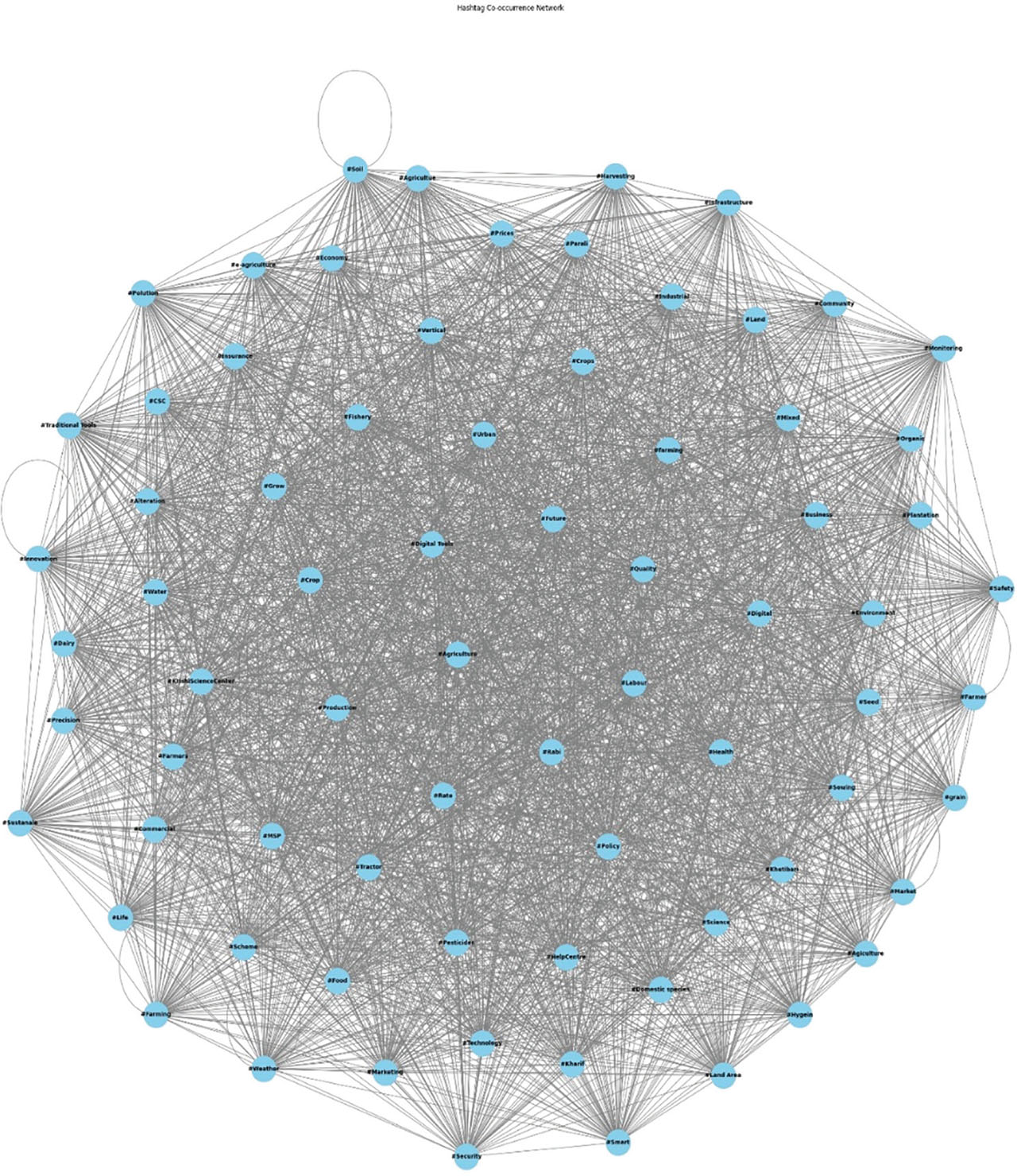
Figure 9:
Co-occurrence network.
| Category | Subcategory | Topics | No. of reviews | |
|---|---|---|---|---|
| General information | Farm size | Small (<5 acres) | 286 | |
| Medium (5–15 acres) | 193 | |||
| Large (>15 acres) | 12 | |||
| Type of farming | Crop farming (e.g., grains, vegetables, fruits) | 372 | ||
| Livestock farming (e.g., cattle, poultry, sheep) | 73 | |||
| Mixed farming (both crops and livestock) | 445 | |||
| Horticulture (e.g., fruits, vegetables, flowers) | 23 | |||
| Aquaculture (fish or shellfish farming) | 16 | |||
| Dairy farming | 03 | |||
| Organic farming | 04 | |||
| Technology awareness and usage | Which of the following technologies are you familiar with? | Precision agriculture tools (GPS-guided equipment) | 0 | |
| Drones for monitoring crops | 0 | |||
| IoT sensors (for soil, water, or weather monitoring) | 3 | |||
| Automated machinery | 403 | |||
| AI or data analytics | 0 | |||
| Farm management software | 0 | |||
| Which of the following technologies do you currently use on your farm? | Precision agriculture tools (GPS-guided equipment) | 0 | ||
| Drones for monitoring crops | 0 | |||
| IoT sensors (for soil, water, or weather monitoring) | 0 | |||
| Automated machinery | 403 | |||
| AI or data analytics | 0 | |||
| Farm management software | 0 | |||
| Challenges in adopting new technology | What are the main reasons you haven’t adopted new farming technology? | High initial costs | 348 | |
| Lack of technical knowledge | 386 | |||
| Limited access to training | 323 | |||
| Poor Internet or GPS access | 303 | |||
| Concerns about data privacy | 286 | |||
| Cultural resistance or tradition | 243 | |||
| Uncertain return on investment | 403 | |||
| Need for skilled labor | 456 | |||
| Rate the following challenges in adopting new technology on a scale of 1–5 (1 = not a challenge, 5 = major challenge): | High initial costs | 1 | 39 | |
| 2 | 49 | |||
| 3 | 69 | |||
| 4 | 88 | |||
| 5 | 103 | |||
| Lack of technical knowledge | 1 | 119 | ||
| 2 | 85 | |||
| 3 | 78 | |||
| 4 | 101 | |||
| 5 | 203 | |||
| Poor Internet or GPS access | 1 | 176 | ||
| 2 | 63 | |||
| 3 | 82 | |||
| 4 | 74 | |||
| 5 | 94 | |||
| Need for skilled labor | 1 | 78 | ||
| 2 | 73 | |||
| 3 | 28 | |||
| 4 | 46 | |||
| 5 | 231 | |||
| How important is it to have access to training and support when adopting new technologies? | Very important | 437 | ||
| Important | 26 | |||
| Neutral | 12 | |||
| Not very important | 05 | |||
| Not important at all | 11 | |||
| Financial and economic considerations | Do you believe the costs associated with new technology are a barrier to adoption? | Yes | 443 | |
| No | 29 | |||
| Maybe | 19 | |||
| Category | Sub-category | Topics | No. of reviews | |
|---|---|---|---|---|
| General information | Farm size | Small (<50 acres) | 286 | |
| Medium (50–500 acres) | 193 | |||
| Large (>500 acres) | 12 | |||
| Type of farming | Crop farming (e.g., grains, vegetables, fruits) | 372 | ||
| Livestock farming (e.g., cattle, poultry, sheep) | 73 | |||
| Mixed farming (both crops and livestock) | 445 | |||
| Horticulture (e.g., fruits, vegetables, flowers) | 23 | |||
| Aquaculture (fish or shellfish farming) | 16 | |||
| Dairy farming | 03 | |||
| Organic farming | 04 | |||
| Awareness and access to new farming schemes | Are you aware of government farming schemes available in your region? | Yes | 323 | |
| No | 168 | |||
| Where do you typically get information on new farming schemes? | Local Government Offices | 29 | ||
| KVKs | 58 | |||
| Agricultural shows or expos | 36 | |||
| Radio/TV programs | 43 | |||
| Internet/social media | 41 | |||
| Other farmers | 116 | |||
| Which types of schemes are you most interested in? | Subsidies for seeds and fertilizers | 231 | ||
| Irrigation and water management schemes | 48 | |||
| Organic farming programs | 23 | |||
| Crop insurance schemes | 261 | |||
| Credit and loan programs | 36 | |||
| Technology adoption schemes (e.g., farm machinery, digital tools) | 238 | |||
| Soil health and conservation programs | 196 | |||
| Challenges in adopting new farming schemes | What challenges do you face in adopting new farming schemes? | Lack of information about schemes | 143 | |
| Complex application processes | 186 | |||
| High costs involved | 36 | |||
| Delayed payments or subsidy disbursements | 217 | |||
| Limited access to financial institutions | 183 | |||
| Difficulty in meeting eligibility criteria | 53 | |||
| Language barriers in documentation | 235 | |||
| Lack of trust in government programs | 56 | |||
| Inadequate support or training | 248 | |||
| Poor infrastructure (e.g., transportation, power supply) | 212 | |||
| Rate the following challenges in adopting the new scheme on a scale of 1–5 (1 = not a challenge, 5 = major challenge): | High costs involved | 1 | 196 | |
| 2 | 33 | |||
| 3 | 28 | |||
| 4 | 39 | |||
| 5 | 27 | |||
| Lack of information about schemes | 1 | 224 | ||
| 2 | 28 | |||
| 3 | 23 | |||
| 4 | 36 | |||
| 5 | 12 | |||
| Delayed payments or subsidy disbursements | 1 | 14 | ||
| 2 | 18 | |||
| 3 | 16 | |||
| 4 | 63 | |||
| 5 | 212 | |||
| Language barriers | 1 | 36 | ||
| 2 | 16 | |||
| 3 | 17 | |||
| 4 | 19 | |||
| 5 | 235 | |||
| Lack of trust in government programs | 1 | 201 | ||
| 2 | 40 | |||
| 3 | 12 | |||
| 4 | 14 | |||
| 5 | 56 | |||
| Poor infrastructure | 1 | 23 | ||
| 2 | 21 | |||
| 3 | 28 | |||
| 4 | 39 | |||
| 5 | 212 | |||
| Financial and economic challenges | Do you face financial challenges in accessing new farming schemes? | Yes | 249 | |
| No | 74 | |||
| If yes, what are the main financial challenges? | Lack of access to credit or loans | 203 | ||
| High interest rates on loans | 226 | |||
| Delayed loan approvals | 198 | |||
| High initial costs of adoption | 215 | |||
| Support and training needs | How important is training in adopting new farming schemes? | Very important | 296 | |
| Important neutral | 14 | |||
| Not very important | 08 | |||
| Not important at all | 05 | |||