
1. Introduction and literature review
Foreign exchange (FX) options are the dominant non-linear derivative in Polish zloty. In 2022, their share in the local options market (including interest rate and equity contracts) amounted to 96% (NBP, 2023). The turnover is generated on the Over-the-Counter market, with non-residents holding a prevailing share of 93% (NBP, 2023). Prices are quoted in implied volatility terms, which depend on the delta and maturity of the contract. The standard model used for premium calculations of European vanilla currency options is the Garman–Kohlhagen formula (1983).
Volatility modelling has been a widespread subject in financial literature since the publication of the first equity options models (Black & Scholes, 1973; Merton, 1976). Since then, volatility has been treated as an exogenous coefficient shaped directly by demand and supply in the options market. Volatility forecasting is a crucial element of risk assessment in the financial markets. It is used for modelling other risk factors and market prices.
Volatility models focus on realized and implied volatility. The former measures the actual instability of prices, while the latter reveals market participants’ expectations. Volatility is forecasted using past returns, such as in GARCH models (see Duan, 1995; Bauwens et al., 2006; Bollerslev, 2008), or by considering the mean-reverting nature of this measure, as in stochastic volatility models (see Hull & White, 1987; Taylor, 1994; Jacquier et al., 2002). However, implied volatility can be treated as a unique commodity influenced by exogenous factors. Vrontos et al. (2021) focused on directional forecasting of implied volatility based on 32 external factors. Fullwood et al. (2021) presented volatility trading using straddles as an alternative to directional and carry trading. The latter study is based on FX options, which are the subject of this research.
FX options due to their high liquidity and economic significance are a common subject of contemporary econometric modelling. Lyócsa and Plíhal (2022) presented a single market study in a time of severe stress and claimed a significant informative content embedded in intraday changes of FX implied volatility. Ding et al. (2021) pointed out that FX markets are dominant risk transmitters in periods of higher spillovers. Zulfiqar and Gulzar (2021) suggested similar behaviour of cryptocurrencies volatility surfaces to emerging currencies with significant skew and kurtosis.
The EUR/PLN market is considered an emerging market with significant risk asymmetry. Statistical evidence of this pattern includes skewness and kurtosis of daily returns. The skewness for the whole sample (22.07.2010–24.10.2023) was 0.22, with an average annual skewness of +0.17 (ranging from –0.25 to + 0.59). The excess kurtosis for the whole sample was 4.42, with an annual average of 1.80. Non-normality of daily returns and fat tails of the density function have profound consequences for FX option pricing.
First, the asymmetry of risk results in high positive risk reversal prices (Zhang & Xiang, 2008; Santa-Clara & Saretto, 2009). Risk reversal involves the simultaneous purchase of a low delta call and the sale of a low delta put (or vice versa). For EUR/PLN, there is a constant demand for high strikes covered by a supply of low strikes. A significant share of investors holding positive carry exposure in the zloty market (i.e., long PLN positions) hedge against potential currency crises. Consequently, the average price of risk reversal during the analysed period was +1.23 (the difference in volatility terms between 25-delta EUR call PLN put and 25-delta EUR put PLN call, calculated as a daily average of the four most liquid maturities – 1M, 3M, 6M, and 1Y), with a maximum of + 4.12 and a minimum of –0.37.
Moreover, there is an interdependence between the price of the underlying asset and its implied volatility (Fassas & Siriopoulos, 2021). In the EUR/PLN market, the average correlation between daily changes in option and spot prices for the whole sample is 30% (for details, see Table A1 in Appendix). This indicates that zloty depreciation leads to an increase in implied volatility for zloty options. This is related to the evidence of growing variance in the spot rate at higher levels. The correlation between log-returns of the spot level in a 3-month window and changes in standard deviation in such a window for the whole sample is 18%. However, market makers add a premium for the non-normality of daily returns as they use a pricing model with theoretical assumptions that are not met (Lim et al., 2006; Hood et al., 2009; Simonato & Stentoft, 2015). Statistical evidence of this behaviour is the average excess of implied volatility over realized volatility (ranging from 0.47 for 1 month to 0.84 for 1 year in percentage points for the whole sample).
Plíhal and Lyócsa (2021) noted that implied volatility is a good predictor for future realized volatility on mature FX markets. For EUR/PLN currency pair, a positive correlation between changes in historical and implied volatility is slightly visible only for standard deviation calculated on past returns. This correlation (whole sample average for all maturities) is 13%, indicating a moderate influence of historical performance on market makers. In contrast, the correlation with future returns (comparison of realized and forecasted volatility) is negative and close to zero (for details, refer Table A1 in Appendix). This might be explained by the fact that implied volatility is not a forecast of future standard deviation, as the pricing model has embedded assumptions that are not met in the real financial market. This realization aligns with Rebonato’s thesis (2004, p. 169): “Implied volatility is the wrong number to put in the wrong formula to get the right price of plain-vanilla options.”
A complete volatility surface is a matrix consisting of market prices for options with various strike prices (i.e. deltas) and expiry dates (i.e. maturities). To build such a surface, one should know both the volatility curve and the volatility smile (Cont et al., 2002). The volatility curve represents the dependence of implied volatility on the maturity of the contract, while the volatility smile represents the dependence on strike (generalized in delta terms). The central points of the volatility surface are generated with prices for ATM options, which are quotes for the so-called zero-delta straddles (Ahoniemi, 2009).
The shape and level of the volatility curve account for the dynamics of implied volatilities for various maturities, reflecting a mean reversion phenomenon (Bali & Demirtas, 2008; Goudarzi, 2013; Ahmed et al., 2018). Evidence of this pattern is seen in the comparison of standard deviation of daily changes in implied volatility for various maturities. For the whole sample, 1-month (1M) instability is twice as high as for 1 year (1Y). When considering the standard deviation of historical volatility, this divergence is even stronger (nine times). This indicates that short-term volatility is much more sensitive to market changes than long-term volatility, which is closer to the long-term mean. In practice, an inverted volatility curve is observed if the general level of volatility is high, and a normal curve if volatility is low. The correlation between changes in the level and changes in the slope is –58% for the whole sample. The volatility curve is built based on the so-called calendar spreads (simultaneous trade on options with different maturities).
The volatility smile encompasses expected skewness and kurtosis of daily returns (Hafner & Schmid, 2005). Market makers quote option strategies that directly forecast higher moments of the density function. These strategies include the aforementioned risk reversal for skewness and butterfly for kurtosis. The latter has limited liquidity and low sensitivity to market impulses and therefore is not analysed in this study. In contrast, the risk reversal is very liquid, and its price shapes the slope of the volatility smile. The slope is directly dependent on the level of risk reversal prices. However, statistical evidence shows a reliance of risk reversal on the level of implied volatility for ATM options. The correlation between 3-month (3M) 25-delta risk reversal and 3M straddle is 31% for the whole sample. It was also recorded by Fullwood et al. (2021) that provides evidence that currencies with high volatility also tend to have higher risk reversal prices. It is connected with stronger hedging flows when risk aversion increases (Husted et al., 2018).
This research looks at the volatility surface components as a function of the underlying price, its volatility, and the prices of option strategies. Considering the above, three models can be built: one referring to the level of implied volatility for ATM options, the second describing the slope of the volatility curve, and the third explaining the slope of the volatility smile.
The aim of the research is to verify the possibility of forecasting implied volatility for a single currency market using information provided solely by that market. The analysis examines whether cointegration exists between the underlying asset prices and its volatility, along with the prices of option strategies that encompass the level and shape of the volatility surface. The cointegration phenomenon is used to construct error correction models (ECMs) that reveal long-term relationships between the time series. However, the majority of such analysis refer to macroeconomic data (i.e. Poon et al., 2005 with modelling exports with exchange rate volatility) or to equity markets (i.e. Altin, 2022 for cointegration between stock and volatility indices). This study, following a concept of Nikkinen et al. (2006), presents such models for examining implied volatility linkages. The error correction mechanism was applied for FX option strategies prices and assesses their forecasting power regarding the direction of volatility changes.
2. Methodology
The research encompasses time series data from the EUR/PLN option market for the period 22/07/2010–31/07/2023 (3,289 daily observations). The data source is Refinitiv. A 3-month period was chosen as the basic maturity due to its adequate liquidity and its position in the geometric middle of the liquid volatility curve. The list of variables is presented in Table 1.
Table 1
Description of variables
| Variable | Description |
|---|---|
| SPOT | EUR/PLN spot exchange rate (end-of-day) |
| 3M ATM | 3-month EUR/PLN implied volatility for ATM option (zero-delta straddle) |
| 3M RR | 3-month EUR/PLN implied volatility for 25-delta risk reversal (in euro call terms) |
| 3M SD | 3-month EUR/PLN historical volatility (standard deviation on log-returns p.a.) |
| SLOPE | Difference between 1-year and 1-month implied volatility for ATM options (calendar spread) |
Source: Author’s own elaboration.
The analysis was conducted in two phases:
In the first phase, the models were calibrated for the full sample, and their efficiency was estimated on the same sample. This approach allowed for the assessment of the model’s quality for annual sub-periods within the sample.
In the second phase, the models were calibrated for the training period only (2010–2021), and forecasting was performed for the validation period (2022–2023). This approach served as a stability check for the applied methodology.
The models were constructed in two forms: as a simple ordinary least squares (OLS) regression on daily returns and as an ECM based on cointegration tests. This allowed for the estimation of the added value of the error correction component used in ECM models.
The interdependence of time series is seen on the Charts 1–3.
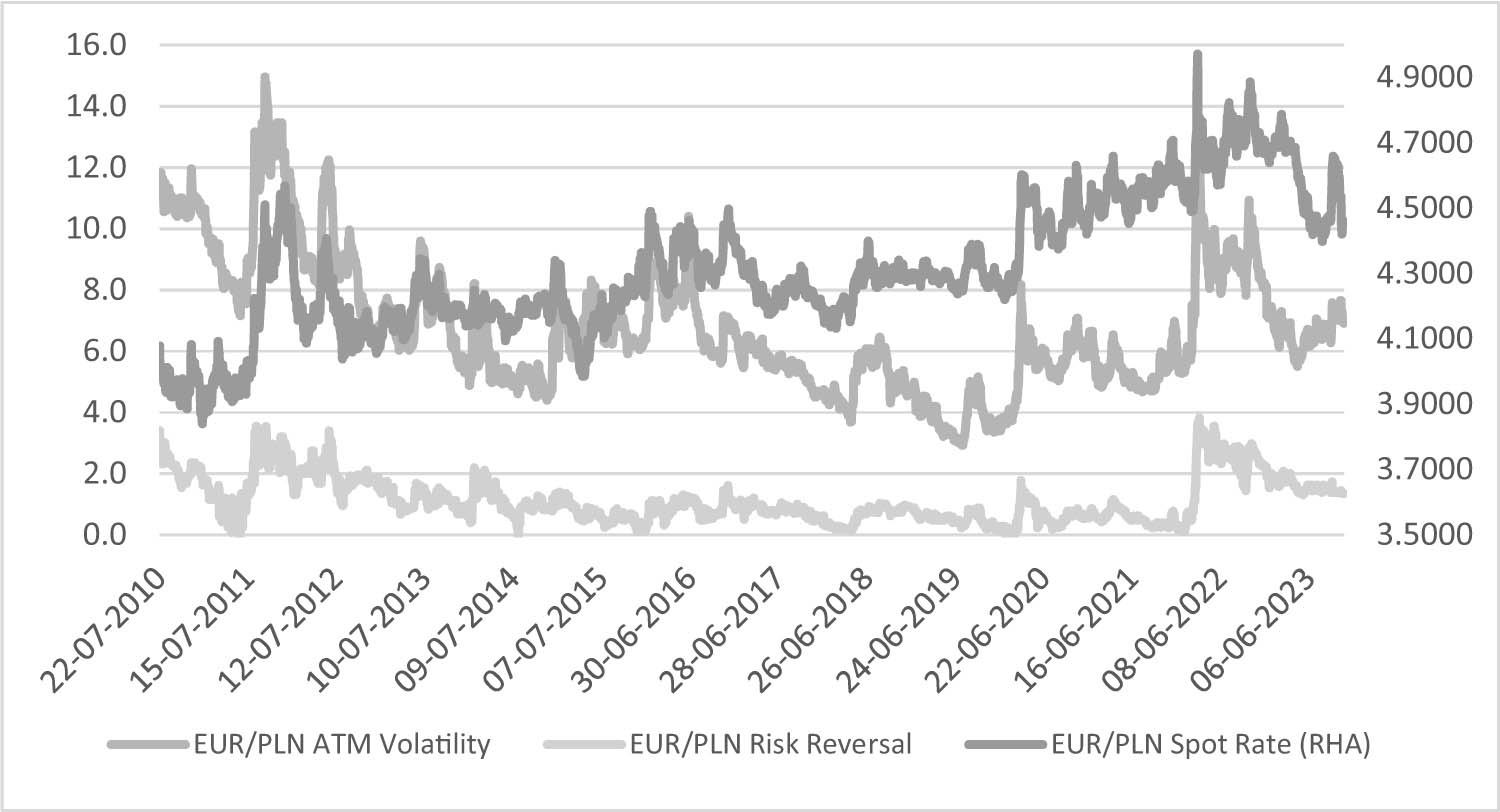
Chart 1
Spot vs ATM volatility and risk reversal on EUR/PLN market.
Source: Refinitiv.
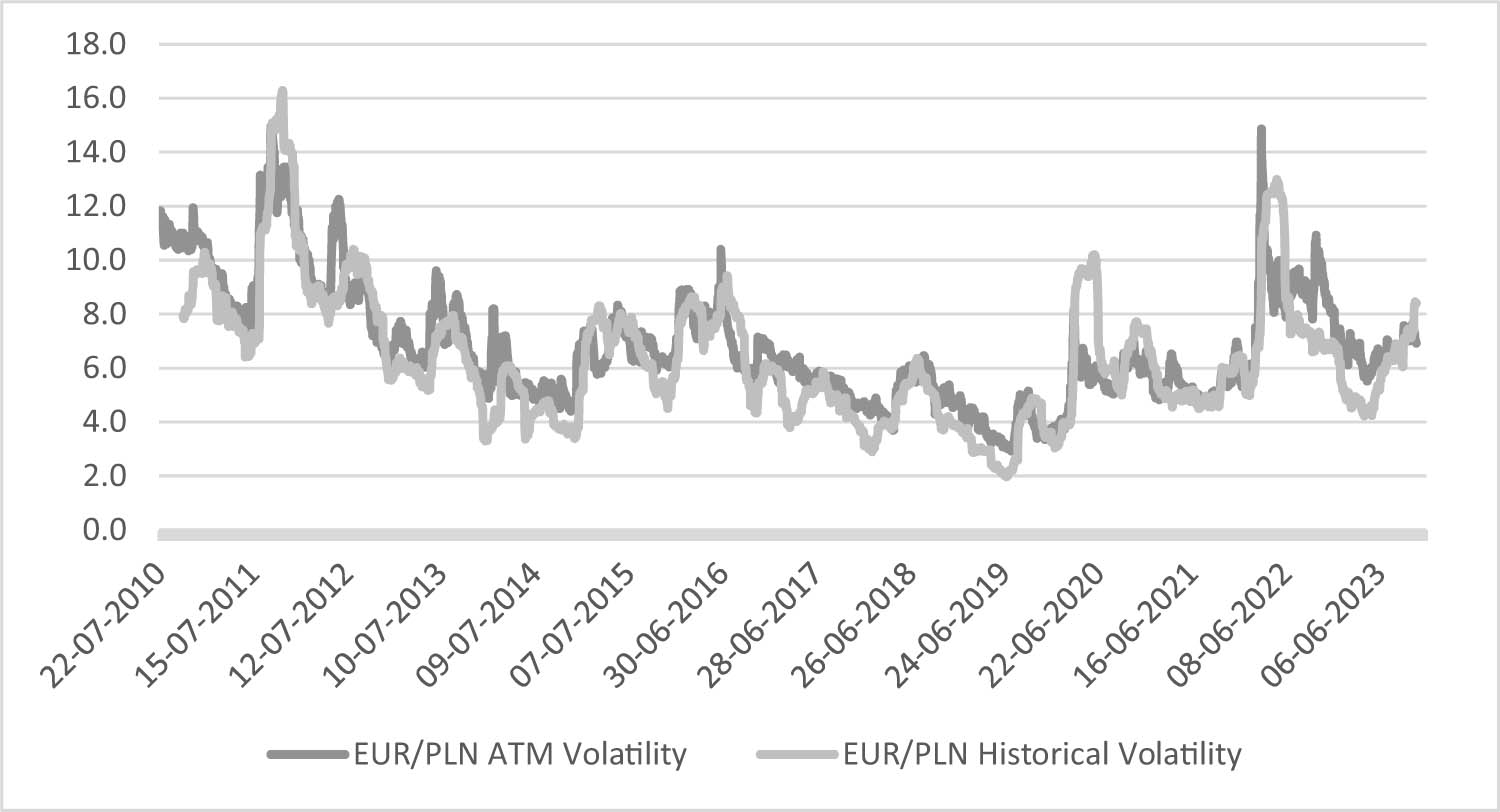
Chart 2
Implied vs historical volatility on EUR/PLN market.
Source: Author’s own calculations on the basis of Refinitiv data.
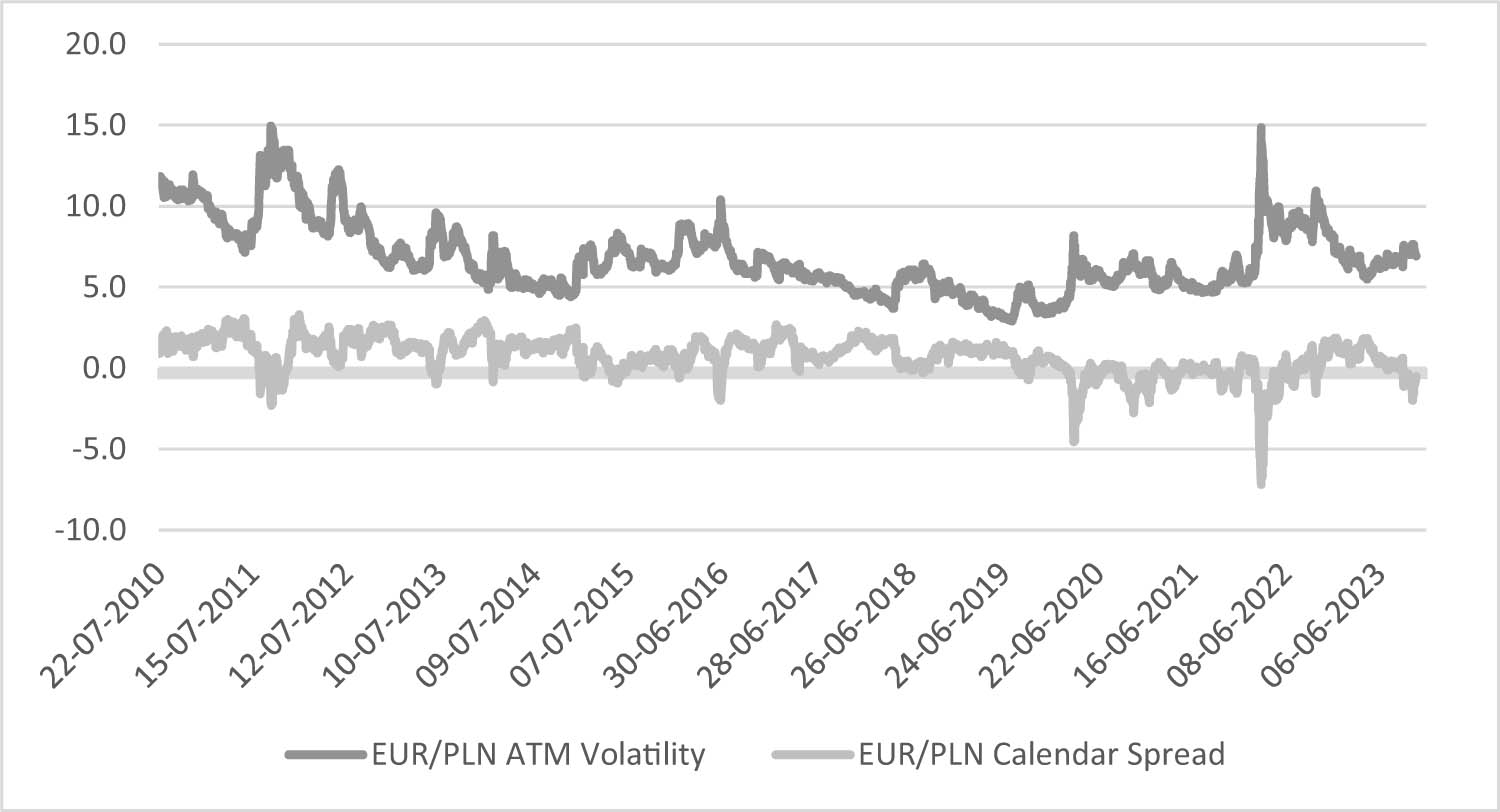
Chart 3
ATM volatility vs calendar spread on EUR/PLN market.
Source: Author’s own calculations on the basis of Refinitiv data.
To build ECMs, the following procedure was followed:
Granger causality analysis (refer Table A2 in Appendix)
Stationarity assessment of variables (refer Table A3 in Appendix)
Construction of cointegration equations and evaluation of the stationarity of their residuals (refer Tables A4 and A5 in Appendix)
The procedure is based on the Engle–Granger cointegration test (1987) and Charemza and Deadman (1997).
The ECM has the following construction:
wherey t ∼ I(1), x t ∼ I(1),
uhat t ∼ I(0).
Based on correlation and causality analysis, the following models were constructed:
Changes in ATM implied volatility explained by spot returns (Model 1).
Changes in ATM implied volatility explained by changes in historical standard deviation (Model 2).
Changes in the slope of the volatility curve explained by changes in ATM implied volatility (Model 3).
Changes in risk reversal explained by changes in ATM implied volatility (Model 4).
A plot of daily returns in all the above-mentioned models is presented in Charts 4–7.
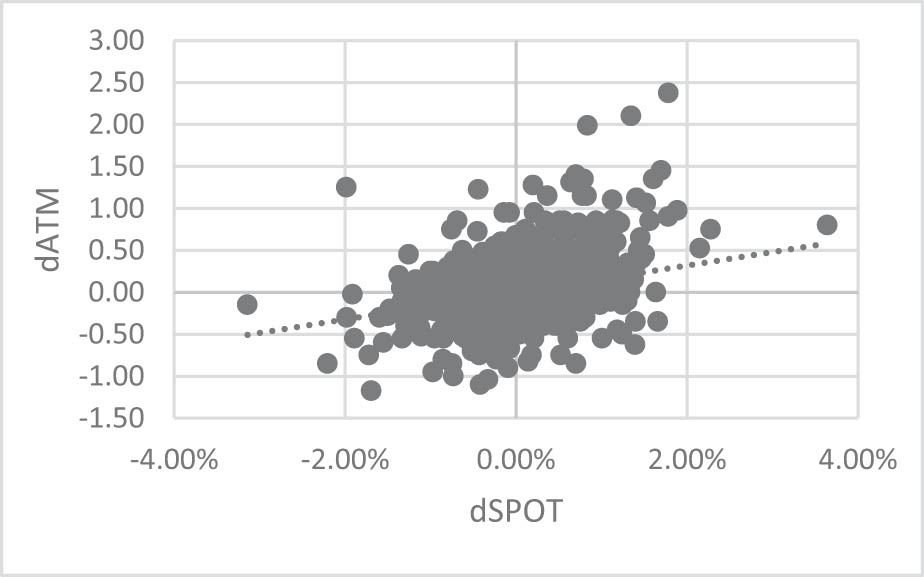
Chart 4
Plot of ATM volatility and FX spot returns.
Source: Author’s own calculations.
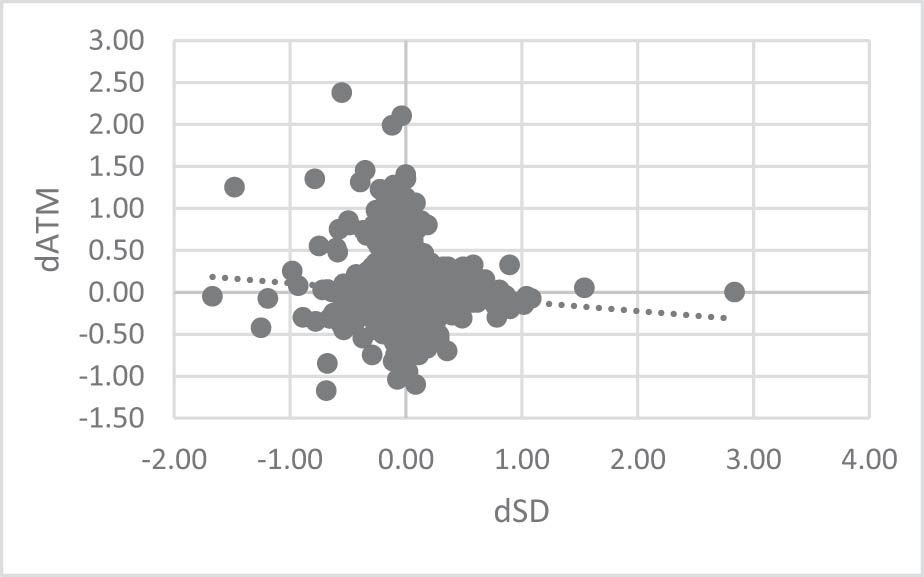
Chart 5
Plot of ATM volatility and historical standard deviation.
Source: Author’s own calculations.
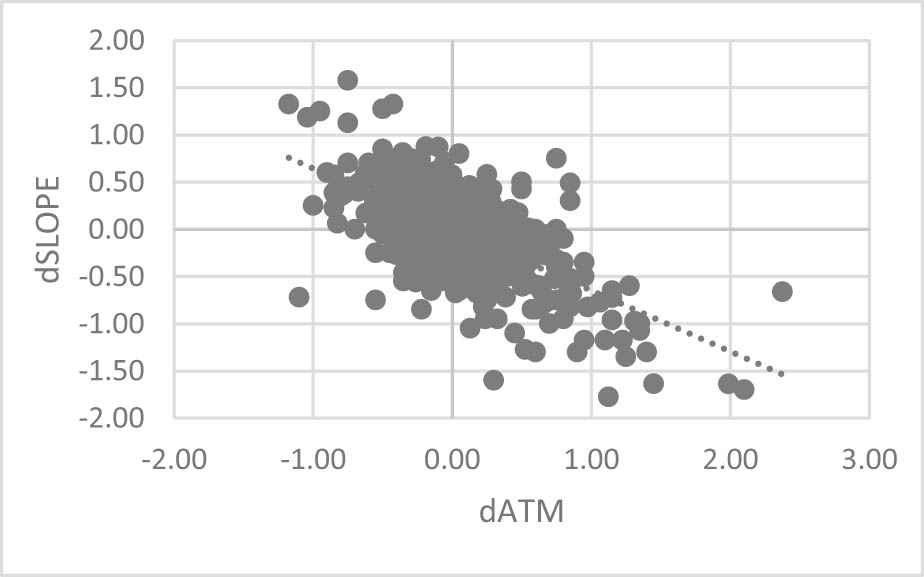
Chart 6
Plot of volatility curve slope and ATM volatility.
Source: Author’s own calculations.
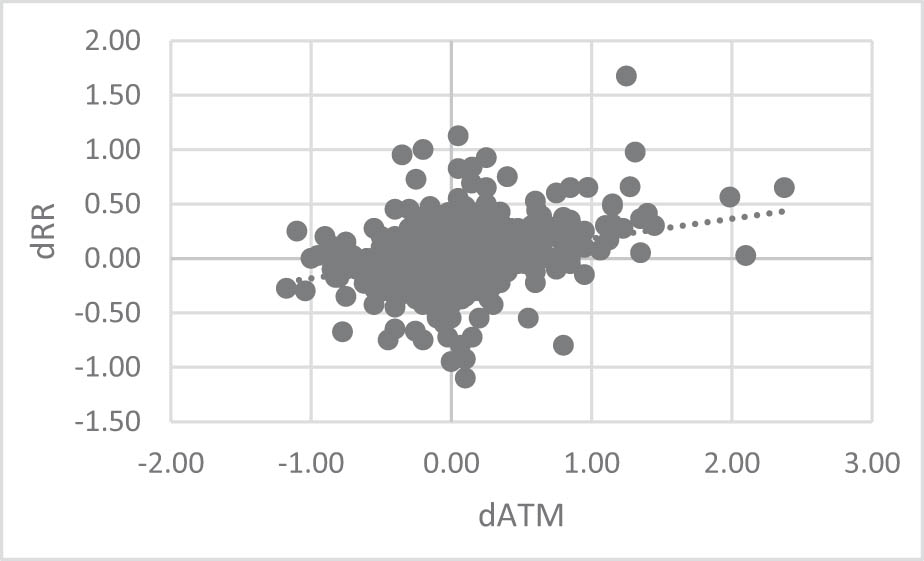
Chart 7
Plot of risk reversal and ATM volatility.
Source: Author’s own calculations.
The rationale of such models is as follows:
Model 1: On emerging currency markets, the depreciation of the local currency brings higher risk, which is reflected in more expensive FX options. This means higher volatility in a high FX rate environment. Therefore, changes in implied volatility can be explained by spot returns.
Model 2: Changes in implied volatility are connected with changes in historical volatility over the same number of days. However, due to psychological and statistical reasons described in Section 1, the link is observed between implied and past standard deviations (not with the standard deviation realized during the life of the contract).
Model 3: Due to mean reversion, the shape of the volatility curve is strictly dependent on the level of implied volatility. Therefore, a change in the shape may be caused by parallel shifts in volatility.
Model 4: The volatility smile is mostly determined by risk reversal. As higher skewness is observed in a volatile environment, it links risk reversal prices with ATM levels. Risk aversion causes demand for both straddles (i.e. ATM) and risk reversals as market players hedge against both spot and volatility rise (due to the phenomenon described in point 1).
3. Results and discussion
An ECM can be constructed if both time series are I(1) and the residual time series is I(0). The stationarity tests give ambiguous results (refer Tables A3–A5). Such situation is not unique according to the analysis related to data from emerging financial markets (Pasaribu, 2002; Kipkoech, 2015; Aderemi et al., 2019). Barnhart and Szakmary (1991) found that results of unit root tests are sensitive to correct model specification that may be important for ECMs for the non-stationary and cointegrated series.
The original time series are I(1) according to Kwiatkowski Phillips Schmidt Shin test (KPSS) tests and residuals are I(0) according to MacKinnon critical values (and in three cases according to more restrictive Blangiewicz–Charemza critical values). Nevertheless, the models have significant parameters, and the sign for the error correction component α2 is always negative (refer Tables A6 and A7 in Appendix).
The four models have the following calibration for the full sample:
To check the serviceableness of the models, a robustness check was performed. The practical value of the model can be confirmed if it forecasts the changes in the explanatory variable. According to Levich (2001), the quality of the forecast in the financial market can be related to direction and not to the size of the change (Chan-Lau & Méndez Morales 2003; Campbell et al., 2014). To verify this feature, the direction quality measure (DQM) was calculated. The results (presented in Tables A8 and A9 in Appendix) indicate that Models 1, 3, and 4 present significant added value in forecasting the direction of the variable change. Its directional forecasting performance ranges from 59 to 66% for full sample model and from 61 to 74% for training sample model. Model 2, based on historical volatility, has random forecasting power (50%) but performed well in the validating period (60%). In general, DQM values for the validating period are much better than the average coefficient for the full sample. This is evidence of the significant usefulness of contemporary directional forecasts based on the calibrated models.
The overperformance of ECM models was measured. OLS models were estimated, and both mean square error (MSE) and DQM were calculated. The comparison of the results is presented in Tables A10 and A11. It is visible that, for the full sample, apart from DQM for Model 4, all ECMs outperform OLS in both measures. For the validating period, the results are less convincing – DQM for Models 3 and 4 and MSE for Model 4 are better for the OLS model.
The stability of DQM and MSE measures can be verified in 14 annual sub-periods. The results are presented in Charts 8 and 9. The MSE ranges are similar for both types of equations. However, for DQM, one can notice a much wider range for OLS. This is evidence of the higher stability of forecasting power for ECM models. Therefore, the added value of the error correction component in forecasting the direction of daily returns is verified.
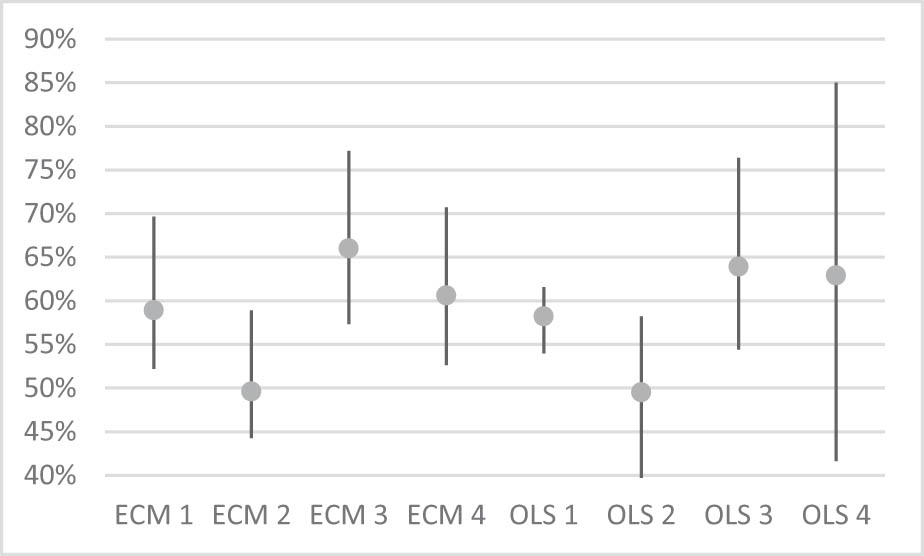
Chart 8
DQM range for the 2010–2023 period. Dot: average value, black bar: min-max for 14 annual periods.
Source: Author’s own calculations.
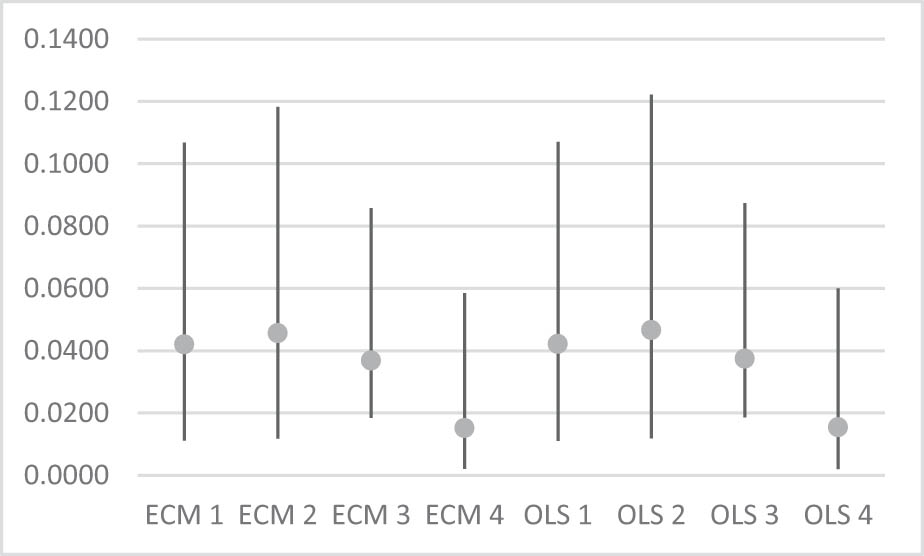
Chart 9
MSE range for the 2010–2023 period. Dot: average value, black bar: min-max for 14 annual periods.
Source: Author’s own calculations.
The findings corroborate previous observations from other markets. Consistent with Dunis and Lequeux (2001), evidence of Granger causality is observed between risk reversal and spot prices in major currency pairs. However, the direction of this causality flows exclusively from the spot market to the options market. This indicates that the depreciation of the local currency leads to an increase in skew risk. In our empirical study, this channel was identified indirectly: spot prices influence ATM volatility, which in turn affects risk reversal. Notably, the EUR/PLN market, unlike major FX markets, exhibits a persistent and significant skew risk, aligning its behaviour more closely with other emerging currencies. This study can also be compared with the empirical results of Filho da Costa (2016) for non-major markets. It confirms that anticipated skewness in zloty returns can be explained by spot returns, although risk reversal itself does not provide predictive information for future spot directional changes.
4. Conclusion
FX options are a popular hedging and investment tool, especially in emerging markets with small open economies that have their own currency, like Poland. Prices of FX options are entirely shaped by implied volatilities feeding the Garman–Kohlhagen model. The volatilities quoted by market makers are collected in matrices known as volatility surfaces. These surfaces are built based on the prices of option strategies. The general level of the surface is created by zero-delta straddles, the maturity axis is shaped by calendar spreads, and the delta axis by risk reversals.
Implied volatilities are connected endogenously – risk reversals and calendar spreads are correlated with straddles. Additionally, there is an exogenous influence generated by the underlying price and its historical variance. For FX options, this means a correlation of volatility changes with spot returns and shifts in historical standard deviation.
To verify such interdependence, OLS and ECM models were calibrated. The models were built using long-term EUR/PLN options time series. This approach allowed for the assessment of the added value of the error correction component based on cointegration of the time series. Furthermore, the forecasting performance and stability of the models were evaluated.
The analysis of coefficients and the forecasting power of the models allowed for the verification of the determinants of the level and shape of the EUR/PLN volatility surface. The models confirm the sign and strength of correlation and causality estimated based on historical time series. Moreover, the models exhibit significant forecasting power regarding the direction of price changes. The direction quality measure for the majority of the models is significantly over 60%.
Funding information
Author states no funding involved.
Author contributions
The author confirms the sole responsibility for the conception of the study, presented results and manuscript preparation.
Conflict of interest statement
Author states no conflict of interest.
Appendices
Appendix
Table A1
Pearson correlation matrix (for daily returns).
| 1M ATM | 3M ATM | 6M ATM | 1Y ATM | |
|---|---|---|---|---|
| SPOT | 32% | 32% | 29% | 25% |
| RR | 33% | 31% | 24% | 11% |
| SD1 | 11% | 15% | 14% | 12% |
| SD2 | −7% | −9% | −10% | −6% |
Source: Author’s own calculations.
Table A2
Granger causality tests (for daily returns).
| SPOT | 3M ATM | 3M RR | 3M SD | |
|---|---|---|---|---|
| SPOT | 10.031 [0.0000]* | 33.117 [0.0000]* | 3.6827 [0.0025]* | |
| 3M ATM | 0.5771 [0.7176] | 16.916 [0.0000]* | 7.9984 [0.0000]* | |
| 3M RR | 1.5067 [0.1842] | 4.1901 [0.0008]* | 5.4973 [0.0000]* | |
| 3M SD | 0.9866 [0.4243] | 1.8946 [0.0919]* | 0.2716 [0.9288] |
*Rejection of the hypothesis about the lack of causality at 0.10 confidence level.
The table presents F-statistics for a test assuming that variables listed in the left-hand column Granger-cause variables listed in the top row of the table.
Source: Author’s own calculations.
Table A3
Stationarity tests.
| Variable | p-value for Augmented Dickey Fuller test (ADF) test | p-value for KPSS test | ADF decision – H0: I(1) | KPSS decision – H0: I(0) |
|---|---|---|---|---|
| SPOT | 0.1401 | Value p < 0.01 | I(1) | I(1) |
| 3M ATM | 0.0168 | Value p < 0.01 | — | I(1) |
| 3M RR | 0.0010 | Value p < 0.01 | I(0) | I(1) |
| 3M SD | 0.0000 | Value p < 0.01 | I(0) | I(1) |
| SLOPE | 0.0000 | Value p < 0.01 | I(0) | I(1) |
Source: Author’s own calculations.
Table A4
Residuals stationarity Engle–Granger test (full sample model)
| Model | Residual variable | p-value for ADF test | ADF value for m = 4, n = 3,284 | MacKinnon (1994) decision | Blangiewicz–Charemza (1990) decision |
|---|---|---|---|---|---|
| 1 | uhat1 | 0.0004 | −3.5194 | I(0) | Rejected |
| 2 | uhat2 | 0.0000 | −4.9595 | I(0) | I(0) |
| 3 | uhat3 | 0.0000 | −5.5724 | I(0) | I(0) |
| 4 | uhat4 | 0.0000 | −4.6977 | I(0) | I(0) |
Extrapolated critical value according to Blangiewicz–Charemza (1990) amounts to 3.88–4.17.
Source: Author’s own calculations.
Table A5
Residuals stationarity Engle–Granger test (training sample model)
| Model | Residual variable | p-value for ADF test | ADF value for m = 4, n = 2,889 | MacKinnon (1994) decision | Blangiewicz–Charemza (1990) decision |
|---|---|---|---|---|---|
| 1 | uhat1 | 0.0009 | −3.3240 | I(0) | Rejected |
| 2 | uhat2 | 0.0001 | −4.0312 | I(0) | Rejected |
| 3 | uhat3 | 0.0000 | −5.0795 | I(0) | I(0) |
| 4 | uhat4 | 0.0000 | −5.2407 | I(0) | I(0) |
Extrapolated critical value according to Blangiewicz–Charemza (1990) amounts to 4.09–4.38.
Source: Author’s own calculations.
Table A6
ECMs (full sample model).
| Model | Response variable | Explanatory variable | α 1 | α 2 | β 0 | β 1 |
|---|---|---|---|---|---|---|
| 1 | 3M VOL | EURPLN | 15.9853*** | −0.0048*** | 9.0466*** | −0.5205*** |
| 2 | 3M VOL | 3M SD | −0.1393*** | −0.0180 *** | 3.4137*** | 0.5325*** |
| 3 | SLOPE | 3M VOL | −0.6468*** | −0.0226*** | 1.0460*** | 0.0453*** |
| 4 | 3M RR | 3M VOL | 0.1813*** | −0.0399*** | −0.7478*** | 0.2750*** |
Source: Author’s own calculations.
Table A7
ECMs (training sample model).
| Model | Response variable | Explanatory variable | α 1 | α 2 | β 0 | β 1 |
|---|---|---|---|---|---|---|
| 1 | 3M VOL | EURPLN | 14.7215*** | −0.0045*** | 21.9061*** | −3.5772*** |
| 2 | 3M VOL | 3M SD | −0.1103*** | −0.0172*** | 2.9705*** | 0.5878*** |
| 3 | SLOPE | 3M VOL | −0.6029*** | −0.0248*** | 0.6832** | 0.0245*** |
| 4 | 3M RR | 3M VOL | 0.1535*** | −0.0601*** | −0.6246*** | 0.2434*** |
Source: Author’s own calculations.
Table A8
DQM for ECM models (full sample model).
| Model | Response variable | Explanatory variable | DQM (excluding zero returns) |
|---|---|---|---|
| 1 | 3M VOL | EURPLN | 58.9% |
| 2 | 3M VOL | 3M SD | 49.6% |
| 3 | SLOPE | 3M VOL | 66.0% |
| 4 | 3M RR | 3M VOL | 60.6% |
Source: Author’s own calculations.
Table A9
DQM for ECM models (training sample model).
| Model | Response variable | Explanatory variable | DQM (excluding zero returns) |
|---|---|---|---|
| 1 | 3M VOL | EURPLN | 60.7% |
| 2 | 3M VOL | 3M SD | 60.3% |
| 3 | SLOPE | 3M VOL | 73.6% |
| 4 | 3M RR | 3M VOL | 62.5% |
Source: Author’s own calculations.