
1. Introduction
The growing interest in renewable energy sources (RES) is inextricably linked to the pursuit of sustainable development, since the use of these sources by the current generation does not diminish the chances of their use by the future ones. Although the start of the process of obtaining energy from RES is an investment requiring the involvement of large financial expenses (i.e., primarily the purchase/construction of equipment), the very operation of energy installations based on RES, including the acquisition of energy from green sources, is constantly becoming cheaper. Roser (2020) states that “in most places power from new renewables is now cheaper than new fossil fuels.” In view of this, it can play as a competitive alternative compared to the acquisition of energy from fossil fuels. As such, RES serve a role not only as a source of “clean” energy, but more importantly as a source of “cheap” energy – encouraging its use by both energy suppliers and households. It should be underlined that the shift toward sustainable energy should encompass the three facets of sustainable development, including social, environmental, and economic considerations, alongside the technical and political/institutional aspects (Kabeyi & Olanrewaju, 2022).
The degree of RES use in a country is a consequence of the efficiency of the energy transition process. The member states of the European Union (EU), in the Paris Agreement, pledged to carry out the energy transition in pursuit of sustainable development, and set targets against, among other things, reducing environmental damage, as part of the Fit for 55 package, a follow-up to the European Green Deal. However, both the COVID-19 pandemic and the energy crisis triggered by Russia’s invasion of Ukraine affected the conditionalities and feasibility of implementation, disrupting the plans and stability of member states’ ongoing efforts (Krawczyńska et al., 2024).
Poland, being an EU member, has also committed to reducing its carbon footprint as part of ratifying the aforementioned acts. The consequence of this was the need to adapt processes to EU compliance, including energy transition, but, as shown, the energy transition process in Poland is progressing inefficiently (Kubiczek et al., 2023a). While it may be slowing down the replacement of fossil fuels with RES, the vision of failing to meet the targets has forced the undertaking of increasingly stringent steps (Tucki et al., 2021). As a result, further and more resolute adoption of RES in Poland will be indispensable.
The aim of this study is to assess the situation, including opportunities, challenges, and prospects for further development of RES use in Poland. In order to achieve it, the following research questions were formulated:
How are the prevailing conditions affecting the energy transition in Poland?
What are the prospects for the future development of RES in Poland in the context of the growing need for independence from fossil fuels?
2. Methods
The volatility of the environment is central to the energy transition’s dynamization, necessitating methodologies that account for it. Political, economic, social, and technological (PEST) analysis, offering a broad perspective, is a versatile tool for this purpose. As Bachman (2008) notes, PEST examines an organization’s environment by considering various coexisting factors shaping its operations. However, it also applies to entire sectors, not just individual enterprises (Igliński et al., 2016). PEST helps identify key influences and assess their direction and strength, enabling a better understanding of how the external macro environment impacts competitiveness (Sammut-Bonnici & Galea, 2015). PEST analysis has broad applications beyond studying individual organizations; it can address wider aspects, such as economic sectors. For example, Igliński et al. (2016) used PEST to analyze the renewable energy sector in the Łódź Voivodeship, justifying its application to a national RES sector analysis. Chosen for this study as part of a thematic literature review, PEST offers greater depth and breadth than a systematic review, especially given the limited role of “gray literature” (e.g., working papers, reports, legislation). This approach is effective in examining environmental issues, including energy transition (Jones et al., 2023; Kubiczek et al., 2023b). Moreover, PEST analysis helps businesses and sectors identify trends, opportunities, and challenges that influence strategic direction (Nandonde, 2019). However, its qualitative nature introduces subjectivity, lacks quantitative data for impact measurement, and often isolates categories, missing interconnected influences. Additionally, the rapidly changing business environment can quickly make the analysis outdated, necessitating regular updates (Mihailova, 2020).
The section including results will consist of four parts that illustrate the course of information acquisition for each part of the PEST analysis. Section 3.1 covers political issues (P), including legal-legislative conditions and development directions, i.e., EU policy and the achievement of established goals within its framework; Section 3.2 comprises economic issues (E), including the presentation of RES demand and supply levels, aspects of economic efficiency, or subsidiarity levels within EU programs; Section 3.3 deals with social issues (S), including social trends and levels of public acceptance; and Section 3.4. deals with technological issues (T), including aspects related to the production and maintenance of green installations.
3. Results of PEST analysis
3.1. Political issues
The political aspects of Poland’s transition toward RES are driven by the need to meet international obligations, particularly those set by the EU. The EU prioritizes the implementation and promotion of RES, aiming for climate neutrality and enhanced energy security. Documents issued by the EU include the introduction of national targets and rules for cooperation between member states, regulate the market and administrative procedures for electricity in the EU, and include protection of energy consumer rights. They also regulate the process of monitoring and reporting progress toward renewable energy targets, strategies, and actions for 2021–2030. The EU aims to increase the share of RES to 42.5%, and with the additional commitment even to 45% by 2030 (European Council, 2023).
A large group of EU documents promoting renewable energy is the European Green Deal, which is a strategy for sustainable development that aims to achieve climate neutrality by 2050 through the transformation of the energy and other sectors. The adoption of this package of initiatives has given direction to regulatory change at European level and within individual member states. Poland, as a member state of the EU, ought to meet the goals set by this organization. However, it also has internal (national) documents regulating the RES market. The main one is the “Act of February 20, 2015 on Renewable Energy Sources,” which sets the goal of strengthening energy security and environmental protection through the use of RES, their reasonable use – bearing in mind long-term economic development policies, and the creation of mechanisms and instruments to support electricity production. Other documents set separate, specific targets for the operation of the energy sector, including RES, in Poland over specific time frames.
Poland has committed to a 21–23% share of RES in gross final energy consumption (until 2030). This is still a lower target than the stated trajectory of 25% (European Commission, 2020, p. 9). Therefore, it is imperative to implement specific measures to expand the market for RES. The Polish government sees particularly great opportunities in the offshore wind sector, where it predicts that the installed capacity of Polish projects could reach 5.9 GW by 2030 and about 11 GW by 2040. However, in order to increase the share of RES, it is necessary to provide a flexible power reserve, develop grid infrastructure and energy storage facilities. Poland has decided to foster the RES market by strengthening the auction support system. The auction system has revitalized the RES market and attracted a new wave of investment, especially in wind farm and photovoltaic (PV) projects. The point of contention is the so-called “windmill law” of 2023 regulating the minimum distance from residential buildings. The adopted distance of 700 m, according to experts, significantly limits the development of wind farms (Elżbieciak, 2023). At the same time, the government is trying to promote RES development at the local level, especially among prosumers (Czarnecka et al., 2022). There is currently a dynamic development of RES micro-installations and activation of energy consumers. The government aims to continue this positive trend in the future and increase the role of prosumers in electricity markets. Poland also seeks to decarbonize its gas supply with biomethane and hydrogen produced from renewable energy. Detailed targets and support measures for RES are set out in the Polish NECP, EPP2040, and multiple national laws and regulations. Current levels of RES energy consumption in the EU are illustrated in Figure 1.
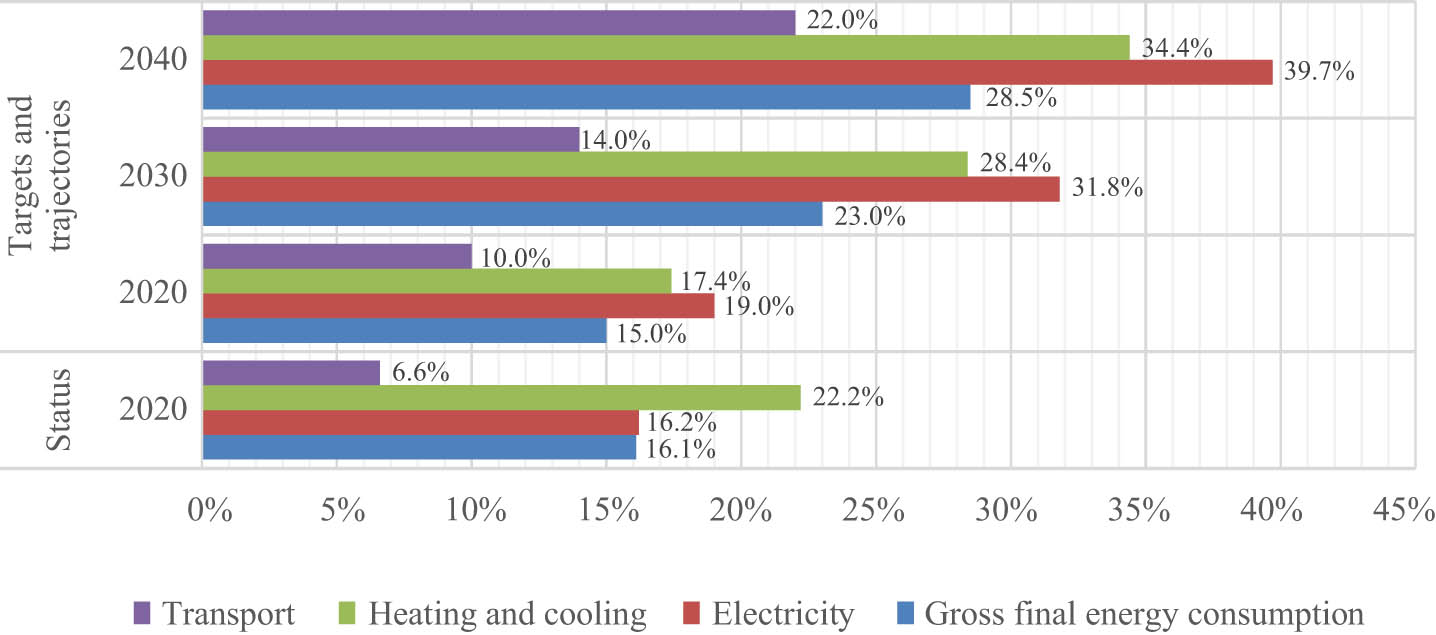
Figure 1
Current levels of RES energy consumption in the EU in different categories with future trajectories.
Source: (IEA, 2022, p. 74).
Poland supports the generation of energy from renewable sources. For instance, it is exempt from excise tax in this country (Dziennik Ustaw, 2009, Article 30). In addition, RES-based projects receive reduced grid connection fees (with a capacity of less than 5 MW), and micro-installations are connected to the grid free of charge. Furthermore, starting and carrying out the business of generating electricity from RES requires obtaining a license under the terms and conditions set forth in the law with the exception of the generation of electricity (Dziennik Ustaw, 2015, Article 3): (i) In a micro installation; (ii) in a small installation; (iii) exclusively from agricultural biogas, including cogeneration (as defined in Article 3 number 33); and (iv) exclusively from bioliquids.
Within the framework of political considerations, the perspective of entrepreneurs and the actions they take need to be explained. Entrepreneurs commit to investments in renewable energy; however, they operate in a setting that is shaped by the national regulatory framework which, in turn, is the result of the implementation of EU directives. Thus, the dynamics of RES sector development is closely linked to energy policy at the national and EU level. Entrepreneurs investing in RES face several challenges (Bernat et al., 2024), including frequent legislative changes, particularly amendments to the RES Act and anticipated future updates. They also encounter difficulties interpreting regulations, especially regarding the obligation to purchase energy from micro-installations. The lack of executive regulation further complicates the registration, balancing, and billing of renewable energy prosumers. Additionally, there are challenges in meeting statutory deadlines for connecting micro-installations to the grid, as well as issues in collaborating with distribution system operators, such as contract finalization, metering installation, and balancing energy consumption with production. Wind power development is also hindered by the 10 H rule in the Wind Power Investment Law, in effect since mid-2016.
In summary, the legal and political conditions of the energy transition in Poland have a three-tier structure: (1) EU regulations that determine (2) national regulations which, in turn, affect (3) the activities of companies. The EU sets energy targets and strives for climate neutrality – these are implemented by member states, including Poland and its legislation. However, at the enterprise level, numerous problems are encountered in the effective adaptation of RES utilization.
3.2. Economic issues
Poland’s economy is sensitive to changes in the price of energy carriers. This is supported by data for 2022, which show that a large proportion of Poland’s electricity was produced from fossil fuels (79%), placing it in the top in the whole EU. Moreover, 69% of the country’s power in 2022 was derived from coal (Ember Climate, 2023). This high proportion of coal in the structure results in Poland’s high carbon footprint and the price of electricity in the country, highly sensitive to changes in commodity prices. In Poland’s 2021 wholesale market, compared to neighboring countries such as Lithuania, the Czech Republic, and Germany, prices were among the highest in the region. Only in Sweden, the energy had higher prices. Despite the high wholesale prices, Poland offered exceptionally competitive prices for households and businesses, compared to the EU (Forum Energii, 2023).
Obtaining energy from renewable sources requires substantial investment which pays off relatively quickly. Various programs and opportunities have been created to allow new infrastructure for obtaining energy from renewable sources. European Funds for Infrastructure, Climate, Environment 2021–2027 is the largest investment program in Poland and the EU. Funding from it is given to projects that are important from the perspective of ensuring energy security at the national level (Standar et al., 2021).
Effective energy transition requires strong policy backing that provides resources and opportunities to help communities manage the social and economic challenges of the transition (Roemer & Haggerty, 2021). Local government units, their unions, entrepreneurs, housing communities and cooperatives, as well as state budget units and subordinate bodies can apply for support. For example, frameworks in Poland like “Stop Smog,” designed for individuals who cannot afford to replace their coal furnaces, and the “Clean Air” program, which offers subsidies for replacing heat sources, exemplify initiatives aimed at promoting cleaner energy solutions in Poland (Kubiczek et al., 2023a). It is essential that the implementation of government programs aimed at encouraging households to adopt energy transition measures be carried out in accordance with the principles of social justice (Czarnecka & Krazniewski, 2024).
The economic efficiency dimension of RES deserves an additional consideration. In case of electricity, the efficiency calculus will be based on the costs of generating, transmitting, and distributing energy, both from coal-fired power plants and energy obtained from wind or PV farms. The economic calculation should also take into account costs relating to the complex social and political processes that accompany economic activities (i.e., the so-called transaction costs). Examples of such costs could be the penalties charged by the EU Court of Justice for the Polish government’s failure to comply with decisions regarding the Supreme Court’s Disciplinary Chamber. Social transfers made by the Polish government between 2016 and 2022, including a several-year freeze on electricity prices for households, are also a factor in the increase in transaction costs. Through Poland’s centralized policies, failure to comply with the recommendations of the EU the country’s budget and economy are significantly burdened by these costs (Ruszkowski, 2022). Also, in view of the escalation of Russia’s invasion of Ukraine, it is of particular importance to maintain good relations with the EU to mobilize funds from the National Recovery Plans to modernize the energy sector (Kawecka-Wyrzykowska, 2022). While there is rising pressure to address the geopolitical impacts of the energy transition, it is noted that increased geopoliticization may hinder the global shift toward low-carbon energy systems (Herranz-Surralles, 2024). As the demand for critical materials essential for renewable energy rises, Russia’s position as an “energy superpower” is being eroded (Vakulchuk et al., 2020), coinciding with a reconfiguration of its ties with Europe due to the Ukraine conflict (Skalamera, 2023).
The Polish RES market has great potential for development, but it also faces numerous barriers and challenges. Nevertheless, the supply of energy from renewable sources will grow. This is a consequence of the climate targets adopted by EU member states and the community as a whole. In 2021, the share of renewables in Poland was more than 15.6%, with the EU average share of more than 21.7%. The country with the highest share of renewables was Sweden, with more than 62.5%. Figure 2 shows the share of RES by EU country.
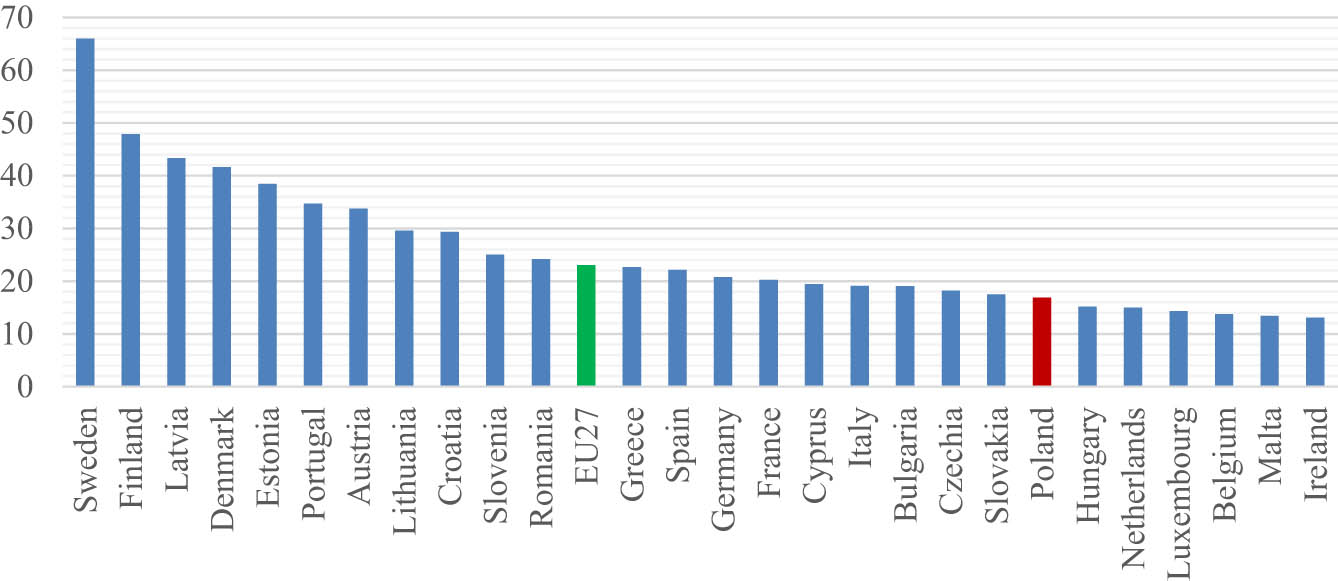
Figure 2
Share of RES in particular EU countries (%).
Source: Own study based on (Eurostat, 2023).
In Poland, the share of RES has been increasing since 2004, although there have been periods such as 2015–2017, when this trend reversed (as shown in Figure 3). The largest share of RES can be observed in heating and cooling. This is related to the rising cost of the equipment and the lower cost of operation, compared to, for example, fossil fuel heating boilers.
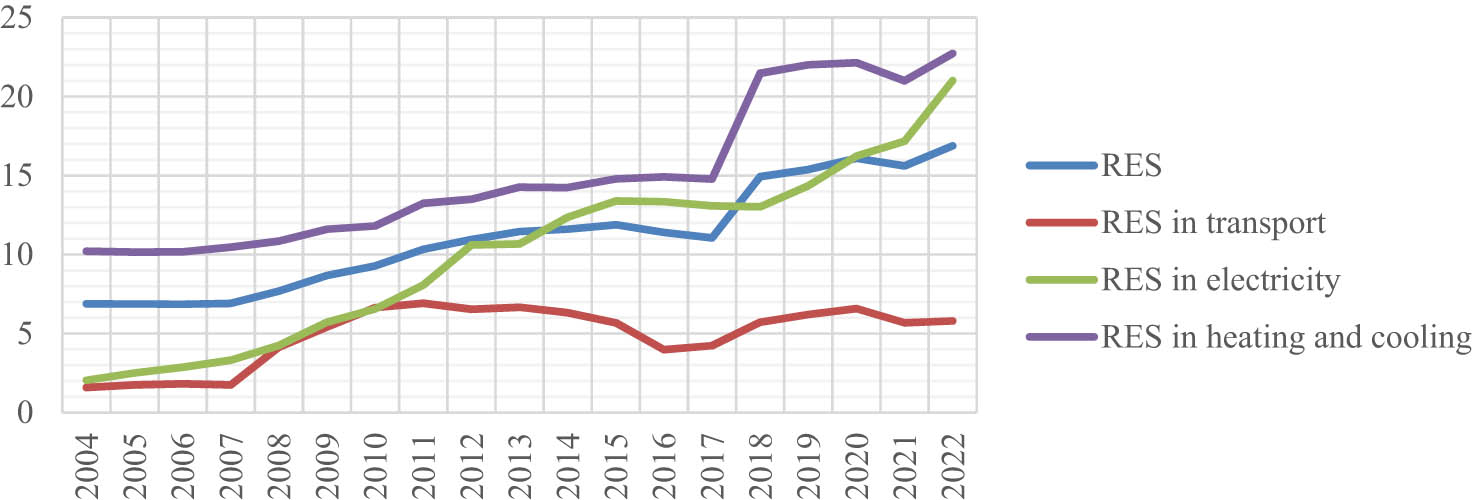
Figure 3
Use of RES in individual economic sectors in the EU (%).
Source: Own study based on (Eurostat, 2023).
The smallest share of RES can be observed in transportation. Its share rose from less than 2% by more than 2 percentage points in 2008 and has since fluctuated in the range of about 4–6%. The main reason may be the cost of purchasing electric cars and the lack of sufficient charging infrastructure for these vehicles.
A further increase in the share of RES is expected in the electricity-related sector. In the electricity generation subsector, the dominant position was held by the PGE Polska Grupa Energetyczna S.A., with a 42.4% market share. PGE was also the leader in sales to end users. ENEA S.A. and TAURON Polska Energia S.A. were next in line. These three producers had more than half of the installed capacity and accounted for more than two-thirds of the country’s electricity production. In 2021, PKN Orlen S.A. joined the group of entities with at least a 5% share of installed capacity, having taken over generators from ENERGA S.A. in 2020 (Urząd Regulacji Energetyki, 2022). The listed entities are state-owned companies, which plan to invest in RES (Table 1).
Table 1
Selected RES investments of leading players in the Polish electricity market.
| Currently | In the future | |
|---|---|---|
| PGE | 20 wind farms, 29 hydroelectric power plants, 4 pumped storage power plants, and 24 PV farms | Further 23 PV installations, the company has secured about 3,000 hectares of land for investment purposes, target: solar farms with a capacity of more than 2 GW |
| ENEA | 26 renewable energy installations including more than 20 hydropower plants, as well as wind farms | Implementing “Enea’s Green Change”: this is the Group’s sustainable transformation strategy building value growth, with the assumption of achieving climate neutrality by 2050, energy storage will be a specialty. |
| ENERGA | 2 PV farms (Wielbark and Gryf) and wind farms in 6 localities. Having small and large hydroelectric power plants | By the end of 2030, the corporation will reach an installed renewable capacity of more than 2.5 GW. Baltic Power’s offshore wind farm of up to 1.2 GW with a completion date of the end of 2026 |
| TAURON | A 5 MW PV farm in Jaworzno. In Bytom, the first microgrid in Poland | In 2030, there will be 3,700 MW installed in wind, PV, and hydroelectric power plants. The strategy “TAURON’s Green Turnaround. Energy Around the Clock” indicates the Group’s priorities, the most important of which is to achieve climate neutrality by 2050 |
As of 6th February 2024.
Source: (Kubiczek & Przedworska, 2024).
The RES retail market in Poland in 2021 saw unprecedented prosumer activity (Urząd Regulacji Energetyki, 2022). Poles’ attitude toward RES indicates interest in producing their own electricity. At the end of 2022, micro-installation capacity reached 9.2 GW, an increase of more than 52% year-on-year. This capacity includes more than 1.2 million prosumer installations, an increase of 41.7% year-on-year. Virtually all of them (99.98%) are PV installations. Total electricity production from micro-installations amounted to about 7.4 TWh. Civic energy development prevented the need to send about 1.8 TWh of electricity (1% of national production) through the National Electricity System. Prosumers contributed 5.5 TWh of electricity to the grid, making up 3.1% of national generation (Dusiło, 2023, s. 30).
The third group of energy producers are owners of small installations. A small RES installation is an installation with an electrical output of 50 kW to 1 MW, connected to a grid with a voltage below 110 kV, or with a thermal output of 150 kW to 3 MW, where the electrical output is 50 kW to 1 MW. Between 2021 and 2022, the number of such installations increased significantly. At the end of 2022, 2,448 producers were registered in the register of small energy producers (Urząd Regulacji Energetyki, 2023, s. 2).
As seen, prosumers play a pivotal role in enhancing energy resilience and efficiency in the renewable energy sector. By generating local energy, often through solar panels, prosumers reduce reliance on centralized power plants, minimize transmission losses, and contribute to both energy self-sufficiency and global sustainability by lowering greenhouse gas emissions (Milčiuvienė et al., 2019). The rise of prosumers challenges traditional energy markets, requiring new regulatory frameworks for decentralized production and consumption (Parag & Sovacool, 2016). This shift fosters new business models, like community energy cooperatives, and allows prosumers to sell surplus energy, promoting further investment in renewables (Mochi et al., 2023; Teotia et al., 2020). However, the rise of prosumers introduces challenges, particularly in terms of managing the complexity of energy transactions and ensuring grid stability. The integration of numerous prosumers into the grid requires advanced management technologies and strategies to balance supply and demand effectively (Hu et al., 2023). Therefore, regulatory frameworks must evolve to ensure fair pricing and equitable access while maintaining the integrity of the energy system (Al-Sorour et al., 2022).
Poland’s reliance on coal, which made up 69% of its electricity in 2022, makes its economy vulnerable to global energy price fluctuations, resulting in higher emissions and electricity costs compared to neighbors. Despite high wholesale prices, Poland has kept electricity rates relatively competitive for consumers. The shift to renewable energy requires major investments, supported by EU funds and national programs like “Stop Smog” and “Clean Air.” This transition also faces economic challenges, including penalties for EU non-compliance (Kubiczek et al., 2023a). However, it offers growth potential, with the rise of prosumers signaling a move toward more resilient, decentralized energy systems.
3.3. Social aspects
Considering social dimensions of energy transition toward RES, as RES are environmentally friendly, their use is widely accepted, with the public mostly not voicing any aversion toward them. On the other hand, there is also a perceptible lack of expression of an active desire to participate in the green transformation among the public. A major challenge in the energy transition, however, may be the insufficient level of environmental awareness.
While RES enjoy broad public support, local acceptance remains low and is considered to be a major obstacle for the implementation of RES projects (Segreto et al., 2020). However, environmental awareness among Poles is high, with 83% in a 2021 study viewing energy from the sun, water, and wind as the most environmentally friendly (Zaworski, 2021, p. 65). As many as 88% of Poles believe that Polish energy should be based on RES.
However, decarbonization in Poland is associated with high social costs. It is troublesome to the point that the decarbonization of the Lower Silesian Coal Basin, one of three coal basins in Poland, has led to the creation of illegal pits of bootleg minings (pol. biedaszyby), from which many Polish families have made a living (Worek et al., 2021). While social costs are at a premium in this context, Poles are in favor of RES development. A 2016 CBOS survey shows that Poles trust RES the most, while oil and coal the least. A 2018 Indicator poll confirms strong public support for government investment in RES. However, the IBRiS survey reveals that 44% of Poles believe that the state should still use its coal resources in the energy sector. Nearly half of Poles (49%) believe that our country should reduce its use of fossil fuels. Moreover, nearly one in two people surveyed believes that renewable energy is expensive (51%), and 37% have no confidence in RES due to instability in electricity supply (Micek, 2021, s. 6).
The growth of RES in Poland faces several societal barriers and threats. Key obstacles include a lack of education and awareness about energy management and modern solutions, limited local organizational capacity, and insufficient knowledge of best engineering practices. Additionally, inadequate non-financial support for local RES initiatives, a shortage of specialists, and weak mechanisms for social dialogue and communication may impede progress (Chmiel et al., 2023, p. 18). Research on Poles’ views of RES shows two contrasting attitudes: on one hand, there is a high support for RES development, especially when considered in the context of reducing environmental pollution. On the other hand, Poles show a high acceptance of the use of traditional energy sources, which they consider an economically rational measure, at least in the short term (Worek et al., 2021).
Further hurdles include discrepancies between declared and actual commitment to action, underdeveloped social capital, limited public trust, and resistance from interest groups. Concerns over economic impacts, land use, landscape changes, and the absence of regulations to promote energy communities also affect the pace of RES development. Public hesitancy to engage in local initiatives, individualistic strategies, low confidence in Poland’s long-term RES strategies, negative stereotypes, and a traditional attachment to coal-based energy further complicate RES acceptance (Chmiel et al., 2023, p. 18).
In terms of social conditions, Poles accept RES and declare that they are environmentally conscious. They support the development of RES, but their actual implementation faces many obstacles and risks – such as inadequate education on energy management or insufficient non-financial support for RES initiatives. The decarbonization of some regions, heavily dependent on coal, is met with high social costs. In Poland, there is also low public willingness to make decisions and cooperate on local initiatives supporting RES.
3.4. Technological issues
The technological determinants of Poland’s energy transition include technologies that allow energy to be extracted while not diminishing its resources. RES-based technologies continue to be developed while being cheaper, more efficient, and competitive methods of energy generation. The most popular green energy sources include solar, water, wind, and biomass, while among the most common technologies that use them are wind turbines, PV power plants, biogas plants, biomass boilers, hydroelectric power plants, or heat pumps (Qazi et al., 2019). The implementation of technologies using these sources has been encouraged by the government or EU programs and preferential legislation.
The expansion of new RES capabilities, especially solar power and wind farms, is pivotal to ensuring the country’s energy security. These technologies have a significantly lower cost of energy production than coal or gas (Adamczewski et al., 2023). With the development of RES, investment in cutting edge technologies is necessary. A keystone of RES technology, and a concern not only for Poland but also for Europe, is the recycling of, for example, PV panels. The lifespan of PV panels is estimated to be around 25–30 years (Tora et al., 2022) and is affected by, among other things, manufacturing defects or weather conditions (Jarosz, 2022). By the early twenty-first century, the first PV panels emerged, indicating that by around 2030, a significant volume of these panels will become waste. Recycling PV panels is challenging due to their complex composition, yet crucial given their durability and diverse materials (Tora et al., 2022).
Moreover, Poland must proactively prepare technologically and develop a recycling plan for the upcoming e-waste challenge. The rapid technological advancements and increased consumer demand for electronic products led to a staggering rise in e-waste generation, estimated at 20–50 million tons annually, with projections indicating a continuous increase at a rate of 4–5% per year (Bhargava et al., 2020). E-waste contains not only hazardous materials, such as lead, mercury, cadmium, zinc, and nickel, but also cuprum, gold, and plastics. On the one hand, it is a challenge to prevent harmful substances from entering the soil (Eneh & Akah, 2012), while on the other hand, it is also important to bear in mind the opportunities of recovering valuable materials from e-waste. This can contribute to a circular economy, where resources are reused and recycled rather than disposed of (Srivastav et al., 2023).
Another technology for acquiring RES is the new offshore wind power technology, the growth of which has also been observed for a number of years. The windiness of the seas and oceans is higher than that of land, but the availability of such power plants is limited to only the countries with access to the coast. The development of offshore wind power will also force the necessity of adapting the transmission grid to receive energy from new sources. The effectiveness of this solution has been demonstrated in prior research, as Weißensteiner et al. (2011) argue that this approach can be highly cost-effective. The Polish Baltic coast offers medium-term potential for the development of this type of energy (PSE S.A., 2022).
One of the axial problems of RES utilization is the overproduction or shortage of energy during changing conditions caused by atmospheric phenomena, diurnal cycles and seasons. For effective implementation of RES-based installations, it is vital to consider the vulnerability of renewable sources, particularly in terms of regional climate variability and climate change (Ravestein et al., 2018). An example of such an event is the situation in Poland, where the state of the country’s power grids resulted in an emergency on April 23, 2023. Polish Power Grid was forced to declare a threat to the security of electricity supply from 11 a.m. to 5 p.m. due to the need to reduce the generation of RES sources connected to medium voltage. The reason was the excess supply of electricity over demand (PSE S.A., 2023a). A similar event took place a week later, i.e., on April 30, 2023, but a supply emergency was not announced (PSE S.A., 2023b). This situation highlights the complex interplay between technological constraints of energy infrastructure and political decisions regarding energy management and supply security. As Sawicki (2023) notes, the national operator has issued an order to understate the production of RES, as “coal-fired power plants are not able to lower their energy production even further, and our neighbors are not able to come in with more of our surplus.”
To boost renewable energy’s contribution to electricity production, it is crucial to prioritize modern energy storage facilities. These should efficiently store extra energy and deliver it back to the grid as needed, balancing the size of renewable energy with present economic demands (CIRE, 2021). In recent years, the commercial use of energy storage has become increasingly widespread. The development of the technology has been fostered by falling component costs (Mutz et al., 2023), the growth of commercial energy storage facilities for power systems (Mir Mohammadi Kooshknow & Davis, 2018), and the rapid development of information and measurement technologies to manage distributed sources (Avancini et al., 2021). At the same time, other energy storage technologies are developing, particularly power-to-gas and hydrogen electrolysis technologies. The first commercial energy storage facilities are already in operation, such as the BESS storage facility in Pomerania region (PSE S.A., 2022).
Analysis of the technological aspect of the regions’ energy transition indicates numerous opportunities for the development of the renewable energy sector. Technological advances in the production and maintenance of installations favor their proliferation, which is accompanied by cost reductions for end users. The costs of renewable energy are also reduced by political support (Ostapenko et al., 2022). As a result, the cost of renewable energy has been declining over the last two decades (Timilsina, 2021). Supporting the future of RES brings considerable benefits to businesses and individual consumers.
4. Conclusion
The pursuit of goals within the framework of sustainable development, along with the accompanying energy transition process, opens up many prospects for implementing RES as one of the backbones of the energy economy. The threat of failing to meet international targets for reducing environmental impact has prompted the EU to intervene and support the transition from fossil fuels. This offers an opportunity to enhance the inefficient energy transition process in Poland. The country still relies heavily on solid fuels, including coal, which is reflected in its high share of coal usage and low share of RES in energy generation. This is confirmed by EU data, which ranks Poland near the bottom among EU countries. However, this does not imply that Poland’s transformation process is not progressing. Even with EU funding, coal remains the predominant energy source in many households, which creates both many opportunities and threats for the use of RES. The current energy crisis and conflict in Ukraine have also brought additional attention to the issue of insufficient RES utilization.
The conducted analysis showed that although the use of RES in Poland is not widespread, the opportunities for its development are significant. In the political aspect, currently existing regulations allow favorable steps to be taken to implement green energy sources (at both household and business levels), and the direction of potential changes will be far more supportive of RES development, rather than inhibiting it. Considering the economic aspect, RES not only provides energy security, but also reduces the cost of obtaining energy. Moreover, the existing opportunities for subsidies for the purchase of the necessary facilities encourage investment. Poland’s largest state-owned electricity companies are taking steps to increase production and use of RES, by investing in their own RES-driven installations, among others. Regarding the social perspective, there is no resistance from the public, as RES contributes to environmental protection. This is indicated by surveys demonstrating Poles’ support for government investment in RES. However, the barrier is the lack of environmental awareness, so that the habits of using coal and the lack of internal duty to choose green energy sources continue. While ecological awareness is increasingly present among Poles, it is yet to translate into widespread actionable behavior. It is worth highlighting that the available technology makes it possible to both efficiently obtain electricity from RES and store it.
The results of the analysis have many practical implications. Their application can be used to set further directions for legislators’ support of RES, as well as shed light on the socio-economic benefits for end consumers. The conducted analysis, however, comes with certain limitations. First of all, the PEST method takes into account solely four dimensions of determinants, which on the one hand makes it focused and harmonized, but the inclusion of other aspects would allow a more comprehensive assessment of the future of RES in Poland and the region as a whole. Moreover, due to its qualitative nature, PEST analysis can introduce subjectivity, overlook the interplay between factors, and quickly become outdated in a fast-changing business environment. Limitations also contribute to setting directions for further research, which can both conduct strategic analysis by other methods, including addressing other scopes, and focus on finding determinants of RES utilization.
Funding information
The paper has received funding by Metropolis GZM (Metropolia GZM) and is part of the project “Ecology or economics – determinants and propensity of Poles for energy transition” (“Ekologia czy ekonomia – determinanty i skłonność Polaków do transformacji energetycznej”). The project “Ecology or economics – determinants and propensity of Poles for energy transition” has been subsidized by the Upper Silesian and Zagłębie Metropolis (GZM) within the framework of the Program “Metropolitan Fund for Support of Science” in the period 2022-2024 (RW/71/2023). (Projekt – Ekologia czy ekonomia – determinanty i skłonność Polaków do transformacji energetycznej” został dofinansowany przez Górnośląsko-Zagłębiowską Metropolię w ramach Programu “Metropolitalny Fundusz Wspierania Nauki” w latach 2022-2024 [RW/71/2023]).
Author contributions
K.P.: writing – original draft, software, methodology, investigation, formal analysis, data curation, conceptualization. B.H.: writing – review & editing, writing – original draft, visualization, Investigation, vunding acquisition. D.K.: writing – original draft, validation, software, resources, data curation. A.R.: writing – review & editing, Writing – original draft, resources, methodology, investigation, data curation. J.K.: writing – original draft, validation, supervision, project administration, methodology, funding acquisition, conceptualization.
Conflict of interest statement
Authors state no conflict of interest.