
1. Introduction
The article aims to test whether excluding trade credit late payments from deductible costs is an effective way to shorten days payable outstanding (DPO). Long and late payments are a severe problem for many businesses, especially during different origin shocks (Auboin, 2021; Zimon & Dankiewicz, 2020). In 2022 in Europe, the average allowed contractual DPO between firms (B2B) was 38 days, while the actual DPO was 51 days (Intrum, 2022). The problem of long and late payments exists today, but it also occurred in the past. In Poland in 2012, the situation of trade creditors had been deteriorating steadily since the 2008 crisis. A consequence of the decline in confidence in the bank loan market was lengthening payment terms in the case of trade credits. From 2008 to 2012, the share of payments made on time declined from 47.0 to 23.7%. In 2012, 57.8% of invoices were paid less than 30 days after the sale, while 10.1% were overdue more than 120 days (Bisnode, 2015).
According to the European Payment Report (Intrum, 2021), more than half of the respondents would look forward to introducing new legislation to solve the problem of late payments in Europe. The same was expected in 2012 in Poland as European initiatives to curb the problem (Directive 2000/35/EC and Directive 2011/7/EU) turned out to be ineffective.1 The prolongation and delay of payment periods from 2008 to 2012 prompted the Polish government to seek independent solutions that could improve the situation of commercial credit providers.
In Poland, to improve payment discipline between entrepreneurs, as of 1 January 2013, under the Act of 16 November 2012 on Reduction of Certain Administrative Burdens in the Economy, new regulations entered into force, which imposed an obligation to adjust deductible costs resulting from unpaid liabilities by the debtor. The new rules were primarily intended to improve SMEs’ functioning and to encourage debtors to pay their liabilities on time. These regulations were in force until 31 December 2015. The act mentioned above amended the Corporate Income Tax Act of 15 February 1992 by adding article 15b, which introduced a solution consisting of the obligation to adjust (reduce) tax-deductible costs in the event of failure to pay the amount resulting from an invoice or other document within 30 days from the date of expiry of the payment deadline agreed by the parties. In the event the payment deadline is longer than 60 days – failure to pay it within 90 days from the date of including the amount resulting from the invoice or other document in tax-deductible costs. After settling the liabilities, the taxpayer could reactivate the delayed payments as a deductible expense. Analogous provisions were introduced in Article 24d of the Personal Income Tax Act. The reduction of expenses referred to in Article 15b par. 1-2 had to be made in the month when the deadline specified in these provisions expired. The Corporate Income Tax Act amendment negatively affected the debtor, as he could not reduce his income due to costs that were not paid on time. In contrast, these provisions did not change the situation of creditors.
Based on the Act of 16 November 2012 mentioned above, changes were also introduced in the Value Added Tax Act. Until the end of 2012, an entrepreneur who did not receive payment after 180 days from the expiry of the payment deadline could adjust the output tax. Since 2013, this period has been shortened, and the seller could take advantage of the so-called bad debt relief in the value-added tax after 150 days. However, the consequence of correcting the VAT by creditors is the obligation to update the input tax by the debtor. For this reason, since 2013, 150 days after the expiry of the payment deadline, the least conscientious creditors have also had to bear the additional costs resulting from the value-added tax.
Some articles (e.g., Kluzek, 2014; Werner, 2013) provide a detailed analysis of the mentioned provisions and describe the difficulties, including those for creditors, that their enactment may cause. Analogous in nature are articles (e.g., van Doesum & Sanderson, 2023) describing the bad debt relief in effect under the value-added tax, which was also intended to help reduce payment congestion. However, the literature lacks empirical analyses addressing the above-mentioned tax instruments’ effectiveness in tackling long and late payments. Such studies also do not exist for other countries that use tax legislation to reduce payment congestion. For this reason, the research problem can be considered original and valuable not only from the perspective of Poland but also from that of other countries that have or are considering analogous provisions. The study of the effectiveness of the above-mentioned regulations allows us to fill the existing research gap.
According to the described legislation, overdue payments of more than 30 days and those unpaid with overdue payments longer than 90 days had to be excluded from tax expenses. This means that companies that paid contractors longer than 90 days after purchase were certainly affected by the reform (treated group), and those that paid in less than 30 days were untreated and did not have to adjust their tax expenses. In the article, two hypotheses are verified.
H1: The obligation to exclude the trade credit late payments from tax-deductible costs makes entities with overdue liabilities shorten DPO.
H2: Excluding the trade credit late payments from deductible costs results in a higher effective income tax rate for entities with overdue liabilities.
The H1 hypothesis is closely related to the article’s purpose. It serves to answer the question of whether excluding trade credit late payments from deductible costs is an effective way of shortening DPO. The H2 hypothesis is aimed at confirming that the regulations under review were actually applied by entrepreneurs, which is a conditio sine qua non for declaring these regulations effective. H2 needs to be verified, as taxpayers do not always comply scrupulously with all of their obligations, especially those that require them to expend considerable effort.
The research was carried out using data on Polish companies from 2010 to 2019. The period studied included 3 years before the implemented tax reform (2010–2012), when the problem of late payments was escalating; 3 years (2013–2015), when the tax reform was in effect, and 4 years (2016–2019) after the completed tax reform. The following years were not included in the analysis due to the COVID-19 pandemic, which significantly affected payment terms. The primary research method was regression analysis, taking into account a difference-in-differences (DID) approach and fixed and random effects panel analysis. The rest of the article consists of a literature review, the research design and data, results, and conclusions.
2. Literature review
The motives for granting and taking trade credit are different. From the perspective of the trade credit provider, the increase in sales and the reduction of storage costs are of particular importance (Daripa & Nilsen, 2011; Mateut et al., 2015; Yan et al., 2020). This is because suppliers provide trade credit to transfer the storage process from the seller to the buyer (Cheng & Pike, 2003) and because it is easy to sell the product to another recipient if the original buyer fails to pay (Longhofer & Santos, 2003; Petersen & Rajan, 1997).
From the borrower’s perspective, the motives are generally of transactional and financial origin (Schwartz, 1974). The transaction motives refer to the issue of effective cash management to reduce transaction costs. The recipient, uncertain of the future deliveries and capable of accumulating the trade liabilities, decides to defer payments when the efficiency of using the current assets exceeds the costs of the trade credit (Zawadzka, 2009). The financial motives relate (often but not exclusively) to interest costs. In the classic trade credit, providers offer discounts for early payments. It means that those who defer payments bear high costs. These costs are often higher than those incurred in the case of a bank loan. It is one of the reasons why financial motives are often related to credit discrimination and information asymmetry. The frequency of the classic trade credit varies from country to country. Early payment rebates are common in the USA, where 63% of businesses offer them, while in Australia and the UK – 23 and 20% respectively (Pike & Cheng, 2001), in Poland – a few to several percentage depending on the sector, the most frequent in trade, agriculture and IT services (Kubiak, 2005). In the literature, trade credit is usually treated as an instrument that helps reduce the information asymmetry between the financial and non-financial markets aligned with the signalling theory argument (Smith, 1987) and the way to alleviate the inefficiency of the financial market (Białek-Jaworska & Nehrebecka, 2016). If the information asymmetry between counterparties is low, liquid suppliers may increase their tolerance to less conservative customers (Zhang, 2020): especially when they are financed by their suppliers and (short-term) creditors.
Trade credit doesn’t only have positive consequences. One of the symptoms of information asymmetry is moral hazard. It concerns a debtor’s actions to intentionally delay payments, which may help to gain additional benefits at the expense of creditors. Such a risk arises when purchasers of goods and services do not suffer any negative consequences of their behaviour.
In the European Union in 2018, the trade credit volume of the non-financial firms was ca. 30% of the gross domestic product (OECD, 2018). As Koralun-Bereźnicka and Szramowski (2021) point out, trade credit financed 5–6% of total assets in Poland in 2020. The DPO could also reflect the scope of the trade credit use. This measure depicts the period that lasts from the moment of purchase of goods and services until the buyer pays for them. DPO (in other words – accounts payable in days) is a ratio that measures the extent to which the company avails itself of credit from its suppliers. While modest levels are expected, undue variations can indicate the company’s liquidity problems (Fight, 2006; Ilter, 2019). The general principle of financing postulates maintaining positive net working capital: short-term liabilities (both interest-bearing and non-interest-bearing liabilities) should be lower than current assets held by the company (Duliniec & Świda, 2021; Petersen & Rajan, 1997).
The scope of trade credit use depends on various characteristics of enterprises. One of them is profitability. The article by Hoang et al. (2019) and also the article by Yazdanfar and Öhman (2016) show that enterprises with larger accounts payable are less profitable. The relationship between the scale of trade credit use and company size can be treated as ambiguous (Dary & James, 2020), but generally, large firms have been found to receive larger amounts of trade credit (Ferrando & Mulier, 2013; Lin & Chou, 2015). Older firms also receive more trade credit, which may be attributed to their perceived high creditworthiness (Dary & James, 2020; Murro & Peruzzi, 2022). More extended trade credit is taken by buyers in a highly competitive market with lower customer concentration (Pike & Cheng, 2001) and industry-specific issues matter (Koralun-Bereźnicka, 2022). In addition, buyers often look to suppliers for finance where access to capital markets is restricted (Lefebvre, 2022; Nicolas, 2022). Buyer firms with liquidity problems (weak net working capital management) are, therefore, likely to pay more slowly than other firms. Agency theory suggests customers will maximise the credit period taken unless appropriate controls or incentives exist.
There are many articles and books on the impact of taxes on the operation of businesses and the effectiveness of fiscal instruments in the state’s socioeconomic policies. These works deal with very different issues such as the impact on the level of investment of accelerated tax depreciation (Guceri & Albinowski, 2021) or restrictions on the tax deductibility of interest on loans and borrowings (Leszczyłowska & Meier, 2021), the impact of reducing VAT rates on the profitability of businesses (Bernal, 2019), the efficiency of reverse charge mechanism for tackling tax fraud (Stiller & Heinemann, 2024). These studies also provide evidence that within the industry, the average GAAP effective tax rate for benchmark-beaters is higher than for their industry peers (Kałdoński & Jewartowski, 2020). At the same time, it is worth noting that some of the above-mentioned works show that the public authority does not always achieve the intended effects through taxes, which makes hypothesis two non-trivial.
Taxes may also affect the use of trade credit (Brick & Fung, 1984). If income tax is determined on a cash flow basis, then the tax cost to the buyer arises only when the buyer pays for the goods and services received. However, in most cases, including Poland, income tax is generally determined on an accrual basis. In such a case, the cost already occurs at the time of purchase of goods and services and not at the time of payment. The ability to reduce income tax without any payment to suppliers improves the financial position of the purchaser.
Although the interest paid on debt (loan and bank credit) is usually perceived as a way to reduce income tax (Thomsen & Watrin, 2018), trade credit can also be seen as a vehicle to enable capital relocation between high and low tax jurisdictions. Desai et al. (2016) observed that companies paying income tax at lower rates provide more trade credit than those paying income tax at higher rates.
Many factors affect payment delays. For example, the lower the use of long-term sources of finance, the higher the trade credit and the late payment increases with difficulties in obtaining bank finance, which generally may refer to a lack of financial stability (Avramidis et al., 2022; Howorth & Reber, 2003; Wilson & Summers, 2002).
Late payment is more likely to be found where customers have problems with net working capital management (liquidity), the relationship with customers is weak, and the satisfaction with the quality of goods or services is not as expected. Days overdue are greater among smaller firms, where customer concentration is low, business is seasonal, firms distribute directly to end-user customers rather than through wholesalers or sales agents, and where markets are highly competitive (Pike & Cheng, 2001). Wu et al. (2020) show that a firm’s late payment behaviour is positively associated with market power and downstream cost-shifting. Firms strategically choose to whom and for how long to delay their trade credit payment. Firms with high capital intensity (high tangibility of assets) and high external financing reduce late payment behaviour to their essential suppliers. Meanwhile, firms with long accounts receivable days shift their downstream costs more to their average suppliers when they have high asset deployability, so they can borrow in a timely fashion should the need arise.
In Poland, late payments appear mainly due to financial reasons. In a survey conducted by Zawadzka (2009), managers of small enterprises indicated that the debtor’s financial problems and difficulties in obtaining additional sources of immediate debts are the most important reasons for making late payments. However, some entrepreneurs deliberately delay payments, especially the smallest ones. In an effort to reduce late and long payments, governments have taken various measures, such as those described in the introduction. Increasing the cost of overdue liabilities may help to eliminate intentional delays in payments because the high price of trade credit reduces incentives for the opportunistic behaviour of debtors (Long et al., 1993).
3. Research design and data
This article aims to determine the effectiveness of the discussed legislation in force in Poland between 2013 and 2015 and whether it limits the moral hazard of trade credit recipients.
Our study exploits panel data of 56,364 Polish firms over 2010–2019 retrieved from the Orbis database. In addition, for a robust check of whether this regulation change impacts an effective tax rate (ETR4), we also use data gained from the Bisnode database.
Figure 1 shows the DPO’s mean, median, and other descriptive statistics for the whole sample of Polish entities in the following years. Figure 1 suggests that the regulations in force between 2013 and 2015 shortened the DPO in each analysed quantile. Different factors could impact the observed changes, but the shorter DPO should not be treated as the result of the changes in the statutory interest rates. In Poland, from May 2012 to December 2015, creditors could charge debtors for late payments at a systematically declining (from 14.5 to 8%) interest rate.
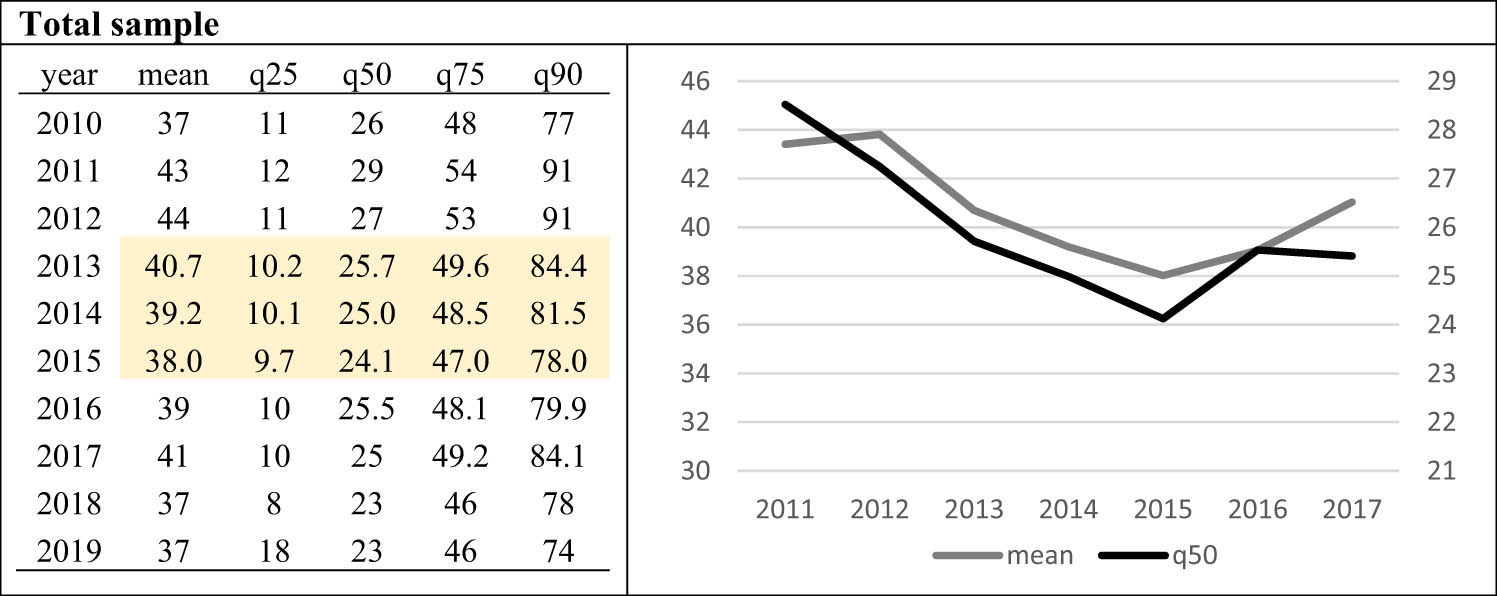
Figure 1
Descriptive statistics of the DPO for the whole sample.
Source: Author’s contribution.
Next, we conduct DID panel data model estimations to verify the first hypothesis. We measure the dependent variable by DPO. For the purpose of DID, we divide the population of Polish enterprises into two groups. The first group includes entities with short DPO (up to 30 days) – these entrepreneurs were not affected by the provisions of Article 15b; they constitute the control group. Therefore, these firms didn’t have to adjust their deductible costs. To distinguish the affected group (treated), we exclude the middle group of entrepreneurs, i.e. those with a DPO in 2012 between 30 and 90 days, and the upper one (with a DPO over 150). Although if the DPO is longer than 90, the debtor had to adjust the costs regardless of how long the contractual payment term was, the latter might be affected by the bad debt relief in the Value Added Tax Act in force from 1 January 2013, related to DPO over 150 days (previously from 1 June 2005 – 180 days). The firms with DPO between 30 and 90 days were excluded from DID analysis because the unambiguous assignment to the treated or untreated group is impossible. We distinguished between treated and untreated companies depending on the average DPO at the end of 2012 – just before the reform.
Figure 2 shows the median DPO in 2010–2015 by treated and untreated groups. The treated group includes those companies that had DPO between 90 and 150 days in 2012, i.e., those affected by the regulations that were in effect in 2013–2015. The chart also includes ranges covering two quartiles around the median. The graph shows that in 2010–2012 the average treated company extended DPO. However, the length of DPO for the 3rd quartile in those years is similar. The size of the median DPO had been declining markedly since the regulations under analysis took effect. The control group consists of companies with a DPO of less than 30 days in 2012. These companies were not affected by the analysed rules. The chart shows that this group includes reliable contractors who generally do not have long and overdue payments, regardless of whether the regulations under discussion were in effect.
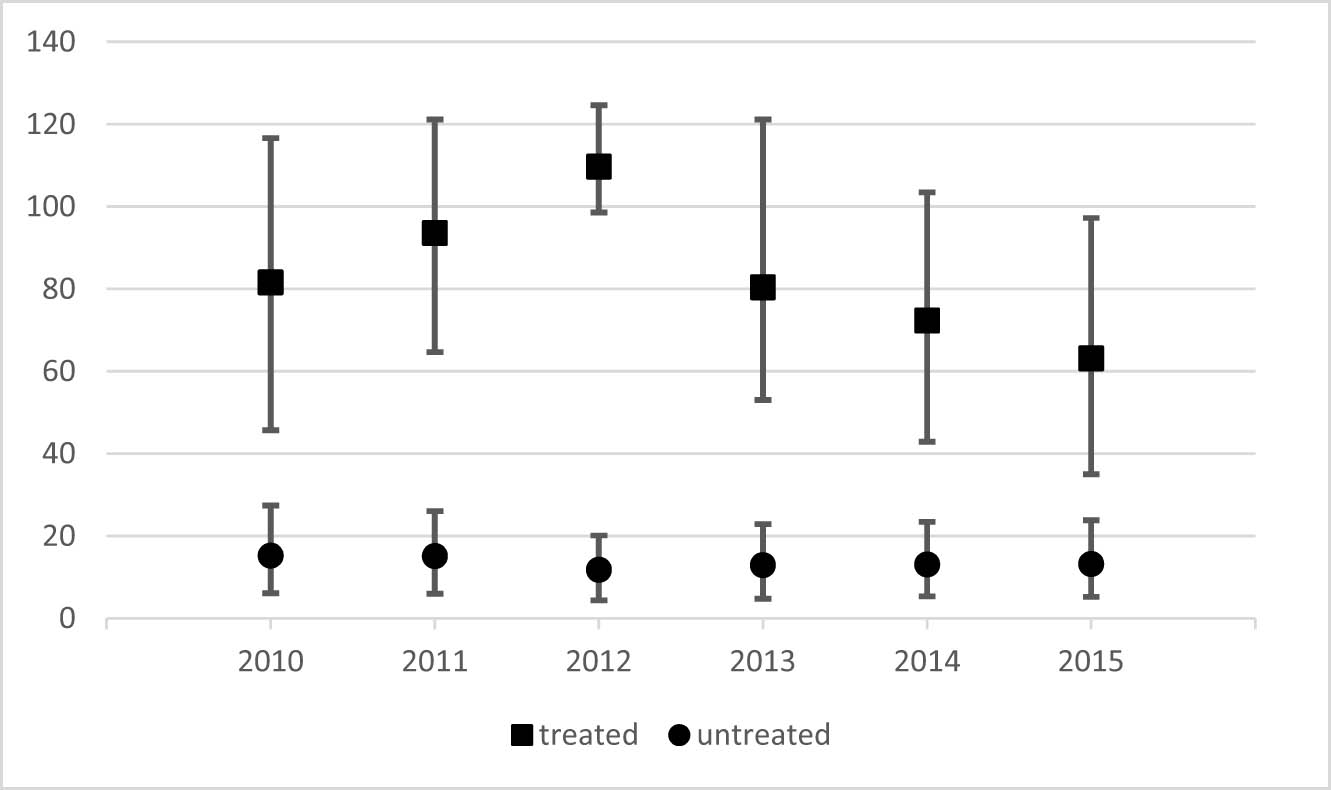
Figure 2
Medians of DPO in 2010–2015 by treated and untreated groups.
Source: Author’s contribution.
In the DiD analysis, the regressions are conducted along the following equation.
To verify the first hypothesis, we consider DPO to be the dependent variable in distinct models and DID (treated*period)–the primary explanatory variable. The variable years_2013_2015 for all treated and untreated enterprises is 0 in 2010–2012 and 2016–2019, and 1 in 2013–2015. The variable treated refers to the firms that were definitely affected by the reform. Although this variable does not appear alone in the regressions, it is used to determine the value of the DID variable. To confirm that the change of DPO within the affected firms is the effect of the analysed reform, we verify the second hypothesis. We expect entities with a DPO between 90 and 150 days in 2012 to have a higher effective tax rate than those with a DPO below 30 days. This would mean the firms excluded trade credit late payments from deductible costs and bore the higher income tax burden. In this case, the dependent variable is the effective tax rate (ETR). The effective tax rate may have different meanings (Devereux & Griffith, 2003; Garcia-Bernardo et al., 2021). In the research, we consider four alternative measures of ETR. First, the standard ETR is calculated as income tax on the gross profit (ETR3). In ETR1, ETR2, and ETR4, we adjust the numerator for deferred tax. Finally, in ETR2 and ETR4, we modify the denominator by adding gross profit depreciation and amortisation. Table 1 provides definitions of variables.
Table 1
Definition of variables.
| Variable | Definition |
|---|---|
| Dependent (explained) variable | |
| DPO | The average DPO of a firm |
| DPO > 30 days | DPO longer than 30 days (subsample that contains only observations with DPO longer than 30 days) |
| ETR1 | Effective tax rate = (income tax – deferred tax)/gross profit |
| ETR2 | Effective tax rate = (income tax – deferred tax)/(gross profit + depreciation & amortisation) |
| ETR3 | Effective tax rate = income tax/gross profit |
| ETR4 | Effective tax rate = (income tax – deferred tax)/(gross profit + depreciation & amortisation), only for data retrieved from the Bisnode database |
| where: deferred tax = ((deferred tax liabilities in t – deferred tax liabilities in a t − 1) – (assets for deferred income tax in t – assets for deferred income tax in a t − 1)) | |
| Test variable | |
| Years_2013_2015 | Dummy variable equals 1 in 2013, 2014 and 2015 year, and 0 otherwise |
| Control variables | |
| SIZE | Firm size measured as ln(total assets) |
| LEV | Leverage = long-term debt/total assets |
| CAPINT | The capital intensity measured as tangible assets/total assets |
| NWC_TA | (current assets – current liabilities)/total assets |
| dummy_negative_NWC | Dummy variable equals 1 when NWC_TA is negative, and 0 otherwise |
| ROA | Return on assets ROA = gross profit/ total assets |
| For DID analysis | |
| firm_DPO less than 30 days in 2012 | Control dummy variable equals one if a DPO in 2012 was lower than 30 days and 0 otherwise |
| firm_DPO between 90 and 150 days in 2012 | Dummy variable equals one if a DPO in 2012 was higher than 90 days and lower than 150 days, and 0 otherwise |
Source: Author’s contribution.
Considering that the Act may also have indirect effects, we notice that if the first contractor paid the second earlier because the Act forced him to do so, the second has the money to pay the third on time, even if the Act does not force him to do so. Thus, we also estimate panel-data models for the DPO without any restrictions for the total sample. Again, a dummy variable equals one for a period when the legislation is in force (between 2013 and 2015) is the test variable. We control for net working capital, leverage, profitability (return on assets ROA), firm size, and capital intensity–tangibility (CAPINT). It is crucial to do so because the strength of business reaction to tax law amendments depends on the role of large trade credit payables in net working capital management and financing strategy. The need to control for these factors arises from the analysis presented in the literature review section.
4. Results
Tables 2 and 3 show the parametric Student’s t-tests outcomes on the significance of the difference in means of DPO over the Article 15b period in the total sample and respective industries. Firstly, these tests focus on years before and during the reform – 2012–2013 – and firms with DPO longer than 30 days in 2012. There is a strong rationale for eliminating those companies with DPOs shorter than 30 days, as it is clear that the Act we are looking at will certainly have no impact on changes to DPOs, as we are not getting out of costs until 30 days after the deadline has passed. If the DPO is between 30 and 90 days long, this law may or may not apply. On the other hand, if the DPO is over 90 days, then the Act certainly applies.
Table 2
Comparison of the average DPO in 2012 and 2013.
| Industry | Mean | t-test | p-value | N if DPO > 30 | ||
|---|---|---|---|---|---|---|
| 2012 | 2013 | 2012 | 2013 | |||
| Total sample | 79.84 | 56.50 | −37.1225 | 0.0000 | 21,505 | 21,478 |
| Manufacturing | 69.83 | 50.67 | −18.7757 | 0.0000 | 5,180 | 5,484 |
| Energy, water supply | 86.01 | 48.37 | −8.7616 | 0.0000 | 510 | 553 |
| Construction; mining | 94.96 | 70.68 | −11.1065 | 0.0000 | 2,714 | 2,526 |
| Wholesale and retail trade | 76.84 | 57.41 | −19.3372 | 0.0000 | 7,092 | 7,068 |
| Catering, culture & entertainment, other services | 84.81 | 56.73 | −5.2196 | 0.0000 | 403 | 329 |
| Transport; ICT, real estate, scientific & technical activities | 85.48 | 56.17 | −20.5605 | 0.0000 | 5,329 | 5,241 |
| Public administration; education; healthcare; NGOs | 68.57 | 41.45 | −5.8093 | 0.0000 | 277 | 277 |
Source: Author’s contribution.
Table 3
Comparison of the average DPO in 2015 and 2016.
| Industry | Mean | t-test | p-value | N if DPO>30 | ||
|---|---|---|---|---|---|---|
| 2015 | 2016 | 2015 | 2016 | |||
| Total sample | 58.18 | 73.09 | −22.5545 | 0.0000 | 15,224 | 18,006 |
| Manufacturing | 52.80 | 63.78 | −10.6701 | 0.0000 | 3,956 | 4,593 |
| Energy, water supply | 50.75 | 66.89 | −3.6967 | 0.0001 | 363 | 445 |
| Construction; mining | 64.71 | 89.97 | −10.7411 | 0.0000 | 1,805 | 2,167 |
| Wholesale and retail trade | 58.14 | 70.15 | −12.2819 | 0.0000 | 5,323 | 6,128 |
| Catering, culture and entertainment, other services | 60.13 | 78.44 | −2.7465 | 0.0031 | 221 | 302 |
| Transport; ICT, real estate; scientific & technical activities | 62.24 | 79.81 | −10.5875 | 0.0000 | 3,389 | 4,130 |
| Public administration; education; healthcare; NGOs | 47.40 | 241.0 | −2.4718 | 0.0069 | 167 | 241 |
Source: Author’s contribution.
Table 2 shows that the tests comparing the average DPO in 2012 and 2013 showed strongly significant variation for the sample overall and separately for the chosen industries. The average DPO has been significantly shortened in the total sample and all particular sectors. Moreover, in 2013, the number of firms with DPO longer than 30 days decreased in the entire sample, particularly in construction and mining; wholesale and retail trade; catering, culture & entertainment and other services; transport, ICT, real estate, and scientific & technical activities. This suggests that buyers considered the Article 15b regulation and paid earlier to their suppliers to avoid an increased tax burden resulting from the required cost adjustments otherwise.
We conducted the analogous analysis as presented above, comparing DPO in 2015–2016 – the year before and after the removal of Article 15b of the Corporation Income Tax Act. We expected taxpayers to be less responsive to this change because of the gain-loss asymmetry. People generally react more strongly to likely losses (2012 and 2013) and are less sensitive to possible gains resulting from the absence of sanctions (2015 and 2016). However, based on the Student’s t-test outcomes provided in Table 3, we can observe the increase in DPO in 2016 in the total sample and all industries separately. The average DPO significantly lengthened in the total sample and distinct industries. Moreover, the number of companies with DPO over 30 days increased in 2016 in all sectors. This shows that the lack of tax incentives to pay on time (as in Article 15b till 2015) encouraged buyers to postpone supplier payments. The extension of DPO happened despite the increase in the penalty interest rate for overdue commercial transactions. On 1st of January 2016, the rate rose from 8 to 9.5%.
Next, in Table 4, we present the effect of the DID analysis. It refers to hypothesis H1. It states that between 2013 and 2015, the liability adjustment period was shortened due to the legislation in force at the time. We measure the dependent variable by DPO and regard DID (treated*period) as the primary explanatory variable. Comparing the treated group (firms with DPO between 90 and 150 days) to a control group (lower than 30 days), we confirm hypothesis H1 that between 2013 and 2015, DPO (which measures the liability adjustment period) shortened as a result of introducing the restrictive tax-deductible expenses limit. The negative coefficients next to the DID variable indicate that DPO was shortened when restrictive legislation was in force. The requirement to exclude tax-deductible amounts resulting from invoices that are not paid on time forces firms to shorten DPO. The fact that firms affected by the amended Corporate Income Tax Act pay their suppliers earlier, up to 8 days, is confirmed by all models (Table 4).
Table 4
Public policy change in 2013–2015 impact on DPO – DID model.
| Pooled OLS | FE | FE | FE | |||||
|---|---|---|---|---|---|---|---|---|
| DPO | DPO | DPO | DPO | |||||
| Coef. | Coef. | Coef. | Coef. | |||||
| (Std. Err.) | (Std. Err.) | (Std. Err.) | (Std. Err.) | |||||
| DID | −8.2606 | *** | −7.6617 | *** | −7.4576 | *** | −5.2356 | *** |
| (0.5497) | (0.4739) | (0.4699) | (0.4649) | |||||
| Years_2013_2015 | −0.7170 | *** | −0.6359 | *** | −0.4403 | *** | −0.3739 | *** |
| (0.1685) | (0.1444) | (0.1433) | (0.1247) | |||||
| Firm_DPO between 90 | 69.6898 | *** | ||||||
| and 150 days in 2012 | (0.3371) | |||||||
| SIZE | 9.3777 | *** | 9.1770 | *** | ||||
| (0.1861) | (0.2156) | |||||||
| LEV | 0.2104 | 4.4687 | *** | |||||
| (0.7007) | (0.9443) | |||||||
| CAPINT | −9.0475 | *** | −44.7629 | *** | ||||
| (0.6238) | (0.9222) | |||||||
| NWC_TA | −51.4319 | *** | ||||||
| (0.7095) | ||||||||
| dummy_negative_NWC | 1.6215 | *** | ||||||
| (0.3839) | ||||||||
| dummy_negative_NWC# | 17.2079 | *** | ||||||
| NWC_TA | (1.7268) | |||||||
| ROA | −6.9075 | *** | ||||||
| (0.4584) | ||||||||
| _cons | 19.4264 | *** | 25.8588 | *** | −115.2718 | *** | −94.0512 | *** |
| (0.1021) | (0.0823) | (2.8401) | (3.4126) | |||||
| Number of observations | 176,876 | 176,876 | 176,876 | 126,859 | ||||
| Number of groups | 27,521 | 27,521 | 22,427 | |||||
| Breuch–Pagan test | 45963.40 | 31448.99 | 29796.13 | 28268.49 | ||||
| p-Value | 0.000 | 0.000 | 0.000 | 0.000 | ||||
| Hausmann test | 24.44 | 1367.96 | 1282.74 | |||||
| p-Value | 0.000 | 0.000 | 0.000 | |||||
| R 2 | 0.2621 | 0.0024 | 0.0194 | 0.0940 |
Standard errors are given below the coefficients. Significance levels are ***p < 0.01, **p < 0.05, and *p < 0.1.
Source: Author’s contribution.
The provisions were even more effective when we excluded the years after the reform. We check the placebo effect, assuming the reform took place in different years than it actually did, on the one hand, in 2011, and on the other, in 2018. The “treated” and “untreated” firms are distinguished based on DPO at the end of 2010 or 2017. In contrast to the original models, the coefficients at the DID_2011 and the DID_2018 variables are either statistically insignificant or positive. We also control for economic prosperity, but it doesn’t change the conclusions regarding the effectiveness of the reform. When the panel-data models were set for the DPO without restricting the total sample, each model’s coefficient at the test variable (the dummy variable equals one between 2013 and 2015 when the legislation was in force) is significant and negative, regardless of our estimation method. In these models, the year effects and industry effects were included. All models support a claim that in 2013–2015, DPO for all firms was shortened due to the legislation in force. If businesses affected by the provisions paid their suppliers earlier, the suppliers would have had the money to settle their obligations, thus reducing the payment congestion. Results of robustness checks are available on request.
In the first column, pooled panel ordinary least squares (OLS) is presented. Next, the panel models with fixed effects are introduced as a result of the Breusch–Pagan and Hausman tests.
The models presented in Table 4 suggest that, in addition to the direct effect of the tax legislation (in force in 2013–2015), in the mentioned years, there were also slight indirect effects in the form of shortening the DPO. Firms that received money from their contractors earlier could accelerate their payments. An interesting conclusion also comes from the analysis of the SIZE variable. The coefficient next to it suggests that large companies with solid market power have longer DPO. However, their smaller suppliers probably cannot force them to pay earlier. In such a case, the only effective way to change it may be through state intervention, such as introducing the analysed regulations.
Entities with more tangible assets have more tax optimisation opportunities, which aligns with Bornemann et al. (2020). Companies with higher net working capital seem to shorten DPO. However, those with higher current liabilities than current assets (negative net working capital) lengthen DPO, also controlling for the relative value of net working capital to total assets. Corporations with higher ROA tend to bear a higher tax burden, which supports the results of Bornemann et al. (2020). Therefore, more profitable companies are strongly motivated to shorten DPO to reduce the tax burden. Besides, they can simply afford it.
The hypothesis H2 is verified to confirm that the observed shortening of the DPO in 2013–2015 for treated entities is the result of the change in the Corporate Income Tax Act. If firms had overdue liabilities, they should exclude the late payments from deductible costs. Thus, their effective tax rate is expected to be higher. On the other hand, if the ETR for treated companies is not higher under the impact of the restrictions, then perhaps firms ignored them and did not make any cost adjustments. In such a case, the observed shortening of the DPO should not be treated as a direct result of the tax act change. Results of the DID analysis provided in Table 5 confirm that the treated firms bore a higher tax burden, no matter how we measure the ETR. Even for the smaller sample (last column with the ETR4 dependent variable), the coefficient next to the DID variable is significant and positive. For firms with a DPO between 90 and 150 days in 2012, ETR is 1 pp. higher than for those with a DPO shorter than 30 days. Even if we consider a DPO of 90 to 150 days in any of the years 2013–2015, then the conclusions would not change. Models based on this alternative assumption are available upon request.
Table 5
Public policy change in 2013–2015 impact on ETR – DiD model.
| RE | RE | RE | FE | |||||
|---|---|---|---|---|---|---|---|---|
| ETR1 | ETR2 | ETR3 | ETR4 | |||||
| Coef. | Coef. | Coef. | Coef. | |||||
| (Std. Err.) | (Std. Err.) | (Std. Err.) | (Std. Err.) | |||||
| DID | 0.0102 | *** | 0.0083 | *** | 0.0098 | *** | 0.0111 | *** |
| (0.0019) | (0.0013) | (0.0018) | (0.0057) | |||||
| Years_2013_2015 | 0.0062 | *** | 0.0034 | *** | 0.0075 | *** | 0.0115 | *** |
| (0.0006) | (0.0004) | (0.0006) | (0.0015) | |||||
| Firm_DPO between 90 | 0.0174 | *** | 0.0140 | *** | 0.0176 | *** | ||
| and 150 days in 2012 | (0.0025) | (0.0019) | (0.0024) | |||||
| _cons | 0.1521 | *** | 0.1115 | *** | 0.1570 | *** | 0.1386 | *** |
| (0.0008) | (0.0002) | (0.0003) | (0.0005) | |||||
| Number of observations | 176,876 | 176,876 | 176,876 | 28,091 | ||||
| Number of groups | 27,521 | 27,521 | 27,521 | 8,380 | ||||
| Breuch–Pagan test | 110,000 | 150,000 | 120,000 | 3,393.36 | ||||
| 0.000 | 0.000 | 0.000 | 0.000 | |||||
| Hausmann test | 1.96 | 7.04 | 0.88 | 24.76 | ||||
| 0.3748 | 0.0296 | 0.6453 | 0.0000 | |||||
| R 2 | 0.0033 | 0.0036 | 0.0033 | 0.0030 | ||||
Standard errors are given below the coefficients. Significance levels are ***p < 0.01, **p < 0.05, and *p < 0.1.
Source: Author’s contribution.
The higher ETR means, on the one hand, that the companies applied the analysed provisions, but on the other hand, the additional tax burden was not sufficient to settle all liabilities on time.
When we set together the models presented in Tables 4 and 5, we can conclude that the analysed tax change had positive consequences by shortening the DPO of those entities that previously delayed payment deadlines. In addition, state intervention, which increased the cost of the trade credit, forced companies to give up opportunistic behaviour and settle their liabilities earlier. As a result, suppliers were less exposed to the moral hazard of their contractors, which is especially important in the case of debtors with a strong market position.
However, a higher income tax burden did not completely solve the problem of late payments, as there were still companies with due trade credits. This could be explained in two ways. Firstly, firms did not pay, not because they did not want to, but because they did not have enough money. Secondly, the alternative sources of finance were still more expensive than trade credit.
In order to determine which companies shortened DPO the most, the next part of the analysis was conducted based on data for 2012–2015, which only included companies for which DPO decreased during this period (in Table 6). The coefficient next to the ROA variable means that companies with higher ROA shortened DPO more than those with lower ROA. Companies with relatively high ROA could afford to shorten their DPO, and the additional cost in the form of the higher tax might have further motivated them to do so. Companies with high ROA (25% of all companies with the highest ROA at the end of 2012) can afford to pay earlier and avoid incurring additional costs of extending payment terms. The high negative coefficients at the triple interaction variable confirm that the provisions analysed are an effective way to reduce the opportunistic behaviour of companies. On the other hand, other models indicate that companies with low profitability and low liquidity (25% of all companies with the lowest ROA and liquidity at the end of 2012) in 2013–2015 had longer payment periods than other companies. This is particularly evident for companies with low profitability, for which the absolute value of the coefficient on the triple interaction variable (DID_LOW ROA) is higher than that of the coefficient on the DID variable. For companies with low profitability, the provisions analysed are not effective. It should not be surprising since, for companies with high losses, excluding overdue payments from deductible expenses may keep the tax unchanged.
Table 6
Entities shortening the DPO between 2013 and 2015.
| Pooled OLS | RE | FE | FE | |||||
|---|---|---|---|---|---|---|---|---|
| Delta DPO | Delta DPO | Delta DPO | Delta DPO | |||||
| Coef. | Coef. | Coef. | Coef. | |||||
| (Std. Err.) | (Std. Err.) | (Std. Err.) | (Std. Err.) | |||||
| ROA | −0.3381 | *** | −0.3360 | *** | −0.4296 | *** | −0.4522 | *** |
| (0.0350) | (0.0365) | (0.0802) | (0.0801) | |||||
| SIZE | 0.0304 | *** | 0.0320 | *** | 0.1367 | *** | 0.1472 | *** |
| (0.0027) | (0.0030) | (0.0202) | (0.0203) | |||||
| LEV | −0.2084 | *** | −0.2063 | *** | −0.3048 | *** | ||
| (0.0340) | (0.0362) | (0.0802) | ||||||
| _cons | −0.8136 | *** | −0.8467 | *** | −2.4691 | *** | −2.6113 | *** |
| (0.0426) | (0.0474) | (0.3152) | (0.3160) | |||||
| Number of observations | 3,619 | 3,619 | 3,619 | 3,619 | ||||
| Number of groups | 2,117 | 2,117 | 2,117 | |||||
| Breuch–Pagan test | 74.33 | 43.57 | 47.03 | 43.57 | ||||
| 0.000 | 0.000 | 0.000 | 0.000 | |||||
| Hausmann test | 35.83 | 31.34 | 35.83 | |||||
| 0.000 | 0.000 | 0.000 | ||||||
| R 2 | 0.070 | 0.078 | 0.052 | 0.057 |
Standard errors are given below the coefficients. Significance levels are ***p < 0.01, **p < 0.05, and *p < 0.1.
Source: Author’s contribution.
Companies with a relatively high share of long-term loans also shortened DPO more. Such companies do not experience financial constraints, and if, due to the tax, the cost of a trade credit increases, its attractiveness relative to a bank loan decreases. The coefficient next to the SIZE variable shows that while larger companies shortened their DPO between 2013 and 2015, the decreases were not as large as for smaller firms. These conclusions are confirmed by the robustness check models, which indicate that smaller enterprises (from the first quartile) had a shorter DPO during the reform period based on the negative coefficients at the DID_SMALL SIZE variable. Large companies (from the last quartile) had a longer DPO during the reform than others. In their case, the effects of the reform are positive but smaller than those of the others (based on a comparison of the DID and DID_LARGE SIZE variables’ coefficients). All the robustness check models described are available upon request.
5. Conclusions
For trade credit recipients, financial motives are essential. Entrepreneurs willingly use this source of financing if they consider it cheap. When creditors do not charge interest or other costs for exceeding payment deadlines, debtors tend to delay payments. Therefore, late trade credit payments are a severe problem in many economies. However, governments have limited instruments to counteract payment congestion. One such instrument is the adjustment of deductible tax costs in case the debtor fails to pay a contractor on time. In Poland, from 2013 to 2015, the adjustment of charges concerned the unpaid invoices within 30 days from the contractual term, no longer than 90 days from the sales day. This article provides strong evidence that the legislation in force in Poland between 2013 and 2015 which excluded unpaid invoices within 30 days from the contractual term from the tax-deductible costs, effectively shortened the DPO and reduced the payment congestion.
All parametric Student’s t-tests identified the significant difference in means of DPO in the total sample and different industries over this legislation period – the year before (2012–2013) and after (2015–2016) regulatory change. Also, the DiD analysis confirms that excluding late payments from deductible costs reduces payment congestion effectively (H1 is confirmed). The higher the effective tax rate for firms with overdue trade credits, the sanctions impact the force of the regulations (H2 is confirmed). On the other hand, the higher tax increases the cost of trade credit. It results in a decrease in overdue payments originating from the opportunistic behaviour of debtors. The obligatory additional cost for unreliable contractors, independent of not-required interest payments for creditors, can be treated as an efficient way of reducing intentional delays of payments.
The cost adjustment generally shortens the DPO but does not completely eliminate the problem. The higher effective tax rate in 2013–2015 for treated companies was not sufficient incentive to make all buyers pay on time because they probably had insufficient money, or the alternative sources of finance were still more expensive than trade credit.
Our research contributes to the growing literature on late payments, trade credit, and insolvency by providing evidence of the effectiveness of governmental support in solving the late payments problem. Our study offers a practical solution for managing the issue of lengthy and delayed payments on the national level through fiscal policy tools based on excluding unpaid costs from calculating taxable bases. It is also worth noting that the article’s merit is in creating a method for studying the effectiveness of using tax laws to reduce payment congestion. An analogous approach to the one proposed by the authors could be applied to the study of the effectiveness of bad debt relief, which appears on VAT grounds and occurs in many countries.
In 2013–2015, when the analysed regulations were in force, adjusting the unpaid trade credit costs was associated with specific difficulties. Accounting generally is based on the accrual principle. However, the rules required that some records be based on cash results (calculated on a cash basis). Therefore, it was a solution that generated additional costs for entities. Also, due to the potential high costs, the tax administration had limited possibilities to control whether taxpayers comply with the law. The arguments mentioned above resulted in the abandonment of these provisions in 2016.
The development of digitisation, in particular the obligation of issuing structured invoices and making cashless payments, may facilitate the automation of specific processes for both entrepreneurs and the administration. Access to real-time data on invoices and payments generates new possibilities for tax administration to control whether taxpayers have excluded overdue payments from costs. It may encourage other governments to adopt solutions, which in Poland turned out to be an effective way of reducing payment congestion.
Acknowledgments
We are grateful to Kieran Byrne, Jarosław Kubiak, Szymon Stereńczak, Danuta Zawadzka, for their helpful comments on the preliminary version of the article. We also wish to convey gratitude to two anonymous reviewers, for their helpful comments and suggestions. All errors and omissions are ours.
Funding information
Supported by funds granted by the Ministry of Science of the Republic of Poland under the “Regional Initiative for Excellence” Programme for the implementation of the project “The Poznań University of Economics and Business for Economy 5.0: Regional Initiative – Global Effects (RIGE)”. The project also financed within the Regional Initiative for Excellence programme of the Minister of Education and Science of Poland, years 2019–2023, grant no. 004/RID/2018/19.
Author contributions
Both authors contribute equally in conceptualization, data curation, formal analysis, methodology, writing – original draft, writing – review & editing of this article.
Conflict of interest statement
Authors state no conflict of interest.
Data availability statement
Data are available on the request from the authors.