
1. Introduction
Mobile marketing has recently experienced a significant development due to the technological evolution of mobile phones. Indeed, the new generation of mobile devices being smartphone, offers a far wider range of marketing possibilities such as one-to-one contact with customers, tracking customers based on their location, and sending personalized advertising messages [Yuan and Raubal, 2014; Elliot et al., 2018; Narang and Shankar, 2019; Hendijani Fard and Marvi, 2020]. Smartphones contain innovative distinct features such as Internet connectivity that allows access to various information and interactions such as cameras or music in MP3 format, mobile video, and TV. These latest developments in mobile technologies coupled with improvements in wireless technology have paved the way for marketing activities to take place in real-time and places [Kumar and Mittal, 2020; Tong et al., 2020; Stocchi et al., 2022]. For example, Pantano and Di Pietro [2012] note that innovative mobile technologies allow purchases by mobile phone and enable consumers to experience shopping differently. Mobile marketing is expected to have a promising future due to the high global penetration of mobile communication devices applications [Gao et al., 2020; Al-Hawary and Obiadat, 2021; Stocchi et al., 2022].
The increasing use and popularity of mobile marketing as a marketing strategy has prompted the attention of many researchers, academics, and digital marketing professionals. Several studies on mobile marketing have attempted to uncover specific issues underpinning the use and benefits of mobile marketing as an alternative strategy to traditional marketing [Shankar et al., 2016; Liu et al., 2019; Banerjee et al., 2021] as well as the adoption of mobile marketing [Gupta and Arora, 2017; Hoang, 2020; Shankar and Rishi, 2020]. With regards to the use of mobile marketing existing literature widely acknowledges mobile marketing as one of the most important marketing forms that enables companies to use mobile phones as an ultimate marketing vehicle, thus establishing a perpetual presence in the life of their customers, anytime, anywhere [Bolat, 2017; Elliot et al., 2018; Kumar and Mittal, 2020; Tong et al., 2020; Mehra et al., 2021].
In light of the above and with the accelerating transformation of digital, mobile, and seamless technologies, the state of art of mobile marketing is altering the business entities with several promising challenges as highly discussed in the existing body of knowledge. Indeed, the practical implications of mobile marketing strategies have to be curtailed despite past research on this evolving phenomenon. Along these lines, precise and novel theoretical clarity on mobile marketing is of utmost significance to the academic community, practitioners, and several policymakers from marketing, mobile marketing, digital marketing, and mobile technologist specialists.
2. The context
Due to the contemporary development of mobile technologies, mobile channels have become a popular form of marketing. It enables companies to establish their presence and reach customers anytime, anywhere. The implications and developments in the consumer market have oriented mobile marketing into a promising research arena over the preceding years. This trend has led to an increase in the number of publications related to mobile marketing in scientific journals and conferences all over the globe. Nevertheless, despite the voluminous research works, the subject of mobile marketing is still being developed, researched, and thoroughly discussed by eminent researchers, the documentation system on the phenomenon of mobile marketing is still fragmented and inconsistent [Elliot et al., 2018; Kumar and Mittal, 2020; Tong et al., 2020; Mehra et al., 2021; Nguyen, 2021]. In this respect, it is imperative to summarize and build a novel generalization of mobile marketing, thereby grasping the nature of the phenomenon. As argued in the extant literature, several research works on mobile marketing have been drawn from well-established theories such as the TPB model, TAM, and UTAUT amongst others from a positivist approach using robust structural models, yet, there is a pressing urge to reinforce this concept theoretically by using an interpretivist approach. Our research aims to uncover qualitative insights on the phenomenon since there is constant advancement in mobile contexts and technologies.
In line with the global trend, mobile marketing has emerged as a key element of modern digital infrastructure in Mauritius since 2016. Today, many local firms across industries are integrating mobile technology within their overall marketing strategy to boost their promotion strategy, distribution strategy, and brand’s visibility by rapidly engaging with a large volume of potential customers. Several factors have prompted the increasing use of mobile marketing by local businesses including an increase in the number of smartphone owners, a decrease in the price of mobile data, improved connectivity, a rise in the number of tech-savvy consumers (Millennial and Gen-Z), and the launch of mobile payment applications by banks and mobile operator. According to Statistics Mauritius (2018), the number of mobile cellular and mobile internet subscriptions increased by 4.3% and 8.1%, respectively during the period 2017 to 2018. It can, thus, be concluded that although mobile marketing is at an early stage, it offers great potential to Mauritian businesses to boost sales by targeting specific audiences and satisfying growing customers’ needs for easy and convenient shopping. The importance of mobile marketing has been increasingly felt during the COVID-19 (sanitary curfew) period when only contactless transactions (both payments and delivery) were allowed. The widespread success of mobile marketing during the sanitary curfew seems to be an eye-opener for local businesses to consider mobile marketing as a means to sustain competitive pressures and to build a closer relationship with customers.
Although the success of mobile marketing depends to a large extent on its adoption by consumers, the strategic intent of the stakeholders should not be overlooked. For example, empirical studies have concluded that telecom service providers [Karamti, 2019] and advertising agencies [Ameen et al., 2020] also contribute to the effectiveness of mobile marketing. A review of existing literature revealed that most of the studies focusing on mobile marketing have been conducted in developed countries [Elliot et al., 2018], while no research has yet been undertaken to explore indigenous and context-specific factors that influence the application of mobile marketing in an island state like Mauritius which faces unique and special developmental challenges such as remoteness, isolation, poverty, as well as limited diversification. Given the specificities and vulnerabilities of Mauritius as an island state, it is not deemed appropriate to draw existing mobile marketing strategies from the literature and apply them in the Mauritian context since those strategies are mainly applicable to businesses that operate in a context that is completely different from that of Mauritius. Limited knowledge of mobile marketing at present may restrict companies’ scope to tap the potential of mobile marketing optimally. The industry, market, technology, and cultural dynamics among others that vary from country to country impact the implementation of mobile marketing strategies by firms and the adoption of mobile marketing by consumers.
To address this gap in the literature, this study aimed to provide a better understanding on mobile marketing by providing constructive insights from the perspective of multi-stakeholders comprising of policymakers of different business enterprises, banks, telecommunication service providers, and the government amongst others. Thus, this study contributes to the existing literature on mobile marketing as well as builds a stepping stone for researchers to deepen their research in the field of mobile marketing.
3. Literature review
3.1. Factors driving adoption of mobile marketing by firms
3.1.1. High mobile phone penetration rate
Several studies including Ameen et al. [2020] and Forenbacher et al. [2019] have identified the high mobile phone penetration rate as one of the most significant drivers for the adoption of mobile marketing by firms across industries. High mobile penetration represents new and unique opportunities to (i) reach out to the vast population of internet users via websites, email, short message service (SMS) and MMS, social media, and apps, (ii) use location-based marketing, and (iii) send personalized messages to targeted customers [Banerjee et al., 2021].
3.1.2. Increased internet connectivity
Mobile marketing is highly associated with technology and the Internet. For example, it is impossible to install or use a mobile app or engage in an online transaction without internet connectivity [Malik et al., 2017]. Good internet connectivity ensures high mobile penetration and effective communication between consumers and the business. According to the Mobile Marketing Association (2020), improved Internet connectivity has prompted marketers to increasingly engage the consumer with their brand and drive to a purchase in real time – either in store or online.
3.1.3. Growing millennial segment
Another factor driving the adoption of mobile marketing strategies among businesses is the growing millennial segment [Donga et al., 2018]. According to Eastman et al. [2014] millennials display diverse behavior and attitudes that differ them from previous generations. This difference in the behavior and attitudes of millennials can be analyzed from two perspectives namely their willingness to use and adopt new technologies and their spending power. Companies consider that this segment can be captured by delivering effective mobile marketing campaigns as they are more driven by technology.
3.1.4. The need for personalized mobile messages and other promotional offers
Given that the SMS was not designed to target individual customers, mobile phone users always have a negative perception on advertisers. Customers, nowadays, do not want to be overloaded with mass advertising, emails, and other irrelevant content. They want to be treated with individual mobile messages and other promotional offers based on their choices, preferences, location, and environment. The emergence of new mobile technologies has, indeed, transformed firms’ targeting strategy by offering them the possibility to enhance personalized promotional incentives based on time and location factors [Luo et al., 2012].
3.2. Key success factors for the implementation of mobile marketing
Several factors contribute to the effective implementation of mobile marketing strategies. These factors include top management commitment, information technology (IT) resources, and qualified human resources.
3.2.1. Top management commitment
Top management support refers to the willingness of the potential decision-makers in an organization to allocate resources for adoption and encourage prospective change from adoption [Hult et al., 2007]. According to Sun et al. [2020], the top manager must have a neutral attitude and be receptive toward change in order for a particular organization to be open toward innovation. Several studies have depicted that lack of management support can lead to resistance to change, drive a poor organizational culture, and hinder innovation toward digital transformation.
3.2.2. Human resources
Since mobile marketing is driven by technology and innovation, firms must have people (human resources) with the right skills and know-how to ensure the successful implementation of mobile marketing strategies. For example, Trainor et al. [2011] found that the integration of human resources and technology positively contribute toward the effectiveness of e-marketing strategies while a lack of technological competencies may limit the development of mobile marketing strategies [Mohr et al., 2009].
3.2.3. IT resources
Another factor contributing to the effective implementation of mobile marketing is IT resources which refer to the deployment of technology infrastructure supporting mobile marketing initiatives [Trainor et al., 2011]. IT resources drive an organization to adopt more mobile strategies to leverage existing and future opportunities. However, Bolat [2017] further stressed on the importance of having organizational practices and activities, such as strategic IT planning, information system development, leveraging and using an information system, and lastly managing an IT function to support of the technology-based initiatives.
3.3. Factors affecting mobile marketing adoption by consumers
On the other hand, numerous studies have identified several factors influencing the adoption of mobile marketing including trust [Menon, 2019], risk and relevance [Gao and Waechter, 2015], security [Chen and Zahedi, 2016], shopping styles [Kim et al., 2017], attitude [Ferraro et al., 2016], perceived ease of use and perceived usefulness [Amin et al., 2014], convenience [Duarte et al., 2018], and website design [Schubert, 2016].
4. Methodology
4.1. Participants’ selection
To achieve the objective of this exploratory study, primary data were collected through focus groups’ interviews with multi-stakeholders consisting of academic scholars, policymakers, and practitioners. Brown et al. [2015] define a focus group as an unstructured and interactive in-depth interview conducted by a proficient facilitator among a small group of research participants simultaneously. The participants of our focus groups’ study were carefully selected based on their specialized knowledge and experiences in providing up-to-date data within the context of mobile marketing research. Since the study was oriented toward a multi-stakeholder approach, the focus groups included enough participants to yield diversity in information on mobile marketing [Onwuegbuzie and Collins, 2007]. One of the main characteristics of a focus group is that it allows observing interactions between group members. Moreover, it provides for interaction among participants from different backgrounds who share their views and past experiences and tries to come to similar conclusions without any bias. The participants are comprised of the academic community in mobile marketing and seamless technologies, IT practitioners from both private and public entities, digital marketers, e-commerce managers, and digital executives from diverse sectors including retail banks, airlines, hotels, and offshore companies amongst others.
4.2. Research instrument
For the collection of qualitative data, a checklist was drawn based on the objectives of the qualitative study. In drawing the checklist, the researchers ensured that full coverage had been given to all the themes surrounding the study. Open-ended questions were included in the checklist and where appropriate probing questions were set based on the participants’ responses to prior questions. The checklist covered several themes including the current status and relevance of mobile marketing, acceleration of mobile marketing, drivers of mobile marketing, benefits of mobile marketing and barriers of mobile marketing, criteria to measure the effectiveness of mobile marketing strategies, and adoption of new mobile marketing strategies in Mauritius.
Since piloting for interviews is an integral aspect and useful in the process of conducting qualitative research [Majid et al., 2017], a focus group meeting was held among academics who have expertise in the arena of mobile marketing and experience in conducting qualitative research for the pilot testing phase. It aimed at testing the appropriateness of the checklist and to provide the researchers with some early suggestions on the viability of the mobile marketing research. The focus group meetings were conducted at the University and the interviews were recorded using digital IC recorders.
4.3. Sample size and data collection
Participant recruitment and selection is a key phase in focus group discussions. In this qualitative study, a non-probability purposive sampling was used to select the participants for the focus group meeting. Purposive sampling is a method where the researcher personally and intentionally selects a representative sample from the target population for analysis, based on specific criteria [Schwester, 2015, p. 182]. A letter of informed consent was also provided to each informant and the researchers obtained approval from the informants [Onwuegbuzie and Collins, 2007; Majid et al., 2017]. As recommended by some focus group methodologists such as Gill et al. [2008], our focus group meetings were limited to 4 to 5 participants as it is easy to manage and it gives sufficient opportunity to all participants to speak. As advised by Krueger [1994], several types of media were used to collect the data, such as flipcharts for summarizing the data, audiotapes of the participants from the focus group meetings, notes taken by the moderator, and all the items recalled by the moderator.
4.4. Analysis of the qualitative data
Transcript-based analysis was used to analyze the data as recommended by Krueger [1994] and Onwuegbuzie and Collins [2007]. The qualitative data obtained from the focus group meetings were transcribed by the team of researchers independently and the responses were checked to ensure consistency. In drawing the conclusions, the field notes from the moderators and the flip charts were also analyzed during the thematic analysis process. The saturation point was reached when the researcher found that the responses from each theme were geared toward homogeneity across the different focus group meetings [; Flick, 1998]. The transcribed data together with the flips notes of the moderators along with several debriefing sessions were all incorporated to ensure cohesive validation of themes and qualitative rigor. The trustworthiness of the data was also ascertained through the experience and expertise of the researchers in the field of collecting qualitative data.
Data were analyzed and a summary of the main conclusions was drawn. This approach is mainly used when decisions must be made quickly (which is common in marketing studies) and conclusions of the research are rather straightforward [Stewart et al., 2007]. The verbal contents for each theme were analyzed. Furthermore, participants’ quotations were used to clarify and illustrate the essential points of the researcher’s interpretations. Thereafter, the report was vetted by the team members and sent to all the participants for validation of the findings. Similarly, the participants also confirmed the completeness and objectivity of the qualitative insights.
5. Findings
5.1. Current status of mobile marketing in Mauritius
Participants’ views were sought on the current state of mobile marketing in Mauritius. Based on the participants’ responses, it can be inferred that mobile marketing in Mauritius is still at the infant stage even though many businesses acknowledge its strategic importance for their growth and sustainability. One of the participants (from the financial services industry) describes the country as “a late entrant in the field of mobile marketing. But I think the direction in which we are going is the right way……” However, most of the participants claimed that businesses are not optimally exploiting the potential of mobile marketing. This perception is generated from the fact that most of the businesses are implementing mobile marketing as a promotion and communication tool across different lines of businesses “in its simplest form” such as “Sending push notification through SMS to remind customers about companies and its products” or “broadly advertising on social media such as Facebook.” However, it was evident from the participants’ responses that mobile marketing presents huge opportunities for marketers to reach and engage more consumers
5.2. The acceleration of mobile marketing in Mauritius
Participants concluded that mobile marketing has a bright future for Mauritian companies although technology acceptance in a small island like Mauritius takes time. All the participants are optimistic about the adoption of mobile marketing by Mauritian customers and consider that it is an effective marketing tool for large, medium, and small enterprises. The increasing number of mobile users represents an opportunity for firms as “any contact is a marketing tool.” Mobile marketing gives access to a maximum number of active and passive users. However, participants believe that the success of mobile marketing depends a lot on the formulation and implementation of the right mobile marketing strategies. This has a lot to do with the ways we interact, the medium used, and the disclosure of personal information. Since the ecosystem in which mobile marketing operates comprises several stakeholders, each of them must play an active role in promoting the use of mobile marketing in Mauritius. For example: (1) The Government as the regulator should set up the appropriate legal framework regulating mobile marketing, (2) Companies should believe in mobile marketing and invest in technology that makes it happen, and (3) Customers willing to embrace the technology and move from offline to online.
Based on the participants’ response, mobile marketing is considered as a real game changer in today’s competitive business world. Hence, companies “should adapt to new technology in an agile way to ensure their sustainability.” Moreover, as technology evolves, new applications takes over existing ones the latest being the Voice Search that can provide valuable insights about users. This information can in turn be used to develop personalized messages and content with a view to improve customers’ experience. For example, one participant considers that “in the near future businesses will eventually incorporate voice technology into their digital marketing strategies to improve their visibility among consumers.”
5.3. Drivers of mobile marketing in Mauritius
Participants stated that several factors prompted businesses to adopt mobile marketing as an innovative means of targeting customers. According to them, the increasing number of mobile users has been one of the most important factors driving the adoption of mobile marketing among local firms. This claim is supported by the fact that “mobile phone penetration rate has reached 145%”; “the number of mobile phone users has been increasing over the years” and “the number of people possessing more than one smartphone has risen.” Participants also emphasized on the improved connectivity offering the opportunity to reach more customers. This statement stems from the fact that “350 mobile hotspots across the island allow users to remotely connect to the Internet” and “76% of mobile and internet subscribers used 49 networks.” Participants further stated that the acceptance of mobile payment transactions by merchants has also pushed firms to adopt mobile marketing strategies. According to the participants, this change in the merchants’ mindset which is key in completing a mobile transaction, is mainly attributed to the fact that “their level of trust in mobile payment systems has increased……” and “they feel secure and perceive less risk to accept cashless transactions……” In addition, participants consider that possibility of “doing their marketing for free using mobile platforms” has prompted firms to adopt mobile marketing strategies. On the demand side, customers’ needs and preferences are urging firms to adopt mobile marketing. For example, participants stated that customers “are also increasingly opting for cashless payment systems….” Results further revealed that the positive response to mobile marketing from both young and old customers is pressing firms to embrace mobile marketing. For instance, one participant stated that more and more customers are “paying greater attention to mobile advertising and mobile social media……” and are “responding positively to the targeted advertising………” However, results indicated that firms should be cautious in sending out marketing ads on the smartphones. Participants believe that irrelevant ads sent at a wrong time can have serious implications for the firm as “users simply avoid advertising that are not relevant to them……” Moreover, “since smartphone owners consider their device to be very personal ……… they don’t want to be troubled or disturbed through unwanted adverts.”
5.4. Perceived benefits of mobile marketing
Participants’ responses revealed that, in general, mobile marketing offers substantial benefits to businesses be it in terms of: (a) high conversion rate of mobile users, (b) customized mobile marketing adverts, (c) increased mobile users’ engagement with brands, (d) reaching a wider mobile audience at a lower cost, (e) lower cost of reaching a wider mobile audience, and (f) the use Geomarketing for seamless targeting of mobile users.
Results indicated that specific characteristics of smartphones represent the best medium to push notify customers across multiple mobile channels “to create engagement……” or “to remind customers about companies’ products and services…….” The results further indicated that the conversion rate with the use of push notifications through smartphones is higher compared to traditional email and SMS that customers “do not pay great attention…………” Furthermore, participants believe that unique characteristics of smartphones “enhances the customer experience…….” Another benefit of mobile marketing as revealed by the participants response is the ability of reaching consumers with appropriate messaging based on the “customers’ location information….” Results also indicate that mobile marketing provides the possibility of communicating with customers on a 24/7 basis as mobile phones are “always on and they are carried everywhere……….” In addition, the participants emphasized on the ease with which “targeted advertising can be sent through smartphones across different platforms such as mobile social media and mobile email ………”
5.5. Barriers to mobile marketing
Participants’ views were sought on the barriers and limiting factors of mobile marketing in Mauritius. Based on the participants’ responses, the following factors limit the adoption of mobile marketing by local firms: cost, lack of willingness of top management, lack of qualified personnel, customers’ attitude toward mobile marketing, and security risk, and privacy associated with mobile marketing.
5.5.1. Costs associated with execution of mobile marketing campaigns
Results revealed that the high costs associated with the implementation of mobile marketing strategies can be a serious limitation to the adoption of mobile marketing “investment in mobile marketing is costly and will take time to obtain return on investment……” On top of the cost associated with the app design, additional costs related to the maintenance of the mobile app include the cost of the platform’s software license, equipment costs, cost of social media integration, database and server cost, App store charges, update costs as well as live support costs. According to the participants, setting up a dedicated digital marketing team also inflates the costs associated with mobile marketing.
5.5.2. Lack of top management commitment toward mobile marketing strategy
Results also revealed that top management commitment is crucial for adopting mobile marketing as managers are responsible for allocating resources needed to make a project successful. “Management should believe in the potential of mobile marketing……” Participants believed that since the implementation of mobile marketing strategy spans over a long period of time, top management should “continuously support mobile marketing initiatives throughout the process…….” One participant stated that “there is a need to educate companies CEO to invest in mobile platforms as a marketing strategy.”
5.5.3. Lack of qualified personnel for mobile marketing campaigns
Participants’ response further indicates that the successful implementation of mobile marketing strategies depends on the availability of qualified and trained personnel with a diverse set of specific skills (Information and Communication Telecommunication [ICT], marketing, and data analytics) to use digital marketing tools and techniques. Realizing the gap in the market, “academic institutions have integrated new modules in the marketing programs to equip students with the required skills to connect with consumers through various devices and digital platforms.”
5.5.4. Customers’ attitude toward mobile marketing
According to the participants, the decision to adopt mobile marketing depends a lot on the “customers’ attitude toward mobile marketing…….” Participants’ response demonstrates that someone having a positive attitude toward mobile marketing tends to react positively to mobile ads. According to one participant, “firms should not focus only on implementing mobile marketing strategies but also devise strategies on how to shift the offline customers to online prospects.” From the participants’ responses, it is evident that Mauritians are not generally keen to use mobile marketing frequently. Results revealed that most of the online transactions are not completed effectively. For example, one participant noted that “Mauritian customers may adapt targeted adverts, use mobile shopping apps, browse product categories and add to cart. The real concern is they stop here. They do not engage in the final payment and purchase.” Participants consider that a change in customers’ attitudes toward mobile marketing can be achieved by educating them on the benefits of mobile marketing.
5.5.5. Security, risk, and privacy associated with mobile marketing transactions
Based on the participants’ responses, it can be deduced that Mauritians in general perceive mobile marketing as being high-risk. Results demonstrate that this perception is developed from the lack of trust or privacy issues associated with mobile marketing. According to one participant, customers are not keen to use mobile marketing because they “fear that sensitive financial information may be shared with third parties” (one participant asserted that “70% of the transactions stop at the time users are requested to make the payment”). To resolve the data security issues, participants believe that “it is high time to shift from the Data Protection Act to the General Data Protection Regulation (GDPR) which is based on European Standards.” According to the participants. GDPR provides “more confidence to customers in terms of data protection and privacy.” Some participants consider that a code of ethics prescribing acceptable digital marketing practices together with the Data Protection Act will help in safeguarding mobile phone users’ personal data when they engage in different mobile tools to access advertising and other mobile app content.
5.5.6. Mobile marketing tools and CRM
Based on participants’ responses, it can be concluded that companies are currently using a wide range of mobile marketing tools including SMS, websites, and mobile apps, and other social media tools such as LinkedIn, Instagram, Facebook, and Twitter to promote their brands and products freely. Results further indicate that firms are employing gamification as a mobile marketing tool to encourage customer’s engagement with a product or service. “My company designed and implemented a mobile app under the name of Eco-Warriors with the aim of creating ecological awareness among the young millennial mobile phone users….” Most of the participants agreed that these aforementioned tools are being used by local firms to effectively “engage with their target audiences” and “customize the products/services based on specific mobile personas.” It can, therefore, be concluded that companies in general are adopting up-to-date mobile marketing tools to reach out their customers and to maintain a good relationship with them (CRM) (see Figure 1).
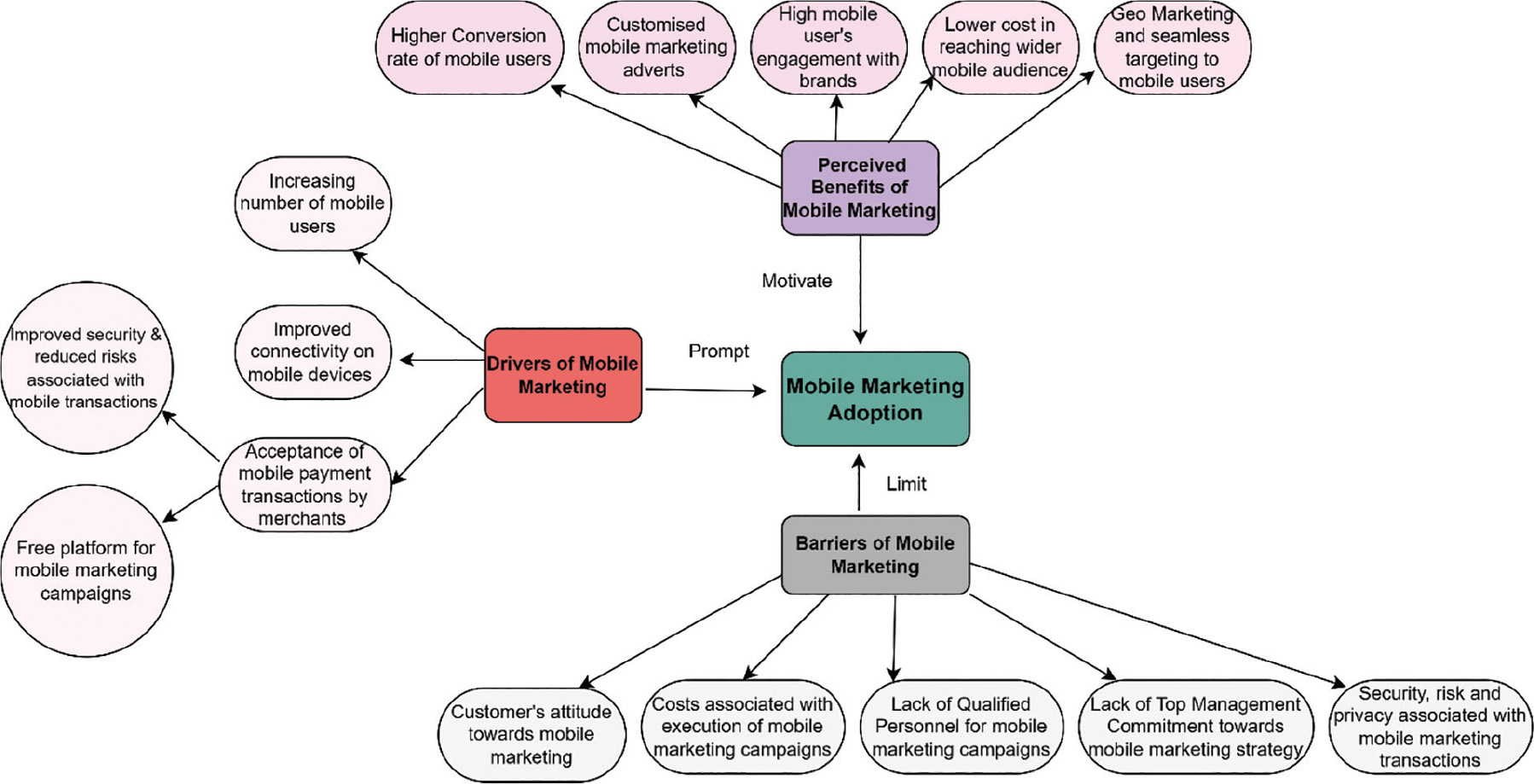
Figure 1.
Drivers, perceived benefits and barriers of mobile marketing adoption.
Source: Author’s Compilation.
6. Theoretical implications
In terms of theoretical contribution, this research is the first original pioneer study exploring the views of multi-stakeholders on mobile marketing strategy. The qualitative insights from this study can be used by several researchers to embark on further qualitative research on mobile marketing. As has already been highlighted in the extant literature, the initial attempt to anticipate the acceptance and adoption of mobile marketing strategy has been explained by replicating the common theoretical frameworks. This study is offering a novel glance by exploring the mobile marketing phenomenon from multi-stakeholders’ perspective since the majority of studies on mobile marketing are focused from the users’ perspective. This research has also established an original theoretical clarity on the phenomenon of mobile marketing. Several researchers from transdisciplinary backgrounds can further use the qualitative findings of this research as a stepping stone to conduct further research works in the field of mobile marketing.
7. Practical implications
This qualitative study on mobile marketing has escalated several interesting managerial implications to specialist practitioners in the field of marketing. Mobile marketing strategy certainly has an optimistic outlook in the context of Mauritius. It can be further recommended that policymakers of mobile marketing campaigns should devise a proper understanding of mobile personas. The unique mobile personas on each and every mobile user should be clearly defined to provide the right and appealing content to the mobile users.
Another implication of this study pertains to the application of mobile marketing strategy integrated with voice search technology tools. It is advised that stakeholders including policymakers, digital marketers, and graphic designers ensure that the mobile browsing sites are highly engaging with live chat assistants and seamless mobile applications in order to enable a unique, memorable, and sustainable mobile browsing experience. It is also noteworthy to understand that there are major transformations in digital and mobile applications. Policymakers of mobile marketing strategies must anticipate these accelerations and ensure that their mobile marketing strategy embeds updated mobile and digital innovations.
8. Conclusions and recommendations
This study is a pioneer study that explored the views of multi-stakeholders on mobile marketing strategy. The phenomenon of mobile marketing has captured the interest of several researchers, scholars, and practitioners in recent years. Research in this arena has gained strong momentum and our initial research has also confirmed that there is a promising future of mobile marketing strategy in Mauritius. The theoretical and practical implications are discussed hereafter.
Based on the findings of the study, the following strategies are proposed to promote the effectiveness of mobile marketing in Mauritius: (1) Profiling and understanding mobile personas, (2) Capitalizing on content management strategies as content is regarded as king, (3) Integrating voice search technology in mobile devices and the overall digital marketing strategy, (4) Using mobile technology to educate the youth on the importance of financial savings and environmental sustainability strategies, (5) Crafting a mobile marketing strategy throughout the whole customer’s journey from Reach to Conversion and Advocacy, (6) Adopting a holistic approach in developing mobile marketing strategy, (7) Understanding the seamless mobile journey of users in the mobile marketing context, (8) Customizing mobile marketing campaigns based on smartphone user’s personas and ensuring that the content is relevant, attractive, engaging and enticing in order to encourage conversion, (9) Encouraging merchants around the country to embrace mobile marketing and taking appropriate measures to safeguard the security and privacy of mobile users, and (10) Using powerful and versatile mediums such as WhatsApp to promote brands on mobile devices and smart phones and blending mobile marketing strategies with voice optimization and face recognition techniques to provide an integrated seamless experience to mobile users.
9. Limitations and future research
Our study has certain limitations that offer opportunities for future studies. The qualitative research approach has been adopted here. As such, the study did not make a significant attempt to contribute conceptually to marketing theory and contemporary mobile marketing. The views of multi-stakeholders were only tapped to explore the concept of mobile marketing. Further conceptual research on mobile marketing has to be conducted to offer a novel theoretical contribution in the domain of mobile marketing where a large portion of studies were mainly empirically focused, offering fragmented results. Moreover, the mixed methods approach proposed for ongoing studies on mobile marketing will enable to purify and validate to substantiate the new constructs of mobile marketing in order to enhance the psychometric properties and validation of scales in the arena of mobile marketing. The conceptual model will be tested by robust structural equation modeling applications to further add theoretical value to the domain of marketing theory where mobile marketing represents an important factor for the visibility, engagement, and sustainability of many digitally focused and mobile-driven companies across the world.
Acknowledgments
This study has been funded by the Higher Education Commission (HEC), Mauritius.