
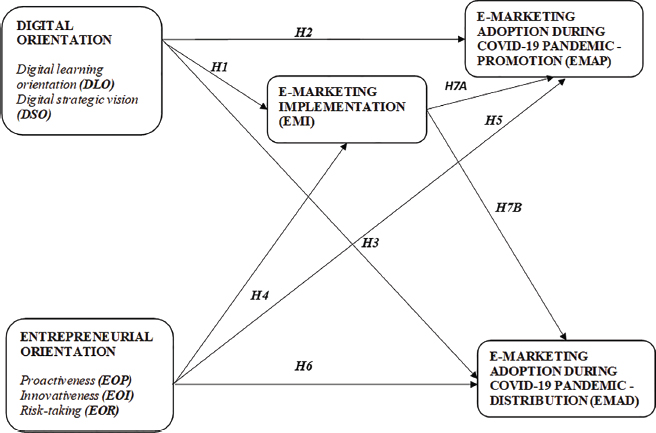
Figure 1.
Conceptual model and research hypotheses.
Source: Own elaboration. DLO, digital learning orientation; DSO, digital strategic vision orientation; EMAD, e-marketing adoption during the COVID-19 pandemic-distribution; EMAP, e-marketing adoption during the COVID-19 pandemic promotion; EMI, e-marketing implementation; EOI, entrepreneurial orientation innovativeness; EOP, entrepreneurial orientation proactiveness; EOR, entrepreneurial orientation risk-taking.
Table 1.
Surveyed companies’ structure
| No. of indications (N = 241)/Percentage | ||
|---|---|---|
| Industry | Fashion | 74/30.56% |
| Cosmetics | 89/36.97% | |
| Consumer electronics/household appliances | 78/32.47% | |
| Manufacturer vs. trade intermediary | Manufacturer | 141/58.50% |
| Trade intermediary | 100/41.50% | |
| Company size (no. of employees) | 50–249 | 155/64.31% |
| 250–999 | 84/34.85% | |
| ?1000 | 2/0.84% | |
Table 2.
Likert scales used to measure reflective constructs, their sources, and factor loadings reliabilities
| Likert scale statements (1–strongly disagree, 7–strongly agree) | Factor loadings | Sources |
|---|---|---|
| DLO | ||
| (AVE = 0.768; item reliabilities = 0.929) | ||
| We offer different trainings to improve the digital expertise of our team members. | 0.925 | Proksch et al. [2021] |
| Digital skills are an important selection criterion in recruiting new team members. | 0.780 | |
| Our team has the necessary skills to further digitalize our company. | 0.957 | |
| New digital technology is readily accepted in our organization. | 0.831 | Khin and Ho [2019] |
| DSO | ||
| (AVE = 0.722; item reliabilities = 0.948) | ||
| Our business has a clear vision of how to stay competitive in the next years with respect to the digital strategy. | 0.786 | Niemand et al. [2017] |
| Our business has a clearly defined digital strategy. | 0.838 | |
| Our digital strategy is implemented in all business units. | 0.884 | |
| Our digital strategy is evaluated and adapted steadily. | 0.875 | |
| We use sophisticated digital technologies in new product development. | 0.904 | Chen et al. [2014] |
| Our firm purchases and uses digital technologies to position itself ahead of competitors. | 0.870 | |
| We always look out for opportunities to use digital technology in our innovation. | 0.783 | Khin and Ho [2019] |
| EOP | ||
| (AVE = 0.590; item reliabilities = 0.851) | ||
| We consistently look for new business opportunities. | 0.843 | Eggers et al. [2013] |
| We continuously try to discover additional needs of our customers of which they are unaware. | 0.720 | |
| We incorporate solutions to unarticulated customer needs in our products and services. | 0.689 | |
| We work to find new businesses or markets to target. | 0.811 | |
| EOI | ||
| (AVE = 0.586; item reliabilities = 0.846) | ||
| We highly value new product lines. | 0.717 | Eggers et al. [2013] |
| When solving problems, we value creative new solutions more than solutions that rely on conventional wisdom. | 0.561 | |
| We consider ourselves as an innovative company. | 0.883 | |
| Our business is often the first to market with new products and services. | 0.857 | |
| EOR | ||
| (AVE = 0.667; item reliabilities = 0.855) | ||
| We encourage people in our company to take risks with new ideas. | 0.887 | Eggers et al. [2013] |
| We value new strategies/plans even if we are not certain that they will always work. | 0.891 | |
| We engage in risky investments (e.g., new employees, facilities, debt, stock options) to stimulate future growth. | 0.648 | |
| EMI | ||
| (AVE = 0.531; item reliabilities = 0.846) | ||
| There are set clear priorities for our e-marketing projects. | 0.527 | Trainor et al. [2011] |
| The latest e-marketing technologies (e.g. Web applications) are installed in our organization. | 0.617 | Shaltoni et al. [2018] |
| In our organization, there is adequate technical support for e-marketing implementation. | 0.803 | |
| In our organization, the implementation of e-marketing is done by employees who have e-marketing knowledge. | 0.860 | |
| The activities of the different departments which are responsible for e-marketing implementation are well coordinated. | 0.784 | |
| EMAP | ||
| (AVE = 0.815; item reliabilities = 0.946) | ||
| At our company, we make full use of various social networks for marketing communication with consumers. | 0.960 | Witek-Hajduk and Zaborek [2016] |
| We use social media to engage consumers in the brand community. | 0.881 | Koumproglou [2016] |
| Our firms allow customers to locate and send information electronically to appropriate contacts within the firm. | 0.935 | Jaganaham et al. [2018] |
| We use e-marketing resources to gather market related information on customers, competitors, and industry. | 0.830 | Colombo and Yasin [2004] |
| EMAD | ||
| (AVE = 0.654; item reliabilities = 0.904) | ||
| We use e-marketing resources to enable customers on-line access to product/price/performance information. | 0.832 | Aziz and Yasin [2004] |
| Our firm provides after sales service to our customers via online information. | 0.781 | Jaganaham et al. [2018] |
| A significant share of online sales of our company’s products is via online intermediaries (e.g., Notino.pl, Zalando.pl) or multi-sided digital platforms (e.g., Amazon, Allegro) | 0.780 | Own elaboration |
| A significant share of online sales of our company’s products is via social commerce (e.g., Facebook) | 0.821 | |
| We use e-marketing resources to provide on-line support to distributors/ dealers. | 0.827 | Aziz and Yasin [2004] |
1 AVE, average variance extracted; DLO, digital learning orientation; DSO, digital strategic vision orientation; EMAD, e-distribution adoption during COVID-19 pandemic; EMAP, e-promotion adoption during COVID-19 pandemic; EMI, e-marketing implementation; EOI, entrepreneurial orientation innovativeness; EOP, entrepreneurial orientation proactiveness; EOR, entrepreneurial orientation risk-taking.
Source: Own elaboration based on SmartPLS.
Table 3.
Fornell-Lacker discriminant validity
| DLO | DSO | EMAD | EMAP | EMI | EOI | EOP | EOR | |
|---|---|---|---|---|---|---|---|---|
| DLO | 0.876 | |||||||
| DSO | 0.191 | 0.850 | ||||||
| EMAD | 0.317 | 0.560 | 0.808 | |||||
| EMAP | 0.330 | 0.633 | 0.797 | 0.903 | ||||
| EMI | 0.357 | 0.535 | 0.409 | 0.507 | 0.729 | |||
| EOI | 0.288 | 0.754 | 0.611 | 0.733 | 0.608 | 0.765 | ||
| EOP | 0.277 | 0.526 | 0.558 | 0.714 | 0.500 | 0.736 | 0.768 | |
| EOR | 0.618 | 0.198 | 0.260 | 0.323 | 0.693 | 0.427 | 0.399 | 0.817 |
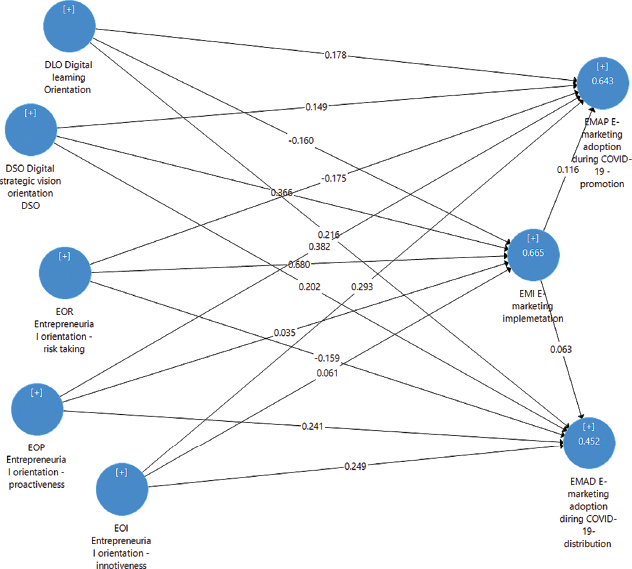
Figure 2.
Estimated structural equation model.
Source: Own elaboration based on SmartPLS. DLO, digital learning orientation; DSO, digital strategic vision orientation; EMAD, e-marketing adoption during COVID-19 pandemic-distribution; EMAP, e-marketing adoption during COVID-19 pandemic promotion; EMI, e-marketing implementation; EOI, entrepreneurial orientation innovativeness; EOP, entrepreneurial orientation proactiveness; EOR, entrepreneurial orientation risk-taking.
Table 4.
Path coefficients and significance of relationships between constructs (total and indirect effects) for all the studied companies
| Hypothesis | Regression paths | Path coefficients | T-statistics | p values | |||
|---|---|---|---|---|---|---|---|
| Indirect effects | Total effect | Indirect effects | Total effect | Indirect effects | Total effect | ||
| H1a | DLO ->EMI | −0.153 | 2.725 | 0.006** | |||
| H1b | DSO ->EMI | 0.365 | 5.502 | 0.162 | 0.000*** | ||
| H2a | DLO ->EMAP | −0.017 | 0.161 | 1.416 | 3.144 | 0.157 | 0.002** |
| H2b | DSO ->EMAP | 0.043 | 0.195 | 1.463 | 2.729 | 0.144 | 0.006** |
| H3a | DLO ->EMAD | −0.009 | 0.206 | 0.662 | 3.160 | 0.508 | 0.002*** |
| H3b | DSO ->EMAD | 0.0260 | 0.224 | 0.641 | 2.226 | 0.552 | 0.026** |
| H4a | EOP ->EMI | 0.038 | 0.553 | 0.580 | |||
| H4b | EOI ->EMI | 0.065 | 0.675 | 0.500 | |||
| H4c | EOR ->EMI | 0.670 | 7.736 | 0.000*** | |||
| H5a | EOP ->EMAP | 0.005 | 0.387 | 0.427 | 5.594 | 0.670 | 0.000*** |
| H5b | EOI ->EMAP | 0.008 | 0.294 | 0.500 | 3.186 | 0.617 | 0.001** |
| H5c | EOR ->EMAP | 0.077 | −0.094 | 1.610 | 1.832 | 0.108 | 0.067* |
| H6a | EOP ->EMAD | 0.004 | 0.247 | 0.260 | 2.581 | 0.795 | 0.010** |
| H6b | EOI ->EMAD | 0.006 | 0.243 | 0.286 | 2.194 | 0.775 | 0.028** |
| H6c | EOR ->EMAD | 0.043 | −0.116 | 0.691 | 1.735 | 0.489 | 0.083* |
| H7a | EMI ->EMAP | 0.118 | 1.551 | 0.121 | |||
| H7b | EMI ->EMAD | 0.069 | 0.667 | 0.505 | |||
1 DLO, digital learning orientation; DSO, digital strategic vision orientation; EMI, e-marketing implementation; EOI, entrepreneurial orientation innovativeness; EOP, entrepreneurial orientation proactiveness; EOR, entrepreneurial orientation risk-taking.
*p < 0.10, **p < 0.0.05, ***p < 0.01; α = 0.10.
Source: Own elaboration based on SmartPLS.