
Table 1.
The selected principal studies on retail BMs
| Reference | Elements of BMs | Contribution to theory of BMs |
|---|---|---|
| Rudolph [2000] | Degree of centralization of management, levels of standardization of store formats, the share of own brands in the offer, And expansion rates | Typology of retailers based on offer (content retailer, channel retailer, global discounter) |
| Schweizer [2005] | Value chain constellation, competitive advantage/market power of the company, and revenue model | Typology of BMs: integrator, orchestrator, layer player, and market-maker |
| Zott and Amit [2010] | Content, structure, and governance | NICE design themes in BM: novelty, lock-in, complementarities, and efficiency |
| Sorescu et al. [2011] | Value appropriation based on operational efficiency, operational effectiveness, and customer lock-in Value creation based on customer efficiency, customer effectiveness, and customer engagement | Innovative ways to implement the design themes into fast fashion model, self-service model, “name your own price” model, leverage complementarities, and adjacency model Leverage exclusive products, enduring consumer relationships via multichannel processes, innovative format which facilitates the shopping experience, rely on stakeholders to determine the optimal depth of assortment and supporting services, and rely on added value tie-ins |
| Pels and Sheth [2017] | Market adaption, mission focus, radical innovation, and inclusive ecosystem | BM matrix (bottom-up/top-down) to serve low-income consumers in emerging markets |
1 Source: Own processing based on Rudolph [2000], Schweizer [2005], Sorescu et al. [2011], Pels and Sheth [2017]. BM, business model.
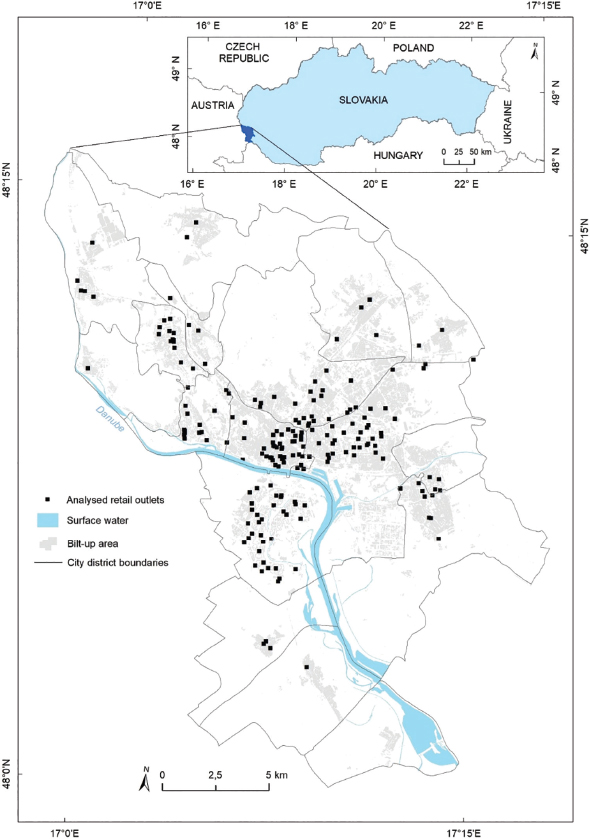
Figure 1.
Study area.
Source: Own processing.
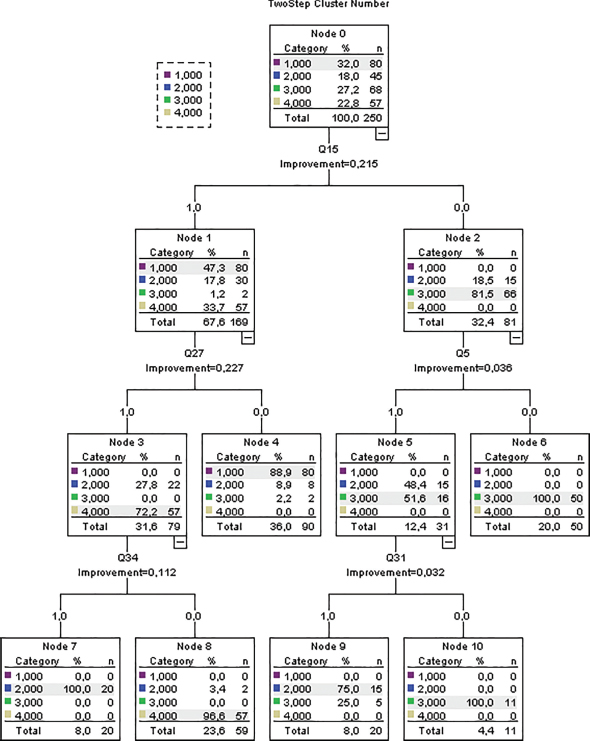
Figure 2.
Decision tree based on the geomarketing element in the BM.
Source: Own processing. BM, business model.
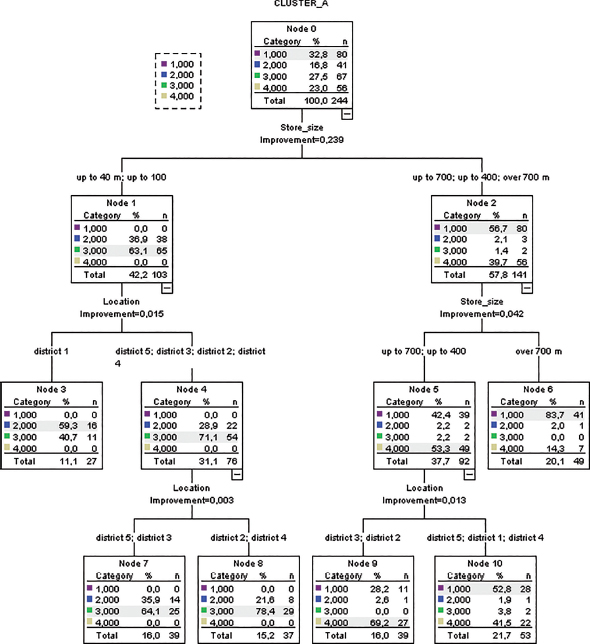
Figure 3.
Resulting decision tree based on store format and location.
Source: Own processing.
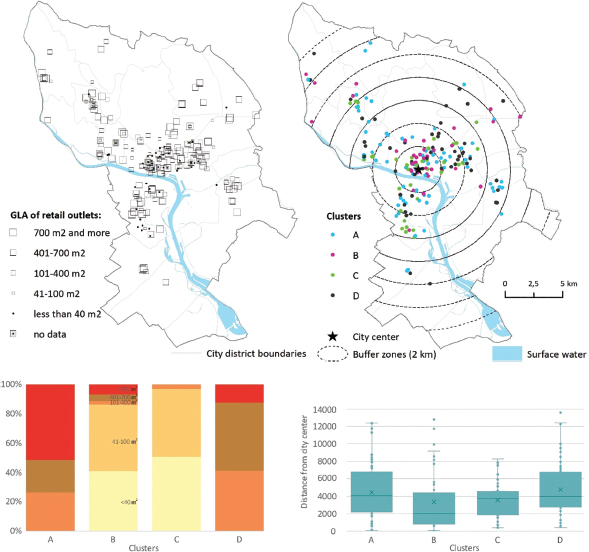
Figure 4.
Mapping clustering retail BMs based on the format size of retail stores.
Source: Own processing. BMs, business models.