
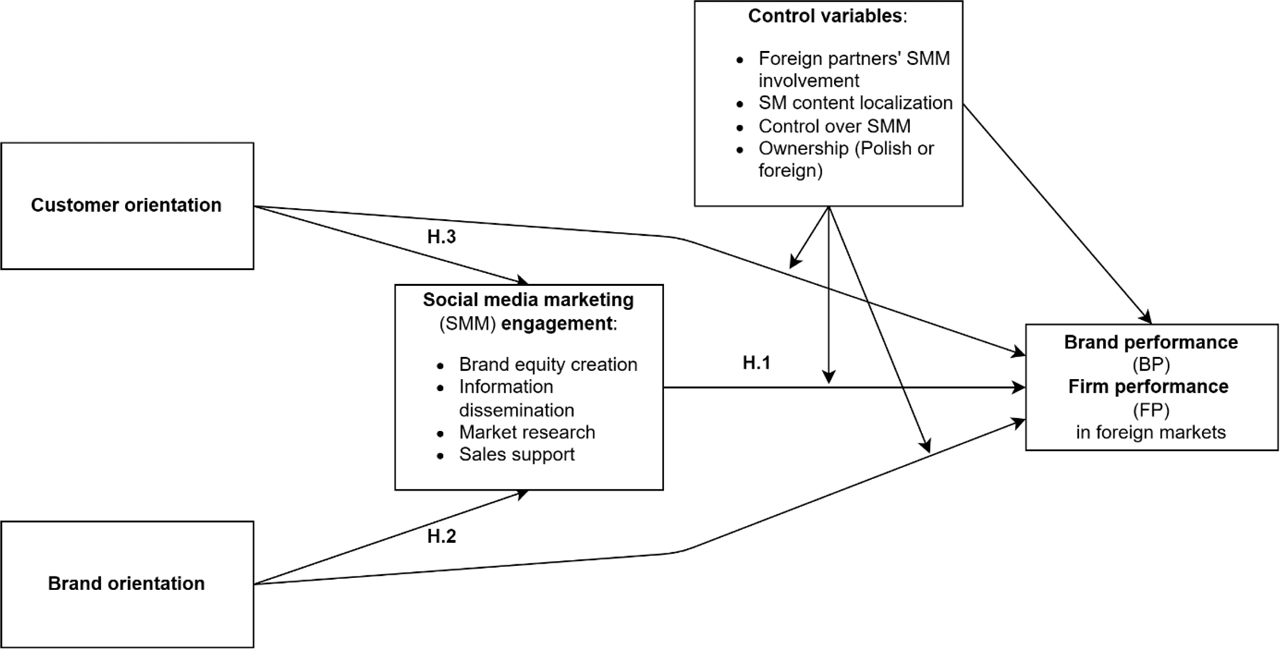
Figure 1
Conceptual model of the research.
Source: Own elaboration.
Table 1
Likert-scale items used to provide indicators for reflective construct in the study, along with their literature sources and metrics of reliability and validity
| Likert-scale items (1 – completely disagree, 5 – completely agree) | Factor loadings | Sources |
|---|---|---|
| Customer orientation (AVE = 0.544; composite reliability = 0.877) | ||
| We constantly monitor our customers’ needs | 0.762 | Mueller et al. [2001] |
| We are aware of how customers perceive our brands and products | 0.769 | Deshpandé et al. [1993] |
| In our organization, employees receive incentives based on customer satisfaction measures | 0.657 | Dutot and Bergeron [2016]; Trainor et al. [2014] |
| In our organization, business processes are designed to enhance the quality of customer interactions | 0.702 | |
| In our organization, various functional areas coordinate their activities to enhance the quality of customer experience | 0.785 | |
| Customer needs always come first, even before the requirements of our owners/shareholders | 0.744 | |
| Brand orientation (AVE = 0.560; composite reliability = 0.910) | ||
| Branding flows through all our marketing activities | 0.734 | Wong and Merrilees [2008], and own elaboration |
| All our departments that contribute to marketing decision-making are also involved in branding | 0.655 | |
| Branding is essential to our strategy | 0.786 | |
| Our brands are the strategic starting point for all our business operations | 0.803 | |
| Long-term brand planning is critical to our future success | 0.748 | |
| Our brands are an important asset to us | 0.593 | |
| Everyone in our company appreciates that branding is the priority for our business | 0.841 | |
| All our business decisions are assessed in terms of how they affect our brands | 0.794 | |
| SMM engagement: Brand equity creation (AVE = 0.606; composite reliability = 0.901) | ||
| We use SM to involve customers in online communities for our key brand | 0.807 | Dutot and Bergeron [2016], and own elaboration |
| We use SM for creating the desired image of our key brand | 0.870 | |
| We use SM to distinguish our key brand from that of competitors | 0.847 | |
| We react swiftly to changes in customer needs and behavior revealed by SM | 0.679 | |
| SM activities by our different departments are well coordinated | 0.626 | |
| We follow SM to make sure that our key brand is viewed favorably by customers | 0.810 | |
| SMM engagement: Information dissemination (AVE = 0.734; composite reliability = 0.917) | ||
| We have frequent interdepartmental meetings to discuss market trends identified via SM | 0.900 | Trainor et al. [2014] |
| Marketing personnel spend time discussing customers’ future needs identified on SM applications with other departments | 0.882 | |
| Data collected using SM on customer satisfaction are disseminated at all levels on a regular basis | 0.840 | |
| When one department finds out something important about competitors using SM, it is quick to alert other departments | 0.801 | |
| SMM engagement: Market research (AVE = 0.543; composite reliability = 0.768) | ||
| We use SM to conduct market research | 0.978 | Dutot and Bergeron [2016], Trainor et al. [2014], and own elaboration |
| We use SM to detect changes in our customers’ product preferences | 0.647 | |
| SM are instrumental in collecting vital data for enhancing customers’ loyalty toward our key brand | 0.504 | |
| SMM engagement (AVE = 0.549; composite reliability = 0.708) | ||
| We enable customers to buy our products via SM | 0.752 | Dutot and Bergeron [2016], and own elaboration |
| Consumers can report and resolve complaints using our SM apps | 0.729 | |
| SM content localization (AVE = 0.677; composite reliability = 0.912) | ||
| Our key brand's SM profiles are run in the languages of the countries where we sell our products | 0.648 | Own elaboration based on Okazaki and Rivas [2002]; Witek-Hajduk [2018] |
| We adjust the content of our key brand's SM profiles to the cultural specificity of the countries where we sell our products | 0.857 | |
| We adapt creative strategies in SM (including sales arguments, emotional references, and symbolism) to the cultural values of the target countries | 0.821 | |
| We adjust the content of the posts that we publish on SM to the specific characteristics of our customers | 0.862 | |
| We make sure that the layouts of our key brand's SM profiles are in agreement with the cultural specificity of our customers | 0.903 | |
| Foreign partners’ SMM involvement (AVE = 0.509; composite reliability = 0.744) | ||
| We cooperate with internationally recognized influencers/bloggers | 0.505 | Own elaboration based on Witek-Hajduk [2018] |
| We cooperate with influencers/bloggers who are known only locally in the target country | 0.625 | |
| We encourage our partners in foreign countries (franchisees, distributors, retailers, and so on) to promote our key brand in SM | 0.939 | |
| Control over SMM (AVE = 0.505; composite reliability = 0.752) | ||
| Our headquarters coordinates our key brand's SM communication strategy in the countries where we sell our products | 0.699 | Own elaboration based on Witek-Hajduk [2018] |
| Our headquarters provides our local foreign-country partners with guidelines and content for publishing in SM | 0.645 | |
| Posts and other brand-related content are published by our local partners in SM only with our agreement | 0.780 | |
[i] Source: Own elaboration.
[ii] AVE, average variance extracted; SM, social media; SMM, SM marketing.
Table 2
Discriminant validity of reflective constructs according to the Fornell–Larcker criterion
| Control over SMM | SM content localization | Customer orientation | Brand orientation | Foreign partners’ SMM involvement | SM engagement: Market Research | SM engagement: Brand equity creation | SM engagement: Sales support | SM engagement: Information dissemination | |
|---|---|---|---|---|---|---|---|---|---|
| Control over SMM | 0.710 | ||||||||
| SM content localization | 0.264 | 0.823 | |||||||
| Customer orientation | 0.209 | 0.299 | 0.738 | ||||||
| Brand orientation | 0.181 | 0.179 | 0.545 | 0.748 | |||||
| Foreign partners’ SMM involvement | 0.117 | 0.130 | 0.081 | 0.130 | 0.714 | ||||
| SM engagement: Market Research | 0.275 | 0.245 | 0.197 | 0.134 | 0.268 | 0.737 | |||
| SM engagement: Brand equity creation | 0.272 | 0.646 | 0.469 | 0.306 | 0.097 | 0.228 | 0.778 | ||
| SM engagement: Sales support | 0.128 | 0.262 | 0.137 | 0.108 | 0.084 | 0.126 | 0.261 | 0.741 | |
| SM engagement: Information dissemination | 0.266 | 0.350 | 0.318 | 0.151 | 0.177 | 0.489 | 0.500 | 0.222 | 0.856 |
[i] Source : Own elaboration.
[ii] SM, social media; SMM, SM marketing.
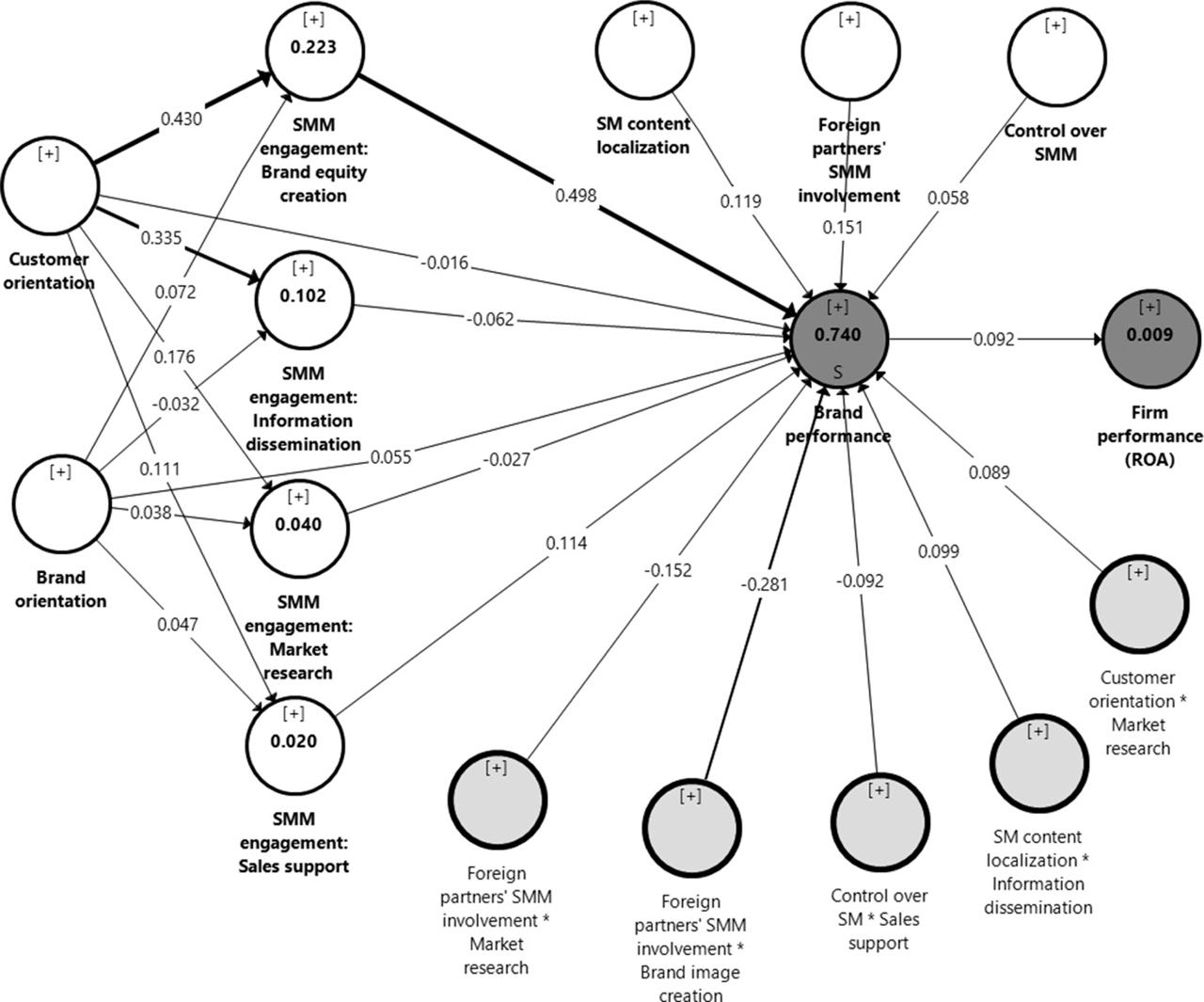
Figure 2
Estimated structural equation model for relationships of social media marketing with brand and firm performance.
Source: Own elaboration.
SM, social media; SMM, SM marketing.
Table 3
Regression weights and significance levels in the structural model (estimation with the bootstrapping method using 5,000 resamples)
| Regression paths | Regression weights (beta) | t-statistics | p-values |
|---|---|---|---|
| Customer orientation →SMM engagement: Market research | 0.176 | 1.845 | 0.066 |
| Customer orientation →SMM engagement: Brand equity creation | 0.430 | 3.789 | 0.000 |
| Customer orientation →SMM engagement: Sales support | 0.111 | 1.191 | 0.234 |
| Customer orientation →SMM engagement: Information dissemination | 0.335 | 3.422 | 0.001 |
| Brand orientation → SMM engagement: Market research | 0.038 | 0.391 | 0.696 |
| Brand orientation → SMM engagement: Brand equity creation | 0.072 | 1.152 | 0.250 |
| Brand orientation → SMM engagement: Sales support | 0.047 | 0.519 | 0.604 |
| Brand orientation → SMM engagement: Information dissemination | 0.032 | 0.435 | 0.663 |
| SMM engagement: Market research → Brand performance | −0.027 | 0.4 | 0.689 |
| SMM engagement: Brand equity creation → Brand performance | 0.498 | 5.866 | 0.000 |
| SMM engagement: Sales support → Brand performance | 0.114 | 2.955 | 0.003 |
| SMM engagement: Information dissemination → Brand performance | −0.062 | 1.092 | 0.275 |
| Customer orientation → Brand performance | −0.016 | 0.227 | 0.821 |
| Brand orientation → Brand performance | 0.055 | 1.277 | 0.202 |
| SM content localization → Brand performance | 0.119 | 1.804 | 0.072 |
| Foreign partners’ SMM involvement → Brand performance | 0.151 | 2.476 | 0.014 |
| Control over SMM → Brand performance | 0.058 | 1.198 | 0.231 |
| Customer orientation * Market research → Brand performance | 0.089 | 1.742 | 0.082 |
| SM content localization * Information dissemination → Brand performance | 0.099 | 2.161 | 0.031 |
| Foreign partners’ SMM involvement * Market research → Brand performance | −0.152 | 2.429 | 0.016 |
| Foreign partners’ SMM involvement * Brand equity creation → Brand performance | −0.281 | 3.854 | 0.000 |
| Control over SMM * Sales support → Brand performance | −0.092 | 1.839 | 0.067 |
| Brand performance→ ROA | 0.092 | 2.561 | 0.011 |
[i] Source: Own elaboration.
[ii] ROA, return on assets; SM, social media; SMM, SM marketing.
Table 4
Comparison of regression weights in the structural model for firms with only Polish capital and those controlled fully or partially by foreign owners
| Regression paths | Regression weights | Difference | Modulus of difference | |
|---|---|---|---|---|
| Only Polish capital | Some or all foreign capital | |||
| Customer orientation → SMM engagement: Brand equity creation | 0.448 | 0.214 | 0.234 | 0.234* |
| SMM engagement: Brand equity creation → Brand performance | 0.426 | 0.647 | −0.221 | 0.221* |
| Brand orientation → SMM engagement: Information dissemination | 0.087 | 0.259 | −0.172 | 0.172* |
| Customer orientation → Brand performance | 0.038 | 0.210 | −0.172 | 0.172* |
| SM content localization → Brand performance | 0.211 | 0.049 | 0.162 | 0.162* |
| Foreign partners’ SMM involvement * Market research → Brand performance | 0.246 | 0.091 | 0.155 | 0.155* |
| Customer orientation → SMM engagement: Information dissemination | 0.350 | 0.217 | 0.133 | 0.133 |
| Brand orientation → SMM engagement: Market research | 0.142 | 0.264 | −0.122 | 0.122 |
| Foreign partners’ SMM involvement * Brand equity creation → Brand performance | 0.287 | 0.176 | 0.111 | 0.111 |
| Control over SMM → Brand performance | 0.041 | 0.135 | −0.094 | 0.094 |
| Customer orientation → SMM engagement: Market research | 0.179 | 0.088 | 0.091 | 0.091 |
| Control over SMM * Sales support → Brand performance | 0.066 | 0.139 | −0.073 | 0.073 |
| SM content localization * Information dissemination → Brand performance | 0.071 | 0.144 | −0.073 | 0.073 |
| Brand orientation → SMM engagement: Sales support | 0.065 | 0.005 | 0.060 | 0.06 |
| Customer orientation → SMM engagement: Sales support | 0.156 | 0.108 | 0.048 | 0.048 |
| Brand orientation → SMM engagement: Brand equity creation | 0.129 | 0.087 | 0.042 | 0.042 |
| Foreign partners’ SMM involvement → Brand performance | 0.165 | 0.130 | 0.035 | 0.035 |
| Brand performance→ ROA | 0.099 | 0.078 | 0.021 | 0.021 |
| SMM engagement: Market research → Brand performance | 0.09 | 0.071 | 0.019 | 0.019 |
| Brand orientation → Brand performance | 0.056 | 0.039 | 0.017 | 0.017 |
| SMM engagement: Information dissemination → Brand performance | 0.088 | 0.077 | 0.011 | 0.011 |
| SMM engagement: Sales support → Brand performance | 0.109 | 0.103 | 0.006 | 0.006 |
| Customer orientation * Market research → Brand performance | 0.107 | 0.105 | 0.002 | 0.002 |