
Table 1
Physical significance: λ(ξ, ξ), λ(q,q), λ(0), a(ξ, ξ).
| Coefficient | Description | Measurement unit |
|---|---|---|
| λ (ξ, ξ ), λ (q,q), λ (0) | Thermal conductivity | W =(meters Kelvin) |
| a(ξ, ξ ) | Thermal conductivity rate | W =(meters Kelvin seconds) |
Table 2
Parameter estimation values for some metals.
| Metal | α′ (10−4 × m2/s) | t1 (picoseconds) | t2 (picoseconds) |
|---|---|---|---|
| Ag | 1.6620 | 0.7438 | 89.286 |
| Cu | 1.1283 | 0.4348 | 70.883 |
| Au | 1.2495 | 0.7438 | 89.286 |
| Pb | 0.2301 | 0.1670 | 12.097 |
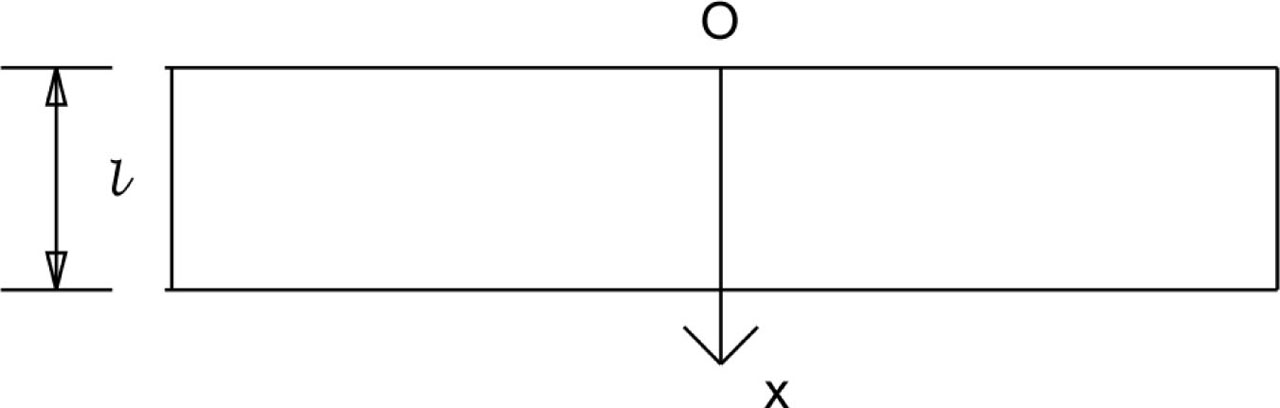
Fig. 1
Thickness of metal sheet: l = 1.0E–6 meters.

Fig. 2
Geometry of dimensionless problem.

Fig. 3
Left panel: Fourier’s parabolic heat equation. Right panel: MCV’s hyperbolic heat equation. β = 1 × 10⁻⁴.

Fig. 4
Left panel: Diffusion z1 = z2 ≠ = 0. Right panel: Generalised heat equation. β = 1 × 10⁻⁴.
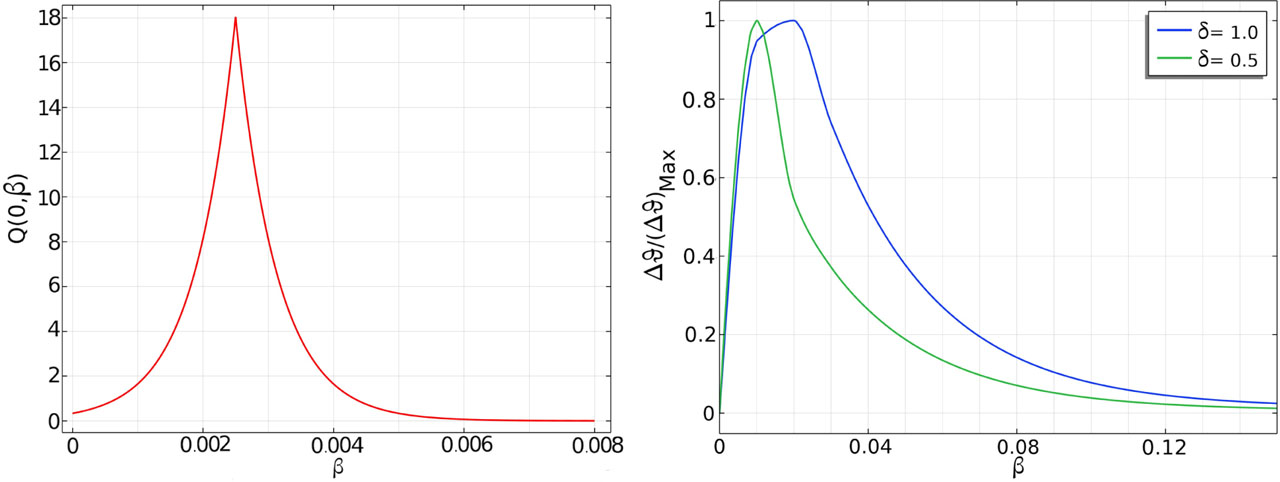
Fig. 5
Left panel: Trend of the dimensionless of heat absorption respect to time dimensionless, due at stimulation of laser. Right panel: Trend rate temperature normalized respect to maximum rate temperature dimensionless.

Fig. 6
Left panel: Trend of the dimensionless temperature of gold metal film when the dimensionless depth changes for various values of the dimensionless time. Right panel: Trend of the dimensionless temperature of gold metal film when the dimensionless time changes for various values of the dimensionless depth.