
INTRODUCTION
Enterprise education is considered an essential subject to instil enterprise skills, competencies and attitudes within students so that they may successfully pursue entrepreneurship (i.e., taking risks and creating an independent enterprise) or intrapreneurship (i.e., identify and exploit ideas within an existing enterprise). The subject includes topics of marketing, innovation, management, ideation, product development, and business planning (Rasmussen and Sørheim, 2006; Costin et al., 2007; Mwasalwiba, 2010); linked together with an applied, experiential curriculum (Bird, 2002; Hytti and O’Gorman, 2004; Birdthistle et al., 2007; Jones and Iredale, 2010). Enterprise education plays a significant role in developing entrepreneurial self-efficacy and entrepreneurial intentionality in its student base. Exposure to the subject can increase entrepreneurial tendencies (intentions, attitudes and self-efficacy) while reducing the negative influence of social norms (Shah et al., 2020). However, while the link between enterprise education and these tendencies has been drawn previously, less is known about the changing levels of these conditions when undertaking an enterprise module and what other factors contribute.
This study investigates factors affecting individual student entrepreneurial tendencies and student satisfaction in an enterprise module. We deepen our understanding of the relationship between entrepreneurial self-efficacy and intentions in the enterprise education context, adding several new and novel areas of exploration. Firstly, the study applies Social Cognitive Career Theory as the theoretical lens. The theory has been mainly studied in the career development context (Lent and Brown, 2017, career development; Sheu and Bordon, 2017); however, our study is one of the first to test the propositions of Bernstein and Carayannis (2012) by examining the effect of an enterprise module on student module satisfaction and entrepreneurial intentions. Secondly, the paper provides a fuller understanding of the enterprise student. We examine the effect of antecedent or pre-module conditions on entrepreneurial tendencies and attitudes. We find students have entrepreneurial tendencies and attitudes before university; thus, the study supports a continued focus on entrepreneurship at the second level. We address a noted need for information on the differential impact of enterprise education on male and female students/ graduates (Nabi et al., 2016). Lastly, the study examines the effect of creativity on the relationship between entrepreneurial self-efficacy and intentions, noting the effect of student self-perceptions of creative ability and creativity training. It has been suggested that enterprise education should be linked to creativity; however, much is still unknown (Berglund and Wennberg, 2006; Hamidi et al., 2008; Book and Philips, 2013; Lewis and Elaver, 2014). We find that self-perceived creativity and creativity training positively predict entrepreneurial self-efficacy, intentionality, and enterprise module satisfaction.
In the following sections, we review previous literature and formulate hypotheses. We discuss our methodology and describe data and data collection. In the final section, we present and discuss our results, followed by the conclusion.
SOCIAL COGNITIVE CAREER THEORY
Entrepreneurial self-efficacy, as an individual’s belief in their capability to attain success and manage challenging goals during new venture creation (Chen et al., 1998; McGee et al., 2009), is considered a precursor to entrepreneurial behaviour and can be affected by the environment and context (Drnovšek et al., 2010). Enterprise education raises student levels of entrepreneurial self-efficacy (Bae et al., 2014; Moberg, 2014; Nabi et al., 2016; Jerkku et al., 2016), as it provides students with mastery experience, vicarious experience, social persuasion, and emotional feedback or encouragement related to start-up creation (Shinnar et al., 2014). The self-efficacy developed within an enterprise education setting has been connected to numerous valuable entrepreneurial factors such as start-up readiness (Adeniyi, 2023) and the intention to pursue an entrepreneurial career – or entrepreneurial intentions (Shah et al., 2020; Saoula et al., 2023).
We use Social Cognitive Career Theory as the theoretical lens to examine the changing entrepreneurial tendencies of enterprise students and the factors affecting them. This theory describes the interplay of cognitive, personality, affective and environmental variables that can affect career choice and within-career behaviours (Sheu and Borden, 2017). The theory spans career-interest development, career choice, performance attainment, and educational and work satisfaction (or well-being) (Lent and Brown, 2017; Lent et al., 1994). Brown et al. (2011, p.81) describe it as a “unifying framework for understanding, explaining, and predicting the processes through which people develop educational and vocational interests, make academic and occupational choices, and achieve varying levels of success and stability in their educational and work pursuits”. For each of these milestones, Social Cognitive Career Theory contends that an individual’s perception of their resultant interest, action, or performance will reshape their appraisal of these experiences (Lent et al., 1994). Thus, the constructivist theory includes a feedback loop, inferring that future decisions are based on lived experiences. Of late, it has been used in the entrepreneurship domain and within enterprise education to explain student phenomena and to predict future entrepreneurial career-related behaviour in student samples (Hemmasi and Hoelscher, 2005; Kassean et al., 2015; Belchior and Lyons, 2021).
We follow the model proposed by Bernstein and Carayannis (2012), which draws upon Social Cognitive Career Theory to propose specific relationships for enterprise students. These authors studied the effects of self-efficacy and outcome expectations on the interest in applying for entrepreneurship majors, using a sample of undergraduate business students, and proposed that student interest in an enterprise module operated on two planes: career and academic. Stemming from these propositions, we study the interplay of student entrepreneurial self-efficacy, module satisfaction, and entrepreneurial intentions in an enterprise education setting, as hypothesised in the next section.
Similar to Verbruggen and Sels (2010), we omit outcome expectations from our study. Outcome expectations are the beliefs that a specific result or consequence will stem from specific behaviours. Theoretically and empirically, the link between outcome expectations and student engagement has already been well established, where enterprise education increases student perceptions of the value and outcome associations of entrepreneurship (e.g. Krueger, 1993; Martin et al., 2013; Peterman and Kennedy, 2003; Zhao et al., 2005). Also, the specific link between entrepreneurial self-efficacy, outcome expectations, and intentions has been found in previous studies (Segal et al., 2002; Kassean et al., 2015; Pfeifer et al., 2016). Instead, we focus on the entrepreneurial self-efficacy construct as the primary focus.
HYPOTHESES DEVELOPMENT
We propose that entrepreneurial self-efficacy positively affects entrepreneurial intentions and enterprise module satisfaction. Many studies of enterprise education have noted this positive relationship between entrepreneurial self-efficacy and intentions (Boyd and Vozikis, 1994; Carr and Sequeira, 2007; Wilson et al., 2007; Bernstein and Carayannis, 2012; Sánchez, 2013; Bullough et al., 2014; Pfeifer et al., 2016; Shah et al., 2020; Wu et al., 2022; Saoula et al., 2023; Adeniyi, 2023). Often studied under the Theory of Planned Behaviour (Ajzen, 1991) and Social Cognitive Theory (Bandura, 1991), when confidence, self-assurance or perceptions of personal control are engendered in an individual towards an action, they are more confident in their potential undertaking, and are more likely to act. When students are taught about entrepreneurship, they are more confident in their abilities (Stumpf et al., 1991; Goddard et al., 2004), more hopeful about potential success in this career, and more motivated to pursue it.
H1: The entrepreneurial self-efficacy of a student in an enterprise module positively affects their entrepreneurial intentions.
Secondly, we expect that students with entrepreneurial self-efficacy will show a positive interest in entrepreneurial learning within an enterprise module. Entrepreneurial self-efficacy is a significant predictor of performance and success (Rauch and Frese, 2007; Miao et al., 2017). We suggest that raised success and skill development may enhance student satisfaction in an enterprise subject. Bernstein and Carayannis (2012) found that enterprise students with higher levels of (general) self-efficacy agreed that an entrepreneurship major would increase their likelihood of entrepreneurial success. We expect a similar result between entrepreneurial self-efficacy and enterprise module satisfaction.
H2: The entrepreneurial self-efficacy of a student in an enterprise module positively affects their satisfaction in the module.
We propose a relationship between creativity and entrepreneurial tendencies, particularly when embedded in an enterprise module. Creativity, as defined by Woodman et al. (1993, p. 294), is “the complex product of a person’s behaviour in a given situation”. While Amabile (1983; 2013) notes that creativity can be multi-level, on an individual level1, it is affected by domain-relevant skills, creativity-related processes, intrinsic task motivation, and the social environment. We propose that entrepreneurial self-efficacy will mediate the relationship between individual creativity and entrepreneurial intentions, a proposition that infers a relationship between creativity and entrepreneurial self-efficacy, as well as creativity and entrepreneurial intentions. The link between creativity (perceptions) and entrepreneurship has been supported (Ward, 2004; De Tienne and Chandler, 2004), and Shahab et al. (2018) have previously found a positive relationship between entrepreneurial creativity, self-efficacy and new venture intentions. Studying Social Cognitive Career Theory, Pfeifer et al. (2016) found that entrepreneurial identity predicted entrepreneurial intentions; thus, if the student considers individual creativity pertinent to the entrepreneurial identity, a relationship to entrepreneurial intentions may be observed. Biraglia and Kadile (2016) used the Social Cognitive Theory to study whether creativity and the entrepreneurial passion of American homebrewers predicted their intentions to move beyond a hobby to a venture. Their study found a link between creativity and entrepreneurship, fully mediated by entrepreneurial self-efficacy. Extrapolating from this study, in an enterprise module, a student with positive perceptions of creative ability may consider themselves more skilled for the aspects involved in entrepreneurship. Hamidi et al. (2008) found that a creativity test had a positive effect on the entrepreneurial intentions of entrepreneurship students, as mediated by entrepreneurial self-efficacy. As such, we expect findings similar to those of Hamidi et al. (2008). We propose that students who perceive themselves as creative will be more likely to increase their efficacy levels for entrepreneurship in an enterprise module, and will be satisfied with the enterprise module as a result.
H3a: Entrepreneurial self-efficacy mediates the positive relationship between individual creativity and entrepreneurial intentions.
H3b: Entrepreneurial self-efficacy mediates the positive relationship between individual creativity and enterprise module satisfaction.
Lastly, we examine the effect of creativity training on module satisfaction. Swaim and Henley (2016) noted that rational persuasion by an instructor/ trainer can increase student valence for completing an enterprise project. Training provides an opportunity for the development of entrepreneurial self-efficacy through enactive mastery (allowing a student to practice a task/ skill), role modelling (demonstrations), and social persuasion (constructive feedback from teachers, interaction with classmates) (Kassean et al., 2015). Perceptions of formal learning have previously been positively linked to the development of entrepreneurial self-efficacy, and entrepreneurial intentions via mediation (Zhao et al., 2005), thus we propose a similar pathway for student perceptions of creativity tuition. In addition, following Moberg (2014), who noted the positive effect that action-based teaching (involving creative thinking and proactive pedagogies) had in increasing student engagement, it is hypothesised that entrepreneurial self-efficacy will mediate the relationship between creativity training and student enterprise module satisfaction.
H4a: Entrepreneurial self-efficacy mediates the positive relationship between creativity training and entrepreneurial intentions.
H4b: Entrepreneurial self-efficacy mediates the positive relationship between creativity training and student enterprise module satisfaction.
METHODOLOGY
Data Collection and Screening
The respondents in this study are a cohort of first-year undergraduate students taking an enterprise education module at an Irish university. Firstly, ethical permissions from the University were obtained for the study and surveys. A pre- and post- module survey was emailed to the student cohort at the start of the academic year (Nov) and again at the end of the academic year (April, before students received their final grades). They were also given the link at the end of their first and last lecture in the module. Students were encouraged to complete the survey, but were aware it would not affect their module grades. Survey responses were merged by their Student ID numbers in Microsoft Excel, and then examined for missing data and unengaged responses. The final dataset contained 177 matched pairs, representing 49.7% of the class. Most respondents are aged 18 or 19 (85.5%, n = 153) and undertaking business degrees (79.1%). The final dataset contains 98 male students and 79 female students, with a high proportion of students from Ireland (84.2%).
Survey Measures
Entrepreneurial Intentions is measured at the post-test stage, using a reduced one-item measure of the Krueger et al. (2000) measure, proposed by Hamidi et al. (2008). It asks: ‘How would you estimate the probability that you will run your own company in the future?’ and is administered with a seven-point Likert scale.
Enterprise Module Satisfaction: Students were asked four questions at the end of the module (time two) about their satisfaction with the enterprise education module, namely ‘My experience of the module made me more enterprising’, ‘My experience of the module made me more entrepreneurial’, ‘I was satisfied with the module in general’, and ‘I enjoyed working with my team during the module’. The items are measured on a seven-point Likert scale, and responses merged to form a composite indicator, indicating perceived interest/ satisfaction in the module.
Entrepreneurial Self-Efficacy is measured as a unidimensional construct devised by Zhao et al. (2005). It was previously found to display discriminant validity with Chen et al.’s (1998) general self-efficacy construct and to be positively related to entrepreneurial intentions, indicating convergent validity. The scale consists of four items relating to an individual’s perception of self-efficacy regarding specific entrepreneurial tasks, measured on a Likert scale ranging from one (no confidence) to seven (complete confidence).
Individual Creativity: Self-perceptions of creativity are based on the scale by Zhou and George (2001) adapted by Janssen and Xu (2008), shortened (13 items) and adapted as self-reporting, with a five-point Likert scale. Preliminary analyses using IBM SPSS, reveal a KMO2 score of .870, and Bartlett’s test of Sphericity significance. Principal Components Analysis reveal two components with eigenvalues greater than one, accumulating 52.421% of the total variance. An inspection of the scree plot supports a two-factor model: one relating to plans, performance, and creative systems (e.g. ‘I suggest new ways to achieve my goals, I help to create plans and schedules to get new ideas working’); and another relating to idea generation (e.g. ‘I often have new and innovative ideas’). For this study, the dimension of idea generation is used only, given that idea generation is more commonly the focus of these early-stage enterprise education modules (Jones et al., 2020).
Creativity Training: During the module, the class received a seminar designed to encourage creative thinking. The level of creativity training students felt they were given during the module is reported on a seven-point Likert scale ranging from 1 (none at all) to 7 (more than enough).
Entrepreneurial Experience: Entrepreneurial experience is used as a control in this study, as personal or familial experience of entrepreneurship is a pertinent factor in extant studies (Kickul et al., 2008; Krueger, 1993; Liguori, 2012; Ramayah et al., 2012; Pfeifer et al., 2016; Tarling et al., 2016). Three dichotomous (yes/no) questions identify student experiences of entrepreneurship: ‘I run my own company at present’, ‘I have run/set up a company in the past’, and ‘Members of my family (parents/siblings) run their own company’. The question responses form a composite scale from 0-4.
Preliminary Analyses
Initially, we compare time one (T1) to time two (T2) changes, then examine the data by gender. In this study, we examine entrepreneurial self-efficacy separately as two iterations (i.e. T1, T2) rather than a gain score variable (T2 minus T1). Verbruggen and Sels (2010) used a similar research design to show (time two) how perceived barriers, goal progress, and self-efficacy mediated the relationship between (time one) personality traits and self-efficacy on career satisfaction. Comparing T1 to T2 changes, we find male students report higher levels of entrepreneurial self-efficacy than female students at the outset of the module (T1: male participants = 19.214, SD 4.33, female participants = 18.165, SD 3.874). Entrepreneurial self-efficacy increases significantly for the full sample and for female students between the two time periods. Entrepreneurial intentions were significantly reduced for the full sample and for male students between the two time periods. Initial intentionality levels for male students (4.49, SD=1.594) are higher than for female students (4.27, SD=1.402), but not significantly so.
Before running the analysis, we examine item, measure and model fit indices using Smart-PLS3. We report Inner VIF scores for the variables ranging from 1.012 to 1.058, which are within acceptable ranges to consider multicollinearity is not an issue. The latent variables in the model are reflective, i.e. measuring largely the same, and/or are manifestations of the same construct. One measure (composite entrepreneurial experience) reported a high kurtosis and a marginal skew, so its Log 10 value is used. Using Cronbach’s alpha (α) and composite reliability (CR), all scales indicate reliability (above 0.8) (See Table 1). For all latent variables, AVE values are above the minimum benchmark of .50 (Fornell and Larcker, 1981). No discriminant validity is reported per the Fornell-Larcker and Heterotrait Monotrait methods. The standardized loadings (λ) are above the threshold of .50 for item reliability (1000 bootstrapping runs), and item communalities (λ2) exceed the minimum requirement of .25. An item was removed from the creativity measure due to poor loadings, bringing the AVE score from .490 to .524.
Table 1:
Reliability and Convergent Validity (Bootstrapped)
| Item | λ | t | λ2 | α | CR | AVE | |
|---|---|---|---|---|---|---|---|
| Individual Creativity | 0.838 | 0.842 | 0.524 | ||||
| I often have new and innovative ideas. | IC10 | 0.845 | 15.379 | 0.71 | |||
| I like to come up with creative solutions to problems. | IC11 | 0.73 | 12.158 | 0.53 | |||
| I like to search out new technologies, processes, techniques and/or product ideas. | IC3 | 0.536 | 5.734 | 0.29 | |||
| I am a good source of creative and innovative ideas. | IC4 | 0.831 | 18.616 | 0.69 | |||
| I think I show creativity when given the opportunity to | IC8 | 0.602 | 8.05 | 0.36 | |||
| Entrepreneurial Self Efficacy (Time one) | 0.874 | 0.876 | 0.643 | ||||
| Successfully identifying new business opportunities | ESE1 | 0.82 | 18.396 | 0.67 | |||
| Creating new products | ESE2 | 0.91 | 25.27 | 0.83 | |||
| Thinking creatively in business | ESE3 | 0.805 | 18.883 | 0.65 | |||
| Commercialising an idea or new development | ESE4 | 0.64 | 8.358 | 0.41 | |||
| Entrepreneurial Self Efficacy (Time two) | 0.918 | 0.919 | 0.741 | ||||
| Successfully identifying new business opportunities | RESE1 | 0.926 | 31.809 | 0.86 | |||
| Creating new products | RESE2 | 0.862 | 25.089 | 0.74 | |||
| Thinking creatively in business | RESE3 | 0.875 | 27.205 | 0.77 | |||
| Commercialising an idea or new development | RESE4 | 0.762 | 12.988 | 0.58 | |||
| Enterprise Module Satisfaction | 0.888 | 0.892 | 0.674 | ||||
| My experience of the module made me more enterprising | EEI1 | 0.838 | 14.331 | 0.70 | |||
| My experience of the module made me more entrepreneurial | EEI2 | 0.875 | 12.045 | 0.77 | |||
| I was satisfied with the module in general | EEI3 | 0.833 | 11.406 | 0.69 | |||
| I enjoyed working with my team during the module | EEI4 | 0.713 | 6.136 | 0.51 |
Verification of the Structural Model
We test the model hypotheses using a consistent Partial Least Squares algorithm and consistent bootstrapping analyses in Smart-PLS3. In the bootstrapped model (x1000), we retain relationships with t values above 1.96, indicating statistical significance. As seen in Table 2, the final bootstrapping results have acceptable t values and significance. Table 3 indicates the specific indirect effects and double mediation. The model tested explains an adjusted 41.8% of the variance in module interest and 36.7% in entrepreneurial intentions (Table 4).
Table 2:
Final Bootstrapped Results
| Path | Sample Mean | Original Sample | T | p (Sig.) |
|---|---|---|---|---|
| Individual Creativity (Generation) → Entrepreneurial Self-Efficacy (time one) | 0.636 | 0.725 | 12.337*** | 0 |
| Entrepreneurial Self-Efficacy (time two) → Entrepreneurial Intentions | 0.538 | 0.560 | 9.818*** | 0 |
| Creativity Training → Module Satisfaction | 0.491 | 0.513 | 8.224*** | 0 |
| Entrepreneurial Self-Efficacy (time one) → Entrepreneurial Self-Efficacy (time two) | 0.408 | 0.298 | 5.625*** | 0 |
| Creativity Training → Entrepreneurial Self-Efficacy (time two) | 0.287 | 0.279 | 4.904*** | 0 |
| Individual Creativity (Generation) → Entrepreneurial Self-Efficacy (time two) | 0.305 | 0.438 | 4.267*** | 0 |
| Entrepreneurial Self-Efficacy (time two) → Module Satisfaction | 0.256 | 0.202 | 3.871*** | 0 |
| Entrepreneurial Experience → Entrepreneurial Intentions | 0.203 | 0.315 | 3.701*** | 0 |
Table 3:
Specific Indirect Effects for Study of Entrepreneurial Intentions and Module Interest
| Path | Sample Mean | T | p (Sig.) |
|---|---|---|---|
| Individual Creativity (Generation) → Entrepreneurial Self-Efficacy (time one) → Entrepreneurial Self-Efficacy (time two) | 0.259 | 5.106*** | 0 |
| Creativity Training → Entrepreneurial Self-Efficacy (time two) → Entrepreneurial Intentions | 0.155 | 4.352*** | 0 |
| Individual Creativity (Generation) → Entrepreneurial Self-Efficacy (time one) → Entrepreneurial Self-Efficacy (time two) → Entrepreneurial Intentions | 0.14 | 4.217*** | 0 |
| Individual Creativity (Generation) → Entrepreneurial Self-Efficacy (time two) → | |||
| Entrepreneurial Intentions | 0.164 | 3.977*** | 0 |
| Individual Creativity (Generation) → Entrepreneurial Self-Efficacy (time one) → Entrepreneurial Self-Efficacy (time two) → Module Satisfaction | 0.066 | 3.239*** | 0.001 |
| Creativity Training → Entrepreneurial Self-Efficacy (time two) → Module Satisfaction | 0.074 | 2.763** | 0.006 |
| Individual Creativity (Generation) → Entrepreneurial Self-Efficacy (time two) → Module Satisfaction | 0.079 | 2.638** | 0.008 |
Table 4:
Effect Sizes and Predictive Ability of the Model (Bootstrapped)
| R Square | R Square Adjusted | Q2 | |
|---|---|---|---|
| Entrepreneurial Intentions | 0.374 | 0.367 | 0.337 |
| Entrepreneurial Self-Efficacy (time one) | 0.526 | 0.523 | 0.271 |
| Entrepreneurial Self-Efficacy (time two) | 0.565 | 0.555 | 0.362 |
We find that the proposed mediators report an adjusted variance of 55.5% (T2) and 52.3% (T1). Lastly, Figure 1 presents the final structural model noting direct effects and explained variances. Figure 2 presents the final structural model, noting the bootstrapped estimates.
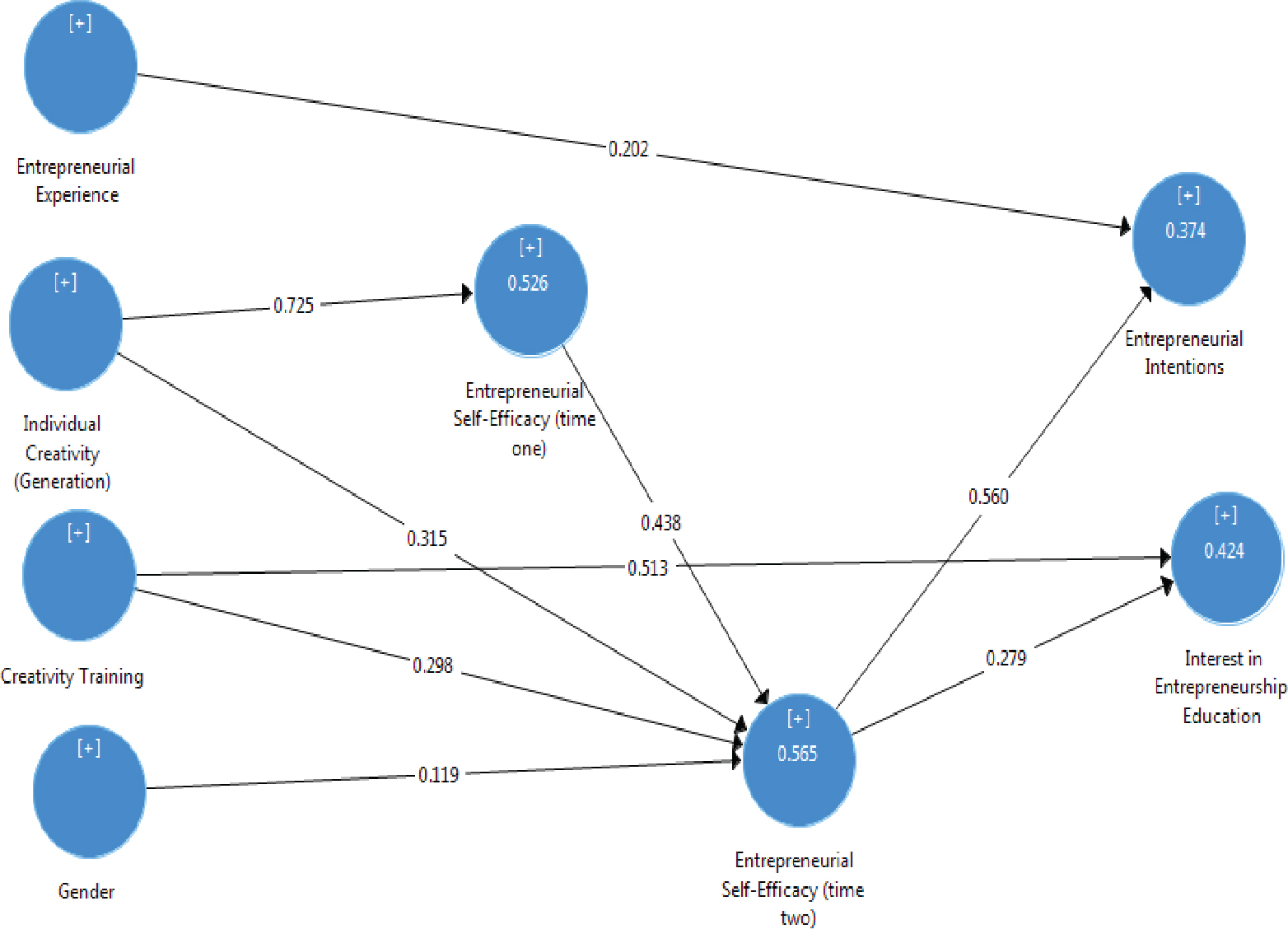
Figure 1:
Final Structural Model noting direct effects and explained variances.
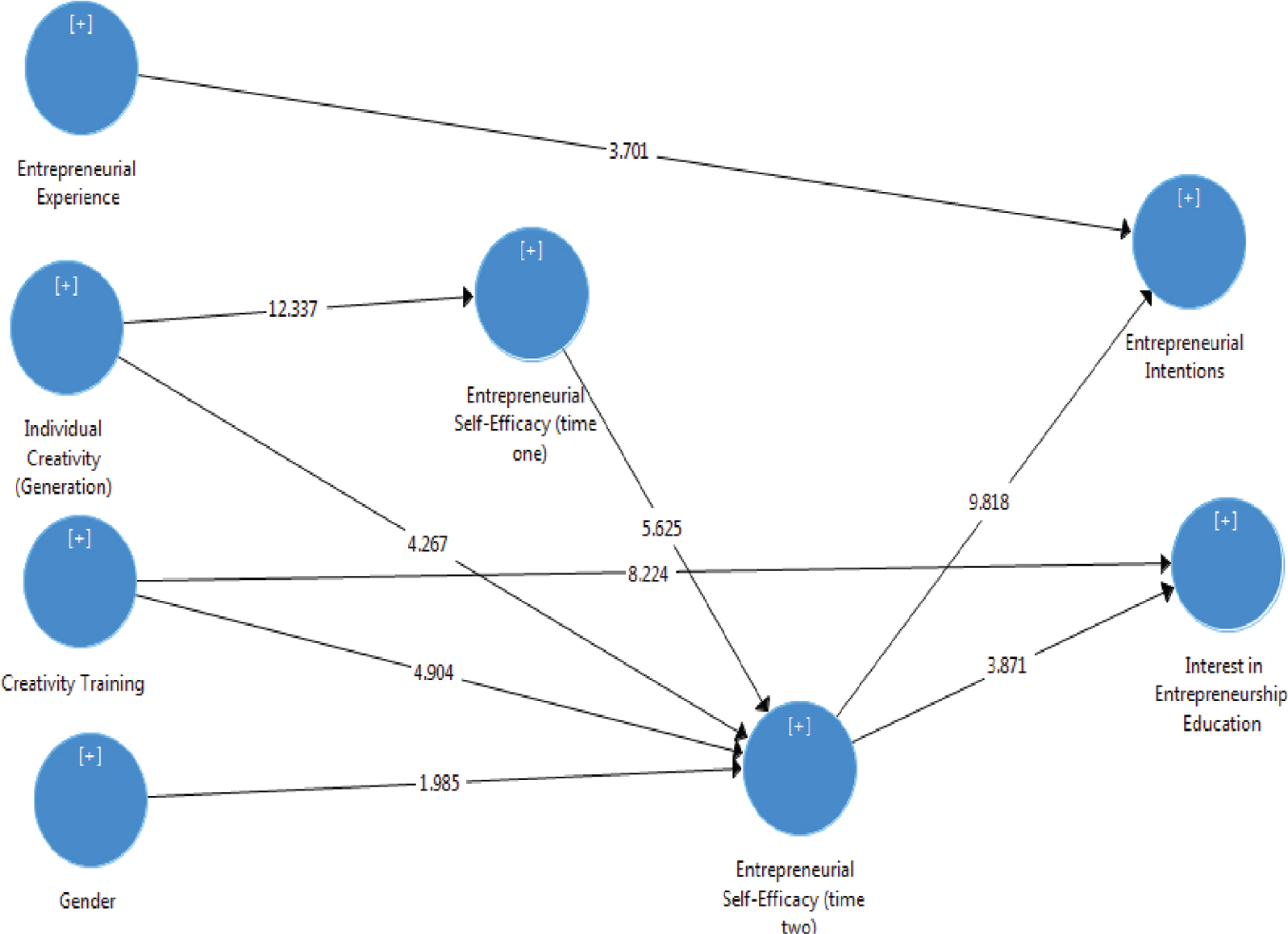
Figure 2:
Final Structural Model noting the bootstrap estimates.
DISCUSSION
We compare student entrepreneurial tendencies before and after an enterprise education module. We find lower initial (T1), and significantly raised (T2) entrepreneurial self-efficacy levels for female students only, echoing the findings of Wilson et al. (2007). This heightened effect for female students may imply that enterprise education is more impactful for female students, and/ or they have fewer opportunities to develop this self-efficacy outside the classroom. Next, we find lowered levels of entrepreneurial intentions across the full sample. These reduced or insignificant changes have also been noted by Von Graevenitz et al. (2010); Bae et al. (2014); and Nabi et al. (2016), and it has been suggested that gaining a full understanding of a challenging entrepreneurial career may negate or limit the positive effect of enterprise education (Moberg, 2014; Kassean et al., 2015). By gender, we find entrepreneurial intentions are higher in male students initially (T1) (Zhao et al., 2005; Sieger et al., 2016; Santos et al., 2016), but these are significantly lowered by time two (female levels also reduced, but not significantly).
The adaptation to Social Cognitive Career Theory proposed by Bernstein and Carayannis (2012) suggests that two parallel cognitive processes occur within enterprise education: one leading to an outcome interest in the entrepreneurship career and one that leads to interest in the module itself. As such, we investigate the effect of antecedent student perceptions and entrepreneurial tendencies on student module satisfaction and entrepreneurial intentions. Firstly, we propose a positive relationship between the entrepreneurial self-efficacy of a student in an enterprise module and their entrepreneurial intentions (H1), employing two iterations of the self-efficacy variable (T1 and T2). Our results show a positive significant relationship between the T2 iteration and entrepreneurial intentions only. The positive link between entrepreneurial self-efficacy has received much consensus in previous studies (Boyd and Vozikis, 1994; Wilson et al., 2007; Zhao et al., 2005; Sánchez, 2013; Bullough et al., 2014); however, we highlight a novel disconnect between the T1 iteration and intentions. This suggests that, previous to a module of enterprise education, even students who are assured about their entrepreneurial capabilities may not yet be considering an entrepreneurial career, and a module of this nature may provide career guidance to these nascent entrepreneurial students. We also propose a positive relationship between entrepreneurial self-efficacy and student interest in an enterprise module (H2) and find a positive (significant) relationship between entrepreneurial self-efficacy (T2) and student module satisfaction, but again, not for T1. This positive association supports the consensus that enterprise education is affirming and engaging for those who have, or have developed entrepreneurial self-efficacy.
Following the propositions of Bernstein and Carayannis (2012), our results indicate that entrepreneurial self-efficacy mediates the positive relationship between creativity (both self-perceived and delivered) and entrepreneurial intentions (H3a/H4a). A single- and double- mediated relationship was found relating to the positive effect of individual creativity on entrepreneurial intentions and self-efficacy. We have previously seen a link between entrepreneurial input factors and entrepreneurial intentions, as mediated by entrepreneurial self-efficacy (Kickul et al., 2008; Yarima and Hashim, 2016). However, creativity is infrequently studied as an input factor. These findings support efforts to develop stronger self-belief and skillsets relating to creative thinking in students. Our results also suggest that students consider creativity and idea generation aligned to entrepreneurial competencies, similar to Camelo-Ordaz et al. (2016), who found that female students consider creativity to be the most important factor in creating a business.
Lastly, entrepreneurial self-efficacy mediates the positive relationship between creativity (self-perceived and delivered) and student satisfaction in an enterprise module (H3b/H4b). This supports the findings of Nasiru et al. (2014; 2015) who found that perceived creativity was related to the entrepreneurial intentions of Nigerian university students. Our novel results highlight the instructor’s and curriculum’s crucial role in developing student interest by incorporating self-efficacy, creativity, self-reflection and self-acknowledgement of creative or entrepreneurial tendencies. Echoing Hamidi et al. (2008), Nasiru et al. (2014; 2015) and Shahab et al. (2018), we call for more research on creativity in enterprise and entrepreneurship modules.
Study Limitations and Future Research
The primary context for the study was an undergraduate module within an Irish University. We acknowledge that institutional factors have a bearing on the delivery and effect of enterprise education, thus considering this group as representative of a wider population, or indicative of enterprise education on a national or international basis may be misleading. It is important to consider enterprise education across cultural, social, and environmental contexts (Wu et al., 2022). Our study points to antecedent enterprise and creativity factors as significant predictors. This is an interesting result, which could inspire study into pre-enterprise education antecedent contexts or experiences – such as school-based business projects or access to role models. In addition, these findings may infer that, methodologically speaking, the exclusion of antecedent entrepreneurial tendencies in empirical research could lead to ambiguous results. These findings also allow us to consider post- module effects. Studying the stability of entrepreneurial intentions over time (11 years), Belchior and Lyons (2024) suggest that entrepreneurship education may buffer the deterioration of entrepreneurial intentions. This, and the parallel effect of such a subject on entrepreneurial self-efficacy or subject interest, would be worthy of exploration.
We call for further inquiry into the link between creativity and enterprise education (Hamidi et al., 2008; Nasiru et al., 2014; 2015). A possible avenue for this research is the link between creativity/ innovation and emotion. Amabile and Mueller (2008) found that an affective state can significantly impact individual creativity, and there is a growing body of work linking the componential model of creativity to affect and emotion (Cardon et al., 2009; Anderson et al., 2014). Additionally, more work could investigate the impact of entrepreneurial experience on the student and student learning behaviours. Berglund and Wennberg (2006) find entrepreneurially minded students to be poor at following rules, while Young and Sexton (2003) note that entrepreneurs tend towards self-directed learning. Cope (2003) suggests that entrepreneurs engage in higher-order and intensive learning during significant and discontinuous (sometimes crisis) trigger events. Thus, we recommend examining curricula that interject moments of key spontaneous learning activities or alternate structures.
CONCLUSION
This research builds on Social Cognitive Career Theory (Lent and Brown, 2017) by showing that self-efficacy links creativity and entrepreneurial intentions. An evolution of self-efficacy among students, especially in the female demographic, underscores a transformative potential within enterprise education to educate and empower. The findings illuminate a pathway where initial self-belief in entrepreneurial capabilities, nurtured and expanded through targeted education, becomes a cornerstone for future entrepreneurial endeavours. To foster entrepreneurial self-efficacy in the classroom, prominence must be given to developing student mastery experiences, social persuasion and vicarious experiences relating to new venture creation (Stumpf et al., 1991; Goddard et al., 2004). Guest speakers can give students a real sense of success, failure and the implications of creative and risk-taking behaviour. As mentors, they can assist students in idea generation, teamwork, and attaining feedback (Wilson et al., 2007; Maritz and Brown, 2013).
This research highlights the critical role of creativity in shaping entrepreneurial self-efficacy and entrepreneurial intentions. Both the preliminary analyses and the model testing (Figures 1 and 2) highlight the importance of antecedent entrepreneurial and creative tendencies to the student of enterprise education. Since creativity training helps students better navigate the challenges of entrepreneurship, it should be a key focus in entrepreneurial education programs (Berglund and Wennberg, 2006; Moberg, 2014). In doing so it reveals the creative thought processes to be integral to cultivating an entrepreneurial mindset. We find that this synergy between creativity and self-efficacy enriches the educational experience and call on entrepreneurship scholars and educators to sharpen their focus on the creative domain.
Notes
[10] Individual creativity is studied herein as the personal perception of creativity rather than the creative talent of the individual. Self-perceptions of creativity have been found to be adequate predictors of creative and academic performance (Chamorro-Premuzic, 2006).
[11] Kaiser-Meyer-Olkin (Kaiser, 1974) is a statistical test used in factor analysis to determine if the data is suitable for factor analysis.