
INTRODUCTION
In recognising the importance of entrepreneurship for economic and societal development, governments and policy makers have paid increasing attention to fostering entrepreneurial activity (GEM, 2023). Accordingly, there has been rapid growth in entrepreneurship education and training across the global higher education landscape (Pittaway, 2021). Traditionally, EE had a strong business or new venture creation orientation, fostering the skills needed to develop entrepreneurial start-ups in a commercially oriented context (Neck and Corbett, 2018). Contemporary entrepreneurship education has become increasingly attentive to engendering a broader set of entrepreneurial competencies within individuals (Zaring, Gifford and McKelvey, 2021; Antonelli, Venesaar, Riviezzo, Kallaste, Dorożyński and Kłysik-Uryszek, 2023) and so the term ‘entrepreneurial education’ is employed to capture the wider perspective (Lackéus, 2015). This wider approach to entrepreneurial education necessitates a shift in focus from purely venture creation to value creation, and from becoming entrepreneurs to becoming entrepreneurial through the development of competencies and skills (Baggen, Lans and Gulikers, 2022). By focusing on developing transferable competencies such as self-reliance, creativity, initiative taking and collaboration, such active learning approaches encourage individuals to behave in an enterprising fashion as a consumer, citizen, employee, or self-employed person in society (De Wet and Tselepis, 2020; Cooney and Brophy, 2023).
Numerous studies have focused on examining course content and pedagogy (e.g., Nabi, Liñán, Fayolle, Krueger and Walmsley, 2017; Neck, Brush and Greene, 2021), student learning and outcomes (Rideout and Gray, 2013), and entrepreneurial intention (Pittaway and Cope, 2007). Gabrielsson, Hägg, Landström and Politis (2020), suggest that studies are predominantly focused on the “what”, or teaching content, the “whom” of students learning processes and the “how” of varying teaching pedagogies. Hägg and Gabrielsson (2020), argue that the “who” of entrepreneurial education, or the educator perspective receives less attention. Recent studies have called for increased focus on the entrepreneurial educator given their importance in the learning process (cf. Brush, Wraae, and Nikou, 2024; Nikou, Brush and Wraae, 2023; Wraae and Walmsley, 2020). The need for enhanced studies in the Scholarship of Teaching and Learning (SoTL) for entrepreneurial education is growing in importance, given the limited historic focus on the role of the educator and the understanding of educational theory underpinning pedagogic practice in entrepreneurial education (Fayolle, 2018; Jones, 2019; Bell and Bell, 2020).
One element of advancing SoTL relates to the development of evidence-based teaching portfolios, with a growing body of literature highlighting the use of portfolios in supporting professional development and enhancing pedagogic practice (Hamilton, 2018; Hoekstra and Crocker, 2015; O’Farrell, 2007; Pelger and Larsson, 2018). A teaching portfolio brings together artifacts that demonstrate an individual’s teaching philosophy, instructional practices and approaches, and impact as an educator; these components are integrated through critical reflection to provide context and depth to the artifacts used as evidence (Seldin, Miller, and Seldin, 2010). Evidence based teaching portfolios are an authentic form of teacher continuous professional development (Hamilton, 2020) and can be used in different contexts and in different career stages (Berrill and Addison, 2010; Hamilton, 2018). Despite the growing interest in teaching portfolios in higher education (Ruge, Schönwetter, McCormack and Kennelly, 2021), the role of teaching portfolios in entrepreneurial education remains underexplored. Nestled in the nexus between education theory and entrepreneurial education practice, this article explores how teaching portfolios can influence pedagogic practice in entrepreneurial education.
The article begins with an introduction to the literature-informed scholarship of teaching and learning, teaching portfolio development, and entrepreneurial education. The article then details the research methodology, describing the autoethnographic inquiry of an entrepreneurial educator’s teaching portfolio, and the applied deductive thematic analysis leading to study findings. Finally, a discussion considering the influence of teaching portfolios in entrepreneurial education is offered, followed by the article’s conclusion, contributions and avenues for future research.
LITERATURE REVIEW
The Scholarship of Teaching and Learning (SoTL)
The growing focus on the quality enhancement agenda in higher education has led to increasing prominence in the scholarship of teaching and learning (SoTL) field (Major and Braxton, 2020; Harrison, Meyer, Rawstorne, Razee, Chitkara, Mears and Balasooriya, 2022). The concept of SoTL was popularised by Boyer (1990) in his seminal piece “Scholarship Reconsidered” where he challenged academics to act not just as “professors”, but as “scholars” integrating teaching and research to adopt a scholarly approach to teaching and learning. Over time, there has been significant developments in the field, with little consensus about the terminology, resulting in a plethora of interpretations in the literature (McCarthy, 2008). It is broadly agreed that the SoTL is a multifaceted, multidimensional term that embodies a vast range of activities and contexts promoting research-informed teaching practice and a culture of research on teaching, learning and assessment (Booth and Woollacott, 2018).
In advancing the SoTL, Olsson, Mårtensson and Roxå (2010), introduced the concept of “pedagogical competence” combining both theoretical subject knowledge and pedagogical practice to enhance the quality of student learning. As illustrated in Figure 1, Olsson et al. (2010) argued that pedagogical competence is a broader concept than teaching skills and can be seen as an upward developing spiral whereby practice may be enhanced as an educator moves through a cycle of practice, observation, theoretical development and planning.
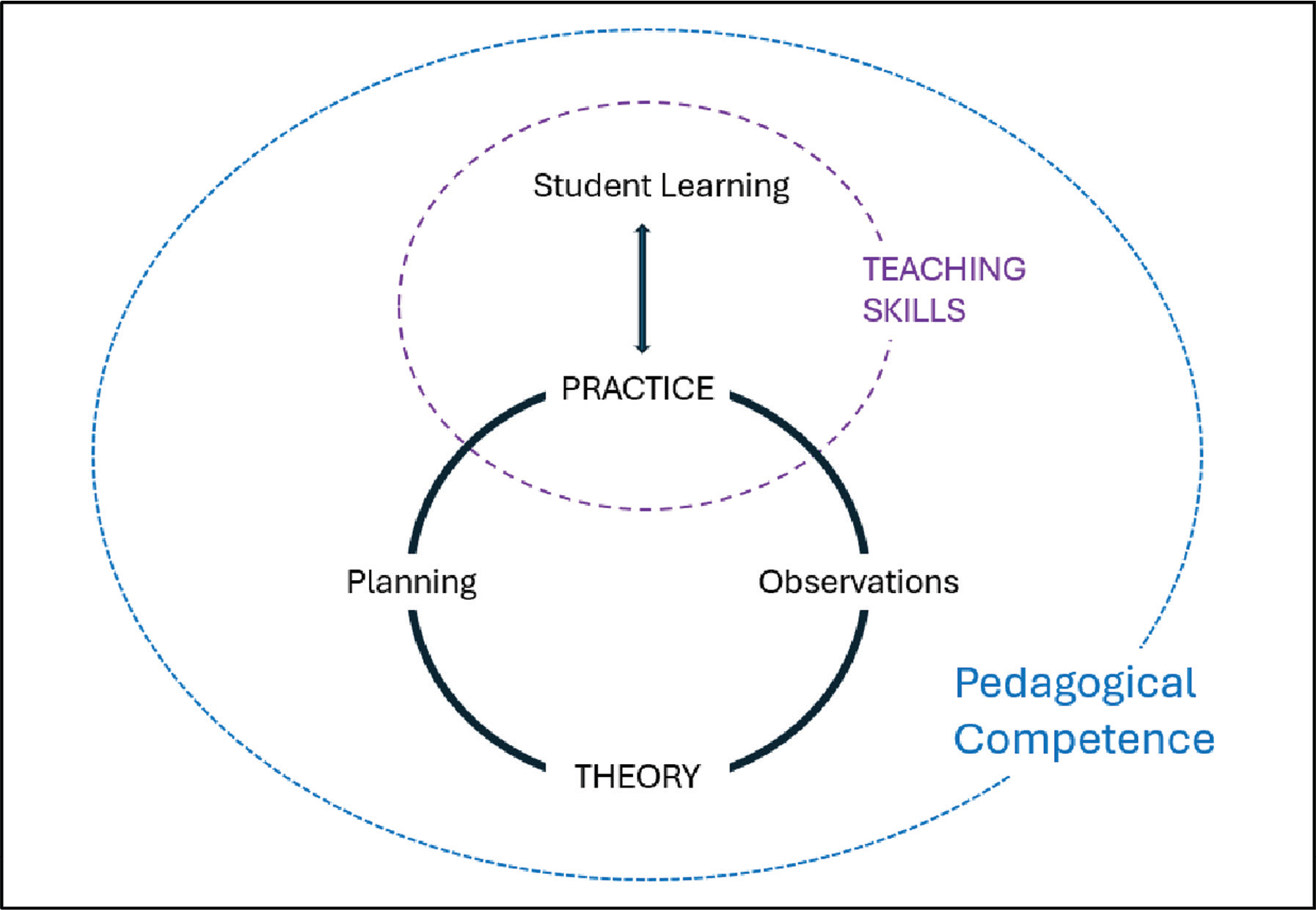
Figure 1:
Pedagogical Competence Framework.
Source: Authors’ own, adapted from Olsson et al. (2010).
Drawing on these insights, as exhibited in Figure 1, pedagogical competence may be developed by sharing one’s practice in a public context such as the publication of academic papers or through the development of a teaching portfolio (Larsson, Anderberg and Olsson, 2015). Evidence-based teaching portfolios are an authentic form of teacher continuous professional development and can be used in difference contexts and in different career stages (Berrill and Addison, 2010). Seldin et al. (2010), proposed that a teaching portfolio bring together artifacts that demonstrate an individual’s teaching philosophy, pedagogic practices and approaches, and impact as an educator. Given the various contexts and purposes for teaching portfolio development, the elements and artefacts included in a teaching portfolio may vary (Pelger and Larsson, 2018). However, these components can be integrated through critical reflection to provide context and depth to the artefacts used as evidence.
There is a growing body of literature highlighting the use of teaching portfolios to enhance pedagogical competence and professional development in higher education (cf. Chalmers and Hunt, 2016; Hamilton, 2018, 2020; Harrison et al., 2022). Recent advances in digital technologies have also seen a growth in the development of e-portfolios (Donnelly and O’Keeffe, 2013; Costelloe, 2021). Chalmers and Hunt (2016) outlined the major components of teaching portfolios as teaching pedagogy, practices, planning, reflection, responses to institutional teaching quality criteria and evidence to support claims of the development of teaching practice. More recently, Hamilton (2020) suggested that a teaching portfolio is a reflective collection of work, summarising a practitioner’s approach to learning and teaching, and providing evidence of major teaching activities and accomplishments. Thus, whilst teaching portfolios can adopt multiple forms and approaches, a common thread is a focus on the perspective of the educator through reflective practice and engagement in a cycle of reflection to continuously enhance and improve practice.
In recognizing the importance of academic professional development, several frameworks and models have been presented in national and international contexts (Svendsen, 2016). For example, the Irish National Professional Development framework was designed to assist and empower staff in higher education in developing, planning and engaging in professional development activities. The framework specifically recognizes the importance of context, and emphasizes values such as inclusivity, authenticity and scholarship, as well as learner-centeredness and collaboration (National Forum for the Enhancement of Teaching and Learning in Higher Education, 2016). The development of teaching portfolios has been identified as a pathway to advance the scholarship of teaching and learning across various disciplines (Buckridge, 2008; Pelger and Larsson, 2018, Harrison et al., 2022), but their influence on entrepreneurial education has been scarcely researched (Cavaller, 2011), leading us to the current study.
SoTL and Entrepreneurial Education
Whilst there has been rapid pedagogical and didactical development, the need to mature the SoTL for entrepreneurial education prevails as a challenge (Neck and Corbett, 2018; Neergaard, Robinson, and Jones, 2021). Fayolle (2018) highlights that we “need strong intellectual and conceptual foundations, drawing from the fields of entrepreneurship and education to strengthen our entrepreneurship courses…we also need to deeply reflect on our practices, as researchers and educators” (p. 692). This compounds the need for pedagogical competence in context (see Figure 1). It is important to understand the “who” of entrepreneurship educators and to encourage other educators to share their journey (Hannon, 2018).
Several authors have made calls for greater philosophical grounding in entrepreneurial education (Hägg and Gabrielsson, 2020; Jones, 2019). Bell (2021) proposes a conceptual framework linking educational philosophies and theory to entrepreneurial education whilst Ramsgaard and Blenker (2022), highlight that no single philosophy or learning theory can be effective in underpinning the diverse continuum and approaches in entrepreneurial education. Contemporary research acknowledges the important contribution that teaching portfolios can play in enhancing philosophical understanding and scholarly practice (Harrison et al., 2022). Despite the growing calls to advance the SoTL in entrepreneurial education, particularly incorporating the perspective of the educator (e.g., Brush et al., 2024), the extant literature remains almost silent on the role that teaching portfolios may play in influencing pedagogic practice. Addressing this research gap has led to the identification of the study’s research question: How can reflective teaching portfolios influence pedagogic practice in entrepreneurial education? An empirical study was designed to gain insight into the key elements in the development of an entrepreneurial educator’s teaching portfolio that would lead to the answering of this question.
RESEARCH METHODOLOGY
Teaching portfolios are personal documents integrating elements of educational practice with critical reflective insight (Chalmers and Hunt, 2016). Since the aim is to explore the influence of teaching portfolios on entrepreneurial pedagogic practice, qualitative analysis of the lead author’s (an entrepreneurial educator) self-reflective teaching portfolio is at the heart of this study. This evidence-based portfolio evolved over 64 pages and was a reflective collection of work, summarizing the educator’s approach to learning and teaching, and providing evidence of major teaching activities and accomplishments. The portfolio development process was not linear or sequential in nature; rather it was cyclical and ongoing, in conjunction with teaching practice. The adopted self-reflective approach draws upon emergent studies of tertiary teaching portfolios through autoethnographic design (Martin, Slade and Jacoby, 2019; Leslie and Camargo-Borges, 2017). Drawing from autoethnographic inquiry, this paper presents vignettes of an entrepreneurial educator's reflections embedded in the “swampy lowlands” (Schön, 1987) of lived experiences and represents the educator’s efforts to make sense of these experiences.
The data gathering for this autoethnographic inquiry was prescribed by the adapted pedagogic competence framework (Olsson et al., 2010, Figure 1) which guided the analysis of the entrepreneurial educator’s teaching portfolio. The approach to data analysis was based on the principles of thematic analysis (Braun and Clarke, 2019), a suitably flexible approach in context (Peel, 2020).
The analytical strategy involved discrete phases of analyses which were conducted across several stages, as defined by Braun and Clarke (2013). These phases involved several cycles of coding, managing codes, categorisation and subsequent data reduction through consolidating codes into a more abstract theoretical framework (themes) (Bazeley, 2009). NVivo (QSR International Pty Ltd. Version 12, 2019) qualitative data analysis software (QADAS) was used to assist in the analysis process. Deductive or a priori coding involves creating codes prior to data analysis and applying those codes to the data (Bingham and Witkowsky, 2022; Braun and Clarke, 2021). In this study, a priori code development was guided by the adapted pedagogic competence framework (Olsson et al., 2010, Figure 1). Both authors coded the data separately and then shared findings, alleviating the potential for insider bias. There followed several meetings, where through an iterative process of analysis, the data and emerging patterns were discussed and refined, from which the ultimate themes emerged.
The Entrepreneurial Educator’s Teaching Portfolio
The entrepreneurial educator has been teaching and researching in higher education for over twenty-five years, with expertise across a variety of disciplines, including entrepreneurial education. The educator is a member of faculty at Technological University Dublin, Ireland. The portfolio was created through a cyclical process of collecting concrete evidence of teaching and students’ learning and through a process of reflective writing and deliberation by the educator on the contents. As a reflective collection of work, the portfolio writing was guided by Rolfe, Freshwater and Jasper (2001).
Informed by McNiff (2016), the teaching portfolio was presented in the first-person style of writing “I”.
Portfolio Development
Describing herself as both a lifelong and life wide learner (OECD, 2021), in Autumn 2022, the educator embarked on a professional development journey through participation in an academic module on professional practice in university learning and teaching. Over a six-month period, the module enabled participants to construct reflective accounts of their pedagogic practice through the development of a teaching portfolio. Through various forms of teaching demonstration (peer observation and microteaching sessions), reflection in and on action, and engagement with education theory and concepts, the module encouraged participants to explore and critically evaluate practice and convention in learning and teaching from both a generic and discipline specific perspective. Following the transformational changes in teaching and learning post Covid (Mottiar et al, 2024), the educator sought to gain scholarly insight on her pedagogic practice as an entrepreneurial educator to enhance her teaching and her student learning.
The teaching portfolio contained the following components: Context and Background, Teaching and Learning Philosophy, Pedagogic Practice, Reflections on Teaching Demonstrations, Evidence from Practice, Action Plans. As illustrated in Figure 2, each of the component areas included the educator’s critical reflection on her pedagogic practice. Context and Background included a reflection on teaching responsibilities, prior learning experiences and professional development plans. Guided by Bowne (2017), the Teaching and Learning Philosophy statement addressed the following questions: Why do I teach?; What do I teach?; How do I teach?; and, How do I measure my own effectiveness? Pedagogic practice was explored across several dimensions including: the use of technology to enhance learning, life story work, authentic learning, active learning and engagement. Reflections on Teaching Demonstrations were based upon several observation sessions including microteaching, peer observation and on an observation session with a pedagogic expert. Evidence from practice was based upon reflection of a critical incident, analysis and consideration of inclusion and diversity in teaching practice. The portfolio conclusion was action focused which included short-medium- and long-term development goals. Additionally, an appendix provided concrete evidence of lesson plans, teaching and observation material and evidence of reflective diaries (Figure 2).
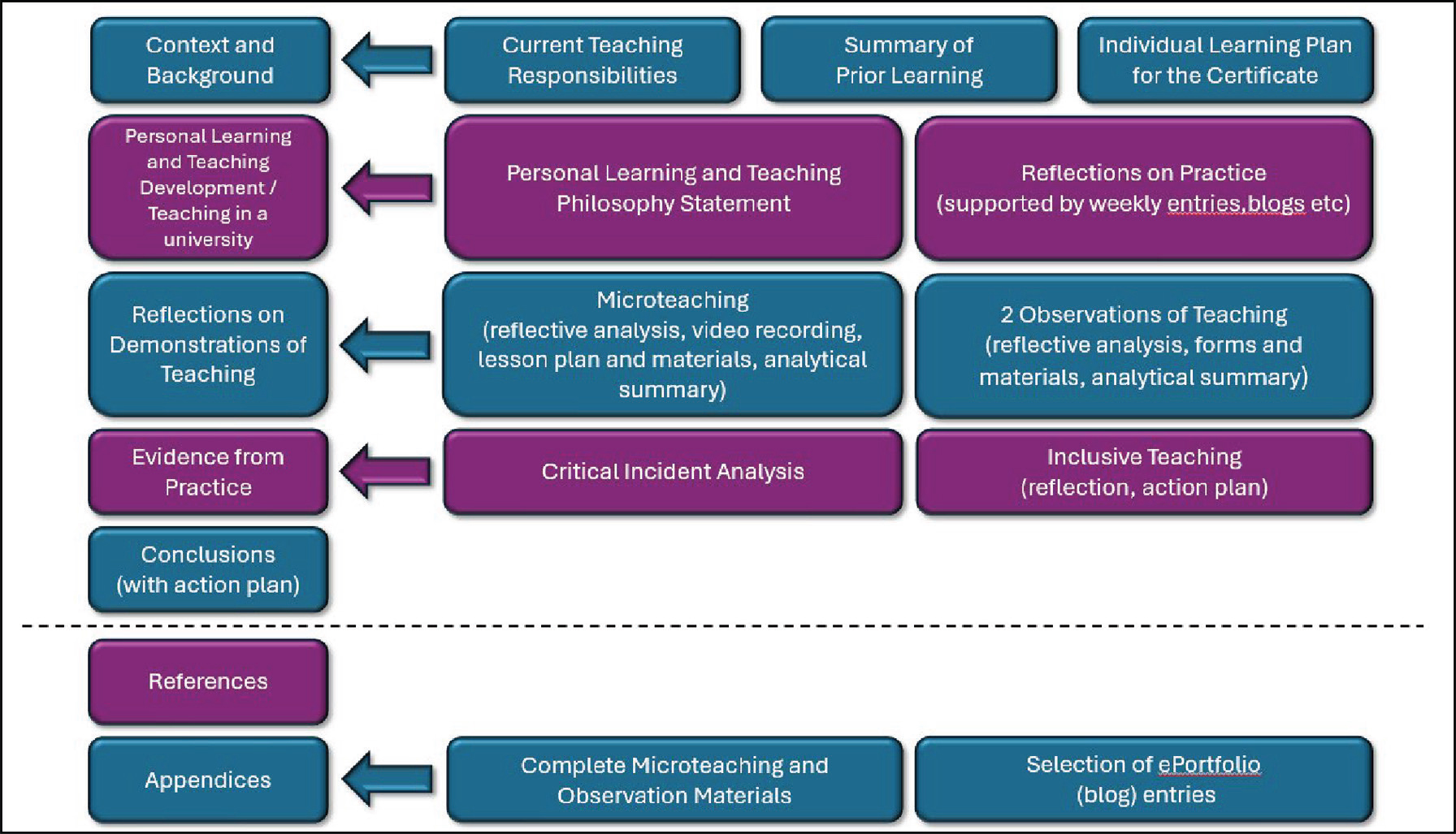
Figure 2:
Teaching Portfolio Contents.
Source: Authors’ own.
FINDINGS
Four meaningful themes were generated from the data, highlighting how teaching portfolios can influence pedagogic practice (Table 1), further illustrated with fragments of the narrative or “power quotes” (Pratt, 2008).
Table 1:
Key Findings
| Theme | Findings | Representative Portfolio Extracts |
|---|---|---|
| Practice Reflections on teaching skills and pedagogical practice. |
| This semester, I also realised that on several occasions minority students were not included in self-selecting groups for group work. Many of my modules involve an element of group work as an active learning activity. Perhaps, this suggests that the relationship and engagement that students have with each other in the classroom reflects wider structural contexts, power and privilege and I am beginning to understand that I can build upon my “sphere of influence” (Tatum, 2021) as a lecturer to promote more inclusive practise in group work. |
| Observation Critical reflection on observation of teaching. |
| The observation feedback has demonstrated to me that I don’t need to have all the answers (Sage on the Stage) and that I don’t need to fill all the space with my voice. Some “white space” can allow students to digest more effectively what is being said. As I prepare for Semester 2 and future academic year, there has been much to learn from this. |
| Theory Knowledge about teaching and student learning |
| As the module progresses, I introduce various elements of entrepreneurial theory and principles through the lens of the Business Model Canvas (Osterwalder and Pigneur, 2010) and Lean start up thinking (Ries, 2011). Through active and experiential learning (Jones and Iredale, 2014) students utilise SimVenture Validate to guide them through ideation, prototyping and portfolio development. |
| Planning Considerations of lesson plans, inclusion, peer observations and action. |
| My longer-term goal is to continue to develop as an educator through deepening my understanding of SoTL with the ultimate goal of enhancing student learning and engagement. I will continue on my life-long and life-wide learning journey and participate in CPD activities in this regard. Moreover, I am hopeful that the supportive environment fostered during the PG cert and collegiality of peers and the relationships built will sustain and further enhance my SoTL (Donnelly, 2007; Shortland, 2004). |
Practice
The practice theme was evidenced in the educator’s reflections on teaching skills and pedagogical practice. As a teaching portfolio, practice was evident in significant areas of the portfolio. Throughout the portfolio, several practices were shared outlining the educator’s pedagogic practice and approaches to teaching. These included: Use of technology to enhance learning, Life Story work, Active learning and Authentic learning, and Inclusive teaching practice. An excerpt from the narrative of reflection on inclusive teaching explores the value of the portfolio in terms of reflective practice:
I have begun to reflect more deeply on the needs of under-represented students in my entrepreneurial education modules. As noted in my critical incident analysis, I have already begun to adopt Universal Design Principles in reviewing entrepreneurial education modules in terms of educational goals, methods, materials, and assessments that will enable all individuals to gain knowledge, skills, and enthusiasm for learning. I have been implementing changes on an incremental basis. For example, last semester I reviewed all course content guided by a UDL checklist (West Virgina, Dept of Education, 2023), THRIVES TU Dublin framework (TU Dublin) and Cast guidelines (CAST, 2023). This included the incorporation of gender neutral and gender inclusive pronouns and language that affirms diversity and avoids alienating students.
The educator further reflects:
This semester, I also realised that on several occasions minority students were not included in self-selecting groups for group work. Many of my modules involve an element of group work as an active learning activity. Perhaps this suggests that the relationship and engagement that students have with each other in the classroom reflects wider structural contexts? power and privilege? and I am beginning to understand that I can build upon my “sphere of influence” (Tatum, 2021) as a lecturer to promote more inclusive practise in group work.
The inclusive teaching excerpt demonstrates how the educator, after having discussed her personal teaching philosophy at the start of the portfolio, presents an exemplar from her inclusive teaching practice, showing how practice has developed based on observations of and reflections on teaching and learning. The excerpt the educator has identified above exhibits how having time to reflect on diversity and inclusion in her own teaching practice has highlighted areas minority students were not included. This demonstrates that through self-reflection, theoretical insight and peer guidance (within the module), the educator’s pedagogic practice is evolving through portfolio development. This theme highlights the cyclical nature of sharing insight on practice through the portfolio.
Observation
The teaching portfolio demonstrated an almost 360-degree observation approach (akin to the 6- point driving check), which included the educator’s critical reflection on being observed by practitioners and peers. In addition, the educator observed peers and shared feedback and insights. The observation theme emerged from the educator’s critical reflections on observation of practice through peer observation, microteaching and pedagogy expert observations. An excerpt from the educator’s reflection following observation of her microteaching is shared below (the Rolf model was used for reflection and this excerpt shares the “what” and “now what” element of this reflection):
What?
The online microteaching session took place toward the end of the postgraduate certificate module. In a small group of six including our tutor, we were guided to teach a short lesson of five-to-seven-minute duration. In advance of the session, we had to create a lesson plan (Appendix X) and circulate to our peer group. I chose to focus on the topic of Business Model Canvas. This forms part of the lecture series in a Enterprise Development module. Students are asked to populate the Business Model Canvas in Week 4 of the Enterprise module. This year, I encouraged students to utilise the Validate Software in populating their Business Model Canvas. We were asked to create an anticipatory reflection in advance of the session. I found it daunting to prepare such a short lesson. As we moved into breakout rooms, I was nervous that the content may be too heavy and complex for such a short period of time. Overall, I just hoped the topic would be well received and that the Bongo technology would work well. Through an online portal we were encouraged to share feedback on the teaching for each of our peers (Appendix X).
Now What?
Having never participated in a microteaching exercise previously, I concur with Donnelly and Fitzmaurice (2011) that learning from this experience has had a direct impact on my teaching practice, course development and collaboration with colleagues (Appendix X). Through this teaching format, I had to source additional material on the Business Model Canvas including short descriptors and YouTube clips, and I have now incorporated these into my in-person teaching of this topic! There were some constructive critical comments in relation to font size, visibility, and a need for more guided notes for students, which I have taken on board. Most importantly, as microteaching served as one of the summation exercises in our peer observation, my self-efficacy (Bandura, 1994) as an educator has been greatly enhanced. The feedback in such a “safe environment” has given me the confidence to test new ideas and pursue collaboration in SoTL with peers in 2023 (watch this space!).
These excerpts highlight the educator’s reflection on peer observation of an entrepreneurial concept and underpins that experience within education theory. Peers were drawn from several disciplines and did not necessarily have an entrepreneurial educator background. Constructive but critical comments from peers throughout the session encouraged the educator to consider enhancing and evolving practice for student delivery. Linking the observation experience back to her own teaching practice, the educator finishes with an action plan and a reflection on how the experience can further enhance her pedagogic practice. Overall, this theme identified the important contribution that observation may play in the development of a teaching portfolio to enhance pedagogic competence.
Theory
The theory theme identified elements in the portfolio which integrate both subject knowledge (entrepreneurship theory) and pedagogical content knowledge. This was evidenced throughout the portfolio in relation to teaching, learning and assessment strategies and led to greater scholarly insight of entrepreneurial education practice. The excerpt below shares insight relating to the educator’s development of a blended enterprise module. It highlights the integration of learning outcomes, teaching and learning activities and module assessment in course design.
The module has been designed through a student-centered approach (Piaget,1964), building upon students’ existing enterprising capabilities (Vygotsky, 1978). Active and experiential learning is a key component of curriculum design, and the smart learning platform SimVenture Validate (SimVenture Validate, n-d) is utilised to provide students with authentic experience of developing a small enterprise and validating their ideas. In a blended learning approach, instructional delivery comprises traditional face-to-face classes supplemented by online activity through engagement with the online business simulation software. Combining online technology with face-to-face teaching practices is considered good practice in enhancing the student learning experience (Choi et al., 2021). I have developed the module with a focus on constructive alignment (Biggs and Tang, 2011) with learning objectives, learning activities and assessment in sync and harmony as detailed below.
The theory theme indicated how through portfolio development the educator critically reflected on her practice, enhancing her understanding of SoTL by integrating content knowledge (entrepreneurship theory) with education theory and insight.
Planning
The planning theme identified several areas in the portfolio that involved detailed planning consideration. This included: lesson plans, peer observation planning, planning for inclusive teaching and learning and action planning. Action planning was a key element within the portfolio conclusion, as exhibited in the following excerpt (see Table 1):
As I write this conclusion, I returned to my first reflective diary (date) where I noted that ‘I am grateful for the opportunity this program will give me to reflect on my teaching philosophy and practice’. Schön, (1983,1987) argued that valuable tacit knowledge can be gained through immersion in observational education practice. It is without a doubt that the development of my teaching portfolio has guided my journey as I developed my personal SoTL …
My longer-term goal is to continue to develop as an educator through deepening my understanding of SoTL, with the ultimate goal of enhancing student learning and engagement. I will continue on my life long and life wide learning journey and participate in CPD activities in this regard. Moreover, I am hopeful that the supportive environment fostered during the PG cert and collegiality of peers and the relationships built will sustain and further enhance my SoTL (Donnelly, 2007; Shortland, 2004).
The findings exhibit how the educator’s experience of developing the teaching portfolio has directly influenced her teaching practice with plans for the short-, medium- and longer-term action building, based upon the knowledge and expertise gained. The findings indicate that through development of the teaching portfolio, the educator critically reflected on teaching practices and guided by insight from peers, experts and the literature put clear plans in place to enhance pedagogic practice and ultimately student learning and engagement.
Through in-depth analysis of the entrepreneurial educator’s teaching portfolio, explored through the lens of the adapted pedagogic competence framework (Olsson et al., 2010, Figure 1), it became evident that the educator’s entrepreneurial education practice had evolved and developed. As exhibited within the various excerpts above, the perspective and voice of the educator was the dominant factor in the teaching portfolio. The findings indicate that through in-depth critical reflection, it is possible to enhance practice using insight and knowledge from observation, practice, theory and planning to guide teaching development.
DISCUSSION
As highlighted in the introduction, teaching portfolios are increasingly being utilised as a useful tool to enhance professional development and pedagogic practice in higher education. This study reinforces the belief that pedagogical competence is broader in scope than merely teaching skills (Olsson et al., 2010) and can be influenced by the development of a teaching portfolio (Larsson et al., 2015). This study analysed an entrepreneurial educator teaching portfolio across four thematic areas of practice, observation, theory and planning (Table 1). Findings suggest that the development of the teaching portfolio influenced the educator’s pedagogic practice. In the context of entrepreneurial education, this study identified that the development of teaching portfolios can help address the call for greater philosophical grounding (Jones, 2019) and reflection on practice (Fayolle, 2018).
In the context of entrepreneurial education, the study highlighted the key elements in the creation of a personalised and contextualised teaching portfolio should include Context and Background, Teaching Philosophy, Pedagogic Practice, Observations, Reflections on Practice, and Action Plans. However, crucial to enhancing pedagogic practice is in-depth engagement with scholarly literature, observation, critical reflection and action planning. The study also demonstrated that the perspective and voice of the educator is a focal point in the development of an evidence-based teaching portfolio. Through a process of critical reflection and professional development, teaching portfolios can help shine the spotlight on the “who” of entrepreneurial education (Hägg and Gabrielsson., 2020). The cyclical reflective nature of a teaching portfolio can influence entrepreneurial pedagogic practice for example, in the introduction of innovative teaching techniques, new technologies, and consideration of inclusion and diversity criteria in teaching approaches. In this study, the development of teaching portfolios allowed the educator the time and space to reflect upon their practice, with the overarching goal to enhance student learning.
CONCLUSION
In his seminal work, Gartner (1988) argued that ‘Who is an entrepreneur?’ was the wrong question for entrepreneurial scholarship. Quoting Yeats (1956) “How can we know the dancer from the dance”? Gartner argued, the entrepreneur is only one part of that process, thus research should focus on what the entrepreneur does – not who he or she is. This altered the traditional discussion concerning entrepreneurship from a focus on the person to an exploration of the behaviour and processes of the entrepreneur. Paradoxically, as entrepreneurial education scholarship has developed, a growing chorus have called for an increased focus on the “who” of entrepreneurial education, to include the educator perspective (Brush et al., 2024; Nikou et al., 2023; Hägg and Gabrielsson., 2020). Given the importance of the educator in the learning process, the exploration of educational theory underpinning pedagogic practice remains underexplored (Jones, 2019; Ramsgaard and Blenker, 2022). This paper proposes that the “Who” or entrepreneurial educator (Hägg and Gabrielsson, 2020) is intrinsically linked to the why, what and how they teach (Bowne, 2017). In exploring teaching portfolios as a professional development tool, this article offers further insight into entrepreneurial educator pedagogic practice.
In answering the study research question (How can reflective teaching portfolios influence pedagogic practice in entrepreneurial education?), this paper identified that a reflective teaching portfolio can enhance pedagogic competency through the integration of practice, observation, theory and planning. As highlighted in this study, reflecting on the pedagogical purpose underpinning the various entrepreneurial teaching and learning practices can deepen the educator’s understanding of the teaching and learning process and enhance student learning outcomes in entrepreneurial education. This study’s contribution extends the pedagogical competence framework (Olsson et al., 2010), integrating education theory with practice in the context of entrepreneurial education.
While the study is limited by highlighting the development of an entrepreneurial education teaching portfolio at one university, the primary focus of this autoethnographic research was naturalistic generalisation and to enlighten educators to the potential benefits of reflective teaching portfolio activity as a tool to support continuous professional development and develop pedagogic competency. The development of entrepreneurial mindsets and engendering entrepreneurial competence have a significant role to play in the future development of citizens and society. Given the critical role of the entrepreneurial educator in this process – how can we know the dancer from the dance? (Yeats, 1956). The development of an evidence-based entrepreneurial educator teaching portfolio to enhance pedagogic competency is just one example of how this might be achieved. Whilst this study has highlighted the influence of reflective teaching portfolio development on the enhancement of pedagogic practice, it has been acknowledged that the process may be resource and time intensive (Harrison et al., 2022). A portfolio is a living document that may be enhanced and developed over time; however, it does require that entrepreneurial educators have the time and support necessary to engage fully in the portfolio process. These insights offer opportunities for further research.