
INTRODUCTION
The use of client service charters for ensuring quality service delivery within the public sector has become essential (Torres, 2005; Thomassen et al., 2014) given that public institutions have a unique mandate to deliver quality services to different stakeholders (Dickinson, 2016; Singh & Slack, 2020; Thomassen et al., 2014). Indeed, public sector institutions play significant roles in the socioeconomic development of many nations through the enactment of policies and ensuring the smooth delivery of government programmes and services to the citizenry (Pareek & Sole, 2020; Siddique et al., 2020). This mandate makes deploying client service charters a significant way to show commitment to quality service delivery in the public sector. A service charter outlines the standards for service delivery, the rights and obligations of all parties, and methods for ensuring that all stakeholders have access to high-quality services. Service charters serve as a psychological contract between public sector institutions and their clients or the citizenry, which compels the institutions to uphold stakeholders’ rights to quality service delivery (Torres, 2006). Besides, service charters help to protect citizens’ rights since most of the provisions in the service charter emanate from regulatory bodies’ requirements, which make some aspects of the services enforceable. However, more research has yet to explore a practical implementation of service charter protocols in the public sector. These protocols are the rules, guidelines, standards, and regulations that serve as a framework for the creation, implementation, management, and eventual retirement of services provided by service providers and ensuring customer rights (Botlhale, 2013). However, working in the public sector of developing economies is very challenging (Chigbu, Chinyamurindi, & Marange, 2024; Fihla & Chinyamurindi, 2018). Undoubtedly, complexities and turbulent environmental conditions have affected the public sector service delivery (Boyne & Meier, 2009; Johansson & Siverbo, 2014; Johnsen, 2023). Furthermore, governments have been under pressure to become effective and efficient due to several factors, including rising citizen expectations, quick technological advancements, and a plethora of other connected issues (Dickenson, 2016; Gromark & Melin, 2013). Consequently, there have been calls for interventions and employees’ commitment to meet public sector work outcomes (Fihla & Chinyamurindi, 2018; Ruzungunde, Chinyamurindi & Marange, 2023).
To this end, institutions organise their capabilities to provide a consistent service experience to the consumer population within a particular business environment (Hooper, Coughlan, & Mullen, 2013). Therefore, service personnel must align and commit their skills with the institutes’ strategic goals to achieve the desired standards and outcomes. This study aims to understand how ‘employability’ factors and organisational ‘work climate’ affect the effective implementation of service charter protocols in the public sector context. Employability is having the capability to gain initial employment, maintain employment, and progress in a chosen occupation or career (Knight & Yorke, 2003). Furthermore, organisational work climate encompasses the collective view of the organisational environment. The structure of the workplace and the leadership reactions that go along with it make up the organisational climate (Chinyamurindi, Mathibe, & Marange, 2023). This study argues that an organisation’s work climate can enhance employees’ progress and effectiveness in service delivery. The notion of effectiveness in this context is achieving quality public service to the stakeholders through managing internal and external organisational environments, as proffered by Garcia-Sanchez, Cuadrado-Ballesteros, and Frias-Aceituno (2013). Indeed, there are concerns among researchers and industry players as to the capabilities of public sector workers in the delivery of innovative services to various public sector stakeholders (Luu et al., 2022; Mizrahi & Krup, 2022). This study contributes to helping fill this gap, exploring and shedding light on the impact of employability skills and work climate on service charters’ effectiveness (SCE) in the public sector.
The service charter’s effectiveness (SCE) is the level of compliance and commitment of service providers to implementing quality services for clients as prescribed in the service charter (Torres, 2005). Limited studies on service charters in developed economies have focused on re-shaping trust in governments (Torres, 2005), strategic alignment of goals and extent of process integration, and some challenging outcomes (Drewry et al., 2005; Thomassen et al., 2014), and on confirmation of a relationship between service guarantees and service charters (McColl, 2013). Meanwhile, Kasera (2014) focused on the public sector agency stakeholder rights in a developing country context. Other African studies confirmed challenges with quality service delivery (Botlhale, 2019; Ohemeng & Ayee, 2016; Ojiako et al., 2022). None of these studies has given research attention to employability factors that affect the effective implementation of service charter protocols amidst peculiar organisations’ work climates. This outcome has created a knowledge gap about the service charter’s practical implementation in the services literature. This study, therefore, argues that insights into ‘employability’ factors can contribute significantly to effective service delivery because having the requisite skills would enable employees to deliver services that meet clients’ expectations. This study relies on the USEM employability model (Knight & Yorke, 2004) because the model provides the opportunity to examine the employees’ characteristics holistically and to evaluate employees’ preparedness to provide the requisite services. The following specific objectives guide this study: 1) to assess how the USEM model’s sub-constructs (Understanding (U) of the subject matter; S-skillfulness, E-efficacy belief, and M-meta-cognition) variously affect SCE; and 2) to examine the moderation effect of ‘efficacy belief’ in the efficacy belief-SCE relationship, in context.
The employability factors (USEM) are for developing university graduates’ competencies and preparing them for the job market (Blackmore et al., 2016; Pool & Sewell, 2007). Studies have yet to focus on determining the outcomes of the impact of the USEM employability elements and work climate on service delivery systems within the public sector. We argue that understanding how the ‘work climate’ and employees’ self-efficacy interact, with explanations through the lens of self-determination theory (SDT) (Deci & Ryan, 1985), helps address issues relating to client service charter deliverables. This direction of study responds to calls for an integrated research approach to understand organisational effectiveness and service delivery through the lens of employability elements based on visible outcomes from the workplace (Bennett & Ananthram, 2021; Cheng et al., 2022; Romgens et al., 2020; Salman et al., 2020).
Significantly, extant organisational and services literature has called for investigations that align workers’ employability, capabilities, and adaptability with service delivery systems, especially for competing demands of stakeholders (Arada et al., 2015; Marzec et al., 2021; Tuominen & Hasu, 2020). Hence, this study responds to these calls for investigation of workers’ capabilities and adaptability to service delivery systems by assessing the nexus of employability, work climate, and SCE, underpinned by SDT. Applying the SDT helps to understand the interactions of the employability elements (i.e., USEM) with the service delivery of protocols and ethical principles stated in service charters. In addition, an inquiry into the ‘work climate’ helps the study understand how the work environment influences the service delivery process in the public sector context. This direction of study, involving different modes and paths, is consistent with arguments by some authors in service literature (e.g., Ohemeng, 2010; Thomassen et al., 2014; Torres, 2005). These authors contend that compliance with the dictates of service charters ought to be a part of a more extensive programme involving different paths for raising the standard of service delivery, but not a stand-alone activity. Hence, a holistic line of inquiry provides insights into employability, work climate, and service charter delivery protocols in the workplace.
Pointedly, this study makes several contributions to the service and organisational literature. 1) this study addresses, in a holistic manner, how ‘employability’ elements and work climate affect a service charter’s effectiveness. In doing so, this study responds to calls from some authors (e.g., Bennett & Ananthram, 2021; Cheng et al., 2022; Romgens et al., 2020; Salman et al., 2020) for an integrated research approach to understanding organisational effectiveness and service delivery through the lens of employability elements. Hence, the study depended on visible outcomes from graduates working in various service delivery units within the public sector in a developing country. 2) For the first time, this study centres on the USEM model to explore how graduate employability competencies influence SCE and has primarily helped to alleviate the concerns among researchers and industry players (e.g., Luu et al., 2022; Mizrahi & Natan, 2022; Ojiako et al., 2022). This was achieved by providing insights into different employability factors among graduate employees and how they influence the implementation of service delivery protocols in the public sector. 3) In applying the USEM model, underpinned by the self-determination theory, our study provides insights into a holistic employability-service charter’s effectiveness model, with organisational ‘work climate’ as a moderating factor, in the client service delivery process. The study presents a novel theoretical perspective for investigating the interactions of employability elements, organisational factors, and service charter delivery protocols in different contexts. In the subsequent sections, we present the theoretical framework and hypotheses; the methodology and discussions of findings follow this. The concluding section discusses the contribution to theory, practice, and policy and ends with the direction for future studies.
THEORETICAL FRAMEWORK AND HYPOTHESES DEVELOPMENT
Self-determination theory (SDT)
The self-determination hypothesis is a metatheory of human motivation and personality development (Deci & Ryan, 1985). The SDT is classified as a metatheory since it comprises different “mini-theories” that work together to explain human motivation and behaviour in detail. The fundamental humanistic principle that humans naturally and consciously use their energies toward self-organisation and advancement is the basis of SDT. In other words, people strive to develop and understand themselves through integrating new experiences, nourishing their needs, desires, and interests, and engaging with others and the outside environment.
The essential psychological needs of humans for autonomy, competence, and relatedness can be undermined, according to SDT, which also holds that people can end up being controlled, fragmented, and alienated (Chen et al., 2015). According to the Basic Psychological Need Theory, the needs for autonomy, competence, and relatedness are fundamental, natural, and universal, meaning that they exist independently of a person’s history or culture (Chen et al., 2015; Deci & Ryan, 1985).
According to the SDT, behaviour results from the interaction of autonomous and regulated motivation, and employees choose their job actions based on their psychological needs and organisational contexts (Ryan & Deci, 2000). Individual characteristics that affect employee motivation can be attributed to SDT (Deci & Ryan, 1985), and diverse values can affect how employee motivation is moulded in response to certain organisational situations (Graves & Sarkis, 2018). Arvanitis and Kalliris (2020) looked at how moral principles could make a person consistent with their actions and behaviours and adhere to moral principles or rules in various situations. The Arvanitis and Kalliris (2020) study highlighted that when a moral principle becomes the main driving force behind behaviour, a person acts by an internal moral system of values, feelings, and motivations. According to Arvanitis and Kalliris (2020), this offered a description of how behaviours emerged through interaction with the environment and relying on excerpts from the SDT.
Alluding to the dictates of the SDT, Huang and Paterson (2017) discovered that certain team members acted in different ways when faced with moral dilemmas, which could affect employee adherence to moral principles in service charters. Zhao et al. (2023) also found that employee activities in certain conditions were not just a team phenomenon but also an example of spontaneous moral behaviour among individual members. This suggested that employees could act differently in the workplace and service delivery based on their skill sets and peculiar experiences when faced with the same situations.
The USEM model of employability
The USEM model (Knight & Yorke, 2002) is part of a sizable body of scholarly work that is based on research and is regarded as the most suitable for defining the employability of graduates (Bennett & Ananthram, 2021; Clarke, 2018; Guilbert et al., 2016). The USEM model encompasses - Understanding (U) of the subject matter, S-skillfulness, E-efficacy belief, and M-meta-cognition, which collectively defines employability, as Knight and York (2004) depict.
The skills, knowledge, and competencies that improve employees’ capacity to find and keep employment, advance professionally, and deal with organisational change and workplace expectations are operationalised as ‘employability’. Additionally, competency as espoused in SDT, explains that employees experience a sense of accomplishment and achievement when they take on challenging tasks. Some organisational theorists and authors (e.g., Pitan, 2016; Romgens et al., 2020) have clearly stated that employability is the presence of the skills required to obtain employment, keep it, and advance. Therefore, it is abundantly evident from the research that “employability” and “employment” do not mean the same thing because employers value graduates’ “can-do” skills more than their “know-how” (Pitan, 2016; Sarin, 2019). Although the ‘root’ of the USEM model is in education (Blackmore et al., 2016; Pool & Sewell, 2007), its application in the public sector can lead to a systemic and client-driven change in client service. The element of competency is important because service delivery requires different skill sets to complement the organisational work climate, to meet the organisation’s mandate. The argument’s premise is that employee skill competency in customer service delivery is critical for transforming the public sector (Agus, 2004; Hagmann et al., 2002; Otoo, 2020). Besides, graduate skills are transferable from the education environment to the workplace (Jackson, 2016), with the right processes and interventions.
Proponents of the USEM model argue that research and industry players ought to have deeper insights into the components of the model (Knight & Yorke, 2004) and to understand how individual characteristics, such as motivation, personality, identity, etc, influence service delivery (Clark & Zukas, 2013). Remarkably, the autonomy element of SDT explains how employees would exhibit a sense of ownership and responsibility for one’s action, and motives them to comply with the dictates of the service charters. Consequently, this study aligns with the argument of researchers (e.g., Blackmore et al., 2016; Pool & Sewell, 2007; Knight & Yorke, 2003) that each element of the USEM model is essential for determining employability and career development.
Employees with the requisite skill sets may exhibit different ways of dealing with clients based on their experience, capabilities, and beliefs about themselves. Therefore, employability could influence how work is done to meet client expectations and service quality standards. This proposition is based on the literature, which attests that HEIs develop employable skills in graduates to make them relevant for industries (Anderson & Lees, 2016; Bennet et al., 2020). Tuononen and Hyytinen’s (2022) study addressed how employability elements contributed to early career progress and revealed individual differences in employability variables amongst graduates and the competency challenges they faced throughout their early careers. This study proposed that These employability elements could impact graduates’ capacity for effective service charter delivery protocols within the public sector.
Service Charter’s Effectiveness (SCE)
To build trust among residents and ensure that clients receive high-quality public services, service charters sought to reform the culture of service delivery through a “bottom-up” strategy (Bankins & Waterhouse, 2018; McColl, 2013). The research of Torres (2005) served as the foundation for the SCE construct. It is operationalised as the extent to which service providers adhere to and are committed to delivering high-quality services to customers as outlined in the service charter of public institutions. The most critical role of the government is to provide its people with high-quality public services and above its regulatory and developmental responsibilities for things like healthcare, education, and other social services (Engdaw, 2020; Pareek & Sole, 2020). Consequently, the efficiency of service delivery is made possible by adopting the organisation’s corporate strategy.
Thomassen et al. (2014) found that critical factors in the establishment and execution of charters included the amount of process integration, trust across organisations, and the strategic alignment of goals throughout the service chain. According to empirical studies, service charters’ philosophy, practices, and performance outcomes in industrialised nations have significant similarities and variations (Clifton et al., 2005; Singh & Slack, 2020). According to research conducted in industrialised economies (Bankins & Waterhouse, 2018; Thomassen et al., 2014; Torres, 2005), these studies on service charters could have done better to address delivery concerns.
Notably, other studies on service charters in the context of developing countries in Africa confirmed challenges with quality service delivery (Botlhale, 2019; Ohemeng, 2010; Ohemeng & Ayee, 2016; Ojiako et al., 2022). These challenges could be linked to employee employability factors and work climate. Employability is the capacity to carry out one’s current job, or generate new work by fully using one’s current set of skills and to enhance organisational outcomes (Hillage & Pollard, 1998). The general trends that lead to organisational changes emphasise values like effectiveness and efficiency, which have been increasingly important in the public sector in recent decades (Vermeeren & Van der Heijden, 2022). In this regard, organisational interventions through service charters could raise the customers’ expectations of efficient service delivery in a congenial work climate. However, employees could be poor at handling the dictates of the service charters when they lack the requisite soft skills. Besides, an uncongenial work environment due to poor leadership may de-motivate employees to give their best in the service delivery process.
According to Hooper et al. (2013), the service environment is the first aspect of the service that the customer perceives. At this stage, consumers are likely to form impressions of the level of service they will receive. Hence, there is a need for further inquiry into competency and skills factors in association with the service charter’s effectiveness.
Association of USEM and services charter’s effectiveness
Luu et al. (2022) succinctly emphasised the value of socially responsible human resource practice competency in service delivery. As indicated earlier, research and industry players need to understand better the model’s constituents and how personality traits like motivation, personality, and identity affect service delivery. Based on the USEM employability, Tuononen and Hyytinen (2022) point out that graduates’ employability characteristics and competency issues may vary throughout their early careers. Hence, this study assumes that employees in the public sector, primarily graduates of higher education institutions (HEI), have been exposed to the necessary employability skills (USEM) that would enable workers to provide adequate services through the protocols of the client service charters.
Understanding (U) of the disciplinary subject matter embodies mastery, focusing on preparing the student to grasp job-specific technical knowledge and move towards career direction and commitments. In this regard, we assume that the employees have had the requisite instructions on various management programmes during their studies in HEIs and, hence, have an adequate understanding of the subject matter. Public service entails actions taken by an official on behalf of the public good and for the benefit of the general populace, ranging from law enforcement to defense, to healthcare and education, and requires engagement with different stakeholders. Understanding the subject will enhance the effective service delivery mandate and influence how clients rate the service (Lages et al., 2018; Zhong, Lomas, & Worth, 2022). For instance, Zhong and colleagues (2022) showed that customers’ behaviour intentions to use an express delivery service were positively impacted by the performance of service providers. Therefore, we present the next hypothesis as follows;
H1:Graduate employees’ understanding of the subject matter has a positive influence on the Service Charter’s Effectiveness.
Besides understanding the subject matter, Skillfulness (S) is a generic and subject-specific skill, sometimes requiring a unique combination of situational knowledge and professional judgment. In a broader context, Skillfulness is the ability to do something that has been learned (Moon, 2004) and ought to be linked to what pertains in the workplace. It includes transferrable soft skills such as communication, collaboration with key stakeholders, and problem-solving capabilities (Pool & Sewell, 2007). These essential elements of Skillfulness are relevant for service delivery because service providers have to build a lasting trust relationship with the client and enhance the commitment to effective service delivery. Hence, this study hypothesises that:
H2: Graduate employees’ skillfulness positively influences Service Charter’s Effectiveness.
While skillfulness requires a unique combination of situational knowledge and professional judgment, efficacy belief (E) relates to personal qualities, including self-theories (Shawcross & Ridgman, 2012).
The self-efficacy hypothesis gave rise to the efficacy belief (Bandura, 1977; 1986). The self-efficacy hypothesis refers to a person’s belief in their capacity to exhibit the behaviours necessary to achieve specific performance goals. Self-efficacy is the conviction that one can control one’s motivations, behaviours, and environment. Therefore, a person’s expectations of self-efficacy determine whether or not they can participate in coping behaviours and how long effort will be maintained in the face of difficulties. People with high self-efficacy are more likely to exert the effort required to succeed than those with low self-efficacy, who are likelier to give up too soon and fail.
Consequently, efficacy beliefs impact how people feel, think, act, and motivate themselves. Those who have confidence in their ability to handle any situation are much more likely to get a job and succeed in their chosen field than those who lack it (Pool & Sewell, 2007). In particular instances, these traits favourably relate to engagement and intent to act (Alsabahi et al., 2021). An employee with an efficacy belief would demonstrate a tremendous intrinsic drive to learn from mistakes, overcome obstacles, and serve as an example to others through his or her achievements (Nirmala, 2021). In this regard, an intrinsic personality attribute will likely improve interpersonal interactions with various clients. However, in cases of weak efficacy belief (Myers, 2010; Seifert & Sutton, 2011), effectiveness may be lessened since employees need more confidence to interact with customers. Consequently, this study postulates that:
H3: Efficacy beliefs of graduate employees influence Service Charter’s Effectiveness.
In addition, metacognition (M) will likely affect employees’ attitudes toward the service delivery process. Metacognition is aligned with levels of information and deep understanding of texts (Soto et al., 2019) and facilitates creativity and critical thinking relevant to real-life situations (Bennett et al., 2020). Metacognition complements efficacy and embraces self-awareness, how to learn and reflect. This type of knowledge enlargement occurs primarily outside of the traditional educational context. Employees with metacognitive skills can forecast how they perform various tasks and track their comprehension and mastery levels (Tempelaar, 2006). According to Hancock and Karakok (2021), metacognitive skills help students monitor and regulate their problem-solving process and solve problems in real-world scenarios. Hence, the study presents the next hypothesis as follows:
H4: Employees’ metacognition positively affects the Service Charter’s Effectiveness.
Moderation role of work climate in efficacy belief - SCE relationship
Much as ‘efficacy belief’ components would influence the SCE; this study contends that ‘work climate’ will solely moderate the efficacy-belief-SCE relationship. This study’s postulation of ‘efficacy belief’ as a significant employability element that needed attention in our study was based on the contention by some authors that ‘efficacy belief’ was employers’ preferred competency in service delivery (e.g., Al-Shehab et al., 2020; de Jong, de Ruyter, & Wetzels, 2006). Besides, Shawcross and Ridgman (2012) confirmed that efficacy belief provided a foundation for ‘understanding’, ‘skills’, and ‘metacognition’ and may, therefore, account for the entire elements of the USEM model in this regard. As efficacy beliefs influence how people think, feel, motivate themselves, and act, such competency could be influenced by the work climate. The literature confirms that repeated past successes can support one’s efficacy conviction (Bhati & Sethy, 2022). This suggests that effective prior experience may enable the person to succeed in related tasks since people need more motivation to take action if they think their actions will result in the desired outcomes (Bhati & Sethy, 2022). Rozman & Strukelj (2021) argue that successful organisations ought to recognise the significance of organisational environment elements that improve work engagement and job performance. Consequently, it is important to understand how employees with a high sense of self and a strong sense of determination will cope with the ‘work climate’ in the service delivery of public sector institutions.
Work climate is defined as shared perceptions of and the meaning attached to the policies, practices, and procedures employees experience and the behaviours they observe getting rewarded and that are supported and expected (Schneider et al., 2013; p. 362). Work climate may be psychological or organisational based. Whereas the psychological climate concerns individual workplace perceptions, the organisational work climate explicitly refers to employees’ views on the work climate (Striebing, 2023). This study is aligned with insights from ‘organisational climate’ since our study focuses on the shared perception of the organisational environment in service delivery protocols and work-based behaviour towards clients.
The relationship between job well-being, organisational climate, and organisational performance has been established (Obeng et al., 2020; Tanskanen & Santti, 2015). Indeed, Tanskanen and Santti (2015) showed how various climate types relate to job well-being—according to a collective evaluation of the employees at a work unit, Tanskanen, and Santti (2015) discovered that employee well-being was significantly lower in units with particularly poor work climates than in units with better work climates. Positive environments, characterised as “relaxed and friendly” and “encouraging and supportive of new ideas,” were more significantly connected with well-being than unfavourable environments. Thus, a worker who experiences a “relaxed and friendly” work environment is more likely to uphold service delivery standards in client service charters and will have deep concerns about customer needs. Undoubtedly, not all employees reacted uniformly to various work climate drivers, as Haryanto et al. (2022) showed that leadership played a role in defining employees’ loyalty towards organisational performance. Furthermore, the work of Obeng et al. (2020) confirmed that organisational commitment played a significant mediating role in the relationship between organisational climate and employee performance. Based on the preceding discussion, we present the next hypothesis as follows:
H5: Organisational work climate moderates the relationship between efficacy belief and the Services Charter’s Effectiveness.
METHODOLOGY
Study respondents
We used a quantitative approach that concentrated on collecting data from graduate employees of the public sector as the inclusion criteria. Specifically, the researchers approached the official 30 ministries that form the Civil Service of the Republic of Ghana to request data collection. However, only fifteen ministries responded affirmatively and provided a welcoming platform for the data collection. The Civil Service of the public sector in Ghana is an institution closest to the elected government, referred to as the secretariat of the executive branch of government. Constituent ministries of the Civil Service are outlined in Chapter 14, Article 190 of the 1992 Constitution of the Republic of Ghana. Service providers from the Civil Service were selected for this investigation due to the relevance of the topic to the citizenry at large. Again, we focused on the service charter’s effectiveness in Ghana for the following reasons. First, Ghana’s public service sector has been ranked high on the continent of Africa. Since then, the occupation has been a search for an efficient, effective, and accountable public sector (Ohemeng et al., 2020). Second, according to Ohemeng (2010), public sector institutions have yet to achieve the desired success in service charter delivery despite the commitment since 2008. We followed the ethical issues, confidentiality, and anonymity within a research context. The population includes all graduate employees in fifteen ministries. Interestingly, the researchers needed access to the total number of the targeted population due to the public bureaucracy involved in getting such information in public sector institutions. Notably, the work of Effective State and Inclusive Development (2007) on the Understanding of politics of change in the public sector of Africa reveals that bureaucracy needs to improve the performance of public sector services on the continent.
Furthering, we employed the convenience sampling method in surveying 402 graduate employees who were ready and willing to respond to the questionnaires. The questionnaires were made available in paper-based to digital format supported by the software installed on tablets and smartphones, applied by the enumerators for the data collection exercise. This approach is more accurate and significantly reduces manual errors. We followed the recommendation of Jenkins and Quintana-Ascencioq (2020), where a minimum sample size for regression is indicated as observations. We administered 522 questionnaires, and 402 were usable, representing 77%. We enhanced the response rate by informing participants of the purpose of the research in advance, having designed the study instrument in simple English, and administering via tablet data. Finally, the participants were ready and willing to respond due to the exciting nature of the topic under investigation.
Survey instrument
We used a survey measurement based on empirical studies to measure employability, organisational work climate, and SCE. To measure employability, 20 items were adapted, based on the USEM model; out of which we used six for understanding the subject matter (U), four items for Skillfulness (S), five items for efficacy beliefs (E), and five items metacognition (M) (Bennett & Ananthram, 2021). Next, we used the 12 items of the Gallup questionnaire on work climate.
SCE was measured based on the instruments from the work of Torres (2006), with five items: improvement of the image of the entity, improvement in service performance, and quality commitment of senior managers. The respondents were presented with 37 items anchored on a five-point Likert scale ranging from 1 (strongly disagree) to 5 (strongly agree). A pre-test survey with (30) graduate employees was carried out before administering the final questionnaire. This minimised the questionnaire’s potential errors (clarity, relevance, reliability, and suitability). The final instrument was revised to suit the Ghanaian context. Next, this study used the common method bias to check the distortion of significant interaction effects in the survey data. Utilising the Harman single factor approach supported by the principal component analysis, all the 60 items simultaneously loaded, resulting in an acceptable total variance of 39% (<50%) (Podsakoff et al., 2003), suggesting that common method bias is not present.
Also, we applied various statistical approaches to analyse the quantitative data. First and foremost, we used the Cronbach alpha analysis to establish the reliabilities of the constructs’ items used in context. Next, we validated the four primary constructs of this study through confirmatory factor analysis. Then, a sensitive analysis (Greenland, 2014; Rothman & Greenland, 1998) was done to screen for the ultimate confounding variables when applying cross-sectional data in quantitative research, as suggested. Finally, we performed the multiple regression analysis supporting moderation analysis to confirm the significant effects of efficacy belief on SCE and moderated by organisational work climate.
DEMOGRAPHICS OF PARTICIPANTS
Subsequently, we present the descriptive results of the demographics of the participants, which showed that most were male (67.25%), aged between 40-50 years (59.43%), while the majority of the participants (77.51%) had more than 10 years working experience in the public sector. Table 1 and Table 2 present the descriptive results of the primary constructs. The results show the average organisational work climate (3.273), understanding of subject matter (3.352), skillfulness (3.535), efficacy belief (3.857), and metacognition (3.998).
Table 1:
Descriptive statistics and loading of Organisational Work Climate
| Items | Items | Loading | AVE | Reliability | CR | |
|---|---|---|---|---|---|---|
| Mean | SD | |||||
| Organisational Work Climate | 3.647 | 1.270 | 0.751 | 0.942 | ||
| I know what my boss expects from me at work | 3.571 | 1.206 | 0.862 | 0.904 | ||
| I have all the tools and materials to do my job optimally | 4.179 | 1.371 | 0.775 | 0.901 | ||
| I can do that which I am best at in my daily job | 3.607 | 1.262 | 0.765 | 0.888 | ||
| I received recognition or praise for delivered work during the last week | 3.143 | 1.167 | 0.739 | 0.899 | ||
| My boss appreciates me as a person | 3.071 | 1.352 | 0.688 | 0.892 | ||
| My development is encouraged | 4.309 | 1.260 | 0.678 | 0.905 | ||
| My opinion does count at work | 3.929 | 0.735 | 0.827 | 0.914 | ||
| The hospital’s mission statement gives me the feeling that my job important | 3.768 | 0.572 | 0.822 | 0.910 | ||
| My colleagues are eager to deliver quality at work | 3.786 | 1.371 | 0.771 | 0.901 | ||
| I have a “best friend” at work | 3.161 | 1.262 | 0.768 | 0.911 | ||
| I talked to someone during the last 6 months regarding my progression at work | 3.443 | 1.167 | 0.709 | 0.899 | ||
| My work provides me with sufficient opportunities to learn and grow | 3.046 | 0.818 | 0.658 | 0.909 | ||
Table 2:
Descriptive statistics and loading of Employability and SCE constructs
| Items | Items | Loading | AVE | Reliability | CR | |
|---|---|---|---|---|---|---|
| Mean | SD | |||||
| Understanding the subject matter | 3.352 | 1.147 | 0.748 | 0.983 | ||
| Identification with future career commitment | 4.394 | 0.942 | 0.846 | 0.914 | ||
| Reconsideration of future career | 3.366 | 0.936 | 0.843 | 0.913 | ||
| Occupational commitment | 3.720 | 1.377 | 0.833 | 0.913 | ||
| Perceived program relevance | 2.520 | 1.391 | 0.671 | 0.914 | ||
| Occupational mobility | 2.447 | 1.130 | 0.654 | 0.825 | ||
| Job-specific technical knowledge | 3.667 | 1.110 | 0.643 | 0.845 | ||
| Efficacy Belief | 3.857 | 1.139 | 0.804 | 0.943 | ||
| Academic self-efficacy | 3.657 | 1.225 | 0.882 | 0.916 | ||
| Emotional intelligence | 4.158 | 0.922 | 0.863 | 0.913 | ||
| Problem-solving and decision-making | 3.697 | 1.144 | 0.774 | 0.914 | ||
| Self-esteem | 4.345 | 0.894 | 0.763 | 0.913 | ||
| Help-seeking behaviour | 3.431 | 1.514 | 0.735 | 0.912 | ||
| Metacognition | 3.998 | 1.277 | 0.835 | 0.954 | ||
| Goal-oriented behaviour | 4.154 | 1.750 | 0.891 | 0.914 | ||
| Career exploration and awareness | 4.236 | 0.813 | 0.868 | 0.913 | ||
| Creativity and critical thinking | 4.043 | 1.214 | 0.857 | 0.916 | ||
| Ethical and responsible behaviour | 3.846 | 1.173 | 0.845 | 0.925 | ||
| Capacity to resolve complex problems with unique solutions | 3.712 | 1.434 | 0.713 | 0.914 | ||
| Service Charter Effectiveness | 3.899 | 1.022 | 0.693 | 0.887 | ||
| Service charters (SC) are implemented to seek an improvement of the image of the entity | 4.357 | 0.893 | 0.747 | 0.913 | ||
| SC is implemented to seek an improvement in service performance | 4.625 | 0.688 | 0.745 | 0.916 | ||
| Quality commitments are set with the support of service senior managers. | 3.429 | 0.974 | 0.676 | 0.913 | ||
| Quality commitments are set with the support of service staff and front-line employees | 3.563 | 0.924 | 0.624 | 0.914 | ||
| The opinion of citizens is obtained through user satisfaction surveys | 3.520 | 1.635 | 0.672 | 0.923 | ||
| Skillfulness | 3.535 | 1.007 | 0.578 | 0.831 | ||
| I interact/communicate with clients in challenging situations | 3.789 | 1.142 | 0.815 | 0.768 | ||
| Technological and digital literacy are my hallmark | 3.487 | 0.859 | 0.813 | 0.781 | ||
| I exhibit ethical and responsible behaviour | 3.209 | 0.900 | 0.805 | 0.768 | ||
| I can judge and manage the emotions of others professionally | 3.655 | 1.128 | 0.583 | 0.823 | ||
SENSITIVE ANALYSIS OF CONFOUNDERS
Proceeding in this study, using cross-sectional data, the sensitive analysis of confounders to screen for potential confounding variables (Rothman & Greenland, 1998) was applied in identifying significant control variables. Thomassen et al. (2012) highlight that the age of employees, educational background, and duration of working experience have direct effects on SCE. This study calculated the crude and ultimate demographic characteristics that are significant for the final regression analysis. The sensitive analysis of the confounders showed significant cruel regression coefficients of organisational work climate on SCE (β = 0.453, t = 4.47, p < 0.05), and employability on SCE (β = 0.442, t = 2.054, p < 0.05). In the first stage, the age of employees, educational background, and duration of working experience regressed on SCE (p = 0.644), was above the threshold p > 0.25 (Greenland, 2014), and was removed from the analysis, while the educational background (p = 0.232), and duration of working (p = 0.059) were retained. In the second stage, the percentage change in the cruel coefficient of SCE (β = 0.57) and coefficient of educational background (β = 0.632) and duration of working experience (p = 0.542) of participants revealed 35.32% and -16.45% respectively, which have met the acceptable threshold of ±>10% (Greenland, 2014). This signifies that educational background and working experience are ultimate confounders. Subsequently, the same procedures were repeated for employability and demographics (age group, educational background, working experience). Repeatedly, the results showed that educational background and work experience were recognised as ultimate confounders with a percentage change in the cruel coefficient of employability (β = 0.477) and educational background (β = 0.386) and working experience (β = 0.335) produced 33.12% and 134% respectively, which met the accepted cut-off point ±>10%. In all, the educational background and working experience of graduate employees were found to be ultimate confounders and were retained in the main regression analysis.
CONFIRMATORY FACTOR ANALYSIS
The Confirmatory Factor Analysis (CFA) was used to assess the convergent and discriminant validity of the studied instruments (Bagozzi et al., 1991). The AVEs in Table 4 were used to check the convergent validity, with a cut-off point of 0.5. Discriminant validity was also tested to determine the latent instruments’ distinction from others. For discriminant validity to be established within the data set, the square of average variance extracted (AVEs) should be greater than the correlations between the instruments in a model (Fornell & Larcker, 1981). This can be seen in Table 3.
Table 3:
Inter-factor correlation matrix
| Constructs | AVE | CR | 1 | 2 | 3 | 4 | 5 | 6 | 7 | 8 | 9 |
|---|---|---|---|---|---|---|---|---|---|---|---|
| USM | 0.748 | 0.983 | 0.865 | .568* | .553** | .439** | .670** | .613** | .441** | .598** | .575** |
| SC | 0.578 | 0.831 | .568* | 0.760 | .405** | .412** | .458** | .683** | .562** | .699** | .671** |
| EB | 0.804 | 0.943 | .553** | .405** | 0.897 | .492** | .558** | .467** | .565** | .426** | .317** |
| MC | 0.835 | 0.954 | .439** | .412** | .492** | 0.914 | .377** | .528** | .544** | .303** | .690** |
| Innovation | 0.790 | 0.907 | .670** | .458** | .558** | .377** | 0.889 | .512** | .596** | .419** | .492** |
| Supportive | 0.748 | 0.925 | .613** | .683** | .467** | .528** | .512** | 0.865 | .656* | .535** | .509** |
| SCE | 0.693 | 0.887 | .441** | .562** | .565** | .544** | .596** | .656* | 0.832 | .684** | .266* |
| WC | 0.751 | 0.942 | .598** | .699** | .426** | .303** | .419** | .535** | .684** | 0.867 | .362** |
| BOU | 0.725 | 0.897 | .575** | .671** | .317** | .690** | .492** | .509** | .266* | .362** | 0.851 |
Table 4:
Hypothesis testing
| Hypothesis | Beta coefficients | Proposed effect | Results |
|---|---|---|---|
| Educational background | 0.522** | ||
| Working experience | 0.688* | ||
| Understanding Subject Matter SCE (H1) | 0.101 | + | Not Supported |
| Skillfulness SCE (H2) | 0.324*** | + | Supported |
| Efficacy belief SCE (H3) | 0.319*** | + | Supported |
| Metacognition SCE (H4) | 0.437*** | + | Supported |
| Organisational work climate*SCE SCE (H5) | 0.336** | + | Supported |
| Coefficient of determination (R2) without moderation | 0.478 | ||
| Coefficient of determination (R2) with moderation | 0.502 |
DATA ANALYSIS
Presented in Table 4 below is a snapshot of the computations of hypotheses tested in this research, depicted in an integrated framework (See: Figure 1). Understanding of the subject matter influenced SCE which did not support H1 (β = 0.101, p = 0.189). Skillfulness, efficacy belief, and meta-cognition, positively and significantly affect SCE (β = 0.324, p = 0.001; β = 0.319, p = 0.001; β = 0.437, p = 0.001), which supported H2, H3, and H4 respectively. H5 was also supported (β = 0.336, p = 0.01), revealing that organisational ‘work climate’ significantly moderates the relationship between efficacy belief and SCE.
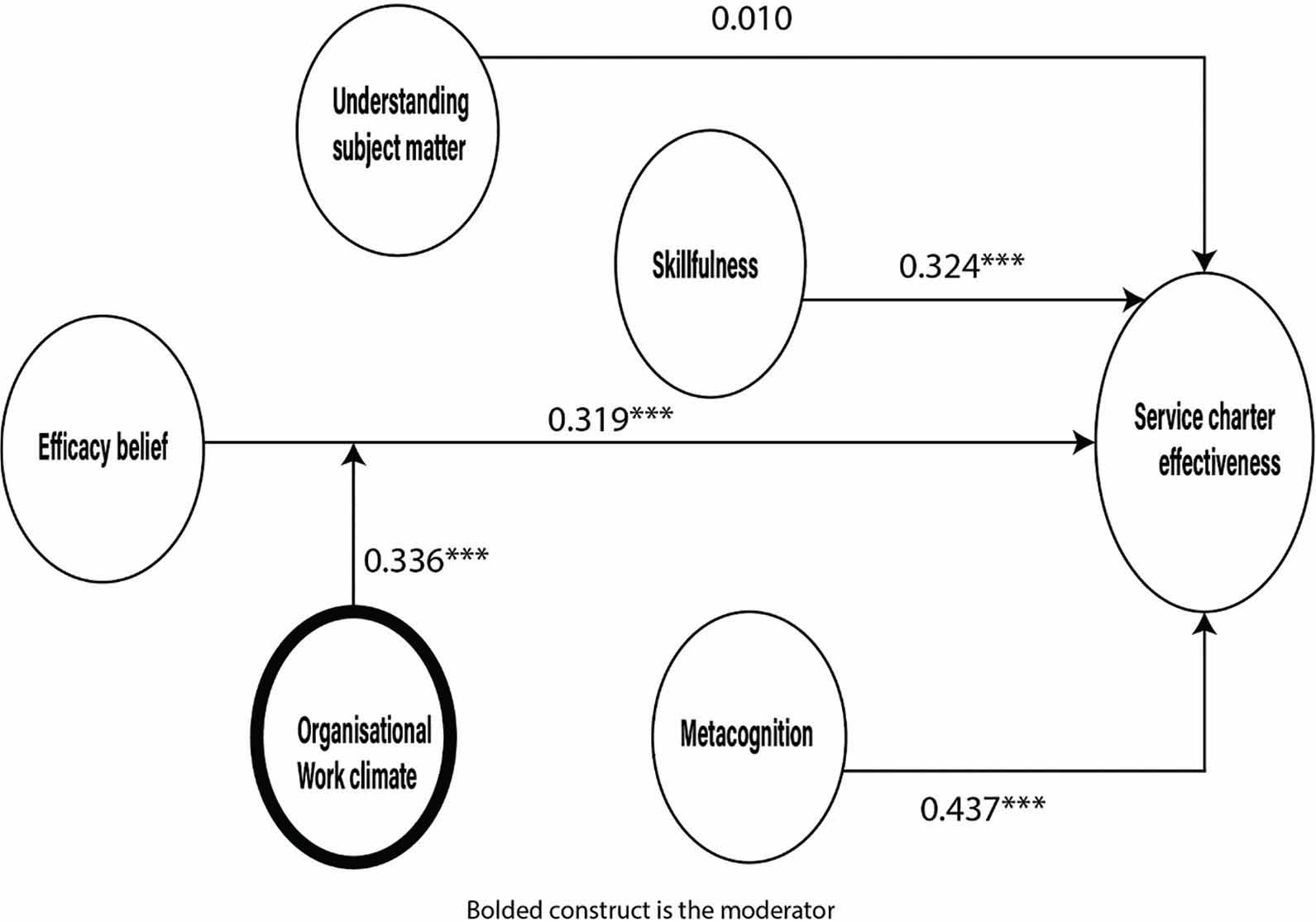
Figure 1:
Tested framework that integrates employability, work climate and SCE.
DISCUSSION
The study aimed to examine the roles of employability and organisational work climate in effectively implementing service charters in the public sector context. The findings from the analysis show that skillfulness, efficacy belief, and metacognition components of the USEM model significantly influence a service charter’s effectiveness. However, understanding the subject matter could have been more significant in explaining the service charter’s effectiveness. The statistical insignificance regarding ‘understanding’ aligns with Romgens and colleagues’ (2020) proposition that specific dimensions of employability are less taken into account in one discipline while receiving much attention in the other. However, whether that is attributable to less attention given to customer service modules in the Management programmes during the graduates’ education at HEI may require further investigation. For instance, Guardia and colleagues’ (2021) research looked for a deeper understanding of the complex relationship between graduates’ acquisition of each skill set and the labour market’s valuation. The Guardia et al. (2021) study examined the mismatch between abilities learned in HEI and employer demands, revealing the necessity to investigate such weaknesses in the sub-Saharan HE system.
This study’s confirmation of the influence of ‘skillfulness’ on service charter’s effectiveness shows that employees possess the requisite skills for communicating and following the protocols to attend to clients’ needs, which is also very relevant for dealing with temperamental clients. Agbenyiga and colleagues (2008) affirmed that Ghanaian workers possess ‘skillfulness’ in social work and are likely to deal with diverse clients’ behaviours in the service delivery process. Further, the significance of ‘efficacy belief’ on SCE meant that public sector employees appreciated that their work output depended on themselves rather than the bosses. This is so because efficacy belief elements are linked to the willingness to act (Romgens et al., 2020) and the ability to take the necessary actions. Indeed, the SDT highlights that individual factors impact employee motivation (Deci & Ryan, 1985), especially employees who believe they can control their motivations, behaviours, and social situations. In a Ghanaian context, Shawcross and Ridgman (2012) confirmed that efficacy belief provided a foundation for understanding, skill, and metacognition. This revelation makes efficacy belief a bedrock for understanding employee capability and service delivery; hence, exploring how organisational ‘work climate’ moderates the efficacy belief-SCE relationship in context is necessary. A positive significant impact of metacognition on SCE implies that Ghanaian employees may exhibit critical thinking and analyse issues through sober reflections before attending to customer needs. Meanwhile, Bennet and colleagues (2020) argue that when individuals are exposed to metacognition processes, they exhibit creativity and critical thinking relevant to real-life situations. Such employees are likely to remain patient and not act quickly on impulse. This virtue is relevant for dealing with emotional and ethnocentric Ghanaian consumers, as Mensah et al. (2011) observed. This virtue is explained from the SDT’s “autonomy” perspective, which illustrates how a person may be free to choose whether or not to support their behaviour.
These findings, thus, reveal the capacity of Ghanaian graduate service providers to meet measurable quality standards proscribed in the service charters and would be ready to take that mandate as their responsibility. Meanwhile, Hellriegel and Slocum (2011) affirmed that employee capability influences behaviour toward organisational effectiveness. Interestingly, in a Ghanaian context, Otoo (2020) confirms the relevance of employee competency in organisational effectiveness and may account for the findings in this regard. Consequently, the association of employee employability with SCE emphasises the need for management to undertake opinion surveys among employees and to monitor employees’ capacity. This will likely help management deploy the relevant initiatives to improve and sustain quality standards as prescribed in the service charters.
This study’s finding of a moderation effect of organisational ‘work climate’ on the relationship between employees’ efficacy belief and SCE shows that managers could provide the relevant work environment for employees in their service delivery efforts. The SDT confirms that not all workers act equally in a workplace situation (Gagne et al.,2022; Huang & Paterson, 2017). As such, it is relevant for senior managers to understand and deal with employees’ peculiar challenges to enable them to exude appropriate behaviours towards various stakeholders. Organisational ‘work climate’ could shift employees’ mindsets about work and enable them to achieve the organisational goals. This finding meant that graduate employees’ efforts in upholding the prescriptions of service charters could be enhanced through managerial support systems since employees would be encouraged to deploy their skill sets for effective service delivery. Managerial support systems, such as transaction processing systems (Takahara et al., 2005), record and analyse real-time employee interaction with customers and identify shortfalls for further improvement.
CONCLUSION
In all, this study makes novel contributions to the employability and service literature by adducing evidence that employability elements and organisational work climate play significant roles in the service charter’s effectiveness within the public sector of a developing country. This study has achieved its objective by demonstrating a positive and significant relationship between employability elements (i.e., skillfulness, efficacy belief, metacognition) and SCE. Additionally, the study revealed a moderation effect of organisational work climate on the efficacy of the belief-service charter’s effectiveness relationship.
Hence, this study significantly contributes to the employability and services literature in several ways. First, the significant effects of the ‘skillfulness’, ‘efficacy belief’, and ‘metacognition’ components of the USEM model on the services charter’s effectiveness support the proposition by Shawcross and Ridgman (2012) that skill development frameworks are multi-dimensional constructs. As such, the key components should be considered when assessing employee capabilities for effective service delivery. Meanwhile, the finding, which shows that ‘understanding’ was insignificant, establishes a direction for future inquiry in similar contexts. Hence, the study extends the application of the USEM model beyond its use in educational theory by confirming its significance for understanding employee competency in workplace practice within the public sector context of a developing country. Again, the study empirically confirms the conceptual scholarly work of Romgens et al. (2020) and responds to Bennett and Ananthram’s (2022) call for integrating competency-based research in workplace outcomes. The study also validates Bennet and Ananthram’s (2021) USEM employability instrument in the public sector, thus assuring its reliability and application in other organisational contexts. Furthermore, the finding of significant moderation effects that organisational ‘work climate’ opens avenues for similar studies to focus on other behavioural change theories, likely to influence service delivery in other contexts.
Hence, in applying the USEM model, underpinned by the self-determination theory, our study develops a holistic employability-service charter’s effectiveness model, with organisational ‘work climate’ as a moderating factor in the client service delivery process, in context. In this way, the study provides a novel baseline theoretical perspective for researchers to investigate the effect of employability on service charter delivery protocols in context.
The study’s findings also have implications for practice. The findings affirm that Civil Service graduate employees possess some capabilities that could be translated into competencies in delivering quality standards proscribed in service charters. Public sector managers should regularly engage with HEIs to inform adaptation of course contents and pedagogies when required. Managers should also be proactive by integrating aspects of the service charters in the selection and recruitment procedures to test new graduate employees’ preparedness for the service delivery task ahead. Furthermore, public institution managers should review their management style and commit to providing a congenial work environment to encourage employees to deal with clients’ needs proactively. Much as ethical service delivery protocols may be necessary for ensuring effectiveness, managers of public institutions ought to be mindful that over-emphasis on procedures and regulations could be counterproductive since that could stifle timeous responses to client needs. Finally, supportive institutional policies that assure management trust and create an environment of open relationships and teamwork will be required to meet clients’ expectations. Thus, our study findings clarify how employability within a congenial working climate could influence quality service delivery in context.
Our study has its limitations that can trigger future research. First, a survey-based approach could have concerns with endogeneity and common method bias. Hence, we suggest that future studies use a longitudinal data set by testing the research hypotheses in other organisational and geographical contexts. This study’s context focused on the Civil Service but could be extended to other public sector institutions, such as state-owned enterprises and government-subvented agencies. Finally, we propose that future studies use multi-group moderation rather than one-way moderation and introduce some mediators in similar study contexts.