

INTRODUCTION
Social inequalities have challenged global health, the elderly population increase, the complexity of health problems, pandemics, and shortages of healthcare professionals (Axelsson et al., 2019; Pype et al., 2016). As a result, in the last decade, global health systems have been encouraged to change their healthcare models for more patient-centered and teamwork-based care (Khalili et al., 2014; Thistlethwaite et al., 2019; Topor et al., 2018). However, in order to improve the healthcare system, the health program’s curriculum must be changed. Medical schools worldwide have been required to design courses with strategies to integrate patient-centered care and teamwork (Alzamil & Meo, 2020; Milutinović et al., 2018; Visser et al., 2018).
To address global health challenges and improve the healthcare system (Guraya & Bar, 2018; Reeves et al., 2016) interprofessional education (IPE) has been intensified to train healthcare professionals in collaborative care skills (World Health Organization [WHO], 2010). Interprofessional education occurs when two or more professions learn about others, with others, and with each other for effective collaboration and improved outcomes in health (WHO, 2010). In addition, collaborative practice happens when health professionals from different areas and with different experiences work together with patients, families, and caregivers to provide high-quality services (WHO, 2010). Studies highlight the importance of IPE opportunities during health care programs to develop better communication skills in a real-life interprofessional team (Nelson et al., 2017). Health care professionals who had IPE opportunities in their courses are more likely to become collaborators at work (Lestari et al., 2016); they also have a better understanding of the roles and the importance of other professionals (Guraya & Bar, 2018; Mukhtar et al., 2018; Sollami et al., 2018; Williams et al., 2015). Gender, age, and different levels of exposure to IPE affect students’ attitudes about interprofessional learning (Milutinović et al., 2018); no studies were found focusing only on students in the last years of the program, that is, while doing their internship.
The concept of interprofessional readiness (Parsell & Bligh, 1999) suggests the student’s willingness to participate in the IPE (Visser et al., 2018). Student attitudes and expectations towards shared learning have been considered the most important predictors of successful implementation of IPE (Milutinović et al., 2018; Hojat et al., 2015; Sciascia et al., 2021). Several instruments to assess IPE readiness have been described; most of them lack psychometric methods, and many were used only once (Hojat et al., 2015; Edelbring et al., 2018). The Readiness Interprofessional Learning Scale (RIPLS), the Interdisciplinary Education Perception Scale (IEPS) (Sciascia et al., 2021; Lie et al., 2013; Peduzzi et al., 2015), and the Jefferson Scale of Attitudes Toward Interprofessional Collaboration (JeffATIC) (Hojat et al., 2015; Ward et al., 2008) are IPE scales with tested measurement support and are the most extensively used to detect differences in student’s attitudes and curriculum impact (Hojat et al.,2015). Jefferson Scale of Attitudes Toward Physician-Nurse Collaboration and Scale of Attitudes Toward Physician-Pharmacist Collaboration (Hojat et al., 2015; Ward et al., 2008) are more specific to the target population of medical, nursing, and pharmacy but have not been adapted to be used with Brazilian students. RIPLS was the first tool to assess interprofessional learning and attitudes towards collaboration among health care professionals, and has been validated for different languages and cultures, including Brazil (Milutinović et al., 2018; Visser et al., 2018; Edelbring et al., 2018; Peduzzi et al., 2015; Cervantes-Sudio et al., 2021).
Based on the relevance of IPE for training health care professionals in accordance with health demands, this study seeks to contribute scientific evidence for the training of medical students in line with global health and national guidelines for interprofessional training.
Background
IPE dates back to the 1960s, with the first interprofessional teaching movements in Europe, North America, and Australia, each driven by different motivations. In 1973, the WHO convened a committee to review medical education and suggested that IPE could encourage holistic assistance and improve health team satisfaction and public appreciation (Barr, 2015; WHO, 1974). As a result, several global actions were developed in response to WHO guidelines, such as the foundation of the Center for the Advancement of Interprofessional Education (CAIPE) in 1987 and the recognition of IPE by the World Federation of Medical Education in 1988 (Barr, 2015).
The many benefits of using IPE in medical program initiatives around the world were confirmed in a meta-analysis which identified positive results for the development of cognitive knowledge, skills, and attitudes by students, especially in practical activities when offered by experts and with adequate resources (Guraya & Bar, 2018). In the Brazilian background, the results of the IPE initiatives have been published since 2011. Studies have shown that IPE learning occurs, especially in practical fields, when students live with students from different health care courses and professional fields. The experience enables them to recognize and reflect on their roles in the team, and enables perception of professional interdependence for comprehensive and patient-centered care. IPE also offers an opportunity to minimize prejudice and differences between professions (Camara et al., 2015; Toassi & Lewgoy, 2016).
Brazilian research suggested that being in a medical program (Oliveira et al., 2018; Prado et al., 2018) influences student readiness for interprofessional learning. Beginner students were highly committed to learning with IPE (Rocha et al., 2017; Prado et al., 2018) because they believed in sharing knowledge about the Brazilian health system (Rocha et al., 2017). Two studies have found that senior medical students may exhibit less readiness for IPE compared to their junior counterparts (Prado et al., 2018; Tompsen, 2018). One study specifically compared attitudes toward pharmacist–physician collaboration among students. A parallel significant difference was observed in the mean scores between first year (52.3) and final-year (49.5) medical students (p=0.007) (Prado et al., 2018). Another study evaluated IPE readiness among students from ten different healthcare programs, including medicine. Although the findings were not disaggregated by course, the study identified that senior students demonstrated lower readiness to collaborate (p=0.0052). The authors noted that the senior students were part of an older curriculum lacking opportunities for interprofessional learning, whereas the other students were enrolled in a new curriculum featuring integrative courses shared among different programs (Nuto et al., 2017).
On that note, it is important to inform the readers that by the time of this study, few students had completed their medical programs under the new medical curriculum implemented by the Government of Brazil in 2014, with a high concentration of practical activities (80%). So far, no studies have been found to assess Brazilian senior medical students’ readiness for IPE, especially 1) under the new curriculum, which may facilitate IPE (Brazil Ministry of Education, 2014) and 2) during their internship with numerous opportunities to work collaboratively with other professionals. Finally, the present study aims to contribute to this lack of literature data.
The medical training model in Brazil
Brazilian medical courses last six years (12 semesters), with a four-year introductory course and two years for internship. During the introductory courses, instructors are encouraged to use active learning with practical activities with community partners. For the internship, students are engaged in public family medicine centers, urgent and emergency units, and hospitals. The Brazilian guidelines for medical school curricula propose: 1) student training must be aligned with the health care system; 2) training should encourage interprofessional learning to promote health care and teamwork ((Brazil Ministry of Education, 2014; Silva et al., 2015) and 3) 30% of the internship should happen in primary care settings and emergency services (Brazil Ministry of Education, 2014).
Brazilian universities have already advanced towards the implementation of the IPE in the first years of the course for the development of skills for collaborative practice (Santos et al., 2018; Rocha et al., 2017; Silva, 2011; Souto et al., 2014; Tompsen et al., 2018; Souza et al., 2021). There are still barriers in health services to inclusion of medical students in daily routines, and well-prepared preceptors for collaborative practice. Preceptors in primary care settings still have a strong medical professional identity based on competition rather than cooperative and collaborative relationships (Barbosa et al., 2021). A lack of scientific data on medical internships and collaborative skills focused on EIP suggests a gap that needs to be addressed. This study investigates the readiness for shared learning, based on EIP, and its associated variables among Brazilian medical students enrolled in the internships.
METHOD
Study Design
Cross-sectional quantitative study (Hulley et al., 2015) to measure medical students’ readiness for shared learning.
Setting and Participants
The participants were Brazilian medical students enrolled in internships from the 9th and 12th semesters, invited from all medical schools in a Brazilian state, four public and two private universities. The inclusion criterion was students regularly enrolled in the course and semester. Of the 751 students who regularly attended internships, 642 agreed to participate in the study.
Instruments and Variables
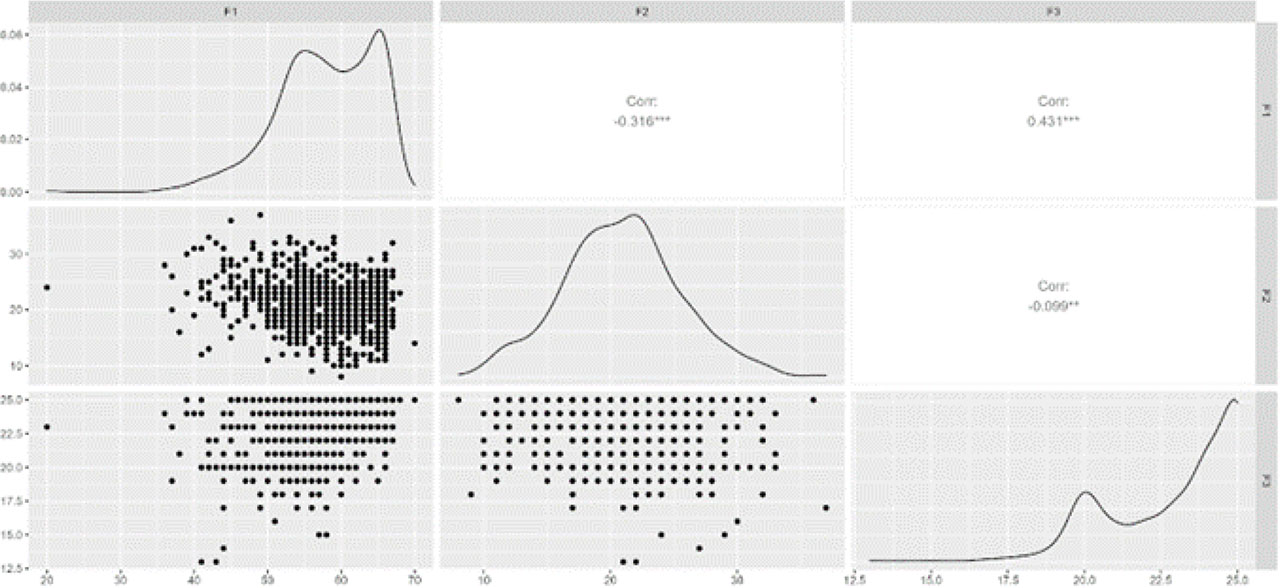
The Brazilian version of the Interprofessional Readiness Learning Scale (RIPLS) (Peduzzi et al., 2015) was used in this study, which is composed of 27 items grouped into three factors: 1) teamwork and collaboration, 2) patient-centered care, and 3) professional identity. In the Brazilian RIPLS, the three factors were correlated with each other, with a factor-positive, direct, and proportional association between F1 and F3; F2 had an association negative and inverse with the other factors (Peduzzi et al., 2015).
The students also answered a sociodemographic questionnaire including age, gender, university and semester enrolled, current clinical practice, previous bachelor’s degree and previous teamwork experience. The data were used to analyze variables associated with readiness for collaborative work.
Data Collection
Data collection took place between October 2019 and February 2020 by trained researchers and research assistants, to avoid power relation bias. Two independent research assistants typed all the answers into an Excel spreadsheet to ensure the reliability of the data. The missing data were addressed through mean imputation technique to ensure a complete dataset for analysis.
Statistical Analysis
The sociodemographic data and RIPLS responses were analyzed using descriptive statistical methods to summarize and present key characteristics of the sample population. This approach included calculating frequencies, percentages, means, and standard deviations to provide an overview of participant demographics and their responses to RIPLS items.
The Additive Models for Location Scale and Shape class – GAMLSS – was used (Stasinopoulos & Rigby, 2007). The GAMLSS class is suitable for modelling the response variable when it does not follow an exponential family distribution and in cases where the returnee exhibits heterogeneity, that is, when the scale or shape of the distribution of the response variable changes with the explanatory variables (Florencio, 2010). The RIPLS factors are continuous variables, with intervals respectively of [0.70], [0.40] and [0.25]. The independent variables were gender, prior college training, previous bachelor’s degree, public or private university, medical program semester, previous teamwork experience, and current clinical practice. To assess the adequacy of the fitted models, a diagnostic analysis was made for each RIPLS’s factor: residuals versus adjusted values, residuals versus order of observations, estimation of kernel density of residues, and a normal QQ of the waste (graphic 1).
Graphic 1.
Diagnostic analysis for F1, F2, F3 RIPLSs factors.
Data for factors F1 and F3 did not show normal distribution, with two peaks (graphic 2); an unexpected pattern was observed for the corresponding value, according to the distribution for each factor. On factor F1, 117 respondents showed the same pattern of response: “I totally disagree” in question 12 and “I totally agree” in the 1 to 9, 10 and 11, and 13 to 16 questions; the participants were “transplanted” to the value 0. Analogous reasoning was performed for factor F3; 33 answers with results equal to 20 were observed, and the respondents marked answer 4 (Agree) on all five questions. For statistical data interpretation of F1 and F3, it considered the distributions of the “transplanted” data to 0; one of the fitted zero distributions for the factor F3 was also considered the truncation condition.
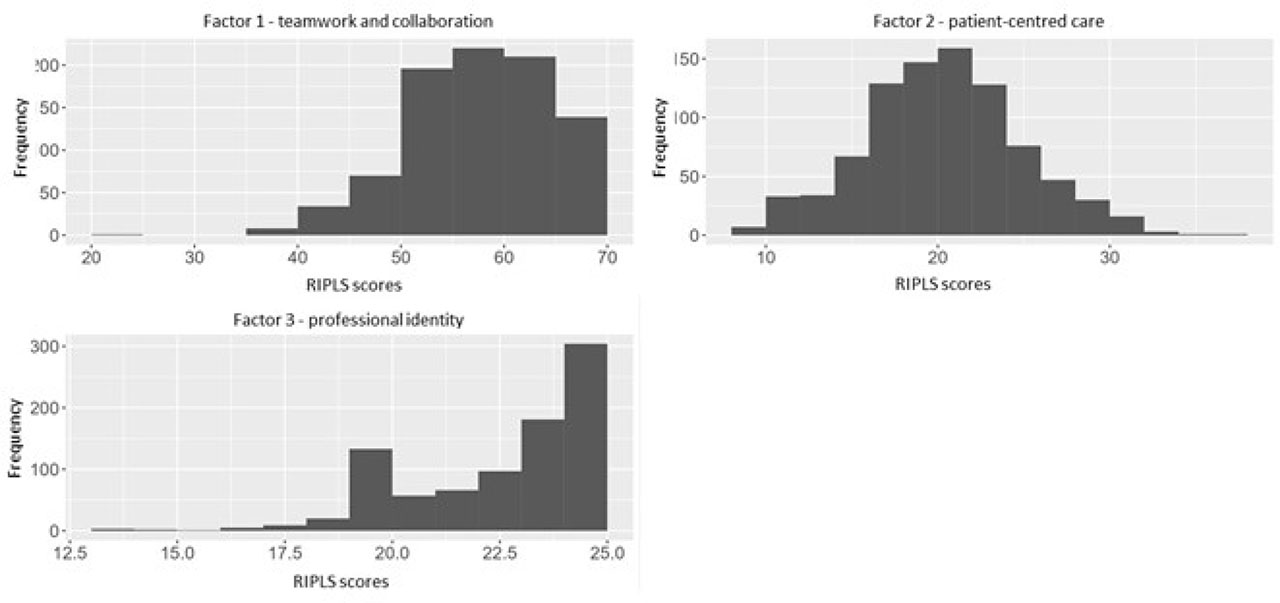
Graphic 2:
F1, F2, F3 RIPLS’s factors distribution.
RESULTS
Out of 751 medical students from the five medical schools, 642 agreed to participate, representing an 85.48% response rate. Sociodemographic information is presented in Table 1.
Table 1:
Brazilian medical students’ personal information.
| Variables | n. (%) | |
|---|---|---|
| Age | Minimum | 21 |
| Maximum | 52 | |
| Gender | Female | 355 (55,2%) |
| Male | 287 (44,7%) | |
| Previous college education | Yes | 72 (11.2%) |
| No | 569 (88.6%) | |
| Did not respond | 01 (0.2%) | |
| Previous bachelor’s degree | Yes. completed | 45 (7%) |
| Yes. not completed | 70 (10,9%) | |
| No | 412 (64,2%) | |
| Did not respond | 115 (17,9%) | |
| Medical program semester | Ninth | 136 (21,2%) |
| Tenth | 177 (27,6%) | |
| Eleventh | 143 (22,2%) | |
| Twelfth | 186 (29,0%) | |
| Prior teamwork experience during the course | Yes | 433 (67,4%) |
| No | 206 (32.2%) | |
| Did not respond | 3 (0.4%) | |
Student availability for IPE
Scores on the availability of medical students for IPE were positive in each of the factors (Table 2). They are willing to work and collaborate in a team (F1) despite not showing interest in activities in small groups with students from other health professions (mean 3.83 - item 14). Students value their professional identity (F2) as important as other healthcare professionals and show concern in promoting patient-centered care (F3) (Table 2).
Table 2:
Mean scores of students by RIPLS factors and RIPLS items.
| RIPLS | N | mean | SD | min | max |
|---|---|---|---|---|---|
| Factor | |||||
| F1 Teamwork | 642 | 4.11 | 1.02 | 1.00 | 5.00 |
| F2 Professional identity | 642 | 2.50 | 0.12 | 1.00 | 5.00 |
| F3 Patient-centered care | 642 | 4.58 | 0.06 | 1.00 | 5.00 |
| Items | |||||
| 1- Learning with other students will help me become a more effective participant of a health care team | 641 | 4.47 | 0.64 | 1.00 | 5.00 |
| 2- Patients ultimately benefit if health care professionals work together to solve patients’ problems | 642 | 4.54 | 0.63 | 1.00 | 5.00 |
| 3- Shared learning with other health care professionals will increase my ability to understand clinical problems | 641 | 4.35 | 0.77 | 1.00 | 5.00 |
| 4- Learning with health care students from other disciplines before qualification would improve relationships after qualification | 637 | 4.38 | 0.77 | 1.00 | 5.00 |
| 5- Communication skills should be learned together with health care professionals | 639 | 3.92 | 1.01 | 1.00 | 5.00 |
| 6- Shared learning will help me to think positively about other health care students and professionals | 640 | 4.18 | 0.81 | 1.00 | 5.00 |
| 7- For small group learning to work, students need to trust and respect each other | 640 | 4.59 | 0.58 | 2.00 | 5.00 |
| 8- Teamwork skills are essential for all students to learn | 640 | 4.53 | 0.65 | 1.00 | 5.00 |
| 9- Shared learning will help me to understand my own limitations | 638 | 4.20 | 0.83 | 1.00 | 5.00 |
| 10- I don’t want to waste my time learning with other health care students | 639 | 1.62 | 0.83 | 1.00 | 5.00 |
| 11- It is not beneficial for undergraduate health care students to learn together | 642 | 1.74 | 0.88 | 1.00 | 5.00 |
| 12- Problem-solving skills for clinicians should only be learned from students of my course | 639 | 1.93 | 1.01 | 1.00 | 5.00 |
| 13- Shared learning with other health care students will help me to communicate better with patients and other professionals | 639 | 4.15 | 0.87 | 1.00 | 5.00 |
| 14- I would welcome the opportunity to work on small-group projects with other health care students | 639 | 3.83 | 0.96 | 1.00 | 5.00 |
| 15- Shared learning helps to clarify the nature of patient problems | 641 | 4.11 | 0.79 | 1.00 | 5.00 |
| 16- Shared learning before qualification would help health care professionals become better team workers | 640 | 4.37 | 0.67 | 1.00 | 5.00 |
| 17- The role of other health professionals is mainly to provide support for doctors | 642 | 1.46 | 1.03 | 1.00 | 5.00 |
| 19- I have to acquire much more knowledge and skills than other health care students | 638 | 3.13 | 1.22 | 1.00 | 5.00 |
| 21- I would feel uncomfortable if another health care student knew more about a topic than I did | 642 | 2.06 | 1.03 | 1.00 | 5.00 |
| 22- Will I be able to use my judgment in my professional role | 637 | 3.45 | 0.95 | 1.00 | 5.00 |
| 23- Reaching a diagnosis will be the main the function of my professional role | 642 | 2.94 | 1.12 | 1.00 | 5.00 |
| 24- My main responsibility as a professional will be to treat my patient | 640 | 3.63 | 1.04 | 1.00 | 5.00 |
| 25- I like to understand the patient’s side of the problem | 640 | 4.33 | 0.62 | 1.00 | 5.00 |
| 26- Establishing a relationship of trust with my patients is important to me | 640 | 4.72 | 0.46 | 3.00 | 5.00 |
| 27- I try to communicate with compassion with my patients | 640 | 4.56 | 0.57 | 2.00 | 5.00 |
| 28- Thinking about the patient as a person is important in getting treatment right | 642 | 4.65 | 0.57 | 1.00 | 5.00 |
| 29- In my profession, one needs skills in interacting and cooperating with patients | 642 | 4.67 | 0.59 | 1.00 | 5.00 |
Table 3 shows the mean scores for each RIPLS factor and independent variables. Factor 1- Teamwork was significantly related to gender, the medical program semester, previous teamwork experience, and current clinical practice at the time of data collection. Factor 2-professional identity was significantly related to gender, previous bachelor’s degree, type of university (public or private), and medical program semester. Finally, factor 3 - patient-centred care was related to gender, previous bachelor’s degree, type of university (public or private), medical program semester, and current clinical practice.
Table 3:
Mean scores of students by RIPLS factors and independent variables.
| RIPLS factor | Variables | N | Mean | SD | p-value | |
|---|---|---|---|---|---|---|
| F1 Teamwork | Male | 286 | 56.50 | 6.71 | <0.001 | |
| Female | 354 | 58.18 | 6.44 | |||
| F2 Professional identity | Male | 286 | 21.61 | 4.68 | <0.001 | |
| Female | 354 | 19.97 | 4.46 | |||
| F3 Patient-centered care | Male | 286 | 22.73 | 2.24 | <0.001 | |
| Female | 354 | 23.04 | 2.03 | |||
| F1 Teamwork | Prior college training | Yes | 72 | 57.06 | 6.40 | 0.2961 |
| No | 568 | 57.46 | 6.66 | |||
| F2 Professional identity | Yes | 72 | 20.21 | 4.57 | 0.484 | |
| No | 568 | 20.77 | 4.63 | |||
| F3 Patient-centered care | Yes | 72 | 22.65 | 2.10 | 0.0735 | |
| No | 568 | 22.93 | 2.13 | |||
| F1 Teamwork | Previous bachelor’s degree | Yes | 522 | 57.41 | 6.42 | 0.592 |
| No | 118 | 57.43 | 7.49 | |||
| F2 Professional identity | Yes | 522 | 20.52 | 4.64 | 0.0453 | |
| No | 118 | 21.53 | 4.50 | |||
| F3 Patient-centered care | Yes | 522 | 22.95 | 2.12 | 0.0411 | |
| No | 118 | 22.64 | 2.18 | |||
| F1 Teamwork | Public university | 1 | 124 | 56.29 | 8.08 | 0.5043 |
| 2 | 58 | 57.67 | 6.56 | |||
| 3 | 87 | 57.47 | 6.41 | |||
| 4 | 91 | 57.20 | 6.26 | |||
| Private university | 5 | 88 | 58.14 | 5.75 | ||
| 6 | 193 | 57.81 | 6.20 | |||
| F2 Professional identity | Public university | 1 | 124 | 19.80 | 5.11 | <0.001 |
| 2 | 58 | 19.10 | 4.22 | |||
| 3 | 87 | 19.24 | 4.10 | |||
| 4 | 91 | 21.87 | 4.04 | |||
| Private university | 5 | 88 | 21.02 | 4.45 | ||
| 6 | 193 | 21.74 | 4.59 | |||
| F3 Patient-centered care | Public university | 1 | 124 | 22.44 | 2.19 | <0.001 |
| 2 | 58 | 22.91 | 2.30 | |||
| 3 | 87 | 22.99 | 2.14 | |||
| 4 | 91 | 22.51 | 2.14 | |||
| Private university | 5 | 88 | 22.74 | 2.38 | ||
| 6 | 193 | 23.40 | 1.79 | |||
| F1 Teamwork | Medical program semester | 9 | 136 | 58.65 | 5.94 | <0.001 |
| 10 | 176 | 57.03 | 6.38 | |||
| 11 | 143 | 57.03 | 6.32 | |||
| 12 | 186 | 57.17 | 7.43 | |||
| F2 Professional identity | 9 | 136 | 19.71 | 4.77 | 0.009 | |
| 10 | 176 | 21.16 | 4.51 | |||
| 11 | 143 | 21.44 | 4.63 | |||
| 12 | 186 | 20.44 | 4.50 | |||
| F3 Patient-centered care | 9 | 136 | 23.21 | 1.97 | 0.0154 | |
| 10 | 176 | 22.99 | 2.01 | |||
| 11 | 143 | 22.60 | 2.37 | |||
| 12 | 186 | 22.81 | 2.14 | |||
| F1 Teamwork | Previous teamwork experience | Yes | 489 | 57.74 | 6.48 | 0.0231 |
| No | 145 | 56.39 | 7.03 | |||
| F2 Professional identity | Yes | 489 | 20.59 | 4.68 | 0.0721 | |
| No | 145 | 21.06 | 4.46 | |||
| F3 Patient-centered care | Yes | 489 | 22.96 | 2.11 | 0.099 | |
| No | 145 | 22.72 | 2.18 | |||
| F1 Teamwork | Current clinical practice | Primary Care | 76 | 58.66 | 6.03 | <0.001 |
| Acute care | 541 | 57.28 | 6.66 | |||
| F2 Professional identity | Primary Care | 76 | 20.51 | 3.83 | 0.1473 | |
| Acute care | 541 | 20.69 | 4.73 | |||
| F3 Patient-centered care | Primary Care | 76 | 23.41 | 1.81 | 0.002 | |
| Acute care | 541 | 22.83 | 2.12 | |||
DISCUSSION
We studied the Brazilian medical students’ readiness for interprofessional education by considering a range of variables such as gender, university and work experiences, current clinical practice, previous bachelor’s degree, and teamwork experience. The scores reflecting medical students’ availability for interprofessional education were positive across all factors. This indicates a willingness to work and collaborate within a team, a value of their professional identity (F2) on par with other healthcare professionals, and a commitment to promoting patient-centered care (F3). The variables of gender and medical program semester seem to influence all RIPLS factors. Current clinical practice positively influenced medical students’ teamwork (factor 1) and patient-centered care (factor 3). Previous bachelor’s degrees and the type of university (public or private) had a significant impact on factor 2-professional identity and factor 3 - patient-centered care. Finally, previous teamwork experience seems to positively impact factor 1 - teamwork.
Females scored higher in teamwork (F1) and patient-centered care (F3) and lower in professional identity (F2). Similar results were found in other studies using RIPLS (Camara et al., 2015; Nuto et al., 2017; Judge et al., 2015; Wilhelmsson et al., 2011; Wong et al., 2016) and also with other scales (Wong et al., 2016; Hansson et al., 2010). The F2 factor is related to more competitive attitudes that impact patient-centered care. The F3 factor relates to the willingness to understand the patient’s side of the problem based on relationships of trust and compassion. Thus, the factors present an inverse relationship (Peduzzi et al., 2015). These findings can also be associated with the social construction of communication and maternal attitudes related to the female gender (Prado et al., 2018; Wilhelmsson et al., 2011). Female students show greater receptivity to group work and cooperation with other professions than male students (Nuto et al., 2017; Wilhelmsson et al., 2011; Wong et al., 2016; Hansson et al., 2010). Women are more likely to work with other people, prefer collaborative processes and friendship, and have a greater understanding of the point of view of others (Reynolds, 2003). In combination with other data from the literature, our findings demonstrate the need for intervention strategies with male students for motivation and receptivity to IPE.
The internship semester of the course influenced medical students’ readiness for shared learning. Students at the end of the internship have greater scores in factor 1- teamwork and factor 3- patient-centered care and lower scores in factor 2 - professional identity than those who were starting their internship. Similar findings suggest that exposure to clinical practice may positively alter students’ preferences concerning the interprofessional approach (Wong et al., 2016; Hood et al., 2014; Rajiah et al., 2016; Salih et al., 2019). Because the studied population was placed under the new medical curriculum (Brazil Ministry of Education, 2014), they were exposed to shared experiences throughout their degree; it may have contributed to the student’s clarity about their role and skills within the interprofessional team and changed students’ attitudes in favor of collaborative practice.
Students previously exposed to teamwork experiences were more collaborative, with higher scores on the F1 (Wong et al., 2016; Rajiah et al., 2016). In the same way, students who had previously completed a healthcare program had lower scores on professional identity (F2) and higher scores on patient-centered care (F3); possibly, it is related to familiarity with the work environment or comfortable feelings in collaborative care (Ward et al., 2008). In our study, nursing (diploma/certificate or bachelor’s degree) was the most frequent previous course completed by the participants. Previous professional training in health areas that move away from traditional biomedical models with a more holistic approach to care (Williams et al., 2011) could justify our findings with higher scores in the F3 – patient-centered care. However, there is no consensus in the literature about it. Two studies did not find a significant difference in EIP readiness among students who completed a previous course (Nuto et al., 2017; Barbosa et al., 2021); one study (Ward et al., 2008) showed students who had previous experience in health care had more positive attitudes.
We found a statistical significance in F2 -professional identity and F3 -patient-centered care among students enrolled in public and private universities. The lowest identity scores (F2) were found in the three medical courses that belonged to the same public institution but in three different cities. In this institution, the curriculum defines that medical students should be exposed early to interprofessional experiences, which may justify the lower results in the F2 -professional identity factor.
Students placed in primary care settings had higher F1 -teamwork and F3 -patient-centered care scores than those in hospital and emergency environments. The results can be explained by the essence of the multidisciplinary composition and teamwork of primary care, therefore it is a suitable place for the development of interprofessionality (Camara et al., 2015).
The present study has limitations that suggest directions for future implementations. First, even with the participation of more than 600 students, the data shows a local culture of IPE of six Brazilian medical schools. Second, most of the data collection was made “in loco” in the practical fields; it may interfere with students’ focus on completing the RIPLS. Finally, this study used a cross-sectional approach that did not accompany the same student’s progression throughout their internship. A follow-up of the interprofessional skills among medical students, following their progress during the internship, could demonstrate the gains and gaps in interprofessional training. We suggest further studies to continuously assess the student response to IPE actions throughout the course.
CONCLUSION
This study brings scientific evidence and practical contributions to the EIP theme among medical students, especially those in internships. It is the first study developed in Brazil that assesses medical students’ readiness for interprofessional learning by identifying the different factors that can contribute to greater readiness.
Acknowledging the factors that influence the student’s readiness for IPE allows medical courses to review their curriculum. In addition, the data can provide resources to develop actions that promote IPE alignment with national guidelines, and worldwide, in promoting collaborative practice. In a local context, this study is the first to analyze all courses in a Brazilian state, which can contribute to training policies in higher education and review of curricula, considering the health interests of local communities.
At the end of this study, we believe that IPE is a potent tool for transforming the training of medical students and meeting the current population health demands.
ACKNOWLEDGMENTS
The authors are grateful to the students who participated in this study. We also thank The Coordenação de Aperfeiçoamento de Pessoal de Nível Superior – Brazil (CAPES) – financing code 001.
Notes
[1] ETHICAL APPROVAL
The Research Ethics Board Review from the Federal University of Mato Grosso – Brazil, number 20087319.4.000.8097, approved this study according to Brazilian ethical guidelines for Human Research. All participants were informed about the research purpose and signed a consent form.