Have a personal or library account? Click to login
Identification of barriers and facilitators of successful interprofessional education (IPE) – a scoping umbrella review / Identifizierung der Einflussfaktoren für die interprofessionelle Ausbildung (IPE) – ein Umbrella Scoping Review Cover

Identification of barriers and facilitators of successful interprofessional education (IPE) – a scoping umbrella review / Identifizierung der Einflussfaktoren für die interprofessionelle Ausbildung (IPE) – ein Umbrella Scoping Review

Open Access
|Dec 2023

Figures & Tables

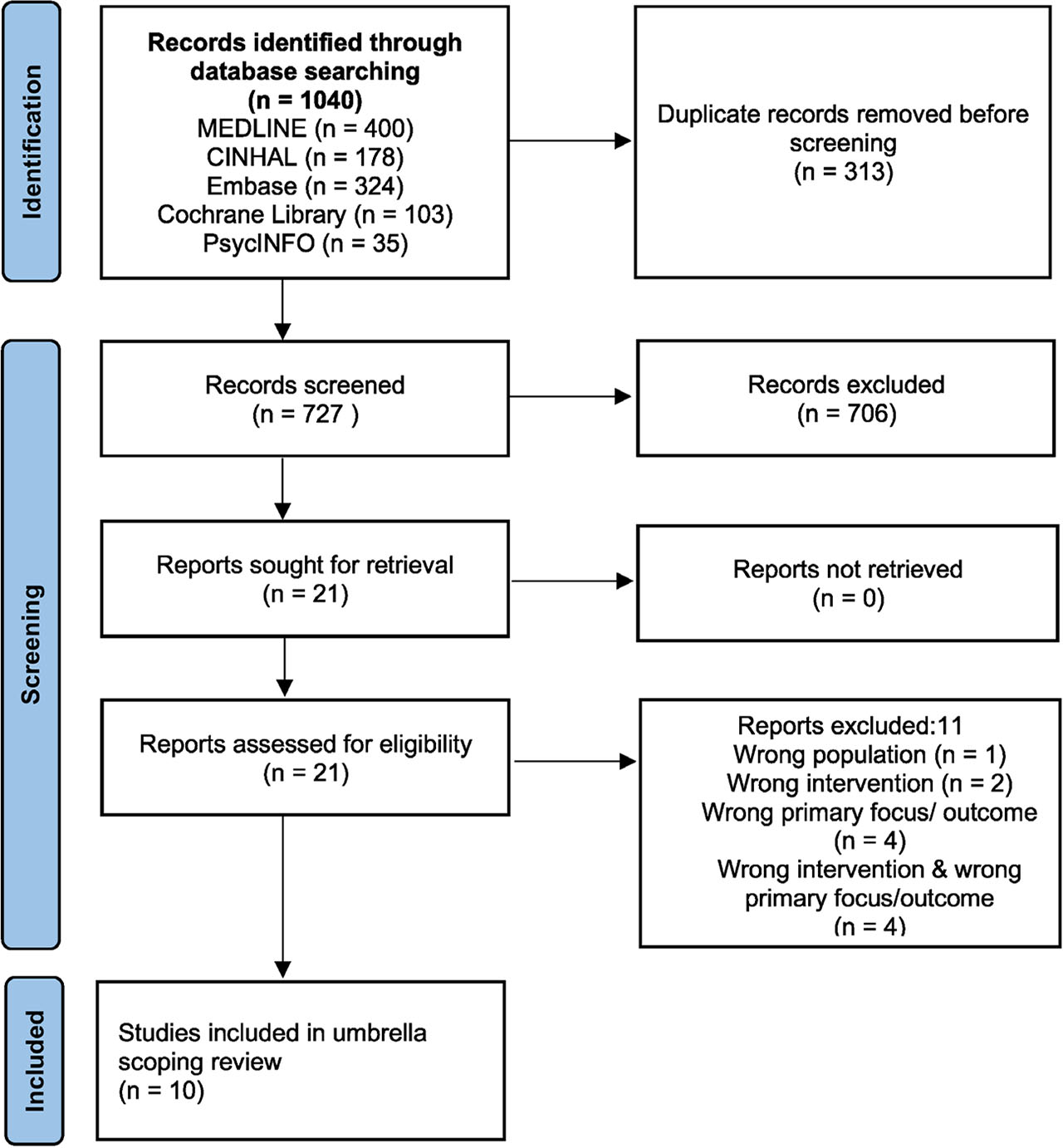
Figure 1:

PRISMA (Preferred Reporting Items for Systematic Reviews and Meta-Analyses) Flow Diagram.
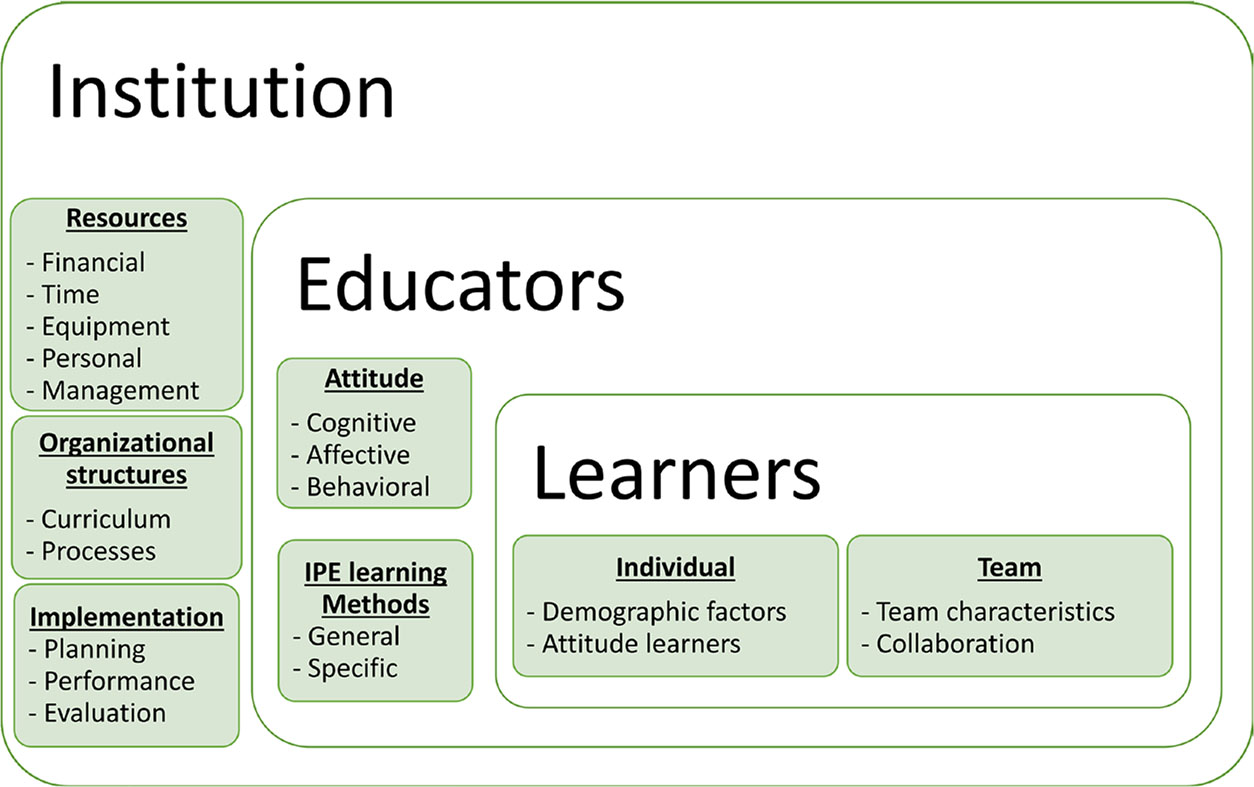

Figure 2:

Model of the interrelated dimensions of the influencing factors for IPE.

Overview of IPE-influencing factors from the perspective of educators_

DimensionIdentified influencing factors educators in IPE
Attitude educators
Cognitive component
  • (+) competent educators [2, 5, 8, 9, 10]

  • (+) knowledge of each other’s roles [6]

  • (−) inadequate faculty development specific to IPE [3, 9, 10]

  • (−) inability to fully understand the IPE concept and its inherent value [1] (−) limited knowledge and skills [4, 8]

  • (−) lack of clarity on (learning) goals [4]

Affective component
  • (+) enthusiasm, humour, and empathy [6]

  • (−) lack of respect; lack of interest [8]

  • (−) sense of academic elitism [8] (+) valuing diversity [10]

Behavioural component
  • (+) active engagement with other profession [9]

  • (+) educating style: not just ‘imparting knowledge’ [8, 9]

  • (−) educating style that corresponds to professional traditions [8, 9].

  • (−) condescension and defensiveness [8]

  • (−) lack of preparations [5, 8]

  • (−) unfamiliarity with teaching different professions [8]

  • (−) time inadequacy [8]

General approaches IPE teaching-learning methods
Overarching approaches
  • (+) patient-centred models [2, 3, 8]

  • (+) team-based approaches [2. 4, 7, 9]

  • (+) self-directed learning [9]

  • (+) experiential-based learning through clinical or community practice and placements [2, 3, 7, 9]

  • (+) teambuilding activities [2, 3, 7, 9]

  • (+) team skills training [9]

  • (+) training in team communication skills [9]

  • (+) combining learning methods [2, 7]

  • (−) employing a single learning method [7]

  • (−) compiling case studies for students [7, 8]

  • (−) silo approach [8]

Supporting tools
  • (+) creating a climate of safety and confidence among learners [5] (+) safe and supportive learning environment [2, 9]

  • (+) creating a motivational environment, providing incentives [2]

  • (+) diversity of educators; co-facilitation [2, 5, 9] (+) providing effective instruction [6]

  • (+) debriefing [4, 5, 6]

  • (+) feedback [6]

  • (+) shared reflection for learners [3, 5, 6, 9]

  • (+) high quality of facilitation [5, 9]

  • (−) lack of adequate supervision/support [8]

E-Learning
  • (+) learning in a non-threatening environment [2]

  • (+) learning at their own time; asynchronous aspect [2, 5]

Continuing education
  • (+) faculty development programs [1, 5, 8, 10]

  • (+) educational theory linked to supporting collaborative social learning [5]

Specific approaches IPE teaching-learning methods
Theory-based learning
  • (−) IPE teaching through lectures [9]

  • (−) teacher who just transmits knowledge [9]

  • (−) sub-optimal IPE – teaching that not represent clinical settings [2]

Exchange-based Learning
  • (+) stimulating collaboration and teamwork [9] (+) face to face small group learning activities [9] (+) learn about roles [9]

  • (+) panel discussion with IP team practitioners [9]

Simulation-based learning
  • (+) support for IPE matched to clinical reality [9]

  • (+) involvement of (simulation) patients in IPE lessons [9]

  • (+) participate in case scenarios in small groups [2]

  • (+) self-efficacy and understanding of others’ professional role [9]

  • (+) value in the discussions during the simulation [4] (+) increased team learning [4]

  • (+) improved interprofessional communication [2, 9]

  • (+) building positive relationships [2]

  • (+) benefit of being an observing participant [4]

  • (−) lack of simulation knowledge [4]

  • (−) lack of faculty expertise in technology [4]

Action-based learning
  • (+) real cases [9]

  • (+) scenarios as learning material for discussion [7]

  • (+) problem-based learning [9]

  • (+) complete root cause analysis and develop recommendations [9]

Practice-based learning
  • (+) authenticity of the context [9]

  • (+) real cases for clinical practice [7]

  • (+) identify the roles of other professions [9]

  • (+) promoted interaction in a non-threatening environment [2] (+) created a lasting impression [3]

  • (−) lack of adequate supervision/support [8]

Overview of inclusion and exclusion criteria

VariableInclusion criteriaExclusion criteria
Population
  • ≥ two different health professions

  • Students/trainees from the health professions

  • Trained health professionals

  • Only one health profession

  • Health professions where the clients are not human, such as veterinarians

  • Persons before the start of training or studies (pre-study internship)

InterventionIPE*
  • IPP**

  • Readiness for IPE/IPP with RIPLS***

OutcomeFocus on influencing factors, barriers, facilitating factorsFocus on effectiveness of the IPE programme and/or knowledge gain through the IPE program
Study designAll different review formats that have conducted a systematic literature review, e.g. systematic reviews, scoping reviews.
  • Empirical studies

  • Reviews without systematic literature search

SettingTeaching, clinical setting, education and training

Overview of IPE influencing factors from the perspective of the learners at the individual level_

DimensionIdentified influencing factors learners in IPE - individual level
Personal characteristics
Demographic factors
  • (0) age and gender [5, 8]

  • (+) younger students [5]

Attitude learners
Cognitive component
  • (0) (previous) experiences [3, 5, 9]

  • (−) own role uncertainty [3, 8, 9]

  • (−) lack of knowledge about each other profession [1, 3, 5, 8]

  • (−) focus on professional knowledge [9]

Affective component
  • (+) enthusiasm and motivation [8, 9]

  • (−) students thought it was time-wasting [8]

  • (−) reserved style [9]

  • (−) lack of respect [1, 3]

  • (−) feeling threatened [9]

  • (−) fear about loss of professional identity [8, 9]

  • (−) distrust [3, 9]

Behavioural component
  • (+) respect and interest in IPE [5, 9]

  • (−) monoprofessional self-identity [1, 9]

  • (−) role and professional identity uncertainty [8, 9]

  • (−) arrogant and aggressive behaviour [9]

  • (−) professional stereotypes [5, 8, 9]

  • (−) lack of clear expectations [8, 9]

  • (−) status [9]

Overview of IPE influencing factors from the perspective of the institution_

DimensionIdentified influencing factors institution in IPE
Resources
Financial
  • (+) external / internal funding [1, 5]

  • (−) different funding and competition [1, 8]

  • (−) lack of financial incentives [1, 5, 8]

  • (−) successfully sustain IPE activities within normal budgets [5]

  • (−) differential salaries [8]

Time
  • (+) flexible schedule; spread over time [2]

  • (−) lack of allocation of time resources [3, 5, 8, 9]

  • (−) different timetables and complex schedules [1, 3, 8]

  • (−) varying program calendars [1, 8]

  • (−) lack of time for implementation of IPE [1, 3. 5, 8]

Rooms/Equipment
  • (+) well-resourced rooms [2, 8]

  • (+) physical space designated for simulation [2, 4]

  • (−) lack of classroom space [3, 5, 8]

  • (−) logistics of the location [8]

  • (−) equipment issues [5]

Personnel
  • (+) regular planning and discussion between facilitators [5]

  • (+) remuneration for IPE faculty training [2]

  • (+) providing online resources for faculty training [8]

  • (−) limited faculty resources [8]

  • (−) high workloads placed upon staff by management [1, 8]

  • (−) poor attendance of medical staff [8]

  • (−) require more staff [8]

Management
  • (+) support through management and leaders [1, 2, 5]

  • (+) shared interprofessional vision by staff [1]

  • (−) lack of (conceptual) support from management [2, 5, 8]

  • (−) limited availability of staff development programs [1, 8]

Organizational structures
Curriculum
  • (+) well integrated with the curricula [2, 8, 9]

  • (+) longitudinal, structured setting/curriculum of IPE [2, 3, 7, 9]

  • (+) referral to a specific standard/framework of competence for IPE [4, 7]

  • (−) various accreditation demands [1, 8]

  • (−) integrating IPE into curriculum of different institutions [3, 8]

  • (−) no underlying principles of competency framework [8]

  • (−) predominantly siloed, content-heavy monoprofessional curricula [1, 3, 8, 9]

Processes
  • (+) structured IPE programmes [2]

  • (+) development of appropriate organisational structures [1]

  • (+) flexibility (interprofessional e-learning the asynchronous aspect) [5]

  • (−) contrasting systems and teaching processes [8]

  • (−) lack of central planning [8]

  • (−) clashes with profession-specific learning activities [5]

  • (−) coordinating students and teachers from different units [8]

  • (−) large number of students [5, 6, 8]

Implementation
Planning
  • (0) different conceptualizations of IPE (top-down vs. student centered IPE) [8]

  • (0) selection of appropriate level of study among students [8]

  • (+) face to face small group learning activities [9]

  • (+) combining learning methods [2, 7]

  • (+) providing electronic resources such as cases or simulations [8]

  • (−) complexity of the learning topic [7]

  • (−) difficulty meeting needs of all disciplines [4]

  • (−) adaption to learners needs [5]

  • (−) dissonance between stated faculty values and educational practice [3, 9]

  • (−) lack of access, structure or continuity to (interprofessional) placements [3, 8]

Performance
  • (+) collaboration and shared commitment of stakeholders [1]

  • (+) wearing a uniform [9]

  • (−) difference in personal objectives of the involved educators [4]

  • (−) high learning load [8]

  • (−) lack of enough time [1, 2, 3, 5, 8, 9]

Evaluation
  • (+) providing standardized assessment tools [8]

  • (+) progress of IPE and the positive results [8]

  • (−) lack of assessment [4, 8, 9]

Overview of IPE influencing factors from the perspective of the learners at team level_

DimensionIdentified influencing factors learners in IPE -team level
Team characteristics
Composition
  • (0) age and gender [5, 8]

  • (0) number of professions and group size [4, 5, 9]

Diversity
  • (0) mismatch in age, profession, and differences in experiences [5, 8]

  • (−) lack of diversity in small learning groups [9]

  • (−) different levels of learning [9]

  • (−) differences in workload [3]

  • (−) differences in the knowledge base [3, 8]

  • (−) different learning needs [8]

  • (−) differences in experiences [3, 8]

  • (−) different learning styles [1, 8]

  • (−) different professional jargons [8]

Collaboration
Goals
  • (+) clear IPE goals [3]

  • (−) unclear or irrelevant IPE goals [3]

  • (−) profession-specific goals in combination with IPE goals [9]

Team processes
  • (+) common values for IPE [8]

  • (+) effective communication [8];

  • open communication style [9]

  • (+) make joint decisions in agreement [6] (+) urgency [9]

  • (−) unfamiliarity [9]

  • (−) lack of active engagement in team tasks [9]

  • (−) lack of conflict resolution strategies [3]

Roles
  • (+) own role clarity [8, 9]

  • (+) equal status [9]

  • (+) team identity; being part of a ‘supra-identity’ [2]

  • (−) different role expectations [8, 9]

  • (−) medical profession is usually perceived as dominant to other professions [8]

  • (−) focusing on one’s own profession [8, 9]

  • (−) professional stereotyping [5, 8, 9]

Interpersonal relationships
  • (+) building interprofessional relationships/time to socialize [3, 9]

  • (+) use of informal learning [5, 9]

  • (+) trust and collegiality [9]

  • (−) the more professionals are specialized, the more difficulties are to collaborate [8]

  • (−) professional tribalism [8. 9]

  • (−) status/power differentials [5, 8, 9]

  • (−) not valuing others’ opinions [9]

  • (−) conflicts or tensions between learners [8]

Language: English, German
Page range: 117 - 135
Submitted on: May 24, 2023
Accepted on: Oct 20, 2023
Published on: Dec 28, 2023
Published by: ZHAW Zurich University of Applied Sciences
In partnership with: Paradigm Publishing Services
Publication frequency: 1 issue per year

© 2023 Marietta Handgraaf, Jasmin Wallin, Christina Groll, André Posenau, published by ZHAW Zurich University of Applied Sciences
This work is licensed under the Creative Commons Attribution-NonCommercial-NoDerivatives 4.0 License.