
INTRODUCTION
In contemporary digital marketing, attention management has evolved from isolated engagement tactics to data-driven reinforcement architectures. Platforms increasingly rely on adaptive systems that calibrate challenges, rewards, and feedback in real time, transforming engagement from a static design tactic into a dynamically calibrated reinforcement architecture. Similar adaptive AI-based architectures have been identified in strategic decision-making contexts, where recursive optimization models reshape organizational planning under uncertainty (Bessa & Barbosa, 2025). Gamification has long served as a mechanism for structuring motivation through points, progression systems, and goal framing (Deterding et al., 2011; Werbach & Hunter, 2012). Simultaneously, artificial intelligence (AI) has enabled unprecedented levels of behavioral tracking and personalization, allowing digital environments to continuously optimize user interactions (Kaplan & Haenlein, 2019; Davenport & Ronanki, 2018). Research on digital transformation further demonstrates that AI restructures organizational and entrepreneurial architectures beyond process automation, embedding adaptive intelligence within core strategic logics (Shatila et al., 2025). Recent bibliometric evidence confirms the rapid expansion of AI-driven digital marketing research, particularly in areas such as personalization, predictive analytics, and behavioral optimization (Nalbant & Aydin, 2025).
The convergence of these domains has produced AI-driven gamification systems capable of shaping not only engagement but also persistent behavioral patterns. Unlike traditional persuasive design, which relies on predefined motivational triggers, adaptive AI systems dynamically recalibrate reinforcement contingencies, adjusting reward timing, difficulty levels, and feedback intensity based on behavioral data. As a result, digital marketing platforms increasingly function as adaptive reinforcement architectures in which psychological conditioning, experiential mechanics, and algorithmic optimization operate recursively, reflecting a broader shift from linear customer funnels to feedback-loop-driven engagement architectures (Palmucci et al., 2025).
Despite extensive research on gamification's motivational effects (Hamari et al., 2014) and AI-enabled personalization mechanisms (Knutas et al., 2018), existing scholarship has largely examined these domains in isolation. Although recent reviews highlight the accelerating integration of AI into digital marketing ecosystems (Nalbant & Aydin, 2025), a theoretically bounded explanation of how behavioral psychology, gamified interface structures, and adaptive algorithms structurally interact remains underdeveloped. Recent empirical analyses further demonstrate that AI-driven personalization simultaneously enhances engagement effectiveness while intensifying ethical and governance concerns, particularly regarding fairness, transparency, and data use (Bell et al., 2024). However, such studies typically assess performance and ethical perception separately rather than modelling their structural interdependence within adaptive reinforcement systems. The literature, therefore, lacks an integrative theoretical framework that explains how behavioral foundations, gamified interface mechanisms, and algorithmic adaptation converge to construct adaptive habit-forming architectures in digital marketing contexts. Moreover, while ethical debates on algorithmic systems have intensified (Mittelstadt et al., 2016; Floridi et al., 2021), recent research in marketing contexts underscores growing concerns regarding algorithmic persuasion, autonomy erosion, and the data privacy paradox associated with AI-enabled personalization (Hari et al., 2025; Saura et al., 2024).
This gap is particularly consequential for digital marketing research. As reinforcement learning systems increasingly modulate user trajectories, the distinction between engagement optimization and behavioral overreach becomes analytically blurred. Without a system-level perspective, it remains difficult to assess how adaptive gamification reshapes motivational dynamics, retention mechanisms, and exposure to ethical risk.
To address this gap, the present study develops a conceptual model that positions AI as a structural habit architect embedded within gamified marketing ecosystems. Drawing on behavioral psychology, gamification theory, and machine-learning-based personalization, the study conceptualises adaptive engagement as a layered reinforcement architecture operating around the user, later formalised as behavioral foundations, gamification interface structures, and algorithmic adaptation mechanisms. The guiding research question is:
How do artificial intelligence, gamification, and behavioral psychology interact to construct adaptive habit-forming architectures in digital marketing environments, and what ethical implications emerge from this interaction?
Methodologically, the study employs an integrative literature review (ILR) to synthesise interdisciplinary research across marketing, behavioral science, human–computer interaction, and AI ethics. The resulting framework distinguishes between behavioral foundations, gamification interface structures, and algorithmic adaptation mechanisms. It identifies key adaptive processes (motivational alignment, reinforcement calibration, and feedback modulation) that together constitute an adaptive reinforcement architecture.
By advancing a system-level model of AI-driven gamification, this study contributes to digital marketing theory in three ways: (1) it integrates previously fragmented research streams into a unified explanatory architecture; (2) it differentiates core adaptive mechanisms from peripheral engagement amplifiers, thereby clarifying theoretical boundaries; and (3) it embeds ethical inflection points directly within the reinforcement logic of adaptive systems. Through this reconceptualization, the study advances a theoretically bounded and operationally articulable framework for analysing adaptive engagement in data-intensive marketing environments.
The remainder of the article is structured as follows. The next section outlines the research methodology. Subsequent sections develop the theoretical model, analyse AI as a habit architect, examine psychological and ethical implications, and discuss theoretical and managerial contributions before concluding.
RESEARCH METHODOLOGY
This study adopts an integrative literature review (ILR) methodology, which is particularly appropriate for interdisciplinary and emerging research domains requiring theoretical synthesis rather than statistical aggregation (Torraco, 2005; Snyder, 2019). Unlike systematic reviews focused on quantitative meta-analysis, ILR integrates conceptual, empirical, and normative research streams to construct new theoretical frameworks (Whittemore & Knafl, 2005). Given the convergence of artificial intelligence, gamification design, behavioral psychology, and digital marketing ethics, this approach allows structured theory development across socio-technical domains.
The review followed five structured stages: (1) problem formulation, (2) literature search and eligibility criteria, (3) screening and selection, (4) thematic synthesis and structured mapping, and (5) conceptual model construction and case integration.
Problem Formulation
The guiding research question was defined as:
How do artificial intelligence, gamification mechanisms, and behavioral psychology interact to shape user habits in digital marketing environments, and what ethical considerations emerge from this interplay?
The objective was not merely to summarise existing studies but to integrate dispersed knowledge streams into a coherent conceptual framework that explains adaptive habit formation in AI-driven marketing ecosystems.
Literature search and eligibility criteria
A structured literature search was conducted across major academic databases, including Scopus, Web of Science, ACM Digital Library, IEEE Xplore, and Google Scholar. The search strategy combined Boolean operators to capture interdisciplinary intersections between artificial intelligence, gamification, behavioral psychology, digital marketing, and AI ethics.
Representative keyword combinations included:
– (“AI” OR “artificial intelligence”) AND “gamification” AND “digital marketing.”
– (“habit formation” OR “habit loop”) AND (“machine learning” OR “adaptive systems”)
– “persuasive technology” AND “ethics.”
– “flow theory” AND “adaptive systems.”
– (“algorithmic personalization” OR “algorithmic personalization”) AND “behavioral design.”
Backward and forward citation tracking was applied to foundational works and recent contributions to ensure both historical depth and contemporary relevance.
Inclusion criteria:
– Peer-reviewed journal articles, academic books, and recognised conference proceedings.
– Publications primarily from 2000–2025, with particular emphasis on research published after 2020.
– Studies addressing at least one of the following domains:
– AI adaptivity or machine-learning-driven personalization,
– gamification structures in digital contexts,
– behavioral psychology and habit formation,
– ethical implications of algorithmic systems.
– Conceptual or empirical relevance to digital marketing environments.
Exclusion criteria:
– Purely technical AI optimization studies lack relevance to behavior or user experience.
– Research focused exclusively on non-digital gamification contexts.
– Non-scholarly commentary, except where used as illustrative industry context.
– Conceptually redundant publications.
The initial search generated 312 records across databases. After removal of duplicates (n = 58), 254 records remained for title and abstract screening. Following the first screening phase, 167 records were excluded for being irrelevant to adaptive behavioral mechanisms or digital marketing contexts. The remaining 87 articles were subjected to full-text evaluation. Following full-text evaluation and application of the eligibility criteria, 41 publications were retained as core theoretical sources, forming the analytical foundation of the integrative review (see Section 2.3 for a detailed breakdown of exclusions).
In addition, four recent publications (2025) were incorporated following the reviewers' recommendations to strengthen the manuscript's positioning within current debates on AI-driven digital transformation, economic modelling, and ethical governance.
Figure 1 presents a structured overview of the literature identification, screening, and selection process.
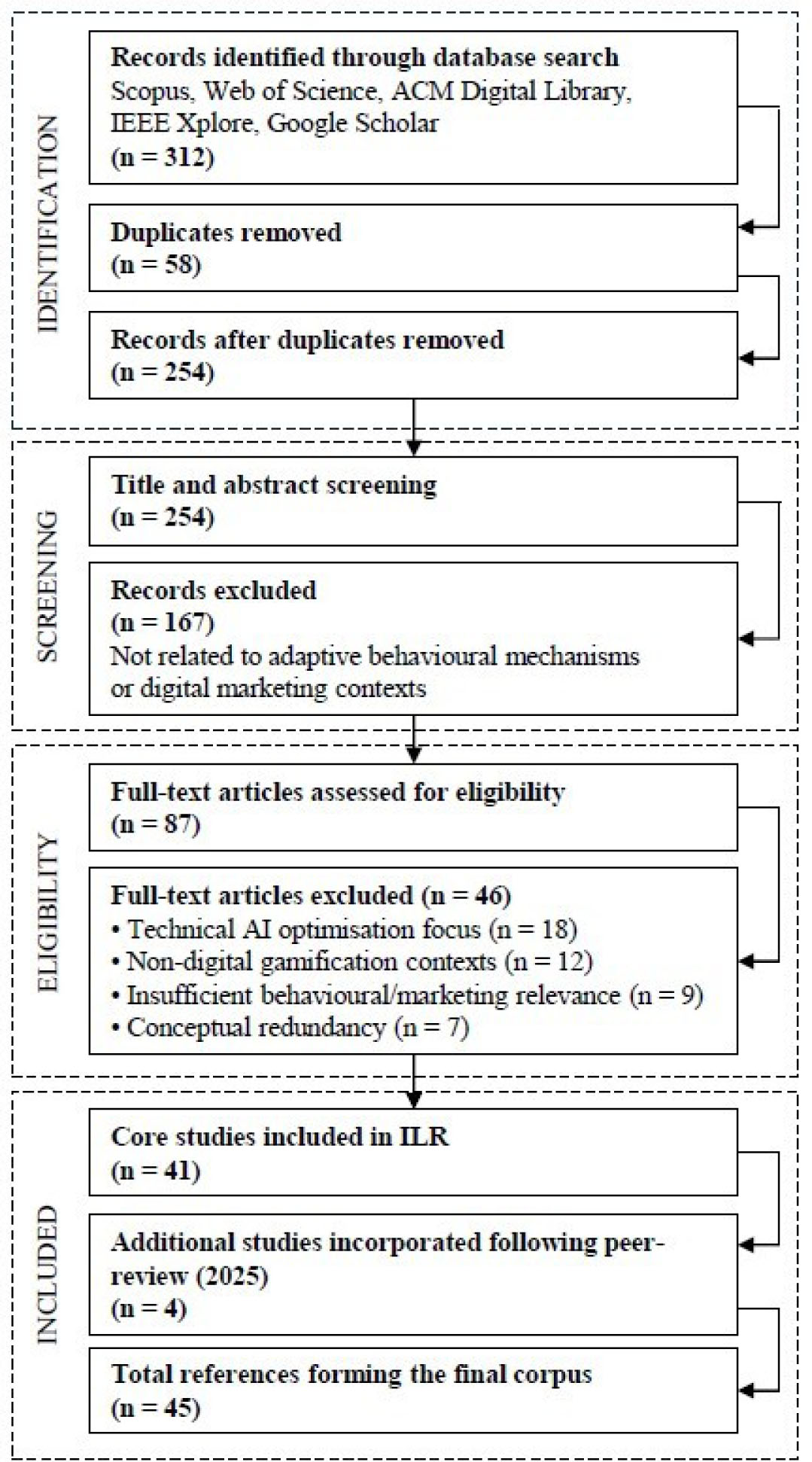
Figure 1.
Literature identification, screening, and selection process
Note: Four additional sources (2025) were incorporated following peer-review to strengthen contemporary contextual positioning.
Source: own study.
Screening and Selection
Screening was conducted in three iterative phases: title and abstract review, full-text evaluation, and thematic consolidation. Of the 87 full-text articles assessed, 46 were excluded due to: purely technical AI optimization focus (n = 18), non-digital gamification contexts (n = 12), insufficient behavioral or marketing relevance (n = 9), and conceptual redundancy (n = 7).
Publications were assessed for theoretical relevance, conceptual contribution, and alignment with the study's interdisciplinary scope. Rayyan software supported categorization, de-duplication, and thematic tagging. Iterative comparison and consistency checks were conducted to enhance coherence in classification decisions. Rather than applying purely quantitative exclusion thresholds, emphasis was placed on conceptual centrality and the potential for theoretical integration.
The 41 publications retained through the eligibility process were subsequently analysed iteratively to construct the structural basis of the proposed adaptive reinforcement architecture.
Thematic synthesis and structured mapping
The selected literature was organised into four primary conceptual clusters:
Behavioral psychology (conditioning, habit loops, flow theory, intrinsic motivation),
Gamification mechanics (reward schedules, feedback systems, progression structures),
AI adaptivity (reinforcement learning, recommender systems, NLP-based personalization),
Ethical and governance frameworks (transparency, autonomy, fairness, value-sensitive design).
Cross-cluster synthesis enabled the identification of interaction mechanisms linking behavioral reinforcement with algorithmic recalibration. Attention was given to how AI-driven optimization modifies the timing, variability, and intensity of reinforcement structures compared to traditional static gamification models.
To clarify the analytical integration process, representative studies were structured and compared across AI techniques, gamification mechanisms, and ethical considerations (see Table 1).
Table 1.
Illustrative mapping of key studies across conceptual dimensions
| Author (Year) | Context | AI Technique | Gamification Mechanism | Ethical Dimension | Analytical Contribution |
|---|---|---|---|---|---|
| Hamari et al. (2014) | Digital platforms | Behavioral analytics | Points & reward systems | Engagement intensity | Empirical evidence of gamification effects |
| Mittelstadt et al. (2016) | Algorithmic systems | Machine learning | Personalised targeting | Transparency, fairness | Mapping of algorithmic ethical risks |
| Floridi et al. (2021) | AI governance | ML optimization | Adaptive system design | Explicability, proportionality | Structural AI ethics framework |
| Knutas et al. (2018) | Personalised gamification | Algorithm-based personalization | Adaptive feedback | Behavioral calibration | Design of personalised gamification processes |
This mapping supported the identification of structural overlaps across domains.
Conceptual Model Construction and Case Integration
Insights derived from thematic synthesis were integrated into a multi-layered conceptual framework, distinguishing:
– behavioral triggers and motivational drivers,
– gamified reinforcement mechanisms,
– algorithmic adaptation processes,
– embedded ethical inflection points within feedback architectures.
To illustrate how adaptive reinforcement architectures manifest in practice, selected digital platforms (e.g., Duolingo, Nike Run Club, Starbucks Deep Brew, Headspace) were examined as analytical exemplars. These cases were selected based on documented integration of adaptive AI systems, gamification mechanisms, and observable behavioral reinforcement cycles. They function as illustrative applications of the conceptual framework rather than empirical validation samples.
The resulting model positions AI not merely as a performance optimization tool but as a structural habit architect embedded within digital marketing ecosystems.
THEORETICAL FOUNDATIONS
Behavioral Foundations of Habit Formation
Understanding AI-driven gamification requires a grounding in behavioral psychology, which explains how repeated actions become stabilised habits. Central to this perspective is conditioning theory. Classical conditioning (Pavlov, 1927) demonstrates how neutral stimuli acquire behavioral meaning through association, while operant conditioning (Skinner, 1953) explains how behavior is shaped through reinforcement contingencies. Variable reinforcement schedules increase behavioral persistence by introducing unpredictability into reward structures.
Building on these foundations, the habit loop model (cue–routine–reward) conceptualises behavioral repetition as a cyclical process in which environmental triggers activate routines that are reinforced through rewards (Duhigg, 2012; Lally et al., 2010).
Digital environments replicate this structure through prompts, structured tasks, and feedback mechanisms that encourage repeated interaction.
Motivational theory further refines this foundation. Self-determination theory (Deci & Ryan, 2013) posits that sustained engagement depends on satisfying three psychological needs: autonomy, competence, and relatedness. Flow theory (Csikszentmihalyi, 1990) complements this view by demonstrating that deep engagement emerges when task difficulty and user skill are optimally balanced. Together, these theories provide the motivational architecture upon which digital reinforcement systems operate.
Rather than treating these mechanisms as isolated psychological phenomena, they form the behavioral substrate that enables structured digital environments to influence persistence and engagement over time.
Gamification as Motivational Interface
Gamification translates behavioral principles into structured experiential design. It integrates game-derived elements such as progression systems, feedback mechanisms, goal framing, and symbolic rewards into non-game contexts (Deterding et al., 2011; Werbach & Hunter, 2012). Beyond surface-level mechanics, gamification serves as a motivational interface that operationalises behavioral reinforcement in user-facing environments.
From a service-oriented perspective, gamification creates value by structuring experiences that are emotionally meaningful and goal-directed (Huotari & Hamari, 2017). Progress indicators, achievements, and structured challenges guide users along predefined pathways while reinforcing perceptions of progress and competence. These elements align closely with goal-setting theory (Locke & Latham, 2002) and reinforcement logic derived from behavioral psychology.
In digital marketing contexts, gamification operates as a behavioral design strategy that embeds reward-based logic into customer journeys. Loyalty programmes, tiered membership systems, and challenge-based engagement mechanisms illustrate how progression structures and feedback systems transform interaction into structured motivational trajectories. Crucially, gamification provides the visible layer through which behavioral principles become experientially actionable.
Algorithmic Adaptation and Reinforcement Logic
While gamification structures motivation at the interface level, artificial intelligence introduces adaptive optimization into this process. AI-driven systems analyse behavioral data and recalibrate reinforcement contingencies in real time. Unlike static rule-based systems, machine learning models allow digital environments to evolve with user behavior.
Reinforcement learning (Sutton & Barto, 2018) is particularly relevant in this context. It models decision-making as an iterative process in which actions are selected based on expected rewards, and strategies are refined through feedback. In digital platforms, this logic enables dynamic adjustment of challenge levels, reward timing, and feedback intensity, increasing engagement persistence.
Personalization mechanisms further enhance this adaptivity. Recommender system architectures, including collaborative and content-based filtering (Ricci et al., 2011), tailor tasks, content, and incentives to individual user profiles. Through continuous data feedback, algorithmic systems modulate behavioral loops, transforming gamification from a static design approach into an adaptive reinforcement architecture.
Importantly, AI in this framework is conceptualised not as a collection of specific technologies but as a structural optimization logic embedded within engagement systems. Its significance lies in its ability to recursively recalibrate motivational dynamics rather than merely automate predefined responses.
Collectively, these theoretical strands (behavioral conditioning, motivational design, and algorithmic adaptation) establish the conceptual foundations for analysing AI-driven gamification as an integrated reinforcement architecture. The following section synthesises these elements into a unified structural model of adaptive habit formation in digital marketing environments.
AI AS A HABIT ARCHITECT
Artificial intelligence in digital marketing environments does not merely optimize content delivery; it restructures behavioral reinforcement systems at the architectural level. In AI-driven ecosystems, habit formation is no longer static or rule-based but dynamically recalibrated through continuous behavioral data flows (Sutton & Barto, 2018; Kumar et al., 2016). This transformation shifts gamification from a predefined motivational layer to an adaptive reinforcement architecture embedded within marketing systems. Recent empirical research on AI-enabled personalization further confirms that algorithmic tailoring significantly intensifies user engagement and experiential relevance by continuously adjusting interaction trajectories (Beyari & Hashem, 2025). Such findings reinforce the argument that AI operates not as a passive recommender but as a behavioral calibration mechanism embedded within digital architectures.
To clarify the theoretical contribution of this study, the proposed model distinguishes between core and peripheral mechanisms within an AI-driven adaptive reinforcement architecture. This distinction enables sharper conceptual boundaries and reduces the risk of theoretical inflation.
Core Mechanisms of Ai-Driven Habit Formation
Core mechanisms constitute the structural conditions under which adaptive habit formation becomes possible. Without these mechanisms, the system reverts to static gamification rather than dynamic behavioral calibration.
The first core mechanism is adaptive reinforcement learning, which continuously adjusts reward contingencies based on observed user behavior (Sutton & Barto, 2018; Verma et al., 2022). Unlike traditional gamified systems with fixed reward schedules, reinforcement learning algorithms recalibrate probabilities, timing, and incentive structures at the individual level. Empirical evidence suggests that such AI-powered gamification significantly influences behavioral intentions and sustained engagement patterns, particularly in data-intensive digital platforms (Gaur et al., 2025), further supporting the structural role of reinforcement optimization within adaptive systems.
The second mechanism is real-time feedback calibration. Adaptive systems modify the intensity, frequency, and sequencing of digital stimuli in response to evolving behavioral patterns. This dynamic recalibration alters the timing of reinforcement and the variability of rewards, thereby strengthening behavioral persistence over time (Kaptein et al., 2015).
The third mechanism is behavioral loop structuring, grounded in cue–action–reward cycles derived from behavioral psychology (Duhigg, 2012; Fogg, 2009). In AI-driven contexts, these loops are not merely implemented but algorithmically optimized through predictive modelling. Behavioral data inform future stimulus delivery, thereby transforming static habit loops into recursive reinforcement infrastructures.
Crucially, these three mechanisms interact rather than operate independently. Behavioral psychology defines the motivational architecture (cue–action–reward), reinforcement learning recalibrates contingencies in real time, and gamification provides the experiential interface through which algorithmic optimization becomes behaviorally salient. The convergence of these mechanisms constitutes the structural core of AI as a habit architect.
Peripheral Amplification Mechanisms
Peripheral mechanisms intensify engagement but do not structurally define the model. These include natural language processing interfaces, affective computing systems (Picard, 2000), multimodal interaction design, and advanced narrative gamification layers.
Such mechanisms enhance immersion and emotional resonance; however, they amplify rather than constitute the adaptive reinforcement cycle. Distinguishing core from peripheral mechanisms clarifies that adaptive reinforcement architecture emerges from reinforcement calibration rather than from surface-level design elements.
Causal propositions
To transform the framework from descriptive synthesis into a falsifiable theoretical architecture, the following propositions are advanced:
P1: The integration of adaptive reinforcement learning with variable reward structures increases the duration and frequency of repeated user interactions over time more significantly than static gamification systems.
P2: Real-time emotional or behavioral calibration moderates the relationship between gamified feedback intensity and longitudinal user retention.
P3: The perceived transparency of algorithmic adaptation mediates the relationship between personalization intensity and perceived user autonomy (Mittelstadt et al., 2016; Floridi et al., 2021).
These propositions enable empirical testing through behavioral analytics, longitudinal retention metrics, and user perception studies. By specifying directional relationships, the model becomes analytically operationalizable rather than purely conceptual.
Theoretical boundaries of the model
The proposed framework applies specifically to data-intensive digital marketing ecosystems characterised by continuous behavioral tracking and adaptive algorithmic optimization. It does not generalise to non-digital persuasion contexts or environments lacking real-time behavioral data streams.
Furthermore, the model assumes sufficient computational capacity to enable individual-level reinforcement recalibration. In low-data or low-adaptivity environments, gamification remains static and does not qualify as adaptive reinforcement architecture.
By explicitly defining its scope conditions, the model avoids conceptual overextension and establishes clear theoretical boundaries.
Illustrative application across platforms
Digital platforms such as Duolingo, Nike Run Club, Starbucks Deep Brew, and Headspace exemplify how adaptive reinforcement architectures operate across educational, wellness, and commercial contexts. These platforms have been discussed in prior studies as examples of AI-enabled adaptive engagement environments (e.g., Beyari & Hashem, 2025; Gaur et al., 2025). In each case, user interactions generate behavioral data that inform algorithmic recalibration of reinforcement structures. Gamification elements (progress tracking, variable rewards, feedback cues) function as behavioral interfaces through which algorithmic optimization becomes experientially meaningful.
These examples serve as analytical illustrations rather than empirical validation. They demonstrate how adaptive reinforcement, behavioral loop structuring, and feedback calibration manifest in real-world digital marketing environments.
By conceptualising AI not merely as a performance-optimization tool but as a structural reinforcement architect embedded within digital ecosystems, the model advances a more precise theoretical understanding of adaptive persuasion in contemporary marketing systems.
PSYCHOLOGICAL MECHANISMS IN AI-GAMIFIED MARKETING
AI-driven gamification operationalises behavioral theory through adaptive psychological mechanisms embedded within digital interaction systems. Rather than functioning as isolated design features, these mechanisms are dynamically coordinated through algorithmic optimization, forming the behavioral logic of adaptive engagement.
At the core of this logic lies the trigger–action–feedback structure, in which contextual prompts initiate user behavior and personalised feedback reinforces repetition (Fogg, 2009; Eyal, 2014). In AI-enhanced environments, triggers are not uniformly distributed but are calibrated based on behavioral data patterns, including usage frequency, performance trajectories, and engagement latency. This dynamic adjustment transforms static motivational prompts into adaptive reinforcement signals.
Recent systematic research further confirms that gamification operates through emotionally mediated engagement pathways. Saha et al. (2025), in a comprehensive review of psychological and experiential mechanisms, demonstrate that affective stimulation, perceived competence, and emotionally resonant feedback significantly amplify customer experience and behavioral persistence in gamified environments. These findings support the view that adaptive systems intensify reinforcement not merely by increasing reward frequency but also by modulating emotional salience and perceived competence in response to user behavior.
Variable reinforcement further strengthens behavioral persistence. Drawing on operant conditioning principles (Skinner, 1953), AI systems modulate the timing and intensity of rewards, introducing calibrated unpredictability into engagement cycles. Unlike fixed gamification structures, algorithmically mediated reinforcement recalibrates reward probabilities in response to behavioral trends, increasing retention potential while reducing monotony.
Flow regulation constitutes another critical mechanism. Adaptive systems adjust challenge levels, pacing, and feedback granularity to sustain alignment between user capability and task complexity (Csikszentmihalyi, 1990). Through continuous behavioral monitoring, AI maintains users within an optimal engagement zone, mitigating disengagement caused by boredom or frustration. This calibration process exemplifies reinforcement calibration within the broader architectural model.
Additionally, affect-sensitive feedback mechanisms personalise emotional framing. Building on affective computing research (Picard, 2000), AI-enabled platforms adjust the tone, intensity, and timing of feedback based on interaction patterns and inferred motivational states. Such modulation enhances perceived responsiveness and strengthens the alignment of system structure with user disposition.
Illustrative examples of these mechanisms can be observed across sectors. Educational platforms employ adaptive lesson sequencing and streak-based reinforcement to sustain learning routines. Fitness applications dynamically calibrate performance milestones and recognition thresholds. Wellness platforms integrate responsive feedback mechanisms to personalise encouragement and pacing. In each case, psychological mechanisms are embedded within algorithmically mediated reinforcement architectures rather than operating as standalone design elements.
Collectively, these mechanisms (adaptive triggering, reinforcement modulation, flow calibration, and affect-sensitive feedback) constitute the psychological operational layer of AI-driven gamification. Their integration demonstrates how behavioral design, experiential structuring, and algorithmic optimization converge to shape persistent engagement patterns.
Importantly, the adaptive nature of these mechanisms introduces both strategic advantages and ethical complexity. As reinforcement becomes increasingly personalised and recursively optimized, the boundary between supportive habit formation and behavioral overreach becomes progressively less distinct. This tension underscores the importance of embedding ethical safeguards within adaptive engagement architectures.
ETHICAL AND SOCIETAL IMPLICATIONS
AI-driven gamified marketing systems amplify not only engagement efficiency, but also normative risks associated with behavioral steering. Emerging work on the data economy and AI-driven behavioral intention further underscores how optimization logics increasingly shape user decision pathways, raising ethical concerns regarding autonomy, data asymmetry, and strategic influence (Saura, 2025). When adaptive algorithms continuously recalibrate reinforcement structures, ethical concerns are not peripheral side effects but structural properties of the system architecture (Mittelstadt et al., 2016; Floridi et al., 2021). Recent research in AI-enabled marketing further underscores that issues of autonomy erosion, opacity, and disproportionate data exploitation intensify as personalization mechanisms become more granular and predictive (Hari et al., 2025; Saura et al., 2024).
Rather than treating ethics as an external evaluative layer, this study embeds ethical analysis within the adaptive reinforcement architecture developed in the preceding sections. The model identifies specific ethical inflection points at which algorithmic adaptivity intensifies asymmetries between platforms and users.
Ethical Inflection Points In the Ai Gamified Cycle
Within the proposed adaptive reinforcement architecture, ethical risk does not arise randomly but instead concentrates at specific structural junctures in the reinforcement cycle. These ethical inflection points correspond directly to the stages identified in the model: data capture, personalization, reinforcement calibration, and feedback opacity.
The first inflection point arises during continuous data capture and behavioral profiling. While such tracking enables predictive optimization, it simultaneously creates asymmetries of informational power between platforms and users (Zuboff, 2019). Contemporary analyses of AI-driven digital marketing confirm that predictive analytics increasingly rely on large-scale behavioral aggregation, reinforcing platform-side epistemic advantage (Nalbant & Aydin, 2025). The accumulation of granular behavioral data transforms marketing environments into persistent monitoring systems, raising concerns regarding surveillance and implicit behavioral steering.
From a distributive and procedural justice perspective, algorithmic personalization may reproduce or intensify asymmetrical power relations when decision logics remain inaccessible or non-contestable (Binns, 2018). In adaptive gamification contexts, such asymmetries may deepen as reinforcement structures are individually calibrated and continuously recalibrated.
A second inflection point occurs within adaptive personalization processes. Reinforcement learning systems dynamically optimize engagement trajectories, often below the threshold of conscious awareness. This optimization may reduce perceived autonomy when users cannot detect how past behavior shapes subsequent digital stimuli (Mittelstadt et al., 2016). Recent marketing-focused scholarship highlights that hyper-personalization can intensify persuasive asymmetries, particularly when predictive models align reinforcement with behavioral vulnerabilities (Hari et al., 2025).
The third structural risk emerges in the calibration of variable reward mechanisms. Algorithmic intensification of reward variability may amplify behavioral persistence through mechanisms analogous to intermittent reinforcement. While effective for engagement, such calibration risks shifting from motivational enhancement to compulsive reinforcement dynamics (Alter, 2017). In feedback-loop-driven marketing architectures, recursive optimization may unintentionally intensify engagement, creating increasingly self-reinforcing cycles (Palmucci et al., 2025).
Finally, ethical sensitivity increases when feedback loops become opaque. If users cannot interpret why certain content, rewards, or prompts are presented, accountability mechanisms weaken, and contestability diminishes (Floridi et al., 2021). Opaque recommender systems and adaptive content sequencing may institutionalise behavioral asymmetry as a structural design feature, raising concerns regarding algorithmic authority, interpretability, and anthropological implications of recommender influence (Machidon, 2025).
Taken together, these inflection points demonstrate that ethical tension scales with optimization intensity. The more precisely reinforcement is calibrated and personalised, the greater the potential divergence between engagement facilitation and behavioral overreach.
Operationalizing Ethical Safeguards Within Adaptive Systems
To avoid remaining at a purely normative level, ethical principles must be translated into structural design safeguards embedded within the adaptive architecture itself. Transparency in AI-driven gamification does not merely imply disclosure of data-collection practices; it requires explainable personalization mechanisms that enable users to understand how behavioral data influence reward calibration and content sequencing (Mittelstadt et al., 2016; Hari et al., 2025). Among these safeguards, perceived transparency is formalised within the model as a mediating variable linking personalization intensity to perceived autonomy (see Proposition 3). Other dimensions, such as reversibility, proportionality, and contestability, function as structural boundary conditions that regulate the intensity of optimization within adaptive reinforcement architectures.
Embedding such safeguards aligns with the principles of Value Sensitive Design, which advocate integrating human values directly into technological architectures rather than treating ethics as post hoc evaluation (Friedman et al., 2013). In adaptive gamification systems, this implies proactively modelling autonomy, reversibility, and proportional reinforcement within optimization logic itself.
User autonomy can be preserved not by eliminating personalization but by ensuring reversibility and agency within reinforcement structures. This may involve mechanisms allowing users to reset behavioral profiles, adjust personalization intensity, or opt out of amplified reward variability. When reinforcement intensity cannot be moderated or overridden, adaptive gamification risks shifting from engagement facilitation toward behavioral manipulation.
The principle of proportionality further requires that the intensity of behavioral nudging remain aligned with declared marketing objectives. Excessive reinforcement amplification, particularly when combined with predictive behavioral profiling, may distort decision-making beyond reasonable persuasive thresholds. Research on the data privacy paradox illustrates how users may simultaneously demand relevance while underestimating the cumulative behavioral impact of algorithmic optimization (Saura et al., 2024). Ethical proportionality, therefore, serves as a boundary condition regulating the intensity of optimization.
Finally, contestability and accountability must be incorporated into system governance. Users should retain the ability to question automated decisions that affect their digital experience, and platforms should maintain auditability mechanisms capable of evaluating reinforcement logic (Floridi et al., 2021). Without such safeguards, adaptive marketing architectures risk institutionalising asymmetrical power relations between platforms and users.
Embedding these safeguards within the model reframes ethics as a structural design dimension rather than an external evaluative layer. The boundary between persuasive design and manipulative architecture emerges precisely where these safeguards are absent. When algorithmic intent remains opaque, reinforcement structures are irreversible, and optimization intensity exceeds proportional engagement objectives, adaptive gamification may shift from habit support to behavioral overreach. Ethical risk, therefore, is not an accidental by-product of digital marketing systems but rather a structural outcome of the intensity of reinforcement calibration.
Societal Implications
At a macro level, adaptive reinforcement architectures may normalise continuous behavioral modulation as a dominant marketing paradigm. As predictive systems scale, reinforcement calibration becomes embedded within everyday digital infrastructures, extending beyond individual transactions into persistent behavioral ecosystems. Bibliometric evidence indicates that AI in digital marketing increasingly converges around predictive personalization and behavioral analytics as central strategic logics (Nalbant & Aydin, 2025). As AI-driven data economies expand, optimization logics increasingly operate not only at the level of individual engagement but also at the level of behavioral intention modelling, shaping strategic influence structures within digital markets (Saura, 2025).
This shift raises concerns not only about individual autonomy but also about collective behavioral homogenization and market-level asymmetries of informational power. When multiple platforms deploy similar optimization logics, users may encounter increasingly standardised engagement architectures, narrowing experiential diversity while intensifying data extraction dynamics (Zuboff, 2019). Economic analyses of AI adoption in platform-based markets further demonstrate how algorithmic optimization reshapes competitive dynamics and pricing logics, reinforcing data-driven feedback structures as central market coordination mechanisms (Hernández-Tamurejo et al., 2025). As such systems scale, optimization architectures influence not only consumer choice but also firms' strategic behavior within digital ecosystems. Moreover, algorithmic recommender systems may shape not only purchasing behavior but broader cognitive exposure patterns and informational framing (Machidon, 2025).
From a governance perspective, the proliferation of adaptive habit systems necessitates regulatory reflection on algorithmic accountability, proportionality of data exploitation, and systemic transparency. Ethical embedding within individual platforms is therefore insufficient without broader institutional safeguards that can address cumulative societal effects.
TOWARD A THEORETICAL MODEL
This section synthesises the previously discussed theoretical foundations into a unified architectural framework. Rather than treating behavioral psychology, gamification, and artificial intelligence as parallel domains, the model conceptualises them as interdependent layers within a single adaptive reinforcement system.
The proposed framework is structured around three interlocking layers: behavioral foundations, gamification interface structures, and algorithmic adaptation mechanisms. These layers do not operate sequentially but recursively, forming a continuous feedback architecture centred on the user.
The first layer, behavioral foundations, draws on conditioning theory and habit-loop models (Pavlov, 1927; Skinner, 1953; Duhigg, 2012) to explain how cues, actions, and rewards drive behavioral repetition. Self-determination theory (Deci & Ryan, 2013) and flow theory (Csikszentmihalyi, 1990) provide complementary perspectives on intrinsic motivation and sustained engagement. Within the model, this layer defines the motivational architecture upon which digital reinforcement operates.
The second layer, gamification interface structures, translates behavioral principles into experiential design. Progression systems, feedback structures, goal framing, and social elements (Werbach & Hunter, 2012; Huotari & Hamari, 2017) function as the visible interface through which reinforcement becomes experientially meaningful. This layer operationalises behavioral triggers within structured digital environments.
The third layer, algorithmic adaptation mechanisms, dynamically recalibrates reinforcement contingencies based on behavioral data. Reinforcement learning models (Sutton & Barto, 2018) enable systems to adjust reward probabilities and feedback intensity in real time, transforming static gamification into adaptive reinforcement architecture. Rather than enumerating specific technologies, the model conceptualises this layer as a general optimization logic that modulates behavioral loops through continuous data feedback.
The intersections between these layers represent distinct adaptive processes. Motivational alignment emerges at the interface between behavioral foundations and gamification structures, reinforcement calibration operates at the intersection of behavioral theory and algorithmic adaptation, and feedback modulation characterises the interaction between gamification mechanisms and AI optimization. Together, these processes form an adaptive reinforcement architecture operating around the user.
Figure 2 visualises this layered system by placing the human actor at the centre of overlapping domains. The diagram illustrates how behavioral design, experiential mechanics, and algorithmic recalibration co-evolve through bi-directional feedback flows, shaping engagement trajectories over time.
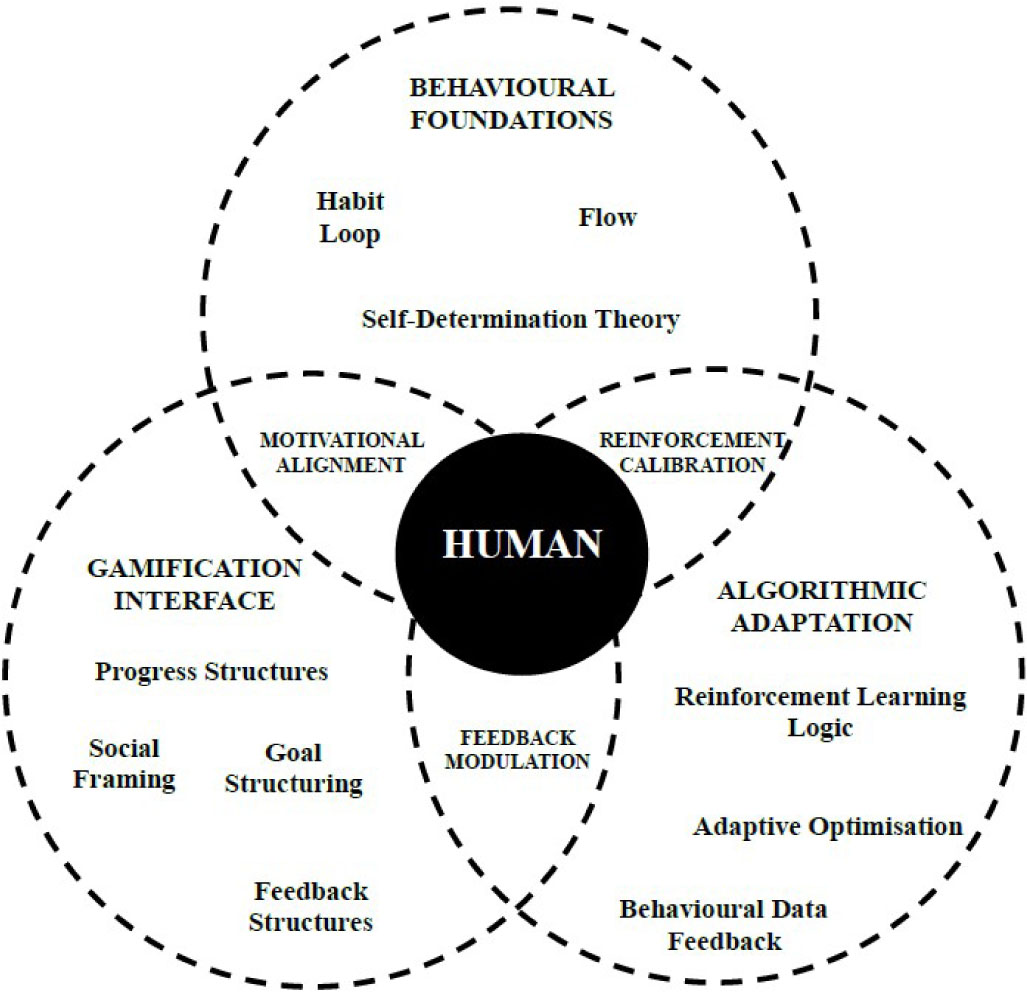
Figure 2.
Adaptive reinforcement architecture in AI-driven gamification
Source: own study.
By conceptualising AI-driven gamification as a layered reinforcement architecture rather than as a collection of isolated techniques, the model establishes a system-level perspective applicable across digital marketing contexts. It provides a structured analytical lens for examining how behavioral design, interface mechanics, and adaptive algorithms converge to shape persistent engagement.
DISCUSSION
The proposed framework conceptualises AI-driven gamification not as an incremental enhancement of digital engagement but as a structural reconfiguration of behavioral reinforcement architectures. By distinguishing between adaptive reinforcement learning, real-time feedback calibration, and behavioral loop structuring, the model reframes AI as a systemic habit architect rather than a peripheral optimization tool.
Theoretical Contribution
This reconceptualization contributes to the literature in four principal ways.
First, it advances theoretical integration beyond descriptive accounts of convergence. Recent marketing scholarship has documented the emergence of AI-enabled feedback-loop architectures and customer-centric adaptive systems (Palmucci et al., 2025), while bibliometric analyses demonstrate the rapid expansion of AI-driven personalization research across marketing domains (Nalbant & Aydin, 2025). However, these contributions primarily map trends or conceptual shifts without specifying the underlying reinforcement logic linking behavioral theory, gamified interfaces, and algorithmic optimization. The present model moves beyond trend identification by articulating a structurally bounded reinforcement architecture in which behavioral conditioning, interface mechanics, and computational adaptation operate recursively within a single system.
Second, the framework introduces a structural distinction between core and peripheral mechanisms. Core mechanisms (behavioral loop structuring, reinforcement calibration, and algorithmic adaptation) constitute the necessary conditions for adaptive habit formation. Peripheral mechanisms, such as symbolic rewards, social comparison, or multimodal interaction layers, intensify engagement but do not define the architecture itself. This differentiation reduces conceptual inflation and clarifies theoretical boundaries, thereby addressing long-noted ambiguities in gamification research (Seaborn & Fels, 2015). In doing so, the model provides sharper analytical criteria for identifying when gamification becomes an adaptive reinforcement architecture rather than remaining a static motivational overlay.
Third, the model extends ethical scholarship in AI marketing by structurally embedding normative risk within reinforcement architecture. While recent studies highlight ethical frontiers in AI-enabled marketing (Hari et al., 2025) and identify tensions between personalization and privacy (Saura et al., 2024), these discussions typically operate at a governance, compliance, or policy level. The present framework advances this discourse by specifying architectural inflection points (data capture, adaptive personalization, reinforcement calibration, and feedback opacity) at which the intensity of optimization amplifies asymmetries between platforms and users. Ethical exposure is thus conceptualised as proportional to the intensity of reinforcement calibration, thereby transforming ethical debate from an abstract principle into an architectural condition.
Fourth, the framework posits falsifiable structural propositions linking the granularity and transparency of reinforcement calibration to perceived autonomy and contestability. This shifts the discussion from normative evaluation to testable design parameters, enabling empirical operationalization. In contrast to broad ethical appeals, the model identifies optimization logic itself as a measurable explanatory variable.
It may be argued that the present framework reorganises rather than reinvents existing research streams. However, its contribution lies not in introducing new variables, but in specifying their structural interdependence and the logic of optimization. By formalising reinforcement calibration as the central architectural mechanism that links behavioral conditioning, interface design, and algorithmic learning, the model shifts the analytical focus from thematic aggregation to system-level causality. This structural specification distinguishes the framework from prior integrative accounts of AI-driven marketing.
Theoretical Implications
The model suggests that adaptive persuasion differs qualitatively from traditional persuasive design. Whereas classical gamification relies on predefined motivational triggers and relatively stable reward schedules (Deterding et al., 2011; Werbach & Hunter, 2012), AI-driven systems recalibrate reinforcement contingencies continuously at the individual level. This transforms engagement from static motivation into dynamic behavioral modulation.
Conceptually, habit formation in digital marketing contexts cannot be adequately explained by conditioning theory or user experience design alone. Instead, it must be analysed as a computationally mediated reinforcement process in which reward probabilities and feedback intensity are algorithmically adjusted in real time (Sutton & Barto, 2018). In this sense, adaptive marketing systems function as adaptive reinforcement architectures rather than isolated engagement tactics. This architectural shift is consistent with broader research demonstrating how AI restructures strategic decision logics beyond operational optimization. In strategic planning contexts, AI has been shown to transform scenario analysis from static forecasting into dynamically adaptive modelling under uncertainty (Bessa & Barbosa, 2025). By analogy, adaptive reinforcement architectures in digital marketing similarly recalibrate behavioral trajectories in response to evolving data environments.
By structurally linking micro-level psychological mechanisms to macro-level marketing architectures (Palmucci et al., 2025), the framework advances a system-level vocabulary that explains how adaptive engagement scales across digital ecosystems.
Managerial and Governance Implications
For practitioners, the model highlights a structural optimization dilemma. Reinforcement calibration enhances personal relevance, retention, and experiential resonance. Simultaneously, increasing granularity and opacity of adaptation amplifies ethical exposure. Managers, therefore, confront not merely a compliance issue but a design-level calibration problem: how to regulate the intensity of optimization while maintaining transparency, proportionality, and user agency.
While recent AI marketing ethics scholarship emphasises explainability and responsible data governance (Hari et al., 2025), this study extends that discussion by arguing that governance must address reinforcement architecture itself. Regulatory approaches that focus exclusively on data-collection practices overlook the behavioral consequences of adaptive calibration mechanisms. As algorithmic systems increasingly shape engagement trajectories, governance frameworks must treat optimization logic as a primary site of accountability (Floridi et al., 2021).
Limitations
Despite its integrative ambition, the proposed framework remains conceptual and requires empirical validation. The structural propositions articulated in Section “AI AS A HABIT ARCHITECT” necessitate longitudinal and experimental testing across diverse digital marketing environments.
Second, the model assumes relatively coherent reinforcement loops. In practice, digital behavior is fragmented, context-dependent, and influenced by emotional and situational variability (O'Brien & Toms, 2008; Montag et al., 2019). Such instability may moderate or disrupt adaptive habit formation.
Third, the framework applies primarily to data-intensive ecosystems characterised by continuous behavioral tracking and algorithmic recalibration. Low-data or intermittent engagement environments may not exhibit comparable adaptive dynamics.
Finally, while ethical inflection points are structurally identified, their measurement requires operational refinement. Constructs such as reinforcement calibration intensity, transparency perception, proportionality of nudging, and perceived autonomy must be empirically specified and validated.
Future empirical studies should operationalise optimization intensity using measurable indicators such as reward variability, the frequency of algorithmic recalibration, or the degree of granularity of personalization. Examining how these indicators relate to perceived autonomy, perceived transparency, and contestability would enable systematic testing of the proposed ethical inflection points. Such operationalization could also help identify threshold effects at which adaptive reinforcement shifts from supportive habit formation toward intrusive behavioral steering.
Directions for Future Research
Future empirical research may test the model by:
– experimentally comparing static and adaptive gamification systems,
– manipulating reinforcement variability and transparency to assess autonomy perceptions,
– measuring behavioral persistence under adjustable personalization intensity,
– auditing algorithmic systems to evaluate calibration logic and ethical proportionality.
Longitudinal cross-sector analyses (e.g., education, fitness, retail platforms) could further clarify boundary conditions and behavioral convergence dynamics.
Methodologically, the framework encourages interdisciplinary research designs combining behavioral analytics, experimental manipulation of reinforcement structures, and algorithmic auditing. Mixed-method approaches may be particularly suitable for capturing both behavioral persistence metrics and subjective perceptions of autonomy and transparency. This integrated methodological orientation aligns with the recursive nature of adaptive reinforcement architectures.
By positioning AI as a structural habit architect embedded within digital marketing ecosystems, this study advances a theoretically bounded and operationalizable framework for analysing adaptive persuasion. Rather than describing digital engagement trends, it articulates a recursive reinforcement architecture that links behavioral psychology, gamification design, and algorithmic optimization within a unified explanatory system.
CONCLUSION
This study reconceptualises artificial intelligence in digital marketing as a structural driver of adaptive reinforcement architectures rather than a supplementary optimization tool. By integrating behavioral psychology, gamification structures, and machine-learning-based calibration into a single recursive architecture, the framework clarifies how contemporary platforms transform engagement into sustained habit formation.
The model advances theory by specifying the structural conditions under which adaptive persuasion operates, distinguishing foundational reinforcement mechanisms from peripheral engagement amplifiers. In contrast to research that documents the rise of AI-driven feedback-loop marketing or maps emerging ethical frontiers, the present framework articulates how behavioral conditioning, interface mechanics, and algorithmic optimization coalesce into a unified adaptive reinforcement architecture.
Importantly, the study embeds ethical analysis within the optimization logic itself, identifying how the intensity, opacity, and reversibility of reinforcement calibration shape outcomes for autonomy and accountability. Ethical risk is thus conceptualised not merely as a governance concern but as a function of structural design parameters.
By positioning reinforcement calibration as the central analytical variable, the framework moves beyond descriptive or governance-level accounts of AI marketing and offers a bounded, falsifiable architecture that is empirically operationalizable.
As AI-enabled marketing systems increasingly rely on recursive feedback infrastructures, understanding their behavioral and normative implications becomes critical. Conceptualising AI as a habit architect provides a structured foundation for future empirical testing, regulatory reflection, and responsible system design in data-intensive engagement environments.