
Table 1.
The comparison and research gap between the presented study and published papers in the area of IoT and blockchain applications in part manufacturing procedures.
| Aspect | The presented research work | Existing Reviews (Summary) | Research Gap |
|---|---|---|---|
| Scope Focus | IoT and blockchain integration specifically for smart machine tools in Industry 4.0. | Broad Industry 4.0 & blockchain and IoT—general smart factories, supply chains, security and trust mechanisms. e.g., smart manufacturing frameworks, smart contract automation, AI-blockchain synergy [20]. | There is limited literature focusing narrowly on smart machine tools; most address broad manufacturing or SCM. |
| Application Examples / Use Cases | Emphasis on concrete use cases: smart contracts for maintenance, traceability in CNC, IoT-enabled predictive maintenance. | Mostly conceptual or generic applications (smart factories, supply chains, digital twins) [21] | A gap exists in case-specific analyses focused on machine tools rather than entire factories or supply chains. |
| proposed frameworks of study | Offers conceptual descriptions of blockchain and IoT for CNC workflows | Provides a bi-dimensional framework mapping blockchain roles to manufacturing systems and PLM, plus discussion of business/organizational barriers and policy/regulatory challenges [26]. | The research gap is focusing on the smart CNC machine tools within the industry 4.0 |
| Blockchain applications in Industry 4.0 | blockchain + IoT for CNC workflows during Industry 4.0 applications | Applications of cyber-physical systems and Blockchains in Industry 4.0 is studied [27]. | The research gap is focusing on the key roles of smart CNC machines tools within Industry 4.0 era. |
| Methodology / literature coverage | Focused on smart CNC machine tools in Industry-4.0 settings: data security, predictive maintenance, quality control, supply-chain traceability, smart contracts for machine-to-machine workflows. | Broad, cross-domain survey of blockchain + IoT taxonomy of architectures, consensus, applications (energy, healthcare, smart cities, IIoT), security/privacy, scalability and open challenges [28] | smart CNC machine tools specifically within the industry 4.0. |
Table 2.
applications, advantages and challenges of blockchain and IoT applications in smart CNC machine tools.
| Focus Area | Theoretical Concepts | Technological Implementations | Real-world Applications | Benefits | Challenges |
|---|---|---|---|---|---|
| Data Security | Decentralized ledger for secure data exchange; cryptographic hashing; immutability. | Blockchain protocols (Hyperledger, Ethereum, IOTA), encryption, access control via smart contracts. | Secure CNC operational data logging; prevention of cyber threats; trusted data exchange. | Protection from tampering, unauthorized access; enhanced trust and operational integrity. | Scalability; blockchain vulnerabilities; interoperability with legacy systems. |
| Traceability | Immutable and transparent transaction records. | Blockchain audit trails; RFID and IoT sensor integration. | Tracking CNC tool lifecycle; tracing product parts across supply chains. | Improved accountability, compliance, and customer assurance. | Standardization; integration complexity across multiple stakeholders. |
| Predictive Maintenance | Data-driven failure prediction; ML models for anomaly detection. | IoT sensor networks; blockchain-backed maintenance logs; edge–fog–cloud architectures. | Aerospace and automotive CNC PdM systems; vibration and temperature monitoring. | Reduced downtime; extended tool life; cost savings. | Data processing latency; integration complexity; blockchain scalability for continuous data logging. |
| Smart Contracts & Automation | Self-executing agreements encoded on blockchain. | Ethereum/Hyperledger smart contracts; API and microservices integration. | Automated service agreements; M2M process triggers; decentralized supply chain transactions. | faster execution; improved coordination. | Legal enforceability; interoperability; coding errors in contracts. |
| Supply Chain Management | Distributed, transparent, and immutable supply chain records. | Blockchain + IoT-enabled part tracking; automated SCM via smart contracts. | Multi-site CNC production coordination; supplier compliance verification. | Improved transparency; fraud reduction; better collaboration. | Scalability; high integration cost; energy consumption in blockchain operations. |
| Quality Control | Immutable quality records; real-time monitoring; automated QA rules. | IoT-enabled QC sensors; blockchain for data storage; digital twins. | Aerospace and automotive machining QA; automated defect detection and traceability. | Enhanced product reliability; regulatory compliance; waste reduction. | Scalability; blockchain integration with existing QA systems; protocol standardization. |
Table 3.
PRISMA flow diagram of the study selection process.
| PRISMA Stage | Number |
|---|---|
| Records identified through database searching | 620 |
| Duplicates removed | 202 |
| Records screened | 418 |
| Records excluded after title/abstract screening | 177 |
| Full-text articles assessed | 241 |
| Full-text articles excluded | 71 |
| Studies included in review | 170 |
Table 4.
Data extraction items used in the review.
| Category | Extracted Data |
|---|---|
| Publication information | Authors, year, source |
| Study characteristics | Experimental, case study, review, framework |
| Blockchain technology | Ethereum, Hyperledger, IOTA, etc. |
| IoT technology | Sensors, MQTT, CoAP and OPC-UA |
| Manufacturing application | PdM, SCM, QC and traceability |
| Key outcomes | Benefits and performance improvements |
| Challenges | Scalability, interoperability and energy usage |
Table 5.
protocol-specific blockchain traits (consensus, data structures, security) and IoT architectural layers (edge-fog-cloud, CPS, service-oriented) mapped to practical use cases in smart CNC machine integration.
| Aspect | Blockchain Protocols | IoT Architectures | Application in Smart Machine Tool Integration |
|---|---|---|---|
| Consensus Mechanism | Ethereum (PoS) – lower energy than PoW, supports complex smart contracts; Hyperledger Fabric – permissioned, modular consensus; IOTA Tangle – DAG-based, feeless for high sensor data throughput [53]. | Edge–Fog–Cloud layered model – edge devices for sensing, fog for preprocessing, cloud for analytics & storage [54]. | Enables low-latency, secure validation of CNC machine sensor data; fog nodes can run lightweight blockchain clients for local verification. |
| Ledger Type | Permissioned (Hyperledger, Quorum) – controlled access, higher throughput; Permissionless (Ethereum, IOTA) – open participation [55]. | Three-tier IIoT architectures – device layer, network layer, application layer. | Protects operational parameters (spindle speed, vibration, temperature) from tampering; enforces access control via smart contracts. |
| Data Structure | Blockchain chain structure (Ethereum, Hyperledger); Directed Acyclic Graph (IOTA, Nano) for scalability in high-frequency IoT data. | Cyber-Physical Systems (CPS) with integrated IoT gateways. | Immutable storage of quality control logs; DAG supports high-frequency telemetry without blockchain congestion. |
| Smart Contract Support | Ethereum – Turing-complete smart contracts; Hyperledger Fabric – chaincode with fine-grained permissions; Quorum – enterprise-grade private smart contracts. | Service-Oriented IoT architecture – API gateways and microservices for machine data services [56]. | Automates predictive maintenance triggers and quality assurance steps directly from sensor readings. |
| Scalability Solutions | Ethereum Layer-2 (Polygon, Optimism); Hyperledger channels; IOTA partitioned Tangle [57]. | Edge analytics to reduce cloud load, fog orchestration for preprocessing. | Supports high data throughput from multi-axis CNCs without blockchain bottlenecks. |
| Security Features | Hyperledger Fabric – MSP for identity management; Ethereum – cryptographic wallets; IOTA – quantum-resistant signatures. | MQTT/CoAP lightweight protocols for constrained devices, secured with TLS/DTLS [58]. | Protects data in transit from edge sensors, ensures end-to-end authenticity from spindle sensor to blockchain ledger. |
| Traceability & Audit | Hyperledger – immutable private channels; Ethereum – public verifiability; IOTA – tamper-proof logs for supply chain. | Interoperable IoT gateways supporting OPC-UA and industrial protocols. | Tracks lifecycle of tooling parts and production parameters for compliance and customer assurance. |
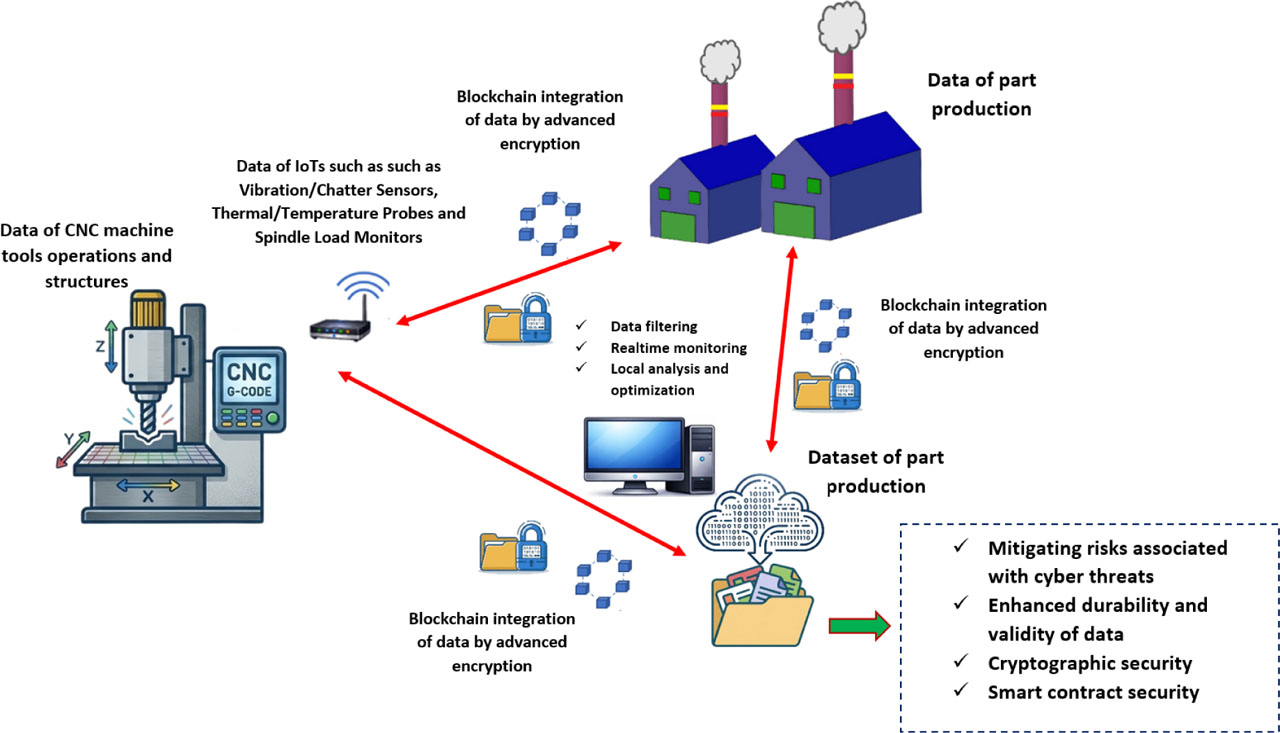
Figure 1.
Application of IoTs and blockchain integration of data by advanced encryption during data sharing of part manufacturing.
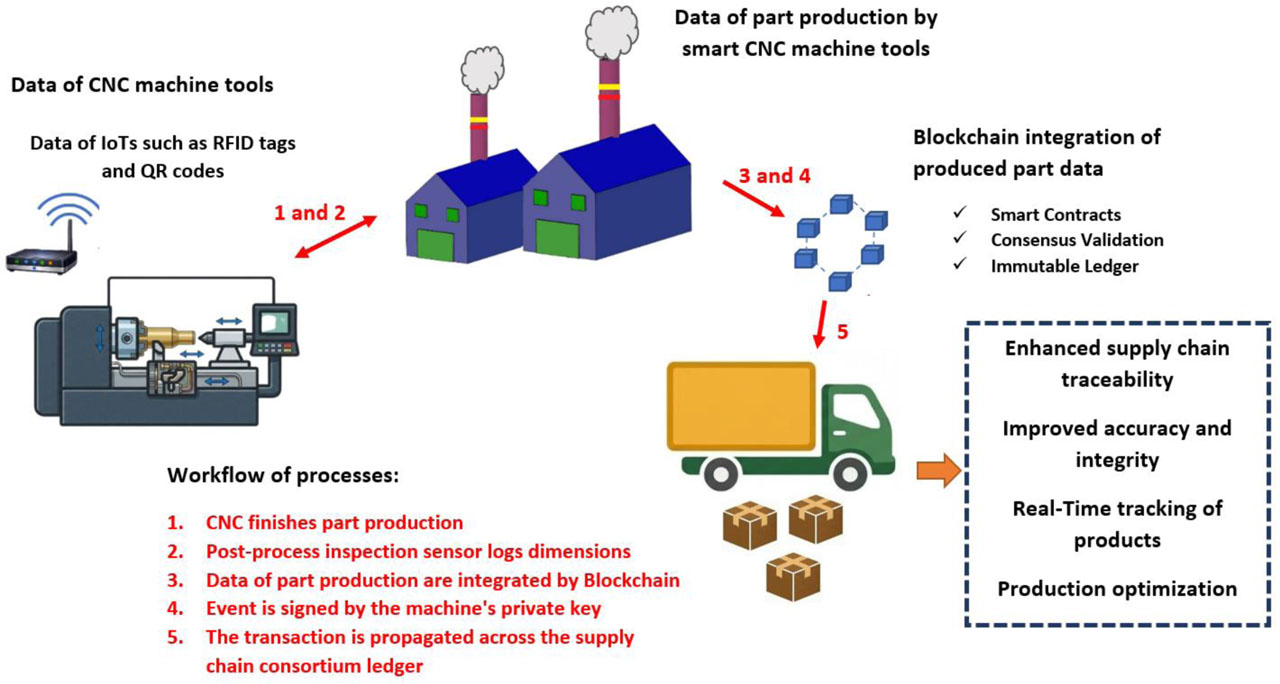
Figure 2.
Applications of IoTs and blockchain in traceability for products throughout the supply chain.
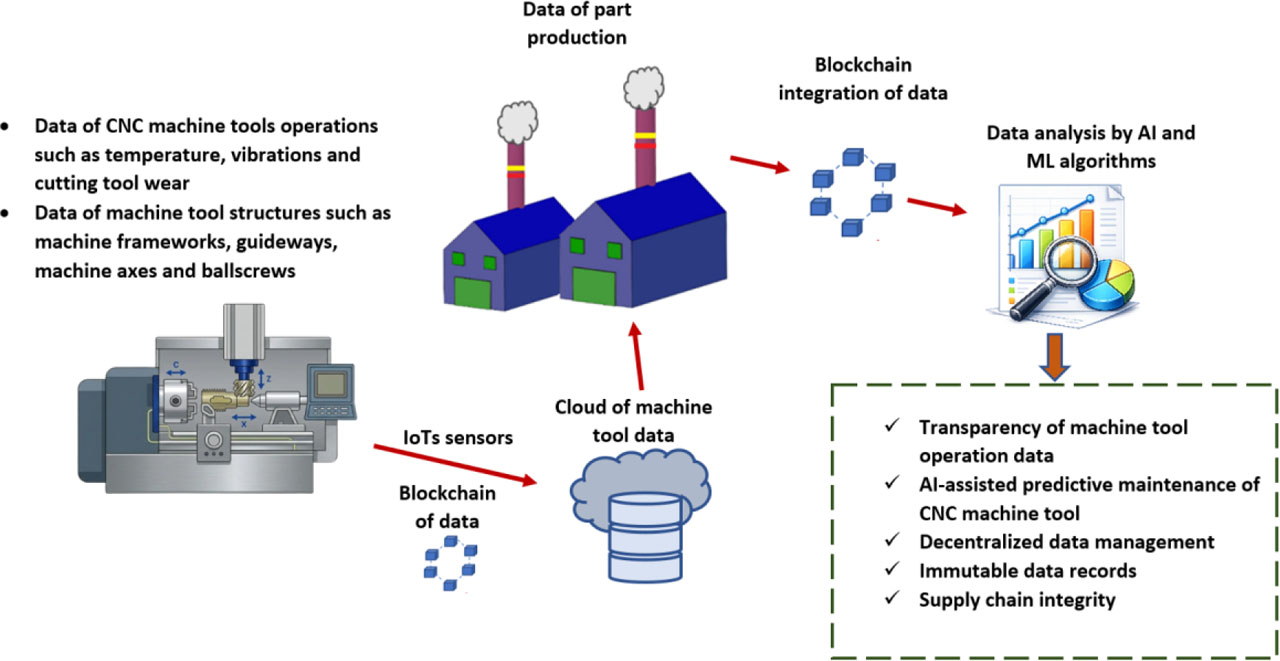
Figure 3.
Application of blockchain technology in transparency of machine tool operation data within part production and manufacturing process.
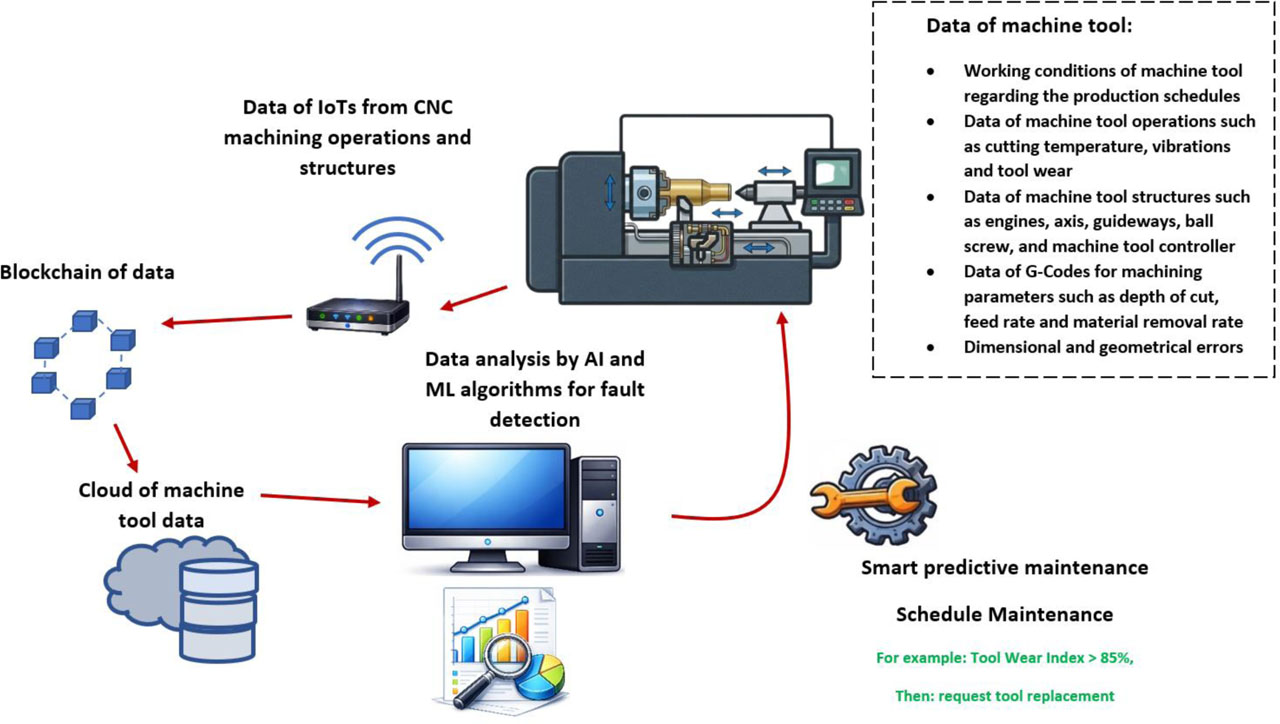
Figure 4.
Applications of IoTs and Blockchain in smart predictive maintenance of CNC machine tools.
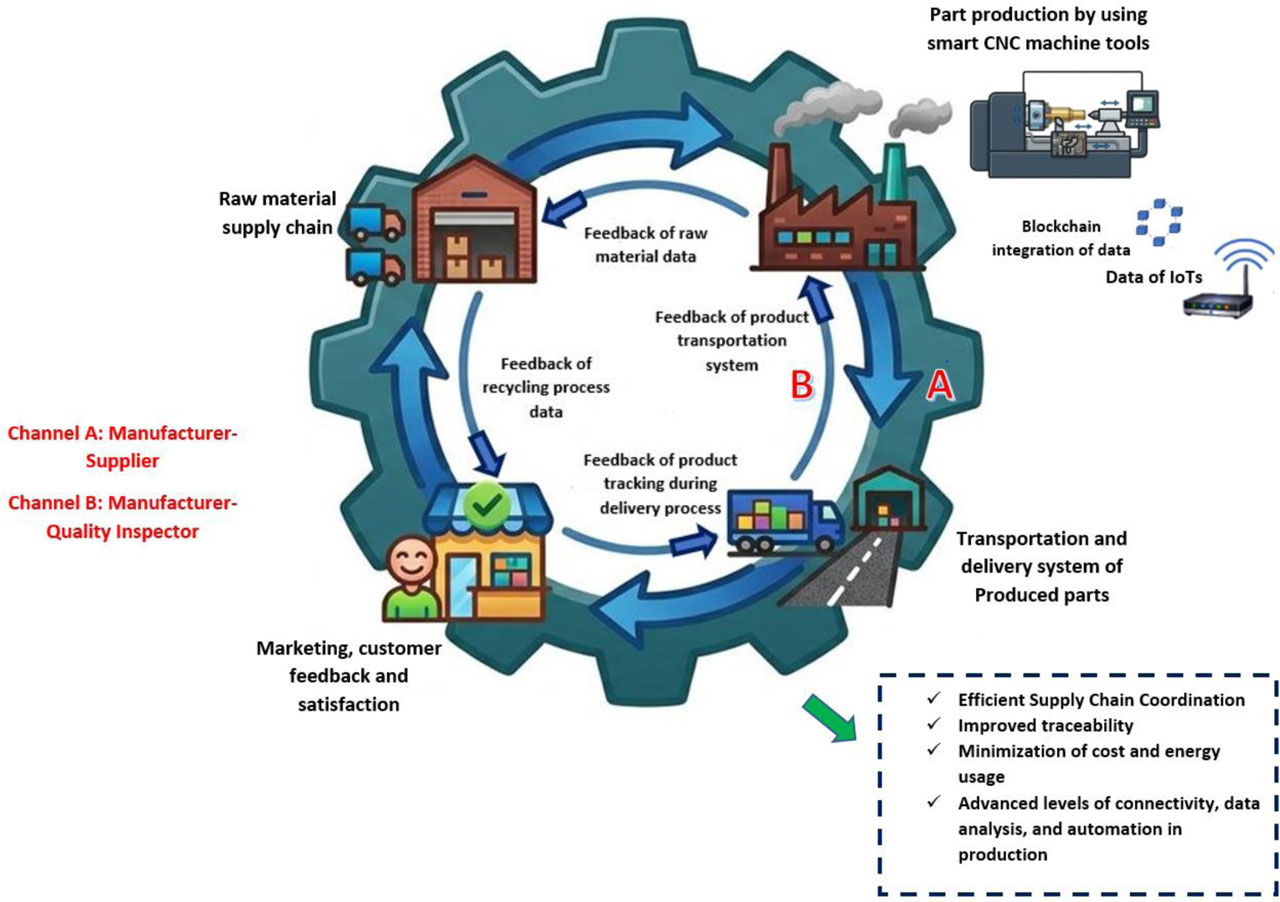
Figure 5.
Application of IoTs and Blockchain during supply chain management of advanced part production by using smart CNC machine tools within industry 4.0 era.
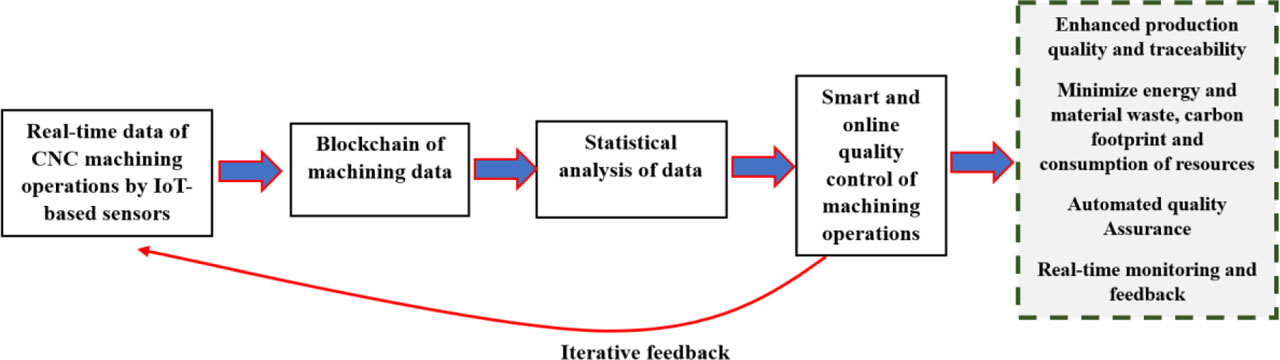
Figure 6.
Application of IoTs and blockchain in Smart and online quality control of machining operations.
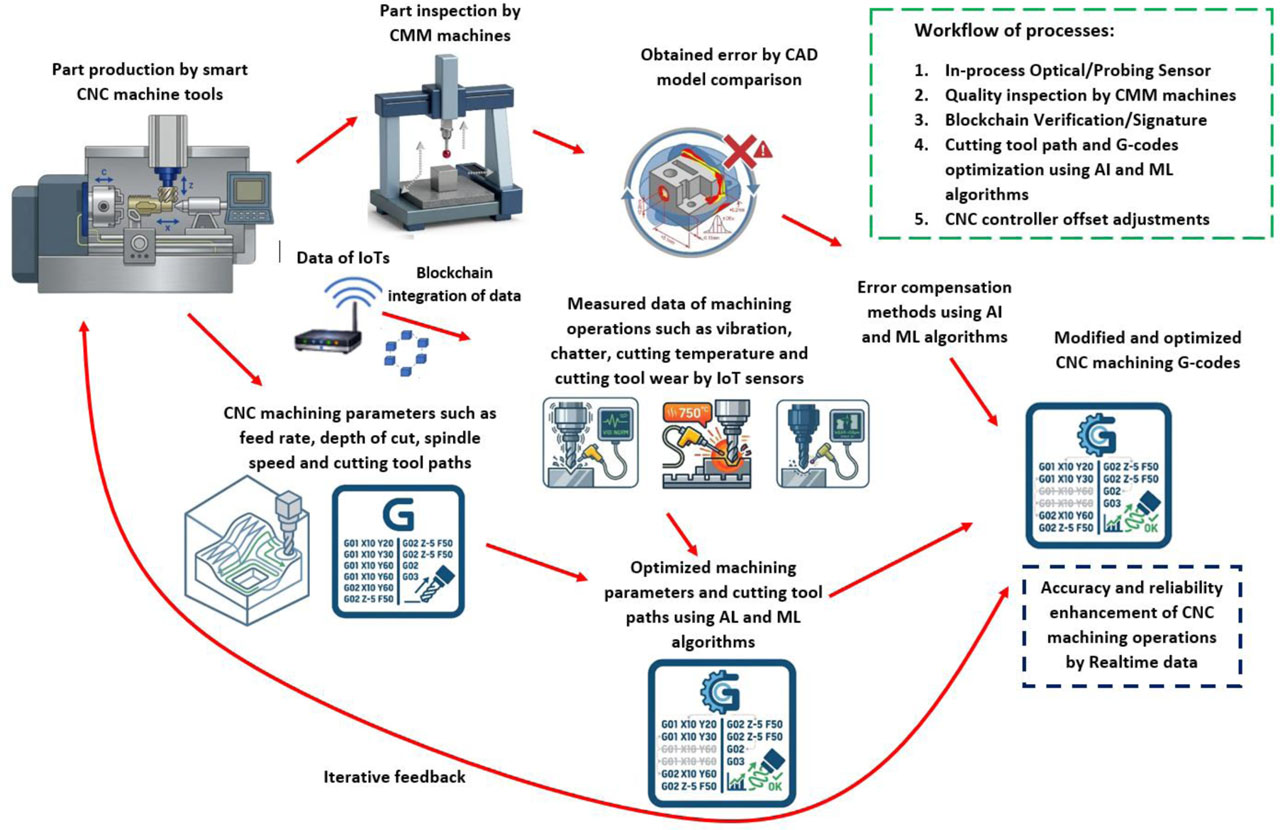
Figure 7.
Application of IoTs and blockchain in accuracy enhancement of smart CNC machining operations.
Table 6.
Strengths, weaknesses, and remaining research gaps for the different approaches of blockchain platforms.
| Approach | Strengths | Weaknesses | Research Gap |
|---|---|---|---|
| Ethereum-Based Systems | Strong decentralization, flexible smart contracts | High latency, transaction fees, scalability limitations | Real-time industrial deployment |
| Hyperledger Fabric | Low latency, permissioned access, high throughput | Limited decentralization, deployment complexity | Cross-platform interoperability |
| IOTA-Based Systems | High scalability, lightweight IoT integration | Lower industrial maturity | Large-scale manufacturing validation |
| Cloud-Based Architectures | High computational capability | Communication delays, centralized risks | Real-time responsiveness |
| Edge–Fog–Cloud Architectures | Low latency, distributed processing | Increased system complexity | Standardized implementation frameworks |
| Blockchain + IoT for Predictive Maintenance | Improved traceability and maintenance reliability | High sensor-data volume and storage requirements | Scalable data-management methods |
| Blockchain + IoT for Quality Control | Immutable quality records and transparency | Integration challenges with existing QC systems | Industrial-scale deployment studies |
Table 7.
Experimental and real-world deployments of blockchain–IoT integration for machine tool monitoring and predictive maintenance.
| Typical Blockchain–IoT Implementation | System Architecture | Blockchain Role | IoT / Edge Components | Machine Tool Application | Key Outcomes |
|---|---|---|---|---|---|
| Ethereum-based CNC Monitoring | Edge–Fog–Cloud with Ethereum blockchain backend | Stores tamper-proof operational logs of CNC machines | Vibration, temperature, and spindle speed sensors over MQTT | CNC milling and turning machines | Provides secure and traceable machine data management, enhances data integrity, and supports condition monitoring and predictive maintenance. |
| Hyperledger Fabric for Tool Lifecycle Management | Layered cloud–fog–edge | Blockchain records tool usage history and maintenance events | RFID tool tracking + CoAP-based sensors for spindle load | Precision machining centers | Improved traceability of cutting tools; enhanced predictive maintenance scheduling |
| Consortium Blockchain for Cross-factory Data Sharing | Multi-cloud integration with edge gateways | Maintains a permissioned shared ledger for secure data exchange and traceability across multiple manufacturing sites | Edge gateways collecting depth of cut, torque, and thermal data | Multi-site CNC production lines | Enables secure cross-factory data sharing, improves traceability and collaboration among manufacturing sites, and supports coordinated production planning and maintenance decision-making. |
| Smart Contract–Driven Predictive Maintenance | Edge analytics + cloud blockchain storage | Smart contracts trigger maintenance requests | Edge devices processing vibration and acoustic emission data | CNC lathes in aerospace component manufacturing | Reduced unexpected failures; improved maintenance efficiency |
| Blockchain-enabled Digital Twin of Machine Tools | Edge–fog–cloud with digital twin in cloud | Blockchain ensures integrity of digital twin state data | Sensors for cutting force, temperature, and speed | Multi-axis CNC machining centers | Increased accuracy of predictive models; ensured trusted data for simulation |
Table 8.
A summary of the identified research gaps.
| Area of study | Identified Research Gap |
|---|---|
| Scalability | Lack of blockchain solutions capable of handling high data throughput from smart machine tools without performance loss. |
| Interoperability | Absence of universal standards for seamless integration between blockchain, IoT, AI, and legacy manufacturing systems. |
| Energy Efficiency | High energy consumption of blockchain consensus mechanisms unsuitable for sustainable manufacturing. |
| Regulatory Frameworks | Unclear legal and compliance guidelines for blockchain use in industrial environments. |
| Smart Contract Reliability | Need for secure, bug-free, and optimized smart contracts for industrial automation. |
| Real-time Processing | Limited blockchain solutions that support real-time decision-making and low-latency operations. |
| Integration with AI/ML | Underexplored synergy between blockchain, AI, and ML for enhanced predictive maintenance and process optimization. |