
1. Introduction
Science has become an indispensable feature of our society. Science has become an integral part of our daily life. There is no aspect of man’s life today which has not been influenced by science in one way or the other. This is because we are living in an age of scientific culture. Science has shrunk the world and totally changed the human outlook. In reality, science currently has a profound impact on all aspects of human life. Science helps us to understand the life, society, and the world around us systematically. Science is not confined in the walls of books only but has touched every aspect of our life. Science gives us an idea about how to think and act critically. Now science is not only used as a teaching subject but also as a process. Scientific and technological literacy is a universal requirement of the hour. Science is an endless process of knowing our nature effectively. It penetrates into the root of objects. It is a process of discovering new truth. Scientific attitude, attitude towards science, scientific methods are the parts of science as a process. Science as a content as well as science as a process is both important in their own ways.
Our society is moving into a technological era. For reasons such as this, the concept of attitude towards science is becoming increasingly important in modern societies. We need adolescent students as well as common people having sound attitude towards science in every sphere of life. If we have to compete with the world in economic growth and knowledge capital, then it is necessary that our teachers should encourage and support our young masses with creativity, knowledge, and favourable attitude towards science. One of the most important roles of science is to help the society to prosper, and move towards betterment and a bright future.
The research on the subject is extensive, and the findings are well known: science is perceived as difficult and not relevant to the lives of most people, interest in science declines over the years of secondary schooling (Barmby et al., 2008; Bennett & Hogarth, 2009). The falling numbers of students choosing to pursue the study of science have caught the attention of the science education research and has led to focus on the factors that influence attitudes towards science (Barmby et al., 2008). Only handful of students are willing to pursue their carrier in science. Our duty is to motivate them to pursue their carriers in science. If school-going adolescent students were made aware of science and technology and its significance in lives as well as society, then it would go a long way in creating sustainable life styles. Keeping this in mind, it is essential to know the students’ attitude towards science subject.
Understanding learners’ attitudes towards science is crucial in shaping effective science education policies and practices. Several recent studies have explored this area, emphasizing various demographic and academic factors influencing students’ attitudes. Binwal (2020) conducted a study to examine the felt problems in studying science and attitudes towards science among Grade 9 adolescent students in Almora, Uttarakhand. A sample of 100 students from different government schools was selected using stratified random sampling. The scientific attitude scale was used for data collection, and t-tests were employed for statistical analysis. The findings showed a significant difference in attitudes between rural and urban students, with urban students having more favourable attitudes. Furthermore, academic performance was found to influence attitudes: students with higher achievement in their previous class showed more positive attitudes towards science. The study concluded that both geographical background and academic achievement impact scientific attitudes and recommended organizing science workshops and awareness programs to enhance interest among rural and low-achieving students. Similarly, Bajaj and Devi (2021) examined attitudes towards science among secondary school students from selected government and private schools in the Jammu district. The study comprised 200 students and employed the Science Attitude Scale. The results indicated that while students from both school types had generally positive attitudes, female students showed more favourable attitudes than males. In addition, students attending private schools and those with higher academic achievement exhibited more positive attitudes towards science. This study highlights the influence of school type, gender, and academic success on students’ orientation towards science education. In a more recent study, Lalruatpuii et al. (2024) carried out a descriptive investigation titled “Attitude Towards Science Among Secondary School Students in Aizawl District.” A total of 367 students from both government and private schools in Mizoram participated in the study. The attitude towards science scale was used as the research instrument. The results indicated that the overall attitude towards science was low. However, female students demonstrated a more positive attitude than their male peers. The findings suggest a need for teachers and the education system to play an active role in cultivating positive scientific attitudes, especially among male students.
Collectively, these studies underline that students’ attitudes towards science are shaped by multiple interrelated factors, including gender, geographical location, and school type. The literature emphasizes the need for context-sensitive interventions that promote scientific interest and positive attitudes, particularly among disadvantaged student groups.
1.1. Methodology
The study employed a descriptive survey method to assess learners’ attitudes towards science subject. The sample consisted of 119 class IX students from a secondary school in Goa, selected using Convenience Sampling. Data were collected using a standardized attitude scale, i.e. Science Attitude Scale by Dr (Mrs.) Avinash Grewal, Questionnaire.
2. Objectives
To study the Students’ attitude towards science subject.
Hypothesis
(1) There is no significant difference between the mean scores of boys and girls with respect to their attitude towards the science subject.
(2) There is no significant difference between the mean scores of students residing in rural and urban areas with respect to their attitude towards the science subject.
2.1. Objective – 1
To study the Students’ attitude towards science subject (Table 1).
Table 1
Students’ attitude towards science.
| Sr. no. | Level of scientific attitude | No. of students | Percentage (%) |
|---|---|---|---|
| 1 | Extremely high favourable | 1 | 0.84 |
| 2 | Highly favourable | 4 | 3.36 |
| 3 | Above average favourable | 44 | 36.97 |
| 4 | Moderate/Average favourable | 42 | 35.29 |
| 5 | Unfavourable | 17 | 14.28 |
| 6 | Very unfavourable | 9 | 7.56 |
| 7 | Extremely unfavourable | 2 | 1.68 |
Source: Author’s contribution.
The findings reveal that the majority of students demonstrate a positive orientation towards science, with 36.97% exhibiting an above average favourable attitude and 35.29% showing a moderate or average favourable attitude. A small percentage of students fall into the higher end of the spectrum, with 3.36% displaying a high favourable attitude and only 0.84% reflecting an extremely high favourable attitude. However, a notable proportion of students exhibit negative attitudes towards science: 14.28% fall under the unfavourable category, 7.56% show very unfavourable attitudes, and 1.68% are classified as extremely unfavourable. These results suggest that while a significant number of students hold a favourable view of science, there remains a considerable group that may benefit from targeted interventions to enhance their scientific attitude (Table 2).
(1) There is no significant difference between the mean scores of boys and girls with respect to their attitude towards the science subject.
Table 2
Gender wise N, Mean, SD, t-value, and p-value of attitude towards science subject.
| Gender | N | Mean | SD | t-value | p-value | S/NS |
|---|---|---|---|---|---|---|
| Male | 66 | 44.6212 | 7.69768 | 2.816 | 0.006 | S |
| Female | 53 | 48.3962 | 6.69196 |
Source: Author’s contribution.
The results indicate that female students (M = 48.40, SD = 6.69) have a higher mean score than male students (M = 44.62, SD = 7.70). The t-value of 2.816 and the associated p-value of 0.006 (which is less than the 0.05 level of significance) suggest that the difference is statistically significant. Therefore, the null hypothesis stating that “there is no significant difference between the mean scores of male and female students with respect to their scientific attitude” is rejected. This implies that gender plays a significant role in influencing students’ attitudes towards science, with female students showing a more favourable attitude than their male counterparts. The data are reported in Graph 1 (Table 3).
(2) There is no significant difference between the mean scores of students residing in rural and urban areas with respect to their attitude towards the science subject.
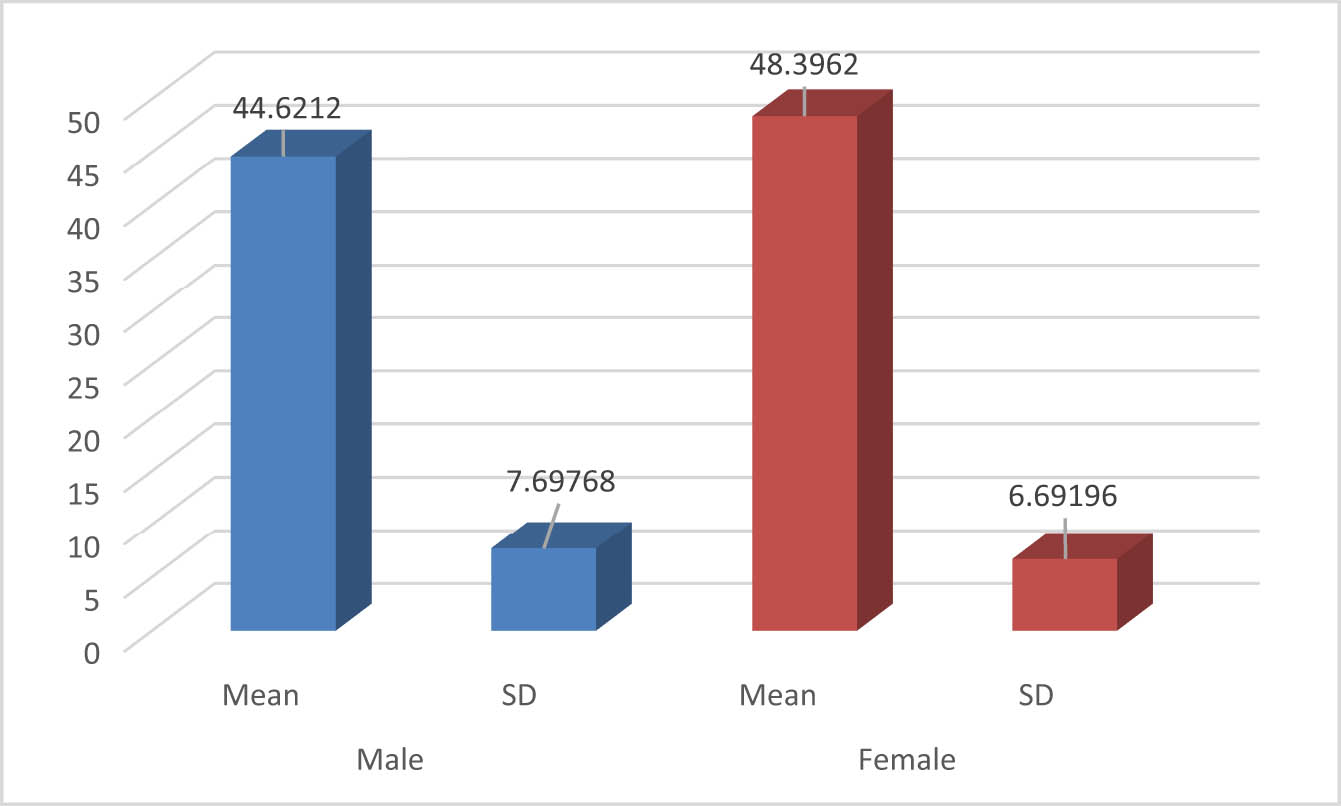
Graph 1
Gender wise comparison of attitude towards science subject.
Source: Author’s contribution.
Table 3
Locality wise N, Mean, SD, t-value, and p-value of attitude towards science of students.
| Locality | N | Mean | SD | t-value | p-value | S/NS |
|---|---|---|---|---|---|---|
| Rural | 23 | 46.4348 | 7.47010 | 0.129 | 0.898 | NS |
| Urban | 96 | 46.2105 | 7.53558 |
Source: Author’s contribution.
The results indicate that the students residing in rural areas (M = 46.43, SD = 7.47) have a slightly higher mean score than those residing in urban areas (M = 46.21, SD = 7.54). However, the t-value of 0.129 and the associated p-value of 0.898 (which is greater than the 0.05 level of significance) suggest that the difference is not statistically significant. Therefore, the null hypothesis stating that “there is no significant difference between the mean scores of students residing in rural and urban areas with respect to their scientific attitude” is not rejected. This implies that residence does not play a significant role in influencing students’ attitudes towards science at least in the context of Goa State, where access to education and exposure to science-related resources may be relatively balanced across regions. The data are reported in Graph 2.
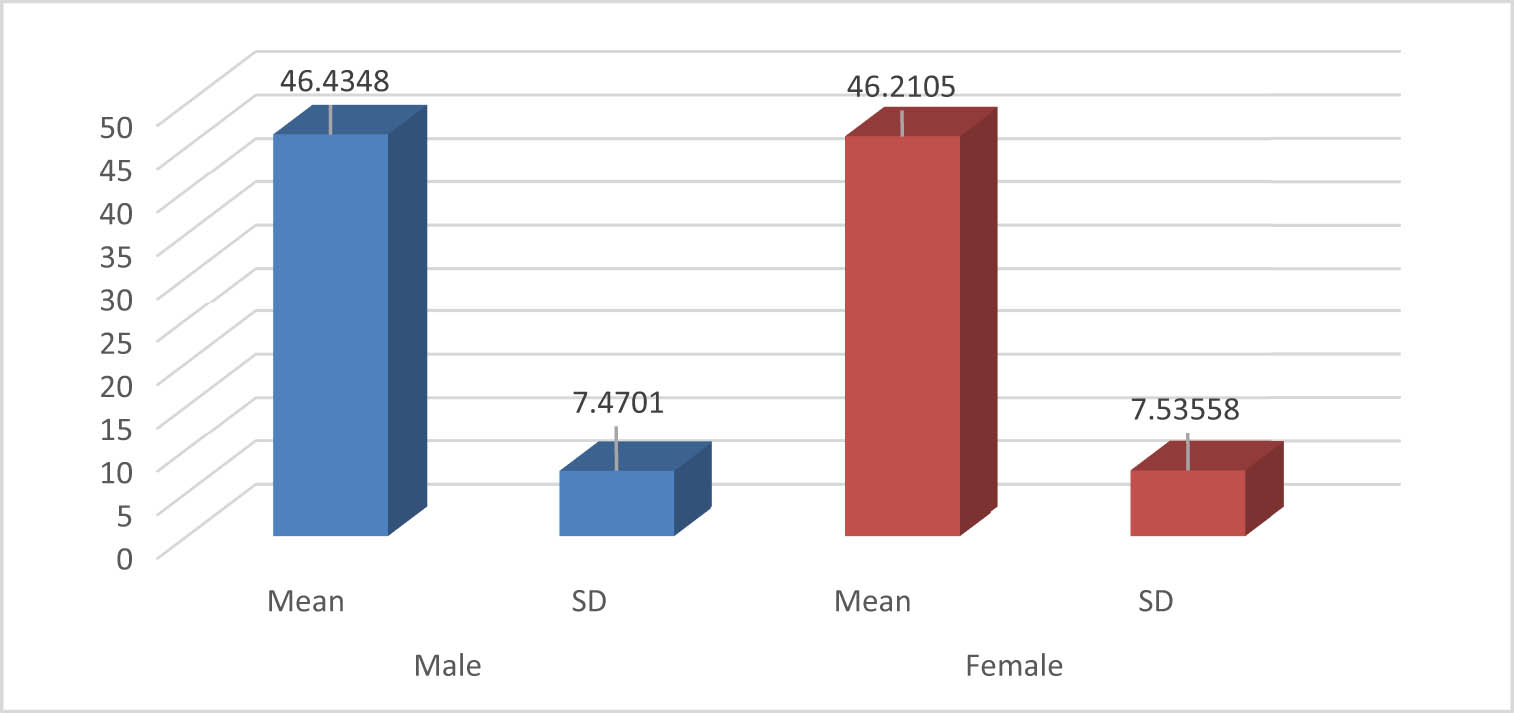
Graph 2
Locality-wise comparison of attitude towards science subject.
Source: Author’s contribution.
2.2. Findings of the study
The study reveals that most students have a positive attitude towards science, with 36.97% showing an above-average favourable attitude and 35.29% displaying a moderate one. However, a notable portion (14.28%) holds an unfavourable view, indicating room for improvement. Gender plays a significant role, as female students (M = 48.40) exhibit a more favourable attitude than male students (M = 44.62), with a statistically significant difference (p = 0.006). In contrast, place of residence (rural vs urban) does not significantly affect attitudes, as the difference in mean scores is negligible (p = 0.898). These findings suggest that while most students are positively inclined towards science, efforts should be made to engage those with less favourable attitudes, particularly through targeted interventions and inclusive teaching strategies. In conclusion, while the general attitude towards science is positive, it is important to address the concerns of students with less favourable attitudes, ensuring that both male and female students are equally encouraged and motivated to engage with science. This will help cultivate a more inclusive and effective learning environment.
3. Discussion
The findings of the study offer meaningful insights into the nature of secondary school students’ attitudes towards science in a school-based context. The data revealed that a majority of students exhibit a moderate to above-average favourable attitude towards science. However, the relatively low percentage of students with highly or extremely favourable attitudes raises concerns about the long-term engagement and interest in science beyond the classroom. This distribution indicates a broad spectrum of engagement with science among students, from enthusiastic learners to those disinterested or even resistant to the subject. Notably, the attitudinal differences based on gender were statistically significant, with female students showing more favourable attitudes towards science than their male counterparts. This observation is consistent with research by Bajaj and Devi (2021) and Lalruatpuii et al. (2024), which supports the notion that girls may maintain a stronger interest in science when they are in encouraging learning environments. For example, Sjøberg and Schreiner (2010), as part of the ROSE project (The Relevance of Science Education), found that girls are more likely to value science that is socially relevant and humanistic, whereas boys tend to be drawn to the technological and mechanical dimensions of science. In settings where the curriculum and teaching methods are designed to be more inclusive, girls often excel over boys in the affective domains of science education (UNESCO, 2017). Conversely, the lack of a statistically significant difference in attitudes between urban and rural students indicates a level of fairness in access to and exposure to science education in the Goa region. This finding contradicts some earlier studies (e.g., Binwal, 2020), which reported more favourable attitudes among urban students, possibly due to better infrastructure and resources. The relatively balanced findings in the present study may reflect successful policy implementations in Goa, where rural and urban schools are relatively well-connected in terms of resource distribution, as highlighted in NCERT reports (2020). These findings emphasize that attitudes towards science are shaped by a complex interplay of factors – including personal interest, academic performance, teacher quality, pedagogical methods, and broader socio-cultural influences (Tuan et al., 2005). Moreover, the observed decline in highly favourable attitudes could be attributed to perceptions of science as difficult or abstract, as seen in other studies (e.g., Barmby et al., 2008; Bennett & Hogarth, 2009). Therefore, addressing students’ attitudes towards science requires systemic educational reform that goes beyond content delivery. It involves designing engaging learning environments, offering career-related exposure, promoting equity in resource access, and developing teacher capacity to recognize and respond to learners’ emotional and motivational needs.
4. Conclusion
Understanding students’ perceptions of science is crucial in shaping their educational experiences and future goals. These perceptions affect not only how learners view the subject but also influence their engagement, motivation, and interest in scientific ideas (Osborne et al., 2003). A constructive attitude towards science encourages curiosity, critical analysis, and a sense of wonder about the world – qualities that are vital in today’s innovation-driven and knowledge-focused society (National Research Council, 2012). On the other hand, negative perceptions can result in a lack of interest, anxiety, and poor performance in the subject, which can restrict students’ educational and career opportunities (George, 2006). Ultimately, nurturing a positive attitude towards science is not just about enhancing academic success – it is about fostering a mindset that appreciates exploration, evidence, and continuous learning. When students perceive science as relevant, accessible, and stimulating, they are more inclined to engage with it in a meaningful and profound way, thus better preparing themselves for a world that increasingly relies on scientific and technological advancements.
5. Educational implications
(1) The study findings have shown that the maximum number of students have shown above average level of scientific attitude (36.97%) and 35.29% of students have shown average level of scientific attitude. So, now it is the responsibility of teachers and parents to put extra efforts in motivating the students and help them to have more positive attitude towards science and score higher marks.
(2) The moderate favourability shown by most students suggests a need for more interactive, student-centred teaching approaches in science. Using real-life examples, inquiry-based learning, and project-based activities could improve engagement.
(3) Since female students showed significantly more favourable attitudes, interventions must focus on improving male students’ engagement in science. Strategies such as mentorship programs, collaborative learning, and competitive science events could be beneficial.
(4) Teachers should give due importance and use suitable strategies to increase scientific attitude of students with unfavourable, very unfavourable, and extremely unfavourable levels.
(5) Teachers play a pivotal role in shaping attitudes. Continuous professional development programs should train science educators in motivational strategies, use of ICT tools, and differentiated instruction that addresses diverse learner needs.
(6) A low percentage of students with extremely favourable attitudes indicates the need for early exposure to science careers. School programs involving scientists, field visits, or science fairs can boost long-term interest.
(7) Instead of relying only on rote-based assessment, evaluative techniques that reward creativity, problem-solving, and curiosity should be encouraged to foster positive science attitudes.
(8) Though rural-urban differences were statistically insignificant, it is still critical to ensure equity in science education through resource distribution, access to laboratories, and local language materials.
(9) Engaging families and communities through science exhibitions, awareness drives, and workshops can support sustained student interest and create a positive science culture.
(10) The secondary school students should be provided with congenial and stimulating atmosphere at home and school for the development of positive attitude towards science.
(11) Proper guidance should be provided to the students from time to time regarding selection of subjects and career choices.
(12) Parents-teachers meeting should be arranged and parents as well as teachers can discuss about how to increase positive attitude of students towards science subject.
Funding information
Authors state no funding involved.
Conflict of interest statement
Authors state no conflict of interest.