
1. Introduction
The contemporary world is marked by profound contradictions. While technological advancements and global connectivity expand access to information, they coexist with growing inequalities, environmental degradation, and the weakening of community ties. Education, as both a social and cultural institution, is traversed by these tensions. Rigid and performative models that prioritise measurable outcomes often weaken the affective, creative, and imaginative bonds essential for learning. Knowledge reduced to content becomes detached from lived experience, emotions, and the creative potential of learners, transforming education into a bureaucratic exercise removed from its humanising mission.
The Pedagogy of Enchantment arises within this context as an exploratory response to these challenges. It proposes re-enchanting education by restoring sensitivity, imagination, and aesthetic experience to the centre of pedagogical practice. To enchant is not to escape reality, but to rediscover it with attentiveness and wonder. This pedagogy invites the school to be a space of listening and welcoming, where human experience becomes the foundation of knowledge construction.
Freire (1968) reminded us that education should be a practice of freedom, a process of critical engagement with reality. Similarly, this investigation seeks to reveal enchantment as a political gesture capable of resisting the reduction in education to instrumental logic. The Pedagogy of Enchantment thus emerges not as a predefined model but as a field of discovery that values reverie, imagination, and the poetic dimensions of knowing.
2. Theoretical framework
This study is based on a theoretical framework that articulates aesthetic experience, play, and participatory pedagogy, understanding that learning emerges at the intersection between sensitivity, imagination, and human relations. Inspired by Gaston Bachelard, John Dewey, Rubem Alves, Loris Malaguzzi, and Paulo Freire, this theoretical field conceives education as a deeply aesthetic, affective, and political process.
Bachelard (1960) positions imagination as a mode of knowledge that transcends rational cognition. His notion of reverie as an active, creative, and poetic force provides a foundation for understanding education as an aesthetic experience rather than a technical process. Dewey (2010) complements this view by defining art as an intensified form of experience, uniting emotion and thought in a dynamic continuum of doing and undergoing. Learning, in this sense, emerges from the lived interaction between person and environment, resonating deeply with the experiential processes of the atelier.
Alves (2003) introduces a poetic pedagogy grounded in love, beauty, and enchantment. For him, to educate is to awaken wonder and to cultivate in learners the capacity to see the world anew. Malaguzzi (1996a), through the Reggio Emilia approach, reinforces this perspective by recognising the child as a subject of rights, intelligence, and multiple languages, capable of constructing meaning through relationships and material encounters. Freire (1996) adds the ethical and political dimension, affirming education as an act of liberation and dialogue, where both teacher and learner are co-authors of knowledge.
These perspectives resonate in contemporary studies that highlight the central role of affective engagement, self-regulation, and a caring educational environment in the learning process. For Li and Xue (2023), the Dynamic Interaction Index – which integrates affection, self-regulation, and a culture of care – demonstrates that sensitive, participatory, and less rigid environments significantly favour children’s engagement, well-being, and overall development.
Thus, the theoretical framework supports a path towards the Pedagogy of Enchantment as an approach that brings together aesthetic sensitivity, listening, play, authorship, and care. In the atelier, a privileged space for this encounter, children and educators construct meaning through poetic, artistic, and relational experiences that transform learning into an act of presence, dialogue, and shared creation.
3. Methodology
The methodology of this investigation is structured around three interdependent axes that interact with each other and allow us to understand the educational phenomenon under different layers: data analysis, literature review, and narrative research articulated with art-based research. This methodological triangulation allows for a broader reading of educational processes, traversing statistical, theoretical, poetic, and experiential dimensions in the atelier.
Data analysis: It relies on statistical studies that examine different pedagogical perspectives. These data show, for example, how Montessori education significantly impacts academic and non-academic outcomes, highlighting contrasts between participatory and traditional pedagogies. Another study analysed discusses behavioural, emotional, and cognitive factors that influence the engagement and performance of university students, offering relevant indicators to understand the relationships between learning, motivation, and integral development.
Literature review: Gathers contributions from authors, philosophers, educators, and researchers who advocate for humanizing and sensitive practices, based on listening, respect for childhood, and the valuing of experiences. This theoretical body supports reflection on pedagogical models that understand the child as a subject of rights, a creative force, and an active agent in the construction of knowledge.
Narrative investigation and research based on experience with art: Anchored in the researcher’s lived experiences as an educator and artist. The narratives emerging from encounters in the atelier – dialogues with children, visual productions, movements, sounds, and observation records – form a poetic and pedagogical corpus that reveals how learning is woven between aesthetic, emotional, and political dimensions. In this context, artistic practice acts as a method of investigation, allowing processes such as drawing, printing, manipulation of materials, and visual compositions to constitute epistemic devices for understanding how children think, feel, imagine, and construct meaning about the world.
By articulating these three axes, the methodology takes on a transdisciplinary, sensitive, and investigative character, capable of capturing both objective data and subjective, symbolic, and relational nuances that permeate the educational experience. This approach allows for a deeper understanding of the Pedagogy of Enchantment as an emerging field, situated between art, childhood, and processes of human formation.
4. The pedagogy of enchantment: New paths, foundations, and inspirations
We are living in a historical period marked by profound tensions. Hyperconnectivity, technological advances, and increased access to information coexist with persistent social inequalities, environmental crisis, and weakening community ties. Schools, as social and cultural institutions, are immersed in these contradictions and are continually shaped by them. The contemporary challenges of education cannot be solved through rigid models, normative prescriptions, or standardising policies. On the contrary, they require sensitivity, skilled listening, and constant reinvention of pedagogical practices.
The technical and performative logic that guides most educational systems, based on goals, standardisation, and mass assessment, weakens emotional and creative bonds. Knowledge reduced to compartmentalised content becomes detached from life, emotions, and people’s creative power, turning the act of educating into a bureaucratic task, disconnected from its humanising dimension. Educating in contexts of crisis demands more than institutional resilience; it requires re-enchantment, that is, understanding the school as a space for welcoming and listening, in which human experience occupies a central position. Freire (1968) already stated that education is a practice of freedom and a path to critical reading of reality and its transformation.
In this scenario, recent studies show that learning is not sustained solely by instructional or cognitive factors, but emerges from the quality of relationships, affective responsiveness, and the emotional environment built in everyday school life. The meta-analysis conducted by Li and Xue (2023), involving more than 93,000 participants, demonstrates that relational variables are strongly associated with school engagement. Among them, the quality of teacher–student interaction reveals one of the highest correlations identified (r = 0.456). The study also points out that positive teaching behaviours, characterised by attention, availability, responsiveness, and emotional support, significantly influence student participation and attention (r = 0.419). These findings indicate that the sensitive presence of adults and the construction of a favourable affective climate are as decisive as teaching methods, curriculum, or material resources (Image 1).
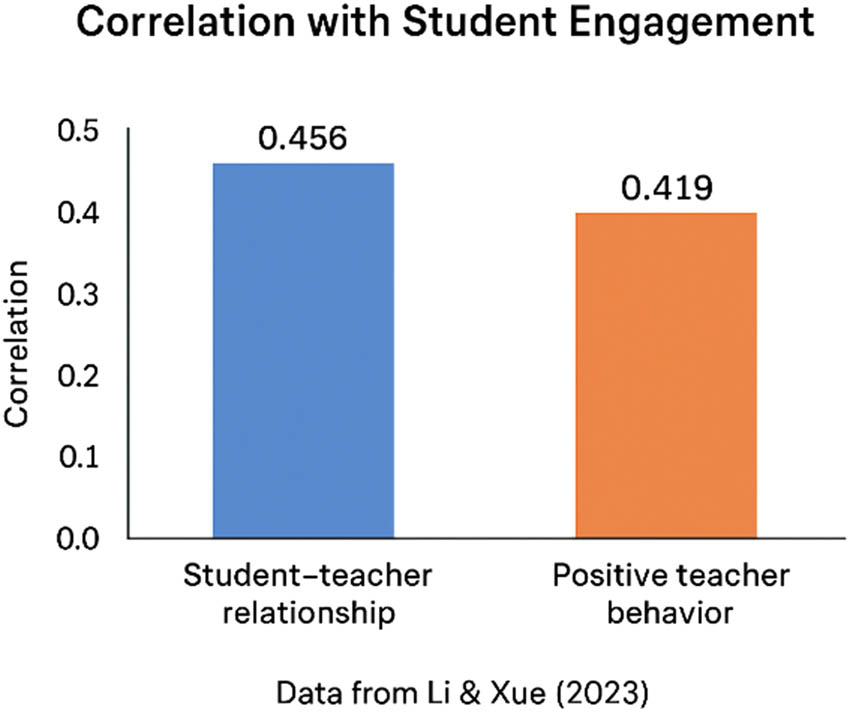
Image 1
Correlation with student engagement.
Source: Author’s contribution.
The graph accurately represents the two main correlation coefficients presented in the meta-analysis by Li and Xue (2023):
Teacher–student relationship → r = 0.456
Positive teaching behaviour → r = 0.419
By highlighting that positive emotions, a sense of belonging, and relational support are directly associated with learning behaviours, Li and Xue (2023) reinforce that affectivity should not be understood as a secondary element, but as a structural component of educational processes. A school guided by listening, recognition, and appreciation of individuality becomes a territory of symbolic safety, in which students feel empowered to participate, explore, create, and persist, conditions that are indispensable for building deep engagement.
This evidence empirically supports the relevance of pedagogical approaches anchored in sensitivity, such as pedagogical documentation, atelier culture, and methodologies based on relationship and presence. By humanising the school experience, these practices increase motivation, strengthen bonds, and foster internal readiness to learn. Thus, they confirm that affectivity and listening are structural dimensions of pedagogical action and directly influence the way children and young people relate to knowledge, to others, and to themselves.
It is in this context that the Pedagogy of Enchantment is inserted, conceived not only as a reaction to contemporary crises, but as a possibility for creating new worlds. Enchantment implies recognising the extraordinary in everyday life, perceiving gestures of beauty and discovery that escape traditional metrics and planning. Fernandes (2025a) points out that this pedagogy values imagination and creativity as central forces in the construction of knowledge, preparing children and young people to exist in the world in all its complexity and delicacy.
The Pedagogy of Enchantment emerges as a response to the symbolic impoverishment of educational institutions. Resulting from prolonged listening to children, exposure to artistic languages, and dialogue with creative processes, it advocates a sensitive and inventive way of inhabiting education, even in contexts of material restriction. Fernandes (2025a) argues that imagination, even in the face of scarcity, expands the possibilities for creation and values simplicity as power.
This perspective dialogues directly with the principles of Loris Malaguzzi, who recognised in children a multiplicity of languages, “a hundred, a hundred and a hundred more,” through which they construct meanings about the world. For Malaguzzi (1996a), these languages do not depend on an abundance of resources, but on contexts that promote listening, freedom of expression, and trust in the sensitive intelligence of childhood. Rigid curricula and standardised practices reduce children’s expressive power and limit their possibility of being fully themselves. In this conception, education is a political and poetic act, a continuous negotiation between heritage and transformation.
Inspired by this theoretical field, the Pedagogy of Enchantment seeks to understand education as an experience that is simultaneously aesthetic and ethical, in which listening, imagination, daydreaming, and multiple forms of expression constitute legitimate avenues of learning. The Montessori and Reggio Emilia approaches reinforce that listening is a political and pedagogical act (Rinaldi, 2006) and that aesthetics is not an adornment, but a constitutive dimension of knowledge processes (Vecchi, 2017). Bachelard (1960) contributes to this by understanding imagination and daydreaming as cognitive forces, rejecting the division between reason and sensitivity and promoting learning that integrates the poetic and the rational. Alves (2011) also places the act of education in the realm of enchantment and love, drawing attention to the beauty and mystery of the world.
The Pedagogy of Enchantment, therefore, is not presented as a fixed model, but as a poetics of pedagogical practice based on aesthetics, attention, and sensitivity. The atelier, understood as a symbolic and relational space, is a privileged environment for children to become researchers and producers of culture. Enchantment, in this sense, is a political and transformative gesture, capable of challenging the logic of control, efficiency, and productivity. Education thus becomes an act of re-enchantment with the present and an ethical commitment to beauty, dignity, and hope.
5. Listening as a pedagogical and political act: Inside and outside the school (and at Home)
Among all the gestures that make up the art of educating, listening is perhaps the most radical. Listening is not just hearing sounds or words, but opening oneself to what pulsates in silence, in the body, in gestures, and in time. It is an ethical and aesthetic attitude that opposes the logic of imposition and training, still so present in schools. Listening requires suspending judgement, decentring the self and opening up to the other, whether it be a child, a space, a material, or an idea.
The Montessori Method and the Reggio Emilia approach share the vision of an active, curious, and powerful child, but follow different paths. While Montessori structures the environment and materials to favour individual rhythms, Reggio Emilia focuses on aesthetics, language, and relationships as driving forces for learning. Montessori emphasises precision, concentration, and autonomy; Reggio emphasises listening, imagination, collaboration, and collective research. Together, the two approaches offer complementary perspectives for thinking about sensitive, participatory education centred on the child’s experience. For this study, research on the Montessori method was used, as there was little data on the Reggio Emilia approach.
As indicated by Randolph et al. (2023), studies show that Montessori education produces positive and statistically significant effects on child development, encompassing academic and non-academic outcomes, in contrast to traditional educational approaches. A comparative analysis between the Montessori and Traditional models and the dynamic environment–student interaction (IDACAA) approach highlights structural differences in how each perspective understands learning. In the Montessori method, children are recognised as active subjects, capable of autonomy, self-regulation, and agency, supported by a prepared environment that values sensory exploration, choices, and freedom with responsibility. The traditional model, on the other hand, tends to centralise control in the teacher, limit student autonomy, and reduce the environment to a fixed structure, prioritising performance and standardised assessments. The IDACAA approach introduces a dynamic system in which the environment continuously adapts to student behaviour, creating cycles of action, feedback, and reconfiguration, which enables emerging learning (Image 2).
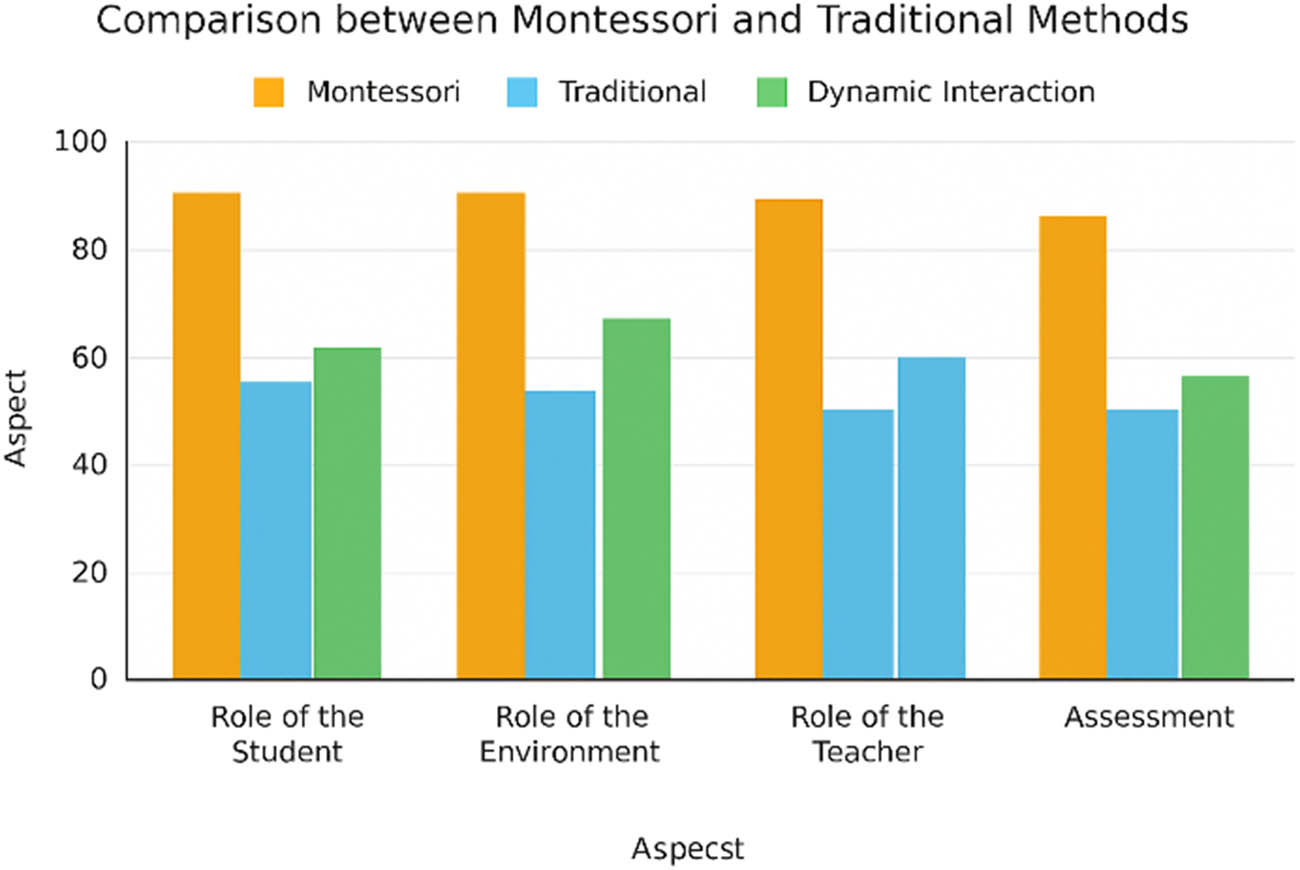
Image 2
Comparison of the Montessori method, the traditional teaching method, and IDACAA.
Source: Author’s contribution.
This comparison reveals a progressive shift – from transmissive teaching to a pedagogy of participation, sensitivity, and interaction – aligning with the principles of the Pedagogy of Enchantment. Both Montessori and IDACAA recognise the importance of observation, listening, responsive mediation and integral development, fundamental aspects for educational practices that integrate imagination, sensoriality, affection, and presence. The contrast with the traditional model highlights the need for approaches that recognise the child as the protagonist and the environment as a co-author of the educational process.
These notes reinforce that affection, a prepared environment, autonomy, and sensitive listening are not just decorative elements, but central variables for learning: they deal with the formation of attention, self-regulation, creativity, and well-being, essential conditions for children to acquire knowledge in a free, creative, and meaningful way. Just as this study proposes a more careful educational format, empirical evidence suggests that environments that respect children’s agency and offer materials and freedom favour not only performance but also the flourishing of subjectivity and sensitivity.
In view of this, incorporating dimensions related to affective engagement, creativity, autonomy, and social relationships – as presented in the collected data – into the assessment index is not mere pedagogical conjecture, but is in line with international evidence that sensitive educational methods promote broad positive results in the cognitive, emotional, and social fields.
In the composition of the Pedagogy of Enchantment, proposed in this study, listening and respect for a more respectful pedagogy is the soil where everything germinates, the starting point, and the destination. It is about listening to what the child says and how they say it, with their silences and gestures, listening to what the materials ask for and offer, listening to the time of the experience, measured not by the clock, but by presence. Listening is recognising the unexpected as a legitimate part of the educational process, overcoming a transmissive pedagogy in favour of a participatory pedagogy.
Inspired by Loris Malaguzzi, this approach understands the child as a person with rights, powerful and creative, capable of constructing knowledge in relation to the world. Listening to the child, for Malaguzzi (1996b), is recognising that they have “a hundred languages, a hundred hands, a hundred thoughts, a hundred ways of thinking, playing and speaking.” The challenge for schools and homes is to create contexts in which these languages can emerge and interact.
The centrality of listening in the Reggio Emilia philosophy is rooted in the idea that children are active protagonists in their own learning process. In the text Stories, Ideas, and Basic Philosophy, published in The Hundred Languages of Children, Malaguzzi (1996b) states that listening is the first ethical and pedagogical gesture of the educator. Listening is not just an act of reception, but a way of being with the other. It is through listening that bonds are built, otherness is recognised, and a truly participatory pedagogy becomes possible.
As the author describes, Reggio teachers “know how to listen to children,” allowing them initiative, imagination, and expression in “a hundred languages,” a metaphor for the multiplicity of ways of communicating and understanding the world. This listening is not restricted to words, but encompasses gestures, silences, actions, and glances, taking on an aesthetic and political dimension.
Rinaldi (2006) deepens this concept by describing the “pedagogy of listening” as an attitude of attention and reciprocity, in which the educator opens themselves up to negotiating meanings with children and among them. Listening is thus an epistemological tool and an ethical foundation of an educational practice that values dialogue and diversity. According to Rinaldi (2006, p. 65), “listening is an ethical attitude that implies being open to being transformed by what one hears.” Listening means allowing oneself to be affected, reviewing certainties, and allowing knowledge to emerge from the relationship and shared experience.
Listening transcends methodology, becoming an ontological principle of the Pedagogy of Enchantment, which proposes an education based on dialogue, creation, and enchantment. Listening is a political and poetic gesture, an exercise in sensitivity that recognises the child as a person and the educator as a learner.
In this context, listening shifts the power in the educational relationship. When the educator truly listens, they recognise that knowledge is constructed together, in a horizontal and democratic movement. In addition to listening between people, this pedagogy also proposes an expanded listening to materials, spaces, and atmospheres. Inspired by atelier practices, this material and poetic listening recognises that environments “speak,” objects summon, and materials provoke questions and meanings.
Practising listening in everyday life is to challenge the rigid structures of the curriculum and welcome the time for doubt, error, and silence. As a political gesture, listening is insurgent, resisting the pedagogy of control and affirming the right to daydreaming, invention, and subjectivity. Thus, the Pedagogy of Enchantment reveals itself as a pedagogy of listening, a way of being in the world that transforms the act of education into encounter, relationship, and poetry.
6. Poetics of reverie: The imaginary as the foundation of the educational experience
Bachelard (1960) presents reverie as a mode of being and knowing that transcends objective rationality. It is an active form of imagination that awakens poetic consciousness and broadens the possibilities of existence. Between the real and the imaginary, the human being rediscovers themselves, finding in poetic language a profound meaning of life. Reverie is not a form of escape but an expansion of reality.
Bachelard (1960) proposes reverie as a path to knowledge grounded in sensitivity and affection, breaking with the technocratic logic of modern education. Introducing this poetics into the educational field opens space for sensitive and aesthetic learning, in which body, memory, and imagination participate in a pedagogy of feeling. Reverie is also an inner dwelling, a space of creative rest and hospitality for the soul, an idea that resonates with atelier practices as territories of contemplation and invention.
In the context of art education, the atelier can be understood as a Bachelardian space where daydreams materialise through sensory languages and materialities. Daydreaming thus becomes an epistemological foundation for the creation of sensitive knowledge, redirecting learning towards the cultivation of aesthetic experience.
Within the Pedagogy of Enchantment, reverie functions as a method of sensitivity and listening, opening the encounter between the real and the symbolic. The educator becomes the guardian of this poetic time, creating conditions for enchantment to emerge. Educating, within this framework, is an act of imagination, listening, and continuous creation.
7. Aesthetic experience as the basis of learning
Dewey’s (2010) philosophy of aesthetic experience provides a theoretical framework for understanding how the atelier becomes a space for inquiry. For Dewey (2010), meaningful experience emerges from active engagement between body, material, and environment. Knowledge arises through doing and feeling, in a rhythm of reflection and transformation.
In the atelier, these ideas manifest in practices that privilege process over product. Children manipulate natural and recycled materials, experiment with colour and texture, and engage in collaborative creation. The atelier facilitator documents these processes, using photographs, drawings, and narratives as tools for reflection.
As noted by Fernandes (2025b), children show joy and engagement when participating in workshop activities. They construct collective stories, create sensory maps, and investigate phenomena such as light, water, and sound. Attentive listening by the educator promotes autonomy, allowing children to propose their own paths and value mistakes as part of learning.
These practices integrate art, play, and social consciousness, revealing that aesthetic experience is not ornamental but fundamental to knowledge construction. The atelier thus becomes a transdisciplinary laboratory where science, philosophy, and art intersect.
8. Atelier as a space for training and research: A new look at the classroom
Within the proposal of the Pedagogy of Enchantment, the atelier is not an auxiliary space of the school but its symbolic and epistemological core. Drawing on the Reggio Emilia approach, this space is designed for aesthetic exploration, open experimentation, and interaction between languages, individuals, and materials. It is a space of expanded listening, where gestures, objects, and affections acquire voice and meaning. Pedagogical action arises from careful observation and sensitive listening rather than predetermined plans. The atelier facilitator acts as a mediator, preparing the environment, intentionally selecting materials, and creating conditions for children to explore and express their multiple languages.
Experiences in the atelier are marked by discovery and experimentation. Children manipulate and combine natural, recycled, and artistic materials, learning through action and sensory engagement. The emphasis is not on task execution but on the creative process involving body, thought, and emotion. Each gesture reveals unique ways of knowing the world. For the atelier facilitator, these experiences become material for reflection and documentation. Photographic records, drawings, and children’s narratives serve as formative tools that value process over product.
The atelier thus constitutes a space of continuous learning: for children, who construct knowledge through experience; and for educators, who learn to observe, support, and be astonished by the everyday educational process. Unlike traditional classrooms, the atelier is a vibrant environment that provokes questions and embraces risk and unpredictability. It presents itself as a research field, where knowledge is born from curiosity and interaction.
In this sense, the atelier also becomes a space for teacher education that demands an epistemological shift. It is not merely about conducting workshops but about developing a poetic and investigative attitude. The educator learns to observe attentively, document processes, and sustain the learning journey, cultivating a listening practice that recognises sensitivity as a legitimate source of knowledge.
In the encounters described in Buscas de Ateliê (Fernandes, 2025b), children expressed joy in attending school and enchantment with the experiences lived. The area was intentionally designed to inspire curiosity, with both the look and materials used playing important roles in enhancing learning. Thoughtfully chosen materials promoted diverse methods of exploration, and creative disorder was welcomed as an essential element of the experience.
The narratives recount moments when children engaged in collective invention processes, such as constructing stories from found objects, creating small sensory maps, or experimenting with colours and textures to represent feelings and memories. Often, curiosity drove individuals or groups to explore topics like plants, water, shadows, or sounds through spontaneous questions.
Documentation also shows that attentive listening and the facilitator’s guidance enhanced children’s agency. They felt encouraged to propose their own pathways, to test hypotheses, and to learn from mistakes, recognising them as essential to the creative process. Small experiments with natural materials, collages, and prints taught key lessons in cause and effect, artistic elements, and caring for others and the environment.
The practices within the atelier integrated art, play, and social awareness, combining diverse areas of knowledge while respecting curricular contexts. Learning occurred through presence and interaction rather than technique. The atelier therefore emerges as a transdisciplinary laboratory where art, science, philosophy, nature, and memory intertwine within living experiences of learning.
Within this framework, the atelier affirms itself as a space of enchantment and inquiry, where one learns through hands, body, and heart, shaping a school that listens, creates, and transforms the world through the senses.
9. Re-enchanting the world: Contributions to a humanising education
As society becomes more focused on productivity and people feel increasingly disconnected, there is a call for education to prioritise the development of human values once again. The Pedagogy of Enchantment proposes a school that restores to life its sensitive and poetic radiance. To enchant is not to escape reality but to deepen the connection with the world, recognising the formative power of everyday life, of simple gestures, of curiosity, and attentive listening.
Re-enchanting the world is a political act that resists automatism and cynicism, reaffirming the value of presence and imagination. The school thus becomes a space for the creation of meaning, where art, philosophy, and play are legitimate paths to knowledge. Within ateliers and formative processes, learning emerges through shared experience and affective engagement with knowledge.
The educator assumes the role of mediator and companion along the journey. Their influence stems from forming connections, listening carefully, and being responsive to the learner’s journey. They learn with those they educate, rather than about them. The humanising education advocated by the Pedagogy of Enchantment constitutes a practice of care and presence that unites reason and sensitivity, transforming the school into a place of beauty, joy, and discovery.
10. Final reflection: The urgency of a sensitive and enchanting education
Revisiting the school as a territory of enchantment is more than a poetic gesture; it is an ethical, aesthetic, and political necessity. In an age marked by technocratic rationality, curricular standardisation, and the silencing of subjectivities, the Pedagogy of Enchantment reclaims experience, imagination, and attentive listening as essential foundations of the educational act. Throughout this study, theory and practice, philosophy and childhood, art, and education have been intertwined in a search for a more human and poetic way of learning. Dialogues with thinkers such as Bachelard, Malaguzzi, Dewey, Alves, and Freire reveal that enchantment constitutes both a pedagogical method and an ethical horizon.
The atelier, as a space of aesthetic and relational experience, has emerged as fertile ground for cultivating sensitive, participatory, and transdisciplinary forms of knowledge. Within it, learning is built through play, curiosity, and the courage to explore uncertainty. Mistakes are not failures but steps in a creative process. In this environment, knowledge is not merely accumulated; it is lived as a poetic encounter with the world.
The Pedagogy of Enchantment is still in the process of becoming, a discovery in motion. It invites us to see children not as future adults but as complete beings, artists of their own paths, capable of imagining gentler, more just, and more humane futures. We recognise, in concluding this journey, that to enchant is to resist despair and to affirm hope. It is to believe that education, grounded in art, affection, and wonder, can indeed re-enchant the world.
Funding information
Authors state no funding involved.
Author contributions
André Luiz Fernandes conceptualized the study and developed the central theoretical proposition of the Pedagogy of Enchantment. He designed the narrative inquiry and art-based research approach, conducted the literature review, and integrated the empirical and experiential materials. He performed the interpretative and formal analyses and wrote the original draft of the manuscript. Carmen Cavaco contributed to the theoretical refinement of the study and provided academic supervision, conceptual guidance, and methodological validation. She critically reviewed the manuscript and contributed to the discussion of the results. Both authors reviewed and approved the final version of the manuscript.
Conflict of interest statement
Authors state no conflict of interest.