
1. Introduction
अनेकसंशयोच्छेदि, परोक्षार्थस्य दर्शकम् ।
सर्वस्य लोचनं शास्त्रं, यस्य नास्त्यन्ध एव सः ॥
It blasts many doubts, foresees what is not obvious |
Science is the eye of everyone; one who hasn’t got it is like a blind ||
Science is one of such activities that man invented to fulfil human needs and ambitions. Science has been driven by curiosity more than anything else. In the pursuit of science, the “Search for truth” takes center stage. Most people value science for its usefulness and the beauty it has to solve and ease human needs. Consequently, it is essential to foster scientific interests among people. Knowing how to use the different scientific tools and equipment that are all around us in today’s scientific world is crucial for one’s survival. Therefore, it is crucial to carry out various programmes and projects for hands-on learning in order to study students’ levels of scientific interest and foster the growth of their scientific attitudes and perspectives. In scientific engagement, aesthetics is prominent. There are various stages at which aesthetic perceptions and considerations enter scientific endeavors. Nature itself is the object of our explorations, provides aesthetic sensations. Scientists sometimes assert the beauty of nature and point out precise phenomena as being beautiful and inspiring amazement and wonder in us, such as formations of minute functional cells and various other natural wonders, “Parsons (2002), Carlson (2011), and Turner (2019).” Science, being a wonderful subject, needs to have a thorough blend of theory and practice. There is a wide scope in science to know and study the wonders of nature and appreciate its beauty. Science as a subject provides a lot of opportunities to develop aesthetic sense and values in students. Therefore, it is essential to study how science is related to aesthetics. The research is an attempt to understand the score of Scientific Attitude and Aesthetic value, and the correlation between them.
2. Scientific attitude
An interest or sentiment towards studying science is referred to as a “science attitude.” The field of science has been reimbursed with increased knowledge. Great scientific advances and the application of those advances have increased the value of science more than ever before by advancing human welfare through their usage in a variety of disciplines.
Every aspect of life has undergone revolutionary change thanks to science. Its effects may be seen everywhere and in all facets of life, including the social, political, economic, and cultural ones. A person’s attitude towards life is referred to as their science attitude. It denotes a readiness to apply scientific methods and techniques to problem-solving and evaluation of concepts or information. Scientific attitude refers to one’s interest in or sentiment towards science subjects.
For a scientist to succeed, there are some important qualities to be pursued, Inquisitiveness, prudent judgement, critical thinking, open-mindedness, objectivity, rationality, and intellectual honesty.
An attitude is a way of looking at things, yet it can also be a sensation or a way of thinking. While the scientific perspective might be described as a manner of looking into things that are governed by facts that are known and demonstrable.
Curiosity shows being intrigued by the various things around. A person who is curious wants to know what something is all about, what it is used for, how it is done, how it works, and other details. He or she looks for solutions to the problems that they desire to comprehend.
Prudent judgement is the ability to take careful and safe judgments based on evidence. An individual with this character does not make snap judgements and instead bases them on facts and trustworthy information.
Open-mindedness is a quality of an individual who does not discount any information that contradicts their beliefs. He or she has impartial and prejudice-free thinking. Here, a person can welcome ideas from others and view them as potential that could aid in carrying out any task or in resolving scientific issues.
Critical thinking is one who is prepared to assess any evidence offered to support a particular conclusion; while doing so, he or she observes the accuracy of any material. Here, one should always be cautious, scrutinize everything, and strive for perfection.
Objectivity is the quality of an individual who records data and observations. Prior to doing the real experiments and observations, he or she frequently interprets these data and checks the consistency of the observations.
Rationality is a mindset that holds that everything has a purpose and can be explained. He or she rejects superstitious beliefs in favour of accepting facts, but only when they are backed up by strong evidence.
Intellectually honest refers to a person who needs to be truthful, for instance, by citing the sources of information.
All these qualities design the scientific attitude of an individual, and these are to be developed in students.
3. Aesthetic value
The term “aesthetics,” which derives from the Greek “aisth etikos,” refers to knowledge that deals with the senses and how we see ourselves and the outside world. The concept of anaesthesia, which is about being unconscious, is the reverse, an-aesthetikos. Thus, aesthetics can be linked to being awake and in the present. Dance, poetry, and visual arts are symbolic media through which aesthetic expressions can be expressed.
According to French physicist Pierre Duhem “it is impossible to follow the march of one of the great theories of physics, to see it unroll majestically its regular deductions starting from initial hypotheses, to see its consequences represent a multitude of experimental laws down to the small detail, without being charmed by the beauty of such a construction without feeling keenly that such a creation of the human mind is truly a work of art (Duhem, 1954).”
Poincare, for example, regarded the beauty of nature as a motivation for scientific enquiry, claiming that the “scientist does not study nature because it is useful to do so. He studies it because he takes pleasure in it; and he takes pleasure in it because it is beautiful.” Many went further, taking beauty to be not only a motivation for the scientist but an indication of the truth of theories. As Heisenberg put it, “If nature leads us to mathematical forms of great simplicity and beauty. we cannot help thinking that they are ‘true’, that they reveal a genuine feature of nature.” And, even more pointedly, Einstein argued that the only physical theories we are willing to accept are the beautiful ones, while Dirac claimed that [a] theory with mathematical beauty is more likely to be correct than an ugly one that fits some experimental data’. Moreover, as Watson remembered, Franklin found the double helix model of the structure of DNA simply ‘too pretty not to be true’.
The aesthetic value of scientific products is also evaluated. It is asserted that many scientific theories, from Newton’s and Einstein’s theories of gravity to the standard model and evolutionary theory, as well as images of oscillating particles, scientific models such as the structure of DNA molecules, and mathematical justifications such as Euclid’s Elements. Experiments such as Rutherford’s explorations of uranium radiation and many other theories are aesthetically valuable and beautiful. Additionally, the method through which scientists develop a product – whether they are creating a theory, an experiment, or a proof is compared to an artistic creation that is open to aesthetic evaluation. According to Breitenbach (2013), aesthetic qualities have an epistemological function in science since they promote thoughtful considerations.
It must be possible to explain why certain aesthetic ideals, such as simplicity and unity, continue to be the ultimate goals of science, regardless of whether scientists have been consistently exposed to successful theories with these characteristics.
Some philosophers contend that a theory’s empirical viability can be reduced to, or manifested as, the aesthetic language utilized by scientists. Accordingly, when a scientist says that a theory has aesthetic value, they are just saying that the theory is empirically sound in a different way. This explanation makes it challenging to defend the fact that, in the absence of supporting data, aesthetic ideals frequently serve as predictors or indications of empirical success or even truth. For instance, string theorists frequently use aesthetic arguments to justify their theories when there is no empirical evidence to back them up.
4. Need and significance of the study
The study focuses on the analysis of Scientific Attitude and Aesthetic levels among postgraduate students at the Central University of Gujarat. The dissertation is based on an analysis of the survey scores grounded on a Likert scale concerning Scientific Attitude and Aesthetics in postgraduate students at Central University of Gujarat. Scientific attitude evaluations assess students’ achievements. Menon’s (1973) research findings indicate that Scientific attitude and level of interest affect their academic performance. However, in the current scenario, it is quite disappointing to discover that there is no room for developing a Scientific Attitude in the real classroom environment, also the development of a scientific mindset and logical reasoning skills is entirely disregarded. Studies that focus on Scientific Attitude and Aesthetics are scarce; the majority of research in Scientific Attitude focuses on performance and approaches. Consequently, it is considered crucial that research be done on Scientific Attitude and Aesthetics. Because they are all connected and dependent on one another, there is no empirical support for this kind of association. Therefore, it is deemed necessary to research the connection between Scientific Attitude and Aesthetics. The current study on examining the correlation between Scientific Attitude and Aesthetic values in postgraduate students of Central University of Gujarat is an attempt to understand the value of encouraging a scientific mindset among students.
Scientific attitude is crucial for a person’s education since it reveals a person’s underlying thoughts. A person will make every effort to accomplish a goal if they have a positive attitude towards it. A scientific mindset is a desire to learn more about one’s surroundings and the conviction that natural causes can always be found for events that appear weird and unexplained. A person becomes a scientist when the have information gained through the scientific method, as well as the abilities and attitudes required for using it. The most significant results of educating in science are positive attitudes towards science. Science education can help pupils develop specific social ethics and values, including honesty, reason, objectivity, and the ability to make decisions based on accurate knowledge. As a result, a teacher has a major influence on how students develop a scientific outlook. The advancement, welfare, and prosperity of the country are also reliant on scientific and technological research and education. The development of objectivity, curiosity, critical thinking, and decision-making, among other things, is a scientific mindset that can help the national progress. The most significant result of science education is a scientific mentality that facilitates rational thought. The person’s behavior and actions reflect a variety of qualities and virtues that the person possesses. For critical thinking and reasoning, a scientific mentality is essential. Nearly all commissions and committees on education that were established following independence have emphasized the value of encouraging a scientific mindset among students.
Aesthetic factors are frequently considered in science; many scientists assert that aesthetic values direct their work, inspire them to explore nature, and even affect how they feel about a theory’s veracity. Some scientists even consider the end result of their intellectual endeavors, such as mathematical proofs, models, or scientific hypotheses, to be works of art. It’s interesting to note that exposure to beautiful equations in mathematicians and scientists activates the same part of the brain as exposure to beautiful artwork. What role can be attributed to aesthetic considerations in scientific thinking, how scientists understand the concept of beauty, and how they come to find some aspects of a theory to be aesthetically pleasing. It never ceases to amaze me how many modern scientists are motivated by aesthetic considerations and how many of them assert that the aesthetic principles they adhere to are timeless and objective. Even though scientists may question the objectivity of aesthetic evaluations, we frequently see these judgements applied in practical reasoning. It is intriguing why we value beautiful explanations and actively look for symmetry, simplicity, and unity in nature and in our representations of the world, even though it is unlikely that any connection between beauty and truth can be rationally justified. Hence, this type of study is required to understand the relationship between science and aesthetics.
Objectives of the study
To study the difference between the scientific attitude and the Aesthetics of male and female postgraduate students of Central University of Gujarat.
To study the correlation between Scientific attitude and Aesthetics in male and female students of the postgraduate program of Central University of Gujarat.
Hypothesis
H01: There is no significant difference between the mean scores of Scientific Attitude in male and female postgraduate students of Central University of Gujarat.
H02: There is no significant difference between the mean scores of Aesthetic Values in male and female postgraduate students of Central University of Gujarat.
H03: There is no significant correlation between Scientific Attitude and Aesthetic Value in male and female post-graduate students of Central University of Gujarat.
Scope of the study
The study is focused on Central University of Gujarat, Gandhinagar city only.
The study solely looks at the relationship between postgraduate students’ Scientific attitudes and aesthetics.
5. Study area of research
The research was carried out with postgraduate students of the Central University of Gujarat. Central University of Gujarat is a public central university in Gujarat offering courses at undergraduate, postgraduate, and doctoral levels.
The Central University of Gujarat has eleven schools in different disciplines with various centers within them; however, five schools belong to the field of science, which are as follows:
(1) School of Applied Material Science (SAMS);
(2) School of Chemical Sciences (SCS);
(3) School of Environment and Sustainable Development (SESD);
(4) School of Life Sciences (SLS);
(5) School of Nano Sciences (SNS); and
(6) School of Education (SOE).
5.1. Population
The population for the present study consists of all the university students of the Gandhinagar district studying in UG and PG courses.
5.2. Sample
The sample of the current study was 100 postgraduate students of Central University of Gujarat selected by random sampling following the Random Number Table technique. Table 1 represents the description of the sample selected for the identification of Scientific Attitude and Aesthetics postgraduate students of Central University of Gujarat.
5.3. Tool
To examine the correlation of Scientific Attitude and Aesthetic in postgraduate students of Central University of Gujarat, the tool has been designed and verified. There are 44 items in the tool based on selected dimensions of Scientific attitude and Aesthetics as per Figure 1. The dimensions used in the tool are as follows:
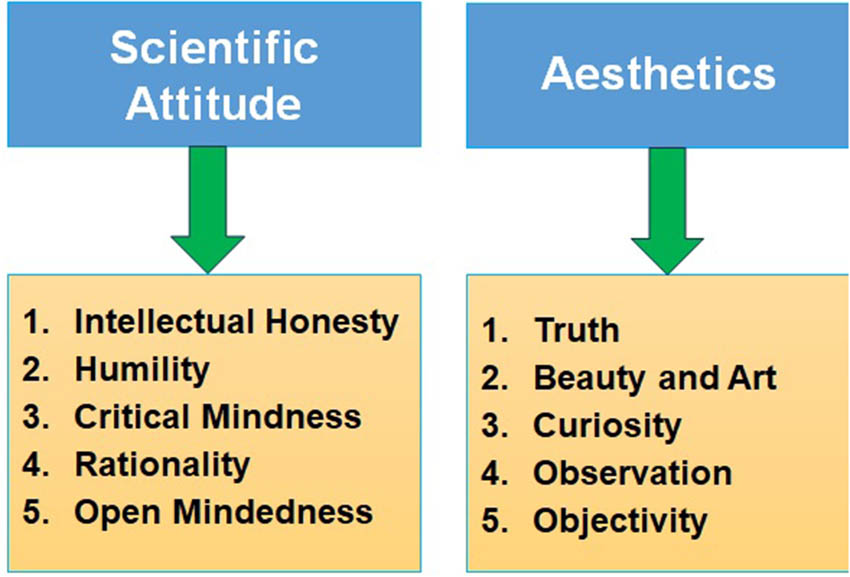
Figure 1
Dimensions of scientific attitude and aesthetics of the study.
Source: Author’s contribution.
5.4. Scoring method
The items in the questionnaire were scored accordingly:
Positive Item Scoring: Strongly Agree: (5), Agree: (4), Undecided: (3), Disagree: (2), Strongly Disagree: (1)
Negative Item Scoring: Strongly Agree: (1), Agree: (2), Undecided: (3), Disagree: (4), Strongly Disagree: (5)
Variables of the study
5.5. Statistical analysis
The statistical analyses conducted in the research study are Arithmetic mean, Standard Deviation, Correlation, and t-test.
6. Data analysis and interpretation
The data collected from postgraduate students of different schools of Central University of Gujarat using the tool for Scientific Attitude and Aesthetics is then compiled with the rating according to response. Table 2 refers to the details of the score received and its bifurcation based on the survey conducted with a sample size of 100 students for the identification of Scientific Attitude and Aesthetics. The total score of the survey score of questionnaires based on Scientific Attitude ranges between 60 and 86, whereas the score of Aesthetics ranges between 63 and 101, the overall score submitted based on the survey of Scientific Attitude and Aesthetics ranges between 132 and 178. The Z-Score of individual raw values of Scientific Attitude ranges between −2.080 and 1.935; however, the Z-Score of Aesthetics is within the range of −2.692 to 2.182. The Normal Distribution Curve in Figure 2 reflects that the set of data for the bell curve meets the expectation. However, the Normal Distribution Curve in Figure 3 shows the Aesthetic values above expectation in a set of data for the bell curve, while comparing the Skewness of the Normal distribution curve of Scientific attitude and Aesthetics with Figures 1 and 2, the bell curve of Aesthetics shows more positive skewness compared to the positive skewness of Scientific Attitude.
Table 2
Scores of scientific attitude and aesthetics (CUG; 2022–2023).
| Stu. No | School | Sem. | Sex | Age | Scientific attitude | Aesthetics | Total score |
|---|---|---|---|---|---|---|---|
| 1 | SAMS | 4th Sem | F | 21 | 70 | 76 | 146 |
| 2 | SAMS | 2nd Sem | F | 25 | 73 | 73 | 146 |
| 3 | SAMS | 2nd Sem | M | 24 | 78 | 81 | 159 |
| 4 | SAMS | 4th Sem | F | 21 | 70 | 76 | 146 |
| 5 | SAMS | 2nd Sem | F | 23 | 67 | 84 | 151 |
| 6 | SAMS | 2nd Sem | M | 29 | 79 | 92 | 171 |
| 7 | SAMS | 2nd Sem | F | 26 | 66 | 86 | 152 |
| 8 | SAMS | 2nd Sem | M | 24 | 60 | 89 | 149 |
| 9 | SAMS | 4th Sem | M | 26 | 69 | 94 | 163 |
| 10 | SAMS | 4th Sem | F | 33 | 72 | 75 | 147 |
| 11 | SAMS | 4th Sem | F | 24 | 75 | 91 | 166 |
| 12 | SAMS | 4th Sem | F | 26 | 76 | 81 | 157 |
| 13 | SAMS | 4th Sem | F | 23 | 79 | 78 | 157 |
| 14 | SAMS | 4th Sem | F | 25 | 72 | 90 | 162 |
| 15 | SAMS | 2nd Sem | F | 25 | 73 | 73 | 146 |
| 16 | SAMS | 2nd Year | M | 23 | 69 | 86 | 155 |
| 17 | SCS | 2nd Year | M | 29 | 76 | 88 | 164 |
| 18 | SCS | 4th Sem | F | 23 | 73 | 81 | 154 |
| 19 | SCS | 4th Sem | M | 24 | 78 | 100 | 178 |
| 20 | SCS | 2nd Sem | M | 21 | 65 | 83 | 148 |
| 21 | SCS | 2nd Year | M | 23 | 69 | 86 | 155 |
| 22 | SCS | 2nd Year | M | 23 | 63 | 88 | 151 |
| 23 | SCS | 2nd Year | M | 29 | 76 | 88 | 164 |
| 24 | SCS | 4th Sem | F | 23 | 73 | 81 | 154 |
| 25 | SCS | 4th Sem | M | 24 | 78 | 100 | 178 |
| 26 | SCS | 2nd Sem | M | 24 | 69 | 63 | 132 |
| 27 | SCS | 4th Sem | M | 23 | 63 | 73 | 136 |
| 28 | SCS | 2nd Sem | M | 24 | 78 | 81 | 159 |
| 29 | SCS | 2nd Year | F | 23 | 63 | 88 | 151 |
| 30 | SCS | 2nd Year | F | 29 | 76 | 88 | 164 |
| 31 | SCS | 2nd Sem | F | 25 | 77 | 75 | 152 |
| 32 | SCS | 2nd Sem | F | 21 | 66 | 89 | 155 |
| 33 | SESD | 2nd Sem | F | 21 | 69 | 87 | 156 |
| 34 | SESD | 2nd Sem | M | 21 | 77 | 86 | 163 |
| 35 | SESD | 1st Year | M | 21 | 81 | 85 | 166 |
| 36 | SESD | 2nd Sem | F | 23 | 74 | 80 | 154 |
| 37 | SESD | 2nd Sem | M | 25 | 77 | 75 | 152 |
| 38 | SESD | 2nd Sem | M | 21 | 66 | 89 | 155 |
| 39 | SESD | 2nd Sem | F | 24 | 82 | 87 | 169 |
| 40 | SESD | 2nd Sem | F | 21 | 69 | 87 | 156 |
| 41 | SESD | 2nd Sem | M | 21 | 77 | 86 | 163 |
| 42 | SESD | 2nd Sem | F | 28 | 65 | 87 | 152 |
| 43 | SESD | 1st Year | M | 21 | 81 | 85 | 166 |
| 44 | SESD | 2nd Sem | F | 23 | 74 | 80 | 154 |
| 45 | SESD | 2nd Sem | M | 25 | 77 | 75 | 152 |
| 46 | SESD | 2nd Sem | M | 21 | 66 | 89 | 155 |
| 47 | SESD | 2nd Sem | F | 24 | 82 | 87 | 169 |
| 48 | SESD | 2nd Sem | F | 28 | 65 | 87 | 152 |
| 49 | SLS | 4th Sem | F | 24 | 85 | 82 | 167 |
| 50 | SLS | 2nd Sem | F | 20 | 71 | 77 | 148 |
| 51 | SLS | 1st Year | F | 22 | 81 | 81 | 162 |
| 52 | SLS | 4th Sem | M | 24 | 85 | 82 | 167 |
| 53 | SLS | 2nd Sem | F | 20 | 71 | 77 | 148 |
| 54 | SLS | 1st Year | F | 22 | 81 | 81 | 162 |
| 55 | SLS | 4th Sem | F | 25 | 75 | 85 | 160 |
| 56 | SLS | 4th Sem | M | 21 | 75 | 85 | 160 |
| 57 | SLS | 2nd Sem | F | 24 | 78 | 91 | 169 |
| 58 | SLS | 2nd Sem | F | 23 | 81 | 94 | 175 |
| 59 | SLS | 2nd Sem | M | 25 | 78 | 88 | 166 |
| 60 | SLS | 2nd Sem | F | 24 | 77 | 97 | 174 |
| 61 | SLS | 4th Sem | M | 26 | 61 | 76 | 137 |
| 62 | SLS | 2nd Sem | M | 28 | 78 | 90 | 168 |
| 63 | SLS | 2nd Sem | M | 25 | 71 | 101 | 172 |
| 64 | SLS | 2nd Sem | M | 24 | 82 | 87 | 169 |
| 65 | SNS | 4th Sem | M | 23 | 78 | 88 | 166 |
| 66 | SNS | 4th Sem | F | 23 | 75 | 79 | 154 |
| 67 | SNS | 2nd Year | M | 22 | 73 | 70 | 143 |
| 68 | SNS | 1st Year | F | 21 | 86 | 81 | 167 |
| 69 | SNS | 2nd Year | F | 23 | 85 | 82 | 167 |
| 70 | SNS | 2nd Sem | M | 21 | 65 | 83 | 148 |
| 71 | SNS | 2nd Year | M | 23 | 69 | 86 | 155 |
| 72 | SNS | 2nd Year | M | 23 | 63 | 88 | 151 |
| 73 | SNS | 2nd Sem | M | 24 | 69 | 63 | 132 |
| 74 | SNS | 4th Sem | M | 23 | 63 | 73 | 136 |
| 75 | SNS | 4th Sem | M | 23 | 78 | 88 | 166 |
| 76 | SNS | 4th Sem | F | 23 | 75 | 79 | 154 |
| 77 | SNS | 2nd Year | M | 22 | 73 | 70 | 143 |
| 78 | SNS | 1st Year | F | 21 | 86 | 81 | 167 |
| 79 | SNS | 2nd Year | F | 23 | 85 | 82 | 167 |
| 80 | SNS | 2nd Sem | F | 24 | 69 | 63 | 132 |
| 81 | SOE | 4th Sem | F | 25 | 75 | 85 | 160 |
| 82 | SOE | 2nd Sem | F | 23 | 81 | 94 | 175 |
| 83 | SOE | 2nd Sem | M | 25 | 78 | 88 | 166 |
| 84 | SOE | 2nd Sem | F | 24 | 77 | 97 | 174 |
| 85 | SOE | 4th Sem | F | 26 | 61 | 76 | 137 |
| 86 | SOE | 2nd Sem | F | 28 | 78 | 90 | 168 |
| 87 | SOE | 2nd Sem | M | 25 | 71 | 101 | 172 |
| 88 | SOE | 2nd Sem | F | 23 | 67 | 84 | 151 |
| 89 | SOE | 2nd Sem | M | 29 | 79 | 92 | 171 |
| 90 | SOE | 4th Sem | M | 26 | 69 | 94 | 163 |
| 91 | SOE | 4th Sem | F | 33 | 72 | 75 | 147 |
| 92 | SOE | 4th Sem | F | 24 | 75 | 91 | 166 |
| 93 | SOE | 4th Sem | F | 26 | 76 | 81 | 157 |
| 94 | SOE | 4th Sem | F | 23 | 79 | 78 | 157 |
| 95 | SOE | 4th Sem | F | 25 | 72 | 90 | 162 |
| 96 | SOE | 4th Sem | M | 21 | 75 | 85 | 160 |
| 97 | SOE | 2nd Sem | M | 24 | 78 | 91 | 169 |
| 98 | SOE | 2nd Sem | M | 26 | 66 | 86 | 152 |
| 99 | SOE | 2nd Sem | M | 24 | 60 | 89 | 149 |
| 100 | SOE | 4th Sem | M | 23 | 63 | 73 | 136 |
Source: Author’s contribution.
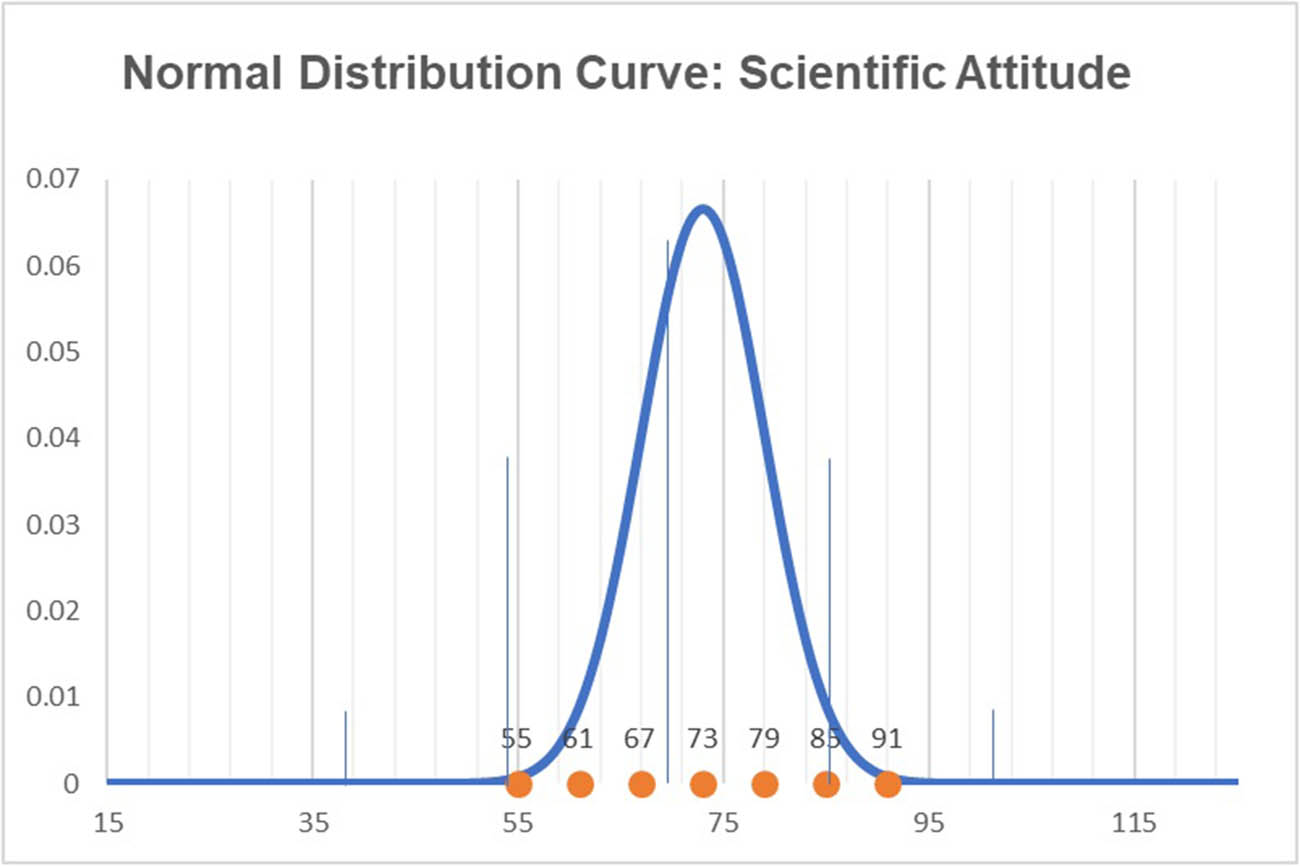
Figure 2
Normal distribution curve: Scientific Attitude.
Source: Author’s contribution.
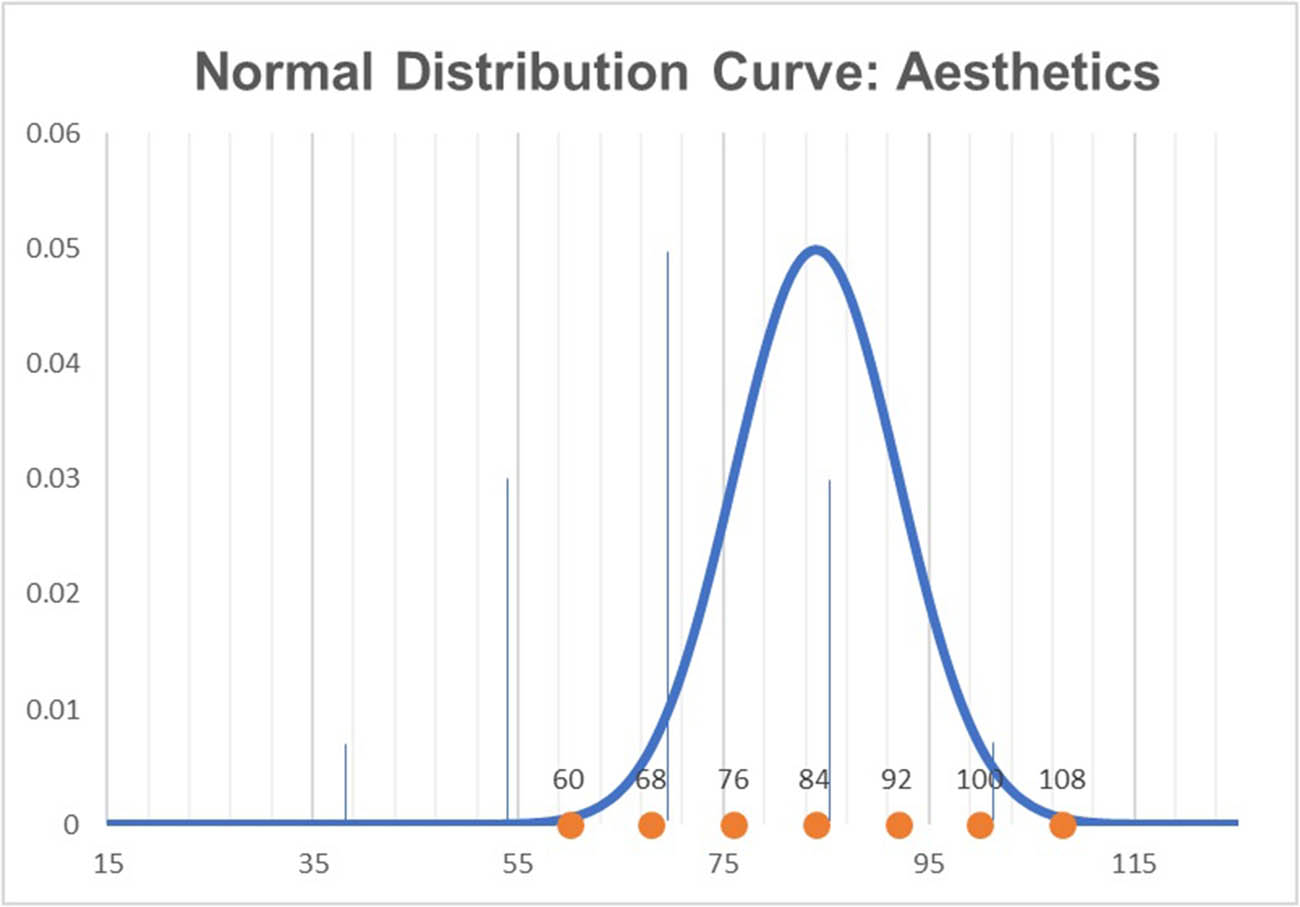
Figure 3
Normal distribution curve: Aesthetics.
Source: Author’s contribution.
7. Results and discussion
The data collected with the tool for Scientific Attitude and Aesthetics from the sample size of 100 students of postgraduate schools of Central university of Gujarat are complied with the rating according to their response, the survey score of questionaires based on Scientific Attitude ranges between 60 and 86, whereas the score of Aesthetics ranges between 63 and 101, the overall score of based on submitted survey of Scientific Attitude and Aesthetic ranges between 132 and 178. Tables 3 and 4 refer to the t-test between mean scores of Scientific Attitude and Aesthetics in male and female postgraduate students of Central University of Gujarat. However, Table 5 states the correlation between Scientific Attitude and Aesthetics among male and female students.
Table 3
The t-test of scientific attitude in male and female postgraduate students of Central University of Gujarat.
| Parameters | Scientific Attitude (Male) | Scientific Attitude (Female) |
|---|---|---|
| Mean | 72.333 | 74.519 |
| Variance | 45.121 | 37.470 |
| Observations | 48 | 52 |
| Pooled Variance | 41.139 | |
| Hypothesized Mean Difference | 0 | |
| Df | 98 | |
| t Stat | −1.703 | |
| P(T ≤ t) one-tail | 0.046 | |
| t Critical one-tail | 1.661 | |
| P(T ≤ t) two-tail | 0.092 | |
| t Critical two-tail | 1.984 | |
Source: Author’s contribution.
Table 4
The t-test of aesthetics in male and female postgraduate students of Central University of Gujarat.
| Parameters | Aesthetics (Male) | Aesthetics (Female) |
|---|---|---|
| Mean | 84.979 | 83.077 |
| Variance | 76.787 | 45.484 |
| Observations | 48 | 52 |
| Pooled Variance | 60.497 | |
| Hypothesized Mean Difference | 0 | |
| Df | 98 | |
| t Stat | 1.222 | |
| P(T ≤ t) one-tail | 0.112 | |
| t Critical one-tail | 1.661 | |
| P(T ≤ t) two-tail | 0.225 | |
| t Critical two-tail | 1.984 | |
Source: Author’s contribution.
Table 5
Correlation between Scientific Attitude and Aesthetics among Male and Female Students of Central University of Gujarat.
| Correlation | Scientific Attitude (Male) | Scientific Attitude (Female) | Aesthetics (Male) | Aesthetics (Female) |
|---|---|---|---|---|
| Scientific Attitude (Male) | 1 | |||
| Scientific Attitude (Female) | 0.099 | 1 | ||
| Aesthetics (Male) | 0.194 | −0.173 | 1 | |
| Aesthetics (Female) | 0.030 | 0.118 | −0.151 | 1 |
Source: Author’s contribution.
H 01 : There is no significant difference between the mean scores of Scientific Attitude in male and female postgraduate students of Central University of Gujarat.
Null Hypothesis (H 0 ): There is no significant difference between the mean scores of Scientific Attitude in Male and Female postgraduate students of Central University of Gujarat (µ = µ 0).
Alternative Hypothesis (H A ): There is a significant difference between the mean scores of Scientific Attitude in Male and Female postgraduate students of Central University of Gujarat (µ ≠ µ 0).
T-test between Scientific attitude of male and female post graduate students of Central University of Gujarat in Table 3 is calculated from total score of Scientific Attitude received from the survey, which states that the t-critical value of one tail test is 1.66 with 0.05 level of significance; however, the t-critical value of two tail is 1.98 with 0.05 level of significance shows 95% of confidence interval among the data of Scientific attitude of male and female students. Further, the p-value >0.05 significance level or t-value is smaller than the t-critical value; hence, we accept the null hypothesis.
Hence, there will be no significant difference between the mean scores of Scientific Attitude in Male and Female postgraduate students of Central University of Gujarat.
Same findings were identified by while observing the attitudes of higher secondary school pupils in Tamil Nadu’s Virudhunagar District towards science. According to Naseerali’s (2013) research on secondary school pupils in Maharashtra, there were no discernible disparities in male and female students’ attitudes towards science. Reddy and Digumarti (2017) concluded no statistically significant variations in attitudes towards science in relation to nine variables, including gender, location, management, and kind of school status, which were acquired from the Chittoor District in Andhra Pradesh.
H 02 : There is no significant difference between the mean scores of Aesthetic Values in male and female post-graduate students of Central University of Gujarat.
Null Hypothesis (H 0 ): There is no significant difference between the mean scores of Aesthetic values in Male and Female post graduate students of Central University of Gujarat (µ = µ 0).
Alternative Hypothesis (H A ): There is a significant difference between the mean scores of Aesthetic values in male and female postgraduate students of Central University of Gujarat (µ ≠ µ 0).
t-Test of Aesthetic values of male and female postgraduate students at Central University of Gujarat in Table 4 states that the t-critical value of one-tail test is 1.66 with 0.05 level of significance, but the t-critical value of two-tail test is 1.98 with 0.05 level of significance showing a 95% confidence interval between the data of Aesthetic in male and female students. Therefore, we accept the null hypothesis because the p-value >0.05 significance level or t-value is lower than the critical threshold. As a result, there won’t be a discernible difference in the mean aesthetic value ratings between male and female postgraduate students at Central University of Gujarat.
H 03 : There is no significant difference in correlation between Scientific Attitude and Aesthetic Value in male and female postgraduate students of Central University of Gujarat.
The objective was to study the correlation between the Scientific Attitude and Aesthetics in male and female postgraduate students of Central University of Gujarat, and Table 5 shows the analysis of data for the objective. From Table 5, it is concluded that there is positive correlation between Scientific Attitude (Male) and Scientific Attitude (Female) with (r = 0.099), Scientific Attitude (Male) and Aesthetics (Male) is positively correlated with (r = 0.194), Scientific Attitude (Male) and Aesthetics (Female) shows a positive correlation of (r = 0.030) and with (r = 0.118) positive correlation with Scientific Attitude (Female) and Aesthetics (Female). However, there is a negative correlation observed with Scientific Attitude (Female) and Aesthetics (Male) with (r = −0.173) and a negative correlation of (r = −0.151) Aesthetics (Male) and Aesthetics (Female).
8. Conclusion
Scientific Attitude quests would be aided by a scientific mindset, which would also encourage the desire to absorb the correct knowledge. Hence, students would be equipped with such a mentality that it is necessary to address their problems in a scientific way. The goal should be to prepare students for scientific achievements in their studies; the sector of science education urgently needs more people with scientific attitudes. Critical thinking and logical thinking both benefit from having a scientific mentality. Teachers need to instill in their students a scientific attitude. The scientific attitude is helpful in everyday life and opens several work opportunities by transforming impossibilities into realities. Many scientists claim that aesthetic values guide their work, inspire them to explore nature, and even alter how they feel about a theory’s truth. Aesthetic aspects are regularly considered in research. The findings of the study support that a scientific attitude and aesthetics are important to study science subjects well and appreciate their beauty.
Funding information
Author states no funding involved.
Author contributions
The author has contributed in the writing of the article.
Conflict of interest statement
Author states no conflict of interest.