
Table 1
Results of the regression analysis regarding the initial training of teachers, and its influence on (a) the quality of the teaching-learning-assessment process of beginners; (b) the effort made in the professional activity; and (c) the quality of the relationship with the students, established by the coordinating teacher.
| Variables | B (SE) | Beta | t | p | R 2 |
|---|---|---|---|---|---|
| Quality of the teaching-learning-assessment process of beginners | 0.272 (0.029) | 0.480 | 9.47 | <0.001 | 0.246 |
| Effort made in professional activity | 0.234 (0.028) | 0.423 | 8.08 | <0.001 | 0.210 |
| Quality of the relationship with the students, established by the coordinating teacher | 0.302 (0.028) | 0.535 | 10.96 | <0.001 | 0.295 |
Note. The analyses are based on N = 301 participants.
Source: Author’s contribution.
Table 2
Results of the moderation analysis, analyzing the influence of the beginner’s openness to get involved in his own training and development as a moderator in the relationship between the duration of the quality of the mentoring program and the pedagogical competence of the beginner teacher.
| Variables | B | SE | t | p |
|---|---|---|---|---|
| Intercept | 1.242 | 502.03 | −174 | 0.143 |
| Quality duration of the mentoring program (P) | 16.04 | 10.04 | 1.60 | 0.111 |
| Pedagogical competence of the beginner teacher (M) | 15.65 | 10.03 | 1.56 | 0.119 |
| Interaction between P and M | −0.30 | 0.20 | −1.48 | 0.141 |
Note. B = non-standard regression coefficients; SE = standard error.
Source: Author’s contribution.
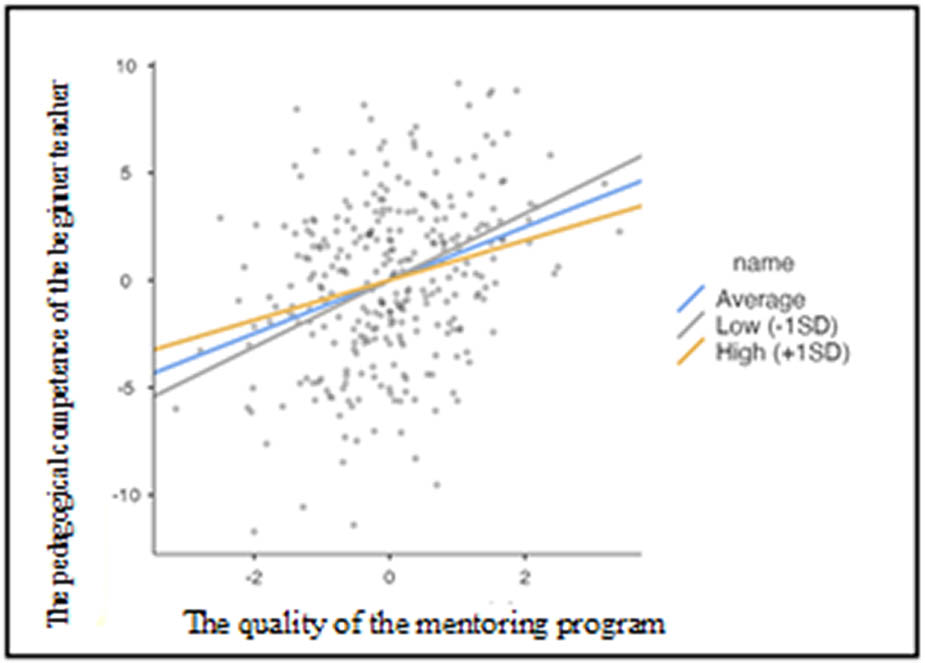
Figure 1
The moderating effect of the variable the beginner’s openness to get involved in his own training and development in the relationship between the duration of the quality of the mentoring program and the pedagogical competence of the beginner teacher.
Source: Author’s contribution.
Table 3
Descriptive statistics – average and standard deviation for levels of mentoring type.
| Mentoring type | N | Media | SD | SE |
|---|---|---|---|---|
| Face-to-face | 107 | 10.01 | 7.74 | 1.088 |
| Blended learning | 137 | 12.64 | 7.53 | 0.724 |
| Online | 57 | 8.28 | 5.76 | 0.827 |
Source: Author’s contribution.
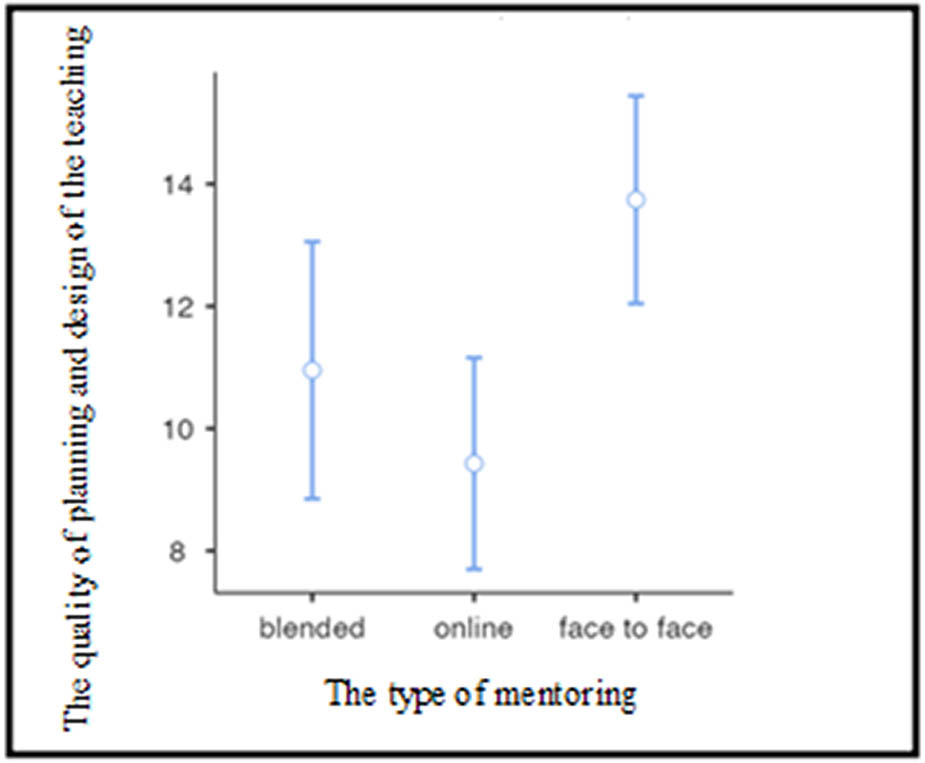
Figure 2
Environments and differences between groups, at the level of the type of mentoring, in terms of the quality of planning and design of the teaching activities used by the beginner teacher.
Source: Author’s contribution.
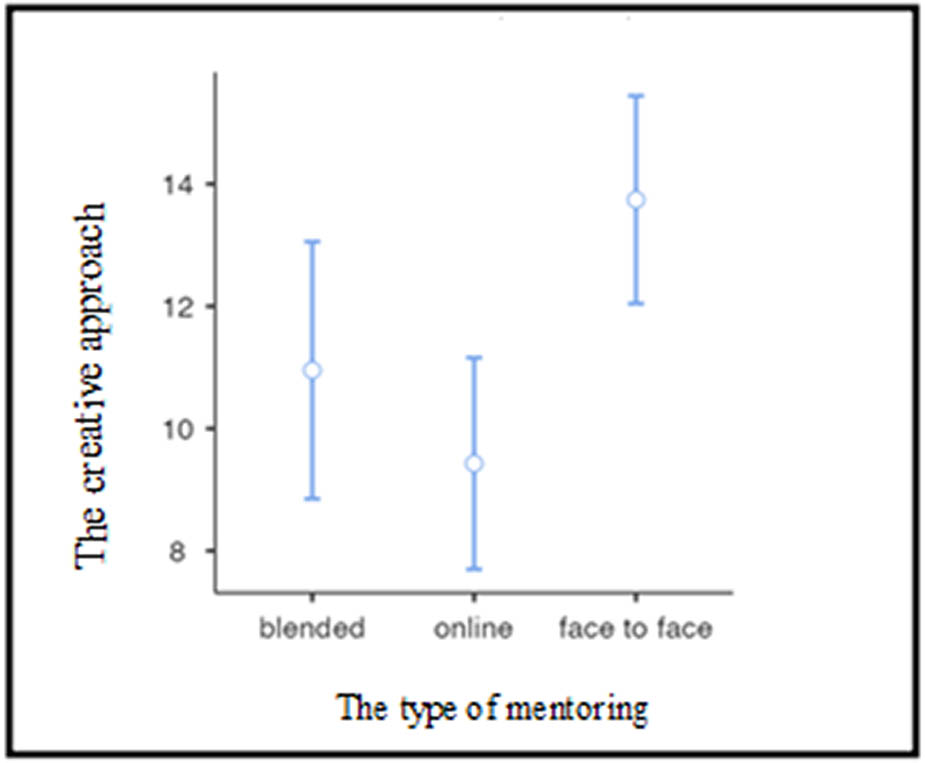
Figure 3
Environments and differences between groups, at the level of the type of mentoring, in terms of the creative approach and strategies used in the lessons by the beginner.
Source: Author’s contribution.
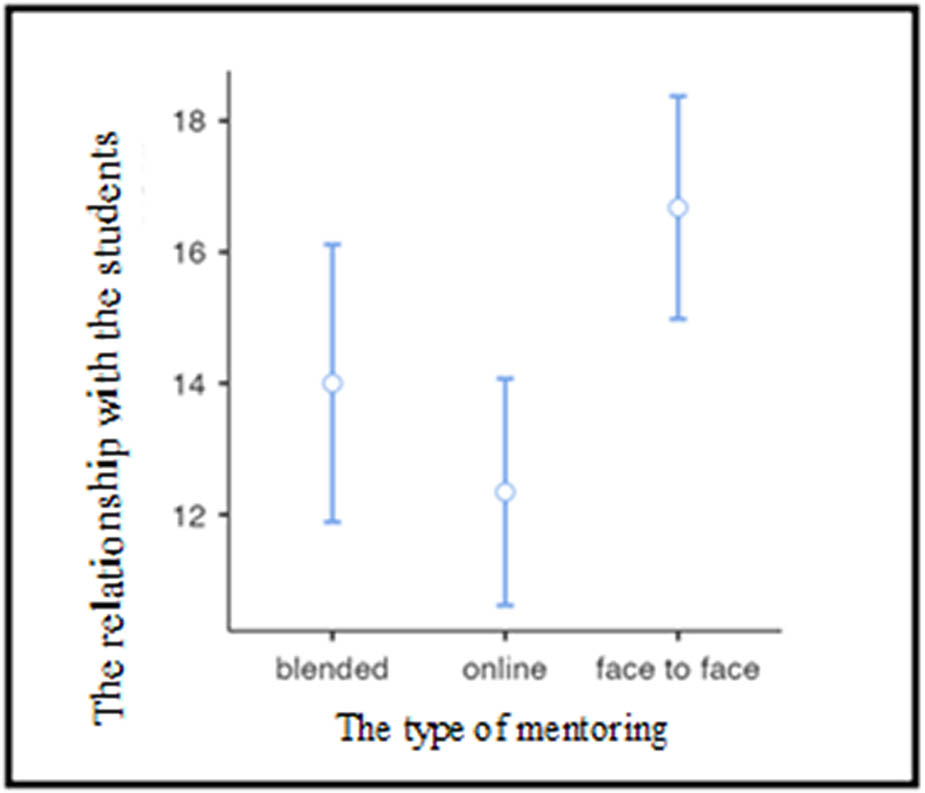
Figure 4
Averages and differences between groups, at the level of the type of mentoring, in terms of the quality of the relationship with the students.
Source: Author’s contribution.
Table 4
Results of the moderation analysis, analyzing the moderating effect of the variable good practice guidelines, in the relationship between the assessment-teaching-learning-assessment activity and the perception of the professional performance of the beginner.
| Variables | Coefficient | SE | Z | p |
|---|---|---|---|---|
| Assessment-teaching activity | 25.98 | 0.870 | 29.85 | <0.001 |
| Good practice guidelines | 25.07 | 0.872 | 28.74 | <0.001 |
| Assessment–teaching activity × good practice guides | 1.90 | 0.868 | 2.19 | <0.05 |
Note. SE = standard error.
Source: Author’s contribution.
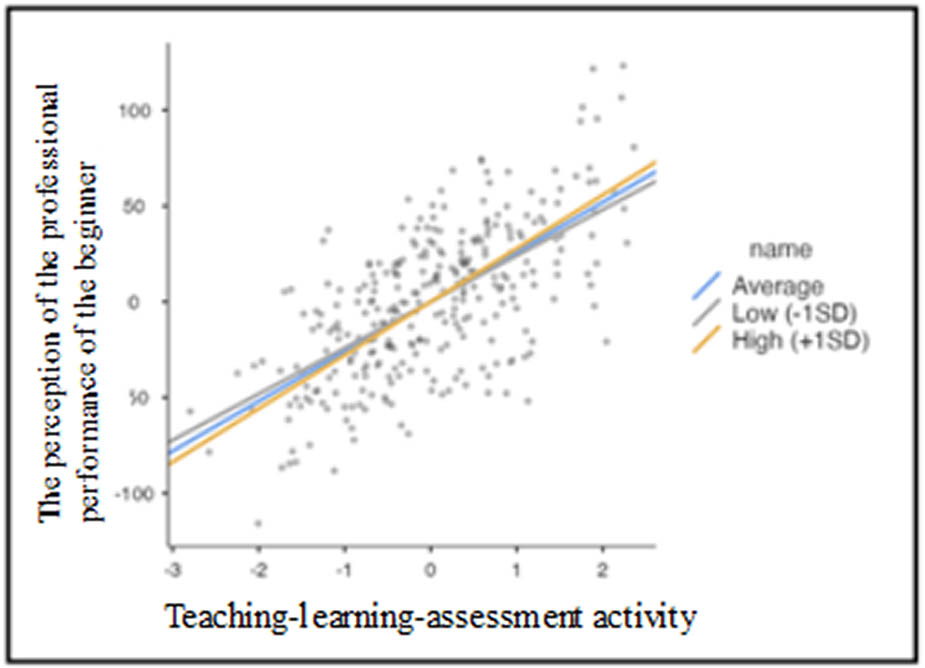
Figure 5
The moderating effect of the variable good practice guides, in the relationship between the assessment-teaching-learning-assessment activity and the perception of the professional performance of the beginner.
Source: Author’s contribution.