
1. Introduction
The timeliness and importance of this study’s topic are highlighted by the changes that have occurred in recent years, which have had a direct impact on teachers, especially beginning teachers, and on their professional careers. “Humanity was shaken by the pandemic caused by Covid. Schools had to adapt, and online pedagogy became a solution to face this historical challenge. Online pedagogy has become a reality and a necessity” (Manolescu, 2022, p. 23). In the context of the pandemic, school closures had negative consequences for all educational stakeholders: teachers, students, and also parents. Teachers and parents formed a team during the pandemic to be able to cope with the demands of online schooling.
Teachers are therefore required to adapt to the demands of society, to students’ needs, and to the school context. Walker (2008) states that an effective teacher is based on 12 important characteristics:
The teacher is always prepared (preparation is a constant);
Is positive (has an optimistic attitude);
Has high expectations for all children;
Is creative in conducting activities;
Is fair;
Is open with students;
Makes students feel good and comfortable in their presence;
Admits when they are wrong;
Has a well-developed sense of humor;
Respects students;
Is forgiving;
Shows compassion.
The major objectives of the Romanian educational system should be valuing the teaching profession, in relation to its importance for society, and improving the initial and continuous training of teachers so that effective teachers exist in the educational system.
The teacher is the core of the educational process; they are the one who organize and lead the entire teaching activity through their structure. “Teachers are special people, who have a structure typical of the profession” (Pânișoară, 2017, p. 15).
Teachers play increasingly diverse roles. They must undergo continuous training and consistently promote high-quality education. It is more necessary than ever to “generate a responsible attitude toward the teaching profession” (Manolescu, 2020, p. 38).
The mentor-beginner collaboration is therefore beneficial to the beginner teacher. Through it, the beginner receives the support needed at the start of their teaching career and to cope with challenges encountered throughout their professional activity.
2. Theoretical framework
The theoretical framework is dedicated to exploring the concepts of mentoring and professional integration, around which the entire theoretical foundation of beginner teachers’ integration into professional activity is built, as well as the investigative approach of the research in this regard.
Mentoring is the term used to describe the relationship between the beginning teacher, known as the novice, and the experienced teacher/expert, known as the mentor.
Socio-professional integration represents a process of adaptation and integration in any field, especially in the teaching profession. Professional integration involves a process of integrating the new employee – the beginner, in the case of education – into the professional environment (Ezechil et al., 2013). The mentor-novice relationship is essential for professional and personal development, being based on collaboration, trust, open communication, respect, and ongoing mutual commitment.
Methods of professional integration can be established in the form of mentoring, professional training, peer evaluation, and planned meetings with the school principal.
Many studies focus on topics that have the common interest of addressing the teacher and the challenges they face in their careers: burnout syndrome (Frenzel et al., 2016), stress and quitting the profession (Kilgallon et al., 2008; Pillay et al., 2005), issues related to classroom management and lack of career support (Borg & Riding, 1991; Greenglass et al., 1997), and the phenomenon of attrition or “teacher attrition” (Oke et al., 2016). These works lead to the idea that it is necessary to implement programs, projects, and plans in schools that train and develop teacher competencies from the beginning to the end of their careers. In most European countries, although there are no legal norms in all institutions, support measures are provided for new teachers. Schools play a role in organizing support methods to offer teachers guidance in their integration into professional activity. “The most frequently recommended support measure is mentoring” (Lazăr & Leahu, 2020, p. 61).
“Increasing professionalism and the demands in designing, implementing, and evaluating initial and continuing teacher training programs represents a main direction of action” (Manolescu, 2020, p. 38).
The documents that legislate mentoring in Romania are as follows: LEN No. 1/2011, LÎP No. 198/2023, LÎS No. 199/2023, and ROFUIP. The term mentoring has been mentioned in Romania since 2011, in LEN No. 1. In LÎP No. 198/2023, mentoring is the process that provides guidance to teachers, with the main objectives of integrating teachers and facilitating their professional development.
3. Research methodology
3.1. Purpose of the study
The aim of the study is to analyze the opinions of students enrolled in the field of primary education pedagogy, of beginning teachers in primary education, and of mentors, regarding the extent to which mentoring activities carried out at the primary education level represent a necessity at the start of the teaching career.
3.2. Main objectives of the study
The objectives of the study are as follows:
To highlight the importance of initial teacher training and the role of the mentor in this process.
To identify the main problematic aspects faced by beginning teachers at the start of their careers.
To facilitate the development of beginners’ professional competencies for professional integration in the educational system.
To propose the design and implementation of educational programs/platforms that promote trust in mentoring activities as a guarantee of success in the teaching profession.
To develop a guide of best practices to support beginning teachers in primary education.
3.3. Research hypotheses and variables
3.3.1. Hypotheses centered on initial teacher training
H1a: Initial teacher training influences
(a) the quality of the beginner’s teaching–learning–evaluation activities;
(b) the effort made in professional activity;
(c) the quality of the relationship with students, established by the coordinating teacher.
H1b: The beginner’s willingness to engage in their own training and development moderates the relationship between the quality of the mentoring program and the pedagogical competence of the beginner teacher.
Statistical tests
Moderation analyses
Multiple regression analysis
Variables
⁓Independent:
Initial teacher training
Quality of the mentoring program
⁓Moderator (independent):
Beginner’s willingness to engage in self-training and development
⁓Dependent:
Quality of teaching-learning-evaluation activity
Effort invested in professional activity
Quality of relationship with students (as perceived by the coordinating teacher)
Pedagogical competence of the beginner teacher
3.3.2. Hypotheses centered on mentor behavior
H2: The type of mentoring (face-to-face, blended learning, or online) influences
(a) the creative approach and strategies used in lessons by the beginner;
(b) the quality of planning and designing teaching activities;
(c) the quality of the relationship with students, as established by the beginner teacher.
Statistical tests
ANOVA (for group differences)
Variables
⁓Independent:
Type of mentoring (face-to-face, blended, online)
⁓Dependent:
Creative approach and strategies in lessons
Quality of planning and instructional design
Quality of student-teacher relationship
3.3.3. Hypotheses on the importance of best practice guides for educational quality in primary education
H3: Best practice guides moderate the relationship between teaching-learning-evaluation activity and the beginner’s perceived professional performance.
Statistical test
Moderation analysis
Variables
⁓Independent:
Teaching-learning-evaluation activity
⁓Moderator:
Best practice guides
⁓Dependent:
Perceived professional performance of the beginner teacher
3.4. Data analysis procedure
Data were analyzed using Jamovi (The jamovi project, 2019) and R (CRAN, 2020) software to obtain descriptive information about the sample.
Moderation, correlation, and ANOVA tests were run using the “medmod,” “regression,” and “ANOVA” packages.
Structural equation modeling regression modeling was also used to test hypotheses through the bootstrap method (n = 10,000), as recommended by the literature. Before running the statistical tests, the distribution was standardized (observations were converted to Z-scores) to allow direct comparison between results from different questionnaires.
3.5. Participants
Participants were recruited through school inspectorates, schools, and universities that expressed interest. They completed the online questionnaires via a shared access link. Completion took approximately 10–15 min.
Three types of questionnaires were designed: C1 (Students in pedagogy): 23 items, C2 (Beginner teachers): 20 items, C3 (Mentors): 15 items.
A total of 940 respondents participated:
301 students (C1);
302 beginners (C2);
337 mentors (C3).
3.6. Investigative approach
The principle of constructing the questionnaire addressed to students enrolled in the field of pedagogy was convergent with the purpose of the investigative approach to know and understand their perception of the teaching profession for which they are preparing. The questionnaire has 23 items.
The questionnaire addressed to beginner teachers aims to find out what are their opinions on the extent to which the mentoring activities carried out at the level of primary education are a necessity at the beginning of the profession and what are the educational needs, in order to meet the school requirements. The questionnaire consists of 20 items.
The principle of constructing the questionnaire addressed to mentors was convergent with the purpose of the investigative approach to know and understand their perception of mentoring and its principles, on identifying the needs of the beginners, from the interaction they had with them. The questionnaire has 15 items.
The questionnaires have the role of accumulating data on the variables that have operationalized the research hypotheses and at the same time follow the issues that constitute the object of investigation of the research.
4. Results
4.1. Hypotheses centered on initial teacher training
4.1.1. Testing the variable: Initial teacher training and its influence on
(a) the quality of the beginner’s teaching-learning-evaluation activity;
(b) the effort invested in professional activity;
(c) the quality of the relationship with students, as established by the coordinating teacher.
To determine whether initial teacher training predicts the quality of teaching–learning–evaluation activity, the level of effort invested in professional activity, or the quality of the student-teacher relationship, multiple regression analysis was used. Overall, the results indicate statistically significant models, with different associations between the studied variables.
The full results are centralized in Table 1.
Table 1
Results of the regression analysis regarding the initial training of teachers, and its influence on (a) the quality of the teaching-learning-assessment process of beginners; (b) the effort made in the professional activity; and (c) the quality of the relationship with the students, established by the coordinating teacher.
| Variables | B (SE) | Beta | t | p | R 2 |
|---|---|---|---|---|---|
| Quality of the teaching-learning-assessment process of beginners | 0.272 (0.029) | 0.480 | 9.47 | <0.001 | 0.246 |
| Effort made in professional activity | 0.234 (0.028) | 0.423 | 8.08 | <0.001 | 0.210 |
| Quality of the relationship with the students, established by the coordinating teacher | 0.302 (0.028) | 0.535 | 10.96 | <0.001 | 0.295 |
Note. The analyses are based on N = 301 participants.
Source: Author’s contribution.
Regarding the quality of the teaching–learning–assessment process of the beginners, the model is statistically significant (F(1,299) = 75.42, p < 0.001), where R 2 = 0.246, explaining 24% of the variance at the level of the dependent variable. The standard error (SE) of the estimate in this case was 0.029.
In the case of the effort made in the professional activity, the model is supported by data (F(1,299) = 63.55, p < 0.001), explaining 21% of the variance in the level of the effort made in the professional activity (R 2 = 0.210). The SE of the estimate in this case was 0.028.
Finally, the regression analysis for the quality of the relationship with the students, established by the coordinating teacher represented the strongest relationship (F(1,299) = 96.62, p < 0.001), where R 2 = 0.295, explaining 29% of the variance at the level of the dependent variable. The SE of the estimate in this case was 0.028.
4.1.2. Testing the variable openness of the beginner to get involved in his own training and development as a moderator in the relationship between the duration of the quality of the mentoring program and the pedagogical competence of the beginner teacher
The influence of the beginner’s openness to get involved in his own training and development, on the relationship between the duration of the quality of the mentoring program and the pedagogical competence of the beginner teacher, was investigated through a moderation analysis, including multiple regression. The results indicate that the model is statistically significant with a coefficient R 2 = 0.163, and explains a moderate level of variance in the pedagogical competence of the beginner teacher, of approximately 16.3% (F(2,297) = 19.32, p < 0.001).
However, both the predictor (i.e., the duration of the quality of the mentoring program) and the moderator (i.e., the beginner’s openness to get involved in their own training and development) revealed positive, but statistically insignificant relationships on the criterion variable (i.e., the pedagogical competence of the beginner teacher). Also, the interaction between the beginner’s openness to get involved in his own training and development with the beginner’s professional competence variable is not statistically significant (p = 0.141). Given that, overall, the proposed model is statistically significant, but the interaction between the two independent variables is not, it suggests that, although the chosen variables have a positive relationship with the dependent variable, the pedagogical competence of the beginner teacher, there is another type of relationship between them, apart from that of moderation. The results are also shown in tabular form in Table 2. The moderation analysis is also graphically illustrated in Figure 1.
Table 2
Results of the moderation analysis, analyzing the influence of the beginner’s openness to get involved in his own training and development as a moderator in the relationship between the duration of the quality of the mentoring program and the pedagogical competence of the beginner teacher.
| Variables | B | SE | t | p |
|---|---|---|---|---|
| Intercept | 1.242 | 502.03 | −174 | 0.143 |
| Quality duration of the mentoring program (P) | 16.04 | 10.04 | 1.60 | 0.111 |
| Pedagogical competence of the beginner teacher (M) | 15.65 | 10.03 | 1.56 | 0.119 |
| Interaction between P and M | −0.30 | 0.20 | −1.48 | 0.141 |
Note. B = non-standard regression coefficients; SE = standard error.
Source: Author’s contribution.
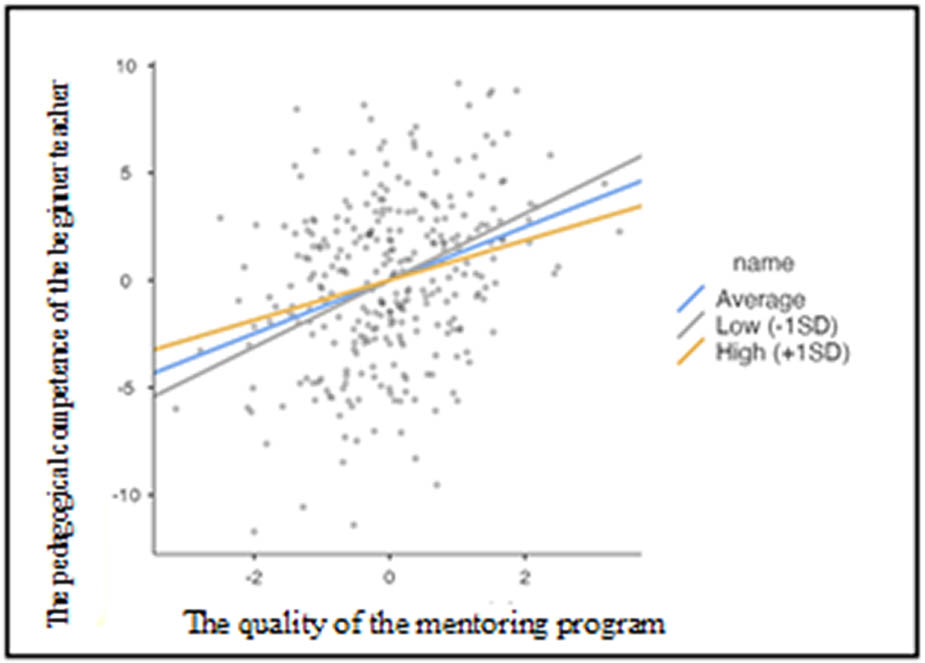
Figure 1
The moderating effect of the variable the beginner’s openness to get involved in his own training and development in the relationship between the duration of the quality of the mentoring program and the pedagogical competence of the beginner teacher.
Source: Author’s contribution.
4.2. Hypotheses centered on mentor behavior
4.2.1. Testing the variable: Type of mentoring (face-to-face, blended, online) and its influence on
(a) the creative approach and strategies used by the beginner;
(b) the quality of instructional planning and design;
(c) the quality of the relationship with students.
The effect of the type of mentoring (i.e., face-to-face, blended learning, or online) on the following dependent variables was investigated:
(a) the creative approach and strategies used in the lessons by the beginner;
(b) the quality of the planning and design of the teaching activities used by the junior teacher;
(c) the quality of the relationship with the students, established by the beginner teacher.
Table 3 reproduces descriptive information on the characteristics of the independent variable, namely, the type of mentoring.
Table 3
Descriptive statistics – average and standard deviation for levels of mentoring type.
| Mentoring type | N | Media | SD | SE |
|---|---|---|---|---|
| Face-to-face | 107 | 10.01 | 7.74 | 1.088 |
| Blended learning | 137 | 12.64 | 7.53 | 0.724 |
| Online | 57 | 8.28 | 5.76 | 0.827 |
Source: Author’s contribution.
The data reveal that the type of blended learning mentoring has the highest average (M = 12.64, SD = 7.53) while the type of online mentoring has the lowest average (M = 8.28, SD = 5.76). To see if the type of mentoring is related to the three dependent variables selected, the ANOVA statistical test was used. In the case of the variable creative approach and strategies used in the lessons by the beginner, the model is statistically significant, reporting F(3,298) = 6.09, p < 0.001, having an effect size (2 = 0.049). Figure 2 presents a visual representation of the environments and differences between the groups, at the level of the type of mentoring, in terms of the creative approach and strategies used in the lessons by the beginner.
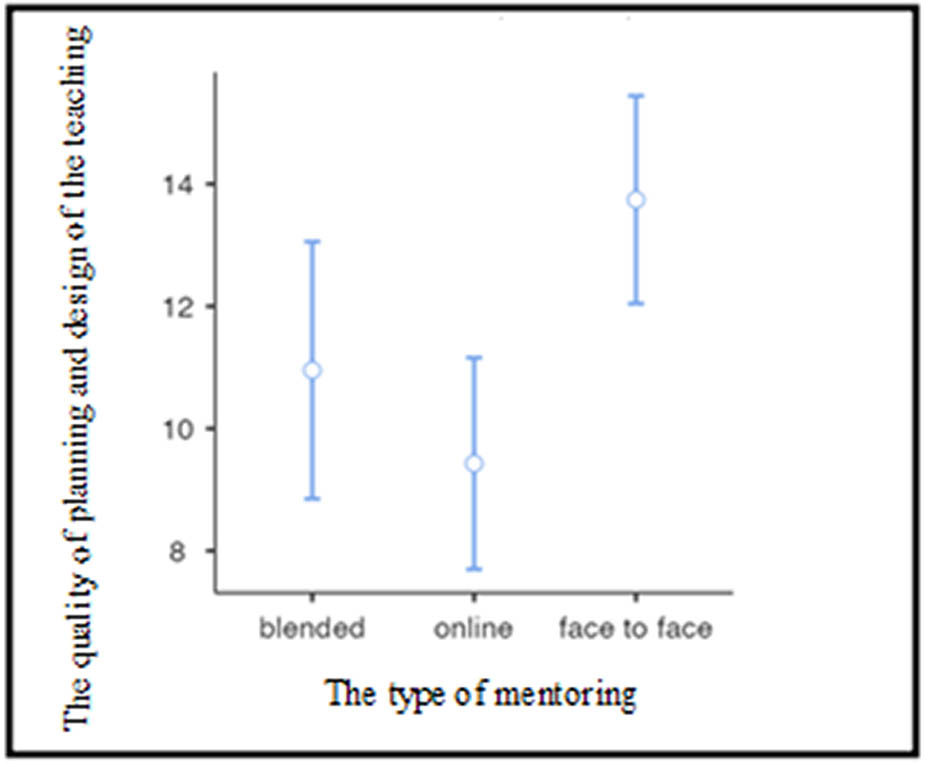
Figure 2
Environments and differences between groups, at the level of the type of mentoring, in terms of the quality of planning and design of the teaching activities used by the beginner teacher.
Source: Author’s contribution.
Regarding the variable quality of planning and design of the teaching activities used by the beginner teacher, the model is not statistically significant, F(3,298) = 0.822, p = 0.441, having an effect size (2 = 0.007). Figure 3 presents a visual representation of the environments and differences between the groups, at the level of the type of mentoring, in terms of the creative approach and strategies used in the lessons by the beginner.
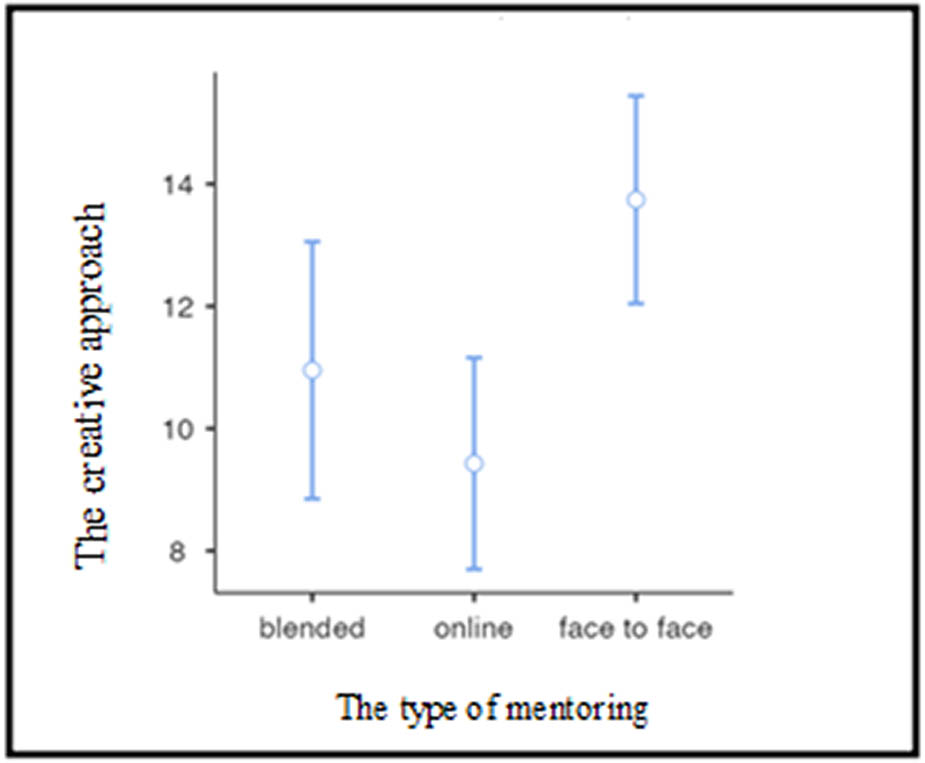
Figure 3
Environments and differences between groups, at the level of the type of mentoring, in terms of the creative approach and strategies used in the lessons by the beginner.
Source: Author’s contribution.
Finally, the effect of the independent variable on the quality of the relationship with the students, established by the coordinating teacher, was examined. In this case, the model is statistically significant, F(3,298) = 6.04, p < 0.001, having an effect size (2 = 0.049). Figure 4 illustrates the averages and differences between the groups, at the level of the type of mentoring, in terms of the quality of the relationship with the students, established by the beginner teacher.
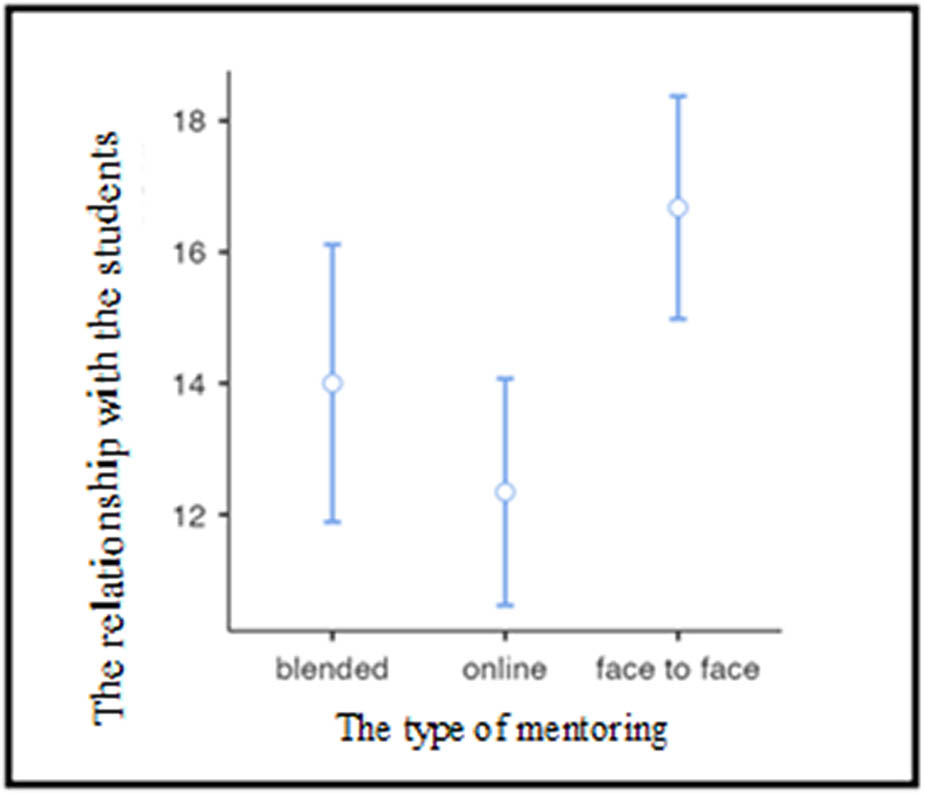
Figure 4
Averages and differences between groups, at the level of the type of mentoring, in terms of the quality of the relationship with the students.
Source: Author’s contribution.
4.3. Hypotheses on the importance of best practice guides
4.3.1. Testing the moderator role of best practice guides in the relationship between teaching–learning–evaluation activity and perceived performance
The influence of the good practice guides on the intensity of the relationship between the assessment–teaching–learning–assessment activity and the perception of the professional performance of the beginner was also tested.
The results obtained reveal that both the good practice guides and the assessment-teaching-learning-assessment activity are good predictors of the perception of the beginner’s professional performance (p < 0.001). Also, the interaction between the independent variable and the moderator (i.e., good practice guides, and the assessment–teaching–learning–assessment activity) is statistically significant (p < 0.028). The results obtained are detailed in tabular form in Table 4, and the interaction of the good practice guides and the evaluation–teaching–learning–evaluation activity, at different levels of the perception of the professional performance of the beginner is illustrated in Figure 5.
Table 4
Results of the moderation analysis, analyzing the moderating effect of the variable good practice guidelines, in the relationship between the assessment-teaching-learning-assessment activity and the perception of the professional performance of the beginner.
| Variables | Coefficient | SE | Z | p |
|---|---|---|---|---|
| Assessment-teaching activity | 25.98 | 0.870 | 29.85 | <0.001 |
| Good practice guidelines | 25.07 | 0.872 | 28.74 | <0.001 |
| Assessment–teaching activity × good practice guides | 1.90 | 0.868 | 2.19 | <0.05 |
Note. SE = standard error.
Source: Author’s contribution.
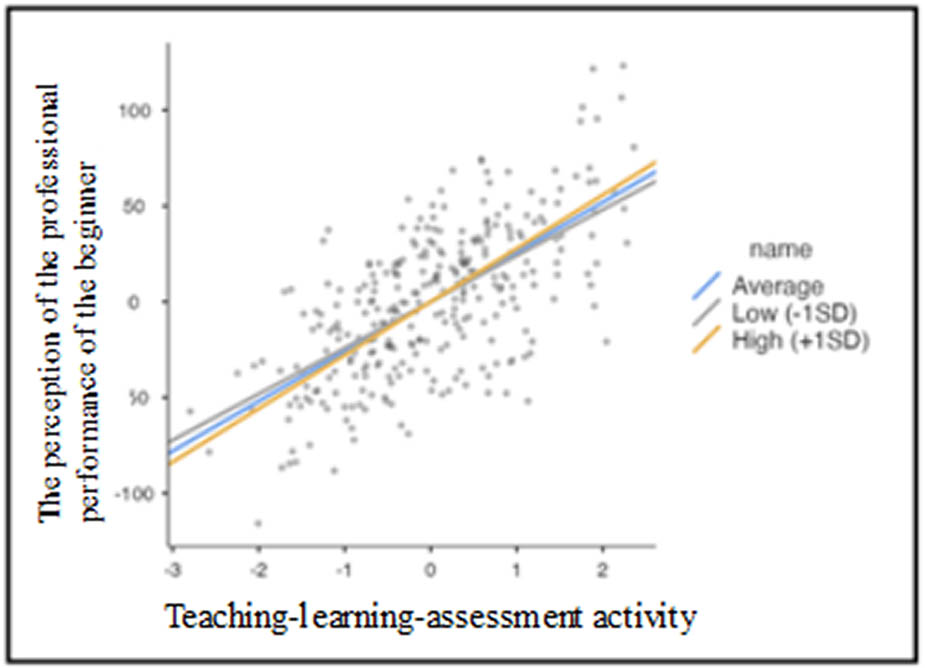
Figure 5
The moderating effect of the variable good practice guides, in the relationship between the assessment-teaching-learning-assessment activity and the perception of the professional performance of the beginner.
Source: Author’s contribution.
5. Conclusion
We can conclude the following:
Students/future teachers identified their motivations for choosing the teaching profession as a desire for change, passion, the wish to discover the educational world, child development, study opportunities, involvement of teachers, working with children, and the desire to shape individuals who in turn build a society based on equity, morality, and justice – one that aspires to progress, a higher quality of life, critical thinking, empathy, and better choices for both the future and the history of humanity. Other motivators include children’s warmth and a sense of social and civic responsibility.
Students/future teachers want appropriate resources and teaching materials for educational activities; recognition of their professional efforts; support in managing difficult situations with students; and opportunities for personal development training.
In the opinion of beginning teachers, mentoring implies support, guidance, coaching, encouragement, professional training, help, experience, advice, initiation, role models, preparation, and facilitation.
Beginning teachers stated that the teacher training system needs innovation.
They also expressed a strong need for training in the following areas:
Personal development;
Pedagogical components;
Understanding students;
Classroom management;
Use of modern techniques;
Differentiated teaching strategies;
School counseling and guidance;
Use of educational technologies;
Educational communication;
Professional ethics;
Intercultural education;
Adult education.
The top priorities for training were using modern techniques, differentiated teaching, and adult education.
Mentors identified strengths such as online courses, digitalization, variety of training courses, the eagerness of beginning teachers to improve, mutual support within professional networks, committed and responsible individuals, the involvement of beginners in diverse activities, modern teacher training methods, diverse educational programs, promotion of modern learning strategies, adaptation to current educational needs, and access to information and technology.
Mentors identified weaknesses such as formalism, bureaucracy, lack of pedagogical practice, insufficient needs analysis of teachers, an overload of theory, lack of hands-on experience in faculties, paid courses, challenges faced by novice teachers, lack of an optimal work environment, insufficient preparation time, low motivation for teacher training, limited practice sessions or mentoring hours, and absence of courses on teaching in mixed classes (including students with special needs or from disadvantaged groups), as well as lack of practical mentoring and dedicated legislation.
6. Limitations of the research
The research presents several limitations.
Lack of involvement and collaboration from certain educational actors and authorities who could have assisted in this effort;
Low support in applying research tools, making it difficult to apply them across a wide area of the country. Therefore, it was not possible to ensure the representativeness of the sample at a national level. The majority of responses came from Bucharest, Prahova, Giurgiu, Tulcea, Alba, Brăila, Vrancea, Hunedoara, Bacău, and Ilfov;
The research data were not generalized because there was no heterogeneity among the participants. The majority of respondents were women.
7. Open issues
We specify the following directions of action:
The possibility of continuing the research regarding the insertion of newcomers into professional activity and mentoring in education at other levels of pre-university education remains open;
Conducting additional analyses regarding the issue of mentoring in education;
Expanding the dimensions of the present research to ensure that the representativeness of the sample at a national level is guaranteed.
Funding information
Author states no funding involved.
Author contributions
The author confirms the sole responsibility for the conception of the study, presented results and manuscript preparation.
Conflict of interest statement
Author states no conflict of interest.