
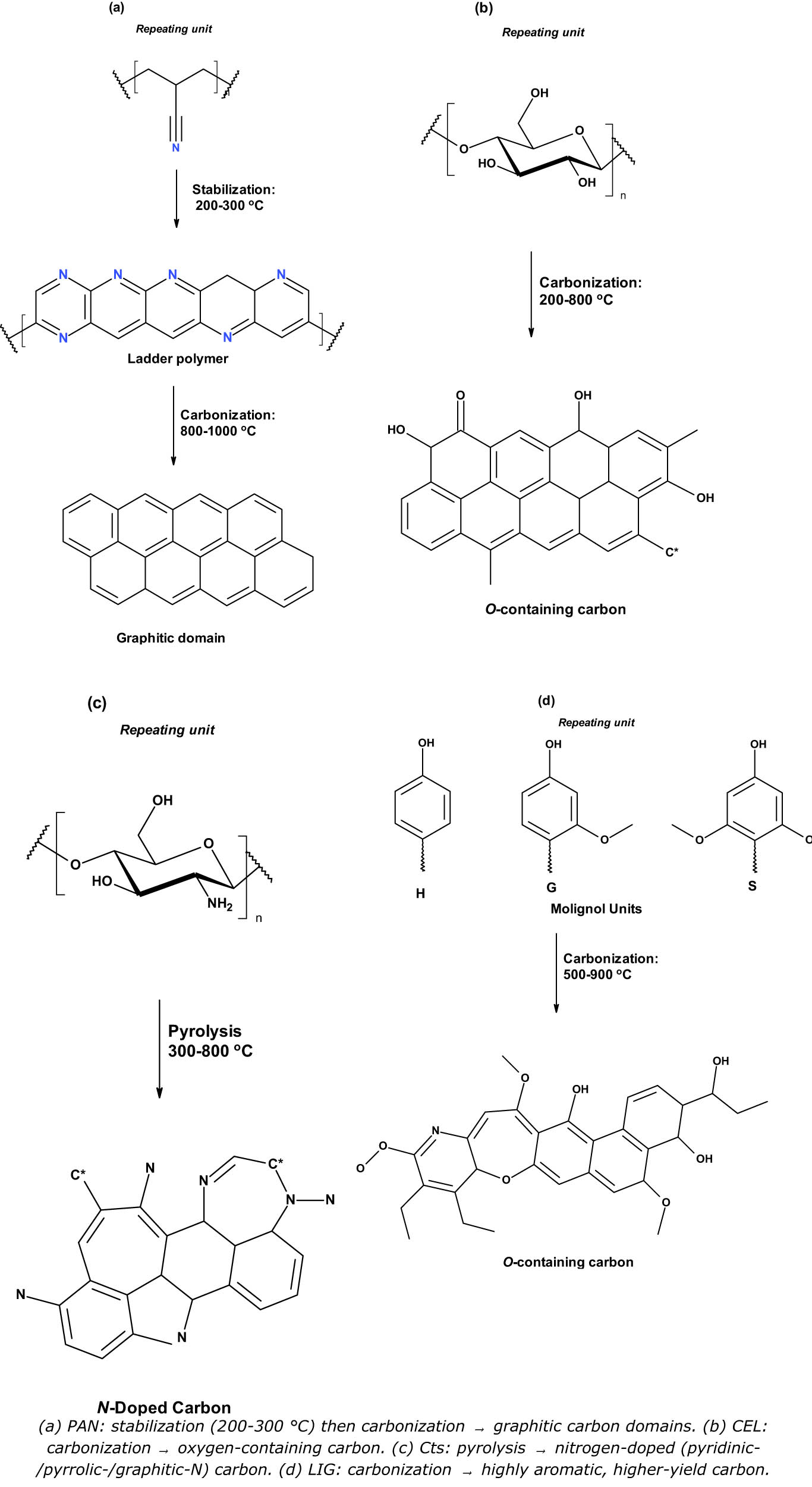
Figure 1
Main chemical structures of representative textile-derived carbon precursors and their thermal transformation pathways: (a) polyacrylonitrile fibre (PAN), (b) cellulose fibre (CEL), (c) chitosan fibre (Cts), and (d) lignin fibre (LIG) [16,24–28].
Table 1
Comparative characteristics of major textile-derived precursors for carbonised fibre production.
| Precursor | C yield (%) | Surface groups after carbonisation | Advantages | Limitations | Applications in water treatment | Refs |
|---|---|---|---|---|---|---|
| PAN | 50–55 | Graphitic domains; residual N-containing groups | High carbon yield; good mechanical stability; controllable pore structure | Fossil-derived; higher production cost | Heavy metals, dyes, pharmaceuticals; ACF filter media | [14,16,24,25,30] |
| Cellulose fibre (cotton, viscose, lyocell) | 20–30 (untreated); 35–45 (H₃PO₄/ZnCl2 or hydrothermally pre-treated) | –COOH, –OH, phenolic groups | Renewable; widely available; oxygen-rich surface | Low carbon yield; limited structural stability | Dye adsorption, metal ions; fast-flow filtration | [30,41] (untreated); [26] (pre-treated) |
| Chitosan fibre | ∼20 (as-spun); higher with NH₄Cl pre-treatment | Nitrogen functionalities (pyridinic-N, pyrrolic-N, graphitic-N) | High selectivity for metal ions; chelation capacity | Lower thermal stability; relatively high cost | Cu2+, Pb2+, Cd2+ removal; catalytic systems | [42] |
| Lignin fibre | 40–50 | Aromatic carbon; O-functional groups | Higher yield among biomass precursors; low raw material cost | Variable feedstock composition; batch-to-batch inconsistency | Activated carbons; dye adsorption | [27,28] |
| Lignocellulosic fibres (flax, hemp, jute) | 20–40 | Mixed O-containing groups | Waste valorisation potential; low feedstock cost | Variable composition; reproducibility issues | Bio-based adsorbents; filtration media | [27,34] |
| Textile waste (cotton/polyester blends) | 25–45 | Mixed graphitic and O-functional groups | Circular economy potential; diverts waste from landfill | Heterogeneous composition; requires pre-sorting | Wastewater treatment; hybrid adsorbents | [34] |
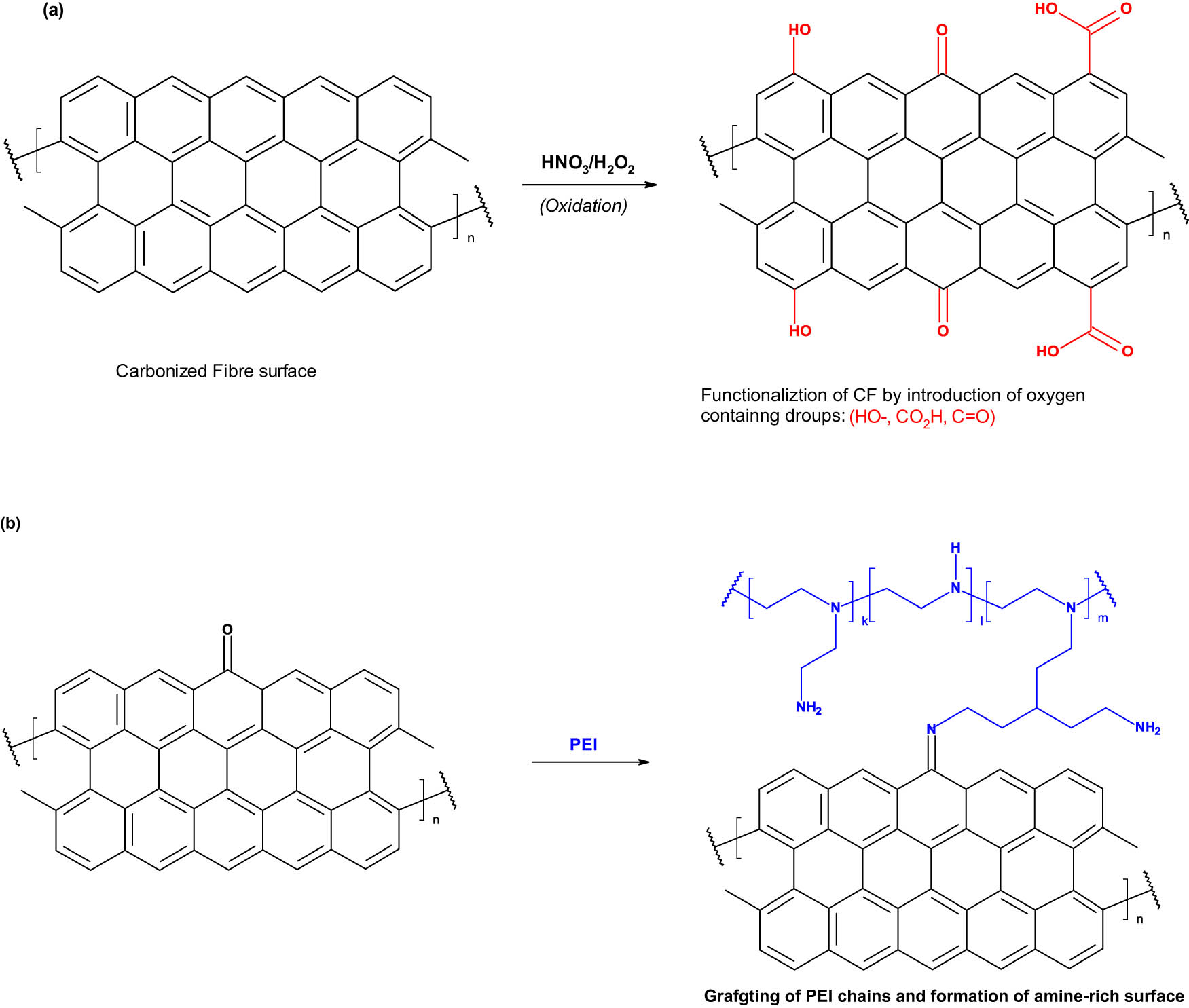
Figure 2
Simplified representative pathways for surface functionalisation of carbonised fibres: (A) oxidative functionalisation introducing oxygen-containing surface groups (-COOH, -OH, C = O) and (B) grafting of PEI chains leading to formation of amine-rich adsorption-active surfaces [44,45].
Table 2
Summary of physicochemical characterisation methods for carbonised fibre surfaces.
| Technique | Parameter measured | Typical values | Refs. |
|---|---|---|---|
| XPS (N 1 s deconvolution) | Pyridinic-N, pyrrolic-N, graphitic-N, oxidised-N | ∼398.5, ∼400.1, ∼401.2, ∼402–405 eV | [43,46] |
| Raman spectroscopy | D-band/G-band intensity ratio | D ∼1350 cm−1; G ∼1580 cm−1 | [47,48] |
| FTIR-ATR | Surface functional groups | Carboxyl ∼1710–1730; carbonyl ∼1600–1650; hydroxyl 3200–3500 (broad); amine N-H 3300–3500 and 1550–1650 cm−1 | [44] |
| TPD (inert gas) | Desorption temperature of O-groups | Carboxylic acids 200–300°C; lactones/anhydrides 350–600°C; phenol/carbonyl at higher temperatures | [44] |
| N2 physisorption (BET/NLDFT) | Surface area, micropore size distribution | Pore widths below 2 nm dominant | [46] |
| Hg intrusion porosimetry | Macropore volume/distribution | 0.1–10 µm | [49] |
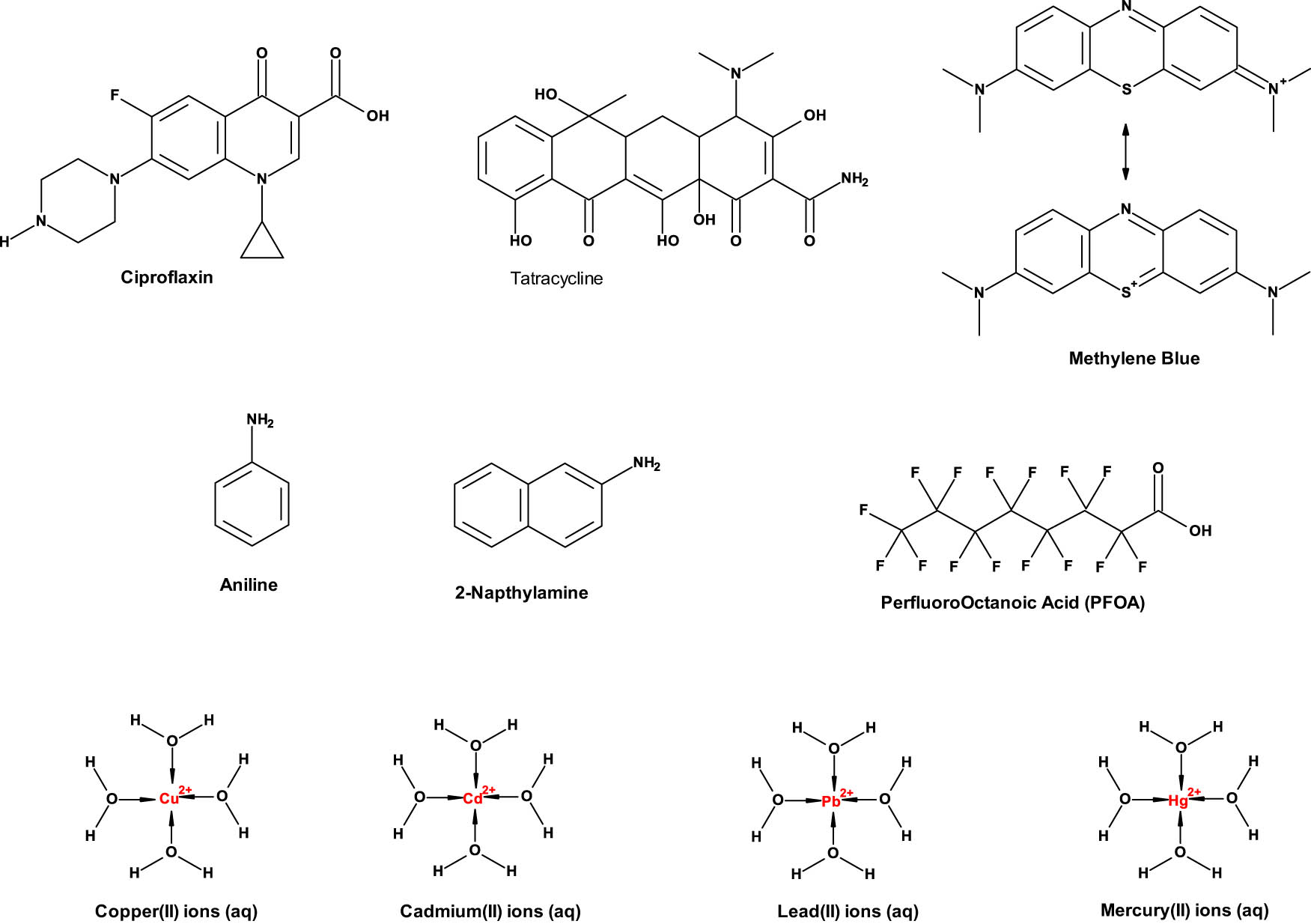
Figure 3
Representative contaminants relevant to textile wastewater treatment, including heavy metal ions, dyes, aromatic amines, pharmaceuticals, and persistent organic contaminants [7,13,15,62,68,69].
Table 3
Principal adsorption interaction mechanisms between functionalised carbonised fibre surfaces and dissolved pollutants.
| Interaction type | Scheme | Occurrence | Ref. |
|---|---|---|---|
| Electrostatic attraction |

| Cationic dyes, protonated amines | [43,44,70] |
| Coordination/chelation |

| Heavy metal ions | [51,62,68] |
| Hydrogen bonding |

| Pharmaceuticals, amines | [43,69] |
| π–π Interaction |

| Aromatic fragments | [43,47,48] |
| Hydrophobic interaction |

| Non-polar organic compounds, PAHs, chlorinated solvents, microplastics | [43,51] |
The Scheme column presents representative interaction geometries, whereas the occurrence column indicates contaminant classes for which a given mechanism is typically dominant or co-dominant under common aqueous conditions (pH 4–8). In practice, multiple adsorption mechanisms often operate simultaneously, and their relative contributions depend on surface functional group density, pollutant speciation, solution pH, and ionic strength [43,44,47,48,51,64,69,70].
Table 4
Representative adsorption performance of carbonised textile fibre-based materials for priority pollutants in industrial wastewater treatment.
| Material/precursor | Target pollutant | qmax (mg g−1) | Removal (%) | pHopt | Ref. |
|---|---|---|---|---|---|
| PAN-ACF nonwoven, chitosan-coated | Cu2+ | 80–200 | — | 5.5 | [32] |
| PAN-ACF nonwoven, PEI grafted | Pb2+ | 150–280 | — | 5.0 | [62] |
| Chitosan-derived N-doped carbon | Cd2+ | 60–180 | — | 6.0 | [63] |
| Viscose-ACF, HNO₃ oxidised | Hg2+ | 50–150 | — | 4.5 | [64] |
| PAN-ACF, KOH activated | Methylene blue | 200–500 | — | 7.0 | [15] |
| Lignin-derived ACF, CO2 activated | Acid Orange 7 | 100–250 | — | 3.5 | [27] |
| PAN-ACF, H2O2 oxidised | Tetracycline | 80–200 | — | 5.0 | [13] |
| Cellulose-fibre-ACF, KOH activated | Ibuprofen | 70–150 | — | 7.0 | [65] |
| Carbonised PAN nonwoven, O₃ oxidised | Microplastics < 100 µm | — | 85–98 | 7.0 | [66] |
| Cascade ACF nonwoven, three-stage | PE/PP fibres < 500 µm | — | 80–95 | 6.5–8.5 | [67] |
Values are indicative ranges drawn from multiple sources and depend on initial concentration, contact time, adsorbent dose, and temperature. ACF – activated carbon fibre; PAN – polyacrylonitrile fibre; PEI – polyethylenimine; q max – Langmuir maximum adsorption capacity (batch isotherm, 25°C) [13,15,27,32,62–67].
Table 5
Representative cascade and hybrid treatment configurations incorporating carbonised textile fibre stages and their reported treatment performance.
| System configuration | Target pollutants | Removal (%) | Other reported metrics | Ref. |
|---|---|---|---|---|
| Two-stage cascade ACF nonwoven | Microplastics + MB dye | > 98% MP; 94% MB | — | [67] |
| Ozonation → ACF nonwoven | Aromatic amines, micropollutants | — | Not quantified (qualitative, see ref.) | [10] |
| UV/H2O2 → chitosan-ACF | Reactive dyes + Cu2+ | 98% colour; 96% Cu2+ | — | [79] |
| MBR → NF membrane | COD, N, pharmaceuticals | — | Not quantified (qualitative, see ref.) | [80] |
| ACF cascade → RO | Complex textile effluent (mixed) | — | BOD < 10 mg L−1; conductivity < 500 µS cm−1 | [15] |
| Coagulation → ACF → UF | Heavy metals + suspended solids | 99% Pb2+ | Turbidity < 1 NTU | [81] |
| SBR bioreactor → ACF polishing | Residual COD + trace organics | 88% micropollutants | BOD < 5 mg L−1 | [82] |
*MBR – membrane bioreactor; SBR – sequential batch reactor; NF – nanofiltration; RO – reverse osmosis; UF – ultrafiltration; ACF – activated carbon fibre; AOP – advanced oxidation process.
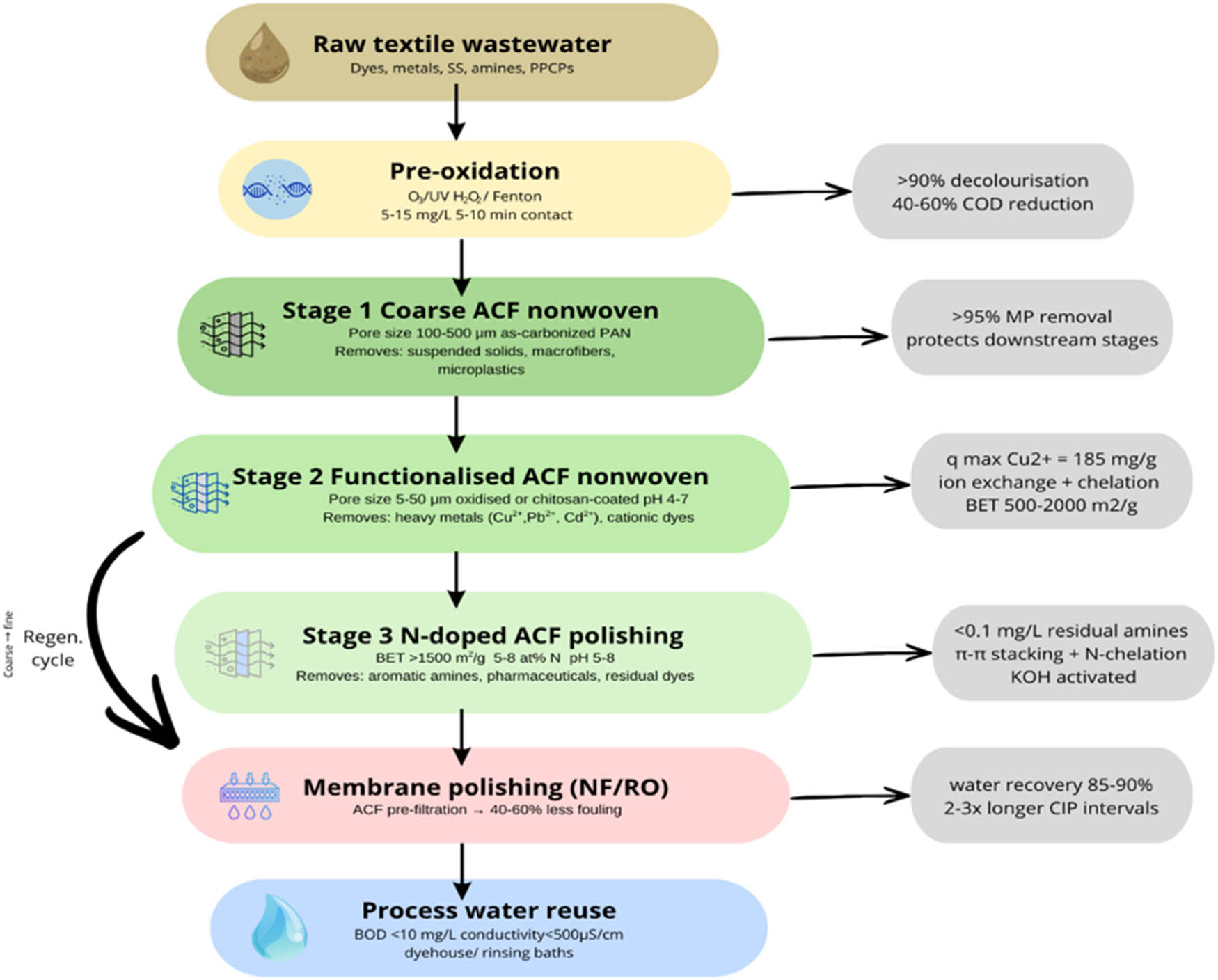
Figure 4
Schematic of a multi-stage cascade treatment train for textile wastewater incorporating pre-oxidation, three ACF nonwoven filter stages, and membrane polishing [10,15,79–83].