
1. Introduction
Access to clean water is under increasing pressure globally. UN estimates put the number of people living in high water-stress regions at over two billion, with supply deficits projected to deepen in many areas by 2050 [1]. Industrial consumption contributes substantially to this pressure and tends to receive less policy attention than agriculture. In Poland, industry accounts for more than 70% of total annual freshwater withdrawals – roughly 7 billion cubic metres, a figure dominated by cooling-water abstraction in the energy sector – drawing from river basins that also supply drinking water to urban populations [2].
The textile sector is a disproportionate contributor. Wet-processing operations – scouring, bleaching, dyeing, printing, and finishing – require water as a reaction medium for salts, alkalis, acids, surfactants, and process chemicals across a wide pH range [3,4]. Processing 1 kg of dyed cotton generates approximately 100–150 litres of effluent [5], and the industry is estimated to contribute substantially to industrial water pollution globally, with some reports suggesting a share of up to 20% [6], though this figure draws on grey literature and should be treated with caution – discharging dyes, aromatic amines, heavy metals, phthalates, and volatile organic compounds into receiving waters. Aromatic amines warrant particular attention: they form through reductive cleavage of azo dye bonds under environmental or metabolic conditions, many are classified as confirmed or suspected carcinogens under EU REACH Annex XVII [7], and their presence in surface waters linked to textile processing and laundering has been documented, though contamination data remain fragmentary and geographically uneven; an early report of river contamination by aromatic amines from azo-dye cleavage [8] predates the tightening of REACH restrictions and substantial changes in the textile sector’s use of these substances since then [9].
Conventional treatment based on activated sludge is effective for readily biodegradable organic load, but handles recalcitrant dyes, heavy metals, and persistent micropollutants such as pharmaceuticals and microplastics poorly [10]. More advanced options – chemical precipitation, coagulation–flocculation, adsorption on granular activated carbon, and membrane filtration – are technically capable of addressing these contaminants, but their cost and operational complexity represent a significant barrier for small- and medium-sized enterprises, which make up the majority of textile processors in Poland and in much of Central Europe. The result is that investment in wastewater upgrading remains low despite tightening regulatory requirements, and there is practical demand for treatment materials that offer high performance at manageable cost and can be regenerated on-site [11].
Carbon-based adsorbents – activated carbons, carbon nanotubes, graphene oxide, biochar – have received sustained research attention for water treatment [12,13]. High surface area and chemically versatile surfaces are the main reasons. Among these, carbonised fibre-based materials obtained from textile precursors have certain practical advantages. Controlled carbonisation of fibrous starting materials preserves the original fabric architecture, producing three-dimensional porous networks that combine activated-carbon-type adsorption capacity with the mechanical integrity and formability of woven or nonwoven textiles [14,15]. This makes it possible to fabricate structured filter elements – rather than loose granular beds – that can sustain continuous flow-through operation without significant pressure drop or channelling, which is relevant for multi-stage cascade configurations.
The fibre precursors studied to date include polyacrylonitrile fibres (PAN), cellulose fibres and their derivatives, chitosan fibres, lignin fibres, and various lignocellulosic waste materials. PAN is the most extensively investigated, drawing on the well-established stabilisation and carbonisation knowledge accumulated in the carbon-fibre composite industry [16,17]. Cellulose fibre-derived carbons are of interest as renewable bio-based alternatives, and the oxygen-rich surface groups they carry after moderate-temperature carbonisation facilitate further chemical modification [18]. Chitosan, obtained from crustacean chitin by alkaline deacetylation, introduces dense primary amine groups onto the carbon surface; after pyrolysis, these are converted into pyridinic-N, pyrrolic-N, and graphitic-N species, which may contribute to enhanced affinity for transition-metal ions such as Cu2⁺, Pb2⁺, and Cd2⁺ depending on the retained nitrogen configuration [19]. Combining biopolymer and synthetic fibre precursors – by blending or co-spinning – gives further scope for adjusting the adsorption characteristics and mechanical properties of the final filter element [20].
Multi-stage or cascade filtration, in which several filter stages with different functions are arranged in series, offers a practical way to deal with the complex composition of textile effluents [10]. A coarse stage can remove suspended solids and microfibres; intermediate stages with functionalised activated-carbon nonwovens adsorb heavy metals and dyes; a final polishing stage targets trace organics and residual colour. When preceded by advanced oxidation (ozonation, UV/H2O2, Fenton chemistry, or persulfate activation) and followed by nanofiltration or reverse osmosis, such trains can produce effluent of sufficient quality for reuse in the dyehouse or finishing bath [21]. Integrated advanced oxidation process (AOP)-membrane configurations remain comparatively underexplored relative to their individual components, with process design, fouling control, and energy demand identified as the main barriers to wider adoption [21]. Recent pilot-scale work combining nanofiltration, reverse osmosis, and persulfate oxidation of biologically treated textile effluent has reported permeate specific energy consumption as low as 0.38–1.2 kWh m−3, with nanofiltration at moderate pressure identified as the most energy-efficient configuration [22]. The economic incentive to close the water loop within the production facility, reducing both freshwater intake and wastewater discharge fees, makes this approach attractive even for small- and medium-sized enterprises, particularly in regions where freshwater abstraction and discharge charges are rising. Closed-loop and zero-liquid-discharge approaches specifically for the textile sector have advanced substantially since 2020, driven by tightening discharge regulations and rising freshwater costs [23].
Existing reviews usually focus on individual aspects of carbonised fibre materials, whereas comprehensive coverage of precursor selection, carbonisation, functionalisation, pollutant removal, and practical applications remains scarce. This review provides an integrated overview of textile-derived carbonised fibres, covering precursor materials, carbonisation and activation processes, surface modification strategies, pollutant removal mechanisms, and the application of carbonised nonwovens in cascade filtration systems. Particular attention is given to regeneration, scale-up challenges, and the circular use of post-consumer textile waste as a feedstock for advanced filtration materials.
2. Textile-Derived Precursors and Carbonisation
Precursor choice shapes carbon yield, pore development, surface chemistry, and ultimately the adsorption performance of the resulting fibres. The main precursor groups studied to date are discussed below, with attention to how each affects properties relevant to water-treatment use. Figure 1 summarizes the principal textile-derived carbon precursors and their transformation pathways during stabilisation, pyrolysis, and carbonisation. The resulting surface chemistry – oxygen groups in CEL-derived carbons, nitrogen configurations in Cts-derived carbons, and graphitic domains in PAN- and LIG-derived carbons – directly governs contaminant selectivity in the filtration systems described in Section 4 [16,24–28].
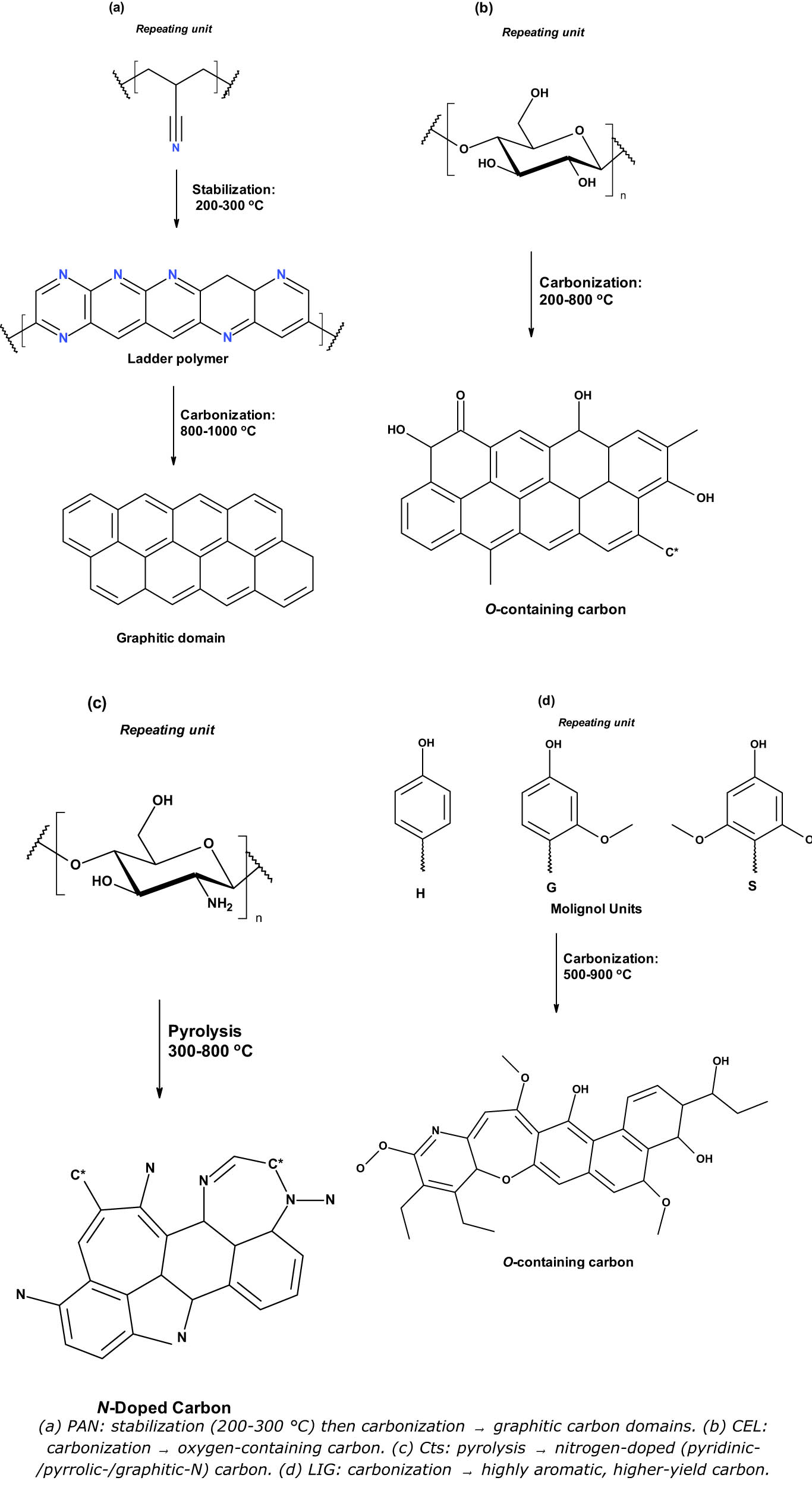
Figure 1
Main chemical structures of representative textile-derived carbon precursors and their thermal transformation pathways: (a) polyacrylonitrile fibre (PAN), (b) cellulose fibre (CEL), (c) chitosan fibre (Cts), and (d) lignin fibre (LIG) [16,24–28].
2.1. Polyacrylonitrile Fibres
PAN has been used as a carbon-fibre precursor since the 1960s, and the processing knowledge accumulated in the structural-composites sector applies largely unchanged to activated carbon fibre (ACF) manufacture for water treatment. Fibres are produced by wet or dry-jet wet spinning from acrylonitrile homo- or copolymers – small additions of itaconic acid or methyl acrylate moderate the exothermic cyclisation during stabilisation [24]. Heating in air at 200–300°C converts the nitrile groups into a thermally stable ladder structure of conjugated C–N and C–C bonds, after which the fibre can withstand the subsequent high-temperature step [25]. Carbonisation in nitrogen or argon at 800–1600°C removes most heteroatoms and leaves a turbostratic graphitic matrix with carbon content above 92 wt% [16]. Carbon yield is 50–55%, markedly higher than for most natural precursors, and partly compensates for the higher raw-material cost.
After activation, PAN-derived ACFs reach Brunauer–Emmett–Teller (BET) surface areas of 1000–2500 m2 g−1, with well-developed microporosity (pore width < 2 nm) that accounts for their high uptake of small organic molecules [14,29]. When the precursor is in nonwoven form, the bonded fibre architecture survives carbonisation, yielding an activated carbon nonwoven with a defined three-dimensional structure suitable for use in flow-through filter modules [30]. Basis weight, fibre diameter, and inter-fibre void volume are all adjustable in the precursor fabric, providing structural control over the finished filter that granular carbon beds cannot easily match. This tunability is the main practical justification for nonwoven PAN-ACF in cascade filter designs.
2.2. Cellulose Fibres and Their Carbonisation
Carbon fibres from rayon (regenerated cellulose) predate PAN-based fibres commercially, with early applications in aerospace dating to the 1950s [16]. Viscose, lyocell, and natural cotton have all been carbonised to produce porous carbon materials for environmental applications. The practical drawback versus PAN is low carbon yield: pyrolysis of cellulose fibres typically delivers only 20–30 wt% carbon because competing depolymerisation and dehydration reactions convert much of the mass to volatiles [30]. Pre-treating with phosphoric acid or zinc chloride, or using a hydrothermal step prior to carbonisation, promotes char formation and can raise yield to 35–45% [26].
Carbonised cellulose fibres retain meaningful amounts of surface oxygen functionality – carboxyl, lactone, and phenol groups – when carbonised at moderate temperatures (below about 900°C). This amphoteric character supports adsorption of cationic metal ions through ion exchange, complexation, and electrostatic attraction, the relative contributions of which shift with pH and the extent of surface oxidation [18]. It should be noted that aerogels cast from cellulose nanofibre or cellulose nanocrystal suspensions are not fibrous in the classical textile-precursor sense – they originate from nanocellulose suspensions rather than spun or natural cellulose fibres – but, after carbonisation, they give very-low-density carbon sponges with open macro- and mesopore networks [31], and are mentioned here only for functional comparison with fibre-based ACF media. This hierarchical porosity supports higher filtration velocities than predominantly microporous PAN-ACFs, which can be useful when high filtration velocity matters more than maximum surface area.
2.3. Chitosan-Based Fibres
Chitosan is obtained from crustacean shells by alkaline deacetylation of chitin. What distinguishes it from PAN fibres or cellulose fibres as a precursor is the high density of primary amine groups (−NH2) along the backbone, which coordinate transition-metal ions through nitrogen lone-pair donation and electrostatic mechanisms. Upon pyrolysis, however, the −NH2 groups are not retained as such; instead, nitrogen is incorporated into pyridinic-N, pyrrolic-N, and graphitic-N configurations. Pyridinic and pyrrolic sites at pore edges retain lone-pair donor character and are responsible for the selective affinity of carbonised chitosan for Cu2⁺, Pb2⁺, Hg2⁺, Cd2⁺, and Ni2⁺ [32]. The degree of deacetylation, typically 75–95% for commercial grades, controls amine density and hence metal-adsorption capacity [33]. Fibres can be wet-spun from dilute acetic acid solution; crosslinking with glutaraldehyde or epichlorohydrin before pyrolysis improves dimensional stability. Pyrolysis of crosslinked chitosan at 600–900°C under nitrogen yields nitrogen-doped porous carbons with 2–8 at % N, which may enhance electrostatic affinity for anionic species depending on the predominant nitrogen configuration (pyridinic vs. graphitic N) and solution pH, and can improve catalytic activity in oxidative processes [32].
2.4. Lignocellulosic and Waste-Derived Precursors
Flax, hemp, jute, coir, and kenaf have all been tested as ACF precursors. Their heterogeneous cell-wall structure – cellulose microfibrils in a hemicellulose-lignin matrix – tends to give broader and less predictable pore-size distributions than pure cellulose fibres or PAN [27]. Lignin deserves separate mention: available in large quantities from pulp and paper production, it has carbon yields of 40–50 wt% depending on lignin source (kraft, organosolv, or soda) and carbonisation temperature, which are closer to PAN than most polysaccharide precursors [28]. Post-consumer textile waste, mainly cotton-polyester blends, has also been examined as a feedstock. Pyrolysis of such mixed-fibre waste gives composite carbons in which the polyester-derived aromatic carbon structures provide a degree of structural reinforcement and the cellulose-fibre-derived fraction contributes surface functional groups [34]. Feedstock heterogeneity is a real problem for process control and reproducibility, but cost and end-of-life management considerations continue to motivate interest in waste-derived feedstocks. In practice, however, the cotton-to-polyester ratio in post-consumer streams varies widely between garment grades and collection sources, and few studies have evaluated whether carbonisation protocols optimised on model single-fibre textiles transfer reliably to unsorted blends. Reported BET surface areas and adsorption capacities for waste-derived carbons show substantially larger inter-study variability than for PAN or virgin cellulose precursors, and reproducibility within ±20% between batches has rarely been demonstrated [34]. Until robust pre-sorting and blending protocols are established at industrial scale, batch-to-batch consistency remains an unresolved obstacle for waste-textile carbonisation feedstocks.
2.5. Carbonisation and Activation Processes
Whatever the precursor, ACF production follows the same general sequence. An optional pre-treatment step – oxidative stabilisation for PAN, catalyst impregnation for cellulose fibres – prepares the fibre for carbonisation at 600–1600°C in an inert atmosphere, which removes heteroatoms and develops the turbostratic carbon structure. Activation then opens and expands the pore network. Physical activation uses steam or CO2 at 800–1000°C; the Boudouard reaction (C + CO2 → 2CO) preferentially burns off the most reactive carbon at defect sites and pore edges, giving predominantly microporous products with narrow pore-size distributions. Chemical activation with KOH – the most widely used agent – works by intercalation and subsequent volatilisation of potassium species, which generates additional mesopores alongside existing micropores; BET areas above 3000 m2 g−1 have been reported under optimised laboratory conditions, though at this level of porosity mechanical integrity tends to be compromised [35,36].
Temperature is the variable with the most pronounced effect on pore structure and surface chemistry. Below about 700°C, a significant share of heteroatom functionality is retained – oxygen and nitrogen groups useful for adsorbing polar contaminants but that limit graphitic order and electrical conductivity. Above 1200°C, graphitic ordering increases, which strengthens π–π stacking interactions with aromatic pollutants but reduces the density of ion-exchange-active surface groups [37]. For water-treatment purposes, 800–1000°C followed by mild activation is generally where the useful range lies: BET areas fall between 800 and 1500 m2 g−1, the pore structure is mixed micro-mesoporous, and enough residual oxygen functionality survives to maintain wettability and ion-exchange capacity. Heating rate and hold time at peak temperature have secondary but measurable effects: slow ramp rates (1–3°C min−1) promote more uniform pore development, whereas rapid pyrolysis can create gaseous-product concentration gradients that cause cracking along the fibre cross-section [38].
For filter module applications, the dimensional changes that occur during carbonisation require attention. PAN nonwovens typically shrink 20–40% linearly depending on stabilisation conditions, applied tension, and precursor composition, and the shrinkage is anisotropic – more pronounced along the fibre length than across the cross-section – which can distort a module fabricated to defined dimensions [39]. Pre-tensioning the precursor fabric during the thermal treatment and optimising the heating profile can keep planar distortion below about 5%, sufficient to preserve inter-fibre pore geometry and ensure predictable pressure drop across the filter element.
PAN remains the most widely used starting material for high-performance ACFs, though bio-based and waste-derived alternatives have attracted growing interest as routes to more sustainable production [40]. The main precursor groups are compared in Table 1.
Table 1
Comparative characteristics of major textile-derived precursors for carbonised fibre production.
| Precursor | C yield (%) | Surface groups after carbonisation | Advantages | Limitations | Applications in water treatment | Refs |
|---|---|---|---|---|---|---|
| PAN | 50–55 | Graphitic domains; residual N-containing groups | High carbon yield; good mechanical stability; controllable pore structure | Fossil-derived; higher production cost | Heavy metals, dyes, pharmaceuticals; ACF filter media | [14,16,24,25,30] |
| Cellulose fibre (cotton, viscose, lyocell) | 20–30 (untreated); 35–45 (H₃PO₄/ZnCl2 or hydrothermally pre-treated) | –COOH, –OH, phenolic groups | Renewable; widely available; oxygen-rich surface | Low carbon yield; limited structural stability | Dye adsorption, metal ions; fast-flow filtration | [30,41] (untreated); [26] (pre-treated) |
| Chitosan fibre | ∼20 (as-spun); higher with NH₄Cl pre-treatment | Nitrogen functionalities (pyridinic-N, pyrrolic-N, graphitic-N) | High selectivity for metal ions; chelation capacity | Lower thermal stability; relatively high cost | Cu2+, Pb2+, Cd2+ removal; catalytic systems | [42] |
| Lignin fibre | 40–50 | Aromatic carbon; O-functional groups | Higher yield among biomass precursors; low raw material cost | Variable feedstock composition; batch-to-batch inconsistency | Activated carbons; dye adsorption | [27,28] |
| Lignocellulosic fibres (flax, hemp, jute) | 20–40 | Mixed O-containing groups | Waste valorisation potential; low feedstock cost | Variable composition; reproducibility issues | Bio-based adsorbents; filtration media | [27,34] |
| Textile waste (cotton/polyester blends) | 25–45 | Mixed graphitic and O-functional groups | Circular economy potential; diverts waste from landfill | Heterogeneous composition; requires pre-sorting | Wastewater treatment; hybrid adsorbents | [34] |
3. Surface Functionalisation Strategies
As-carbonised PAN and cellulose fibres carry a hydrophobic, weakly acidic surface [43]. This is suitable for non-polar organics and positively charged dyes, but not for the selective removal of anionic species or specific heavy-metal ions. Without modification, carbonised fibre filters work for a limited contaminant range. Surface functionalisation is what extends them to the full spectrum of industrial effluent chemistry.
The most widely applied approaches involve oxidative activation of carbon surfaces and the introduction of amine-containing functionalities through polymer grafting. These modifications increase surface polarity, improve wettability, and create adsorption-active sites capable of interacting with metal ions, dyes, and other polar contaminants. Representative pathways of oxidative functionalisation and polyethylenimine (PEI) grafting are schematically illustrated in Figure 2.
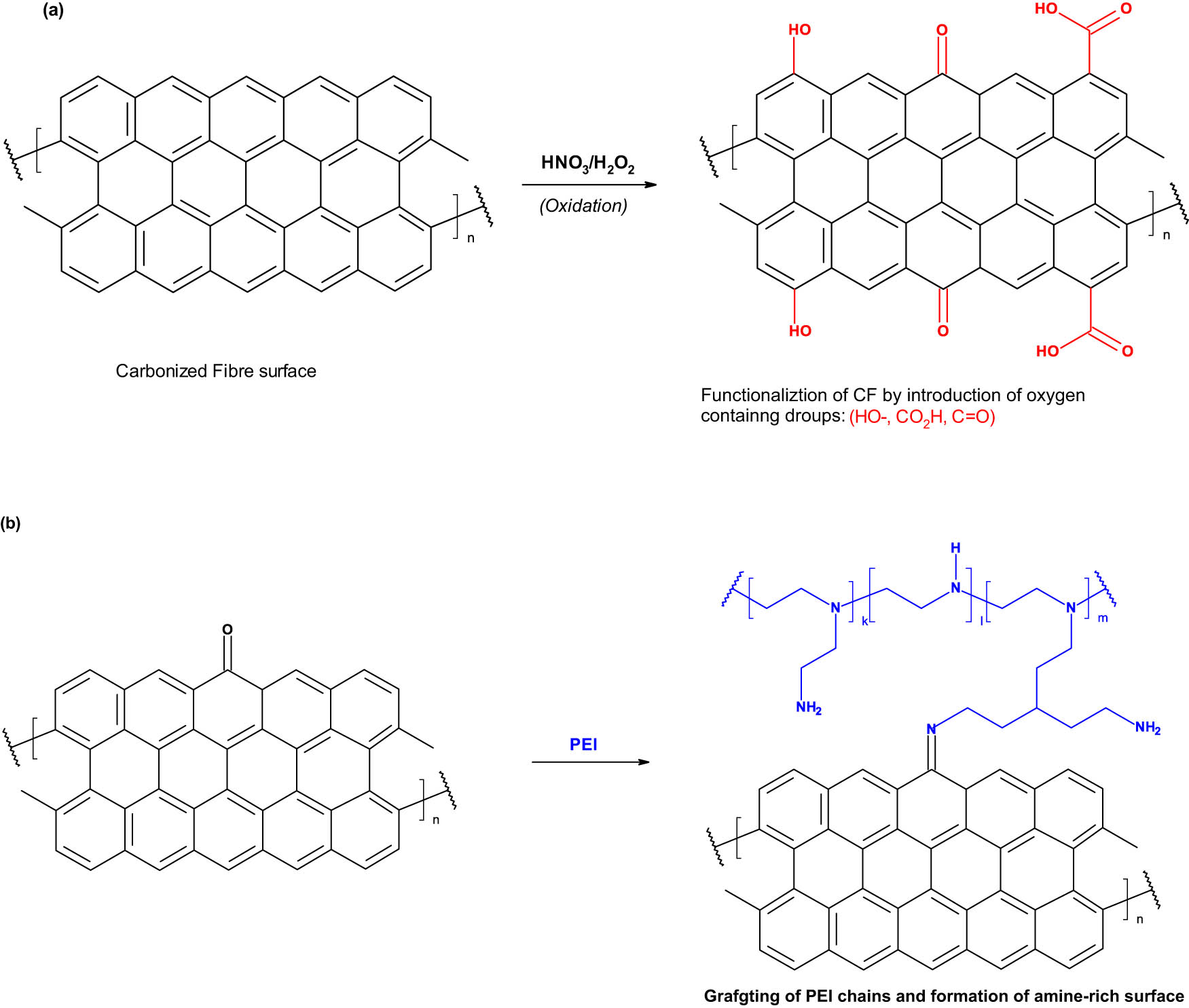
Figure 2
Simplified representative pathways for surface functionalisation of carbonised fibres: (A) oxidative functionalisation introducing oxygen-containing surface groups (-COOH, -OH, C = O) and (B) grafting of PEI chains leading to formation of amine-rich adsorption-active surfaces [44,45].
3.1. Physicochemical Characterisation of Carbonised Fibre Surfaces
Interpreting adsorption data and comparing results across studies requires consistent characterisation of both surface chemistry and pore structure. X-ray photoelectron spectroscopy (XPS) is the primary tool for quantifying surface elemental composition and for resolving the chemical state of heteroatoms: deconvolution of the N 1 s core-level spectrum distinguishes pyridinic-N (∼398.5 eV), pyrrolic-N (∼400.1 eV), graphitic-N (∼401.2 eV), and oxidised-N (∼402–405 eV), each of which has a distinct role in metal-ion coordination, electrostatic interactions, and Fenton-type catalysis [43,46]. Raman spectroscopy provides complementary information on graphitic order through the D/G band intensity ratio: the D band (∼1350 cm−1) reflects defect-induced disorder at pore edges and grain boundaries, while the G band (∼1580 cm−1) corresponds to in-plane vibrations of sp2-hybridised carbon [47,48]. A high D/G ratio indicates a defect-rich surface with greater density of adsorption-active edge sites; a low D/G ratio reflects more ordered graphitic domains with stronger π–π stacking capacity towards aromatic pollutants. [47,48] Fourier-transform infrared spectroscopy (FTIR-ATR) provides semi-quantitative identification of surface functional groups: carboxyl (∼1710–1730 cm−1), conjugated carbonyl (∼1600–1650 cm−1), hydroxyl (broad, 3200–3500 cm−1), and amine N-H stretching and bending bands (3300–3500 and 1550–1650 cm−1, respectively) [44]. Temperature-programmed desorption (TPD) under inert gas provides quantitative data on the density and thermal stability of individual oxygen-containing groups: carboxylic acids release CO2 at 200–300°C, lactones and anhydrides at 350–600°C, and phenol and carbonyl groups at higher temperatures, though these ranges overlap in practice and peak assignments should be treated as indicative [44]. Pore structure is characterised by N2 physisorption at 77 K, with the BET equation applied to the multilayer range and non-local density functional theory (NLDFT) used for micropore size distribution analysis; pore widths below 2 nm make a dominant contribution to adsorption capacity for small organic molecules and metal ions [46]. Mercury intrusion porosimetry extends the accessible range into the macropore region (0.1–10 µm) that governs hydraulic permeability and pressure drop in filter modules [49].
These characterisation methods and the parameters they provide are summarised in Table 2.
Table 2
Summary of physicochemical characterisation methods for carbonised fibre surfaces.
| Technique | Parameter measured | Typical values | Refs. |
|---|---|---|---|
| XPS (N 1 s deconvolution) | Pyridinic-N, pyrrolic-N, graphitic-N, oxidised-N | ∼398.5, ∼400.1, ∼401.2, ∼402–405 eV | [43,46] |
| Raman spectroscopy | D-band/G-band intensity ratio | D ∼1350 cm−1; G ∼1580 cm−1 | [47,48] |
| FTIR-ATR | Surface functional groups | Carboxyl ∼1710–1730; carbonyl ∼1600–1650; hydroxyl 3200–3500 (broad); amine N-H 3300–3500 and 1550–1650 cm−1 | [44] |
| TPD (inert gas) | Desorption temperature of O-groups | Carboxylic acids 200–300°C; lactones/anhydrides 350–600°C; phenol/carbonyl at higher temperatures | [44] |
| N2 physisorption (BET/NLDFT) | Surface area, micropore size distribution | Pore widths below 2 nm dominant | [46] |
| Hg intrusion porosimetry | Macropore volume/distribution | 0.1–10 µm | [49] |
3.2. Functionalisation Methods
3.2.1. Oxidative Functionalisation
Wet oxidation with HNO₃, H2O2, or (NH₄)2S2O₈, or gas-phase treatment with ozone or air at 300–400°C, introduces carboxyl, carbonyl, lactone, and hydroxyl groups at basal-plane edges and defect sites without large losses of BET surface area [44]. The pH_pzc typically shifts from around 6 on as-carbonised fibres to 4 after HNO₃ oxidation, broadening the pH range over which cationic metal ions are taken up by ion exchange, and improving wettability for filter modules that need rapid wet-out during start-up [50]. Degree of oxidation needs to be controlled: excessive treatment degrades the graphitic structure and reduces micropore volume, so there is a practical ceiling that depends on the intended application [44].
3.2.2. Polymer and Biopolymer Grafting
Polymer grafting places more functional groups on the surface than oxidative etching can achieve and allows more targeted chemical design. PEI, a branched polyamine with primary, secondary, and tertiary amine groups, can be grafted onto oxidised ACFs by carbodiimide-mediated amide coupling; the resulting materials show substantially higher heavy-metal and CO2 uptake than the unmodified substrate [51]. Chitosan coatings – applied by dip-coating ACF fabrics in dilute acetic acid solution and crosslinking with glutaraldehyde – bring the metal-chelating selectivity of the biopolymer to the filter medium while retaining the mechanical support of the carbon fibre scaffold; Cu2+ electrosorption capacity was about 2.2-fold higher on the chitosan-impregnated composite than on the pristine fibre [52]. Coating stability during acid-wash or oxidative regeneration is a persistent practical concern, covalent grafting strategies that resist hydrolytic detachment are therefore under active investigation.
3.2.3. Metal-oxide and Nanoparticle Deposition
Depositing metal-oxide nanoparticles on carbonised fibre surfaces adds photocatalytic or Fenton-type oxidation capability alongside adsorption. TiO2 anchored by sol-gel or hydrothermal routes [53] generates OH and O₂− under UV irradiation that can mineralise adsorbed dye molecules and thereby regenerate adsorption capacity without added reagents [54]. Fe₃O₄-decorated fibres catalyse heterogeneous Fenton reactions (Fe2+ + H₂O₂ → ·OH) in the dark, and their magnetic character simplifies separation in powdered-fibre configurations [55]. Silver and copper nanoparticles at 0.5–2 wt% suppress biofilm formation through sustained ion release and intracellular oxidative stress, which helps in biological pre-filter stages where microbial colonisation would otherwise shorten service life [56]. The ecotoxicity of released Ag⁺ ions to aquatic organisms is a recognised concern that warrants consideration when Ag-bearing filter stages are deployed in effluent treatment systems. [57] Particle size (ideally below 10 nm), loading, and surface distribution all need to be controlled since aggregates reduce catalytic activity and loose particles can enter the treated water.
3.2.4. Nitrogen Doping
Nitrogen content can be increased beyond what the precursor alone provides either by post-carbonisation treatment in ammonia at 700–900°C, or by incorporating nitrogen-rich molecules (melamine, urea, dicyandiamide) into the spinning formulation before fibre formation [58]. The N atoms are incorporated in pyridinic, pyrrolic, and graphitic configurations; pyridinic and pyrrolic sites at pore edges are the most useful for metal-ion coordination and for catalysing oxygen reduction in Fenton-type systems, while graphitic-N raises electrical conductivity [59]. In materials where N-doping is combined with KOH activation, BET areas above 2000 m2 g−1 and nitrogen contents of 5–8% have been reported, with demonstrated uptake across metal ions, cationic dyes, and antibiotics [60,61].
4. Removal of Priority Pollutants
How well carbonised fibre materials perform in practice comes down to whether they can reduce contaminant concentrations to levels meeting discharge limits or process-water reuse standards. For the textile sector, the pollutants appearing most consistently in both regulation and published work are heavy metals, dyes and aromatic amines, pharmaceuticals and personal care products (PPCPs), and microplastics.
Table 4 presents a comparative overview of representative removal performance for the major pollutant groups discussed in Sections 4.1–4.4. The following subsections discuss the corresponding adsorption mechanisms, removal efficiencies, and representative adsorption capacities reported for carbonised fibre-based materials.
Figure 3 presents representative contaminants discussed in Sections 4.1–4.3 and serves as a reference for the pollutant classes considered throughout this section.
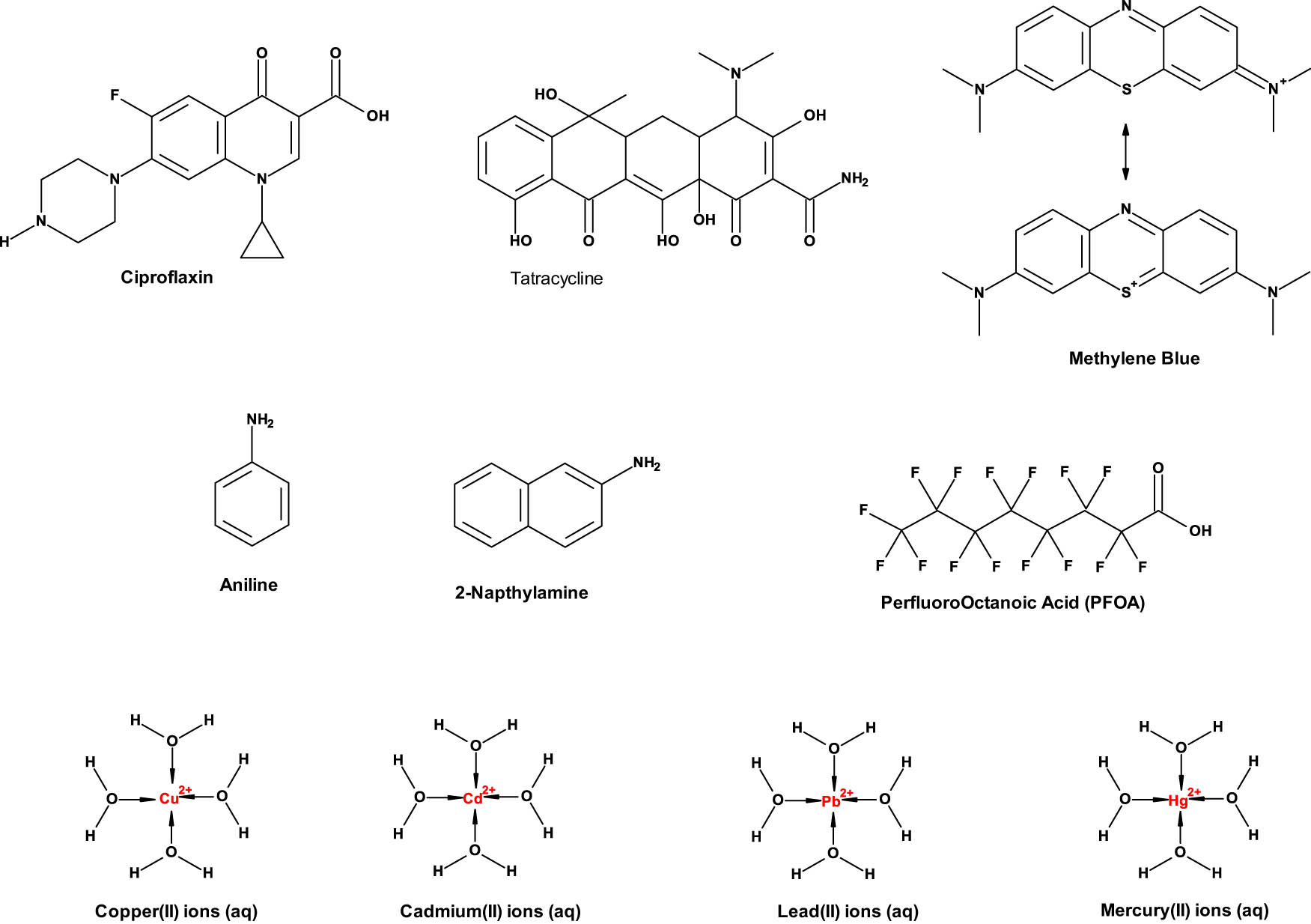
Figure 3
Representative contaminants relevant to textile wastewater treatment, including heavy metal ions, dyes, aromatic amines, pharmaceuticals, and persistent organic contaminants [7,13,15,62,68,69].
The principal adsorption mechanisms involved in their uptake by functionalised carbonised fibre materials are summarised in Table 3. In practice, pollutant removal is rarely governed by a single interaction mechanism; instead, adsorption typically results from the combined effects of electrostatic attraction, coordination, hydrogen bonding, π–π interactions, and hydrophobic interactions, whose relative contributions depend on pollutant speciation, surface chemistry, pH, and ionic strength [44,51].
Table 3
Principal adsorption interaction mechanisms between functionalised carbonised fibre surfaces and dissolved pollutants.
| Interaction type | Scheme | Occurrence | Ref. |
|---|---|---|---|
| Electrostatic attraction |

| Cationic dyes, protonated amines | [43,44,70] |
| Coordination/chelation |

| Heavy metal ions | [51,62,68] |
| Hydrogen bonding |

| Pharmaceuticals, amines | [43,69] |
| π–π Interaction |

| Aromatic fragments | [43,47,48] |
| Hydrophobic interaction |

| Non-polar organic compounds, PAHs, chlorinated solvents, microplastics | [43,51] |
The Scheme column presents representative interaction geometries, whereas the occurrence column indicates contaminant classes for which a given mechanism is typically dominant or co-dominant under common aqueous conditions (pH 4–8). In practice, multiple adsorption mechanisms often operate simultaneously, and their relative contributions depend on surface functional group density, pollutant speciation, solution pH, and ionic strength [43,44,47,48,51,64,69,70].
4.1. Heavy Metals
Cu2+ Pb2+, Cd2+, Hg2+, Ni2+, and Zn2+ enter textile effluents mainly from mordanting baths, metallic dye processes, and finishing chemicals. Their uptake on carbonised fibres involves overlapping contributions from physical adsorption into micropores by van der Waals forces, ion exchange at carboxylate and phenolate surface groups (which becomes increasingly important above pH_pzc), and surface complexation at nitrogen-donor sites on N-doped or chitosan-coated fibres [32]. These relative contributions depend on pH, ionic strength, and the coordination chemistry of each metal. Langmuir q max values for Cu2+ on chitosan-coated PAN-ACF nonwovens are around 185 mg g−1 at pH 5.5, roughly 2.5 times the uncoated ACF value under the same conditions, which is consistent with amine-group chelation as the primary uptake route [32]. For Pb2+and Hg2+, which form stable N- and S-donor complexes, functionalised ACF fibres have shown 36-fold higher batch capacities than granular activated carbon at sub-10 mg L−1 concentrations [62,71].
The limitation of most published work is that single-solute batch tests dominate the dataset, and competitive effects from real effluent matrices are rarely examined. Ca2+ and Mg2+from water hardness compete with heavy metals for amine and carboxylate sites, and in synthetic hard water (250 mg L−1 CaCO₃ equivalent) effective capacity can be measurably lower than in deionised water, though the magnitude of this competitive effect is highly system dependent, and reported values vary widely across studies. Introducing higher-affinity groups – thiol (–SH) or imidazole – partially restores selectivity since these form thermodynamically preferred complexes with soft-acid Hg2+ and Cd2+ over competing Ca2+ [71].
4.2. Textile Dyes and Aromatic Amines
Textile effluents carry dyes from several structural classes – reactive, acid, basic, vat, and disperse – which differ enough in charge and molecular size that no single adsorption condition handles all of them well. Cationic dyes such as methylene blue (MB) and crystal violet adsorb readily on 16 oxidised ACF at neutral pH via electrostatic attraction to the negative surface and π–π stacking between the aromatic dye rings and graphitic basal planes [15]. For MB on KOH-activated PAN-ACFs, reported q max values exceed 300 mg g−1, the combination of high microporosity and a net negative surface charge at pH 7 evidently places these materials among the better-performing carbon adsorbents for this dye class [15]. Anionic reactive dyes are more difficult: sulphonate groups give the molecule a net negative charge, so adsorption on an equally negative ACF surface is electrostatically unfavourable above pH 4. Either pH reduction below pH_pzc, or positive surface charge introduced by PEI grafting or chitosan coating (amino groups protonated below pKa ∼ 6.3), is needed for effective uptake [27,72,73].
Many aromatic amines – including 4-aminobiphenyl, benzidine, and 2-naphthylamine – are classified as confirmed or probable human carcinogens under REACH Annex XVII, making their removal from effluent a regulatory requirement. On N-doped ACFs at near-neutral pH, adsorption proceeds mainly through π–π electron donor–acceptor interactions between the amine-bearing aromatic rings and the graphitic surface [43,74]. First-order kinetics with half-lives in the 10–25 min range have been reported for aniline and substituted aromatic amines on 16 oxidised and nitrogen-treated ACFs [43,74]; residual concentrations below 0.1 mg L−1 are achievable from 50 mg L−1 initial solutions, which falls below the EU Water Framework Directive indicative thresholds for priority hazardous substances [7].
4.3. Pharmaceuticals and Personal Care Products
Two entry routes bring PPCPs into textile effluents: wash-off from fibres treated with biocidal or UV-protective finishes, and co-discharge with municipal wastewater at shared treatment sites. Tetracycline antibiotics, present in surface waters at 0.1–10 µg L−1, adsorb on PAN-derived ACFs mainly through π–π stacking and hydrogen bonding at the fused ring system, with electrostatic contributions below the pKa values of the zwitterion (pH 3.3 and 7.7) [13]. Ciprofloxacin, a fluoroquinolone, shows higher q max on a chitosan-modified activated carbon composite than on the unmodified carbon, attributed to complexation of the quinolone carbonyl and carboxylate groups with surface amine ligands [75]. For NSAIDs such as ibuprofen and diclofenac, the optimum lies around pH 5–6, where the undissociated form predominates and hydrophobic partitioning into ACF micropores is most effective [65].
4.4. Microplastics
Regulatory pressure on microplastics in surface water and drinking water is increasing, and domestic laundering of synthetic textiles is now recognised as a major diffuse source. An estimated 0.2–0.5 g of microfibres per kilogram of fabric is released per wash cycle, reaching municipal wastewater systems in large quantities [76], with textile-industry effluent treatment plants specifically identified as a disproportionate contributor relative to municipal systems [77]. Particle removal by carbonised nonwoven filters operates differently depending on size: larger particles are retained by size exclusion and depth filtration at inter-fibre pores, while smaller particles (below about 10 µm) are captured mainly through mechanical straining within the internal pore network and hydrophobic interaction between the non-polar polymer surface and the carbon matrix. Because oxidised ACF surfaces and PE/PP/PS microplastics both carry a net negative charge under near-neutral conditions – the same charge mismatch that limits anionic-dye uptake in Section 4.2 – direct electrostatic attraction is unlikely to be the dominant mechanism at unmodified surfaces. Positively charged PEI- or chitosan-modified ACF surfaces, by contrast, can capture microplastics electrostatically, analogous to their effect on anionic dyes [78].
Activated-carbon-based nonwoven filters in column/fixed-bed configurations have been reported to remove more than 95% of micron-scale polystyrene microplastics [66]. Multi-stage carbon-based filtration trains, combining coarse and fine media, have been reported to improve overall microplastic capture beyond what a single stage achieves [67]. The particle load is split between stages, which also slows the pressure-drop increase that signals the need for regeneration. The published evidence base for microplastic removal by carbonised fibre filters is, however, narrow. Most studies have used model suspensions of monodisperse polystyrene or polyethylene microspheres in clean water matrices, which do not reflect the heterogeneous size distribution, irregular morphology, and complex surface chemistry of microplastics encountered in real textile effluents. The effect of co-occurring dissolved organics and surfactants on electrostatic capture efficiency has received little attention, and long-term fouling behaviour under continuous operation has not been systematically characterised. Because the values compiled below come from studies using different feed concentrations, contact times, adsorbent doses, and temperatures, Table 4 should be read as an indicative comparison of orders of magnitude rather than as a rigorous ranking of materials. Representative removal efficiencies for microplastics and other priority pollutants discussed in Sections 4.1–4.4 are summarised in Table 4.
Table 4
Representative adsorption performance of carbonised textile fibre-based materials for priority pollutants in industrial wastewater treatment.
| Material/precursor | Target pollutant | qmax (mg g−1) | Removal (%) | pHopt | Ref. |
|---|---|---|---|---|---|
| PAN-ACF nonwoven, chitosan-coated | Cu2+ | 80–200 | — | 5.5 | [32] |
| PAN-ACF nonwoven, PEI grafted | Pb2+ | 150–280 | — | 5.0 | [62] |
| Chitosan-derived N-doped carbon | Cd2+ | 60–180 | — | 6.0 | [63] |
| Viscose-ACF, HNO₃ oxidised | Hg2+ | 50–150 | — | 4.5 | [64] |
| PAN-ACF, KOH activated | Methylene blue | 200–500 | — | 7.0 | [15] |
| Lignin-derived ACF, CO2 activated | Acid Orange 7 | 100–250 | — | 3.5 | [27] |
| PAN-ACF, H2O2 oxidised | Tetracycline | 80–200 | — | 5.0 | [13] |
| Cellulose-fibre-ACF, KOH activated | Ibuprofen | 70–150 | — | 7.0 | [65] |
| Carbonised PAN nonwoven, O₃ oxidised | Microplastics < 100 µm | — | 85–98 | 7.0 | [66] |
| Cascade ACF nonwoven, three-stage | PE/PP fibres < 500 µm | — | 80–95 | 6.5–8.5 | [67] |
Values are indicative ranges drawn from multiple sources and depend on initial concentration, contact time, adsorbent dose, and temperature. ACF – activated carbon fibre; PAN – polyacrylonitrile fibre; PEI – polyethylenimine; q max – Langmuir maximum adsorption capacity (batch isotherm, 25°C) [13,15,27,32,62–67].
5. Cascade Filtration and Hybrid Treatment Systems
Textile wastewater seldom contains just one type of contaminant. Heavy metals, reactive dyes, aromatic amines, suspended solids, and biological load often occur together, which makes single-stage treatment inadequate for regulatory compliance or process-water reuse. Each stage in a cascade handles a different contaminant class, and its chemistry and pore structure can be chosen accordingly. When carbonised nonwoven stages are combined with oxidative pre-treatment and downstream membrane polishing, the treatment train can in principle close the production water loop. The configurations discussed below are proposed conceptual designs, assembled from component performance reported in separate studies, rather than technologies tested as integrated systems. Table 5 summarises representative configurations discussed in the literature.
Table 5
Representative cascade and hybrid treatment configurations incorporating carbonised textile fibre stages and their reported treatment performance.
| System configuration | Target pollutants | Removal (%) | Other reported metrics | Ref. |
|---|---|---|---|---|
| Two-stage cascade ACF nonwoven | Microplastics + MB dye | > 98% MP; 94% MB | — | [67] |
| Ozonation → ACF nonwoven | Aromatic amines, micropollutants | — | Not quantified (qualitative, see ref.) | [10] |
| UV/H2O2 → chitosan-ACF | Reactive dyes + Cu2+ | 98% colour; 96% Cu2+ | — | [79] |
| MBR → NF membrane | COD, N, pharmaceuticals | — | Not quantified (qualitative, see ref.) | [80] |
| ACF cascade → RO | Complex textile effluent (mixed) | — | BOD < 10 mg L−1; conductivity < 500 µS cm−1 | [15] |
| Coagulation → ACF → UF | Heavy metals + suspended solids | 99% Pb2+ | Turbidity < 1 NTU | [81] |
| SBR bioreactor → ACF polishing | Residual COD + trace organics | 88% micropollutants | BOD < 5 mg L−1 | [82] |
*MBR – membrane bioreactor; SBR – sequential batch reactor; NF – nanofiltration; RO – reverse osmosis; UF – ultrafiltration; ACF – activated carbon fibre; AOP – advanced oxidation process.
5.1. Cascade Filtration Design Principles
Good cascade design starts with feed characterisation: flow rate, suspended-solids load, chemical oxygen demand (COD) fractionation, and pollutant speciation together determine the number of stages, their order, and the surface chemistry at each layer. Working from coarse to fine is the natural sequence. An initial stage with inter-fibre pore size 100–500 µm removes macro-particles, textile fibres, and microplastics by depth filtration and inertial impaction, protecting downstream stages from rapid clogging [67]. A second stage uses oxidised or chitosan-modified ACF nonwoven with inter-fibre void dimensions of 5–50 µm to ensure adequate contact time; the actual removal of heavy metals and cationic dyes occurs by adsorption within the internal carbon micro- and mesoporosity of the fibres, not by mechanical interception at the structural pore level. A polishing stage of N-doped ACF with BET area above 1500 m2 g−1 targets trace micropollutants, aromatic amines, and pharmaceuticals [10]. As a proposed design approach rather than a validated protocol, stage mass could be sized from isotherm data at the design outlet concentration with a safety factor of 1.5–2.0 on breakthrough capacity to account for competitive adsorption in real multicomponent streams; this factor is an engineering estimate and has not itself been reported in the cited studies. It should be noted that Langmuir q max values derived from batch isotherms at 25°C are not directly transferable to continuous-flow module performance; dynamic breakthrough capacity, empty-bed contact time, superficial velocity, and regeneration loss per cycle are the operationally relevant parameters and differ substantially from batch-derived figures. Figure 4 illustrates a conceptual treatment train, proposed here rather than reported as a tested integrated system, combining the three ACF stages with upstream oxidation and downstream membrane polishing; the individual component performance values shown are drawn from separate literature reports [10,15,67,79–82], but the train as a whole has not been validated experimentally.
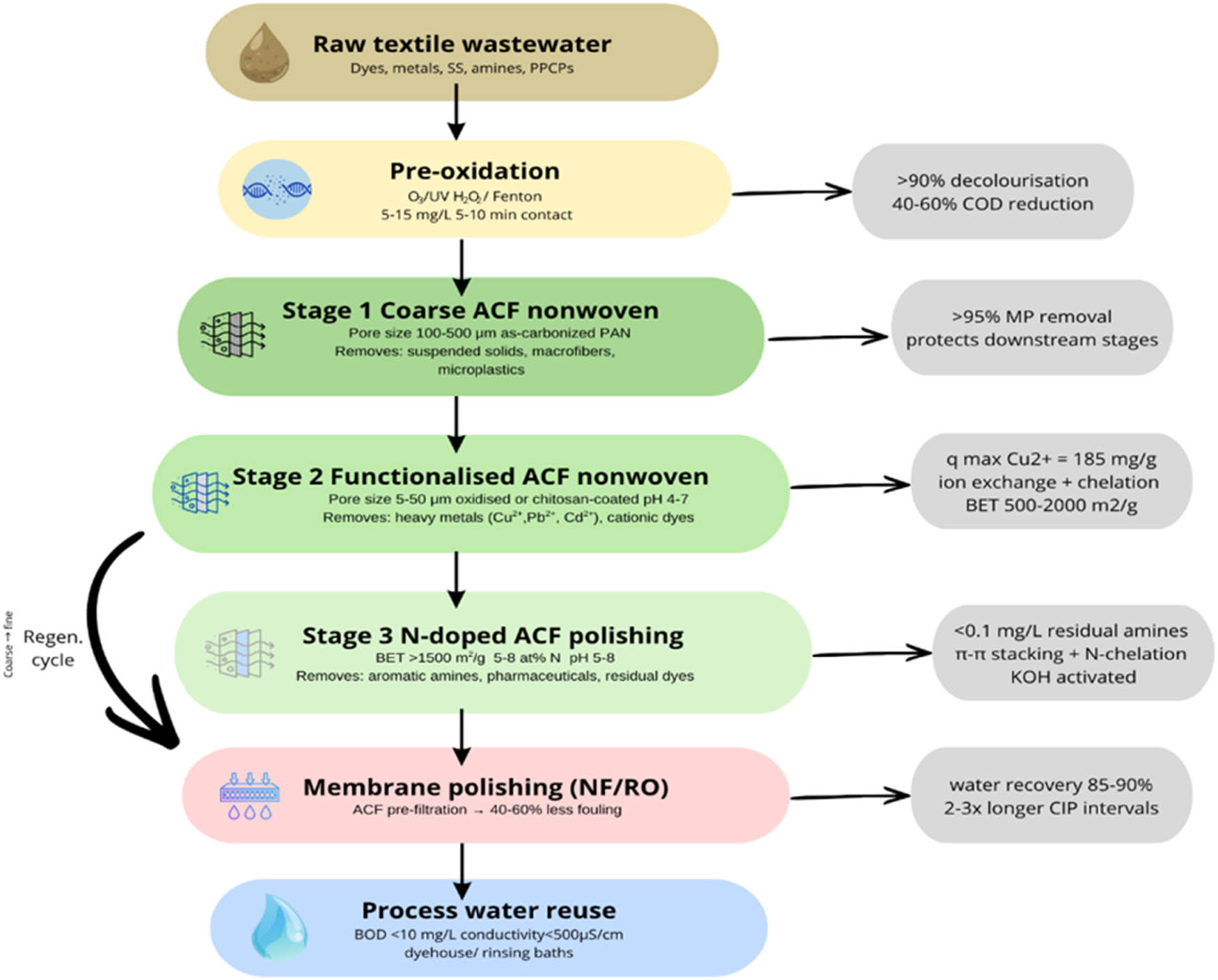
Figure 4
Schematic of a multi-stage cascade treatment train for textile wastewater incorporating pre-oxidation, three ACF nonwoven filter stages, and membrane polishing [10,15,79–83].
Nonwoven architecture gives design freedom that granular carbon beds do not. Fibre diameter (5–20 µm), basis weight (100–500 g m−2), and sheet stacking density can each be specified independently, so pressure drop, residence time, and contact area need not move together as they do in packed beds. Multi-layer stacks with graded pore structure – coarser at the inlet, finer downstream – can be formed into compact cylindrical or flat-sheet modules that fit standard industrial pressure vessels [15]. Hydraulic resistance increases approximately linearly with basis weight and decreases with mean fibre diameter, which are straightforward parameters for scale-up calculations.
5.2. Integration with Advanced Oxidation Processes
Ozonation, UV/H2O2, Fenton chemistry, and photocatalysis all produce hydroxyl radicals (·OH, E° = 2.80 V) capable of mineralising persistent organics that resist biological treatment and adsorption [10]. This pairing works in both directions: AOP pre-treatment converts large, non-polar dye molecules into smaller, more polar fragments that adsorb more readily on ACF, while the ACF stage concentrates residual organics and prolongs their contact with the oxidative environment [79]. ACF pre-adsorption of hydrophobic micropollutants followed by in-situ photocatalytic regeneration with TiO2-ACF under UV can regenerate capacity without added reagents [53,54,84]. For textile effluents, ozonation at 5–15 mg L−1 with 5–10 min contact time typically gives more than 90% decolourisation and 40–60% COD reduction, cutting the adsorptive load on the downstream ACF stage and extending service life by a factor of 3–5 compared with direct filtration of raw effluent [10].
Fenton and photo-Fenton chemistry (Fe2+/H2O2, pH 3–4) can mineralise persistent azo-dye degradation products more completely than ozone, but require precise pH control and produce iron sludge as a secondary waste. Fe₃O₄-functionalised ACF nonwovens used as heterogeneous Fenton catalysts shift the working pH to 5.5–6.5, removing the need for acidification and neutralisation steps and cutting sludge production [55]. Residual H2O2 must be quenched or decomposed before the water reaches downstream RO membranes since oxidant carry-over causes irreversible membrane damage.
5.3. Integration with Membrane and Biological Processes
Where the goal is effluent of sufficient quality for reuse in dyeing or rinsing, membrane polishing – MF, UF, NF, or RO depending on the required separation – is the logical final step. Their main operational vulnerability is fouling: colloidal organics, surfactants, scaling salts, and biofilms raise transmembrane pressure, reduce permeate flux, and shorten service life [80,85]. ACF pre-filtration removes the colloidal fraction by size exclusion (in pores below 0.1 µm), reduces dissolved organic carbon by adsorption, and strips out the most surface-active species that initiate gel-layer fouling, allowing NF and RO to run at lower pressure and with longer intervals between cleaning events [15]. Studies on pre-treatment of secondary effluents before membrane filtration have reported substantially lower normalised flux decline rates and extended CIP intervals compared with direct membrane operation [81], though the magnitude of benefit varies with feed composition and the specific ACF configuration used.
In a membrane bioreactor (MBR), activated sludge or biofilm treatment is combined with in-line MF or UF in a single vessel. The secondary clarifier is eliminated, and the permeate is already clarified to a standard suitable for NF or RO polishing. Placing carbonised ACF nonwoven stages inside the MBR aeration tank – as structured carriers that double as biofilm support and adsorbent – has been reported to buffer peak organic loading on the membrane module and to protect the biomass from inhibitory compounds such as heavy metals and biocidal dyes that would otherwise suppress biological activity [82]. Fill-draw SBR operation suits ACF filter integration well. During the quiescent decant phase, suspended biomass settles and the ACF stage can be run under gravity-driven flow with little risk of biomass fouling.
6. Challenges, Circular Economy Perspectives, and Conclusions
6.1. Regeneration and Fouling
ACF nonwovens cost roughly three to five times more per unit mass than granular activated carbon [11], which makes regeneration an economic necessity rather than an optional step. Three main routes exist.
Thermal treatment at 700–900°C in steam or CO2 pyrolyses the adsorbed organic layer and restores more than 90% of initial capacity, but each cycle burns off 5–10% of the carbon mass at pore edges, so cumulative micropore loss is significant over time [36]. It is important to distinguish these two figures: the >90% recovery refers to the specific (mass normalised) adsorption capacity of the carbon that remains after regeneration, not to the total capacity of the filter element. Because 5–10% of the carbon mass is lost at each thermal cycle, the total capacity of the element declines cumulatively – roughly by a factor of (0.90–0.95)ⁿ after n cycles – even though the per-gram performance of the surviving material is largely preserved, a distinction long recognised for granular activated carbon, where progressively more make-up carbon must be added over successive cycles even as per-unit-weight capacity recovery remains high [86]. Service-life projections in Sections 6.2 and 6.4 should therefore be based on cumulative mass loss of the element, not on the per-cycle capacity-recovery figure alone.
Acid-alkali washing – sequential rinse with HCl or H2SO₄ at pH 2 to strip metal ions by proton competition, followed by NaOH at pH 12 to restore surface charge – suits metal-laden stages and avoids high-temperature structural damage, though it produces concentrated eluates requiring further treatment [29]. In-situ photocatalytic regeneration of TiO2-bearing ACF nonwovens under UV irradiation sidesteps both thermal cycling and chemical reagent use, but works only for compounds that ·OH can oxidise and requires optically transparent housings that trade off against mechanical robustness [53,54].
A critical gap in the published record concerns long-term stability under industrially representative conditions. To the authors’ knowledge, identified regeneration studies rarely extend beyond 20–30 cycles, and none have sustained real textile effluent as feed throughout; stable adsorption performance of functionalised ACF nonwovens across more than 50 regeneration cycles under industrially representative conditions has not been documented in the reviewed literature. Whether surface coatings – PEI grafts, crosslinked chitosan layers, sol-gel nanoparticle deposits – retain structural and chemical integrity through the repeated pH swings (pH 2–12) and elevated temperatures (up to 60°C) of industrial acid–alkali cleaning sequences remains unanswered. This is not a minor technical detail: without credible service-life data covering at least 50 cycles, an operator cannot project consumable costs or size a replacement inventory, which in practice means the technology cannot clear a basic economic feasibility review.
Fouling – contaminant accumulation that backwashing does not fully reverse – is the other main cause of performance decline in continuous-flow operation. In practice, it does not happen all at once. Surface-active organics and humic-like substances are taken up rapidly at primary adsorption sites within the first few hours of operation. Over the following days, colloidal particles and macromolecules work their way into mesopores. Microbial colonisation develops on the timescale of weeks, gradually blocking surface area and reducing permeability [87]. Nano-Ag or nano-Cu functionalisation limits the biological stage, but the earlier two phases call for hydraulic or chemical intervention. Backwash protocols that combine upward-flow water jets with air-scour restore 80–95% of initial permeability if applied at the first measurable rise in pressure, but their effect diminishes once a compressible colloidal cake has formed [88].
6.2. Scale-Up Challenges
Batch laboratory data systematically overpredict performance in pilot-scale continuous-flow systems, and the discrepancy is not always discussed honestly in the literature. Axial dispersion and channelling in multi-layer nonwoven stacks reduce effective contact time below the design value. Non-uniform flow distribution in large-area modules (above 1 m2) arises from pressure gradients in feed manifolds. Elevated operating temperatures (40–60°C, typical of textile process streams) shift adsorption equilibria and can degrade polymer coatings [5]. Pilot trials on real textile effluents consistently report capacities 30–50% below laboratory isotherm predictions, attributed to competitive adsorption from background dissolved organic matter and to kinetic limitations at industrial flow velocities [43]. The membrane sector has workable pilot-testing and techno-economic frameworks; similar tools for ACF cascade systems do not yet exist, and their absence is a practical obstacle to industrial adoption.
6.3. Circular Economy Perspectives
These materials fit within circular-economy logic on two separate counts. Using sorted cotton-polyester waste, PAN-based acrylic scrap, or crustacean-processing residues as carbonisation feedstocks converts end-of-life waste into functional filter media, avoiding both landfilling and the energy-intensive production of virgin activated carbon from coal or coconut shell [28]. LCA comparisons generally show lower global warming potential and cumulative energy demand for waste-derived carbons than for coal-based GAC [89], though the margin narrows when feedstock sorting and pre-treatment are energy-intensive. The environmental benefit case, however, rests on the assumption of controlled feedstock composition. Post-consumer textile waste arrives as polydisperse blends of unknown fibre-type ratios, variable dyestuff loads, and residual finishing chemicals; each of these parameters shifts the optimal carbonisation temperature and the surface chemistry of the product. Without upstream sorting to textile-grade homogeneity – a step that is costly and not yet widely available at collection scale – the environmental and performance claims made for waste-derived ACF feedstocks should be treated with caution. On the water side, treating process effluent to reuse quality closes or partially closes the production water loop. A plant treating 300 m3 day−1 with 80% water recovery, for instance, would avoid abstracting roughly 240 m3 day−1 of freshwater and discharging the equivalent volume as polluted effluent – a benefit that grows as water tariffs and discharge fees rise.
A dedicated economic assessment of this pathway is largely absent from the literature and remains an important gap. Techno-economic feasibility of textile-waste-derived activated carbon is explicitly flagged as an open research need [90], and cost data specific to carbon fibre production from textile-waste feedstocks are only beginning to emerge: a recent techno-economic analysis of carbon fibre made from recycled acrylic textile waste reported approximately 20% lower production cost than virgin-precursor carbon fibre at 50% recycled content, alongside a roughly 40% reduction in cradle-to-gate greenhouse-gas emissions [91]. These figures concern fibre production rather than the full cascade filtration system discussed here, and do not include downstream costs such as activation, module fabrication, regeneration, or comparison against conventional treatment trains (coagulation, granular activated carbon, membrane processes). A dedicated techno-economic and comparative cost analysis of carbonised-fibre cascade filtration against these established alternatives is therefore identified as a priority for future work before the concept proposed here could be assessed for practical industrial adoption.
The spent adsorbent from chemical regeneration cycles carries concentrated heavy metals, dye fragments, and degradation products that themselves require management. Thermal regeneration recovers the carbon for reuse and concentrates inorganics in the ash residue, which may be worth processing by hydrometallurgical routes for copper, lead, or zinc recovery if concentrations are high enough [92]. Alkali eluates from chitosan-coated stages tend to be ammonium-rich; these can in principle be treated by nitrification-denitrification before discharge, integrating the regeneration circuit into the plant’s broader wastewater management.
6.4. Conclusions and Future Perspectives
The picture that emerges from this review is uneven: the materials science is well-developed, but the path to industrial deployment remains obstructed by gaps in long-term performance data and the absence of standardised evaluation tools.
For continuous-flow ACF nonwovens, PAN continues to give the most predictable combination of surface area, microporosity, and mechanical strength [14,16,24]. Cellulose fibres, chitosan fibres, and lignocellulosic materials carry useful surface chemistries for specific contaminant classes and have real cost and environmental advantages, but carbon yield and structural reproducibility from these precursors remain below what PAN delivers [27,30,68].
As-carbonised fibres without modification cover a narrow contaminant range. Oxidative treatment, polymer grafting, nanoparticle deposition, and nitrogen doping each extend performance into different areas of the pollutant spectrum [44,51,58]. Whether complex composite coatings hold up through many regeneration cycles is a practical question that the literature has not yet answered convincingly [29,36]. Identified cycle tests typically stop at 10–20 iterations using synthetic single-contaminant feeds, which is an insufficient basis for projecting operational service life in an industrial setting.
Multi-stage ACF cascades can reach the effluent quality needed for process-water reuse, but only when combined with upstream oxidation and downstream membrane polishing [10,15,80]. No single stage achieves this on its own and claims to that effect in the literature should be read critically.
Industrial uptake remains slow. ACF nonwovens cost 3–5 times more than granular carbon [11], real-effluent performance falls 30–50% short of laboratory isotherm projections [5,43], and there are no standardised testing or techno-economic tools that would let an end-user build a credible business case. Until those tools exist, the technology is unlikely to move beyond pilot demonstrations at scale.
Rising virgin raw-material costs and increasing discharge charges are gradually improving the economics of waste-derived filter media and closed production water loops, without requiring any change in the regulatory framework [28,89].
Three gaps stand out as priorities for future work: continuous carbonisation and activation processes suitable for variable-composition waste-textile feedstocks at production scale [34]; systematic characterisation of competitive adsorption and fouling kinetics under realistic, dynamic multicomponent flow conditions, since most published data still rely on idealised single-contaminant batches [5,43]; and accelerated ageing protocols capable of supporting credible service-life predictions and regulatory acceptance [29,36].
7. Abbreviations
The following abbreviations are used in this manuscript:
- ACF
Activated Carbon Fibre
- ACFs
Activated Carbon Fibres
- CAN
Activated Carbon Nonwoven
- ACNs
Activated Carbon Nonwovens
- AOP
Advanced Oxidation Process
- AOPs
Advanced Oxidation Processes
- BET
Brunauer-Emmett-Teller (specific surface area method)
- BOD
Biochemical Oxygen Demand
- CED
Cumulative Energy Demand
- CIP
Cleaning-In-Place
- CNF
Cellulose Nanofibre
- CNC
Cellulose Nanocrystal
- COD
Chemical Oxygen Demand
- DD
Degree of Deacetylation
- DOC
Dissolved Organic Carbon
- EU
European Union
- GAC
Granular Activated Carbon
- GWP
Global Warming Potential
- LCA
Life Cycle Assessment
- MB
Methylene Blue
- MBR
Membrane Bioreactor
- MF
Microfiltration
- MP
Microplastics
- NF
Nanofiltration
- NSAIDs
Non-Steroidal Anti-Inflammatory Drugs
- N-PC
Nitrogen-Doped Porous Carbon
- N-PCs
Nitrogen-Doped Porous Carbons
- PAN
Polyacrylonitrile Fibre
- PPCPs
Pharmaceuticals and Personal Care Products
- PE
Polyethylene
- PEI
Polyethylenimine
- PS
Polystyrene
- q max
Maximum Adsorption Capacity (Langmuir Isotherm)
- REACH
Registration, Evaluation, Authorisation and Restriction of Chemicals
- RO
Reverse Osmosis
- ROS
Reactive Oxygen Species
- SBR
Sequential Batch Reactor
- SMEs
Small and Medium-Sized Enterprises
- TiO2
Titanium Dioxide
- UF
Ultrafiltration
- UV
Ultraviolet Radiation
- VOCs
Volatile Organic Compounds
- Fe₃O₄
Magnetite (Iron Oxide)
Acknowledgements
This work was completed while one of the authors (M.G) was a doctoral student at the Interdisciplinary Doctoral School of the Lodz University of Technology in Poland.
Funding information
This work was supported by the Ministry of Science and Higher Education, Poland, under project Science for Society II “Water, a priceless resource – actions for its protection, number, NdS-II/SN/0269/2023/01.
Author contributions
Conceptualisation, M.H.K.; literature survey and data curation, M.H.K., Z.M., M.G., M.S.; writing-original draft preparation, M.H.K., Z.M., M.G., and M.S.; writing-review and editing, M.H.K., Z.M., M.G., M.S., I.K.-K., J.O., A.W., and R.Ż. All authors have read and agreed to the published version of the manuscript.
Conflict of interest statement
The authors declare no conflicts of interest.
Ethical approval
Not applicable.
Consent to participate
All authors have read the submitted version.
Consent to publish
All authors have and approved the submitted version for publication.
Data availability statement
Not applicable.